

My daughter, Claire, was sixteen years old, gentle in a way that sometimes frightened me.
Not weak.
Not timid.
Gentle.
There is a difference.
She noticed when someone was sitting alone. She remembered birthdays nobody else remembered. She carried extra pencils because she knew someone would forget one. When she was eleven, she once walked home in the rain because she had given her umbrella to an elderly woman waiting at the bus stop.
That was Claire.
And for reasons I could never understand, kindness did not make school easier for her.
It made her a target.
At school, Claire had almost no friends.
Her classmates mocked the secondhand sweaters she liked to wear, hid her backpack during lunch, whispered whenever she raised her hand in class, and once wrote a cruel word across her locker in permanent marker.
I wanted to march into the school every time.
Claire always stopped me.
“They’ll get bored eventually, Mom,” she would say.
They never did.
The worst of them was a boy named Rocky Bennett.
Rocky was popular, athletic, loud, and surrounded by the kind of students who laughed before they even knew what the joke was.
He had pulled Claire’s chair away once when she was about to sit down.
He had taken a photograph of her eating alone and posted it in a group chat with a humiliating caption.
He had even called her “charity shop Claire” because most of her clothes came from thrift stores.
I spoke to his parents twice.
I spoke to the school counselor.
I spoke to the vice principal.
Every conversation ended with the same words.
“We’re monitoring the situation.”
Nothing changed.
Claire kept getting up every morning.
She kept packing her lunch.
She kept walking through those school doors.
I used to watch her from the car and wonder how someone so young had learned to carry humiliation so quietly.
Then, in early October, everything changed.
It began with exhaustion.
Claire started coming home and falling asleep on the couch before dinner.
At first, I blamed school.
She was taking advanced biology and chemistry, volunteering in the library, and preparing for college entrance exams.
Then she stopped eating.
“Not hungry,” she would say.
A few days later, she complained about headaches.
Then dizziness.
Then nausea.
I made an appointment with our family doctor, but the morning before we were supposed to go, I heard something crash upstairs.
I ran to Claire’s room.
She was on the floor beside her bed.
Her face was frighteningly pale.
“Claire?”
She opened her eyes but seemed unable to focus on me.
“Mom?”
That one word came out so weakly that something inside me went cold.
I called an ambulance.
By the time we reached the hospital, Claire could barely sit upright.
Doctors ran blood tests.
They checked for infection.
They checked her heart.
They checked her kidneys and liver.
They asked about medications, food allergies, supplements, travel, illnesses at school.
Nothing immediately explained what was happening.
Claire was admitted overnight.
Overnight became three days.
Three days became six.
And every day, she seemed a little weaker.
Her fever came and went.
Her hands sometimes trembled.
She developed strange abdominal pain and bouts of dizziness so severe that nurses would not allow her to walk unassisted.
I barely left the hospital.
I slept in a chair beside her bed.
I showered in the small family bathroom down the hall.
I drank terrible vending-machine coffee at two in the morning and stared at medical monitors as though I could force them to tell me what was wrong with my child.
For the first four days, nobody from school visited.
Not one student.
Not one card.
Not one text that Claire showed me.
Mrs. Evans, her homeroom teacher, called twice.
The school counselor sent an email.
But Claire’s classmates?
Nothing.
I hated them for that.
I hated every one of those children who had spent years making my daughter feel invisible.
Then, on the fifth afternoon, I heard laughter in the hallway.
At first, I thought another patient had visitors.
Then I heard squeaking sneakers.
Whispers.
Someone shushing someone else.
A nurse appeared at Claire’s door with a strange smile.
“Mrs. Carter?”
“Yes?”
“You may want to come outside.”
I stepped into the hallway.
And froze.
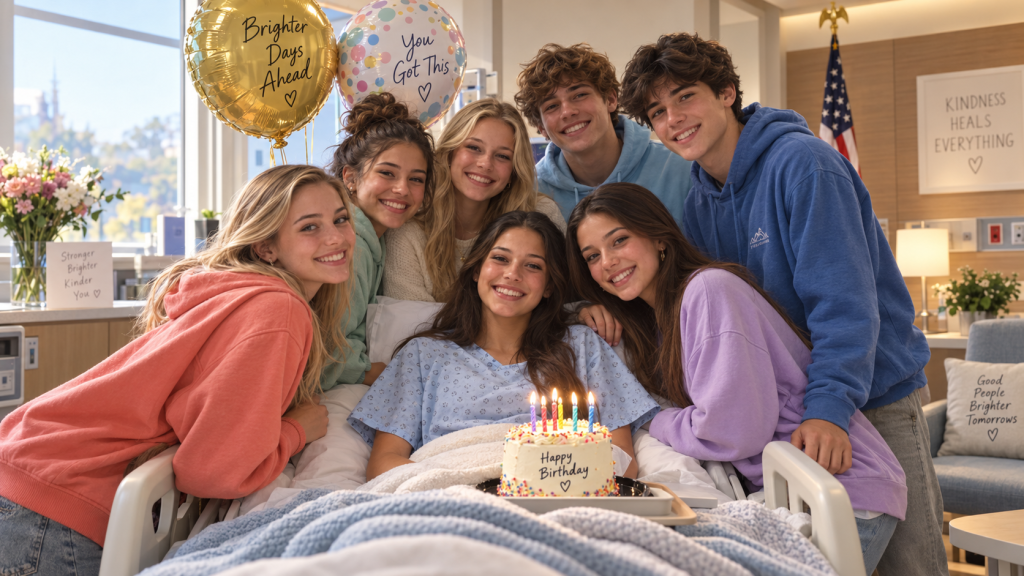
Nearly Claire’s entire class was standing there.
Twenty-seven teenagers filled the corridor.
Some held balloons.
Some carried cards.
One girl had cupcakes.
Another had a bouquet of yellow flowers.
Rocky stood near the back holding an enormous stuffed brown bear almost as tall as he was.
For several seconds, nobody spoke.
I honestly thought I might be dreaming.
Then a girl named Marissa stepped forward.
“Can we see Claire?”
I stared at her.
Marissa had once poured chocolate milk into Claire’s backpack.
I knew because I had spent forty minutes cleaning Claire’s textbooks in our kitchen sink.
“You want to see Claire?”
Marissa lowered her eyes.
“If she wants us.”
I walked back into the room.
Claire looked at me.
“What?”
“There are some people here.”
The students slowly filed through the door.
When Claire saw them, her mouth fell open.
“Why are you guys here?”
Nobody answered at first.
Then Rocky stepped forward and lifted the ridiculous stuffed bear.
“This idiot has been blocking half the hallway,” he said quietly. “So you better appreciate him.”
Claire stared at him.
Then, unexpectedly, she laughed.
It was the first real laugh I had heard from her since we entered the hospital.
Within twenty minutes, the room had transformed.
Someone connected a phone to a small speaker.
They played music quietly.
They ate cupcakes.
They signed cards.
They taped photographs and colorful notes to the wall.
Claire smiled so much that evening that her cheeks hurt.
When everyone finally left, she looked at the decorated room.
“I don’t understand.”
“Neither do I.”
“Maybe they feel bad.”
“Maybe.”
Claire touched one of the cards beside her bed.
It said, Come back soon. School is weird without you.
She smiled.
The next afternoon, they returned.
Not all of them.
About twelve.
They brought Claire’s homework, though almost none of it got done.
The next day, eight students came.
The day after that, fifteen.
They played cards.
They brought movies.
They smuggled in fries even though the nurse made them remove them immediately.
Rocky came every single day.
And that bothered me more than anything.
I knew what he had done to Claire.
I remembered every meeting.
Every complaint.
Every excuse.
Yet now he sat beside her bed helping her solve crossword puzzles and arguing about movies as though they had been friends for years.
Something did not fit.
So I called Mrs. Evans.
“I’m surprised too,” she admitted.
“You don’t know why they’re coming?”
“I know several students have been worried about her.”
“They were never worried before.”
There was a pause.
“Sometimes teenagers realize they’ve been cruel when something serious happens.”
I wanted to believe that.
I really did.
But I had spent sixteen years being Claire’s mother.
I knew when she was hiding something.
And every time I asked why her classmates had suddenly changed, she avoided my eyes.
“It doesn’t matter, Mom.”
“It matters to me.”
“They’re being nice now.”
“That doesn’t erase what happened.”
“I know.”
“Then tell me what changed.”
She would smile faintly.
“Maybe they did.”
A week after Claire was admitted, the room was full again.
Five students sat on the floor.
Two were arguing over a card game.
Marissa was braiding another girl’s hair.
Claire looked tired but happy.
I stepped into the hallway to give them space.
A few seconds later, the door opened behind me.
Rocky came out.
He closed the door carefully.
“Mrs. Carter?”
I turned.
For the first time since I had known him, Rocky did not look confident.
His face was pale.
His eyes were red.
I started to thank him for visiting Claire.
He backed away.
“Do you really have no idea what Claire did?”
I stared at him.
“What do you mean?”
His jaw tightened.
“Or are you pretending?”
“Rocky, I don’t know what you’re talking about.”
He looked toward Claire’s door.
“You really don’t know.”
“Aren’t you here to cheer her up?”
Rocky pulled his phone from his pocket.
His hands were trembling.
“We promised Claire we’d never tell.”
“Tell me what?”
“We can’t hide it anymore.”
He unlocked his phone.
Then he held it toward me.
“Watch this.”
I pressed play.
The first video was filmed in a school hallway.
Claire stood beside a small girl I recognized from the middle-school wing attached to the high school.
Three boys were standing nearby.
One was Rocky.
The recording shook as someone laughed behind the camera.
The younger girl was crying.
Rocky said something I couldn’t fully hear.
Then Claire stepped between them.
“If you want someone to laugh at, laugh at me.”
Rocky’s expression changed.
Even through the screen, I could see it.
Claire continued.
“Leave her alone.”
The video ended.
Another clip began.
Claire was in the cafeteria.
A boy sat alone with an empty tray.
Claire placed half of her lunch in front of him.
“You didn’t eat yesterday either,” she said.
“I’m not hungry.”
“Then save it for later.”
Another clip.
Claire placing a backpack outside the counselor’s office.
Another.
Claire handing money to a girl near the vending machines.
Another.
Claire sitting on the bathroom floor beside Marissa, who was crying so hard she could barely speak.
The next video showed Claire confronting two students who were holding a phone.
“Delete it.”
“No.”
“If you post that video, I’ll tell Mrs. Evans who recorded it.”
The students looked furious.
Claire didn’t move.
Eventually, one of them deleted something.
“What is this?” I whispered.
Rocky swallowed.
“Her.”
I looked at him.
He wiped his eyes angrily.
“We thought she hated us.”
“Why would she help you?”
“That’s what we couldn’t understand.”
He scrolled.
There were dozens of videos.
Screenshots.
Messages.
Photographs.
Stories I had never heard.
Claire had quietly returned Rocky’s wallet after he lost it, without telling anyone he had been carrying nearly three hundred dollars from a weekend job.
She had helped Marissa when Marissa had a panic attack in the bathroom.
She had anonymously left grocery gift cards in another student’s locker after learning that his father had lost his job.
She had stopped classmates from sharing an embarrassing recording of a boy having an anxiety episode.
She had sat with a girl named Jenna for almost two hours after Jenna’s parents announced they were divorcing.
She had tutored another student in chemistry for weeks without ever mentioning it.
And somehow, she had done most of it while those same students continued to mock her.
“Why?” I whispered.
Rocky’s face crumpled.
“Because she knew things.”
“What things?”
“That my dad had lost his business.”
I stared at him.
Rocky looked down.
“Those clothes I used to make fun of her for?”
“Yes.”
“My family was basically broke last year.”
I said nothing.
“My mom was buying my shoes on credit. My dad was pretending everything was fine. Claire found me behind the gym one day because I was freaking out. I thought everyone would find out.”
“What did she do?”
“She promised she wouldn’t tell.”
“And then you kept bullying her?”
His eyes filled again.
“Yes.”
“Why?”
“Because I was stupid.”
His voice cracked.
“Because when I was around everyone else, I wanted them laughing with me instead of at me.”
I felt anger rise in my chest.
Rocky did not defend himself.
“I know,” he whispered. “I know how bad that sounds.”
“It sounds cruel.”
“It was.”
He took a breath.
“But that isn’t the worst thing.”
The air changed.
I looked at his phone.
“What is the worst thing?”
Rocky scrolled to a final video.
“This was taken the day before she got sick.”
The screen showed the rear section of the school.
I recognized the old science building.
Behind it was a greenhouse used by the environmental science program.
The video was filmed from far away.
Claire stood near the greenhouse door.
A man wearing a gray work jacket was moving containers from the back of a maintenance truck.
Another person stood beside him.
The person’s face was mostly hidden.
Claire approached.
The sound was faint.
I turned up the volume.
“You can’t leave those here,” Claire said.
The man replied, “Go back inside.”
“What is that?”
“School equipment.”
Claire pointed toward one of the containers.
“The label says agricultural concentrate.”
My stomach tightened.
The person beside the man moved closer to Claire.
“You weren’t supposed to see that.”
Claire stepped backward.
The camera shook.
Then Claire stumbled against the wall.
The recording ended.
I couldn’t even make it three seconds into replaying it before my knees gave out.
Rocky grabbed my arm before I hit the floor.
“Mrs. Carter!”
I leaned against the wall.
“What happened after that?”
“I don’t know everything.”
“Who filmed this?”
“Jenna.”
“Why didn’t she tell anyone?”
“She thought it was just some maintenance thing.”
“And Claire?”
“She came back to class about twenty minutes later.”
“How did she look?”
“Bad.”
“How bad?”
“Like she’d been crying. Or sick.”
My heart began pounding.
“Did she say anything?”
Rocky nodded.
“She told us not to go near the greenhouse.”
“Why?”
“She wouldn’t say.”
I grabbed the phone.
“What exactly happened there?”
“We don’t know.”
“Then why didn’t you show this to someone sooner?”
“Claire made us promise.”
“That promise stopped mattering when she ended up in a hospital.”
“I know.”
Rocky’s voice broke.
“That’s why I’m telling you.”
I went straight to the nurses’ station.
Within minutes, Claire’s doctor, Dr. Patel, was standing with me in a small consultation room watching the video.
He replayed it twice.
“Do you recognize the containers?” I asked.
“No.”
“Could they have caused this?”
“It’s possible, but we cannot conclude that from a video.”
“What do we do?”
“We identify what was in them.”
He ordered another toxicology panel and contacted the hospital’s poison control specialist.
Then I called the school.
The principal, Mr. Dawson, answered.
I told him I needed to know what chemicals had been stored behind the science building.
There was a long silence.
“Mrs. Carter, I’m not aware of any unusual materials.”
“I have a video.”
Another pause.
“What kind of video?”
“One showing my daughter near containers behind the greenhouse the day before she became ill.”
His tone changed immediately.
“We’ll look into it.”
“No.”
“Excuse me?”
“You’re not going to ‘look into it.’ You’re going to tell me what was there.”
“Mrs. Carter, I understand you’re upset.”
“My daughter has been in a hospital for eight days.”
I heard him inhale.
“I’ll contact facilities.”
“You have thirty minutes before I contact everyone else myself.”
I hung up.
Claire was awake when I returned to her room.
One look at my face told her everything.
“Rocky told you.”
I closed the door.
“Yes.”
She looked toward the window.
“Why didn’t you tell me?”
“I didn’t want you worrying.”
I almost laughed.
Instead, tears filled my eyes.
“Claire, you are in a hospital.”
“I know.”
“You might have been exposed to something dangerous.”
“I wasn’t sure.”
“Tell me exactly what happened.”
She was quiet.
Then she sighed.
“A freshman named Lily started helping in the greenhouse this semester.”
“The younger girl from the video?”
Claire looked surprised.
“You saw that too?”
“Yes.”
She sank deeper into the pillow.
“Lily told me the plants were dying. She said there was a strange smell sometimes after maintenance came.”
“What kind of smell?”
“Sharp. Chemical.”
“Why were you involved?”
“Because she was scared.”
Of course.
That was Claire.
Someone else was afraid, so she walked directly toward the thing everyone else avoided.
“The day before I got sick, I saw a contractor unloading containers.”
“Was he alone?”
“No.”
“Who was with him?”
Claire hesitated.
“Mr. Vale.”
The name meant nothing to me at first.
Then I remembered.
Graham Vale was the district’s facilities director.
He had attended parent meetings.
He approved maintenance projects.
He was responsible for environmental compliance at multiple schools.
“What were they doing?”
“Putting containers in the storage room behind the greenhouse.”
“What did the labels say?”
“One said something about soil treatment. Another had a warning symbol.”
“Did anything spill?”
Claire looked down.
“One container had leaked.”
My blood went cold.
“Claire.”
“It wasn’t a lot.”
“That doesn’t matter.”
“There was liquid near the doorway. I didn’t touch it.”
“Did you breathe fumes?”
“Probably.”
“How long were you there?”
“Maybe ten minutes.”
I closed my eyes.
“Why didn’t you tell the doctors?”
“Because I didn’t connect it.”
“You told those students not to go near the greenhouse.”
“That was because Lily works there.”
“So you knew it might be dangerous.”
“I knew something was wrong.”
I sat beside her bed.
“Why didn’t you tell me?”
Claire’s eyes filled with tears.
“Because Mr. Vale said I misunderstood what I saw.”
“He spoke to you?”
“He caught me taking pictures.”
“What did he say?”
Her voice dropped.
“He said the school had been storing approved materials and that people could lose their jobs if I started spreading rumors.”
I felt sick.
“He threatened you?”
“Not exactly.”
“Claire.”
“He said my scholarship recommendation could become complicated if teachers thought I was causing trouble.”
That was enough.
I stood.
Claire grabbed my wrist.
“Mom, please.”
“No.”
“I don’t want anyone losing their job.”
“My job is keeping you alive.”
She started crying.
That stopped me.
I sat again.
For several minutes, neither of us spoke.
Then she whispered, “There’s more.”
“What?”
“The containers weren’t supposed to be there.”
“How do you know?”
“I checked.”
“Checked what?”
“Public environmental reports.”
Of course she had.
Claire had apparently conducted more investigation while sick than half the adults responsible for the school.
She explained that the greenhouse’s drainage system emptied into a narrow runoff channel behind the athletic field.
The maintenance contractor had apparently been using the area to store leftover agricultural chemicals from landscaping work.
Claire had photographed the labels.
“Where are the pictures?”
“My phone.”
Her phone was inside the drawer beside her bed.
She unlocked it and opened a hidden folder.
There were eleven photographs.
Labels.
Serial numbers.
Warning symbols.
A leaking container.
The maintenance truck’s license plate.
And one photograph showing Mr. Vale standing beside the contractor.
I sent everything to Dr. Patel.
Then I called the police non-emergency line and the county environmental health office.
Things moved quickly after that.
By evening, the greenhouse was closed.
The next morning, environmental inspectors arrived at the school.
Parents received an email saying the greenhouse and surrounding grounds were temporarily inaccessible due to “a maintenance concern.”
That phrase made me furious.
Maintenance concern.
My daughter could barely stand.
At noon, Dr. Patel entered Claire’s room carrying a folder.
His expression was serious, but for the first time, there was something else in it.
Relief.
“We found something.”
I stood immediately.
“What?”
“Claire’s toxicology results show exposure consistent with a class of agricultural chemicals.”
Claire stared at him.
“So that’s why I’m sick?”
“We believe it may explain a significant portion of your symptoms.”
“Can you treat it?”
“Yes.”
My knees almost gave out again.
“Yes?”
“Yes.”
He was careful.
There were still tests.
Still monitoring.
Still no guarantee that recovery would be immediate.
But there was finally a direction.
A cause.
Something they could treat.
I began crying before I realized it.
Claire reached for my hand.
That afternoon, Rocky arrived with Marissa, Jenna, and three other students.
Claire told them what the doctors had found.
Nobody cheered.
Instead, they became quiet.
Rocky looked like someone had punched him.
“We should’ve told sooner.”
Claire shook her head.
“You didn’t know.”
“I knew something weird happened.”
“You also knew I asked you not to say anything.”
“That was stupid.”
Claire smiled weakly.
“Probably.”
Rocky wiped his eyes.
“I’m sorry.”
“For telling?”
“For everything.”
The room became silent.
He looked directly at Claire.
“For the chair thing. The photos. Your locker. The names. All of it.”
Claire didn’t answer.
Rocky continued.
“I kept thinking that if I apologized after you got sick, it would look fake.”
“It kind of does,” Claire said.
Everyone froze.
Then Claire smiled.
Rocky laughed through his tears.
“Fair.”
“But you kept coming.”
“I didn’t know what else to do.”
Claire looked at him for a long moment.
“You could start by not treating people like garbage.”
Rocky nodded.
“Yeah.”
“And if somebody else does it?”
“I stop them.”
“You actually stop them.”
“I will.”
Claire leaned back.
“Then start there.”
That became the beginning.
Not forgiveness.
Not instantly.
Real life does not change that neatly.
But it was the beginning.
Over the next several days, more information surfaced.
The environmental inspectors found multiple improperly stored containers behind the greenhouse.
Some had damaged seals.
One had leaked into the soil near a ventilation intake connected to an old science preparation room.
Several students had reported headaches during the previous month.
A custodian had complained about the smell.
His complaint had apparently been marked “resolved” without a full inspection.
Then the story became worse.
The contractor responsible for landscaping had been paid to dispose of excess chemical products through a certified waste facility.
Instead, investigators believed some materials had been temporarily stored on school property to avoid disposal costs.
Mr. Vale knew containers had been placed there.
Whether he knew the exact danger became a matter for investigators.
The school district placed him on administrative leave.
The contractor lost access to district property.
Environmental authorities began a formal inquiry.
I expected Claire to feel vindicated.
Instead, she looked devastated.
“What if people lose their jobs?”
“Claire.”
“What if somebody’s family depends on that paycheck?”
I sat beside her.
“Consequences are not the same thing as cruelty.”
She looked at me.
“People had a responsibility to keep students safe.”
“But maybe they made a mistake.”
“Then investigators will determine that.”
She looked unconvinced.
“You are allowed to care about people and still let them be accountable.”
That sentence stayed with her.
And, eventually, with me too.
As Claire improved, the truth about her classmates continued emerging.
Every day someone told me another story.
Marissa admitted that Claire had protected her during the worst moment of her life.
“My parents were getting divorced,” she said.
“I didn’t want anyone knowing. I had a panic attack in the bathroom. Claire found me.”
“You were horrible to her.”
Marissa nodded.
“I know.”
“Why?”
She looked ashamed.
“Because after she saw me crying, I felt like she had power over me.”
I had never considered that.
Sometimes people hated the person who had seen them vulnerable.
Not because that person had done anything wrong.
Because shame was easier to turn outward.
A boy named Ethan told me Claire had been giving him lunch money for almost two months.
His father had been unemployed.
“My mom thought the school cafeteria was free,” he admitted.
“Claire never told her?”
“No.”
“Why?”
“She said being hungry was already embarrassing enough.”
Jenna confessed that Claire had stopped a video of her being humiliated from spreading online.
Another student told me Claire had rewritten his science notes because he struggled to read his own handwriting.
Someone else said Claire had spent three Saturdays helping her study for algebra.
One by one, the students who had ignored her, mocked her, or quietly allowed others to mock her realized something unbearable.
The girl they had treated as worthless had been protecting them.
And she had never used their secrets against them.
Not once.
That was why they came.
Not because Claire was sick.
Not only because they felt guilty.
They came because her absence forced them to see the space she had quietly occupied in all their lives.
She had been the person catching people before they fell.
Nobody had noticed until she was the one falling.
Two weeks after her admission, Claire finally walked the entire hospital corridor without assistance.
The students applauded.
A nurse told them to keep it down.
They applauded more quietly.
Rocky walked backward in front of Claire carrying the giant stuffed bear.
“You know this thing has a name now.”
Claire raised an eyebrow.
“What?”
“Reginald.”
“That is an awful name.”
“Reginald disagrees.”
Claire laughed.
I cried.
Again.
I had become very good at crying in public.
Three days later, doctors told us Claire could go home.
The morning of her discharge, I packed cards into boxes.
There were more than seventy.
Students from other grades had sent them.
Teachers.
Parents.
Even people Claire barely knew.
As I folded her hospital blanket, Claire stood beside the window.
“Mom?”
“Yes?”
“Do you think people only care because I almost died?”
My hands stopped.
“No.”
She looked at me.
“I think some people cared and didn’t know how to show it.”
She said nothing.
“And some people didn’t appreciate you until they were afraid of losing you.”
“That’s worse.”
“In some ways, yes.”
Claire stared outside.
“I don’t want to be everybody’s lesson.”
That broke my heart more than anything.
I walked over.
“You don’t have to be.”
“What if school is weird?”
“It will be.”
“What if they’re nice because they feel guilty?”
“Some of them probably will be.”
“What if it doesn’t last?”
“Then you’ll learn who changed and who didn’t.”
She nodded slowly.
“And you do not owe forgiveness to anyone just because they apologize.”
She looked surprised.
“I don’t?”
“No.”
“But you always say forgiveness is important.”
“It is. But forgiveness doesn’t mean pretending nothing happened.”
She leaned against me.
“I’m tired.”
“I know.”
The first week at home was quiet.
Claire slept twelve hours a day.
She took medication.
She completed follow-up tests.
Her strength returned slowly.
The school offered home instruction, and for once, I did not encourage her to rush back.
The students continued visiting.
But something changed.
Instead of coming as one giant guilty crowd, they came in smaller groups.
They stopped performing kindness and started practicing it.
Rocky came over one afternoon carrying math homework and a grocery bag.
“What’s that?” Claire asked.
“Food.”
“My mom has food.”
“For your mom.”
He handed me the bag.
Inside were coffee, bread, soup, fruit, and a packet of the terrible cookies Claire loved.
“Your mom said hospital vending machines destroyed her standards.”
I stared at him.
“How do you know that?”
“Claire told us.”
Claire smiled.
I took the bag.
“Thank you.”
Rocky nodded.
Then he looked at Claire.
“We also did something.”
“That sentence usually scares me.”
“We talked to Mr. Dawson.”
“Why?”
“About the bullying.”
Claire’s smile disappeared.
“What did you say?”
“Everything.”
She stared at him.
“You told him what you did?”
“Yes.”
“All of it?”
“Most of it.”
“Rocky.”
“All of it.”
He looked miserable.
“I’m suspended from basketball for two games.”
Claire’s mouth opened.
“You love basketball.”
“I know.”
“Why would you admit it?”
Rocky shrugged.
“Because I keep saying I’m sorry.”
He looked at her.
“So I figured maybe I should do something that actually costs me something.”
Claire said nothing.
Rocky shifted awkwardly.
“I’m not telling you so you’ll forgive me.”
“Then why tell me?”
“Because I used to think being a good person was just not getting caught doing bad stuff.”
He gave a small, embarrassed laugh.
“That was apparently not the correct definition.”
Claire almost smiled.
“No.”
“Anyway, Marissa talked too.”
“And Jenna?”
“Everybody.”
That week, the school announced a formal review of its bullying policies.
Students who had participated in harassment received consequences based on documented incidents.
But the administration also created something Claire cared about more.
An anonymous reporting system.
A peer support program.
And mandatory staff training about repeated social harassment.
Mrs. Evans visited our house one evening.
She sat at our kitchen table and cried.
“I failed her.”
Claire looked uncomfortable.
“You didn’t.”
“Yes, I did.”
Mrs. Evans took a breath.
“I knew you were isolated. I knew students made comments. I thought because you continued getting good grades and never complained, you were handling it.”
Claire stared at her tea.
“I was handling it.”
“That doesn’t mean you should have had to.”
That sentence stayed with me.
Adults often praise children for being strong when what we really mean is that their suffering was convenient enough for us not to confront.
Claire returned to school six weeks after entering the hospital.
I drove her.
Of course I did.
I would have driven the car directly into her classroom if they had allowed it.
She wore jeans, white sneakers, and the same thrift-store green sweater Rocky had once mocked.
“Are you sure about that sweater?” I asked.
She looked down.
“What’s wrong with it?”
“Nothing.”
“Then yes.”
We pulled into the school parking lot.
Claire stared at the building.
“You don’t have to go in.”
“I know.”
“We can leave.”
“I know.”
“I will absolutely take you for pancakes instead.”
She laughed.
“Mom.”
“I’m serious.”
“I know.”
Then she opened the door.
Students were gathered near the entrance.
My stomach tightened.
Claire saw them.
Rocky.
Marissa.
Jenna.
Ethan.
Lily.
And several others.
They weren’t holding balloons.
No signs.
No ridiculous performance.
They were simply waiting.
Rocky saw Claire and lifted one hand.
“Hey.”
Claire walked toward them.
I stayed in the car.
She reached the group.
Nobody hugged her without permission.
Nobody made a speech.
They just turned toward the entrance together.
Then something unexpected happened.
A freshman dropped a stack of books.
Before Claire could move, Rocky bent down and helped pick them up.
The freshman looked terrified.
Rocky handed him the books.
“No problem.”
That was all.
But Claire turned around.
She looked at me through the windshield.
And smiled.
I understood.
Change did not arrive with apologies.
It arrived in small moments when nobody was watching.
The environmental investigation continued for months.
The school eventually replaced the old greenhouse storage system.
The contaminated soil was removed.
The ventilation system was inspected and upgraded.
Families of several students were notified that their children might have experienced low-level exposure.
Fortunately, no other student became seriously ill.
The district publicly acknowledged that safety complaints had not been handled correctly.
Mr. Vale resigned before the investigation concluded.
The contractor was fined and barred from district work while regulators pursued additional action.
Claire never celebrated any of it.
She simply said, “I hope they fix things.”
They did.
Mostly because she had refused to ignore what she saw.
But the biggest change happened somewhere I hadn’t expected.
Inside Claire.
Before the hospital, her kindness had no boundaries.
She gave and gave and gave.
She believed understanding someone’s pain meant accepting whatever they did to her.
Afterward, she changed.
Not into someone colder.
Into someone wiser.
When a girl who had mocked her asked for help with biology, Claire said, “I can show you my notes, but I’m not doing your assignment.”
When another student made a joke about her clothes, Claire looked directly at him.
“That’s not funny.”
He apologized immediately.
When Rocky once teased her too aggressively out of old habit, she stopped walking.
He froze.
“Sorry.”
She nodded.
And they continued.
She learned that kindness did not require disappearing.
That was perhaps the most important thing she learned.
By spring, Claire had formed a small circle of actual friends.
Not twenty-seven.
Five.
Rocky was one of them.
So was Marissa.
And Lily, the freshman Claire had originally protected.
Sometimes I found them in our kitchen eating everything in sight.
Sometimes they argued.
Sometimes Claire became annoyed and told them to leave.
That made me happier than the hospital visits ever had.
Real friendship was not permanent gratitude.
It was ordinary.
Messy.
Mutual.
One afternoon, almost seven months after Claire became ill, I came home and found Rocky sitting alone on our front steps.
He was holding a small box.
“Is Claire home?”
“She’s upstairs.”
He looked nervous.
“What’s that?”
“Something for her.”
I called Claire.
She came downstairs.
Rocky handed her the box.
Inside was a simple silver keychain.
On one side were the words:
BE KIND.
Claire smiled.
Then she turned it over.
The other side said:
BUT TAKE NO CRAP.
She laughed so loudly I could hear it from the kitchen.
“This is terrible.”
“You love it.”
“I absolutely do.”
Rocky grinned.
Then his expression became serious.
“There’s something else.”
Claire looked at him.
He handed her a folded piece of paper.
She opened it.
I tried not to stare.
Eventually she handed it to me.
It was an acceptance letter.
Rocky had been selected for a student mentoring program.
“You?”
Claire said.
“Rude.”
“You used to throw people’s backpacks in trash cans.”
“Character development.”
Claire laughed again.
Rocky looked at me.
“I know I can’t undo what I did.”
“No,” I said.
He nodded.
“But I can make sure somebody else doesn’t become who I was.”
“That matters.”
He looked relieved.
Claire attached the keychain to her backpack.
The same backpack someone had once hidden.
The same backpack someone had once ruined with chocolate milk.
It remained there for the rest of the school year.
In June, Claire received an award at the school’s end-of-year ceremony.
Not for what happened at the greenhouse.
Not for being sick.
Not for “inspiring” anyone.
She would have hated that.
The award was for community service.
Mrs. Evans read the nomination aloud.
It had been submitted by Claire’s classmates.
The letter described dozens of small things Claire had done.
Meals shared.
Secrets protected.
Homework explained.
Lonely students noticed.
Cruel jokes interrupted.
No single act sounded dramatic.
Together, they told the story of who my daughter had been when nobody was applauding.
Claire stood onstage, embarrassed beyond belief.
Then Mrs. Evans read the final sentence.
“Claire taught us that kindness is not what you do when people are kind to you. It is who you choose to be when they are not.”
I looked toward Rocky.
He was crying.
Marissa was crying.
Half the auditorium was crying.
Claire was definitely pretending not to cry.
Afterward, she found me in the crowd.
“You knew about this.”
“I absolutely did not.”
“You’re a terrible liar.”
“I am an excellent liar.”
“Mom.”
“Fine. Mrs. Evans might have mentioned something.”
Claire groaned.
Then she hugged me.
I held her tighter than necessary.
She whispered, “You’re doing the thing.”
“What thing?”
“The hospital hug.”
“I don’t know what that means.”
“The one where you squeeze like you think I’m going to disappear.”
I loosened my arms.
“Sorry.”
She looked at me.
“I’m still here.”
Three words.
That was all.
But I had spent months needing to hear them.
“I know.”
Behind us, Rocky called Claire’s name.
She turned.
Her friends were waiting near the doors.
“Go,” I said.
She hesitated.
Then she ran toward them.
I watched my daughter disappear into a crowd that no longer looked like a threat.
A few weeks later, while cleaning her room, I found the original hospital cards in a box beneath her bed.
Some were funny.
Some awkward.
Some obviously written by teenagers who had no idea what to say.
One card had only six words inside.
I’m sorry I didn’t see you.
There was no name.
I sat on Claire’s bed holding it for a long time.
When she came upstairs, she saw me.
“You found those.”
“Do you know who wrote this?”
She looked.
“Yes.”
“Who?”
She smiled.
“Does it matter?”
Maybe it didn’t.
I put the card back.
Claire sat beside me.
“Mom?”
“Yes?”
“Do you know what the weirdest thing is?”
“What?”
“I used to think everyone hated me.”
My heart tightened.
“And now?”
“Now I think most people were just scared.”
“Of you?”
“Of themselves.”
She shrugged.
“Rocky was scared people would find out his family had money problems. Marissa was scared people would know she was struggling. Ethan was scared people would know he was hungry.”
“And you?”
Claire looked toward the window.
“I was scared if I stopped being nice, I’d become like them.”
I took her hand.
“You were never going to become like them.”
“You don’t know that.”
“Yes, I do.”
She smiled.
“But I did learn something.”
“What?”
“I can be kind without letting people hurt me.”
I squeezed her hand.
“That’s a very expensive lesson.”
She laughed.
“Hospital expensive?”
“Do not start.”
She leaned her head against my shoulder.
We sat there quietly.
For years, I had wished Claire would become tougher.
What I had not understood was that toughness did not mean becoming hard.
It meant knowing where kindness ended and self-respect began.
The following year, when Claire started her senior year, I expected everything to feel different.
Some things did.
Some didn’t.
Teenagers were still teenagers.
Rumors still spread.
Friendships still broke.
People still said stupid things.
But one afternoon in September, Claire came home carrying a bright orange backpack that definitely was not hers.
“Whose is that?”
“A freshman’s.”
“Why do you have it?”
“Some kids took it.”
My heart sank.
“Claire.”
“I handled it.”
I raised an eyebrow.
“How?”
“I told them to give it back.”
“And?”
“They didn’t.”
My stomach tightened.
“So I got Rocky.”
I stared.
“You got Rocky.”
She nodded.
“What did Rocky do?”
“Asked nicely.”
“Rocky Bennett?”
“People find him very persuasive.”
“Claire.”
“He didn’t threaten anybody.”
“Claire.”
“He stood there.”
I tried not to smile.
“And?”
“They gave me the backpack.”
She turned toward the stairs.
Then stopped.
“Oh, and the freshman’s coming over later.”
“Why?”
“She doesn’t have anyone to sit with at lunch.”
Of course.
Some things would never change.
And perhaps I no longer wanted them to.
That evening, I stood in the kitchen preparing dinner while Claire, Rocky, Marissa, Lily, and a nervous freshman named Nora crowded around our table.
They laughed.
They argued.
Someone spilled soda.
Rocky accused Claire of cheating at cards.
Claire threw a napkin at him.
For one moment, I was back in that hospital room.
The machines.
The pale face.
The stuffed bear.
The fear.
Then Claire laughed.
Not the careful laugh she used to give me when pretending everything was fine.
A real laugh.
Loud.
Unembarrassed.
Alive.
She caught me staring.
“What?”
“Nothing.”
“Mom.”
“I’m making dinner.”
“You’re doing the face.”
“What face?”
“The emotional mom face.”
“I do not have an emotional mom face.”
Everyone at the table laughed.
I pointed the wooden spoon at them.
“None of you are getting dinner.”
Rocky raised his hand.
“Mrs. Carter, with respect, I’ve seen your freezer. There are frozen pizzas.”
“Out.”
More laughter.
Claire looked at me.
And there it was again.
The thing I had once begged the universe to give back to me.
My daughter.
Not the sick girl in a hospital bed.
Not the lonely girl walking into school alone.
Not the victim everyone suddenly felt guilty about.
Claire.
Complicated.
Stubborn.
Too kind sometimes.
Stronger than she knew.
I had once thought the mystery was why those students suddenly came to the hospital.
I eventually understood that was never the real mystery.
The real mystery was how a girl who had been given so many reasons to become bitter had managed to remain compassionate.
How she had walked through cruelty without allowing cruelty to decide who she became.
How she had protected people who had failed to protect her.
And how, when they finally understood what she had done for them, those students made a choice.
Some made it too late.
Some imperfectly.
Some awkwardly.
But they chose to become better than they had been.
The hospital visits did not erase the bullying.
The apologies did not erase the loneliness.
The investigation did not erase the fear.
Nothing erased anything.
That was another lesson.
Healing was not erasing the past.
It was refusing to let the past write every page that came afterward.
Months later, I drove past the school greenhouse.
It had been rebuilt.
New glass.
New ventilation.
New safety signs.
A locked chemical cabinet.
Near the entrance was a small plaque.
I pulled over because I had never noticed it before.
I walked closer.
The plaque did not mention Claire’s illness.
It did not mention the investigation.
It simply read:
NOTICE WHAT OTHERS OVERLOOK.
I stood there smiling.
Then my phone buzzed.
A message from Claire.
Mom, where are you?
I typed back.
On my way.
Three dots appeared immediately.
Bring pizza.
I laughed.
Of course.
I drove home.
When I pulled into our driveway, the front door opened.
Claire stepped outside.
Rocky appeared behind her.
Then Marissa.
Then Lily.
Then Nora.
“Did you get it?” Claire shouted.
I held up the pizza boxes.
The entire group cheered.
“You people could show this level of excitement about my cooking,” I said.
Rocky shook his head.
“Let’s not make promises we can’t keep.”
Claire shoved him.
He laughed.
I watched them walk inside together.
And for the first time since the day my daughter collapsed beside her bed, I realized I was no longer waiting for disaster.
I was simply watching her live.
That was enough.
More than enough.
Sometimes I still think about Rocky standing in that hospital hallway.
Pale.
Terrified.
Holding out his phone.
“Do you really have no idea what Claire did?”
At the time, I thought he was about to reveal something terrible about my daughter.
Instead, he revealed something beautiful.
Something none of us had fully understood.
Claire had been changing people long before anyone noticed.
Quietly.
One secret.
One lunch.
One defended student.
One second chance at a time.
And when she finally needed people to show up for her, they did.
Not because she had been perfect.
Not because they were.
But because somewhere between guilt, fear, gratitude, and love, a classroom full of teenagers learned something most adults spend their whole lives trying to understand.
Kindness can be ignored.
It can be mocked.
It can even be mistaken for weakness.
But sometimes it stays in people.
Sometimes it waits.
And sometimes, when the person who gave it most needs it returned, it finds its way home.
💬THE END! THANK YOU FOR READING!