

I bought a duplex and told no one.
Not my parents.
Not my cousins.
Not even my older sister, Dileia.
For most people, that probably sounds secretive.
For me, it was self-preservation.
In my family, good news had a strange habit of becoming communal property before the person who earned it had even finished celebrating.
A raise meant someone needed help with rent.
A bonus meant Mom remembered a home repair she had been postponing.
A tax refund meant somebody suddenly had an emergency.
If you bought a new car, everyone wanted to know what happened to your old one.
If you took a vacation, someone calculated how much you must be making.
If you said you were saving money, the question became what exactly you were saving it for and whether that goal was really more important than whatever crisis had appeared that week.
And if I had announced that I had bought an entire duplex before turning thirty?
I knew exactly what would have happened.
My mother would have started wondering whether a relative could stay upstairs.
My father would have asked whether the downstairs rent could help with something they needed.
Dileia would have had a dozen ideas about how she could “help.”
By the time everyone finished offering suggestions, the property I had spent years working toward would somehow feel like a family project.
So I kept my mouth shut.
My name is Ranata Harris.
I was twenty-eight at the time, and I worked in civil engineering in Charlotte.
There was nothing glamorous about the way I saved enough money to buy Caldwell Street.
I did not inherit anything.
I did not win anything.
I did not have a wealthy boyfriend quietly paying my bills.
For six years, I lived below my means.
I rented a small one-bedroom apartment twenty minutes from work.
I drove the same Honda I had bought used after college.
I took lunches to the office when coworkers were ordering takeout.
I picked up weekend drafting jobs when other people were sleeping in.
I learned to say no to trips I wanted to take.
I learned to look at a hundred-dollar purchase and ask myself how many hours of my life it represented.
By the time I had saved $67,000, I was exhausted, proud, and ready to do something with it.
I started looking for property.
My buyer’s agent was a man named Marcus Bell.
Marcus was patient, which was fortunate because I was probably one of the most cautious buyers he had ever met.
We looked at duplexes with foundation cracks.
We looked at a triplex with plumbing that sounded like a dying animal every time someone flushed a toilet.
We toured one place where the owner insisted the mold covering half the basement wall was “cosmetic.”
Marcus waited until we got back outside before saying, “If mold starts paying rent, maybe we reconsider.”
Eight months into the search, he sent me Caldwell Street.
It was a 1962 brick duplex on a quiet street lined with maples and older houses that had slowly begun getting renovated.
The building was not beautiful.
Not yet.
The gutters needed replacing.
The upstairs kitchen looked like someone had stopped decorating in 1987.
The hardwood floors were scratched.
The bathroom vanity leaned slightly to the left.
But the structure was sound.
The roof had several years left.
The foundation was good.
The plumbing was older but functional.
And most importantly, the numbers worked.
The lower unit was occupied by a married couple named Ben and Yolanda Perez.
They had lived there for almost three years.
They paid on time.
They took care of the yard.
Their rental history was clean.
The upper unit was vacant.
That gave me options.
I could renovate it without disturbing a tenant.
I could eventually rent it at market rate.
I could even live there myself someday if I wanted.
The asking price was $289,000.
After inspections and negotiations, I bought it for $276,000.
The day I signed the closing documents, I stared at my name printed alone on the deed.
Ranata Harris.
Owner.
Nobody else.
No parent.
No sibling.
No partner.
Just me.
Patricia Oay, the attorney handling closing, slid the keys across the conference table.
“You look like you’re waiting for somebody to tell you there’s been a mistake,” she said.
I laughed.
“That obvious?”
“A little.”
I picked up the keys.
“I’ve wanted this for a long time.”
“Then enjoy it for one evening,” she said. “Tomorrow you can start worrying about maintenance.”
She was joking.
Mostly.
Within the first month, I learned that ownership was a constant conversation between pride and invoices.
I had the floors refinished.
I repainted the bedrooms.
I replaced outdated light fixtures.
I had an electrician correct two questionable outlets.
I repaired the bathroom valve.
I had a plumber inspect the lines.
I replaced the back steps because one board moved when you stepped on it.
And I installed four security cameras.
One camera covered the front porch.
One covered the driveway.
One watched the rear entrance.
The fourth was temporarily mounted inside the upstairs unit near the entry while it remained vacant.
I did not install them because I expected my family to break in.
I installed them because I was a landlord.
I wanted documentation if contractors entered.
I wanted to know when packages arrived.
I wanted video if somebody damaged the property.
Those cameras ended up being the reason nobody could later convince me that what happened had been a misunderstanding.
The Tuesday everything changed, I left Charlotte early to drive to Greensboro for my mother’s birthday.
I had bought her a necklace and a bakery cake she liked.
Dad had promised to cook dinner.
I planned to stay overnight in my childhood bedroom and drive back before sunrise.
At 4:47 p.m., while I was about halfway there, my phone chimed.
Motion detected.
Caldwell Street — Unit B.
I glanced at the notification.
At first, I assumed it was Gretchen, the property manager I had hired to help me with paperwork and tenant coordination.
Then I remembered she had texted me that morning saying her daughter had a fever and she was working from home.
I pulled off the highway into a gas station parking lot and opened the camera feed.
A man I had never seen before stood inside my upstairs unit.
He wore a dark jacket and khaki pants.
He was examining the living-room windows.
A woman stood beside him photographing the kitchen with her phone.
My first thought was that maybe I had forgotten about a contractor appointment.
Then I saw the third person enter.
Dileia.
My older sister.
She stepped through the doorway wearing black slacks, a cream blouse, and heels.
She held the door open with one hand and made a sweeping gesture toward the hallway with the other.
She looked polished.
Professional.
Comfortable.
She looked exactly like a real estate agent giving a showing.
My pulse started pounding.
Then she reached into her pocket.
When her hand came back into view, she was holding a brass key.
I stared at my screen.
A key.
To my property.
I had never given Dileia a key.
In fact, as far as she knew, I did not own Caldwell Street.
I watched her unlock a closet.
She said something to the couple.
The audio was not clear enough for me to hear every word, but her body language told me everything.
She was not visiting.
She was presenting the property.
I stopped watching.
Then I called 911.
The dispatcher asked for the address.
I gave it.
“Are you currently there?”
“No. I’m about ninety minutes away.”
“Do you know the people inside?”
“One of them is my sister.”
“Does your sister live there?”
“No.”
“Does she have permission to enter?”
“No.”
“Is she on the deed?”
“No.”
“Does anyone currently reside in the unit?”
“No. It’s vacant.”
I explained that I owned the duplex and that I had live security footage showing three people inside the upstairs unit without permission.
The dispatcher asked whether I could provide proof of ownership if officers requested it.
“Yes.”
“Do you want officers dispatched?”
“Yes.”
That answer came easily.
People later questioned why I did not turn around immediately.
Why did I continue to Greensboro?
Why did I go to dinner?
The answer is simple.
I had already done the most important thing.
I had called the police.
The footage was saved.
My deed was stored digitally.
The strangers were not threatening my tenants.
Racing back while furious would not make me think more clearly.
And I knew myself.
When I get angry, I get quiet.
When I get extremely angry, I get methodical.
So I continued driving.
At my parents’ house, Mom opened the door wearing a blue sweater and the gold earrings Dad had bought her for their thirtieth anniversary.
“You’re early,” she said.
“You usually complain I’m late.”
“I like keeping you confused.”
I hugged her.
For several minutes, I almost convinced myself the situation at Caldwell Street had somehow resolved itself.
Dad was in the kitchen pulling roasted chicken from the oven.
Mom had made green beans.
There were potatoes on the stove.
The television in the living room was playing softly.
Everything smelled like the home I had grown up in.
“Where’s Dileia?” I asked.
Mom rolled her eyes.
“She said she’d be here by five.”
I checked the time.
5:08.
Dad shook his head.
“You know your sister.”
Yes.
I did.
We sat down anyway.
Dad started telling me about his upcoming cardiology appointment.
Mom asked whether I was dating anyone.
I avoided the question.
Then, at 5:23, my phone rang.
The number showed Charlotte.
I stood up immediately.
“I need to take this.”
Mom looked concerned.
“Work?”
“Something like that.”
I stepped into the living room.
“Hello?”
“Ms. Harris?”
“Yes.”
“This is Officer David Reyes with Charlotte-Mecklenburg Police. I’m at the property on Caldwell Street.”
My stomach tightened.
“Yes.”
“We have three individuals here. One identifies herself as your sister, Dileia Harris.”
“She is.”
“She says she has your permission to show the property.”
“She does not.”
He paused.
“She says she is acting as your real estate agent.”
“She absolutely is not.”
“She also says you’re considering selling the upper unit.”
“I am not.”
Another pause.
“Can you provide documentation showing that you own the property?”
“Yes.”
“Do you have access to email?”
“Yes.”
He gave me an address.
I opened the cloud folder I had created the day I closed.
Within ninety seconds, I sent the deed, title insurance certificate, closing statement, insurance policy, and county tax record.
Officer Reyes confirmed receipt.
“I’m going to review this. Are you returning to Charlotte tonight?”
“I am now.”
“Okay. We’ll remain here while we sort this out.”
I hung up.
When I walked back into the dining room, both my parents stared at me.
Mom lowered her fork.
“Everything okay?”
I picked up my purse.
“I have to go.”
“Go where?”
“Charlotte.”
Dad frowned.
“You just got here.”
“I know.”
“What happened?”
I hesitated.
Then I said, “I need to handle something at one of my properties.”
Mom blinked.
“One of your what?”
Dad slowly set down his glass.
“You own property?”
“Yes.”
“What property?”
“A duplex.”
Mom stared at me.
“You bought a duplex?”
“A few months ago.”
“And you didn’t tell us?”
I looked toward the door.
“I really don’t have time to explain right now.”
Mom stood.
“Ranata, you cannot casually say you bought a building and then walk out.”
“I can tonight.”
“Why?”
I looked at her.
“Because Dileia is inside it.”
The room went silent.
Mom’s expression changed.
“What?”
“With two strangers.”
Dad frowned.
“What do you mean inside it?”
“I mean exactly that.”
Mom shook her head.
“There must be some explanation.”
“I’m sure she’ll provide one.”
I kissed Mom’s cheek.
“Happy birthday. I’m sorry.”
Then I drove back to Charlotte.
Officer Reyes called again while I was on the highway.
He said the two strangers were Greg and Sandra Holt.
They believed they were touring a legitimate property.
They had found an online real estate listing three days earlier.
“For what?” I asked.
“The upstairs unit.”
“That unit isn’t separately deeded.”
“I understand.”
“How much is it listed for?”
There was a pause.
“Three hundred ten thousand dollars.”
I almost missed my exit.
The entire duplex had cost me $276,000.
Dileia had listed my upstairs unit alone for $310,000.
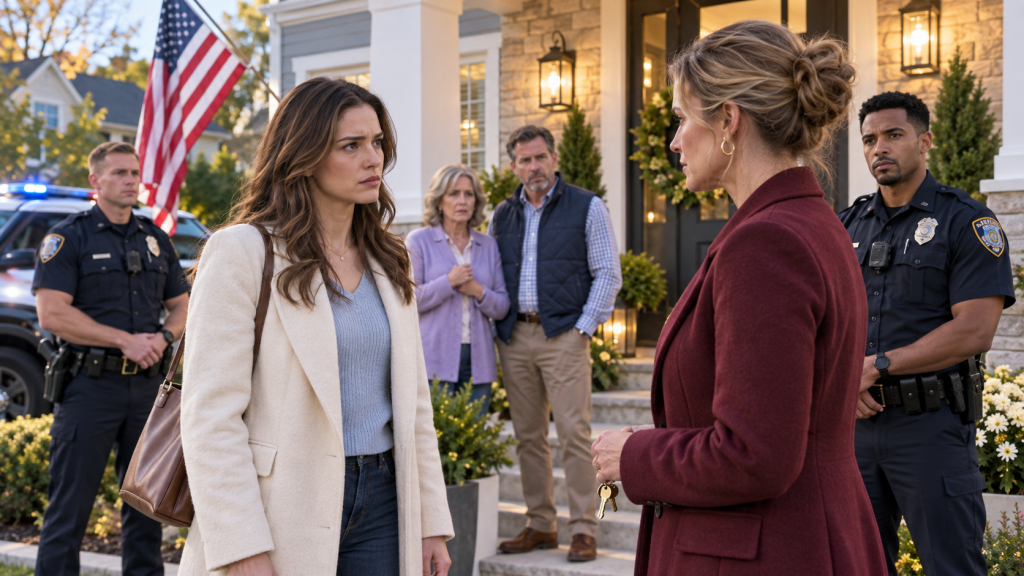
By the time I reached Caldwell Street at 6:11, two patrol vehicles were parked outside.
Ben and Yolanda were watching from behind their downstairs curtains.
Greg and Sandra stood on the sidewalk.
Dileia stood near the porch with her arms crossed.
The second I stepped out of my car, she marched toward me.
“Ranata, you’re making this bigger than it is.”
I walked past her.
“Officer Reyes?”
A man near the patrol car raised his hand.
I introduced myself.
He confirmed that the ownership documents matched county records.
Sandra approached carefully.
“We’re really sorry.”
“You don’t need to apologize.”
“We had no idea.”
“I believe you.”
Greg held up his phone.
“We found the listing online. Your sister scheduled the showing.”
He showed me the screen.
There it was.
Caldwell Street.
Photographs of the rooms I had spent months repairing.
My kitchen.
My floors.
My windows.
My bathroom.
Asking price: $310,000.
Listing contact: Dileia Harris.
Real estate license information included.
I felt physically sick.
Sandra said, “She told us the owner was motivated.”
I looked at Dileia.
“The owner was motivated?”
Dileia rolled her eyes.
“Oh, come on.”
Officer Reyes glanced between us.
I held out my hand.
“The key.”
Dileia frowned.
“What?”
“The key to my building.”
She looked down.
The brass key was still in her hand.
“Where did you get it?”
“It’s not important.”
“It’s extremely important.”
“I was going to tell you.”
“Tell me what?”
“That I found buyers.”
“For property I’m not selling?”
“You hadn’t decided yet.”
“I had absolutely decided.”
“You weren’t doing anything with the upstairs.”
“I renovated it.”
“It was sitting empty.”
“For six weeks.”
She threw up her hands.
“This is exactly why I didn’t call you first. You always overthink everything.”
Sandra’s eyes widened.
Greg looked at the ground.
I said, “You listed something you don’t own.”
“I was trying to help.”
“No.”
“I know real estate.”
“That doesn’t make you the owner.”
“I found interested buyers.”
“Congratulations. You found buyers for someone else’s property.”
She lowered her voice.
“I thought we could split it.”
For a moment, even Officer Reyes looked surprised.
“Split what?” I asked.
“The profit.”
I actually laughed.
One short sound.
Not because anything was funny.
Because my brain did not know what else to do.
“What profit?”
“You bought low. I found people willing to pay more. We both make money.”
“There is no ‘we.’”
Her face tightened.
“I’m your sister.”
“You are not on the deed.”
“That’s not the point.”
“It is exactly the point.”
She crossed her arms.
“I’ve been helping Mom and Dad for years while you’re down here living your own life.”
That sentence could have dragged me into twenty years of family history.
I could have reminded her who drove four hours when Dad’s back went out.
Who researched Medicare plans.
Who paid a portion of their roof repair.
Who sent her $1,200 when she fell behind on rent.
Who quietly solved problems without announcing them to everyone.
But none of those facts had anything to do with Caldwell Street.
So I looked at Officer Reyes.
“What do you need from me for the report?”
Dileia stared at me.
“Seriously?”
“Yes.”
“You’re going to treat me like a criminal?”
“I’m going to document what happened.”
“We’re family.”
“You remembered that after the police arrived.”
Greg and Sandra were released because they had entered in good faith believing they were attending a legitimate showing.
Before leaving, Greg emailed me screenshots of his messages with Dileia.
Sandra apologized again.
I told her not to worry.
Then the Holts drove away.
Dileia stayed.
“You embarrassed me in front of clients.”
I stared at her.
“They were not your clients for this property.”
“You know what I mean.”
“No. I don’t think I do.”
She stepped closer.
“Nothing would have happened without your signature anyway.”
That stopped me.
“What did you just say?”
She blinked.
“I said nothing could close without you.”
“So you knew you had no authority.”
“I knew eventually I’d have to bring you in.”
“Eventually?”
She sighed.
“I would’ve brought you the offer.”
“You were going to market my property, show my property, negotiate with buyers, then surprise me with paperwork?”
“You’re making it sound bad.”
“I’m describing it.”
She had no answer.
That night, I changed every exterior lock.
I changed the mailbox lock.
I changed the garage lock.
I reset the security codes.
I added alerts for every door.
Gretchen came over to help me document everything.
Before reporting the listing, we photographed it.
The price.
The description.
The posting date.
The photographs.
Dileia’s agent information.
Her brokerage.
Everything.
The listing disappeared before midnight.
It did not matter.
I had screenshots.
The next morning, I called Patricia Oay.
She remembered me.
“How’s landlord life?”
“My sister tried to sell my duplex.”
There was a long silence.
“Start from the beginning.”
I did.
When I finished, Patricia asked three questions.
“Do you have the security footage?”
“Yes.”
“Listing screenshots?”
“Yes.”
“Police report?”
“Yes.”
Then she asked, “Is your sister’s real estate license active?”
“As far as I know.”
Patricia went quiet.
“The issue isn’t whether you can prove what happened. You can. The issue is what result you want.”
That question mattered.
I did not want revenge.
I did not want Dileia homeless.
I did not want to ruin her career because I was angry.
But I also knew exactly what would happen if I let my family handle this privately.
Mom would cry.
Dad would tell us life was short.
Dileia would apologize for the “miscommunication.”
Eventually the story would become that she had simply tried to help and I had overreacted.
So I said, “I want it documented that she has no ownership interest, no authority to enter, and no authority to list, lease, advertise, sell, or represent anything involving Caldwell Street.”
“Good,” Patricia said. “That’s clear.”
She prepared a formal notice.
She also recommended that I file a complaint with Dileia’s brokerage and the state real estate regulator.
That part bothered me.
“I don’t want her life destroyed.”
“You are not deciding the outcome,” Patricia said. “You’re reporting the facts. The people responsible for licensing decide what those facts mean.”
I had barely finished reading Patricia’s draft when Mom called.
Her voice was already tense.
“Dileia told us you called the police on her.”
“She entered my property without permission.”
“She said she was showing it to buyers.”
“Yes.”
“So why didn’t you just call her?”
“Because I discovered strangers inside a property nobody in this family was supposed to know I owned.”
Mom sighed heavily.
“She made a mistake.”
“A mistake is forgetting an appointment.”
“Ranata.”
“She created a real estate listing.”
“She thought she was helping.”
“No.”
“Why do you always have to be so absolute?”
“Because ownership is absolute.”
Mom was silent.
Then she said, “Don’t destroy your sister’s career over one mistake.”
Before I could answer, Dad’s voice came from the background.
“Ask her why she hid a duplex from her own family.”
There it was.
The shift.
Dileia’s behavior was suddenly less important than my secrecy.
Dad got on the phone.
“You bought a building and never told us?”
“Yes.”
“Why?”
“Because I knew exactly what would happen.”
“What’s that supposed to mean?”
“It means everybody would immediately have ideas about what I should do with it.”
“That’s insulting.”
“It’s also happening right now.”
Mom came back on.
“We’re your family.”
“That doesn’t make you shareholders.”
She gasped.
“Ranata.”
“I’m not trying to be cruel. But this property belongs to me.”
Then Mom said something that changed the entire conversation.
“Dileia says you promised her part of it years ago.”
I went still.
“What?”
“She said you two discussed investing together.”
“No, we didn’t.”
“She said—”
“Ask her for proof.”
“Why would she lie?”
I almost laughed.
“Mom, we are having this conversation because she listed property she doesn’t own.”
Mom went quiet.
I said, “Ask her for one text. One email. One document. Anything showing that I promised her ownership.”
“She said it was verbal.”
“Of course she did.”
“Ranata, don’t talk like that.”
“I’m going to file the complaint.”
Mom inhaled sharply.
“You’re serious.”
“Yes.”
“She could lose her license.”
“That is for the commission to decide.”
“You’re choosing a building over your sister.”
“No. I’m choosing facts over a lie.”
I hung up.
Within minutes, Dileia texted.
You’re really doing this?
Then:
Mom is crying.
Then:
You always turn everything into rules and paperwork.
I stared at that message for a long time.
Rules and paperwork.
She said it like those were character flaws.
But rules were what defined ownership.
Paperwork was what stopped people from rewriting the past.
So I filed the complaint.
I attached the security footage.
The screenshots.
The police report number.
My deed.
Patricia’s letter.
Then I went to work.
Three days later, Dileia’s broker called me.
His name was Harold Kim.
“Ms. Harris, I oversee your sister’s license at our office.”
“All right.”
“We became aware that a listing was entered using our brokerage information without a valid listing agreement.”
“That’s correct.”
“I want you to know that our office did not authorize it.”
“I understand.”
“We are investigating internally.”
He sounded deeply embarrassed.
Then he said something nobody in my family had said.
“I’m sorry this happened.”
I closed my eyes.
“Thank you.”
He asked whether I would provide copies of the listing screenshots.
After checking with Patricia, I sent them.
Two days later, Dileia was suspended by the brokerage pending investigation.
That was when the family pressure became relentless.
My aunt called.
“You only have one sister.”
My cousin messaged.
Family disputes should stay private.
Dad texted in capital letters.
FAMILY SHOULD NOT DESTROY FAMILY.
I responded with one sentence.
Please ask Dileia how she got the key.
No one answered.
Then Ben called.
My downstairs tenant.
“Ranata, I think I need to tell you something.”
“What?”
“Your sister has been here before.”
The room seemed to tilt.
“When?”
“A couple times.”
“How many?”
“At least twice that I noticed.”
“Why didn’t you call me?”
“She said you sent her.”
I closed my eyes.
“What exactly did she say?”
“The first time she said she was checking upstairs for you.”
“And the second?”
“She had a guy with her.”
“What guy?”
“I don’t know. Contractor maybe. He had one of those measuring devices.”
I immediately called Gretchen.
We checked the archived security footage.
The cloud storage retained thirty days.
There she was.
Twenty-six days before the unauthorized showing.
Dileia entered alone.
She stayed fourteen minutes.
Eighteen days before the showing, she returned with a man carrying a laser measuring tool.
They went room to room.
He photographed walls.
Measured spaces.
Opened the kitchen cabinets.
This was not impulsive.
It had been planned.
I sent the clips to Patricia.
She amended our documentation.
Then Marcus called.
The agent who had helped me buy Caldwell Street sounded uneasy.
“I got a weird question.”
“About what?”
“Your duplex.”
My stomach tightened.
“From who?”
“An investor I know.”
“What did he ask?”
“Whether Caldwell Street had a title issue.”
I sat down.
“What title issue?”
“He heard there might be some off-market transfer happening.”
“What does that mean?”
“He wasn’t clear.”
“Marcus.”
“I pushed him. Apparently Dileia had talked about arranging some kind of investor deal.”
My mouth went dry.
“Did she forge anything?”
“I don’t know.”
I called Patricia immediately.
She ordered a fresh title search.
Those twenty-four hours were miserable.
I imagined forged deeds.
Fake liens.
Documents I had never seen.
Someone trying to borrow against the property.
The title search came back clean.
No unauthorized liens.
No transfers.
No competing ownership claims.
For the first time in days, I slept.
The licensing investigation continued.
Several weeks later, Patricia and I attended an interview.
The investigator asked calm, specific questions.
Had I ever hired Dileia?
No.
Had I ever discussed giving her ownership?
No.
Did she contribute to the down payment?
No.
Did she pay for renovations?
No.
Did she have permission to access the upstairs unit?
No.
Had I given her a key?
No.
Did I know how she obtained one?
“No.”
At the time, that was still the biggest mystery.
Then, about a month later, Mom called.
Her voice sounded different.
Not angry.
Not defensive.
Tired.
“Can you come here Saturday?”
“Why?”
“I found something.”
“What?”
“I don’t want to explain over the phone.”
Saturday morning, I drove to Greensboro.
Dad was sitting at the dining table.
Mom stood beside him.
Dileia was not there.
A small plastic bag sat on the table.
Inside was a brass key.
Mom pushed it toward me.
“Is that one of yours?”
I examined it.
It looked like the same type used at Caldwell Street.
“Where did you get this?”
“Dileia’s desk.”
“You searched her desk?”
“She asked me to find tax paperwork.”
Mom put down another item.
A hardware store receipt.
The date was five weeks before the showing.
Two key copies.
My stomach dropped.
Mom sat down.
“I confronted her.”
“What did she say?”
“She said you gave her permission.”
“I didn’t.”
“I know.”
“How?”
Mom looked ashamed.
“Because I remembered something.”
She rubbed her forehead.
“The weekend you stayed here after that family cookout, you left your keys in the hallway.”
I remembered.
At the time, the plumbing in my apartment building had been shut off overnight.
I had stayed with my parents.
My Caldwell Street spare key had been clipped to my key ring because I had visited the duplex before driving north.
Mom said quietly, “Dileia borrowed my car while you were showering.”
The answer became obvious.
“She took my key.”
Mom nodded.
“She admitted copying it.”
Dad stared at the table.
His jaw was tight.
“Why?” he said.
Mom looked at him.
“She said she knew Ranata had bought something in Charlotte and wanted to see it.”
I stared at them.
“She knew?”
Mom nodded.
“How?”
“She saw an email.”
“What email?”
“You had sent me an insurance document around that time. Apparently when she used my laptop, she saw an email preview with the Caldwell Street address.”
I leaned back.
“So she searched public records.”
“That’s what she says.”
I felt strangely calm.
The mystery was solved.
She had discovered the property.
Looked up the deed.
Waited until she had access to my keys.
Copied one.
Visited secretly.
Then started planning how to profit from something I owned.
Mom started crying.
“I’m sorry.”
I said nothing.
She reached for my hand.
“I should have believed you.”
“You should have believed the evidence.”
“I know.”
“No, Mom. That’s the point. This wasn’t about choosing between daughters. There were videos. A deed. A listing. Police. And somehow everyone still asked me to treat it like a misunderstanding.”
She wiped her face.
“I didn’t want to believe she would do something like that.”
“I understand.”
“But that doesn’t make it okay.”
“No.”
Dad looked at me.
“I owe you an apology too.”
I waited.
He swallowed.
“I was angry that you bought property without telling us.”
“I know.”
“I thought it meant you didn’t trust us.”
I looked at him.
“I didn’t.”
That hurt him.
I could see it.
But it was true.
“And after everything that happened,” I continued, “can you honestly tell me I was wrong?”
He looked down.
“No.”
Mom cried harder.
Normally, I would have immediately moved beside her.
I would have reassured her.
I would have softened what I had said.
I did not.
For years, I had been the person who made discomfort disappear for everyone else.
That habit was part of the problem.
Mom finally asked, “Are you going to drop the complaint?”
“No.”
She closed her eyes.
“I had to ask.”
“I’m not changing my statement. I’m not telling anyone it was a misunderstanding.”
Dad nodded slowly.
“That’s fair.”
Mom looked at him in surprise.
He continued.
“She has to deal with what she did.”
For the first time since this started, I felt like my father was standing beside me instead of between us.
The brokerage terminated Dileia several weeks later.
The state real estate commission imposed disciplinary action after its investigation.
Her license became inactive for a period, and she was required to complete additional education and satisfy conditions before returning to active practice.
I did not celebrate.
I did not post about it.
I did not tell relatives, “I told you so.”
I simply read the letter, forwarded a copy to Patricia, and filed it away.
Dileia reacted differently.
She sent me one message.
Hope your precious duplex was worth losing your sister.
I read it several times.
Then I replied.
Caldwell Street didn’t cost me my sister. Your decisions did.
After that, we did not speak for nine months.
At first, the silence hurt.
Then it became peaceful.
I rented the upstairs unit to a nurse named Simone.
She was twenty-six, worked night shifts, and wanted somewhere quiet.
Ben and Yolanda renewed downstairs.
The duplex did exactly what I had intended it to do.
The rent covered the mortgage, insurance, taxes, maintenance reserves, and left a modest monthly profit.
Nothing dramatic.
No overnight wealth.
Just steady progress.
I repaired the gutters.
Painted the exterior trim.
Replaced the garage door.
Improved the landscaping.
Every project reminded me that Caldwell Street was real.
Mine.
Not because I shouted about it.
Because I had bought it.
Nine months after our last conversation, Dileia appeared outside my apartment.
Not the duplex.
My personal apartment.
I opened the door but did not invite her inside.
She stood there holding an envelope.
“I need five minutes.”
I crossed my arms.
“You have five.”
She handed me the envelope.
Inside was a cashier’s check for $1,200.
I recognized the amount immediately.
Money she had borrowed from me three years earlier.
“What’s this?”
“Something I owe you.”
“You’ve owed it for three years.”
“I know.”
“Why now?”
She looked down.
“I’m trying to start fixing things.”
I did not respond.
She took a breath.
“I was jealous.”
That was not what I expected.
She continued.
“You were younger than me. You had the stable job. Savings. Then you bought property.”
“You didn’t know I bought it until you snooped.”
“I know.”
“So what happened?”
“I saw the Caldwell Street address in Mom’s email. I looked it up. I found your name on the deed.”
“And?”
“I got angry.”
“At me?”
“At everything.”
She rubbed her hands together.
“My real estate career wasn’t going well. I kept telling everyone I was about to have a big month, but most months I was barely covering my bills. Then I saw you had bought an entire duplex.”
“So you thought you deserved part of it.”
“Yes.”
The honesty surprised me.
She did not excuse it.
She did not say she was helping.
She did not say I misunderstood.
“Yes,” she repeated. “That’s what I thought.”
I waited.
“I told myself that because I knew real estate and you didn’t, I could create value. I thought if I brought you a buyer offering more than you paid, you’d be impressed.”
“You listed one unit for more than I paid for the entire duplex.”
“I know.”
“You knew it wasn’t separately deeded.”
“I know.”
“What exactly were you planning?”
She closed her eyes.
“At first, I thought I could find an investor interested in the whole property.”
“Then why list Unit B?”
“Because I was trying to test demand.”
I stared at her.
“That makes no sense.”
“I know that now.”
“You’re a licensed agent. You knew it then.”
She looked ashamed.
“Yes.”
The word landed heavily.
Finally, she was admitting the truth.
Not that she made a mistake.
That she knew better.
I asked, “How many keys did you copy?”
“Two.”
“Who had the second?”
“The contractor who came with me.”
“What contractor?”
“Someone I knew who flips houses. I wanted him to estimate renovation value.”
“Where is the key?”
“He gave it back. I destroyed both copies after the police came.”
“Can you prove that?”
“No.”
“Then understand why I’ll never fully trust that.”
“I do.”
We stood silently.
Then I said, “Did you tell Mom I promised you part of the property?”
“Yes.”
“Why?”
“Because I panicked.”
“You lied.”
“Yes.”
“Why did you say we had planned to invest together?”
“Because it sounded believable.”
That answer hurt more than almost anything else.
Because she knew our parents would believe it.
She knew family history could be used against me.
“You were willing to make me look dishonest to protect yourself.”
“Yes.”
Her eyes filled with tears.
“I’m sorry.”
I had heard those words from Dileia before.
But always with a condition.
I’m sorry, but you embarrassed me.
I’m sorry, but you know how stressed I was.
I’m sorry, but Mom overreacted.
This time there was no “but.”
I said, “I’m not calling the commission.”
“I know.”
“I’m not asking your brokerage to reconsider anything.”
“I know.”
“I’m not telling Mom this is fixed.”
“I know.”
“And I’m not ready to forgive you.”
Her eyes dropped.
“I know.”
Then she stepped back.
“That was my five minutes.”
She turned toward the stairs.
“Dileia.”
She looked back.
I held up the cashier’s check.
“Thank you for paying this back.”
She nodded.
Then left.
Our relationship did not repair itself overnight.
That would have been another version of pretending.
Instead, it rebuilt slowly.
A text on Mom’s birthday.
Coffee several weeks later.
A short conversation at Thanksgiving.
Then another.
Trust came back in inches.
Not miles.
I watched what she did more than I listened to what she promised.
She took an administrative job with a property management company.
She told them about the disciplinary history.
She started attending continuing-education classes even before she was required to.
She stopped borrowing money.
She stopped turning every conversation into a competition.
My parents changed too.
Dad stopped asking what everything cost.
Mom stopped suggesting what I should do with my properties.
When I eventually bought another small rental, I told them.
Not because they were entitled to know.
Because I wanted to tell them.
There is a difference.
Mom hugged me.
Dad asked whether the inspection went well.
Neither asked whether a relative could live there.
Nobody suggested Dileia manage it.
I noticed.
Two years after the Caldwell Street incident, we all sat around my parents’ dining table again for Mom’s birthday.
Same room.
Same chairs.
Different family.
Dad raised his glass.
“To your mother.”
We all laughed.
Mom said, “That better be the whole toast.”
Dad shook his head.
“And to learning things before we’re too old to learn them.”
Mom narrowed her eyes.
“What did you learn?”
He looked at me.
“That grown children are allowed to have boundaries.”
Dileia glanced at me.
Then raised her glass slightly.
“Amen.”
It was small.
But it mattered.
Later that evening, Mom and I stood in the kitchen wrapping leftover cake.
She asked, “Do you ever regret buying Caldwell Street?”
I thought about the police.
The legal fees.
The family arguments.
The months of silence.
Then I thought about the rent deposits.
The equity.
The repaired floors.
The first night I stood inside the upstairs unit after changing every lock.
“No,” I said.
Mom smiled.
“I didn’t think you did.”
On the drive back to Charlotte, I stopped at the duplex.
It was nearly midnight.
The porch light glowed.
Ben and Yolanda’s television flickered behind the downstairs curtains.
Simone had moved out by then after buying a townhouse, and a teacher named Kayla rented upstairs.
Someone had planted flowers near the walkway.
The building looked peaceful.
I stood across the street looking at it.
People often talk about boundaries as though they are walls.
Sometimes they are.
But I began thinking of boundaries as doors.
Doors can open.
Doors can close.
The important part is deciding who gets a key.
For most of my life, being the responsible daughter meant being available.
Being the reliable sister meant fixing problems.
Being successful meant sharing the result before I had decided what I wanted.
Caldwell Street changed that.
It taught me that reliability without limits becomes expectation.
Generosity without boundaries becomes entitlement.
Peace that depends on one person accepting disrespect is not peace.
It is surrender.
It also taught me the value of documentation.
The security footage meant nobody could tell me I had imagined what happened.
The deed meant ownership was not debatable.
The screenshots meant the listing could not vanish along with the truth.
The police report meant the incident could not later become a harmless family misunderstanding.
Patricia’s letter meant my boundary existed outside everybody’s memory.
Facts protected me when emotion tried to rewrite the story.
Years passed.
Dileia eventually completed every requirement necessary to return to active real estate work.
Before she reactivated her license, she called me.
“I wanted you to hear this from me.”
“What?”
“My license is active again.”
I was silent for a second.
Then I said, “Congratulations.”
“Thank you.”
She hesitated.
“I’m not asking you to use me as your agent.”
I laughed.
“Good.”
“I figured that would be pushing it.”
“A little.”
She laughed too.
Then she said something that surprised me.
“When new agents complain about paperwork, I tell them about Caldwell Street.”
“What do you say?”
“I say I almost lost my career because I confused family with permission.”
I sat quietly.
“That’s accurate.”
“I know.”
That became the sentence I remembered most.
Because our entire family had confused family with permission.
My parents had believed family entitled them to information.
Dileia believed family entitled her to access.
I believed family obligated me to absorb bad behavior without making anyone uncomfortable.
We were all wrong.
Years later, I sold Caldwell Street.
By then, the neighborhood had changed.
Several houses had been renovated.
Property values had risen.
The duplex had appreciated significantly.
I had also paid down the mortgage.
The sale was not some fantasy fortune.
But after expenses, repairs, taxes, closing costs, and the loan payoff, I walked away with a meaningful return.
Marcus represented me.
Patricia handled closing.
When I sat at the conference table signing the final documents, Patricia smiled.
“This property has certainly kept us in touch.”
I laughed.
“You could say that.”
She pushed the final statement toward me.
“You did well.”
I looked at the number.
For a few seconds, I remembered being twenty-eight.
Sitting at another table.
Signing the original deed.
Wondering whether I was ready.
I had been ready.
Even when nobody else knew.
When I walked outside after closing, Dileia was standing beside my car.
“What are you doing here?”
“Marcus told me closing was today.”
I raised an eyebrow.
“He did not tell me your numbers.”
“Smart man.”
She held out a small gift bag.
“I brought you something.”
Inside was a little wooden frame.
Mounted in the center was a brass key.
Underneath it was a metal plaque engraved with three words.
ASK PERMISSION FIRST.
I stared at it.
Then I laughed so hard I had to lean against the car.
Dileia smiled.
“Too soon?”
“It’s been years.”
“That doesn’t answer the question.”
“No. It’s not too soon.”
Patricia came outside and looked at the frame.
She burst out laughing too.
I hugged Dileia.
The hug did not erase what happened.
Forgiveness never erased it.
But that was the point.
Healing did not require pretending.
It required remembering accurately and choosing what came next.
On the drive home, I thought about the afternoon my camera notification first appeared.
I remembered sitting in that gas station parking lot watching strangers walk through my kitchen.
I remembered seeing Dileia holding my key.
I remembered how instinctively part of me wanted to ask whether I was overreacting.
That instinct was gone now.
You can love somebody and still lock the door.
You can forgive somebody and still require accountability.
You can help family without handing them ownership of your future.
You can say no without being cruel.
And sometimes the most powerful sentence you can say is the simplest one.
You did not have permission.
That sentence protected more than a duplex.
It protected the life I was building.
It forced my parents to see patterns we had normalized.
It forced Dileia to confront choices she had spent years explaining away.
And it forced me to understand that being dependable did not mean being endlessly available for other people to use.
A few months after selling Caldwell Street, I bought my own house.
Three bedrooms.
Small backyard.
A sunny home office.
Nothing enormous.
Just mine.
When Mom and Dad visited for the first time, Dad walked through the kitchen admiring everything.
Dileia came too.
At the end of the evening, Dad stood at the front door.
“So when do we get our spare key?”
The entire room went silent.
Then he smiled.
“I’m joking.”
Mom slapped his arm.
Dileia laughed so hard she nearly dropped her purse.
I laughed too.
Really laughed.
That was the moment I knew our family had changed.
Not because what happened had become meaningless.
Because it had become something we could acknowledge without rewriting.
Eventually, I gave one person a spare key.
My best friend Camille.
She lived fifteen minutes away and had once driven across Charlotte in the middle of the night because I thought I smelled gas.
When Dileia found out, she pretended to look offended.
“Camille gets a key?”
“Yes.”
“What about me?”
“No.”
She pressed a hand dramatically against her chest.
“I’m wounded.”
“You’ll survive.”
She smiled.
“I will.”
No argument.
No guilt.
No entitlement.
Just a joke.
One afternoon, years after everything happened, Dileia and I were driving back from lunch when we passed Caldwell Street.
The new owners had painted the front door dark green.
Someone had installed flower boxes beneath the upstairs windows.
Dileia looked out the passenger side.
“You know what’s ridiculous?”
“What?”
“If I had just called and said, ‘Hey, I found out you bought a duplex. Do you need help finding a tenant?’ none of this would have happened.”
“Correct.”
“I might even have gotten a referral.”
“Maybe.”
“Instead I tried to sell something that wasn’t mine.”
“Yes.”
She shook her head.
“I really was an idiot.”
I kept my eyes on the road.
“I’m not arguing.”
She laughed.
Then, after several seconds, she became serious.
“Thank you.”
“For what?”
“For not covering for me.”
I glanced at her.
“You hated me for reporting it.”
“I did.”
“And now you’re thanking me?”
“Yes.”
“Why?”
“Because everybody had covered for me my whole life.”
That sentence surprised me.
She looked out the window.
“Mom covered bills when I was irresponsible. Dad made excuses when I missed things. You fixed problems. Every time I messed up, somebody softened the consequence.”
I said nothing.
“So when Caldwell Street happened, I genuinely thought you would eventually do the same.”
“That’s why you were so angry.”
“Yes.”
“Because I didn’t rescue you.”
“Yes.”
She looked at me.
“And that’s probably the reason I finally changed.”
I let that sit between us.
Then I said, “That was an expensive lesson.”
She smiled.
“Apparently those are the only kind I remember.”
We laughed.
And that was the real ending of Caldwell Street.
Not the police report.
Not the disciplinary letter.
Not the sale.
The real ending was that we stopped repeating the same family pattern.
I stopped measuring love by how much inconvenience I could absorb.
My parents stopped treating information about my life as something they were automatically owed.
Dileia stopped assuming that closeness created entitlement.
We became more separate.
And because of that, strangely enough, we became closer.
There are people who hear this story and think the lesson is never trust family.
I disagree.
I still trust my family.
But trust is not blindness.
Trust is not handing someone unlimited access because you share DNA.
Trust is built by behavior.
It can be damaged.
It can be repaired.
And when it is repaired, it should come back differently than it existed before.
Dileia never received another key to one of my properties.
She did not ask.
I never used her professionally as my real estate agent.
She understood.
We found other ways to be sisters.
Coffee.
Birthdays.
Phone calls.
Laughing about Dad’s terrible jokes.
Taking Mom shopping.
Arguing over which restaurant made better cheesecake.
Normal things.
Things that did not require deeds.
Or lawyers.
Or police.
Years later, the little framed brass key Dileia gave me still sits on a shelf in my office.
Visitors sometimes ask what it means.
I usually smile and say, “Long story.”
Because it is.
It is a story about money.
Ownership.
Family.
Resentment.
Accountability.
Forgiveness.
And one duplex nobody knew I owned.
But mostly, it is a story about learning that love and boundaries are not opposites.
Sometimes boundaries are what make healthy love possible.
I worked too hard for my life to let guilt manage it.
I spent too many years becoming the person everyone depended on to believe that being dependable meant surrendering my choices.
And I learned something that I wish I had understood much earlier.
You do not have to become angry to become firm.
You do not have to hate someone to hold them accountable.
You do not have to explain a boundary until everyone agrees with it.
Sometimes the deed is enough.
Sometimes the camera footage is enough.
Sometimes “no” is enough.
And sometimes changing the locks is not an act of revenge.
It is simply recognizing that the person who had access should never have had the key in the first place.
Caldwell Street eventually belonged to someone else.
But what I learned there still belongs to me.
My success does not automatically become a shared resource.
My silence does not create permission.
My generosity is voluntary.
My property is mine.
My boundaries do not require a family vote.
And forgiveness does not mean handing the key back.
💬THE END! THANK YOU FOR READING!