

“How confused?” Mom asked.
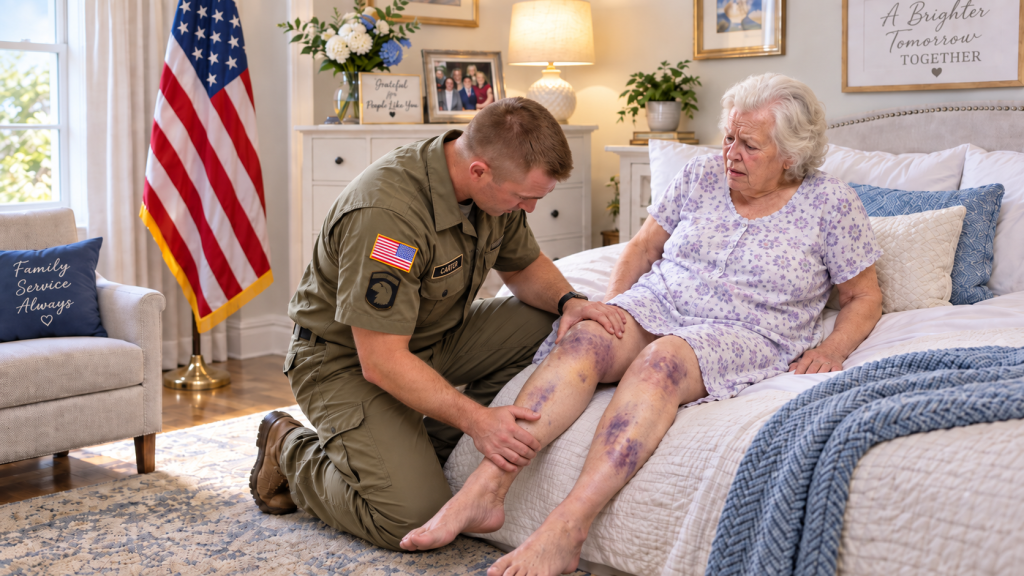
I looked at the bruises around her wrists again.
Even in the low light, they were impossible to ignore.
Dark purple bands wrapped around both arms, with smaller yellow marks underneath that looked older.
My stomach tightened.
I wanted to storm downstairs, drag Abigail into the kitchen, demand answers, and call every authority I could think of.
Instead, I forced myself to stay still.
“Confused enough to make her believe everything is going according to plan,” I whispered.
Mom studied me for several seconds.
Then she gave a tiny nod.
“I can do that.”
Her voice was calm.
Too calm.
I realized then that whatever had happened while I was deployed had gone on long enough for fear to become routine.
That realization was worse than the bruises.
I crouched beside her.
“Did she do that to you?”
Mom looked toward the closed door.
“She’ll hear us.”
“I changed the passwords to the security system.”
“That doesn’t mean she isn’t listening.”
I glanced around the room.
The lamp was gone.
The clock was gone.
Even the little radio Mom used to keep beside her bed had disappeared.
I opened the closet.
Most of her clothes were missing.
“What happened to your things?”
“She moved them.”
“Where?”
“I don’t know.”
“Did she take your phone?”
“Yes.”
“Why?”
“She said I was calling people and embarrassing the family.”
“Who were you calling?”
“You.”
The answer hit me like a punch.
I sat down on the edge of the mattress.
“I never got any calls.”
“She changed something with the phone plan.”
Of course she had.
During deployment, service was unreliable.
Sometimes messages arrived days late.
Sometimes not at all.
Abigail had used the perfect cover.
Distance.
Time zones.
Military communication rules.
She had known exactly how difficult it would be for Mom to reach me.
Mom reached over and touched my arm.
“Samuel, listen to me.”
“I’m listening.”
“You cannot confront her tonight.”
“I know.”
“No, you don’t.”
Her fingers tightened.
“You still think this is about me.”
I stared at her.
“What else is it about?”
“Money.”
I already knew about the transfer request.
But something about the way she said the word made me feel colder.
“What money?”
Mom looked at the door again.
Then she leaned closer.
“Your father’s trust.”
I frowned.
Dad had died twelve years earlier.
He had left Mom comfortable, but not wealthy.
At least, that was what I had always believed.
Mom saw my expression.
“He never told you everything.”
“Mom.”
“There was property.”
“What property?”
“Land your grandfather owned outside Richmond.”
I shook my head.
“I thought that was sold years ago.”
“So did I.”
Her mouth tightened.
“Until three months ago.”
I felt my pulse increase.
“What happened three months ago?”
“A developer bought the surrounding parcels.”
“How much is the land worth?”
Mom looked directly at me.
“Enough.”
“How much?”
“The offer was just under two million dollars.”
For a few seconds, neither of us spoke.
Downstairs, I could hear Abigail opening and closing cabinets.
A glass clinked against the countertop.
Normal sounds.
Domestic sounds.
The sounds of a perfectly ordinary house.
I looked back at Mom.
“Does Abigail know?”
“She found the letter.”
“What letter?”
“The attorney sent a certified notice.”
“When?”
“Three days after you left for deployment.”
That explained the timing.
I stood and paced once across the tiny room.
“Why didn’t you accept the offer?”
“I wasn’t sure I wanted to sell.”
“Why?”
“Because your father loved that land.”
“Mom, that isn’t important right now.”
“I know.”
She swallowed.
“I’m telling you what happened.”
I crouched again.
“Keep going.”
“She started asking questions.”
“Abigail?”
“Yes.”
“About the property?”
“At first.”
“And then?”
“She wanted to know who inherited if something happened to me.”
My jaw tightened.
“What did you tell her?”
“That the trust passes to you.”
I felt sick.
Mom continued.
“She laughed.”
“She laughed?”
“She said, ‘That makes things easier.’”
A chill moved down my back.
“What does that mean?”
“I didn’t understand then.”
She looked toward the door again.
“I do now.”
I wanted to ask more, but footsteps approached.
Mom immediately let her eyes go unfocused.
The transformation was extraordinary.
Her shoulders sagged.
Her mouth opened slightly.
When Abigail knocked once and opened the door, Mom was staring blankly at the wall.
Abigail looked from her to me.
“What are you doing in here?”
“Checking on her.”
Her smile returned.
A gentle, sympathetic expression that would have fooled anyone who hadn’t seen the locked door.
“She gets worse at night,” Abigail said.
Mom suddenly looked at me.
“David?”
My father’s name.
Abigail’s eyes brightened.
I nearly admired Mom’s timing.
Nearly.
I put a hand on her shoulder.
“It’s Samuel, Mom.”
She frowned.
“Samuel?”
“Yes.”
“My son?”
Abigail stepped forward.
“See?”
Her voice carried something dangerously close to triumph.
“This is what I’ve been trying to tell you.”
Mom looked frightened.
“When are we going home?”
“We are home,” Abigail said patiently.
Mom began rubbing her hands together.
“No. No, this isn’t my house.”
Abigail looked at me.
I lowered my eyes.
“Tomorrow,” I said quietly.
“What about tomorrow?”
“The evaluation.”
Relief crossed her face.
“You agree?”
“I think we need answers.”
She touched my cheek.
“Oh, Samuel.”
I almost flinched.
Instead, I covered her hand with mine.
“You’ve been carrying this alone.”
“I have.”
“I’m sorry.”
“You couldn’t have known.”
There it was.
Permission.
Excuse.
A path back toward trust.
I gave it to her deliberately.
“We’ll deal with it together.”
Her shoulders relaxed.
Behind her, Mom stared at the floor.
But I saw the smallest movement at the corner of her mouth.
Abigail kissed me.
Then she turned toward Mom.
“Time for your medication.”
“What medication?” I asked.
She froze.
“Her sleep medication.”
“Which one?”
“Samuel, please.”
“I’m asking because I should know.”
She sighed.
“Lorazepam.”
Mom’s eyes flashed toward me.
“Who prescribed it?”
“Dr. Reeves.”
Our family doctor.
I made a mental note.
“How much?”
“Half a milligram.”
“How often?”
“As needed.”
Mom looked down.
I had known her long enough to recognize controlled fury.
Abigail opened a small bottle.
I took it from her.
“Let me.”
Her eyebrows lifted.
“You’ve done enough tonight,” I said.
For one dangerous second, I thought she might object.
Then she smiled.
“You’re sweet.”
I waited until she left.
Then I looked at the label.
The bottle had Mom’s name on it.
The prescription was legitimate.
But the directions said one tablet at bedtime as needed.
I shook one into my palm.
“Have you been taking these?”
Mom whispered, “She makes me.”
“How many?”
“Sometimes two.”
I closed my fist.
“Every night?”
“Almost.”
“Why didn’t you spit them out?”
“Sometimes I did.”
She pointed toward the baseboard.
I looked down.
Behind a loose strip of wood were four tablets.
That told me two things.
First, Mom was very much cognitively intact.
Second, Abigail had been keeping her sedated.
I slipped the hidden tablets into my pocket.
“Don’t take this.”
Mom nodded.
I filled a paper cup from the bathroom sink and poured the pill into the toilet.
Then I flushed.
“Tomorrow morning, we leave together.”
“What if she changes the plan?”
“She won’t.”
“How do you know?”
“Because she thinks she won.”
I stayed with Mom another ten minutes.
Then I locked the door from the outside again.
It remains one of the hardest things I have ever done.
Even though she understood why.
Even though the key stayed in my pocket.
Even though I returned twice during the night.
Each click of that lock made me feel like I was cooperating with the very thing I meant to stop.
But Abigail needed to believe her world was still intact.
At 1:17 a.m., I opened my laptop in the guest bathroom and logged into Mom’s financial accounts.
The first thing I noticed was a new device listed under trusted access.
Abigail’s laptop.
The second was a series of password reset requests.
The third was a draft transfer authorization.
Eighty thousand dollars.
Recipient account name: A. Mercer Holdings.
Abigail’s maiden name was Mercer.
I searched the business registry.
A. Mercer Holdings had been formed six weeks earlier.
Registered agent: Abigail Mercer Carter.
Business address: a mailbox service across town.
I stared at the screen.
She hadn’t even tried very hard to hide it.
That was either arrogance or haste.
Possibly both.
Then I checked Mom’s credit report.
Two inquiries.
One for a home equity line.
Another for a private assisted-living facility.
I clicked through documents in Mom’s email.
Abigail had forwarded several to herself.
Tax returns.
Bank statements.
Insurance information.
A copy of Dad’s trust.
And one document that made me stop breathing for a second.
A draft petition for guardianship.
The language was clinical.
“Progressive cognitive decline.”
“Unsafe decision-making.”
“Episodes of self-harm.”
“Financial vulnerability.”
The document requested emergency authority over Mom’s finances.
Attached was a statement from Abigail describing incidents that, according to Mom, had never happened.
Burning food on the stove.
Wandering barefoot down the street at night.
Leaving faucets running.
Failing to recognize family members.
Becoming violent when redirected.
All lies.
But detailed lies.
Dates.
Times.
Witnesses.
I recognized two of the witness names.
Mrs. Smith.
And our next-door neighbor, George Wilkins.
I doubted either had actually seen anything.
They had probably only heard Abigail’s version afterward.
That was how narratives became evidence.
Tell enough people the same story, and eventually they start remembering your story as something they witnessed.
At 2:04 a.m., I opened the deleted security logs.
The cameras covered the driveway, kitchen, living room, upstairs hallway, and back entrance.
Abigail had deleted entire blocks of recordings.
But she had missed one thing.
Motion metadata.
It didn’t show video.
But it showed when doors opened, when cameras detected movement, and when recordings were manually removed.
I created a timeline.
June 4.
Mom entered kitchen, 7:14 p.m.
Upstairs motion, 7:26.
Recording deleted, 7:31.
June 11.
Front door opened, 2:03 p.m.
Mom returned, 2:19.
Hallway motion.
Recording deleted, 2:25.
June 18.
Kitchen motion, 9:41 p.m.
Upstairs hallway motion, 9:48.
Recording deleted, 9:53.
Over and over.
Something had been happening.
Something Abigail did not want preserved.
At 2:46 a.m., I called a number I hadn’t used in years.
Martin Hale answered on the fourth ring.
“Samuel?”
“Sorry.”
“Do you know what time it is?”
“Yes.”
“Are you home?”
“Yes.”
He paused.
Martin had been my supervisor when I worked financial fraud.
Retired now.
Still one of the sharpest people I knew.
“What happened?”
“I need advice.”
“What kind?”
“Potential elder abuse, financial exploitation, false guardianship petition.”
The sleep disappeared from his voice.
“Your mother?”
“Yes.”
“Your wife involved?”
I said nothing.
He understood.
“Do not confront her.”
“I haven’t.”
“Good.”
“I have records.”
“Preserve originals.”
“I am.”
“Do you have physical evidence?”
“Bruising.”
“Photograph it.”
“I already did.”
“Medical evaluation?”
“Scheduled psychiatric evaluation in the morning.”
“Who arranged it?”
“Abigail.”
“Then assume the evaluator has been given a narrative.”
“I know.”
“What do you plan to do?”
“Give him the other narrative.”
Martin exhaled.
“Not a narrative. Evidence.”
“Right.”
“Samuel?”
“Yes?”
“If your mother is being physically restrained or unlawfully confined, this is beyond financial fraud.”
“I know.”
“Call adult protective services.”
“I will.”
“Call law enforcement if she’s in immediate danger.”
“I understand.”
“Do it before you get clever.”
That stung because he was right.
My old instincts wanted a perfect case.
A complete file.
Every document aligned.
But Mom was not an investigation.
She was my mother.
I ended the call and went upstairs again.
She was awake.
“I called Martin.”
“That old bulldog?”
I smiled despite myself.
“He said hello.”
“You’re lying.”
“I am.”
“He never liked me.”
“He loved you.”
“He loved your pie.”
“Same thing.”
Mom laughed quietly.
It was the first normal sound I had heard from her since coming home.
Then her expression changed.
“Samuel.”
“What?”
“There’s something else.”
“Tell me.”
“She tried to get me to sign something.”
“What?”
“I don’t know.”
“When?”
“Last week.”
“How?”
“She brought a notary.”
I stiffened.
“Who?”
“A woman named Denise.”
“Last name?”
“I don’t know.”
“What happened?”
“I refused.”
“And then?”
“She got angry.”
Mom stared at her wrists.
I followed her eyes.
“Is that when—”
“Yes.”
My throat tightened.
“She held you down?”
“She grabbed me.”
“With what?”
“Her hands at first.”
“At first?”
Mom swallowed.
“Then she used one of your old exercise straps.”
For several seconds, everything inside me went silent.
I had resistance bands in the garage.
Black nylon straps.
I stood.
“Where?”
“She threw it away.”
“Where?”
“Kitchen trash.”
Garbage collection was Monday.
It was currently Saturday.
I went downstairs.
Abigail was asleep.
I checked the kitchen bin.
Nothing.
Then the outdoor cans.
The first held recycling.
The second was half full.
I put on gloves from the garage.
Three bags down, I found it.
Black nylon.
Buckled.
Cut at one end.
I photographed it where it lay.
Then I placed the entire trash bag inside a clean contractor bag without touching anything else.
By 4:30 a.m., I had backed up everything to three locations.
At 5:10, I finally slept.
At 6:43, Abigail woke me by opening the curtains.
“Morning.”
I sat up slowly.
She was already dressed.
Blue blouse.
Gray skirt.
Pearl earrings.
Professional.
Respectable.
The uniform of credibility.
“Coffee?”
“Please.”
She sat beside me.
“About yesterday…”
“What about it?”
“I know seeing your mother like this is painful.”
I watched her face.
“I should have prepared you better.”
“You did what you thought was best.”
Her eyes softened.
“I was afraid you’d blame me.”
“For what?”
“For not stopping it sooner.”
Stopping what?
The dementia she invented?
The injuries she caused?
The money she tried to take?
I reached for her hand.
“You’ve been here.”
She squeezed my fingers.
“I love you.”
“I know.”
That was the first lie I told her that morning.
Maybe she had loved me once.
I genuinely didn’t know.
But whatever existed now had become something else.
Something transactional.
Controlling.
Dangerous.
At breakfast, Mom performed brilliantly.
She put sugar in her coffee twice.
Asked what day it was.
Called Abigail “Margaret,” which had been Dad’s sister’s name.
Then she looked at me and asked when Samuel was coming home.
Abigail almost glowed.
I hated how much she enjoyed being believed.
At one point Mom dropped her spoon.
When she bent to retrieve it, Abigail said sharply, “Leave it.”
Mom froze.
The command was automatic.
Practiced.
I noticed.
Abigail noticed that I noticed.
Her expression immediately softened.
“I just don’t want her falling.”
“Of course.”
I picked up the spoon.
Mom met my eyes.
Game still on.
We left at 8:20.
Abigail insisted on sitting beside Mom in the back seat.
I drove.
During the trip, she explained the evaluation.
“The psychiatrist specializes in geriatric cognitive decline.”
“What’s his name?”
“Dr. Evan Walsh.”
“How did you find him?”
“Dr. Reeves referred us.”
I nodded.
“Good.”
Mom stared out the window.
“Where are we going?”
Abigail patted her knee.
“To see a doctor.”
“Why?”
“Just a checkup.”
“I’m not sick.”
“I know.”
“You said I’m crazy.”
Abigail’s face tightened.
“I never said that.”
“You said nobody would believe me.”
Silence.
I looked in the mirror.
Abigail stared at Mom.
Mom turned slowly toward her.
For one terrifying second, I thought she had gone too far.
Then Mom blinked.
“Who are you?”
Abigail relaxed.
I almost laughed.
Instead, I kept driving.
Dr. Walsh’s office occupied the third floor of a medical building beside a private hospital.
The waiting room smelled like disinfectant and coffee.
Abigail handled the paperwork.
Of course she did.
When the receptionist asked who should be listed as primary family contact, Abigail answered before I could.
“Me.”
I leaned forward.
“Add me too.”
She smiled.
“Of course.”
Ten minutes later, a nurse called Mom’s name.
We entered a consultation room.
Dr. Walsh was around sixty.
Gray hair.
Wire-frame glasses.
Calm voice.
He shook my hand.
“Captain Carter?”
“Major.”
“Sorry.”
“No problem.”
He greeted Abigail warmly.
That worried me.
“You’ve spoken before?” I asked.
Abigail answered.
“Just by phone.”
Dr. Walsh looked uncomfortable.
“Mrs. Carter provided history ahead of the appointment.”
“How much history?”
“A fairly detailed account.”
“I see.”
He turned to Mom.
“Mrs. Carter, how are you feeling?”
Mom looked at him blankly.
“Who are you?”
“My name is Dr. Walsh.”
“Are you David’s friend?”
Abigail sighed softly.
The doctor noticed.
He began with basic questions.
Date.
Location.
Current president.
Recent events.
Mom deliberately missed several.
Then he asked her to remember three words.
Apple.
Table.
Penny.
She repeated apple, table, penny.
Five minutes later, she said apple, chair, nickel.
Dr. Walsh made notes.
Abigail’s breathing became almost cheerful.
I watched.
He asked Mom to draw a clock.
She placed the numbers badly.
Hands pointed incorrectly.
More notes.
Then he asked Abigail for examples of recent decline.
She opened her folder.
And performed.
That is the only word for it.
Performed.
She described Mom wandering outside at 2 a.m.
“She was barefoot.”
Mom stared down.
“She didn’t know where she was.”
Abigail’s voice trembled.
“I found her three blocks away.”
“When?” Dr. Walsh asked.
“June 12.”
I knew the metadata for June 12.
The front door had not opened between 9:00 p.m. and 7:00 a.m.
Abigail continued.
“She leaves appliances on.”
“Frequently?”
“Three times last month.”
Another lie.
“She becomes combative when I try to help.”
“What kind of combative behavior?”
“She scratches.”
Mom’s hands tightened.
“Kicks sometimes.”
The doctor looked toward Mom.
“Has she ever hurt you?”
Abigail hesitated beautifully.
Then lowered her eyes.
“A few times.”
I understood then how dangerous she really was.
Not because she could lie.
Lots of people lie.
Because she knew how to make a lie feel reluctant.
Truthful people often qualify.
Manipulators who understand credibility learn to imitate that hesitation.
Dr. Walsh turned to me.
“Major Carter, have you witnessed any of these behaviors?”
Abigail looked at me.
This was the moment she had planned.
I could see it.
Husband home from deployment.
Trusted military officer.
Concerned son.
If I validated her story, the rest became easy.
Guardianship.
Medication.
Placement.
Financial control.
I folded my hands.
“I arrived yesterday.”
“So you haven’t personally observed the progression?”
“No.”
Abigail relaxed slightly.
Then Dr. Walsh asked the question I had been waiting for.
“Do you have any concerns you would like me to consider?”
“Yes.”
Abigail turned toward me.
I reached down.
Opened my briefcase.
Removed a thick blue folder.
And placed it on his desk.
Her face changed.
“What’s that?”
Dr. Walsh looked at me.
I slid the folder toward him.
“A different history.”
Abigail gave a small laugh.
“Samuel.”
I ignored her.
The doctor opened the cover.
The first page was a timeline.
The second was a copy of Mom’s bank activity.
The third showed the transfer request.
The fourth showed Abigail’s corporate registration.
The fifth contained screenshots of deleted security files.
Then came photographs of Mom’s wrists.
Dr. Walsh stopped.
The room became very quiet.
Abigail’s chair creaked.
“Samuel, what is this?”
I turned toward her.
“Documentation.”
Her face hardened.
“Of what?”
“Let the doctor read.”
“This is ridiculous.”
Dr. Walsh looked up.
“Mrs. Carter, these photographs are recent?”
“I don’t know what those are.”
Mom spoke for the first time in several minutes.
“They were taken last night.”
Abigail froze.
Dr. Walsh looked at Mom.
Her posture changed.
She sat straighter.
The confusion disappeared from her face.
“Apple,” she said.
The doctor stared at her.
“Table.”
Silence.
“Penny.”
Abigail went white.
Mom continued.
“September twentieth. Saturday. We are at your office on the third floor of Saint Anne Medical Plaza.”
Dr. Walsh slowly lowered his pen.
Mom looked at Abigail.
“And I know exactly who she is.”
Abigail stood.
“This is some kind of setup.”
“Sit down,” I said.
“Don’t you dare tell me what to do.”
Dr. Walsh raised a hand.
“Mrs. Carter, please remain seated.”
“She’s manipulating you!”
“Who?”
“His mother!”
Mom laughed once.
Dry and bitter.
“Oh, now I’m clever?”
Abigail pointed at her.
“You see? This is what she does!”
Dr. Walsh’s expression changed.
Not dramatically.
But enough.
The story he had been given no longer matched the patient sitting in front of him.
He looked at me.
“What else is in the folder?”
“Documentation showing repeated attempts to access my mother’s finances. A draft guardianship petition. Deleted home security records. Medication inconsistencies. And an audio recording.”
Abigail’s mouth opened.
I removed my phone.
“What recording?”
I pressed play.
Her voice filled the room.
Clear.
Relaxed.
Confident.
“Nobody is ever going to believe that old woman.”
Then another voice.
Mrs. Smith.
“I don’t know, Abigail. Evelyn seems pretty sharp when I talk to her.”
Abigail laughed.
“That’s because you only see her for five minutes. Once I get the evaluation done, Samuel will sign whatever they put in front of him.”
The recording ended.
Dr. Walsh stared at her.
Abigail’s breathing changed.
Fast.
Shallow.
She looked at me as if she had never seen me before.
“You recorded me?”
“Yes.”
“In my own house?”
“My house too.”
“You had no right.”
Mom spoke quietly.
“And you had no right to lock me in a bedroom.”
Dr. Walsh stood.
“I’m going to ask everyone to remain here.”
Abigail moved toward the door.
He stepped aside rather than block her.
“You can’t keep me here.”
“No,” he said. “I cannot.”
She reached for the handle.
Then someone knocked.
Twice.
The door opened.
Two people stood outside.
A woman wearing an Adult Protective Services badge.
And a uniformed police officer.
Abigail stopped moving.
I had made the calls before we left home.
The timing was not perfect.
Real life rarely gives you perfect timing.
But the officer had arrived while we were still inside.
The APS investigator introduced herself as Lena Ortiz.
“Mrs. Carter?”
Abigail lifted her chin.
“Yes?”
“I’m actually here to speak with Evelyn Carter.”
Mom raised her hand.
“That’s me.”
Ortiz looked at the bruises.
Then at the folder.
“May we speak privately?”
“Yes,” Mom said.
Abigail immediately objected.
“She’s not competent to—”
Dr. Walsh interrupted.
“I have not made that determination.”
“You told me she had dementia!”
“I did not tell you that.”
“You said her symptoms were consistent!”
“I said the symptoms you reported warranted evaluation.”
The distinction mattered.
Abigail realized it too late.
The officer asked her to step into the hallway.
She refused.
“This is insane.”
I said nothing.
She turned on me.
“You did this.”
“Yes.”
“After everything I did for your mother?”
Mom stood.
Slowly.
Carefully.
“You locked me in a dark room.”
“For your safety!”
“You took my phone.”
“Because you kept making confused calls.”
“You restrained me.”
“You attacked me!”
“That is a lie.”
“You tried to hit me!”
“When?”
“Last Thursday.”
Mom looked at Dr. Walsh.
“I was at my dentist last Thursday.”
Abigail blinked.
It was small.
But everyone saw it.
Mom continued.
“Dr. Patel’s office. Ten-thirty appointment. Ask them.”
Ortiz made a note.
Abigail looked at me.
I could see her calculating.
Not panicking.
Calculating.
That frightened me more.
Then she said, “Samuel, can we speak privately?”
“No.”
“Please.”
“No.”
Her voice changed.
Lower.
Intimate.
“We’re married.”
“I remember.”
“You owe me a conversation.”
I looked at Mom’s wrists.
“No.”
The officer escorted Abigail into the hallway.
She was not arrested.
Not then.
The evidence still needed review.
Statements needed to be taken.
Medical examination.
Financial records.
But the world Abigail had constructed started collapsing that morning.
Not dramatically.
Not all at once.
Piece by piece.
Dr. Walsh completed a full evaluation.
Without Abigail in the room, Mom scored almost perfectly.
He asked her why she had intentionally failed earlier.
“Because my daughter-in-law wanted me declared incompetent.”
“Why cooperate with that?”
“My son asked me to.”
He looked at me.
I said, “I needed her to reveal what she had told you.”
Dr. Walsh did not approve.
I could tell.
Neither did I, entirely.
But he understood.
He documented that Mom showed no evidence of major cognitive impairment during the evaluation.
He also documented concerns about possible coercion, medication misuse, confinement, and financial exploitation.
The police photographed Mom’s injuries.
A nurse examined the marks.
She believed some were consistent with restraint.
Not proof.
Consistent.
That word matters.
Evidence rarely arrives labeled.
It accumulates.
At noon, we returned home with the police.
Abigail rode separately.
She had demanded access to the house because many of her belongings were inside.
The officer allowed it.
Under supervision.
When we entered, Mom stopped in the foyer.
Sunlight came through the tall windows.
She stood there for a long moment.
I realized she had not been downstairs freely in almost two weeks.
“Mom?”
“I’m fine.”
But she wasn’t.
Not yet.
Nobody would be fine after that.
Abigail came in behind us.
“You’re making me look like a criminal.”
Mom turned.
“I haven’t made you look like anything.”
Abigail laughed sharply.
“Oh, please.”
The officer stepped closer.
“Ma’am.”
She raised both hands.
“I’m packing.”
Upstairs, she filled two suitcases.
I watched from the doorway.
“You planned this,” she said.
“No.”
“You came home looking for a reason to hate me.”
“I came home wanting coffee and lemon pie.”
She stopped folding.
“What?”
“That’s what I was thinking about on the plane.”
She stared at me.
“I wanted coffee, Mom’s lemon pie, and my wife.”
Her face softened for half a second.
Then hardened again.
“I was your wife.”
“Yes.”
“I kept this house running while you were gone.”
“Yes.”
“I took care of her.”
“No.”
Her hands shook.
“You have no idea what it was like.”
“What was it like?”
“She hated me.”
Mom had never liked Abigail much.
That was true.
They were civil.
Sometimes warm.
But never close.
“She criticized everything.”
“That doesn’t justify locking her up.”
“She undermined me.”
“That doesn’t justify taking her money.”
“I did not take her money.”
“You tried.”
“That was for expenses.”
“Eighty thousand dollars?”
“The facility wanted a deposit.”
“No facility asked for eighty thousand.”
“You don’t know that.”
“I called them.”
She froze.
I had called.
At 7:10 that morning.
The assisted-living facility on the credit report inquiry had quoted an initial deposit under five thousand dollars.
They also said no admission application had been completed.
I continued.
“A. Mercer Holdings?”
Her face changed.
“That company has nothing to do with this.”
“It received the transfer request.”
“That was temporary.”
“For what?”
She said nothing.
The officer stepped closer.
Abigail zipped the suitcase.
“Talk to my lawyer.”
That was the last sentence she said to me that day.
She left.
Not in handcuffs.
Not screaming.
She rolled two suitcases down the driveway, got into a rideshare, and disappeared around the corner.
Mrs. Smith watched from across the street.
So did three other neighbors.
By evening, the story Abigail had spent months building had started reversing.
Mrs. Smith came over first.
She stood awkwardly on the porch holding a casserole.
People always bring casseroles when they don’t know what else to bring.
“Samuel.”
“Mrs. Smith.”
“Is your mother alright?”
“She will be.”
She looked ashamed.
“I believed Abigail.”
“I know.”
“She told us Evelyn wandered.”
“I know.”
“She said…”
“I know.”
Mrs. Smith’s eyes filled.
“I should have checked.”
Mom appeared behind me.
“Yes,” she said.
Mrs. Smith flinched.
Mom looked at the casserole.
“What is it?”
“Chicken.”
“With mushrooms?”
“Yes.”
“I hate mushrooms.”
Mrs. Smith laughed through her tears.
Mom did too.
It was the first crack in the nightmare.
Not forgiveness.
Not yet.
But humanity.
Over the next week, the investigation widened.
Dr. Reeves, our family doctor, turned over records.
He had never diagnosed dementia.
He had written “reported cognitive concerns” based almost entirely on information Abigail supplied.
He had recommended psychiatric evaluation because Abigail repeatedly contacted his office claiming Mom was deteriorating.
She had exaggerated his notes in the guardianship documents.
The notary was located.
Her name was Denise Harper.
She told investigators Abigail had asked her to notarize a power-of-attorney document.
Mom had refused to sign.
Denise had left after less than ten minutes.
She remembered tension but had not witnessed physical abuse.
The black restraint strap was collected.
So were Mom’s medication bottles.
Pharmacy records showed early refill requests.
Someone had been giving her more lorazepam than prescribed.
Again, not proof by itself.
But another piece.
Then came the security backup.
I had assumed the deleted footage was gone.
It wasn’t.
The home security company retained encrypted emergency backups for thirty days.
Three clips were recovered.
The first showed Abigail blocking Mom from leaving the kitchen.
No physical violence.
But clear intimidation.
The second showed Abigail removing Mom’s phone from her hand and putting it in her pocket while Mom demanded it back.
The third was worse.
No beating.
No dramatic assault.
Nothing like what movies teach us to expect.
Abigail grabbed Mom’s wrists after Mom reached for the front door.
She forced her backward.
Mom struggled.
Abigail wrapped a black exercise strap around one wrist while shouting that she was “out of control.”
Mom shouted back.
Then Abigail dragged her out of camera range.
The video ended.
I watched it once.
Only once.
The detective asked whether I needed a break.
“No.”
My voice sounded far away.
Mom refused to watch it at all.
“I remember,” she said.
“That’s enough.”
Financial investigators found more.
Abigail had researched conservatorship law.
Searched phrases like “selling property for incapacitated parent.”
Downloaded templates.
Contacted three private care facilities.
Created A. Mercer Holdings.
And spoken with a real estate broker about the Richmond land.
The broker told investigators Abigail represented herself as Mom’s future financial guardian.
She had asked how quickly the property could be sold once legal authority was granted.
That was the heart of it.
Not sudden madness.
Not one angry mistake.
A plan.
Maybe she had not started by intending to hurt Mom.
Maybe it began with greed.
Then manipulation.
Then control.
Then fear of being exposed.
I stopped trying to understand the exact moment Abigail crossed the line.
Some lines matter more than motives.
Three weeks after I came home, she was arrested.
The charges were not as simple as the neighbors expected.
Real cases never are.
Unlawful restraint.
Elder abuse.
Attempted financial exploitation.
Fraud-related charges connected to falsified representations.
Medication misuse remained under investigation.
Her attorney denied most of it.
They argued that Abigail genuinely believed Mom was declining.
They said she had been overwhelmed.
They said any physical restraint occurred during “behavioral episodes.”
They said the financial transfers were intended for care.
They said I returned from deployment angry, misunderstood the situation, and used my investigative background to construct a case against my wife.
For a while, that hurt more than I expected.
Not because I believed it.
Because some people did.
Abigail’s sister called me.
“You destroyed her life.”
I answered, “She restrained my mother.”
“She was trying to help.”
“She tried to take eighty thousand dollars.”
“For care.”
“She created a company in her own name.”
“She was protecting assets.”
“From who?”
Silence.
Then her sister hung up.
My marriage ended in paperwork.
No dramatic confrontation.
No final speech.
Divorce petitions.
Temporary financial orders.
Attorney meetings.
Boxes of belongings.
Passwords.
Accounts.
Insurance.
The machinery of separating two lives.
I learned things I didn’t want to know.
Abigail had accumulated twenty-seven thousand dollars in personal credit card debt.
I had not known.
She had been moving money between accounts for months.
Small amounts at first.
Then larger.
She had lost money in an online investment scheme.
Then borrowed from a friend.
Then lied to cover it.
The Richmond property must have looked like rescue.
Two million dollars.
Enough to erase mistakes.
Enough to start again.
Enough to justify anything, if you are already practiced at justifying yourself.
Mom never sold the land.
Not immediately.
For months, she refused to discuss it.
“I don’t want that woman deciding what I do with your father’s property,” she said.
Eventually, almost a year later, she sold part of it.
Not all.
She donated some of the proceeds to an elder legal-aid organization.
When I asked why, she said, “Because not everyone has a son who comes home at the right moment.”
That sentence stayed with me.
I had come home at the right moment.
But also too late.
Too late to prevent the bruises.
Too late to prevent weeks of fear.
Too late to stop someone I loved from hurting someone else I loved.
For a long time, guilt followed me.
Mom noticed.
Of course she did.
One Sunday, she set a lemon pie on the kitchen table.
The first one since my return.
I stared at it.
“You made one.”
“Obviously.”
“I thought you didn’t want to bake anymore.”
“I didn’t.”
“What changed?”
“You’re depressing.”
I laughed.
She cut two slices.
We sat.
For a few minutes, neither of us spoke.
Then she said, “You keep looking at me like you failed.”
I put down my fork.
“I should have known.”
“How?”
“I should have called more.”
“You were deployed.”
“I should have noticed something in your emails.”
“She controlled my email.”
“I should have—”
“Samuel.”
I stopped.
Mom pointed her fork at me.
“Do you remember when you were eight and tried to build that treehouse?”
“Yes.”
“You used six nails.”
“It held.”
“For seventeen minutes.”
I smiled.
“You fell into the hydrangeas.”
“I remember.”
“And afterward you said you should have known the branch was rotten.”
I waited.
She took another bite.
“You think knowing something afterward means you could have known it before.”
I looked down.
“You couldn’t.”
The kitchen was quiet.
Then Mom added, “But once you knew, you acted.”
I nodded.
“That matters.”
It took me a long time to believe her.
The trial did not happen for nearly eighteen months.
Abigail eventually accepted a plea agreement.
She admitted to unlawful restraint and attempted financial exploitation.
Other charges were dismissed as part of the agreement.
She received a combination of incarceration, probation, restitution requirements, and a long-term protective order preventing contact with Mom.
People expected us to celebrate.
We didn’t.
Mom attended sentencing.
I sat beside her.
Abigail stood at the defense table.
She looked different.
Thinner.
Older.
For the first time since I had known her, completely unsure of herself.
Her attorney spoke about stress.
Financial pressure.
Isolation.
Marriage strain caused by deployment.
Caregiver burden.
All real things.
None of them erased what happened.
Then Abigail spoke.
She turned toward us.
“I am sorry.”
Mom did not react.
Abigail continued.
“I convinced myself Evelyn was becoming unstable.”
Mom’s face remained still.
“I was scared.”
The prosecutor looked down.
“I made choices I regret.”
Then she looked at me.
“I never wanted to lose you.”
That was the only moment I nearly lost control.
Because even then, the sentence centered her loss.
Not Mom’s confinement.
Not the bruises.
Not the fear.
Her loss.
The judge imposed sentence.
A deputy led her away.
Mom stood.
“Ready?” I asked.
“Yes.”
We walked outside.
Reporters waited near the courthouse steps.
Mom stopped when one asked how she felt.
She looked at him.
Then at the cameras.
“I feel eighty years old.”
A few people laughed nervously.
Mom continued.
“And I would like to go home and have lunch.”
That clip ended up online.
People called her tough.
Brave.
Sharp.
She hated all three descriptions.
“I wanted soup,” she complained.
“You became inspirational.”
“Terrible.”
“You’re famous.”
“Even worse.”
Life slowly became ordinary again.
That was the best ending I could have imagined.
Mom moved into a small condo six months after the case closed.
Not assisted living.
Not with me.
Her choice.
She wanted elevators, no yard, and neighbors close enough to hear her television.
She bought a ridiculous red sofa.
Adopted a twelve-year-old dog named Walter.
Joined a book club she described as “six women drinking wine and pretending to read.”
She got another phone.
Then a backup phone.
Then, because she had apparently learned paranoia from me, she kept emergency cash in three different places.
“Where?”
“None of your business.”
“Mom.”
“If I tell you, they’re not secret.”
Fair.
I returned to duty for another year.
Then I left the Army.
Not because of what happened.
Not entirely.
But coming home had changed something.
I had spent years believing that danger announced itself clearly.
Uniforms.
Weapons.
Borders.
Sirens.
It doesn’t.
Sometimes danger pours wine at dinner.
Sometimes it fills out medical forms.
Sometimes it smiles at neighbors.
Sometimes it says, “I’m doing this for her own good.”
I went back to investigative work.
This time specializing in financial exploitation cases involving older adults.
Martin called it predictable.
“You always did need a crusade.”
“It’s not a crusade.”
“Sure.”
He came to Mom’s condo for dinner once.
She served lemon pie.
He ate three slices.
“I knew he loved me,” she said.
“I heard that,” Martin replied.
Good things returned.
Not the same things.
Different ones.
That matters too.
Three years after my deployment ended, Mom and I drove to Richmond.
The remaining section of Dad’s property was covered in tall grass.
An old maple stood near the edge.
Mom walked slowly beside me.
Walter the dog had died by then.
She carried his old leash around her wrist because she hadn’t been able to throw it away.
“This was your grandfather’s,” she said.
“I know.”
“You hated coming here.”
“There were mosquitoes.”
“You cried constantly.”
“I was six.”
“You still complain about mosquitoes.”
“Because they remain terrible.”
Mom laughed.
We walked to the maple.
She touched the bark.
“Your father wanted to build a cabin here.”
“He told me.”
“He would have hated the condo.”
“Absolutely.”
“He would have hated the red sofa.”
“Everyone hates the red sofa.”
“I love it.”
“I know.”
We stood there quietly.
Then Mom said, “I’m selling the rest.”
I looked at her.
“You’re sure?”
“Yes.”
“What changed?”
“I’m done letting land carry emotions.”
“That sounds healthy.”
“Don’t be patronizing.”
“I wasn’t.”
“You were.”
She looked across the field.
“I’m keeping enough to live comfortably.”
“Good.”
“I’m giving some to the legal-aid fund.”
“Good.”
“I’m giving some to you.”
“No.”
“Yes.”
“No.”
“Samuel.”
“I don’t want it.”
“Too bad.”
“Mom.”
“You flew across the world and saved me from your wife. Take the money.”
I laughed.
“That is the worst inheritance argument I’ve ever heard.”
“It worked.”
“No, it didn’t.”
She turned toward me.
“Then use it for something useful.”
That became the Carter Elder Protection Fund.
Small at first.
It paid for emergency legal consultations.
Temporary housing.
Forensic accounting.
Security changes.
Sometimes just transportation for an older person trying to get away from someone controlling them.
Mom insisted her name not be used publicly.
Then complained nobody knew she founded it.
Contradictions are a privilege of being eighty-three.
She eventually agreed to let the fund use Dad’s name too.
Evelyn and David Carter Protection Fund.
When the first annual report arrived, she read every page.
Then found three typos.
Of course.
One night, years after everything happened, we sat in her condo watching a terrible detective show.
The fictional investigator found a hidden camera and announced the entire case was solved.
Mom snorted.
“That’s not how your cases work.”
“No.”
“You mostly stare at spreadsheets.”
“Correct.”
“Boring.”
“Very.”
She looked at me.
“Do you still have the recording?”
I knew which one she meant.
“Yes.”
“Why?”
“Evidence archive.”
“The case is over.”
“I know.”
“Delete it.”
I hesitated.
That recording had been the turning point.
The proof that cracked the performance.
The moment Abigail’s confidence became evidence against her.
I had kept copies long after I needed them.
Maybe because deleting it felt like lowering a guard.
Mom noticed.
“You don’t need it anymore.”
“I know.”
“Do you?”
I looked at her.
At the woman Abigail had called confused.
At the woman who had memorized dates while being drugged.
Hidden medication behind a baseboard.
Tracked her own dental appointment to disprove a lie.
Played dementia convincingly enough to expose the trap.
“No,” I said.
I opened the archive on my laptop.
Found the audio file.
Selected it.
Delete.
The computer asked if I was sure.
I looked at Mom.
She smiled.
“Very dramatic.”
I clicked yes.
Gone.
Mom reached for the remote.
“Now can we finish the show?”
“The detective already solved it.”
“He solved it incorrectly.”
“That’s not how television works.”
“It should.”
We watched anyway.
I used to think justice was the moment the truth came out.
The folder on the doctor’s desk.
The recovered video.
The arrest.
The courtroom.
The sentence.
Those moments mattered.
But they weren’t the whole thing.
Justice was Mom choosing her own condo.
Choosing whether to sell the land.
Choosing what medication to take.
Choosing who could enter her home.
Choosing how to spend her money.
Choosing whether to forgive.
She never forgave Abigail.
People sometimes judged her for that.
Mom did not care.
“Forgiveness is optional,” she said once. “Peace is not.”
She found peace.
That was enough.
As for me, I never remarried.
Not because Abigail destroyed my faith in people.
That would give her too much power.
I dated.
I lived.
I worked.
I learned to trust again.
Carefully.
Normally.
Without turning every relationship into an investigation.
Mostly.
Mom teased me about that too.
A few months before her eighty-seventh birthday, she asked me to drive her past the old house.
The house where I had found her locked upstairs.
Someone else owned it now.
Young couple.
Two children.
A swing set in the yard.
The upstairs bedroom window was open.
White curtains moved in the breeze.
Mom stared for a while.
“Do you want to stop?” I asked.
“No.”
“You sure?”
“Yes.”
We drove past.
At the end of the street, she said, “Turn around.”
I did.
We passed again.
This time she smiled.
“What?”
“Nothing.”
“Mom.”
“I just wanted to see it with the window open.”
That sentence stayed with me longer than anything said in court.
The window open.
Sometimes healing is that small.
Sometimes it is simply seeing a door that used to be locked standing open.
A few weeks later, we celebrated her birthday at my house.
Martin came.
Mrs. Smith came too.
Yes, that Mrs. Smith.
She and Mom became unlikely friends after the case.
Mostly because guilt turned into persistence and persistence eventually turned into friendship.
Mrs. Smith brought a casserole.
No mushrooms.
Mom approved.
At dessert, I carried out a lemon pie.
Eighty-seven candles would have been a fire hazard, so we used three.
Mom protested.
“I’m not three.”
“You’re lucky there are any candles.”
“I survived your wife. I can survive eighty-seven candles.”
Martin nearly choked on his coffee.
Mom blew them out.
Everyone clapped.
She looked around the table.
At friends.
At me.
At the open windows.
At the dog belonging to Mrs. Smith sleeping under the chair.
Then she said, “This is much better.”
“Than what?”
She raised one eyebrow.
“You know.”
I did.
I still sometimes remembered that first afternoon home.
Abigail in a cream-colored dress.
Neighbors listening.
Her soft voice.
“His mother has dementia.”
Then Mom’s fist against the bedroom door.
“Samuel! Please don’t leave me in here.”
I had spent years wondering what would have happened if I had arrived one week later.
One month later.
After the evaluation.
After guardianship.
After the property sale.
After the money disappeared.
I stopped asking myself eventually.
There is no answer to a life that didn’t happen.
The one that did happen was enough.
I came home.
I listened.
I believed the right person.
And when Abigail assumed nobody would believe an old woman, she made the one mistake she could never undo.
She forgot that my mother had spent her entire life teaching me how to recognize the truth.
💬THE END! THANK YOU FOR READING!