

My MIL Called 911 When I Refused to Let Her Move In—Then the Officer Asked Who Owned the House
At 4:17 on a Thursday afternoon, my husband texted me:
“Mom’s moving in. It’s already decided.”
I was sitting at the kitchen table finishing a quarterly report when the message appeared across my screen.
For a few seconds, I genuinely thought I had misunderstood it.
I read it once.
Then again.
Then a third time.
Mom’s moving in.
It’s already decided.
Not “Can we talk about Mom staying with us?”
Not “Would you be comfortable if Mom stayed for a few weeks?”
Not even “We have a problem and I need your help.”
Apparently, a decision involving my home, my office, my privacy, and potentially several months of my life had already been made.
And I had been informed after the fact.
I immediately called Mark.
He answered on the fourth ring.
“What does ‘already decided’ mean?”
There was traffic noise behind him.
He sounded distracted.
“Mom needs somewhere to stay for a while.”
“How long?”
“I don’t know. A few weeks. Maybe a couple months.”
I slowly closed my laptop.
“And when exactly were you planning to ask me?”
“Claire, come on.”
“No. I’m serious.”
“She’s my mother.”
“I know who she is.”
He sighed.
That sigh irritated me more than the text.
It was the sigh Mark used when he had already decided I was making something unnecessarily difficult.
“Her rent went up,” he said. “She hates the apartment. She’s lonely. The neighborhood isn’t great anymore. Lisa can’t take her.”
“Why not?”
“Lisa needs her spare room for work.”
I stared at the wall across from the kitchen table.
“So Lisa’s office is protected, but mine isn’t?”
There was another pause.
Then Mark said, “You’re home three days a week. We can move your desk upstairs.”
That was the moment I realized he had already chosen my office for his mother.
He hadn’t just told Diane she could stay.
They had apparently discussed where she would sleep.
Probably where her things would go.
Possibly even how long she would stay.
And somehow none of those conversations had included me.
“You already made the entire plan,” I said. “I’m just finding out what my part is.”
“You’re turning this into something it isn’t.”
“Really? What is it?”
“My mother needs help.”
“And your solution was to volunteer my house without asking me.”
“Our house.”
I looked down at my wedding ring.
That phrase landed differently than he intended.
“Our house.”
For most couples, it was affectionate.
For Mark, lately, it had become a convenient way of treating anything I owned as shared whenever he wanted access to it.
I lowered my voice.
“Call your mother before she arrives.”
“We’ll talk when I get home.”
“No. Call her now.”
Another pause.
A longer one.
Then something in my stomach tightened.
“Mark.”
“What?”
“Is she already on her way?”
Silence.
“Mark?”
The call ended.
He had hung up.
I sat there staring at my phone.
For nearly five years, I had convinced myself Mark’s worst habit was conflict avoidance.
Whenever his mother became demanding, he gave her whatever she wanted because it was easier than dealing with the consequences of saying no.
Whenever Lisa needed money, transportation, babysitting, storage space, or a favor, Mark somehow found a way to make it happen.
But until that afternoon, most of the consequences had been minor.
A canceled dinner.
A weekend interrupted.
A holiday schedule rearranged.
A loan that took months to be repaid.
I had tolerated it because marriage involved compromise.
At least that was what I told myself.
I also told myself Mark understood there were limits.
My home was one of them.
I had bought that house seven years before I met him.
It wasn’t enormous.
It wasn’t a mansion.
But it was mine.
A three-bedroom brick colonial with maple floors, a deep backyard, and a kitchen I had renovated myself after saving for almost four years.
My grandmother had left me a modest inheritance when she died.
I combined that money with savings from nearly a decade of working in corporate compliance and bought the house outright.
No mortgage.
No family loan.
No help from Mark.
When we married, I offered to add him to the deed.
He refused.
At the time, I thought it was romantic.
“Your grandmother helped you build this,” he said. “It should stay yours.”
I loved him for saying that.
Years later, I would remember those words and wonder exactly when he stopped meaning them.
At 5:11, a silver SUV pulled into the driveway.
I was standing at the front window.
Diane climbed out first.
Then Mark’s sister, Lisa.
That was when I knew this had all been arranged long before Mark sent that text.
Lisa opened the trunk.
Together they started unloading.
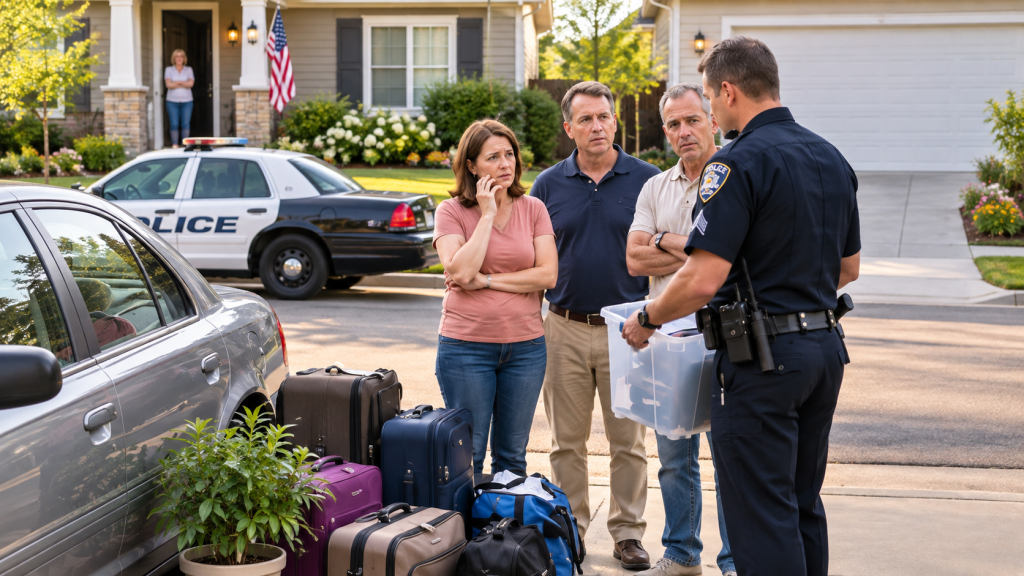
One suitcase.
Then another.
Then a third.
Storage bins.
A garment bag.
A toiletry case.
A grocery bag filled with prescription bottles.
A box labeled WINTER CLOTHES.
And, unbelievably, a peace lily.
I stared at the plant through the window.
Nobody packed a houseplant for a two-week visit.
The doorbell rang.
I opened the door.
Diane stood there smiling like she was checking into a hotel.
“Hi, sweetheart.”
“Hello, Diane.”
She glanced over my shoulder.
“Which room did Mark clear out?”
“He didn’t.”
Her smile disappeared.
Behind her, Lisa sighed dramatically.
“Oh, Claire. Don’t start.”
I looked at the mountain of luggage covering my porch.
“You two are standing here with enough stuff to relocate permanently.”
Diane frowned.
“Mark said I could stay here.”
“You’re welcome inside as a guest. You’re not moving in today.”
“My son lives here.”
“Yes.”
“Then move, sweetheart. These bags are heavy.”
I stayed exactly where I was.
“The luggage stays outside until Mark and I have an actual conversation.”
Lisa laughed.
“She’s seventy-four.”
“Yes, Lisa. Mark mentioned that. It continues to be true.”
Lisa’s expression sharpened.
Diane stepped closer.
“My son does not need permission to let his mother into his house.”
That sentence caught my attention.
His house.
Not our house.
Not the house.
His house.
There had been little comments over the years.
Diane telling friends I was “lucky Mark provided so well.”
Lisa joking that I had “married up.”
Diane once asking whether I felt guilty spending “Mark’s money” on renovating the guest bathroom.
I had corrected her that time.
She had waved it off.
I assumed she was being forgetful.
Now I wasn’t so sure.
Lisa pulled out her phone and began recording.
“What are you doing?”
“Documenting this.”
“For what?”
“In case we need proof of how you treat Mom.”
Diane folded her arms.
“Mark said I could stay here.”
“I heard you.”
“And I am his mother.”
“I also heard that.”
“You don’t seem to understand.”
“No, Diane. I understand perfectly. You believe Mark can move another adult into this house indefinitely without discussing it with me.”
“Because it’s his home.”
I almost corrected her.
Almost.
But something stopped me.
Maybe it was curiosity.
Maybe anger.
Maybe I wanted to understand exactly what Mark had been telling his family.
Diane took out her phone.
“Who are you calling?” I asked.
“911.”
Lisa looked pleased.
I genuinely thought Diane was bluffing.
She wasn’t.
I heard the dispatcher answer.
Diane raised her voice.
“Yes, hello. My daughter-in-law has locked me out of my son’s house and refuses to let me inside.”
I leaned against the doorframe.
I could have ended the argument immediately.
The deed was in the filing cabinet twenty feet behind me.
Property tax records.
Insurance paperwork.
Closing documents.
Everything.
But by that point, I wanted Mark to explain it himself.
The dispatcher apparently asked whether Diane lived at the address.
“I’m moving in today,” Diane said.
That was not the question.
The dispatcher must have repeated it.
Diane frowned.
“No, I haven’t lived here before.”
Another pause.
“Yes, my son lives here.”
Another.
“Well, his wife is being extremely hostile.”
I almost laughed.
Instead, I stepped back into the house and waited.
Lisa kept recording.
“You’re really going to make the police deal with this?”
“I didn’t call them.”
“You caused it.”
“No. Your mother called emergency services because I wouldn’t let her move into my house.”
Lisa rolled her eyes.
“You always have to control everything.”
That accusation was so absurd I actually smiled.
“Interesting choice of words.”
At 5:34, Mark’s car pulled into the driveway.
Almost at the exact same moment, a police cruiser turned onto our street.
Mark parked.
He climbed out.
Then he saw his mother.
Lisa.
The luggage.
The peace lily.
And the flashing lights.
For the first time all afternoon, he looked like he understood just how badly he had miscalculated.
He walked toward us quickly.
“What happened?”
Diane threw her hands up.
“Your wife happened.”
Officer Ruiz stepped out of the cruiser.
He appeared to be in his forties.
Calm expression.
Professional posture.
Tired eyes.
The kind of officer who had probably seen twenty family arguments more dramatic than ours before lunch.
Diane hurried toward him.
“Officer, thank goodness.”
He glanced at the luggage.
Then at the house.
“Who called?”
“I did.”
“Can you tell me what happened?”
“My daughter-in-law is refusing to let me into my son’s house.”
Lisa folded her arms.
“She’s being completely unreasonable.”
Officer Ruiz looked at me.
“Ma’am?”
“Claire Bennett. I live here.”
“Does Mrs. Bennett live at this address too?”
Diane answered before I could.
“I’m moving in today.”
Ruiz looked back at her.
“Have you ever lived here before?”
“No.”
“Do you receive mail here?”
“No, but my son told me I could stay.”
“Do you have a lease?”
“No.”
“A key?”
“No.”
He nodded slowly.
Then turned toward Mark.
“Sir?”
Mark stepped forward.
“I’m Mark Bennett.”
Officer Ruiz asked the question that changed everything.
“Do you own the property?”
It was such a simple question.
That was what made the silence so ugly.
Mark looked at me.
Then his mother.
Then Lisa.
Then Officer Ruiz.
“Claire,” he said, “can we please stop embarrassing everybody?”
There it was.
Not:
“Mom, you misunderstood.”
Not:
“Officer, the house belongs to Claire.”
Not even:
“I handled this badly.”
Apparently, I was the one embarrassing everybody.
Officer Ruiz waited.
“Sir, I still need an answer.”
Mark rubbed the back of his neck.
Then finally said:
“No.”
Diane blinked.
“What?”
Mark looked miserable.
“No. I don’t own the house.”
Lisa lowered her phone slightly.
Officer Ruiz glanced toward me.
“Who does?”
Mark swallowed.
“Claire.”
Diane stared at him.
“The deed is in Claire’s name,” he continued. “She bought it before we got married.”
The change in Diane’s face was immediate.
Confusion.
Then disbelief.
Then anger.
“You told me this was your house.”
“I said we lived here.”
“You said, ‘Come stay at my house.’”
“It’s how people talk, Mom.”
“No.”
Her voice rose.
“You let me believe you owned this place.”
Lisa turned toward her brother.
“Wait. You don’t?”
Mark snapped, “Does it matter?”
“Yes,” Diane said. “It matters!”
Officer Ruiz cleared his throat.
“Mrs. Bennett?”
He meant me.
“Yes?”
“Can you verify ownership?”
“I can.”
I stepped inside and returned with the folder.
He looked over the deed.
Then compared my ID to the name.
“That’s sufficient.”
Diane looked at the papers.
“But Mark pays the mortgage.”
I looked at her.
“There is no mortgage.”
She stared.
“What?”
“I bought the house outright.”
“With whose money?”
The question was so insulting that Officer Ruiz actually looked at her.
“With mine.”
I continued.
“My grandmother left me part of it. I saved the rest.”
Diane looked at Mark.
“You told me you were paying for this house.”
Mark’s face went red.
“I said I contribute.”
“To utilities,” I said quietly.
He looked at me sharply.
But by then I had stopped protecting him from his own lies.
It wasn’t that Mark contributed nothing.
He paid for groceries.
He covered the internet.
Some utility bills.
We split vacations.
He had purchased furniture.
He had helped with landscaping.
But he had never paid a mortgage because there wasn’t one.
He had never paid property taxes.
He had never paid homeowner’s insurance.
And until that afternoon, I had never imagined he was presenting any of that differently to his family.
Diane’s mouth tightened.
“So you’ve been letting us think you provided all this.”
“Mom—”
“You let me brag about you!”
Lisa looked uncomfortable.
Officer Ruiz stepped slightly between them.
“Ma’am, I understand this is upsetting, but this is becoming a family disagreement rather than an emergency.”
Diane pointed at me.
“She still won’t let me inside.”
Ruiz looked at me.
“Do you want her to enter?”
“As a temporary visitor tonight, yes. As a resident moving belongings into the house, no.”
Diane scoffed.
“I’m not sleeping in some hotel.”
Officer Ruiz said calmly, “Ma’am, if the homeowner doesn’t consent to you establishing residence, I can’t force her to allow it.”
“My son lives here!”
“That doesn’t override the property owner.”
Mark suddenly spoke.
“I live here too. I should be allowed to have guests.”
Officer Ruiz nodded.
“You can invite guests, depending on household agreements and applicable law. But from what I’m hearing, your mother is not attempting to visit for dinner. She arrived with belongings intending to establish residence.”
Diane gestured toward the suitcases.
“For a few months!”
I looked at Mark.
“A few months?”
He avoided my eyes.
Originally he had said weeks.
Maybe months.
Apparently Diane had already been promised months.
Officer Ruiz looked between us.
“This isn’t something police are going to resolve for your family. But Mrs. Bennett has stated she does not consent to Mrs. Bennett—”
He stopped.
Then looked between Diane and me.
“You both have the same last name?”
“Unfortunately,” Diane muttered.
Ruiz ignored that.
“She does not consent to the mother establishing residence here.”
Then he looked directly at Diane.
“You cannot force entry.”
Diane crossed her arms.
“Fine.”
She looked at me.
“I’ll leave.”
Then she pointed at Mark.
“But he’s coming with me.”
For one absurd moment, the whole scene felt like a teenager being collected after a school fight.
I expected Mark to laugh.
Or tell her he was staying.
Instead, he looked at me and said:
“Maybe I should.”
That hurt more than I expected.
Not because I wanted him to stay.
By then I was furious.
But because it confirmed something I had spent years refusing to see.
When forced to choose between being fair to me and avoiding his mother’s anger, Mark would choose avoiding his mother’s anger every time.
He walked inside.
I followed him.
Behind us, Diane started directing Lisa to put the luggage back into the SUV.
Mark went upstairs.
I stood at the bottom of the stairs.
“What are you doing?”
“Packing a bag.”
“For how long?”
“I don’t know.”
“Okay.”
He turned around.
“Okay?”
“What do you want me to say?”
“I thought you’d at least try to fix this.”
I stared at him.
“You invited your mother to move into my home without telling me.”
“Our home.”
“Legally mine.”
His expression darkened.
“So that’s what this is about?”
“No. This is about you making a major decision behind my back.”
“She needed somewhere to stay.”
“Then why didn’t you ask?”
“Because I knew you’d say no.”
The honesty stunned me.
There it was.
The real reason.
Not urgency.
Not miscommunication.
Not stress.
He had deliberately avoided asking because he knew my answer might interfere with what he wanted.
I folded my arms.
“So you decided my consent wasn’t necessary.”
“I decided family comes first.”
“I’m your family.”
“You know what I mean.”
Unfortunately, I did.
He disappeared into the bedroom.
A few minutes later, he returned carrying a duffel bag.
At the door, he paused.
“Mom’s upset.”
“I noticed.”
“You humiliated her.”
“She called the police on me.”
“You could have just let her inside.”
“You could have just asked.”
He looked exhausted.
“This is ridiculous.”
“No, Mark. What’s ridiculous is that your mother just discovered from a police officer that you don’t own the house you apparently told everyone you own.”
“I never said I owned it.”
“You let them believe it.”
He looked away.
That was enough of an answer.
Then he walked outside.
Diane was waiting beside Lisa’s SUV.
Before getting in, she turned toward me.
“This house has changed you.”
I almost responded.
Then realized the sentence made no sense.
I had owned the house before I ever met her.
So instead I said nothing.
They drove away.
The police cruiser followed a minute later.
And suddenly the street became quiet again.
I closed the front door.
Then locked it.
That night, Mark didn’t call.
He didn’t text.
I slept alone for the first time in nearly six years.
And despite everything that had happened, the strangest part was how peaceful the house felt.
The following morning, I woke at 6:30.
There were fourteen messages on my phone.
Three from Lisa.
Five from Diane.
Six from Mark.
I opened Mark’s first.
“You made Mom cry.”
The second:
“She barely slept.”
Third:
“I hope you’re happy.”
Fourth:
“We need to talk.”
Fifth:
“You’ve seriously damaged my relationship with my family.”
Sixth:
“I’m coming by tonight.”
I stared at the messages.
Not one apology.
Not one acknowledgment of what he had done.
I put my phone down and went to work.
Around lunchtime, Lisa called.
I ignored it.
She called again.
Then texted:
“You need to understand something.”
I responded:
“What?”
Her reply arrived almost immediately.
“Mom gave up her apartment because Mark promised she could stay there.”
I froze.
I called her.
“You said what?”
Lisa sounded irritated.
“She gave notice two weeks ago.”
Two weeks.
Mark had known for at least two weeks.
Maybe longer.
“You mean this wasn’t sudden.”
“Of course it wasn’t sudden. Moving takes planning.”
I almost laughed.
Exactly.
Moving takes planning.
And everyone had apparently been planning except me.
“Where is she staying now?”
“With me.”
“In your office?”
“No. On my couch.”
“Why not the spare room?”
Silence.
Then Lisa said, “That’s different.”
“Why?”
“Because I work from home.”
“So do I.”
“Three days a week.”
The absurdity was almost impressive.
I ended the call.
Then I called Mark.
He answered immediately.
“Finally.”
“Your mother already gave notice on her apartment.”
He went quiet.
“You knew.”
“Yes.”
“For two weeks?”
“Closer to three.”
Three weeks.
He had spent three weeks knowing his mother intended to move into my home.
Three weeks eating dinner across from me.
Three weeks sleeping beside me.
Three weeks discussing where she would put her clothes, furniture, medication, and houseplant.
All while saying nothing.
“Why didn’t you tell me?”
“I was trying to find the right time.”
“You texted me less than an hour before she arrived.”
“I panicked.”
“No, Mark. You waited until it would be harder for me to say no.”
“That’s not fair.”
“It’s exactly what happened.”
He became defensive.
“What was I supposed to do? Tell my seventy-four-year-old mother she was homeless?”
“You were supposed to talk to your wife before promising her a home that wasn’t yours to promise.”
“We’re married. Why do you keep saying the house is yours?”
“Because yesterday your mother called the police claiming she had a right to enter because she thought you owned it.”
“That was a misunderstanding.”
“No. That was a lie you allowed to continue.”
He didn’t answer.
I asked the question I had been avoiding.
“Why did you let your family believe you bought this house?”
“I didn’t.”
“Mark.”
“I never specifically said that.”
“You just carefully never corrected them.”
Silence.
I closed my eyes.
“How long?”
“What?”
“How long have they believed that?”
Another pause.
“Since before we got married.”
I felt something inside me shift.
Not break.
Shift.
Like a door quietly closing.
“Come get the rest of your things this weekend.”
“What?”
“You heard me.”
“Claire.”
“I need space.”
“So now you’re kicking me out?”
“You left.”
“You told me okay.”
“You packed a bag and walked out with your mother.”
“Because you were acting insane!”
I hung up.
That evening, Mark showed up anyway.
I saw his car pull into the driveway.
He tried his key.
It worked.
I had considered changing the locks.
But I hadn’t yet.
He came inside.
“We need to stop behaving like children.”
I was sitting at the kitchen table.
The same place where I had received his text.
“I agree.”
“Good.”
He sat opposite me.
“Mom can stay with Lisa temporarily.”
“How generous of Lisa.”
“She’ll look for another apartment.”
“Good.”
“So we can move past this.”
“No.”
His expression changed.
“What?”
“We can talk about it. But we’re not moving past it.”
He rubbed his forehead.
“Claire, what do you want from me?”
“The truth.”
“You have it.”
“No, I don’t.”
I opened a folder.
Inside were printed bank statements.
Utility records.
House documents.
He stared at them.
“What is this?”
“I spent today looking at our finances.”
His shoulders stiffened.
That reaction told me everything.
“What did I miss?”
“Nothing.”
“Then why do you look nervous?”
“I don’t.”
I slid one statement across the table.
“For the last eleven months, there are transfers from our joint account to an account ending in 8841.”
He looked at the paper.
“That’s nothing.”
“It totals almost eighteen thousand dollars.”
He said nothing.
“What is account 8841?”
“Mom’s.”
There it was.
I stared at him.
“You gave your mother eighteen thousand dollars?”
“She needed help.”
“From our joint account?”
“I put money into that account too.”
“So do I.”
“She had expenses.”
“Eighteen thousand dollars of expenses?”
He stood.
“Why are you auditing me?”
“I’m asking where our money went.”
“Our money.”
“Yes. Our money. Unlike the house, that account actually belongs to both of us.”
He paced toward the window.
“She had medical bills.”
“What medical bills?”
“I don’t know. Things.”
“Things?”
“She needed help with rent. Car repairs. Credit cards.”
I looked at him.
“So her rent went up, but you were already helping pay it.”
“Yes.”
“How long?”
“A while.”
“How long?”
“Maybe two years.”
I sat back.
The moving-in plan suddenly made more sense.
Mark hadn’t just been rescuing his mother.
He had been subsidizing her life.
And apparently decided moving her into my house would be cheaper.
“Was the plan for her to stop paying rent completely?”
He didn’t answer.
“Mark.”
“Yes.”
“And stay here for free?”
“She’s my mother.”
“For how long?”
“I don’t know.”
“Months?”
He looked away.
“Potentially longer.”
I almost laughed.
There it was.
The truth behind “a few weeks.”
“You intended for this to become permanent.”
“No.”
“But you knew it might.”
“Yes.”
“And you still didn’t ask me.”
He slammed his palm onto the table.
“What do you want me to do? Abandon her?”
“I want you to stop creating emergencies and then using guilt to make me responsible for fixing them.”
His face changed.
For the first time, he looked genuinely angry.
“You’ve never liked my mother.”
“That’s not true.”
“She knows it.”
“Your mother dislikes boundaries.”
“She’s seventy-four!”
“And still capable of understanding the word no.”
He stared at me.
Then said something I would never forget.
“Maybe I made a mistake marrying someone who values property more than family.”
The room went silent.
I stood.
“No.”
He frowned.
“No what?”
“You made a mistake marrying someone whose property you intended to use without permission.”
“That’s not what I said.”
“That’s what you did.”
He grabbed his keys.
“This conversation is impossible.”
“Then maybe you should leave.”
He walked toward the door.
Before opening it, he turned around.
“You’re going to regret making this such a big deal.”
That sentence worried me.
Not because it sounded threatening.
Because it sounded rehearsed.
Two days later, I understood why.
Saturday morning, I woke to someone knocking.
When I opened the door, Diane was standing on the porch.
Alone.
No luggage.
No Lisa.
No police.
She looked tired.
Older somehow.
“Can I come in?”
I hesitated.
Then stepped aside.
She sat at the kitchen table.
For several seconds, neither of us spoke.
Finally she said, “Mark told me you’re thinking about divorce.”
“I said I needed space.”
“He says you’re throwing away your marriage over a misunderstanding.”
I looked at her.
“Do you believe that?”
She twisted her hands together.
“I don’t know what I believe.”
That surprised me.
Then she reached into her purse.
She pulled out a folded envelope.
“I think you should see this.”
Inside was a printed email.
From Mark.
Sent nearly a month earlier.
The subject line read:
MOVING PLAN.
My stomach dropped.
Diane watched my face.
I read.
Mark had written:
“Don’t worry about renewing your lease. We’ll move you into the downstairs office. Claire may complain initially, but she’ll get over it. Once you’re settled, she won’t make you leave.”
I read the sentence twice.
Then kept going.
“We can store your larger furniture in the garage for now. Eventually we can convert the upstairs bedroom if you want more privacy.”
Eventually.
Not temporary.
Not weeks.
Eventually.
I looked at Diane.
“You had this the whole time?”
She nodded.
“Why show me now?”
Her eyes filled with tears.
“Because he lied to me too.”
She took a breath.
“He told me you knew.”
I felt cold.
“He said you didn’t love the idea, but you agreed.”
I sat down.
Diane continued.
“He told me the office was already being cleared.”
I remembered Mark casually suggesting two months earlier that I move my work setup upstairs because the light was better.
At the time, I thought he was being thoughtful.
Now the suggestion looked completely different.
Diane wiped her eyes.
“I shouldn’t have called the police.”
“No.”
“I was angry.”
“I know.”
“I genuinely believed I had been invited by both of you.”
That did not excuse her behavior.
But it changed something.
She hadn’t arrived expecting to overpower me.
She had arrived believing the discussion had already happened.
Mark had lied to both of us.
“What else did he tell you?”
Diane hesitated.
Then looked embarrassed.
“That the house would eventually be his anyway.”
I stared at her.
“What?”
“He said because you were married, everything was basically shared.”
I felt my heartbeat quicken.
“He told me that if anything happened to you, the house would automatically become his.”
“That isn’t necessarily how the estate plan works.”
Her face changed.
“What estate plan?”
I didn’t answer.
Before marrying Mark, I had created a will.
After the wedding, I updated it.
Mark would receive financial assets.
But the house was placed into a trust designed to eventually pass to my niece and nephew.
Mark had a lifetime occupancy provision if I died while we were still married.
But he could not sell the property.
I had done it because the house was tied to my grandmother’s inheritance.
Mark knew that.
At least I thought he did.
Diane looked horrified.
“He told me eventually we could sell this place and buy something with an in-law suite.”
I leaned back slowly.
“We?”
“He said once I moved in, we’d start making plans.”
That afternoon, after Diane left, I called my attorney.
Her name was Priya Shah.
She had handled my grandmother’s estate and later prepared my will.
I explained everything.
The unauthorized moving plan.
The money transfers.
Mark’s statements about the house.
The email.
She listened quietly.
Then asked one question.
“Do you feel safe in the house?”
“Yes.”
“Good. Next question. Do you want to preserve the marriage?”
I stared at the kitchen window.
“I don’t know.”
“That’s fine. You don’t have to decide today. But you should protect your financial position while you decide.”
She told me to open a new individual bank account.
Redirect my paycheck.
Leave enough money in the joint account for ordinary shared bills.
Document every transfer.
Photograph valuables.
Change passwords.
Review beneficiaries.
Nothing dramatic.
Nothing secretive.
Just organized.
For the first time since Thursday, I felt grounded.
That night, I slept well.
Sunday afternoon, Mark returned.
This time he brought flowers.
He placed them on the kitchen counter.
“I’m sorry.”
I waited.
“I handled things badly.”
“Yes.”
“I shouldn’t have surprised you.”
I said nothing.
“And I shouldn’t have let Mom believe the house was mine.”
Still nothing.
He seemed frustrated by my silence.
“What?”
“Is that everything?”
He stared at me.
Then his eyes moved toward the table.
The printed email sat there.
His face changed.
“Where did you get that?”
“Your mother.”
He closed his eyes.
“Claire.”
“You told her I had agreed.”
“I was trying to keep everybody calm.”
“You lied.”
“Yes.”
“You told her once she moved in, I wouldn’t make her leave.”
“I thought you’d adjust.”
“You planned to trap me into accepting it.”
“That’s not fair.”
“You deliberately waited until she gave up her apartment.”
“I thought once you saw she had nowhere else to go—”
He stopped.
Too late.
The sentence was already out.
I stared at him.
“You created the exact situation you planned to use against me.”
He shook his head.
“That sounds worse than it was.”
“It sounds exactly like what it was.”
He sat down.
“Claire, I love you.”
I hated how much that sentence still affected me.
Because I believed him.
That was the worst part.
I believed Mark loved me.
But I was beginning to understand that love without respect could become its own kind of manipulation.
He continued.
“I was scared you’d say no.”
“So you removed my ability to say no.”
“I thought once Mom was here, things would work out.”
“For whom?”
He didn’t answer.
“Not for me.”
“No.”
“Not really for Diane either.”
He looked down.
“No.”
“For you.”
His silence was the answer.
I sat opposite him.
“I found the transfers.”
He immediately knew what I meant.
“How much did you see?”
“All of them.”
He rubbed his face.
“I was going to tell you.”
“When?”
“I don’t know.”
“After she moved in?”
“Maybe.”
I took off my wedding ring.
I didn’t throw it.
I didn’t slide it dramatically across the table.
I simply placed it beside my coffee mug.
Mark stared at it.
“Don’t do that.”
“I need time.”
“You’re seriously talking about ending our marriage?”
“I’m seriously talking about whether we still have the marriage I thought we had.”
Tears appeared in his eyes.
That surprised me.
Mark rarely cried.
“I screwed up.”
“Yes.”
“I can fix it.”
“Maybe.”
He reached for my hand.
I moved it away.
“But fixing it doesn’t mean making me comfortable enough to stop talking about it.”
He nodded slowly.
For the first time, he looked less defensive.
“What do you need?”
“Transparency.”
“Okay.”
“Every account.”
“Okay.”
“Every debt.”
He hesitated.
That hesitation told me there was more.
“How much?”
He stared at the table.
“About thirty-two thousand.”
I felt the air leave my lungs.
“What?”
“Credit cards.”
“Whose?”
“Mine.”
“For what?”
He looked ashamed.
“Mostly helping Mom.”
The eighteen thousand from our joint account had not been enough.
He had borrowed another thirty-two thousand dollars.
I stood so quickly the chair scraped the floor.
“You hid thirty-two thousand dollars of debt?”
“I was handling it.”
“How?”
“I was making payments.”
“With what money?”
“My salary.”
“You mean money that should have been contributing to our life.”
He said nothing.
I walked into the living room.
For a moment, I couldn’t speak.
Then suddenly a hundred little mysteries became obvious.
Why Mark had stopped suggesting vacations.
Why he kept postponing replacing his aging car.
Why his credit score had mysteriously dropped.
Why he became irritated whenever I suggested combining more of our finances.
I turned around.
“Leave.”
“Claire.”
“Leave.”
He stood.
“Please.”
“I cannot have this conversation anymore today.”
He nodded.
At the door, he stopped.
“I’m sorry.”
This time, I believed he meant it.
But apologies do not erase consequences.
Over the next month, everything changed.
Mark stayed with Diane.
Ironically, Diane had found a small furnished apartment within ten days.
She didn’t need my house.
She needed a realistic budget and help finding a place.
Something Mark could have done without deceiving anyone.
Diane called me once a week.
Our conversations were awkward at first.
Then surprisingly honest.
She admitted she had spent years bragging about Mark’s success because it made her feel secure.
She admitted she liked believing he owned the house.
And she apologized again for calling 911.
Not a “sorry you were offended” apology.
A real one.
“I was wrong,” she said. “I tried to use the police to win a family argument.”
“Yes.”
“I’m embarrassed.”
“You should be.”
She laughed weakly.
“I suppose I deserved that.”
Lisa took longer.
For almost two weeks, she blamed me for everything.
Then Diane showed her Mark’s email.
That changed the conversation.
Lisa called me.
“I owe you an apology.”
“Yes.”
“I really thought you were just refusing to help.”
“You were recording me on my own porch.”
“I know.”
“Why?”
She sighed.
“Because Mark told us you might make Mom look crazy.”
That sentence made my stomach turn.
Another lie.
Another attempt to control the story before it happened.
“Did he say anything else?”
Lisa hesitated.
“He said you were controlling with money.”
I laughed.
“I didn’t even know about thirty-two thousand dollars of debt.”
Silence.
“You didn’t know?”
“No.”
Lisa muttered something I couldn’t hear.
Then said, “That idiot.”
For the first time since everything began, we agreed completely.
Mark and I started marriage counseling.
Not because I had decided to stay.
Because I wanted to understand whether the relationship could be repaired.
The counselor asked Mark why he lied.
At first, he gave complicated answers.
Family pressure.
His father dying young.
Feeling responsible for Diane.
Wanting to be the successful son.
Then, during one session, the counselor asked:
“What did you believe would happen if you told Claire the truth?”
Mark sat quietly.
Finally he said:
“She might say no.”
“And then?”
“I’d have to disappoint my mother.”
The counselor nodded.
“So instead, you chose to betray your wife.”
Mark looked down.
“Yes.”
That was the first time he said it plainly.
No excuses.
No misunderstanding.
No complicated explanation.
He had betrayed me because disappointing me felt easier than disappointing his mother.
Oddly, hearing him admit it gave me more hope than all his previous apologies.
Not enough to erase what happened.
But enough to keep listening.
Three months passed.
Mark moved into a rented studio apartment.
I stayed in the house.
We separated our finances.
He stopped sending Diane money.
Not because she no longer needed occasional help, but because the help became transparent and reasonable.
Diane downsized.
Sold furniture.
Canceled subscriptions.
Worked with a financial counselor.
And, in one of life’s stranger twists, she became almost aggressive about refusing Mark’s money.
“I’ve caused enough trouble,” she told me.
I reminded her gently that Mark had made his own decisions.
She nodded.
“So did I.”
Six months after the police cruiser appeared in my driveway, Mark and I sat on my porch.
Not our porch.
Mine.
That distinction mattered.
But not in the way he once accused me of making it matter.
Ownership was not about power.
It was about boundaries.
Responsibility.
Consent.
Mark looked at the garden.
“I used to think being married meant there shouldn’t be things that are yours and things that are mine.”
I waited.
“But that was convenient because most of the things I wanted access to were yours.”
I smiled faintly.
“At least you’re honest.”
“I’m trying.”
He looked at me.
“Do you think we can come back from this?”
I considered the question.
The old version of me would have rushed to reassure him.
I would have said yes because I hated uncertainty.
But I had learned something important.
Promises made too quickly often become another way of avoiding reality.
“I don’t know,” I said.
He nodded.
And for once, he accepted an answer he didn’t like.
That mattered.
A year after Diane called 911, Mark and I were still married.
But not living together.
Not yet.
Some people thought that meant our counseling had failed.
I disagreed.
For the first time in our marriage, neither of us was pretending.
Mark was paying off his debt.
He had learned to tell his mother no.
More importantly, he had learned to tell her the truth.
Diane and I were never going to become best friends.
But something unexpected happened between us.
Respect replaced resentment.
She stopped calling the house Mark’s.
Every time she visited, she asked before bringing anything larger than a handbag through the door.
Once she arrived carrying a small peace lily.
I stared at it.
She stared at me.
Then we both started laughing.
“Too soon?” she asked.
“Definitely.”
She handed it to me anyway.
I kept it.
It now sits in the kitchen window.
As for Lisa, she eventually admitted her office probably wasn’t quite as sacred as she had claimed.
When Diane needed somewhere to stay between apartments, Lisa cleared out half the spare room.
Diane stayed eleven days.
Nobody died.
Nobody called 911.
Nobody lost access to their workspace forever.
Amazing what becomes possible when everyone agrees beforehand.
Mark eventually asked if he could move home.
Not announced.
Not assumed.
Asked.
We were sitting in the counselor’s office.
He said:
“I’d like to come home eventually, but only when you’re ready.”
The counselor looked at me.
I thought about the night he left.
The hidden money.
The email.
The police lights.
The humiliation.
Then I thought about the year afterward.
The accountability.
The therapy.
The debt payments.
The boundaries.
The moments when Mark had chosen difficult honesty over easy lies.
“I’m not ready today,” I said.
He nodded.
“Okay.”
Three months later, I was.
When Mark moved back, he arrived with two suitcases.
I stood in the doorway.
For one second, the scene felt strangely familiar.
He noticed it too.
We both looked at the bags.
Then at each other.
He smiled nervously.
“Am I allowed inside?”
I laughed.
“Yes.”
“No police?”
“Depends.”
“On?”
“Did you bring a peace lily?”
He held up his hands.
“Absolutely not.”
I stepped aside.
He carried his bags in.
And this time, nobody had decided anything without me.
That was the difference.
People sometimes ask whether I regret refusing Diane that afternoon.
I don’t.
If I had moved aside, carried her suitcases upstairs, and tried to “keep the peace,” I might never have discovered the truth.
Not just about who owned the house.
Everyone eventually learned that.
The bigger truth was about what ownership meant inside a marriage.
Mark had mistaken access for entitlement.
Diane had mistaken her son’s invitation for authority.
Lisa had mistaken family loyalty for permission to override boundaries.
And I had mistaken keeping everyone comfortable for keeping a marriage healthy.
Those were not the same thing.
The police officer never arrested anyone.
There was no dramatic courtroom showdown.
No handcuffs.
No screaming neighbors watching from the sidewalks.
Officer Ruiz simply asked one question:
“Who owns the property?”
But sometimes one ordinary question exposes years of extraordinary assumptions.
Diane had assumed the house belonged to her son.
Lisa assumed Mark controlled our finances.
Mark assumed I would eventually surrender rather than create conflict.
And I assumed the man I married would never intentionally place me in a situation where saying no made me look cruel.
Every one of us learned something that afternoon.
Some lessons were embarrassing.
Some were expensive.
Some nearly ended a marriage.
But the most important one stayed with me.
Love does not eliminate the need for permission.
Marriage does not erase individual boundaries.
Helping family does not require sacrificing someone else’s consent.
And saying no to an unfair situation does not make you heartless.
Sometimes it simply means you finally understand where your responsibility ends and someone else’s begins.
A few weeks ago, Diane came over for Sunday dinner.
Mark cooked.
Lisa brought dessert.
After dinner, Diane stood near the kitchen window admiring the peace lily.
“It looks healthier here than it ever did at my apartment,” she said.
“That’s because Claire remembers to water it,” Mark replied.
Diane smiled.
Then looked at me.
“Good thing somebody in this family knows how to take care of what belongs to her.”
For a second, everyone went quiet.
Then Mark laughed.
Lisa laughed.
And eventually I did too.
A year earlier, that sentence would have sounded like a challenge.
Now it sounded like acknowledgment.
The house was still mine.
The marriage was ours.
And finally, everyone understood the difference.
💬THE END! THANK YOU FOR READING!