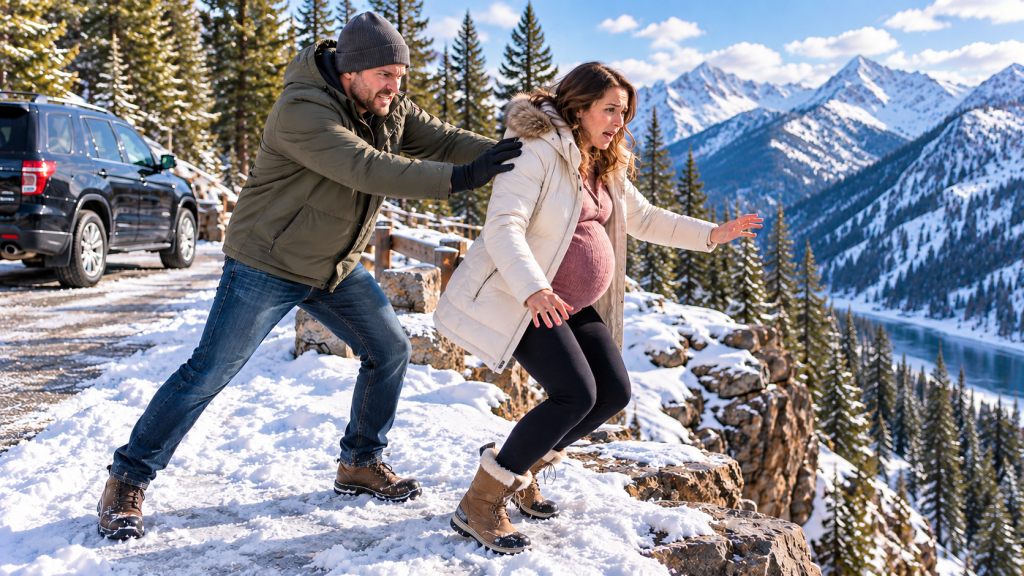
Nine months pregnant, I was pushed from an icy cliff by the husband who wanted my $50 million life insurance payout.
Three days later, he stood at the funeral everyone believed was mine, smiling beside his secret lover as if he had already won.
He thought I was dead.
He thought our baby was dead.
He thought fifty million dollars was about to make him free.
What Michael Carter didn’t know was that I was still alive.
And while he was accepting condolences beside my coffin, I was lying in a hospital bed learning exactly how long he had been planning my murder.
At the funeral, I later learned, Michael showed almost no grief at all.
“They both froze out there,” he reportedly told someone behind the chapel. “That useless woman finally got what she deserved.”
Those words would haunt me for years.
Because only hours before I disappeared, I had been standing beside him in Rocky Mountain National Park, begging him to stop arguing and take me home.
The weather had changed faster than expected.
The morning had started cold but clear, with pale sunlight falling across the mountains and snow clinging to the pine branches.
By afternoon, the sky had turned gray.
The wind grew sharp.
Snow swept across the frozen ground in violent gusts, stinging my face and catching beneath the soles of my boots.
I was thirty-eight weeks pregnant.
My back hurt.
My ankles were swollen.
Every few minutes, I had to stop and breathe because our son had apparently decided that my lungs were optional.
I had never wanted to go hiking that day.
Michael had insisted.
“One last adventure before the baby comes,” he had said over breakfast.
I remember staring at him.
“A mountain trail?”
“It’s barely a hike. We’ll drive most of the way.”
“The forecast says snow.”
“The forecast says everything.”
He smiled.
The kind of smile I once believed meant he loved me.
“Come on, Claire. You’ve spent the last month inside. Fresh air will be good for you.”
I should have trusted the uneasy feeling in my stomach.
Instead, I trusted my husband.
That almost killed me.
Michael and I had been married for seven years.
When we met, I was twenty-eight and had recently taken over a portion of my family’s investment company after my father died.
Michael was charming, ambitious, intelligent, and completely unimpressed by my money.
Or so I thought.
He worked in commercial real estate.
He drove a five-year-old sedan.
He refused to let me pay for dinner on our first date.
When he proposed eighteen months later, he used his grandmother’s ring.
My mother adored him.
My friends envied me.
Even my attorneys said the prenuptial agreement was unusually straightforward.
Michael never complained about it.
“I’m marrying you,” he told me. “Not your bank account.”
For years, I believed him.
The first cracks appeared slowly.
He began making comments about how my family’s trust was structured.
He asked whether my inheritance would eventually transfer completely into my name.
He wanted to know why the investment company required two signatures for certain withdrawals.
He started joking that our accountants treated him like “the poor husband who married into royalty.”
I laughed.
Then I began noticing his spending.
Watches.
Hotel charges.
Private club memberships.
Trips he claimed were business related.
And Ashley Monroe.
Ashley was his executive assistant.
Thirty-two.
Stylish.
Confident.
Always around.
She attended company dinners, charity events, business trips, and eventually even some functions that had nothing to do with Michael’s work.
Whenever I asked about her, Michael rolled his eyes.
“She runs my schedule, Claire.”
“She also attended your cousin’s birthday.”
“She helped organize the restaurant reservation.”
“And spent four hours drinking champagne with your family?”
“Are you jealous of my assistant now?”
That was Michael’s favorite weapon.
Make me question myself.
Make me feel insecure.
Make every reasonable concern sound irrational.
During pregnancy, it became worse.
He criticized my appearance.
Complained that I was tired.
Acted irritated when I asked him to attend appointments.
He slept in the guest room because I “moved around too much.”
When I cried, he said hormones were making me dramatic.
The man I married seemed to disappear.
In his place stood someone impatient, cold, and increasingly resentful.
Still, I never imagined murder.
Not until that mountain.
We had walked less than half a mile from where Michael parked when the argument started.
He accused me of trying to control him financially.
I asked what he meant.
He brought up a transfer I had stopped two weeks earlier.
Nearly four hundred thousand dollars had been scheduled to move from one of our joint investment accounts into an unfamiliar corporate entity.
Our financial controller flagged it.
When I asked Michael about it, he claimed it was an investment opportunity.
I refused to approve it until our attorneys reviewed the paperwork.
He was furious.
“You embarrassed me.”
“I asked for documentation.”
“You made me look like a criminal.”
“No, Michael. I asked why four hundred thousand dollars was being transferred to a company I’ve never heard of.”
He started walking faster.
I struggled to keep up.
“Slow down.”
“You wanted to come.”
“No. You wanted me to come.”
He turned.
Snow blew between us.
His face looked different.
Flat.
Empty.
“Everything has to be your decision, doesn’t it?”
I stared at him.
“What are you talking about?”
“The house. The investments. The trust. The baby.”
“The baby?”
“You chose the hospital. You chose the doctor. You chose the nursery.”
“Because every time I asked you to help, you said you were busy.”
He laughed bitterly.
I remember putting both hands over my stomach.
Our son moved beneath my coat.
“Michael, please. I don’t want to fight out here.”
He stepped closer.
“You think you’re untouchable.”
I blinked.
“What?”
“All that money. All those lawyers. Your precious family name.”
My pulse quickened.
There was something in his voice I had never heard before.
Not anger.
Hatred.
I looked back toward the trail.
“We’re leaving.”
“No.”
“I’m going back to the car.”
I turned.
Michael caught my arm.
Hard.
“Let go.”
“Listen to me.”
“You’re hurting me.”
He released me.
For one second.
Then he began walking closer.
I stepped backward.
The wind howled around us.
Snow erased our footprints almost as quickly as we made them.
“Michael.”
He kept coming.
Behind me was a rocky drop.
I could see nothing beyond the blowing snow.
I put up one hand.
“Stop.”
His expression became strangely peaceful.
That terrified me more than his anger.
“I really did try,” he said.
“To do what?”
“Make this marriage work.”
My heel slipped.
I caught myself.
“Michael, please.”
He looked at my stomach.
Then back at me.
“I’m sorry, Claire.”
And he pushed me.
Both hands.
Straight against my shoulders.
My feet disappeared from beneath me.
I remember screaming his name.
I remember grabbing at his jacket and catching nothing.
Then there was only air.
Rock.
Snow.
Sky.
My body struck the slope once.
Twice.
I hit something hard enough to force all the breath from my lungs.
Then I landed on a narrow shelf of snow-covered rock perhaps thirty or forty feet below the trail.
Pain exploded through my hip and shoulder.
For several seconds, I couldn’t breathe.
My first thought wasn’t about Michael.
It wasn’t even about dying.
It was my baby.
I wrapped both arms around my stomach.
“No.”
I could barely hear my own voice.
“No, no, no. Stay with me.”
The baby didn’t move.
Panic swallowed me.
I pressed my hands against my belly.
“Please.”
Nothing.
Above me, a shadow appeared near the cliff edge.
Michael.
He looked down.
Our eyes met.
I expected horror.
Shock.
Regret.
Instead, he smiled.
“Michael!”
My voice cracked.
“Help me!”
He leaned slightly over the edge.
“Don’t worry.”
I stared up at him.
“You and the baby won’t suffer long.”
Then he disappeared.
For several seconds, I genuinely wondered whether I had imagined everything.
My husband couldn’t have said that.
My husband couldn’t have pushed me.
My husband couldn’t be walking away.
Then I heard another voice.
A woman.
“Is she dead?”
Ashley.
My blood went cold.
Michael answered.
“I can’t see her.”
“What if she survived?”
“She fell forty feet.”
“That doesn’t answer me.”
There was a pause.
I pressed one hand over my mouth.
My entire body trembled.
Ashley stepped closer to the edge.
I saw the shape of her red winter coat.
The same coat I had seen hanging in Michael’s office three weeks earlier.
“Michael, I’m freezing.”
“For fifty million dollars, you can be cold another five minutes.”
My heart stopped.
Fifty million.
I knew exactly what he meant.
Six months earlier, Michael had convinced me to restructure several insurance policies.
We were expecting a child.
He said it was responsible planning.
My father had carried substantial life insurance, and after his death it had provided additional liquidity while complicated assets were settled.
Michael suggested similar coverage.
I agreed.
The largest policy was fifty million dollars.
Michael was the beneficiary.
At the time, I thought nothing of it.
Standing on that ledge, I understood everything.
The argument.
The hike.
The remote trail.
The weather.
Ashley.
The insurance.
This wasn’t spontaneous.
This wasn’t an angry husband losing control.
Michael had planned my death.
And my unborn son’s death was acceptable collateral.
I heard Ashley say something else, but the wind swallowed her words.
Then Michael laughed.
A low sound.
Almost relaxed.
Their voices slowly disappeared.
They left.
They simply walked away.
Snow began settling over my coat.
My gloves were torn.
One side of my body throbbed so badly I could barely move.
Blood trickled from a scrape near my hairline, but the worst pain came from my hip.
I tried shifting toward the rock wall.
My leg screamed.
I stopped.
The ledge beneath me was perhaps four feet wide.
Below it, the mountain dropped into white emptiness.
I couldn’t climb.
I couldn’t stand.
I had no phone.
Michael had insisted phones would lose signal anyway and suggested leaving mine in the car so it wouldn’t get damaged in the snow.
Another part of the plan.
I started laughing.
Not because anything was funny.
Because sometimes terror becomes so enormous that the mind doesn’t know what else to do.
My laugh became a sob.
Then I felt movement.
A tiny kick.
I froze.
Another movement.
My baby.
Alive.
I pressed both hands against my stomach.
“Oh, thank God.”
I cried openly.
“Stay with me, sweetheart.”
The darkness tried to pull me under.
I fought it.
I counted breaths.
One.
Two.
Three.
I recited my childhood address.
My father’s birthday.
Every employee in my department.
Anything to keep my mind awake.
I thought about the nursery.
Pale blue walls.
A wooden crib my mother bought.
The stuffed bear waiting on the shelf.
The name I had chosen.
Noah.
Michael had complained that the name sounded “too soft.”
I had stopped caring.
“Noah,” I whispered.
“You stay with me.”
The temperature kept dropping.
At some point, I lost feeling in my fingers.
My teeth stopped chattering.
I knew enough about hypothermia to understand that was bad.
Very bad.
I started imagining warmth.
My childhood bedroom.
Sunlight.
My mother making pancakes.
My father sitting at the kitchen counter reading financial pages while pretending not to listen to my teenage complaints.
Then the memories became dreams.
I don’t know how much time passed.
Later, rescuers estimated I had been on the ledge nearly two hours.
What saved me was a group of experienced climbers returning from another route.
One of them noticed disturbed snow near the upper trail.
Another found a piece of fabric caught on a branch below the cliff.
They alerted park rangers.
The weather made reaching me from below nearly impossible.
A helicopter was requested.
I remember the light before I remember the sound.
A beam swept across the mountain.
Gone.
Then back.
I thought I was hallucinating.
The light held on me.
Rotor noise shattered the storm.
I tried raising one arm.
Nothing happened.
The helicopter hovered above the ridge.
A cable descended through blowing snow.
A rescuer came down.
He landed on the ledge on one knee and immediately crawled toward me.
“Ma’am!”
I opened my eyes.
“Can you hear me?”
“My baby.”
He leaned close.
“What?”
“I’m pregnant.”
He looked down.
His expression changed.
“How far along?”
“Nine months.”
He immediately called something into his radio.
Then he checked my pulse.
“Stay with me. What’s your name?”
“Claire.”
“Claire, I’m Evan. We’re getting you out.”
I grabbed his sleeve.
“My husband pushed me.”
He stopped.
“What?”
“Michael.”
My lips barely moved.
“He pushed me.”
Evan looked toward the ridge.
Then back at me.
“Okay. Don’t worry about that right now.”
“My baby.”
“We’re taking care of both of you.”
He wrapped me in an insulated blanket, secured a harness around us, and signaled the helicopter.
As we rose from the ledge, I looked down once.
The place where I should have died disappeared beneath blowing snow.
In the helicopter, a medic placed oxygen over my face.
Another began checking me.
My eyes stayed fixed on the portable monitor.
I had no idea what any of the numbers meant.
Then the medic looked at me.
“We have a fetal heartbeat.”
I cried so hard my entire body shook.
At the hospital, everything became lights and voices.
Doctors.
Nurses.
Monitors.
Questions.
Someone cut off my wet clothing.
Someone examined my shoulder.
Someone said my core temperature was dangerously low.
Another person shouted that the baby’s heart rate was dropping.
I remember grabbing a nurse’s hand.
“Don’t let him die.”
“We’re doing everything we can.”
“Please.”
“You need to stay calm.”
“Save him.”
The next thing I remember was waking beneath fluorescent lights.
My throat hurt.
My head felt heavy.
There was a dull ache across my abdomen.
For several terrifying seconds, I couldn’t remember why.
Then everything returned at once.
The mountain.
Michael.
Ashley.
The fall.
My baby.
I tried sitting up.
A nurse rushed over.
“Mrs. Carter, please don’t move.”
“My baby.”
She smiled.
“He’s alive.”
I burst into tears.
“Where?”
“He was delivered by emergency cesarean section. He needed help breathing at first, but he’s stable in the neonatal unit.”
I covered my face.
“Can I see him?”
“When the doctor clears you.”
“Is he okay?”
“He’s being monitored very closely.”
I nodded.
My entire body shook.
Then another memory returned.
Michael.
I grabbed the nurse’s wrist.
“My husband.”
She hesitated.
That hesitation terrified me.
“Is he here?”
“I’ll get the doctor.”
“No.”
I held tighter.
“Do not tell my husband I’m alive.”
Her expression changed.
“Mrs. Carter—”
“He tried to kill me.”
Within fifteen minutes, two law-enforcement officers were standing beside my bed.
A park investigator named Daniel Ruiz and a county detective named Rebecca Shaw.
They asked if I was strong enough to speak.
I told them yes.
Then I told them everything.
Michael pushing me.
Ashley’s voice.
The fifty million dollars.
The insurance policy.
The way they walked away.
Detective Shaw took notes without interrupting.
When I finished, she looked at Ruiz.
Something passed between them.
“What?” I asked.
Shaw pulled her chair closer.
“Claire, your husband already reported you missing.”
I stared at her.
“When?”
“About three hours after the estimated time of your fall.”
Of course.
He needed an alibi.
“What did he say?”
“He claimed you became upset during an argument and walked away from him during the storm.”
I laughed bitterly.
“Nine months pregnant?”
“He said you refused to return to the vehicle.”
“That’s ridiculous.”
“We know.”
Ruiz spoke.
“There’s something else.”
My stomach tightened.
“What?”
“Search teams recovered a deceased woman from a ravine several miles from where you were found.”
I stared at him.
“She had no identification.”
“What does that have to do with me?”
Shaw answered.
“Your husband identified her as you.”
The room disappeared.
For a moment, I heard nothing except the monitor beside my bed.
“He what?”
“He made a visual identification.”
“But I’m alive.”
“Yes.”
“How could he possibly identify another woman as me?”
“That,” Shaw said quietly, “is one of the questions we’re asking.”
The dead woman had suffered significant injuries after falling into a ravine.
Her face was difficult to identify.
Her approximate height, hair color, and build were similar to mine.
She had been found wearing a dark winter coat.
Michael claimed trauma and weather exposure had altered my appearance.
He identified my wedding ring.
Except it wasn’t my wedding ring.
It was a similar ring.
A detail that immediately made police suspicious.
Michael had apparently expected my body to disappear beneath snow.
When another body was found, he saw opportunity.
A death certificate would speed everything up.
Including the insurance process.
“Does he know I survived?” I asked.
Shaw shook her head.
“Very few people know your identity right now.”
“Keep it that way.”
Ruiz exchanged a glance with her.
“Claire, this isn’t a television show.”
“I know.”
“We cannot use you as bait without considering your safety.”
“I’m not asking to walk into his house.”
“What are you asking?”
I looked toward the window.
Snow was falling outside.
“He thinks he won.”
Shaw waited.
“I want him to keep thinking that.”
That evening, I saw Noah for the first time.
He was impossibly small.
Not premature-small, but vulnerable in a way that shattered me.
Tiny hat.
Tiny fingers.
Monitors taped to his body.
A nurse helped position my wheelchair beside the incubator.
I reached through the opening and touched his hand.
His fingers curled around mine.
That was the moment everything changed.
Up until then, part of me wanted revenge.
Standing beside my son, I wanted justice.
There was a difference.
Revenge wanted Michael afraid.
Justice wanted Michael incapable of ever touching us again.
“I promise,” I whispered to Noah. “He will never hurt you.”
The next day, Detective Shaw returned with information from my financial team.
Michael had begun making inquiries about the insurance policy less than twelve hours after my supposed death.
Not formally filing a claim.
Not yet.
But calling the broker.
Asking about required documentation.
Asking whether accidental death in a national park qualified.
Asking whether my pregnancy complicated payment.
He had also contacted one of my estate attorneys.
Not to discuss funeral arrangements.
To ask how soon certain marital assets transferred following death.
My attorney found the questions disturbing and contacted my mother.
My mother was devastated.
Police had initially told her I was presumed dead.
To protect the investigation, they later informed her privately that I was alive.
She arrived at the hospital just before midnight.
The moment she entered my room, her knees nearly buckled.
“Claire.”
I started crying.
“Mom.”
She crossed the room and wrapped me in her arms.
Neither of us spoke for several minutes.
Then she looked toward the neonatal wing.
“The baby?”
“Alive.”
She pressed both hands over her mouth.
I nodded.
“His name is Noah.”
She cried again.
Once she calmed down, her grief turned into something colder.
“I’m going to destroy him.”
I almost smiled.
“No.”
She looked at me.
“We’re going to let him destroy himself.”
The funeral was scheduled three days later.
Michael moved quickly.
Too quickly.
Police encouraged the process.
The unidentified woman’s remains stayed under law-enforcement control, but Michael was told that due to the circumstances, a closed-casket service would be appropriate.
He accepted immediately.
My mother publicly played the role of a shattered parent.
She deserved an Academy Award.
At the hospital, I watched portions of the funeral through a secure video feed arranged by investigators.
It was surreal.
My photograph stood beside flowers.
My name was printed on programs.
People cried for me.
Friends hugged each other.
Coworkers whispered about how unfair it was that a mother and baby had died weeks before Christmas.
And Michael stood beside the coffin wearing a black suit.
Ashley stood twenty feet away.
Black dress.
Pearl earrings.
Eyes lowered.
They barely looked at each other.
Which made their relationship more obvious to me.
People having an affair often believe avoiding eye contact makes them invisible.
Instead, it creates a strange gravity.
The entire room bends around the thing they’re pretending isn’t there.
During the service, Michael spoke.
“My wife was complicated.”
I almost laughed.
That was his opening line.
“Claire was strong, stubborn, passionate, and sometimes impossible.”
Several mourners shifted uncomfortably.
“But she loved deeply.”
He paused.
“I’ll spend the rest of my life wishing our final conversation had been different.”
Technically true.
I hoped he spent the rest of his life remembering it.
Then came the moment I will never forget.
After the service, hidden microphones recorded Michael speaking with Ashley behind the chapel.
Ashley whispered, “People are watching.”
“They’ve been watching all day.”
“Your mother-in-law hates me.”
“She hates everyone.”
“Michael.”
“What?”
“This feels wrong.”
He laughed.
“Now it feels wrong?”
“I mean being here.”
“You wanted this as much as I did.”
“I never said—”
“Yes, you did.”
There was silence.
Then Michael said the sentence that killed any remaining doubt.
“They both froze out there. That useless woman finally got what she deserved.”
Ashley didn’t correct him.
She didn’t act shocked.
She simply asked, “When can we leave?”
That recording became evidence.
But police wanted more.
Because Michael’s attorneys could claim he was angry, grieving, drinking, speaking cruelly without admitting murder.
So investigators followed the money.
That was where his plan truly collapsed.
The four-hundred-thousand-dollar transfer I had stopped?
It was going to a shell company controlled indirectly by Ashley.
The company had rented a luxury condo in Denver.
Bought furniture.
Paid deposits on two vehicles.
And reserved a villa in the Caribbean for six weeks beginning one month after my supposed death.
Michael and Ashley had been preparing their new life before murdering me.
Then there were the insurance searches.
Deleted from Michael’s office computer but recovered by digital investigators.
“Life insurance contested suicide.”
“Accidental death hypothermia claim.”
“Body identification after fall.”
“National park missing person presumed dead.”
“What happens to fetus life insurance if pregnant insured dies.”
That last one made me physically sick.
I stopped reading.
Detective Shaw closed the file.
“You don’t need to see everything.”
“Yes, I do.”
“Claire.”
“If this goes to trial, his lawyers will make me hear it anyway.”
She nodded slowly.
There was more.
Michael had rented a satellite phone two weeks before the trip but left it hidden in his vehicle.
He bought traction cleats for himself.
None for me.
He had downloaded topographic maps showing remote cliff areas.
He researched storm conditions.
And Ashley’s phone records placed her near the trail at the exact time I fell.
The case was becoming stronger.
But Ashley remained the weak point.
Police didn’t know whether she had helped plan the murder or arrived afterward.
I knew what I heard.
But hearing two people talk after I fell wasn’t the same as proving she knew beforehand.
That changed four days later.
Ashley panicked.
Maybe it was the investigation.
Maybe it was Michael’s arrogance.
Maybe guilt finally reached her.
Whatever the reason, she contacted an attorney.
Then she asked for a deal.
When Detective Shaw told me, I felt nothing.
“What did she say?”
“She claims Michael planned everything.”
“Of course she does.”
“She says she tried to stop him.”
I laughed.
“She stood above me asking whether I was dead.”
“I know.”
“She didn’t call for help.”
“I know.”
“She walked away.”
Shaw nodded.
“Ashley admits that.”
“What does she want?”
“Reduced charges in exchange for full cooperation.”
I looked at Noah sleeping in the hospital bassinet beside me.
“What can she prove?”
“A lot.”
Ashley had messages.
Hundreds.
Michael complaining about me.
Talking about money.
Planning a future.
At first, the messages were ugly but not criminal.
Then they changed.
Six months before the mountain, Michael wrote:
“Once the policy is active, everything becomes easier.”
Ashley replied:
“You better not be serious.”
Michael:
“I’m always serious.”
Weeks later:
“She trusts me completely.”
Later:
“Snow covers mistakes.”
Then, five days before the hike:
“Forecast looks perfect.”
Ashley answered:
“You’re terrifying me.”
Michael:
“You’ll thank me when we’re done.”
Ashley didn’t report him.
She went with him.
Her attorney argued she thought Michael was fantasizing until the final moment.
I didn’t believe her.
Maybe the jury eventually would.
Maybe they wouldn’t.
But the messages proved premeditation.
Police decided they had enough.
The only question was how to arrest him.
Detective Shaw wanted it controlled.
Quiet.
No dramatic confrontation.
I agreed.
Mostly.
Michael had scheduled a meeting with the insurance company.
He believed the initial payout process would begin that afternoon.
Afterward, he planned to meet Ashley at the condo.
Except Ashley would already be in police custody.
Michael walked into the insurance office at 2:14 p.m.
He wore an expensive navy suit.
He carried a leather folder.
He asked for sparkling water.
He reportedly joked with the claims representative about paperwork.
Then Detective Shaw entered the conference room.
Michael’s attorney wasn’t present.
He hadn’t thought he needed one.
The claims representative excused himself.
Michael looked at Shaw.
“Can I help you?”
She sat across from him.
“Mr. Carter, we need to ask additional questions about your wife’s death.”
He sighed.
“I’ve answered everything.”
“You identified her body.”
“Yes.”
“You’re certain it was Claire?”
His jaw tightened.
“Of course.”
Shaw opened a folder.
“What made you certain?”
“My wife’s appearance.”
“The body suffered extensive facial injuries.”
Michael hesitated.
“Her hair. Her clothing.”
“The coat was a different brand.”
“I wasn’t exactly checking labels.”
“The ring?”
“That too.”
“It wasn’t Claire’s ring.”
He stared at her.
“Excuse me?”
“The stone in Claire’s ring has a microscopic serial inscription registered by the jeweler.”
Michael said nothing.
“The ring recovered from the deceased woman doesn’t match.”
He leaned back.
“Then maybe she changed it.”
“A week before her death?”
“I don’t know.”
Shaw closed the folder.
“Would you like to change your identification?”
Michael stood.
“I think I need a lawyer.”
“You do.”
He froze.
Two officers entered.
Shaw continued.
“Michael Carter, you are under arrest for attempted first-degree murder, conspiracy, insurance fraud, and related offenses.”
According to Detective Shaw, Michael actually laughed.
“Attempted?”
That single word exposed him.
Shaw said nothing.
His face changed.
“Attempted?”
Then he understood.
“No.”
The officers approached.
“No.”
He backed away.
“She’s dead.”
Shaw watched him.
“Who?”
“My wife.”
“How do you know?”
“I identified her.”
“You just questioned your own identification.”
His breathing became shallow.
“No.”
Shaw later told me this was the moment Michael stopped performing.
He looked terrified.
“Where is Claire?”
She didn’t answer.
“Where is she?”
Officers took his arms.
Michael struggled.
“Is she alive?”
Still no answer.
“Where is my wife?”
Shaw finally stood.
“Your wife survived.”
Michael went completely still.
“She survived the fall.”
His face drained of color.
“And your son survived too.”
For several seconds, he couldn’t speak.
Then he whispered:
“That’s impossible.”
Not thank God.
Not my baby.
Not I’m sorry.
Impossible.
It was the perfect summary of everything he was.
Michael’s arrest made national news.
My supposed death had already drawn attention because of my family’s business profile and the unusual circumstances.
My reappearance turned the story into a media storm.
Reporters camped outside the hospital.
News helicopters circled.
Headlines called me “the woman who returned from her own funeral.”
I hated that phrase.
I hadn’t returned from anything.
I had survived a murder attempt.
The real tragedy was the woman whose body Michael used to fake my death.
Her name was Elena Martinez.
She was forty-one.
A teacher from New Mexico traveling alone.
Investigators eventually determined that she had died in an unrelated hiking accident during the same storm.
Her family spent days believing she was simply missing while strangers buried their daughter under my name.
I met Elena’s sister months later.
I apologized even though she told me repeatedly none of it was my fault.
We cried together.
Michael had stolen dignity from more people than just me.
The criminal case took nearly a year.
During that time, Noah grew from a fragile newborn into a smiling baby who loved grabbing my hair.
I went through physical therapy.
My hip healed slowly.
My shoulder required surgery.
The scar along my abdomen faded.
The nightmares didn’t.
Sometimes I woke convinced I was still on the ledge.
I would feel cold even beneath blankets.
Then I’d hear Noah breathing through the monitor and remember where I was.
My mother moved into the guest room for three months.
My friends rotated meals.
My company temporarily reassigned nearly every major responsibility I had.
For the first time in my life, I allowed people to help me without pretending I was fine.
The divorce itself was almost comically simple.
Michael’s attorneys initially tried to delay things.
My legal team buried them in evidence.
The prenuptial agreement protected nearly everything I owned.
Michael discovered that attempting to murder your wealthy spouse is not an effective wealth-building strategy.
His accounts were frozen.
His company removed him.
Several business partners sued.
The condo he had arranged with Ashley became evidence.
The insurance policy never paid a cent.
Ashley accepted a plea agreement.
She admitted knowing Michael planned to cause “an accident” during the hike.
She claimed she believed he would frighten me or abandon me temporarily rather than push me from a cliff.
Prosecutors clearly didn’t believe all of that.
Neither did I.
But her cooperation gave them more evidence.
She provided hidden audio recordings.
Apparently, after Michael began discussing murder, Ashley started secretly recording some conversations because she feared he might eventually blame everything on her.
One recording was devastating.
Michael’s voice:
“She goes over the edge, nobody questions anything.”
Ashley:
“She’s pregnant.”
Michael:
“That’s why now works.”
Ashley:
“That sounds horrible.”
Michael:
“It sounds practical. Once the baby is born, everything gets complicated.”
Ashley:
“What if someone sees?”
Michael:
“During a snowstorm? Out there?”
Then silence.
Michael continued:
“By the time anyone finds her, it’ll look like she slipped.”
That recording ended his defense.
His lawyers shifted strategies.
First they claimed the recording was taken out of context.
Then they claimed Ashley manipulated him.
Then they suggested I slipped during an argument and Michael panicked.
Then Michael insisted I had become unstable during pregnancy and threatened to jump.
That was the accusation that finally made me agree to testify.
I had hoped not to.
I wanted to protect my peace.
But I would not allow him to turn my attempted murder into another story about an irrational woman.
The courtroom was silent when I entered.
Michael sat at the defense table.
It was the first time I had seen him since the mountain.
He looked smaller.
Not physically.
Emotionally.
For seven years, I had allowed his moods to dominate rooms.
One look could ruin dinner.
One sarcastic comment could make me question myself for hours.
From the witness stand, I finally saw him clearly.
Not powerful.
Not brilliant.
Not mysterious.
Just a selfish man who believed other people existed to serve him.
The prosecutor asked me to describe the hike.
I did.
The argument.
The cliff.
The push.
The fall.
Michael’s words.
Ashley’s voice.
The money.
When I repeated what Michael had shouted down to me—
“You and the baby won’t suffer long”—
someone in the gallery gasped.
Michael stared at the table.
Then came cross-examination.
His attorney approached slowly.
“Mrs. Carter—”
“Ms. Bennett.”
I had legally returned to my maiden name.
He corrected himself.
“Ms. Bennett, your marriage was under significant stress before this incident, correct?”
“Yes.”
“You had argued about finances?”
“Yes.”
“You had accused your husband of infidelity?”
“I asked whether he was having an affair.”
“Repeatedly?”
“When evidence justified the question.”
He changed direction.
“You were upset on the mountain.”
“I was afraid.”
“Before the alleged push.”
“Before the push, I was upset that my husband had brought me into a snowstorm nine months pregnant and started a fight.”
A few jurors looked toward Michael.
His attorney continued.
“You slipped several times on the trail, didn’t you?”
“Yes.”
“So it was dangerous.”
“Yes.”
“It’s possible you slipped.”
“Before he placed both hands on my shoulders or after?”
The attorney paused.
“I’m asking whether the terrain itself—”
“I did not fall because of the terrain.”
“You were under enormous physical and emotional stress.”
“I was.”
“Your memory may not be perfect.”
“No memory is perfect.”
“So you admit—”
“But I remember my husband’s hands.”
The attorney stopped.
I looked directly at Michael.
“I remember his face when he pushed me.”
The courtroom went silent.
“I remember asking him for help.”
Michael finally looked up.
“I remember him smiling.”
His attorney objected.
The judge overruled.
I continued.
“And I remember my son moving inside me while I lay alone in the snow because his father decided fifty million dollars mattered more than whether we lived.”
Michael looked away.
The jury deliberated for less than six hours.
Guilty.
Attempted first-degree murder.
Conspiracy to commit murder.
Insurance fraud.
Evidence tampering.
Identity-related fraud connected to Elena’s body.
Several additional charges.
At sentencing, Michael asked to speak.
I almost didn’t attend.
My mother told me I owed him nothing.
She was right.
But I went.
Not for him.
For myself.
Michael stood before the judge.
“I made terrible mistakes.”
Mistakes.
That word nearly made me laugh.
“I was under pressure,” he continued. “My marriage was falling apart. Ashley manipulated my emotions. I said things I didn’t mean.”
Ashley, sitting elsewhere in the courtroom awaiting sentencing on her own charges, stared straight ahead.
Michael looked toward me.
“Claire, I loved you.”
I felt nothing.
“I know you don’t believe that.”
Correct.
“But I did.”
The judge eventually interrupted.
“This proceeding is not an opportunity to retry the case.”
Michael’s mouth tightened.
He turned forward again.
When the sentence was announced, he closed his eyes.
Decades in prison.
Enough that Noah would be an adult long before Michael had any realistic chance of freedom.
When court adjourned, Michael turned toward me one final time.
Guards waited beside him.
“Claire.”
I stopped.
My attorney touched my arm.
I nodded.
Michael stepped as close as security allowed.
“You destroyed my life.”
There it was.
Even then.
I destroyed his life.
Not the murder plan.
Not the affair.
Not the fraud.
Me.
I looked at him.
“No, Michael.”
He waited.
“You did.”
Then I walked away.
Ashley received a reduced sentence for cooperation, though not the complete immunity she had hoped for.
Years later, people would occasionally ask whether I forgave her.
The question always bothered me.
Forgiveness is often treated like an obligation victims owe the people who hurt them.
I don’t see it that way.
I eventually stopped hating Ashley.
That was enough.
She disappeared from my life.
Michael disappeared behind prison walls.
And I built something new.
Not immediately.
Healing isn’t a movie montage.
There were bad months.
Court dates.
Physical therapy.
Panic attacks.
Insurance paperwork.
Media interviews I refused.
Online strangers inventing theories.
People who wanted every detail.
People who claimed I should write a book.
People who wanted to know whether Michael “seemed evil” when I married him.
No.
He didn’t.
That was the lesson I struggled with most.
Michael wasn’t standing at our wedding with murder in his eyes.
He was charming.
Attentive.
Funny.
Patient.
Maybe part of him loved me once.
Maybe he only loved what he imagined my life could give him.
I stopped needing to know.
My therapist helped me understand something important.
Sometimes searching for the exact moment someone became cruel keeps you psychologically tied to them.
You don’t need the perfect explanation to walk forward.
You only need the truth about what happened.
And the truth was enough.
Noah turned one surrounded by family.
We held his party in my mother’s backyard.
There were blue balloons tangled in trees.
A crooked cake.
Too many presents.
He smashed frosting into his hair and laughed until he hiccupped.
At one point, I stepped away from everyone and watched him from the patio.
My mother came beside me.
“You okay?”
I nodded.
“Thinking.”
“Dangerous habit.”
I smiled.
She followed my gaze.
Noah was crawling after a balloon.
“He looks like you.”
“Everyone says that.”
“He has Michael’s ears.”
“Mom.”
“I’m sorry.”
I laughed.
It felt good.
Normal.
She slipped her arm around me.
“Your father would have adored him.”
“I know.”
For a while, we watched quietly.
Then she asked something she had never asked before.
“Do you ever wish you hadn’t found out?”
I looked at her.
“About Michael?”
She nodded.
“If the transfer had gone through. If you never questioned Ashley. If you never knew.”
I thought about it.
“No.”
“Even after everything?”
“No.”
I looked toward my son.
“Because the truth almost killed me.”
Then I added:
“But believing the lie would have eventually destroyed me anyway.”
Two years after the mountain, I returned to Rocky Mountain National Park.
Everyone told me not to.
My therapist said I didn’t have to prove anything.
My mother thought I had lost my mind.
But I wanted to go.
Not to the exact cliff.
That area carried no magic for me.
I didn’t need to conquer the location.
I simply wanted to see the mountains without seeing Michael.
So on a warm summer morning, I brought Noah.
We walked an easy trail.
Wildflowers covered the slopes.
The snow was mostly gone except for distant peaks.
Birds moved through the trees.
Noah held my hand.
He was obsessed with rocks.
Every thirty seconds, he stopped to pick one up.
“This one.”
“Yes, sweetheart.”
“Rock.”
“I know.”
“Big rock.”
“That’s actually a tiny rock.”
“BIG.”
“Fine. Huge.”
We reached an overlook.
Nothing dangerous.
Wooden railing.
Families nearby.
Sunlight everywhere.
Noah pointed toward the mountains.
“Snow.”
“Yes.”
“Cold?”
“Very.”
He leaned against my leg.
For a second, the memory returned.
Wind.
Falling.
Michael’s face.
The ledge.
Then Noah tugged my hand.
“Mommy?”
I looked down.
He held out one of his rocks.
“For you.”
I crouched.
“For me?”
He nodded proudly.
I took it.
“Thank you.”
He smiled.
And just like that, the mountain became something else.
Not the place where Michael tried to end my life.
The place I brought my son years later.
The place where he gave me a gray rock.
The place where I laughed.
The place where I went home alive.
On the drive back, Noah fell asleep in his car seat.
I pulled over at a scenic turnout.
For several minutes, I watched clouds move across the peaks.
My phone buzzed.
A notification from my attorney.
Michael had filed another appeal.
Denied.
I stared at the screen.
Once, that message would have made my heart race.
Now?
Nothing.
I locked the phone.
Placed it face down.
And drove home.
People sometimes imagine justice as a dramatic moment.
A guilty verdict.
Handcuffs.
A prison door.
Those moments mattered.
But the justice I cherish most came afterward.
Michael wanted my money.
I still had it.
He wanted my life.
I was living it.
He wanted freedom with Ashley.
He lost both.
He wanted our son gone before Noah could complicate his financial plans.
Noah grew up surrounded by people who loved him.
Michael wanted my final memory to be his face smiling above a cliff.
Instead, one of my strongest memories became my son holding out a rock beneath a summer sky.
That is what Michael never understood.
Survival isn’t only refusing to die.
Sometimes survival is refusing to let the person who hurt you become the author of everything that follows.
I kept Michael’s surname for years because I thought marriage meant building one shared identity.
After the trial, I changed my name back to Bennett.
Noah carries Bennett too.
My father’s name.
My name.
One day, when Noah is old enough, I’ll tell him the truth.
Not the sensational version strangers read online.
Not the fifty-million-dollar headline.
Not the funeral story.
I’ll tell him that his mother trusted someone who betrayed her.
That terrible things happened.
That brave strangers helped save us.
That doctors fought to keep him alive.
That investigators refused to ignore suspicious details.
That his grandmother stood beside us.
That justice sometimes takes patience.
And most importantly, that none of what happened defined him.
He was not the baby his father tried to erase.
He was simply Noah.
Curious.
Funny.
Stubborn.
Kind.
Completely obsessed with rocks.
Every year on the anniversary of the rescue, I send a message to Evan, the rescuer who came down on the cable.
The first year, I mailed him a photograph of Noah.
The second year, we met for coffee.
He tried to downplay what he did.
“Anybody on the team would’ve done the same.”
Maybe.
But he was the one who landed beside me.
He was the one who said, “We’re getting you out.”
Once, I asked whether he thought I would survive.
He became quiet.
“Honestly?”
“Yes.”
“No.”
I swallowed.
“How bad was I?”
“Very.”
“And the baby?”
He shook his head.
“I couldn’t believe you were pregnant when you told me.”
I laughed softly.
“Neither could Michael apparently.”
Evan smiled but didn’t laugh.
Then he said something I’ve never forgotten.
“You kept talking.”
“What?”
“On the cable. You kept saying something.”
“I don’t remember.”
“You kept saying, ‘Not today.’”
I stared at him.
“Really?”
“Over and over.”
Not today.
I liked that.
Not today.
Not on that ledge.
Not for fifty million dollars.
Not because my husband decided my life was more valuable as a payout.
Not because the storm was brutal.
Not because the odds were terrible.
Not because someone I loved wanted me gone.
Years have passed now.
Michael is still in prison.
Ashley has served her sentence and, as far as I know, lives quietly somewhere far away.
I never looked her up.
The insurance policy was rewritten.
My estate was restructured.
The company grew.
My mother retired.
Noah started school.
Our lives became ordinary.
Beautifully ordinary.
Sometimes I make breakfast while Noah complains about socks.
Sometimes I answer emails while laundry sits unfolded for three days.
Sometimes we miss appointments.
Sometimes he refuses vegetables.
Sometimes I burn dinner.
And every single ordinary inconvenience feels like a gift.
Because there was a moment on a frozen mountain when I believed I would never see another morning.
Michael thought fifty million dollars represented my value.
He was wrong.
Money can be counted.
Life cannot.
He thought killing me would solve every problem he believed I caused.
Instead, his decision exposed everything.
His affair.
His fraud.
His greed.
His lies.
His plans.
He stood beside a coffin believing it represented his victory.
It became the beginning of his downfall.
And the cruelest irony?
He never received one dollar.
Not one.
The fortune he tried to kill for remained untouched.
The woman he wanted gone survived.
The child he dismissed as an inconvenience survived.
And the future he imagined with Ashley disappeared the moment police told him two words he never expected to hear:
“She survived.”
Sometimes justice arrives in a courtroom.
Sometimes it arrives in handcuffs.
Sometimes it arrives as a newborn heartbeat doctors thought they might lose.
And sometimes it’s as simple as waking up years later, opening your curtains, hearing your child laugh in the next room, and realizing the person who tried to end your story failed.
Michael thought the cliff would be my ending.
It wasn’t.
It was the place where his story stopped controlling mine.
And mine began again.
💬THE END! THANK YOU FOR READING!