

My mother walked both of my sisters down the aisle.
Twice.
When Paige married her first husband, Mom stood beside her beneath a cathedral-length veil, crying so beautifully that the photographer used the picture in his portfolio.
When that marriage ended eighteen months later and Paige married again, Mom walked her down another aisle without hesitation.
“Everyone deserves the wedding they were meant to have,” she told people.
Two years later, when Lauren married, Mom did it again.
She adjusted Lauren’s veil, kissed her cheek, and held her hand all the way to the altar as though she were delivering something precious.
So when my own wedding morning finally arrived, I suppose some stubborn, childish part of me still hoped my mother might look at me the same way.
She didn’t.
I was standing in the bridal suite wearing the dress I had paid for myself when Mom looked me over and said, with complete calm,
“I refuse to walk my greatest regret to the altar.”
The room went silent.
Not awkwardly quiet.
Not temporarily still.
Silent.
My fingers tightened around the edge of my veil.
Behind Mom, my sisters exchanged the tiny smiles they had perfected during childhood.
Those smiles meant the same thing they always had.
Emma had been reminded of her place.
Paige touched the diamond bracelet around her wrist.
Mom had helped buy it before Paige’s second wedding.
Lauren tilted her head.
“Don’t cry, Emma,” she said sweetly. “You’ll ruin the cheap mascara.”
I looked at my reflection instead of answering.
Twenty-nine years old.
White gown.
Hair pinned perfectly.
Shoulders straight.
Expression controlled.
And somehow, in that room, I felt twelve again.
Twelve years old and standing in the hallway while Paige and Lauren showed me photographs from the Paris vacation I had supposedly been “too young to appreciate.”
Sixteen and watching Dad hand Lauren the keys to a new car while explaining that there wasn’t enough money for the advanced mathematics program I wanted to attend.
Eighteen and being told my college fund had “never really existed.”
Twenty-two and learning that my sisters’ tuition had somehow been paid without a single loan.
Twenty-five and asking my parents why Grandpa Arthur no longer called on my birthday.
Being difficult, according to my family, meant remembering.
It meant noticing.
It meant asking why.
Dad leaned against the doorway in his gray tuxedo.
He smiled as though my humiliation were mildly entertaining.
“Your mother has a right to her feelings,” he said. “You’ve always been difficult.”
I turned toward him.
“No,” I said quietly. “I’ve always asked questions.”
His smile tightened.
“Same thing, with you.”
My fiancé, Daniel, stepped forward.
I saw the anger in his face before he said a word.
Daniel knew what my childhood had been like.
Not every detail.
But enough.
He knew that invitations to family dinners made my stomach tense.
He knew that after phone calls with Mom, I sometimes stared at nothing for ten minutes before speaking again.
He knew that I had spent years pretending I no longer cared about things that still hurt.
He took one step toward my father.
I touched his sleeve.
“Don’t,” I whispered.
His jaw tightened.
“Emma—”
“Not yet.”
Mom gave a short laugh.
“Still dramatic. Even today.”
Then the bridal-suite door opened.
My grandfather stood there.
Arthur Bennett was eighty-one years old and leaned heavily on a black cane, but nobody who knew him had ever mistaken age for weakness.
His white hair was neatly combed.
His navy suit was older than either of Paige’s marriages.
His shoulders had narrowed over the years, but his eyes remained sharp.
He looked at Mom.
“Margaret,” he said, “you said what?”
Mom stiffened.
“This is family business.”
Grandpa stepped into the room.
“I am family.”
Dad moved forward.
“Arthur, don’t make a scene.”
Grandpa didn’t even look at him.
He came directly toward me.
For a moment, neither of us spoke.
Then he held out his hand.
“I’ll walk you.”
My throat tightened.
“Grandpa…”
“You were never a regret, Emma.”
His thumb pressed gently against my palm.
“You were the only one who came back for the truth.”
Mom’s expression changed.
Only slightly.
But I saw it.
So did Grandpa.
Outside the room, the organ began playing.
Guests were already seated.
Nearly two hundred people filled the old stone church.
Relatives.
Neighbors.
Business associates.
Members of my parents’ charitable foundation.
Doctors from hospitals the Stone Family Foundation funded.
Local politicians.
Board members.
People who had spent years admiring my parents’ generosity.
People who believed Margaret and Richard Stone had built their success through discipline, integrity, and family values.
Most of them had no idea that eighteen months earlier, I had opened a bank statement that was never meant for me.
That statement had changed everything.
At the time, I was working as a forensic accountant for a firm specializing in internal fraud investigations.
My job was simple in theory.
Follow money.
Ignore explanations.
Ignore reputations.
Ignore tears, titles, and excuses.
Numbers didn’t care who had the better story.
They only cared where they came from and where they went.
One rainy Thursday, I received a letter from an investment company addressed to Emma Bennett Stone.
Bennett was my middle name.
My grandfather’s surname.
At first, I thought it was advertising.
Then I noticed the account number.
And the words:
BENNETT EDUCATIONAL TRUST.
I had never heard of it.
I called the firm.
After several security questions, the representative sounded confused.
“Ms. Stone, this account was created for you when you were six.”
I gripped the phone tighter.
“For me?”
“Yes.”
“What happened to it?”
There was a pause.
“It was closed eleven years ago.”
My stomach dropped.
“Closed by whom?”
“I’m afraid I can’t release additional information without documentation.”
That was where it started.
One question became ten.
Ten became fifty.
I found old tax records.
Trust filings.
Estate documents.
Copies of statements buried in storage boxes.
And eventually, I learned that Grandpa had funded educational trusts for all three of us.
Same amount.
Same investment structure.
Same conditions.
Paige received hers.
Lauren received hers.
Mine disappeared.
More precisely, mine had been liquidated.
The money had been transferred into an account controlled by my mother.
Mom had always told me there was no college fund.
That wasn’t true.
There had been nearly $180,000 by the time I turned eighteen.
Enough for tuition.
Enough for graduate school.
Enough that I wouldn’t have worked nights balancing invoices for a shipping company while attending classes during the day.
Instead, I had graduated with loans.
My sisters graduated debt-free.
At first, I told myself there had to be an explanation.
Then I discovered the signatures.
My signature.
On forms I had never seen.
My name authorizing withdrawals I had never authorized.
The deeper I looked, the worse it became.
By the time I contacted Grandpa, I was no longer investigating a missing college fund.
I was investigating my family.
For years, Mom told me Grandpa had become distant because he disapproved of my choices.
She said he hated that I studied accounting instead of joining Dad’s company.
She said he considered me disrespectful.
Grandpa, meanwhile, had been told that I wanted nothing to do with him.
Letters he mailed to me disappeared.
Birthday cards vanished.
Checks were deposited elsewhere.
Emails were intercepted through an old family account Mom still controlled.
When Grandpa finally heard my voice after nearly seven years of silence, neither of us spoke for several seconds.
Then he said,
“Emma?”
I started crying.
Not gracefully.
Not quietly.
I sat on my apartment kitchen floor and cried like a child.
“I thought you stopped loving me.”
Grandpa’s breathing changed.
“They told me you asked me to stop contacting you.”
That sentence broke something open between us.
Within a week, we were sitting across from each other in the office of his attorney, Miriam Hale.
Grandpa brought boxes.
Old trusts.
Property documents.
Foundation paperwork.
And one yellow envelope containing photocopies of letters he had sent me that were later returned to him.
Some had handwriting on the envelopes.
NOT AT THIS ADDRESS.
Others said:
REFUSED.
The handwriting looked like my mother’s.
That was when Grandpa told me something else.
Something my parents never expected me to discover.
My grandmother Evelyn had left me an inheritance.
Not just the educational trust.
A separate inheritance.
A significant one.
Grandma died when I was fourteen.
According to her estate plan, each granddaughter would receive a portion of her investment portfolio at twenty-five.
Paige received hers.
Lauren received hers.
Mine had supposedly been transferred too.
Except it hadn’t reached me.
Someone had created an account using my identifying information.
Someone had signed documents in my name.
Someone had moved the money through three companies connected to my father.
The total was just over $640,000.
That was before we examined the foundation.
Grandpa wanted to confront them immediately.
I stopped him.
“No.”
He stared at me across Miriam’s conference table.
“They stole from you.”
“I know.”
“They lied to me for years.”
“I know.”
“Then why are we waiting?”
I slid a file toward him.
“Because I don’t think I’m the only person they stole from.”
That silenced him.
Three months later, I knew I was right.
Transfers from the Stone Family Foundation had been routed through consulting companies that performed little or no actual work.
One belonged to Dad’s longtime business partner.
Another was registered to an address connected to Mom’s cousin.
A third existed only on paper.
Money designated for medical equipment, scholarship programs, and community clinics had been shaved away in small percentages.
Three percent here.
Five percent there.
Seven percent somewhere else.
Never enough in one transaction to attract casual attention.
Enough over twelve years to become millions.
I documented everything.
Quietly.
Legally.
Methodically.
Grandpa hired an independent law firm.
The attorneys brought in an outside investigative team.
We notified the proper people without alerting my parents.
For eighteen months, I smiled through family dinners.
I listened to Mom criticize my career.
I listened to Dad joke that accounting was “glorified bookkeeping.”
I listened to Paige complain about the renovations on her second home.
I listened to Lauren describe a $40,000 kitchen remodel.
And I kept following the money.
Then Daniel proposed.
I almost refused a large wedding.
Not because I didn’t want to marry him.
Because I knew my family would use the event as another stage.
Daniel understood.
“Then let them,” he said.
“What?”
“Let them show everyone exactly who they are.”
I stared at him.
He took my hand.
“You’ve spent your whole life hiding their behavior because you were embarrassed by it. Maybe you don’t have to hide anymore.”
So we invited them.
All of them.
And Mom behaved exactly as I expected.
She tried to control the florist.
Criticized my dress.
Mocked our venue.
Complained that Daniel’s family was “too ordinary.”
She repeatedly compared my wedding to my sisters’.
And on the morning of the ceremony, she gave me the final gift I never knew I needed.
She refused to walk me.
Now Grandpa and I stood outside the sanctuary doors.
His hand rested over mine.
The music changed.
The doors opened.
Everyone turned.
I heard the whisper ripple through the church when guests realized Grandpa was beside me instead of Mom.
We began walking.
Slowly.
His cane tapped against the stone floor.
Tap.
Step.
Tap.
Step.
Daniel waited at the altar.
His eyes found mine.
And for the first time all morning, I smiled.
Then, halfway down the aisle, Grandpa stopped.
The organist hesitated.
The music stumbled into silence.
I knew this had not been planned.
“Grandpa?”
He looked toward the front pew.
Mom sat there beside Dad.
Paige and Lauren sat nearby.
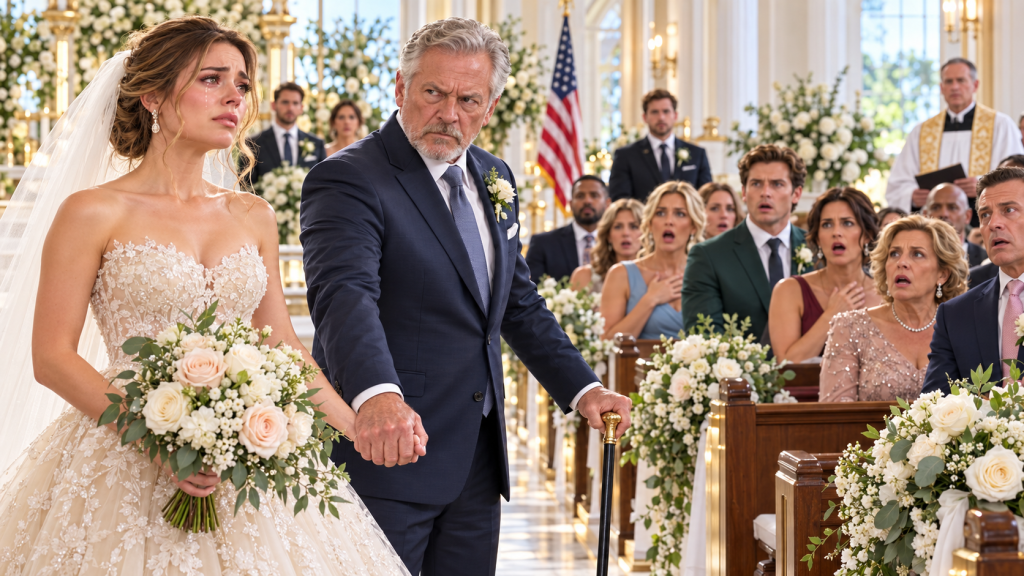
Mom’s expression was furious.
Grandpa turned fully toward her.
Then he said eight words.
“Margaret, tell Emma where her inheritance really went.”
The church gasped.
Dad’s smile vanished.
Mom went pale.
For a second, she looked almost unrecognizable.
Not powerful.
Not elegant.
Afraid.
“Arthur,” she whispered, “this is not the place.”
Grandpa’s voice carried farther than hers.
“You made it the place when you called her your greatest regret.”
No one moved.
Mom stood.
“Sit down,” Grandpa said.
She stared at him.
“What?”
“You spent years telling this family Emma was dishonest, selfish, ungrateful, and unstable whenever she questioned you.”
His hand tightened around mine.
“Today, people are going to know why.”
Dad stepped into the aisle.
“That is enough.”
Grandpa finally looked at him.
“No, Richard. It’s twelve years too late for enough.”
Dad glanced around the church.
Cameras were already out.
That terrified him more than anything.
“Arthur, we can discuss this privately.”
“I tried privately.”
Grandpa reached inside his suit jacket.
Mom inhaled sharply.
He removed a folded piece of paper.
“My attorney gave me permission to read this.”
Dad’s face changed.
“Attorney?”
Grandpa unfolded the page.
“This is a notice confirming that an independent financial examination of the Stone Family Foundation identified substantial irregularities involving restricted charitable funds.”
Voices erupted across the church.
Mom turned toward me.
“You.”
I said nothing.
Her eyes widened.
“You did this.”
I looked at her calmly.
“I followed the money.”
Dad walked toward me.
Daniel immediately stepped down from the altar.
So did his brother.
Dad stopped.
“You had no right.”
I almost laughed.
“No right to investigate my own stolen inheritance?”
Paige stood.
“What stolen inheritance?”
Grandpa turned toward her.
“Your grandmother left each of you the same amount.”
Paige blinked.
“So?”
“So you received yours.”
Grandpa looked toward Lauren.
“So did you.”
Then he pointed gently toward me.
“Emma’s was taken.”
Lauren frowned.
“That’s ridiculous.”
I removed the flash drive from beneath my bouquet.
“It’s documented.”
Mom shook her head.
“She doesn’t understand what she found.”
“I’m a forensic accountant.”
“You’re a vindictive little girl.”
“No.”
My voice remained steady.
“I’m the woman who finally stopped believing you.”
That hurt her.
I could tell because she stopped performing for the room.
Her face hardened.
“You want the truth?”
“Yes.”
“Fine.”
Mom stepped into the aisle.
“You were difficult from the day you were born.”
A murmur moved through the guests.
Dad whispered,
“Margaret.”
But she continued.
“Paige was easy. Lauren was easy. They appreciated what they had. You questioned everything. You watched. You judged.”
“I was a child.”
“You were exhausting.”
Grandpa’s face tightened.
Mom pointed toward me.
“And yes, we used the education money.”
The room erupted.
Paige stared at her.
“You did what?”
Mom ignored her.
“We needed liquidity. Richard’s company was struggling.”
Dad looked away.
“You told me there wasn’t any money,” I said.
“There wasn’t after we used it.”
A woman near the front whispered,
“Oh my God.”
Mom lifted her chin.
“We intended to replace it.”
“Did you?”
Silence.
“No.”
“And Grandma’s inheritance?”
Mom’s face flickered.
Dad spoke.
“That was different.”
I looked at him.
“How?”
“It was family money.”
“It was legally mine.”
“Your grandmother didn’t understand how complicated things had become.”
Grandpa slammed his cane once against the floor.
“Do not speak for my wife.”
Dad flinched.
Grandpa’s voice trembled now, but not from age.
From fury.
“Evelyn knew exactly what she was doing. She loved all three girls. Equally.”
Mom muttered,
“She always favored Emma.”
Grandpa looked at her.
“No, Margaret. Emma was the one who never asked us for anything.”
That sentence cut deeper than shouting would have.
Paige stared at me.
Lauren looked confused.
For the first time, I wondered whether they truly knew.
Then Paige spoke.
“If Emma had over six hundred thousand dollars, where did it go?”
I answered.
“Some of it paid Dad’s company debt.”
Dad closed his eyes.
“Some paid for the house addition.”
Mom said nothing.
“Some paid Paige’s second wedding.”
Paige’s mouth fell open.
“What?”
“And $74,000 went toward Lauren’s condominium down payment.”
Lauren stood abruptly.
“That is not true.”
I looked at her.
“The transfer cleared four days before you closed.”
She looked at Mom.
“Tell her she’s lying.”
Mom didn’t.
Lauren’s face drained.
“You told me that money came from Grandma.”
“It did,” I said.
“Just not your share.”
The silence became unbearable.
Paige slowly removed the diamond bracelet.
Mom noticed.
“Don’t be ridiculous.”
Paige stared at her.
“Did you buy this with Emma’s money?”
Mom snapped,
“It doesn’t matter.”
“It matters to me.”
“No, it doesn’t. Not today.”
Paige’s voice rose.
“You made me wear this in front of her.”
The room felt suddenly too small.
Memories flooded back.
Birthdays.
Christmases.
Graduations.
Mom giving Paige jewelry while handing me gift cards.
Mom joking that some daughters “earned investment.”
Mom telling relatives I lacked ambition while quietly draining the money Grandma had left me.
I expected satisfaction.
Instead, I felt tired.
Daniel came to my side.
His hand settled gently against my back.
Mom noticed.
“This is exactly why she doesn’t deserve any of you,” she said bitterly. “Look at what she’s done to this family on her wedding day.”
I finally lost patience.
“What I’ve done?”
My voice echoed through the church.
“I didn’t steal from my daughter.”
Mom recoiled.
“I didn’t forge her signature.”
Dad said,
“Keep your voice down.”
I turned toward him.
“I didn’t steal charitable donations.”
That changed the room.
Several foundation board members stood.
One of them, Dr. Samuel Reid, stepped into the aisle.
“What does that mean?”
Dad stared at me.
I continued.
“It means my inheritance was how I found the pattern. But it wasn’t where the pattern ended.”
Mom whispered,
“Emma.”
I looked directly at Dr. Reid.
“There are payments from restricted foundation accounts to companies with undisclosed connections to my parents.”
He went pale.
“How much?”
“Based on the records I reviewed, at least $3.8 million requires explanation.”
Someone cursed under their breath.
Dad lunged forward verbally before physically.
“That is an outrageous lie.”
A woman’s voice came from the back.
“No, Richard. It isn’t.”
Everyone turned.
Miriam Hale entered the sanctuary carrying a leather folder.
Grandpa exhaled.
Mom whispered,
“No.”
Miriam walked toward us.
She was sixty-two, silver-haired, calm, and completely unimpressed by wealth.
She stopped beside Grandpa.
“Mr. Stone, I’m Miriam Hale. I represent Arthur Bennett and his estate interests.”
Dad glared at Grandpa.
“You brought a lawyer to the wedding?”
Grandpa nodded.
“You brought thieves.”
That drew another gasp.
Miriam opened the folder.
“We have not come here to conduct a criminal proceeding. However, because several foundation board members are present, Mr. Bennett decided they should be informed that a formal forensic report has been delivered to counsel.”
Dr. Reid looked furious.
“Why wasn’t the board told earlier?”
Miriam answered.
“Because investigators needed to preserve records.”
Dad laughed nervously.
“Investigators?”
“Yes.”
The word hung in the air.
Mom sat down.
For the first time that day, she looked old.
Not eighty-one like Grandpa.
But suddenly fragile.
Paige walked over to me.
She held out the diamond bracelet.
“I didn’t know.”
I looked at it.
Then at her.
“I know.”
She blinked.
“You do?”
“I know you didn’t know where the money came from.”
Her shoulders dropped.
Then I added,
“But you knew how they treated me.”
She froze.
“I…”
“You knew.”
Her eyes filled.
“You laughed.”
Paige lowered her head.
I looked toward Lauren.
“So did you.”
Lauren wiped at her cheek.
“We thought you were jealous.”
“Because Mom told you I was.”
Lauren nodded.
“And because believing her was easier.”
She had no answer.
Mom suddenly stood again.
“This is absurd. We gave all three of you everything.”
I stared at her.
“No. You gave them everything.”
I pointed toward myself.
“You gave me explanations.”
My father finally lost his temper.
“You ungrateful little—”
Grandpa stepped between us.
He was eighty-one.
Dad was still strong.
But the sight of Grandpa moving in front of me silenced my father.
“You will never speak to her that way again.”
Dad scoffed.
“You think she cares about you? She found you because she wanted money.”
Grandpa turned toward me.
Then back to Dad.
“When Emma learned what happened, do you know the first thing she asked me?”
Dad said nothing.
“She asked whether I had enough money left for my own care.”
My throat tightened.
Grandpa continued.
“She didn’t ask when she would be repaid. She didn’t ask what property she would inherit. She asked whether I was safe.”
Mom looked away.
“That,” Grandpa said, “is the daughter you called your greatest regret.”
No one spoke.
Then Dr. Reid addressed Dad.
“Richard, I want the foundation’s accounts frozen pending review.”
Dad stared at him.
“You can’t do that.”
“I’m board chairman.”
“This is my foundation.”
Dr. Reid’s expression hardened.
“No. That may be the problem. You apparently forgot that it wasn’t.”
Mom whispered,
“Richard…”
He looked at her.
Something passed between them.
Fear.
Understanding.
Maybe blame.
For years, they had moved together like a single unit.
That morning was the first time I saw the fracture.
Miriam closed her folder.
“There will be time to address the finances later.”
Then she looked toward me and Daniel.
“This is still a wedding.”
Grandpa smiled.
“Yes.”
I looked at Daniel.
He stepped close.
“We can leave,” he whispered.
“What?”
“We can go anywhere. Courthouse. Backyard. Beach. I don’t care.”
My eyes filled.
“You still want to marry me after this?”
He stared at me.
“Emma, I was prepared to marry you when the biggest emergency was your mother insulting the mascara.”
A laugh escaped me.
Small.
Unexpected.
Then Grandpa chuckled.
A few guests laughed too.
The tension cracked.
Daniel reached for my hand.
“I came here for one reason.”
“What?”
“You.”
I looked down the aisle.
At the flowers.
At the guests.
At Mom and Dad.
For most of my life, they had controlled every room simply by controlling the story.
Emma was difficult.
Emma was jealous.
Emma was ungrateful.
Emma imagined things.
Emma caused problems.
Emma ruined celebrations.
I realized that leaving now would allow them one final rewrite.
They would say I destroyed my wedding.
They would say I ran away.
So I straightened my veil.
I handed the flash drive to Miriam.
Then I looked at Grandpa.
“Ready?”
His face softened.
“I’ve been ready for years.”
The organist hesitated.
Daniel turned toward her.
“Could we try that again?”
She smiled.
The music began.
Grandpa and I resumed walking.
Tap.
Step.
Tap.
Step.
This time, people stood.
Not because tradition demanded it.
Because somehow everyone understood that the old man beside me had done more than replace my mother.
He had restored something she had tried to steal.
Not money.
Not inheritance.
Belonging.
When we reached the altar, Grandpa hugged me.
His voice broke.
“Your grandmother should be here.”
I whispered,
“She is.”
He kissed my forehead.
Then he placed my hand in Daniel’s.
The ceremony began.
Mom and Dad remained seated.
Neither smiled.
Paige cried quietly.
Lauren stared at the floor.
When it came time for our vows, Daniel went first.
He had written something beautiful about choosing each other through every ordinary morning and every impossible day.
Then it was my turn.
My prepared vows were tucked somewhere inside the bridal suite.
I didn’t need them anymore.
I looked at him.
“I spent a long time believing love was something people gave you only when you behaved correctly.”
Daniel’s eyes filled.
“I thought you had to earn softness. Earn loyalty. Earn a place at the table.”
The church was completely quiet.
“Then I met you.”
I smiled.
“You never asked me to make myself smaller so you could love me more.”
He squeezed my hands.
“You taught me that the people who truly love you don’t punish you for asking the truth.”
Behind Daniel, Grandpa wiped his eyes.
“So I promise you this. I will never make you guess whether you are wanted. I will never use silence as punishment. And whatever happens after today, I will always choose truth with you.”
Daniel whispered,
“Always.”
We exchanged rings.
When the minister pronounced us husband and wife, the church erupted.
Not everyone stood.
My parents didn’t.
But I didn’t look at them.
Daniel kissed me.
And for the first time that morning, I forgot they existed.
The reception was held at a restored estate outside the city.
For about twenty minutes, I wondered whether my parents would attend.
They did.
Of course they did.
People like my parents didn’t retreat when exposed.
They regrouped.
Mom entered wearing the same elegant blue dress, her posture rigid.
Dad followed her.
Several board members immediately moved away.
Mom walked directly toward me.
Daniel saw her coming.
“So much for peace.”
“I’ve got it.”
She stopped in front of me.
“We need to talk.”
“We’ve talked.”
“Privately.”
“No.”
Her nostrils flared.
“Emma.”
“Anything you need to say can be said here.”
She looked around.
Grandpa stood nearby speaking with Miriam.
Paige and Lauren were together near the windows.
Mom lowered her voice.
“You have no idea what you’ve started.”
“I know exactly what I started.”
“Your father could lose everything.”
I almost smiled.
“There it is.”
“What?”
“You’re worried about him.”
“He is your father.”
“And I’m your daughter.”
Mom flinched.
I continued.
“You didn’t come over to ask what you did to me.”
Her expression hardened.
“You’ve always seen yourself as a victim.”
“No.”
I shook my head.
“I spent years refusing to.”
That was the truth.
I had defended them.
Made excuses.
Said Mom was stressed.
Said Dad was old-fashioned.
Said my sisters needed more support.
Said Grandpa probably had reasons for disappearing.
The one person I had blamed most consistently was myself.
Mom leaned closer.
“Withdraw whatever report you filed.”
“I can’t.”
“You can.”
“I won’t.”
“You’re destroying your family.”
“No. I’m refusing to protect what you did.”
She stared at me.
Then her voice softened.
It was the voice she used when anger failed.
“Emma, sweetheart.”
I nearly laughed.
She hadn’t called me sweetheart in years.
“You don’t understand how business works.”
“I understand forged documents.”
Her face tightened.
“I understand diverted charitable funds.”
“Nothing has been proven.”
“Then an investigation should clear you.”
That stopped her.
I stepped closer.
“If you’re innocent, you should welcome it.”
Mom looked toward Dad.
He was standing alone near the terrace doors.
Nobody was speaking to him.
For a man who had spent decades collecting influential friends, isolation looked unnatural on him.
Mom whispered,
“You always hated us.”
I felt something inside me finally become quiet.
“No.”
I looked at her.
“I spent most of my life trying to make you love me.”
Her mouth opened.
I continued.
“That’s why this hurts you so much. Not because I hate you.”
I took Daniel’s hand.
“Because I finally stopped trying.”
I walked away.
The reception continued.
There was dancing.
Cake.
Champagne.
Grandpa gave a speech.
He stood slowly, tapping his spoon against his glass.
“I was told to keep this short because I am eighty-one and everyone assumes that means I tell long stories.”
People laughed.
He smiled.
“They are correct.”
More laughter.
Then he looked at us.
“I loved my wife Evelyn for fifty-three years.”
His voice softened.
“She believed people reveal themselves most clearly when they think nobody important is watching.”
Mom stared at the table.
“Emma was always watching. Not because she was suspicious. Because she cared about fairness.”
He raised his glass.
“Today she married a man who sees that quality as strength.”
Daniel put his arm around me.
Grandpa continued.
“And if my Evelyn could see her now, I believe she would say what I should have said years ago.”
He looked directly at me.
“You were never difficult.”
My eyes filled.
“You were paying attention.”
The room applauded.
That was the moment I finally cried.
Not in the bridal suite.
Not in the church.
There.
Beside my husband.
With my grandfather raising his glass.
Three weeks later, the foundation placed both of my parents on administrative leave.
The independent audit widened.
The numbers increased.
$3.8 million became $4.4 million.
Then $4.9 million.
Some transactions had legitimate explanations.
Others did not.
My father insisted everything was bookkeeping error.
My mother blamed employees.
Then consultants.
Then Dad.
Dad blamed Mom.
Their united front collapsed quickly.
Paige called me one evening.
“I need to tell you something.”
“What?”
“I found documents.”
My stomach tightened.
“What documents?”
“Mom had me sign papers years ago.”
I sat down.
“What kind?”
“I don’t know. She said they were related to Grandma’s estate.”
“When?”
“Around my second wedding.”
I closed my eyes.
“Send them to Miriam.”
Paige was quiet.
Then she said,
“Emma?”
“Yes?”
“I’m sorry.”
I waited.
“For the money?”
“For everything.”
Her voice cracked.
“I knew Mom treated you differently.”
I didn’t answer.
“I liked that I was the favorite.”
There it was.
The first honest thing Paige had ever said about us.
“I told myself it was because I was easier. Better. Whatever she said.”
She inhaled shakily.
“When you questioned things, I joined them because I was scared that if Mom decided you were right, she might look at me the way she looked at you.”
I stared at the wall.
“I don’t know what you want me to say.”
“Nothing.”
Paige sniffed.
“I just needed you to know I finally understand that you weren’t trying to take anything from me.”
“No.”
“You were trying to figure out why everything had been taken from you.”
We stayed on the phone for nearly an hour.
It didn’t fix twenty years.
But it was a beginning.
Lauren took longer.
She avoided me for almost four months.
Then one afternoon she arrived at my office without calling.
She placed a cashier’s check on my desk.
I looked at the amount.
$74,000.
“What is this?”
“The condominium money.”
“Lauren…”
“I sold some investments.”
“You don’t have to—”
“Yes.”
She pushed the check closer.
“I do.”
I looked at her.
She seemed different without Mom beside her.
Less polished.
More uncertain.
“I didn’t steal it,” she said.
“I know.”
“But I benefited from it.”
“Yes.”
Her eyes filled.
“And when you were working two jobs in college, I made fun of your clothes.”
I said nothing.
“I called you cheap.”
“Yes.”
She wiped her cheek.
“I was horrible.”
“You were young.”
“So were you.”
That answer surprised both of us.
She sat down.
For the first time in our adult lives, Lauren and I talked without performing.
No competition.
No mother measuring us against each other.
No father making jokes.
Just two sisters sitting in an office trying to understand how a family had been shaped around favoritism.
I did not accept the $74,000.
Not then.
Instead, I told Lauren to hold it until the estate attorneys determined what repayment would look like.
For the first time, the money felt less important than the truth.
Six months after the wedding, prosecutors announced charges connected to fraudulent transfers, forged financial instruments, and misuse of charitable funds.
I didn’t celebrate.
People expected me to.
Coworkers asked whether I felt vindicated.
Friends said, “You must be relieved.”
Relief wasn’t the word.
There was grief.
There was anger.
There was shame I knew didn’t belong to me but still had to unlearn.
And there was something else.
Freedom.
Dad accepted a plea agreement the following year.
Mom fought longer.
She insisted she had done what was necessary to preserve the family.
Even during a deposition, she referred to my inheritance as “resources that were better used elsewhere.”
That sentence ended any doubt I had left.
She still believed she had been entitled to it.
Grandpa recovered part of the money through civil action.
Insurance and asset sales covered more.
Several properties were sold.
The foundation reorganized under an independent board.
Its name was eventually changed.
That mattered to me more than I expected.
For years, the Stone name had been stamped across hospitals, scholarship programs, charity galas, and glossy brochures.
Removing it felt appropriate.
Good work deserved to exist without being used as camouflage.
A year after the wedding, Grandpa moved into a smaller house near us.
He complained about it constantly.
“The kitchen is tiny.”
“You don’t cook.”
“That is irrelevant.”
“The yard is easier to maintain.”
“I had a gardener.”
“You fired him.”
“He criticized my roses.”
“He told you roses need water.”
Grandpa frowned.
“A negative man.”
Daniel adored him.
Every Sunday, we had dinner together.
Sometimes Paige came.
Eventually Lauren did too.
We were awkward at first.
There were conversations we avoided.
Then conversations we couldn’t avoid anymore.
One evening, Paige apologized for the attic bedroom.
I laughed.
“You didn’t put me there.”
“No. But when Mom moved you upstairs, I asked if I could turn your old room into a dressing room.”
I stared at her.
“You did.”
She covered her face.
“I was fourteen.”
“You were evil.”
She laughed.
“I know.”
That was the strange thing about healing.
It wasn’t dramatic.
There was no single apology that repaired everything.
It came in small moments.
A sister admitting something without defending it.
A phone call returned.
A birthday remembered.
A family dinner where nobody compared us.
Grandpa lived long enough to meet my daughter.
We named her Evelyn Arthur Stone.
He complained that Arthur was a terrible middle name for a girl.
Then he cried for twenty minutes.
When Evelyn was three months old, I found him sitting in our living room with her asleep against his chest.
He looked down at her tiny face.
“Your grandmother would have spoiled her terribly.”
“I’m sure you’ll compensate.”
He smiled.
Then his expression grew serious.
“Promise me something.”
“What?”
“Never make her earn her place in this family.”
My throat tightened.
“I won’t.”
He looked at me.
“I should have protected you better.”
“You didn’t know.”
“I should have known.”
I sat beside him.
“Grandpa.”
He stared down at my daughter.
“I thought money would protect everyone.”
He laughed sadly.
“Turns out money only reveals people faster.”
I leaned against his shoulder.
“You came back.”
“So did you.”
Grandpa died peacefully two years later.
He was eighty-four.
Daniel and I were with him.
So were Paige and Lauren.
His funeral was held in the same church where he had stopped halfway down my wedding aisle.
I stood near the altar and stared at the stone floor.
I could still hear his cane.
Tap.
Step.
Tap.
Step.
During the service, the minister asked whether anyone wanted to share a memory.
I hadn’t planned to speak.
But I stood.
I walked to the front.
And I told them about the eight words.
“Margaret, tell Emma where her inheritance really went.”
A few people smiled sadly.
I looked toward the aisle.
“My grandfather stopped my wedding because he believed truth mattered more than appearances.”
My voice shook.
“He was not a perfect man. He missed things. He trusted people he shouldn’t have trusted. He believed family could police itself.”
I looked toward Paige and Lauren.
“But when he learned the truth, he didn’t protect his reputation.”
I paused.
“He protected me.”
After the funeral, Miriam handed me an envelope.
“Arthur asked me to give you this afterward.”
My hands trembled.
Inside was a letter.
Emma,
If you are reading this, I have finally found a way to win an argument without giving you the opportunity to interrupt me.
I laughed through tears.
Daniel put his arm around me.
I continued.
You spent too many years asking whether you were difficult.
You were not.
Difficult people demand loyalty without accountability.
Difficult people punish questions.
Difficult people take love and turn it into debt.
You were never difficult.
You were brave before you knew bravery had a name.
I stopped reading.
My vision blurred.
Daniel kissed my temple.
There was more.
Do not let what happened make you suspicious of happiness.
Your mother taught you that love could disappear when you disappointed someone.
She was wrong.
The right people do not love you less when you become more yourself.
Build something honest.
Raise children who can disagree with you without fearing exile.
Love your sisters if they earn your trust, but never lie to yourself to keep peace.
And please tell Daniel I still think he overpaid for that lawn mower.
I laughed again.
At the bottom he had written:
You were never anyone’s regret.
You were Evelyn’s joy.
And mine.
Grandpa Arthur.
I folded the letter carefully.
For years, I had believed closure would arrive when my parents were punished.
It didn’t.
It arrived there.
Standing outside a church.
Holding a letter from the man who had walked me down the aisle.
My mother wrote to me once after Grandpa died.
The envelope sat unopened on my desk for nearly a week.
Eventually, I read it.
It was four pages long.
There were explanations.
Excuses.
Memories.
A few apologies.
Mostly, there were attempts to make me understand how pressure had changed her.
How Dad’s business failures had frightened her.
How keeping up appearances had become necessary.
How one bad financial choice led to another.
Near the end, she wrote:
I know you believe I loved your sisters more.
That isn’t exactly true.
You simply made me feel judged.
I read that sentence several times.
Then I finally understood something.
My mother had not hated me because I was less worthy.
She had resented me because I noticed things she wanted hidden.
Even as a child.
I noticed when stories changed.
I noticed when bills disappeared.
I noticed when adults contradicted themselves.
I noticed when kindness existed only with witnesses.
I noticed when generosity came with conditions.
And instead of changing her behavior, she tried to change my perception of myself.
Difficult.
Ungrateful.
Jealous.
Dramatic.
The labels were never descriptions.
They were warnings.
Stop looking.
Stop asking.
Stop seeing.
I folded the letter and placed it in a box.
I never responded.
Not because I hated her.
Because some relationships end long before anyone has the courage to admit it.
Years later, on my daughter Evelyn’s fifth birthday, we hosted a party in our backyard.
Paige brought an enormous cake.
Lauren arrived with too many balloons.
Daniel grilled hamburgers badly and insisted they were “smoky.”
They were burned.
Grandpa would have insulted them mercilessly.
I was standing near the porch when Evelyn ran toward me wearing a crooked paper crown.
“Mommy!”
I bent down.
“What happened?”
She looked furious.
“Aunt Paige says I can’t have another cupcake.”
Behind her, Paige shouted,
“I said she already had three!”
Evelyn crossed her arms.
“I disagree.”
I stared at her.
Daniel started laughing.
Lauren nearly dropped her drink.
Paige groaned.
“Oh no.”
I smiled.
“What?”
“She’s you.”
I looked at my daughter.
Serious eyes.
Stubborn chin.
Absolutely certain she deserved an explanation.
For a moment, I saw myself at five.
At twelve.
At eighteen.
The girl who had always been told that questions were disrespect.
I crouched beside Evelyn.
“You disagree?”
“Yes.”
“Okay. Tell me why.”
Her entire face brightened.
She launched into a complicated argument involving birthdays, frosting distribution, and alleged cupcake inequality.
I listened.
Actually listened.
Then I said,
“You make some interesting points.”
Paige stared at me.
“Do not negotiate with the terrorist.”
I laughed.
Evelyn received half a cupcake.
She considered this a historic legal victory.
That evening, after everyone left, Daniel and I sat on the porch.
Our daughter slept upstairs.
The yard was scattered with balloons and wrapping paper.
He reached for my hand.
“You know what today is?”
I thought.
Then I realized.
Our wedding anniversary.
The same date.
Years earlier, my mother had called me her greatest regret.
I looked through the window toward the hallway where Grandpa’s wedding photograph hung.
In the picture, his cane was in one hand.
My arm was linked through the other.
We were both smiling.
Mom had tried to turn that morning into a final humiliation.
Instead, she accidentally gave me the clearest picture of my life.
Family was not the person standing beside you because tradition said they belonged there.
Family was the person who stepped forward when someone else stepped away.
Family was the eighty-one-year-old man who crossed a bridal suite and offered his hand.
Family was a husband who waited at an altar while the truth exploded around him.
Family was sisters who eventually learned that apology meant changing how they behaved.
Family was a little girl with frosting on her face who knew she could disagree with her mother and still be adored.
Daniel squeezed my hand.
“You okay?”
I smiled.
“Yeah.”
And I meant it.
For years, I thought the most important thing Grandpa did at my wedding was expose my parents.
It wasn’t.
The real gift came before that.
Before the eight words.
Before the gasps.
Before the lawyers and investigations and bank records.
It happened in the bridal suite when he took my hand after my mother refused.
“You were never a regret,” he told me.
At the time, I thought he was comforting me.
Years later, I understood he was correcting the biggest lie my family had ever taught me.
I had spent almost thirty years believing I needed their approval to prove I belonged.
I didn’t.
I never had.
And sometimes I wonder what would have happened if Grandpa had simply kept walking that day.
If he had swallowed the truth for the sake of appearances.
If he had waited until after the ceremony.
Maybe my parents would have continued controlling the story.
Maybe the foundation board would have ignored the warning signs.
Maybe Paige and Lauren would have continued believing I was the problem.
Maybe I would have continued carrying shame that never belonged to me.
But Grandpa stopped.
Right in the middle of the aisle.
He turned toward the people who had spent years silencing me.
And in eight words, he forced an entire room to look at the truth.
My mother thought refusing to walk me to the altar would prove I was unwanted.
Instead, it gave Grandpa the chance to show me who had always wanted me there.
And when I look back now, I don’t remember Mom’s rejection first.
I remember the sound of an old black cane against a stone church floor.
Tap.
Step.
Tap.
Step.
And the hand of an eighty-one-year-old man holding mine tightly enough to remind me that I had never been walking alone.
💬THE END! THANK YOU FOR READING!