

My adoptive mom laughed to her wealthy guests at the $17 million lake house.
“She’s just my husband’s charity project.”
A few people around the dining table chuckled.
Then my sister added, “We don’t include her in family decisions.”
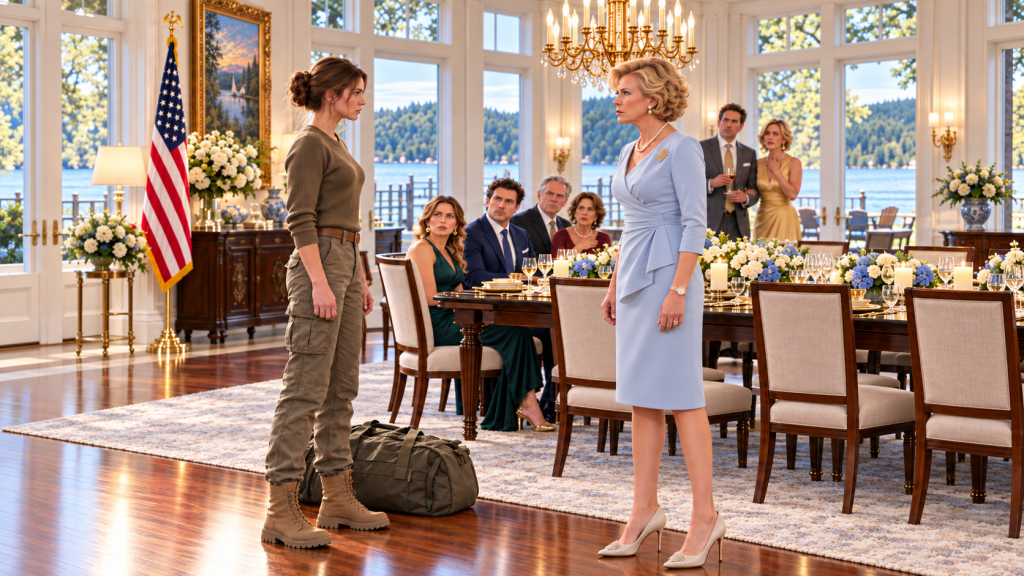
I stood in the hallway holding one Army duffel bag, fresh off fourteen months in Kuwait and northern Iraq, listening to people I had known most of my life explain why I didn’t belong in my own family.
For several seconds, I didn’t move.
Rain tapped softly against the enormous windows overlooking Lake Anna.
Beyond the glass, gray water stretched beneath a low Virginia sky.
Inside, crystal glasses caught the light from the chandelier above the dining table.
My adoptive mother, Diane Ward, sat at the head of that table as though she owned everything she could see.
Maybe that was why she spoke so freely.
She believed no one who mattered would challenge her.
Especially not me.
“She’s not really family,” Diane continued, lifting her wineglass, “so naturally we don’t involve her in estate planning.”
Another laugh.
I recognized some of the people sitting with her.
A real estate developer from Richmond.
A retired judge.
A banker.
A surgeon and his wife.
People Diane liked having around because their presence made her feel important.
My younger adoptive sister Chloe sat beside her in a white sweater, smiling into her glass.
Across from Chloe sat her husband, Marcus Bell.
Marcus leaned back in his chair and added, “Elena is more comfortable blowing things up than managing assets.”
That drew an even louder laugh.
I looked down at my boots.
Two months earlier, I had supervised a $12.8 million military infrastructure operation involving more than sixty personnel and civilian contractors.
We had completed the project under budget.
Nobody under my command had been seriously injured.
I had spent fourteen months making decisions that affected lives, equipment, supply chains, security schedules, and millions of dollars.
But according to Marcus, I was apparently the family idiot because I wore combat boots instead of loafers.
I could have walked away.
Part of me wanted to.
Arthur had always told me never to waste energy proving myself to people committed to misunderstanding me.
But another part of me was tired.
Tired of leaving rooms so Diane could feel victorious.
Tired of swallowing comments because confronting her would supposedly “cause tension.”
Tired of being told that dignity meant silence.
So I picked up my duffel bag and walked into the dining room.
The laughter stopped immediately.
Diane’s face slowly lost color.
Chloe’s smile vanished.
Marcus sat forward.
For the first time all evening, nobody had anything clever to say.
I set my duffel gently beside the wall.
“Please,” I said.
I looked around the table.
“Don’t stop because of me.”
Diane stood too quickly.
“Elena.”
Her voice changed completely.
Warm.
Motherly.
False.
“We didn’t know you were already here.”
“I know.”
That was all I said.
The retired judge suddenly became deeply interested in his napkin.
The banker stared at his wine.
Marcus cleared his throat.
“You came straight from the airport?”
“Base.”
“Oh.”
Silence again.
Chloe finally forced a smile.
“You could have texted.”
“I did.”
She looked confused.
I pulled my phone from my pocket.
“Yesterday.”
Diane stepped around the table.
“Well, you know how chaotic everything has been.”
I did know.
My father, Arthur Ward, had died eight months earlier.
The official cause was pancreatic cancer.
Unofficially, I sometimes thought grief had killed the house before the disease killed him.
Arthur had been seventy-two.
He built Ward Development from a small construction company into a regional real estate business worth somewhere north of sixty million dollars.
He made money, but he never worshipped it.
That was one of the first things I remembered about him.
I had been four years old when Arthur and Diane adopted me.
My biological mother died from an overdose.
My biological father had never been identified.
According to the social worker, I had been moved between temporary homes three times before Arthur met me at a charitable foundation event.
He later told me that I refused to speak to anyone.
I simply sat underneath a table holding a broken red crayon.
Arthur crawled underneath the table in his expensive suit.
He stayed there for almost an hour.
He never asked me to come out.
He just sat beside me.
Eventually, I handed him the crayon.
Six months later, I was living in his house.
A year after that, the adoption was finalized.
Arthur never called me adopted unless paperwork required the word.
He called me his daughter.
Diane never quite did.
To outsiders, she performed motherhood beautifully.
Christmas photographs.
School fundraisers.
Matching dresses when Chloe and I were little.
But inside the house, she had dozens of subtle methods for reminding me that I was different.
Different rules.
Different expectations.
Different standards.
When Chloe crashed a BMW at nineteen, Diane called it a learning experience.
When I got a B+ in chemistry at sixteen, Diane asked whether community college might be more realistic for someone like me.
When Chloe dropped out of graduate school after one semester, Diane said she was finding herself.
When I received an ROTC scholarship, Diane told her friends the military was “a practical path for Elena.”
Arthur always corrected her.
Sometimes gently.
Sometimes not.
I learned early that most of their arguments were about me.
It made me feel guilty.
I spent years trying to make myself easier to love.
Smaller.
Quieter.
More useful.
Arthur noticed.
When I was seventeen, he sat with me on the dock behind the lake house.
“You know you don’t have to earn your place here, right?”
I had laughed because I didn’t know how else to respond.
He hadn’t.
“I mean it, Elena.”
He placed one hand over mine.
“This family became yours the day the judge signed those papers. Anyone who tells you differently is lying.”
Arthur had a way of saying things that made them feel permanent.
Which was why his death left me feeling as though gravity itself had changed.
Diane approached me in the dining room and tried to hug me.
I stepped aside before she could.
Something flickered across her face.
Annoyance.
Then embarrassment.
She remembered the audience.
“You must be exhausted,” she said.
“Probably.”
“We prepared your old room.”
“That’s thoughtful.”
Marcus rose.
He was forty-one, handsome in the polished, overconfident way of men who had never suffered consequences proportional to their decisions.
He held out his hand.
“Welcome home, soldier.”
I looked at it.
Then at him.
“Colonel.”
His hand dropped slightly.
“Right.”
I wasn’t a colonel.
I was a lieutenant colonel.
Marcus knew that.
He simply never cared enough to remember.
Chloe stood next.
My sister and I had once been close.
At least I had believed we were.
She was two years younger than me.
When we were children, she climbed into my bed during thunderstorms.
At fifteen, she made me promise to beat up her first boyfriend if he broke her heart.
At twenty-two, she cried against my shoulder the night before her wedding because she was afraid adulthood would change everything.
Maybe it had.
Or maybe money had.
Or Diane.
Or Marcus.
Whatever the reason, somewhere along the way Chloe stopped seeing me as her sister and started seeing me as competition.
“Can we talk tomorrow?” she asked.
“About what?”
Her eyes darted toward Marcus.
“Family things.”
There it was.
Family.
Suddenly I qualified.
I looked at Diane.
Then Chloe.
Then Marcus.
“Sure.”
I picked up my duffel.
Behind me, conversations remained dead.
Diane followed me into the hallway.
“Elena.”
I stopped.
She lowered her voice.
“You embarrassed me.”
I turned.
“I walked into a room.”
“You knew what you were doing.”
“No. What were you doing?”
Her jaw tightened.
“It was a joke.”
“That’s what people say when they’re embarrassed by something they meant.”
She looked toward the dining room.
“We can discuss this privately.”
“You already discussed it publicly.”
Her eyes hardened.
For half a second, the social mask dropped.
“You always were dramatic.”
Then she turned and walked away.
My room was almost exactly as I remembered it.
Same walnut bed.
Same framed photograph of West Point that Arthur had given me.
Same shelves.
Same view of the lake.
Someone had removed most of my personal things.
Probably Diane.
I didn’t care.
I showered.
Unpacked.
Then sat on the edge of the bed and stared at the photograph on the nightstand.
Arthur and me.
We were standing beside the lake.
I was twenty-three.
Newly commissioned.
He had one arm around my shoulder.
I remembered what he whispered before the picture was taken.
Never let anyone make you grateful for something that was supposed to be love.
I slept badly.
The next morning, I woke before sunrise out of habit.
By six, I had already run four miles around the property and showered.
At seven-fifteen, I walked into the kitchen.
Diane, Chloe, and Marcus were waiting.
That alone told me the conversation mattered.
Diane never voluntarily woke before eight.
A thick folder sat on the marble island.
Marcus gestured toward it.
“We wanted to discuss an opportunity.”
I poured coffee.
“An opportunity for whom?”
He smiled.
“All of us.”
That usually meant him.
Chloe pushed the folder toward me.
“Marcus is expanding Bell Ridge Commercial.”
“I thought Bell Ridge was downsizing.”
His smile tightened.
“Repositioning.”
“Of course.”
Diane gave me a warning look.
“Elena.”
I opened the folder.
Ridgemont Capital Bank.
Commercial restructuring facility.
Four million dollars.
Joint guarantees.
Collateral support.
I kept reading.
Chloe started talking quickly.
“The lender simply wants stronger collateral partners temporarily. Once Marcus closes two projects this quarter, everything gets refinanced.”
“Mostly procedural,” Marcus added.
I didn’t answer.
There were missed payments.
Covenant violations.
Default warnings.
Pending litigation disclosures.
The further I read, the worse it became.
Bell Ridge wasn’t expanding.
It was bleeding.
Marcus had personally guaranteed millions.
Several lenders were already circling.
Buried near the back of the agreement was language they had probably hoped I would skim.
My ownership interest in certain Ward family assets would be pledged as primary recovery collateral.
Primary.
Not secondary.
Not equal.
Primary.
I read the provision twice.
Then I looked at Marcus.
“What ownership interest?”
For the first time, he seemed uncomfortable.
“Your future family interest.”
“Be specific.”
Diane crossed her arms.
“Elena, you’re overcomplicating something very straightforward.”
I ignored her.
“What assets?”
Marcus hesitated.
“Trust interests. Future distributions. Whatever applies.”
“You don’t know?”
“My lawyers prepared it.”
“Apparently.”
Chloe leaned forward.
“It’s temporary.”
I flipped backward through the agreement.
“How much are you already in default?”
Marcus’s face hardened.
“That isn’t relevant.”
“It’s the most relevant question in the document.”
“We’re not in default.”
I tapped the disclosure.
“This says otherwise.”
“That’s technical.”
I looked at Chloe.
“How much?”
She glanced at her husband.
“Marcus said it’s under control.”
That answered everything.
Diane stepped closer.
“This family has supported you your entire life.”
I closed the folder.
“And?”
“And sometimes family members help each other.”
“By signing four-million-dollar guarantees?”
“You have assets.”
“What assets?”
Nobody answered.
Interesting.
I leaned back.
“You all seem very informed about my finances.”
Diane’s mouth tightened.
“We know Arthur provided for you.”
“So did he provide for Chloe.”
“That’s different.”
“Why?”
Nobody answered that either.
I pushed the folder away.
“No.”
Chloe blinked.
“Elena.”
“No.”
“You haven’t even considered it.”
“I read it.”
Marcus scoffed.
“You spent ten minutes.”
“That was enough.”
He leaned toward me.
“You manage military projects, Elena. This is commercial finance.”
“And this document says that if your company defaults, assets tied to my interest get targeted before yours.”
His face changed.
Barely.
But enough.
“I knew you wouldn’t understand it.”
I smiled.
“That isn’t a denial.”
Diane slammed one hand against the counter.
“Enough.”
We all looked at her.
She took a breath.
Then lowered her voice.
“You owe this family, Elena.”
I stared at her.
“For what?”
Her answer came immediately.
“For taking a stray in.”
Silence.
Even Marcus looked uncomfortable.
Chloe’s lips parted.
“Mom.”
Diane didn’t stop.
“We fed you. Educated you. Gave you opportunities you never would have had otherwise. Arthur spent a fortune treating you exactly like his own daughter.”
I nodded slowly.
“Arthur did.”
Her eyes narrowed.
“We both did.”
“No.”
The word came out quiet.
That somehow made it stronger.
“You tolerated me because Arthur loved me.”
Diane laughed bitterly.
“You have no idea what I sacrificed.”
“I’m sure you’re about to tell me.”
“You came into our home with problems. Night terrors. Behavior issues. Therapy appointments. You were difficult.”
“I was four.”
“You were not easy.”
“I was four.”
Chloe looked down.
I suddenly understood that some people could spend decades resenting a child for surviving badly.
I stood.
Diane looked at the contract.
“We are trying to preserve this family’s future.”
“No. You’re trying to preserve Marcus’s company.”
Marcus pushed back from the island.
“You think you’re better than us because you wear a uniform?”
“No.”
I met his eyes.
“I think I’m better at reading contracts.”
His face flushed.
Chloe stepped between us.
“Elena, please. If Bell Ridge collapses, hundreds of employees could lose their jobs.”
“Then Marcus should restructure the company honestly.”
“He needs capital.”
“Then find investors.”
“The bank wants collateral.”
“Then pledge his own.”
Marcus stared at me.
That silence told me more than the paperwork.
He had already pledged everything.
Diane’s expression changed.
Cold.
“If you refuse to help this family, then perhaps it is time to formally reconsider your place in it.”
I picked up my coffee.
“What does that mean?”
“You know exactly what it means.”
“I’d like to hear you say it.”
Her eyes met mine.
“We can remove you completely.”
Chloe whispered, “Mom.”
But Diane was committed now.
“No future distributions. No involvement in family property. No invitations. Nothing.”
I carried my mug to the sink.
“If you want to disown me, do it in writing.”
Then I left.
Rain was falling harder when I climbed into my truck.
I sat behind the wheel for almost ten minutes without starting the engine.
My hands weren’t shaking.
That almost bothered me more.
I had imagined conversations like that for years.
Different words.
Same wound.
Some small part of me had always hoped that after Arthur died, Diane would eventually stop fighting a competition that existed only in her mind.
Instead, she had finally said out loud what she had spent decades implying.
Stray.
I looked through the windshield at the lake house.
Seventeen million dollars of stone, timber, glass, and carefully curated memories.
Arthur had loved this place.
I suddenly hated it.
I started the truck.
Then I remembered the envelope.
Six days before Arthur died, I was sitting beside his hospital bed.
He was thinner than I had ever seen him.
The cancer had taken almost everything except his mind.
He asked the nurse for privacy.
Then he reached into the drawer beside his bed and handed me a cream-colored envelope.
My name was written across the front.
“Elena.”
I had started to open it.
He stopped me.
“Not yet.”
“When?”
“If Diane ever asks you for money.”
I laughed softly.
“Dad.”
“I’m serious.”
His eyes were sharp.
“Open it if she asks you for money.”
I tucked the envelope into my travel document case.
After he died, I forgot about it.
Grief did that.
It turned important objects into invisible ones.
Now I reached behind the passenger seat and pulled out the case.
The envelope was still inside.
I opened it.
There was only one sheet of paper.
Arthur’s handwriting.
Go see Victor.
Don’t tell Diane first.
And don’t sign anything.
Below that was an address.
Victor Vance.
Attorney at Law.
Charlottesville.
Forty minutes later, I climbed the stairs above an old brick pharmacy and found Victor’s office.
No marble lobby.
No receptionist.
No modern art.
Just wooden shelves, legal books, and a coffee machine that sounded like farm equipment.
Victor was seventy if he was a day.
Thin.
Silver hair.
Dark suspenders.
When he saw me, he froze.
“Elena.”
“You knew I was coming?”
He studied me.
“I knew you might.”
He closed the office door.
“Did Diane ask you for money?”
I handed him the loan documents.
He read the first pages.
Then his face became very still.
“Did you sign?”
“No.”
“Did you initial anything?”
“No.”
“Give anyone authorization?”
“No.”
He exhaled slowly.
“Good.”
“Why?”
Victor carried the folder to his desk.
Then he walked to a bookshelf and pulled three legal volumes aside.
Behind them was a wall safe.
He entered a code.
Inside were binders.
Files.
A cedar document box.
He carried several items to the desk.
“Sit.”
I did.
Victor remained standing.
“Your father knew exactly what Diane was.”
I looked at him.
“That’s a strong statement.”
“He spent thirty-eight years married to her.”
Victor opened the first binder.
Bank statements.
Property records.
Trust amendments.
Internal company emails.
Copies of checks.
Private correspondence.
“Arthur started documenting Diane’s financial behavior nearly six years ago.”
“Why?”
“Because money was disappearing.”
I looked through the records.
Transfers.
Consulting payments.
Loans.
Large withdrawals.
Many routed through entities I didn’t recognize.
“Was she stealing?”
Victor chose his words carefully.
“Arthur believed she was diverting marital and company funds to Chloe and Marcus without authorization.”
“How much?”
“Over several years?”
He leaned back.
“Approximately 6.2 million dollars that we can prove.”
I stared at him.
“Arthur knew?”
“Eventually.”
“Why didn’t he stop it?”
“He did.”
Victor turned another page.
“He quietly removed Diane from operational accounts, restructured ownership, and created protections around major assets.”
“Why didn’t he tell me?”
“Because he didn’t want you fighting his battles while deployed.”
That sounded exactly like Arthur.
Victor opened the cedar box.
Inside was a certified trust document.
He removed it carefully.
“Your father amended the trust before he died.”
I looked down.
Ward Family Asset Protection Trust.
Amended and Restated.
Eighteen months earlier.
Victor turned to the ownership schedule.
“Read.”
I did.
Lake house.
Three rental properties.
Commercial holdings.
Investment accounts.
Controlling interest in Ward Family Holdings.
I kept reading.
Diane Ward.
Lifetime residential rights at the lake property subject to conditions.
Chloe Bell.
Non-controlling beneficiary interest.
Marcus Bell.
No direct beneficiary rights.
Then my name.
Elena Ward.
Successor controlling trustee.
Primary voting authority.
Ultimate ownership beneficiary.
I read it again.
Then again.
“This can’t be right.”
“It is.”
“The lake house?”
“Owned by the trust.”
“Who controls the trust?”
“You.”
I looked up.
Victor nodded.
“Effective upon Arthur’s death.”
I sat back.
“They don’t know?”
“They know there is a trust.”
“That’s not what I asked.”
His mouth twitched.
“No. They do not know the current control structure.”
“How?”
“Arthur’s instructions were explicit. Certain schedules were sealed until one of several triggering conditions occurred.”
“Diane asking me for money?”
“Specifically, Diane or anyone acting with her knowledge attempting to pressure you into guaranteeing, transferring, or encumbering trust property.”
I stared at the loan papers.
Victor looked at them too.
“Arthur knew his wife.”
I rubbed my forehead.
“This is insane.”
“No.”
Victor’s expression became grim.
“This is where it gets worse.”
He opened another folder.
Three weeks earlier, Diane had approached Ridgemont Capital regarding Marcus’s debt.
She represented herself as authorized to pledge the lake house.
The lender requested proof.
She provided documents.
Victor slid a scanned authorization toward me.
At the bottom was my name.
Elena Ward.
Under it was a signature.
It looked similar to mine.
Not perfect.
But close enough to fool someone unfamiliar with it.
I stared at the page.
“I never signed this.”
“I know.”
“Who did?”
“That is one of several questions we need answered.”
“Why would my signature matter if they think Diane owns the house?”
Victor tapped the trust.
“Because somebody knows enough about the trust to know Diane requires your authorization.”
My stomach tightened.
“So they know.”
“Somebody does.”
“Chloe?”
“Possibly.”
“Marcus?”
“Likely.”
Victor turned his laptop toward me.
“There’s more.”
Emails.
Marcus to a loan officer.
Diane copied.
One message read:
Elena is deployed and difficult to reach. We have family authorization and can provide executed consent.
Another:
Her involvement is largely nominal. Diane retains practical control of the property.
Victor let me read in silence.
Then he said, “Elena, they didn’t just need your help.”
He tapped the forged document.
“They already tried to use you.”
I felt something inside me become very calm.
The kind of calm that comes right before decisions.
“What happens now?”
Victor leaned back.
“That depends on what you want.”
“I want to know everything.”
He nodded.
“Then we proceed carefully.”
Over the next four hours, Victor explained what Arthur had done.
The lake house had originally been personally owned.
Eighteen months before his death, Arthur transferred it into the trust.
The rental properties followed.
Then portions of Ward Development.
Arthur did not entirely cut Diane or Chloe off.
He created income provisions.
Housing protections.
Education funds for future grandchildren.
He had simply removed Diane’s ability to sell, borrow against, or transfer the major assets.
There were conditions.
Important ones.
Diane could remain in the lake house for life unless she attempted fraud, unauthorized encumbrance, intentional waste of the property, or interference with trust administration.
I reread that clause.
“Attempted unauthorized encumbrance.”
Victor nodded.
“If proven, it terminates her residential right.”
“She could lose the house?”
“She never owned it.”
I thought about her sitting beneath that chandelier the night before telling wealthy guests I was her husband’s charity project.
Victor watched me.
“Do not make decisions angry.”
“I’m not angry.”
That surprised both of us.
I was hurt.
But anger?
No.
Something colder had replaced it.
Clarity.
“Call the bank,” I said.
Victor raised an eyebrow.
“You’re certain?”
“I want to know what they submitted.”
He picked up the phone.
Ridgemont’s legal department responded faster than expected.
Apparently, Victor’s name carried weight.
By late afternoon, we were in a conference room at the bank’s Charlottesville headquarters.
The chief legal officer, a woman named Priya Desai, entered with two compliance executives.
Marcus’s loan officer was not invited.
That told me plenty.
Priya shook my hand.
“Ms. Ward, thank you for coming.”
“Lieutenant Colonel Ward is fine.”
Her eyes flicked briefly toward Victor.
Then she nodded.
“Of course.”
She placed a folder on the table.
“We received notice from Mr. Vance that certain authorization documents may be disputed.”
“They’re forged.”
Priya’s face remained professional.
“Then we have a significant issue.”
She showed me the documents.
My supposed authorization.
A copy of my military ID.
An old passport scan.
A property acknowledgment form.
My stomach dropped.
“That passport copy came from the family office.”
Victor looked at me.
“You’re sure?”
“Yes. Arthur kept travel documents there for years.”
Priya turned another page.
“Someone also provided a notarized signature affidavit.”
Victor took it.
His expression changed.
“The notary is Samantha Keene.”
I recognized the name.
Diane’s personal assistant.
The woman had worked for her for twelve years.
Priya continued.
“The bank had not finalized the collateral position. We were waiting for independent trust verification.”
“So they haven’t borrowed against the house?”
“No.”
I exhaled.
“But Mr. Bell’s company is already in technical default under separate facilities.”
“How bad?”
Priya hesitated.
Victor answered for her.
“You can tell her. She has direct financial exposure if their representations remain uncontested.”
Priya nodded.
“Bell Ridge has approximately eleven million dollars in total debt across known facilities. Ridgemont holds four million.”
I stared at the folder.
Marcus had told Chloe he needed a temporary restructuring.
In reality, he was drowning.
“What happens if he collapses?”
“Depends on asset liquidation, guarantees, creditor priority, and litigation.”
“Will Chloe lose her house?”
Priya didn’t answer.
Victor did.
“Possibly.”
That part hurt.
Chloe had two children.
My niece and nephew.
They were innocent.
Whatever I did next, I would not punish them for their parents’ stupidity.
I left the bank after five.
Victor walked beside me.
“You have options.”
“I know.”
“We can notify Diane immediately.”
“No.”
He glanced at me.
“She doesn’t know we know.”
“That can be useful.”
Victor smiled slightly.
“Arthur would be proud.”
“Arthur would tell me not to enjoy this.”
“He would.”
“I’m trying.”
The next morning, I returned to the lake house.
Diane was in the sunroom.
Chloe sat nearby.
Marcus was pacing.
They looked exhausted.
I looked rested.
That seemed to irritate them.
Diane stood.
“Well?”
“Well what?”
“The loan.”
“Oh.”
I took off my jacket.
“I thought I was disowned.”
Chloe groaned.
“Can we not do this?”
“Do what?”
“Be dramatic.”
I almost laughed.
Marcus walked toward me.
“We need a decision today.”
“I gave you one yesterday.”
“You didn’t understand the stakes.”
“I understand them better now.”
His eyes narrowed.
“What does that mean?”
I looked at him.
“Exactly what I said.”
Diane interrupted.
“You went somewhere yesterday.”
“Yes.”
“Where?”
“Out.”
She stared.
“You are staying under my roof.”
There it was.
I glanced upward.
“About that.”
Marcus’s phone rang.
He looked at the screen.
His face changed.
He answered.
“Hello?”
Silence.
Then he walked away.
“No, that doesn’t make sense.”
Chloe watched him.
“What?”
He raised one finger.
“No. We provided authorization.”
My eyes met Diane’s.
For the first time, I saw fear.
Marcus turned toward me.
“What did you do?”
Chloe stood.
“What happened?”
He ended the call.
“Ridgemont froze the restructuring.”
Diane looked at me.
“Elena.”
I folded my arms.
“Why would a bank freeze it?”
Marcus stepped closer.
“Did you contact them?”
“Why would I?”
“Because you’re vindictive.”
“That seems like a strange accusation from someone asking me to guarantee four million dollars.”
Diane’s face hardened.
“You had no right to interfere.”
I looked at her.
“No right?”
She realized the mistake immediately.
I let the silence stretch.
Then I said, “Interfere with what, exactly?”
Nobody spoke.
Marcus looked at Diane.
Chloe looked between all of us.
“What is going on?”
I almost felt sorry for her.
Almost.
“Ask your husband.”
“Marcus?”
He shook his head.
“This is being blown out of proportion.”
“What is?”
He didn’t answer.
I walked toward the coffee machine.
Behind me, Diane said, “You went to Victor.”
My hand stopped.
Interesting.
I turned slowly.
“What makes you say that?”
Her face revealed too much.
She knew.
Maybe not everything.
But enough.
“You always were Arthur’s little spy.”
“No.”
I set the coffee scoop down.
“Arthur didn’t need me to spy on you.”
Her eyes widened.
I continued.
“He kept records.”
Marcus went pale.
Chloe whispered, “Records of what?”
Diane ignored her.
“Whatever Victor told you, he hated me.”
“Victor showed me documents.”
“What documents?”
Marcus interrupted sharply.
“Diane.”
She snapped, “Be quiet.”
I had never seen her speak to him like that.
Then Chloe said the sentence that broke everything open.
“Mom, did you sign Elena’s name?”
Diane turned.
Marcus froze.
I said nothing.
Chloe looked at him.
Then at Diane.
“Oh my God.”
Diane immediately shook her head.
“No.”
Marcus said, “Nobody forged anything.”
I smiled faintly.
“I didn’t say anything was forged.”
His face went white.
Silence.
Chloe stepped backward.
“You did.”
Marcus lifted both hands.
“Chloe, listen.”
“You signed her name?”
“It was temporary authorization.”
“You forged my sister’s signature?”
Diane snapped, “She was overseas!”
Chloe turned toward her.
“You knew?”
Diane’s composure cracked.
“We were trying to save your husband’s company.”
“By committing fraud?”
“Don’t be childish.”
Chloe stared at her mother.
Something shifted in her expression.
For the first time in years, I saw the girl who used to crawl into my bed during thunderstorms.
Confused.
Afraid.
Marcus stepped toward her.
“Baby.”
“Don’t.”
He stopped.
Diane turned back to me.
“You could fix this.”
“I could.”
Her eyes sharpened with hope.
“All you have to do is confirm the authorization.”
“No.”
“Elena.”
“No.”
“You would destroy your sister’s family over paperwork?”
I looked at Chloe.
Then back at Diane.
“You did the paperwork.”
Diane’s mouth tightened.
“You have always wanted this.”
“Wanted what?”
“To take Chloe’s place.”
I stared at her.
Even after everything, she still believed life was a competition between two daughters.
“You think I want Marcus’s collapsing company?”
Her face flushed.
“You know what I mean.”
“No. I really don’t.”
Then the doorbell rang.
Diane looked annoyed.
I knew exactly who it was.
Victor entered with a process server and another attorney.
The room went silent.
Diane’s face emptied.
Victor removed his glasses.
“Good morning, Diane.”
She whispered, “Get out.”
“I’m afraid I can’t.”
“This is my house.”
Victor looked at me.
Then back at Diane.
“No.”
Her expression changed.
Chloe stared.
Marcus looked genuinely sick.
Victor opened his briefcase.
“Diane Ward, pursuant to Article Eight, Section Four of the Ward Family Asset Protection Trust, you are hereby given formal notice of administrative review regarding attempted unauthorized encumbrance of trust property.”
Diane stared at him.
“What trust property?”
Victor looked around the room.
“The lake house.”
Chloe sat down.
Marcus whispered something I couldn’t hear.
Diane laughed.
It sounded brittle.
“Arthur left this house to me.”
“No.”
Victor handed her a certified copy.
“He granted you a conditional lifetime residential interest.”
She didn’t take it.
“So who owns it?”
Victor looked at me.
Diane followed his gaze.
Her face slowly changed.
Marcus closed his eyes.
Chloe whispered, “Elena?”
Victor answered.
“Lieutenant Colonel Elena Ward is the controlling trustee and ultimate ownership beneficiary.”
Nobody moved.
Then Chloe said softly, “Wait.”
She looked at me.
“You’re the owner?”
I didn’t feel victorious.
That surprised me.
For years, I imagined what it might feel like for Diane to finally be wrong about me in a way she could not dismiss.
I thought it would feel satisfying.
It didn’t.
Mostly, I felt sad that Arthur had needed to protect me from his own wife.
Diane stared at the papers.
“This is impossible.”
“It is certified,” Victor said.
“He wouldn’t do this.”
“He did.”
“I was his wife.”
“Yes.”
“For thirty-eight years!”
Victor’s expression remained calm.
“And during the final six, he documented unauthorized transfers, concealed loans, and attempted misuse of company assets.”
Her voice broke slightly.
“He told you that?”
“He showed me.”
She looked at me.
“This is because of you.”
“No.”
“It always was.”
“No, Diane.”
I finally raised my voice.
“This is because of you.”
She flinched.
The room went still.
I walked closer.
“I spent my childhood believing I had to be quieter, smarter, more disciplined, and more grateful because you treated love like a loan.”
Her eyes hardened.
“Don’t lecture me.”
“I’m not finished.”
For once, she went silent.
“Arthur loved me. You resented him for it. I joined the Army because I wanted a life built on something I earned myself, and somehow even that became proof to you that I didn’t belong.”
She looked away.
“You called me a stray yesterday.”
Chloe closed her eyes.
I continued.
“You said your husband took me in as a charity project.”
Diane said nothing.
“And then this morning you wanted me to risk everything to save Marcus.”
“That is what family does.”
“No.”
I looked directly at her.
“That is what you demand from people you don’t respect.”
Victor quietly placed more documents on the table.
“Diane, your residential rights are suspended pending review.”
Her head snapped toward him.
“You cannot throw me out.”
“This notice provides thirty days to relocate temporarily while the trust investigates the collateral fraud.”
“No.”
Her voice rose.
“No. Absolutely not.”
Marcus stepped in.
“Maybe we should all calm down.”
Victor turned toward him.
“Mr. Bell, you will also be receiving correspondence.”
His face fell.
“Regarding?”
“The forged authorization, attempted collateral pledge, and records indicating trust documents were accessed through your company’s counsel.”
Chloe stared at her husband.
“You told me lawyers handled everything.”
Marcus looked desperate.
“They did.”
“Did you know Elena owned the house?”
Silence.
That was the answer.
Chloe stood slowly.
“You knew.”
“Chloe—”
“You knew my sister controlled the trust.”
“I knew there were complications.”
“You knew.”
He reached toward her.
She moved away.
“How long?”
He said nothing.
“How long, Marcus?”
“Several months.”
Her face crumpled.
I stepped forward, but she raised one hand.
Not yet.
She looked at Diane.
“And you?”
Diane stared at the floor.
Chloe started crying.
Not loudly.
That somehow made it worse.
“You sat there last night telling people Elena wasn’t family.”
Diane lifted her chin.
“I was embarrassed.”
“By what?”
“Everything!”
Her voice cracked.
“Arthur left control to her!”
There it was.
The truth.
Not adoption.
Not behavior problems.
Not childhood burdens.
Power.
Arthur trusted me.
And Diane could not tolerate it.
She looked at me.
“I spent thirty-eight years beside that man. I hosted his clients. Raised his children. Built his reputation. And in the end, he gave control to you.”
“I didn’t ask him to.”
“That makes it worse.”
I understood then.
There would never be a sentence I could say that would heal her.
Because I had never caused the wound.
Arthur’s trust in me had simply exposed it.
The next several weeks were ugly.
Ridgemont referred the forged documentation to investigators.
The notary, Samantha Keene, hired an attorney and quickly admitted that Diane had pressured her to notarize documents outside normal procedure.
She insisted Marcus provided the signature pages.
Marcus blamed Diane.
Diane blamed Marcus.
Both blamed Arthur.
Sometimes they blamed me.
Bell Ridge entered formal restructuring.
Two projects were sold.
Marcus’s vacation property disappeared.
His sports car disappeared.
His membership at a private golf club disappeared.
I didn’t celebrate any of it.
People think revenge feels like fireworks.
Usually, consequences are quieter.
Emails.
Court dates.
Signed agreements.
Auction notices.
Phone calls nobody wants to answer.
Chloe moved with the children into one of the trust-owned rental homes.
When she asked me if she could stay there, she could barely look at me.
“Yes,” I said.
She started crying.
“I don’t deserve that.”
“The kids do.”
That made her cry harder.
We sat on the front porch.
For a long time, neither of us spoke.
Then she said, “I laughed.”
I looked at her.
“At dinner.”
She wiped her face.
“When Mom called you the charity project.”
“I remember.”
“I laughed.”
“Yes.”
She swallowed.
“I don’t know why.”
“Yes, you do.”
She looked at me.
I wasn’t cruel.
I didn’t need to be.
“You wanted her approval.”
Chloe looked down.
“I always had it.”
“Exactly.”
That was the part she had never understood.
People who receive unconditional approval often become terrified of losing it.
Chloe spent her whole life watching what happened to me when Diane disapproved.
Somewhere along the way, she learned the lesson Diane wanted her to learn.
Stay on my side.
Or become Elena.
“I’m sorry,” Chloe whispered.
I stared at the lake.
“I believe you’re sorry.”
“That’s not the same as forgiving me.”
“No.”
She nodded.
“Fair.”
Months passed.
The trust review concluded that Diane had violated the residential conditions.
She permanently lost her right to live in the lake house.
Victor asked what I wanted to do with the property.
I stood on the dock one morning and thought about Arthur.
Seventeen million dollars.
Eight bedrooms.
A wine cellar nobody needed.
A private theater.
A boat house bigger than the first apartment I lived in after commissioning.
For Diane, the house had been proof of status.
For Arthur, it had been where he taught me to fish.
Where he helped Chloe ride a bicycle.
Where we buried our old golden retriever beneath an oak tree.
I didn’t want to sell it.
Not yet.
But I didn’t want to turn into Diane either.
So I changed it.
One wing became temporary housing for military families receiving long-term treatment at nearby hospitals.
Another section was made available through Arthur’s foundation for Gold Star families and veterans transitioning out of service.
Victor laughed when I showed him the plan.
“What?”
He shook his head.
“Arthur predicted you would do something like this.”
“Did he?”
“He said you would ruin a perfectly good luxury property by putting it to use.”
I smiled for the first time in weeks.
“That sounds like him.”
Diane moved to a condo outside Richmond.
She still received a trust income sufficient to live comfortably.
I could have challenged even that.
I didn’t.
Punishment wasn’t my goal.
Boundaries were.
Marcus eventually accepted a civil settlement with the bank and other creditors.
The forged documents led to criminal scrutiny, though prosecutors ultimately resolved parts of the matter through negotiated charges related to fraud and false statements.
His business never recovered.
Neither did his marriage.
Chloe filed for divorce eleven months after I came home.
She never asked me to pay her legal bills.
I did anyway.
Quietly.
Through Victor.
When she eventually discovered it, she called me.
“Why?”
“Because you’re my sister.”
She started crying.
That sentence meant more than anything I could have said.
Two years after Arthur died, I retired from active duty.
I stayed in the reserves and accepted a position overseeing infrastructure security for a large engineering firm.
It paid more than the Army ever had.
Marcus would have hated that.
I found the thought amusing.
One autumn afternoon, Victor asked me to come to his office.
He looked older.
Still sharp.
Still stubborn.
He placed the cedar box on the desk.
“There’s something else.”
I laughed.
“No more trusts.”
“No more trusts.”
He handed me a small digital recorder.
“Arthur made this three days before he died.”
I stared at it.
“For me?”
Victor nodded.
I pressed play.
There was static.
Then Arthur’s voice.
Weak.
Familiar.
“Elena.”
I stopped breathing.
“If Victor has given you this, then something went badly enough that I’m no longer there to fix it.”
I covered my mouth.
Victor looked away.
Arthur continued.
“I’m sorry for that.”
A pause.
“I’m also sorry I did not protect you sooner.”
Tears blurred my vision.
“You were the easiest child I ever loved, though Diane may have convinced you otherwise.”
I laughed through tears.
Arthur’s voice continued.
“You arrived in my life believing every meal might be your last one in our house. You hid crackers in your room for almost a year.”
I remembered.
“You apologized every time you broke something. Sometimes even when you hadn’t broken it.”
Another pause.
“I should have understood what that meant.”
My shoulders shook.
“You never owed us gratitude for adopting you. We owed you safety because we chose to become your parents.”
I closed my eyes.
“If Diane ever tells you that love was a debt, she is wrong.”
The recording crackled.
“I gave you control of the trust because you are the only person in this family who never asked me for anything.”
I laughed softly.
“That probably means you’ll give half of it away. Victor hates that idea.”
Across the desk, Victor muttered, “He wasn’t wrong.”
I smiled.
Arthur continued.
“Take care of Chloe if she lets you. She is weaker than you in ways she doesn’t understand yet.”
Then his voice became quieter.
“And take care of yourself.”
A long pause.
“You are my daughter, Elena.”
I cried harder.
“Not because a judge said so.”
Another breath.
“Because I said so.”
The recording ended.
For a long time, Victor and I sat in silence.
Finally, he handed me a tissue.
“Terrible man.”
I laughed.
“He really was.”
That Christmas, Chloe and the children came to the lake house.
No formal dinner.
No wealthy guests.
No seating chart.
We cooked spaghetti.
The kids spilled juice on an expensive rug.
Nobody died.
I considered that progress.
After dinner, Chloe and I stood in the hallway outside the dining room.
The same place where I had stood with my duffel bag two years earlier.
She looked toward the table.
“Do you ever think about that night?”
“Yes.”
“I do.”
She folded her arms.
“I hate who I was.”
“Then don’t be her.”
She looked at me.
“That simple?”
“No.”
I smiled.
“But that clear.”
Later, while the kids watched a movie, the front gate intercom rang.
I answered.
It was Diane.
She hadn’t been invited.
For a moment, neither of us spoke.
Then she said, “I brought gifts for the children.”
I looked at Chloe.
She had heard.
Her face tightened.
I could have refused.
I almost did.
Then I thought of Arthur.
Boundaries.
Not cruelty.
I pressed the gate button.
Diane entered twenty minutes later.
She looked different.
Smaller somehow.
Not physically.
Life had simply removed the audience she once performed for.
She carried two wrapped gifts.
When she saw me, she stopped.
“Elena.”
“Diane.”
Chloe took the gifts.
The children ran in from the theater room.
“Grandma!”
Diane’s face broke.
She hugged them.
For several minutes, nobody spoke about the past.
Eventually, the children disappeared again.
Diane stood near the fireplace.
She looked around the room.
“You changed the house.”
“Yes.”
“I heard veterans stay here.”
“Sometimes.”
She nodded.
“Arthur would have liked that.”
“I think so.”
Silence.
Then she looked at me.
“I was cruel to you.”
I said nothing.
She swallowed.
“For years.”
Still, I said nothing.
“I kept telling myself I was angry at Arthur.”
She looked down.
“But that wasn’t the whole truth.”
Chloe sat quietly across the room.
Diane continued.
“You made me feel replaceable.”
I frowned.
“I was a child.”
“I know.”
Her voice broke.
“That’s the shameful part.”
For the first time in my life, she wasn’t defending herself.
“I saw how he looked at you,” she said.
“With pride. With patience. And instead of understanding that a parent can love more than one child, I treated affection like something finite.”
She rubbed her hands together.
“I punished you for being loved.”
My throat tightened.
Diane looked at me.
“I don’t expect forgiveness.”
“That’s good.”
She nodded.
Pain crossed her face.
But she accepted it.
That mattered.
“I’m sorry, Elena.”
I had imagined hearing those words for thirty years.
They did not heal everything.
Nothing could.
But they changed something.
A locked door inside me opened slightly.
“I believe you’re sorry,” I said.
She gave a sad laugh.
“That’s what you told Chloe.”
Chloe smiled faintly.
“Yep.”
Diane looked toward the hallway.
“I suppose forgiveness is harder.”
“It should be.”
She nodded.
Then she picked up her coat.
“I should go.”
Chloe stood.
“You can stay for dessert.”
Diane looked surprised.
Then she looked at me.
I didn’t object.
So she stayed.
Not as owner.
Not as matriarch.
Not as the woman deciding who qualified as family.
Just as a grandmother eating pie at a table where nobody was required to earn their chair.
Later that night, after everyone left or went to bed, I walked to the dock.
The lake was black beneath the winter sky.
Lights from the house reflected across the water.
I sat where Arthur and I used to sit.
For years, I thought belonging was something other people gave you.
A last name.
A key.
An inheritance.
A seat at a table.
I had been wrong.
Belonging was knowing who you were even when someone else tried to rewrite it.
Arthur hadn’t made me his daughter by leaving me millions.
He had done it decades earlier by crawling under a table beside a frightened four-year-old girl and waiting until she was ready to trust him.
The trust documents didn’t make me family.
The lake house didn’t make me family.
The money certainly didn’t make me family.
Love did.
Choice did.
The life we built did.
I took Arthur’s old note from my pocket.
I carried it with me sometimes.
Go see Victor.
Don’t tell Diane first.
And don’t sign anything.
I laughed quietly.
Even dying, Dad knew exactly what kind of trouble I would walk into.
Behind me, the doors opened.
Chloe stepped onto the porch.
“You coming inside?”
“In a minute.”
She nodded.
Then paused.
“Love you.”
For years, those words between us had become rare.
Now they sounded uncomplicated.
“Love you too.”
She went back inside.
I stayed by the lake a little longer.
Not because I was lonely.
Because for the first time in my life, I understood something Arthur had been trying to teach me since I was four.
I had never been the charity project.
I had never been the stray.
I had never been the outsider who should be grateful for scraps of affection.
I was Arthur Ward’s daughter.
I was Chloe’s sister.
I was the woman Diane had underestimated.
I was a soldier who came home carrying one duffel bag and discovered that the house everyone used to measure her worth had legally been hers all along.
And the best part wasn’t watching their faces when the lawyer revealed it.
It wasn’t the bank freezing the loan.
It wasn’t Marcus losing his company.
It wasn’t Diane discovering she could no longer control the home she had treated like a kingdom.
The best part was realizing I didn’t need any of those things to prove who I was.
Arthur had left me the house.
But more importantly, he had left me the truth.
And once I finally understood it, nobody could ever make me stand outside my own family again.
💬THE END! THANK YOU FOR READING!