
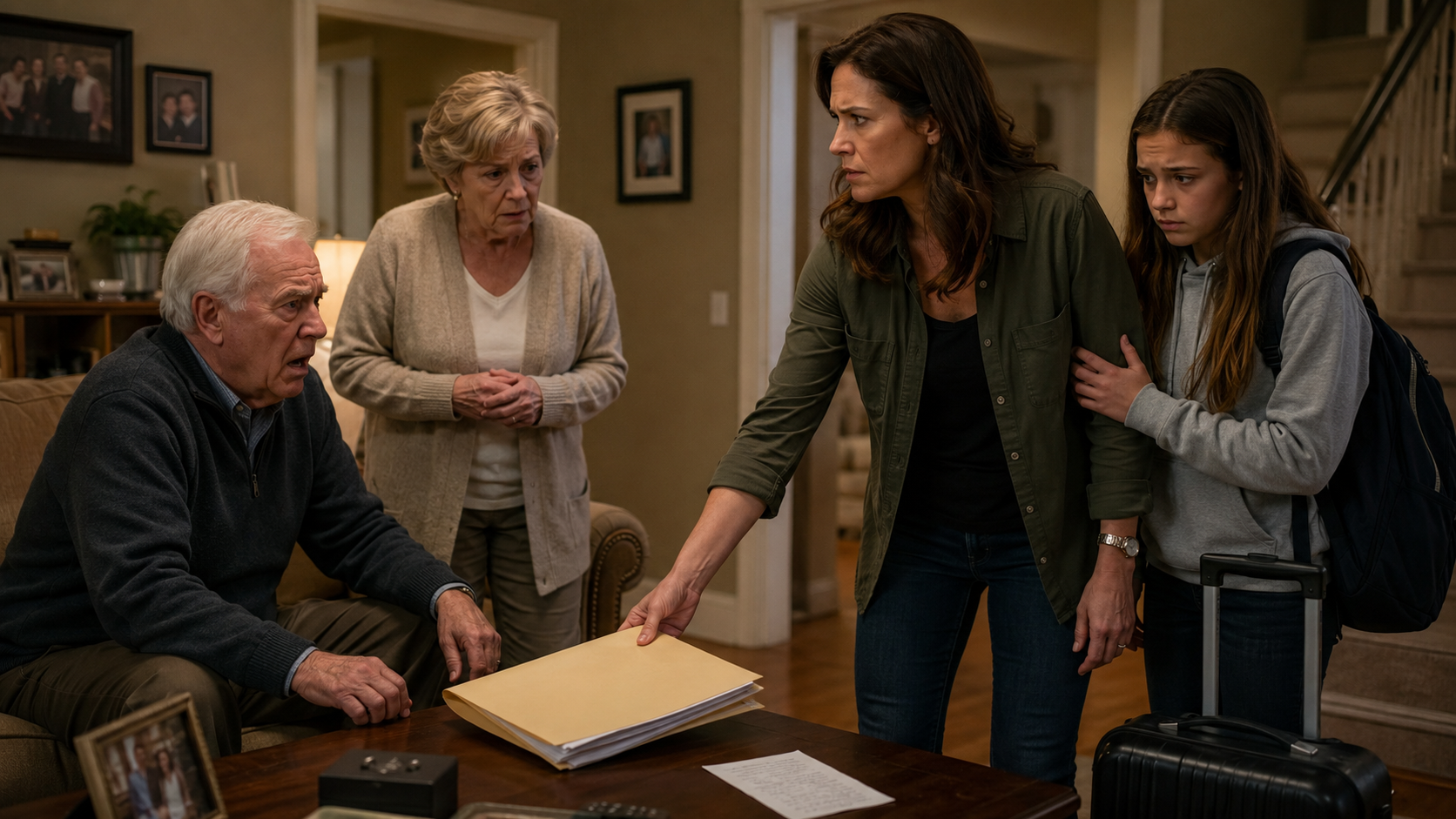
While I was away on a work trip, my fourteen-year-old daughter woke up to a note from my parents: “Pack your things and leave. We need the room for your cousin. You’re not welcome here.”
I was in the middle of a client presentation in Phoenix when my phone kept vibrating across the table.
I ignored the first call, then the second.
But when Emma’s name appeared for the third time, something felt wrong.
I stepped out into the hallway and answered.
At first, there was only silence.
Then her voice came through, small and shaky, barely holding together.
“Mom… Grandpa and Grandma made me leave.”
My hand tightened around the phone.
“What do you mean they made you leave?”
She sniffled.
“There was a note on my bedroom door this morning. It said, ‘Pack your things and leave. We need the room for your cousin. You’re not welcome here.’”
For a second, the entire hallway tilted.
My parents had begged me to let Emma stay with them while I traveled for work. They said it would be good for her. They said she needed family around her. They said I worried too much.
“Where are you now?” I asked.
“At the bus stop,” she whispered. “I have my backpack. Grandma said I was old enough to figure it out.”
My chest went cold.
“Do not move,” I said. “Stay exactly where you are. I’m calling someone right now.”
I hung up and called my best friend, Nora, who lived twenty minutes from my parents’ house. She answered on the second ring.
“Nora, I need you to get Emma. Now.”
She did not ask questions. That is why she is family in every way that matters.
Then I walked back into the conference room, packed my laptop with shaking hands, and told my boss I had a family emergency.
Three hours later, I was on the first flight home.
By the time I landed, Nora had Emma safe at her house, wrapped in a blanket, drinking hot chocolate with swollen eyes. When I walked through Nora’s door, Emma stood up so fast the blanket fell off her shoulders.
“Mom,” she cried.
I pulled her into my arms and held on so tightly I could feel her heartbeat against mine.
She kept apologizing.
“I’m sorry. I didn’t mean to make trouble. I didn’t know where else to go.”
That broke something inside me.
My daughter had been abandoned by the people who were supposed to protect her, and somehow she still thought she was the problem.
I kissed the top of her head.
“You did nothing wrong,” I said. “Not one thing.”
Nora handed me the note in a plastic bag. Emma had kept it folded in her backpack.
The handwriting was my mother’s.
Pack your things and leave. We need the room for Tyler. You are not welcome here anymore.
Tyler was my sister’s son.
My parents had always favored my sister, Rachel. She was the golden child. Her son was the golden grandchild. Emma and I were tolerated when convenient, criticized when not.
But this was different.
This was not favoritism.
This was cruelty.
I told Emma to stay with Nora for the evening. Then I drove straight to my parents’ house.
My mother opened the door wearing her church cardigan, like she was prepared to look innocent before I even spoke.
“Oh,” she said. “You’re back already.”
I walked past her into the living room.
My father was in his recliner. Rachel was on the sofa, scrolling through her phone. Tyler sat on the floor playing video games.
Emma’s suitcase was still by the front door.
They had not even brought it inside.
My father muted the television.
“You don’t need to come in here making a scene,” he said.
I looked at him.
“You put my child out of the house.”
My mother sighed.
“Emma is dramatic. We only told her she needed to go stay somewhere else because Rachel and Tyler needed the guest room.”
“She was at a bus stop alone,” I said.
Rachel rolled her eyes.
“She’s fourteen, not four.”
“She is a child.”
My father leaned forward.
“She is your responsibility, not ours. We helped as much as we could.”
I laughed once, not because anything was funny, but because the sound was better than screaming.
“You begged me to leave her here.”
My mother folded her arms.
“And we changed our minds. That is our right. This is our house.”
That was the first lie.
I reached into my bag and pulled out the folder.
Plain manila. Thick. Waiting.
The room changed the second they saw it.
My mother’s eyes moved to my father.
Rachel sat up.
My father frowned.
“What is that?”
I placed the folder on the coffee table.
“Three hours after I got home, I promised myself I would give you one chance to tell the truth.”
My father’s face tightened.
“What truth?”
I opened the folder and pulled out the first document.
“The deed.”
My mother went still.
I placed it in front of them.
“This house does not belong to you.”
Rachel scoffed.
“What are you talking about?”
I looked at her.
“It belonged to Grandma Helen. When she died, she left it in a trust. Half for Dad. Half for me.”
My father stared at the paper.
His lips parted.
“Wait… what is this?”
I slid the next page forward.
“A copy of the trust. Certified by the county clerk.”
My mother’s face lost color.
“How did you even get that?”
“From the courthouse,” I said. “Where legal records live when people forget lies do not erase ink.”
For years, my parents told me Grandma Helen had left everything to my father. I believed them because I was young when she died. I believed them because families like ours train the quiet daughter not to ask questions.
But six months earlier, after my parents started hinting that Emma and I should “know our place,” I requested a copy of the estate file.
I did not know what I was looking for.
I only knew something had never felt right.
What I found was worse than I expected.
My grandmother had left me half the house and half the savings account connected to it. My father had never disclosed it. My mother had helped him transfer funds, pay taxes from the trust, and treat the property as if it belonged only to them.
I had been quietly building the case with an attorney while still trying to convince myself I would never need to use it.
Then they threw my daughter out.
My father picked up the trust document with trembling fingers.
“This is old.”
“It is legal.”
My mother whispered, “We raised you.”
“No,” I said. “Grandma helped raise me. And apparently, she protected me better after death than you did while standing in front of my child.”
Rachel stood.
“This is insane. You’re really doing this over a bedroom?”
I turned to her.
“No. I’m doing this because a fourteen-year-old girl was told she was not welcome in a house she legally has more right to than you do.”
Tyler looked up from his game, confused now.
My father’s voice dropped low.
“You wouldn’t sue your own parents.”
I pulled out the final document and placed it on top.
“You’ve already been served.”
My mother grabbed the arm of the sofa.
Rachel’s mouth fell open.
My father went pale before he even reached the second line.
The lawsuit demanded a full accounting of the trust, repayment of misused funds, and removal of my father as trustee. It also requested an emergency order preventing them from selling, transferring, or removing assets from the property.
My mother started crying.
Not sorry tears.
Caught tears.
“You’re destroying this family,” she said.
I thought of Emma sitting alone at a bus stop with her backpack and a handwritten eviction note from her own grandmother.
“No,” I said. “You did that before my plane landed.”
The case moved faster than they expected.
My attorney filed everything Monday morning. By Thursday, the court froze the accounts. Within a month, my father had to produce bank records, tax records, and years of withdrawals he could not explain.
He had used trust money to pay Rachel’s car loan, Tyler’s private school deposit, and renovations to the guest room Emma had been thrown out of.
The judge was not amused.
My father was removed as trustee.
The house was ordered sold unless I wanted to buy out his legal share after deducting the money he had taken.
I did.
Not because I wanted the house.
Because Emma did.
The day we moved in, she stood in the doorway of that same guest room, now freshly painted pale yellow, and asked, “Am I really allowed to sleep here?”
I hugged her from behind.
“Baby, this room is yours.”
She was quiet for a long time.
Then she said, “Grandma said I wasn’t welcome.”
I looked around the house my grandmother had tried to protect for me. The house my parents had lied about. The house my daughter had been kicked out of.
Then I said, “She doesn’t get to decide that anymore.”
My parents moved into a small rental across town. Rachel stopped speaking to me after the court ordered her to repay part of the money. My father still tells people I betrayed him.
That is fine.
People like him always call it betrayal when you stop letting them steal from you.
Emma is sixteen now.
She keeps the original note in a frame inside her closet, not because she wants to remember the pain, but because she says it reminds her of the day she learned one truth:
Being rejected by cruel people is not the same as being worthless.
And every time I pass her bedroom door, I remember the way my parents’ faces changed when they finally understood.
They had thrown my daughter out of a house that was never fully theirs.
Thanks for reading❤️ Follow Page For More Real Life Stories.