

Thirteen years after my husband walked away from me and our twin boys for another woman, I saw him again at the most prestigious academic competition in the state.
The second Nathan recognized me, the smile disappeared from his face.
“How dare you show up here,” he snapped.
He was so focused on protecting the spotlight around Preston—the son he proudly introduced to everyone as his brilliant golden child—that he barely noticed the two sixteen-year-old boys standing directly behind me.
He didn’t recognize them.
Not even for a second.
Eli and Ethan were the twin sons he had abandoned when they were three.
And before the day was over, those two boys were about to become the biggest surprise of the entire championship.
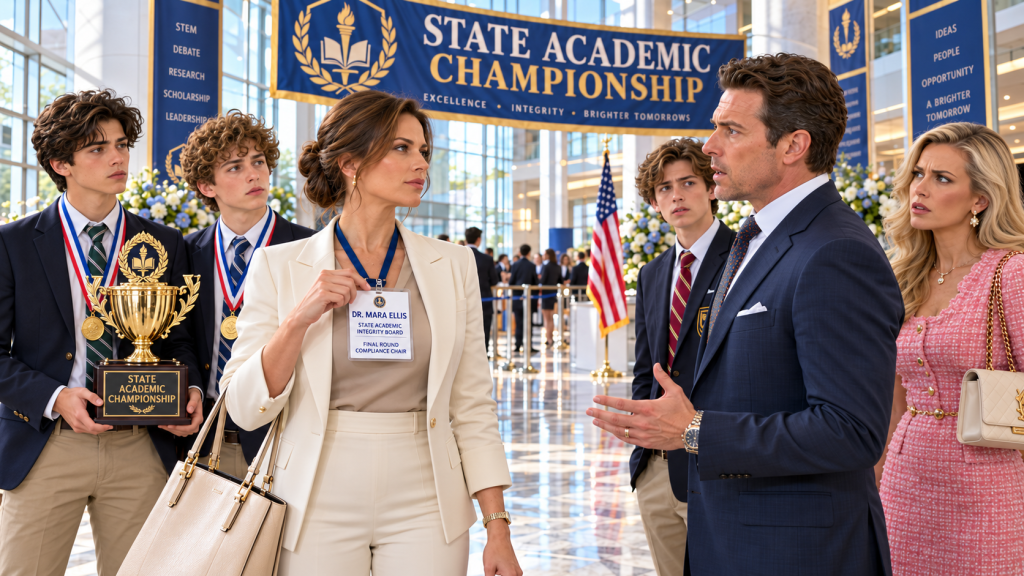
The first time I saw Nathan Crowe after thirteen years, he was standing beneath an enormous banner that read:
STATE ACADEMIC CHAMPIONSHIP
He looked polished.
Successful.
Completely at ease.
Like a man who had never once walked away from two small children and left their mother to rebuild an entire life alone.
Then his eyes found me.
His expression changed instantly.
“How dare you show your face here.”
The lobby of the Grand Whitmore Convention Center seemed to quiet around us.
Parents turned to look.
Students stopped talking.
Local news crews waited near registration, hoping to capture proud families and excited finalists.
Nathan stepped directly into my path.
At forty-six, he had become the kind of man strangers trusted immediately.
Expensive suit.
Luxury watch.
Perfect posture.
A smile that looked carefully rehearsed.
Beside him stood Celeste, the woman he had left me for.
She wore a cream blazer and a diamond necklace that probably cost more than my first car.
Between them stood Preston.
I already knew exactly who he was.
Anyone following the competition did.
Preston Crowe.
Math prodigy.
Debate champion.
Likely future valedictorian.
Nathan’s greatest source of pride.
Nathan’s eyes traveled over my simple navy dress and worn leather bag.
“This is an invitational event, Mara,” he said. “Not some reunion for people who don’t belong here.”
Celeste gave a small laugh.
“Nathan, be nice. Maybe she works here.”
I tightened my grip on the registration envelope in my hand.
Behind me, Eli and Ethan went completely still.
They were sixteen now.
Tall.
Quiet.
Dark-haired.
They had Nathan’s cheekbones and my eyes.
The last time their father had really looked at them, they were three years old.
Now they were standing only a few feet away.
Nathan looked directly past them.
Nothing.
No recognition.
Not even curiosity.
Ethan leaned slightly toward me.
“Mom?”
“I’m fine,” I whispered.
Nathan smirked.
“Listen carefully. Preston worked too hard for today to have it ruined by old mistakes.”
Old mistakes.
That was what he called them.
Thirteen years of birthdays he never attended.
Thirteen years without phone calls.
Thirteen years of me taking extra shifts, finishing night classes, searching for scholarships, and answering questions from two little boys who couldn’t understand why their father never came back.
I could have argued.
I could have reminded him of everything.
Instead, I calmly opened the envelope in my hand.
Then I removed three official badges.
I clipped the first one onto my dress.
Nathan’s expression changed.
Because the badge did not say PARENT.
It read:
DR. MARA ELLIS
STATE ACADEMIC INTEGRITY BOARD
FINAL ROUND COMPLIANCE CHAIR
For the first time since I arrived, Nathan looked uncertain.
I smiled.
“Good morning, Nathan.”
Then I stepped around him.
“Try not to embarrass yourself before the opening ceremony.”
Eli and Ethan followed me toward registration.
Nathan watched us leave.
He still had no idea who those boys were.
And he had absolutely no idea what they were about to accomplish.
Inside the championship hall, Nathan recovered quickly.
I watched from a distance as he introduced Preston to judges, donors, journalists, and university representatives.
“My son has been preparing for this since middle school,” I heard him tell one reporter.
He rested his hand proudly on Preston’s shoulder.
“Some kids are simply born exceptional.”
Preston smiled politely.
Unlike Nathan, he didn’t seem arrogant.
If anything, he looked exhausted.
There were dark circles beneath his eyes, and every time Nathan spoke for him, Preston’s shoulders tightened.
I filed that observation away.
Not because Preston was Nathan’s son.
Because I had spent enough years around high-achieving teenagers to recognize pressure when I saw it.
My job that day was not to judge scores.
That distinction mattered.
When Eli and Ethan qualified for the championship, I disclosed our relationship immediately.
I had been recused from reviewing their entries, their appeals, their scores, and every decision affecting their placement.
Another compliance officer handled their division.
My role in the final event was to oversee procedural integrity across the competition and intervene only if a rule violation affected the championship as a whole.
I had spent my adult life learning that integrity mattered most when protecting it was inconvenient.
Nathan, I would soon discover, still believed rules were obstacles other people were expected to follow.
The opening ceremony began at nine.
Hundreds of people filled the ballroom.
Students sat in reserved rows near the front.
Parents crowded behind them.
University recruiters occupied tables along the side walls.
The competition was divided into several categories: mathematics, scientific research, engineering design, logic, public argument, and the interdisciplinary final.
Only twelve students had qualified for the championship round.
Preston was one of them.
So were both of my sons.
Nathan apparently hadn’t studied the finalist list closely enough to notice their names.
That didn’t surprise me.
Thirteen years earlier, he hadn’t cared enough to know which twin preferred blueberries and which one hated the texture of mashed potatoes.
Why would he recognize their names on a website now?
The announcer stepped onto the stage.
“Ladies and gentlemen, welcome to the forty-second State Academic Championship.”
Applause filled the ballroom.
The finalists were introduced alphabetically.
A girl named Amelia Brooks walked onstage first.
Then Marcus Chen.
Then Preston Crowe.
Nathan shot out of his chair.
“That’s my boy!”
Several parents smiled.
Preston flushed and gave a quick wave.
Then came another name.
“Eli Ellis, representing Westbridge Academy.”
Nathan barely reacted.
Eli stood.
He wore the same charcoal suit I had bought him for homecoming.
As he passed me, he gave the smallest smile.
I mouthed, “You’ve got this.”
He walked onto the stage.
Thirty seconds later, the announcer continued.
“Ethan Ellis, independent research finalist and statewide mathematics qualifier.”
That got Celeste’s attention.
She turned toward Nathan.
“Ellis?”
Nathan frowned.
For the first time, he looked closely at the stage.
Ethan joined his brother beneath the lights.
The twins were not identical, though strangers often thought they were.
Eli was broader through the shoulders.
Ethan was half an inch taller.
But standing side by side, both with dark hair and the same sharp cheekbones Nathan saw in his own mirror every morning, the resemblance became much harder to ignore.
Nathan stared.
Celeste stared too.
Her face slowly lost its color.
“Nathan,” she whispered.
He didn’t answer.
The first round began.
Students were given complex mathematics problems and three minutes to submit solutions.
Preston was excellent.
There was no denying it.
He solved the first equation with twenty seconds remaining.
Nathan clapped loudly.
The second problem involved probability.
Preston answered correctly again.
Nathan leaned toward a reporter sitting nearby and said something that made the man laugh.
Then came the third problem.
It was harder.
Only four students answered correctly.
Eli was one of them.
Preston wasn’t.
Nathan stopped smiling.
The fourth problem was brutal.
A proof involving combinatorics and graph theory.
The timer began.
Thirty seconds passed.
Then sixty.
Students scribbled furiously.
Eli stopped writing after ninety seconds.
Ethan kept going.
Preston stared at his page.
When time expired, the judges collected the answers.
The chief mathematics judge stepped forward several minutes later.
“Only two finalists completed a correct proof.”
The room quieted.
“Eli Ellis and Ethan Ellis.”
The applause was enormous.
I stayed seated.
My hands were folded tightly in my lap.
Inside, every part of me wanted to stand on the chair and scream.
I remembered teaching those boys multiplication at the kitchen table while pasta boiled on the stove.
I remembered buying used science books from library sales because new textbooks were too expensive.
I remembered Ethan crying at age eight because another child had asked why he didn’t have a dad at career day.
I remembered Eli quietly telling him, “We’ve got Mom.”
Now they were standing beneath championship lights while hundreds of people applauded them.
I swallowed hard.
Nathan was staring at them as though someone had changed the language of the world without warning him.
Celeste leaned close.
“Are those—”
“I don’t know,” he whispered.
I heard him anyway.
I don’t know.
Three words that somehow contained thirteen years.
The competition moved into logic.
Then scientific reasoning.
Then argument analysis.
Preston recovered strongly.
He was sharp, disciplined, and clearly talented.
Eli excelled in mathematics and logic.
Ethan dominated the research questions.
After three rounds, the moderator approached the microphone.
“We currently have two students tied for first place overall.”
Nathan leaned forward.
The moderator smiled.
“Eli Ellis and Ethan Ellis.”
A low murmur moved through the room.
The scoreboard appeared on the screen.
ELI ELLIS — 184
ETHAN ELLIS — 184
PRESTON CROWE — 179
Nathan looked at the numbers.
Then at the twins.
Then at me.
I saw it happen.
Recognition.
Not the warm, emotional recognition a father might have after years apart.
Something colder.
Calculation.
He looked at their ages.
Their names.
Their faces.
Then he stood.
I knew he was coming before he took his first step.
I quietly moved toward the side aisle.
He intercepted me near a service corridor.
“Mara.”
I kept walking.
“Mara.”
His hand touched my elbow.
I stopped and looked down at it.
He removed it immediately.
“Those boys.”
“Yes?”
His face tightened.
“Are they Eli and Ethan?”
Behind him, Celeste stood several feet away.
She already knew the answer.
I looked directly into Nathan’s eyes.
“Yes.”
He blinked.
For one strange second, he looked genuinely shocked.
Then offended.
“You brought them here without telling me?”
I almost laughed.
Instead, I asked, “Telling you what?”
“That they were competing.”
“You’ve had thirteen years to learn what your children were doing.”
His jaw tightened.
“Don’t make this dramatic.”
“I’m not.”
“You could have warned me.”
“Warned you?”
I lowered my voice.
“That your sons exist?”
Celeste looked away.
Nathan glanced around, checking whether anyone was listening.
That told me everything.
His concern wasn’t Eli.
It wasn’t Ethan.
It wasn’t the fact that he had just failed to recognize his own children.
His concern was embarrassment.
“What have you told them about me?” he asked.
“The truth.”
His eyes sharpened.
“Your version of the truth.”
“No, Nathan. The documented version.”
He stared at me.
I continued calmly.
“You left when they were three. You moved in with Celeste six weeks later. You missed Eli’s emergency surgery. You stopped calling regularly before their fourth birthday. You canceled seven scheduled visits in eighteen months. At age five, they stopped asking when you were coming because you never came.”
“That is not what happened.”
“It’s exactly what happened.”
“You made it difficult.”
I felt something old and tired move inside me.
Not anger.
That had burned out years ago.
Nathan had no idea how freeing it was to stand in front of someone who once had the power to break you and realize they no longer had access to anything important.
“I mailed you school photographs every year until they were nine,” I said.
His expression changed slightly.
“I sent report cards. Birthday invitations. Their soccer schedule. Ethan’s science fair photographs. Eli’s spelling bee results.”
Nathan opened his mouth.
I continued.
“Then your attorney sent me a letter asking that all nonessential personal correspondence stop.”
Celeste turned sharply toward him.
“What letter?”
Nathan’s face hardened.
“This isn’t the place.”
“No,” I agreed. “It isn’t.”
I started to walk away.
He stepped in front of me again.
“If they’re my sons, there’s a conflict.”
There it was.
Not How are they?
Not Do they remember me?
Not Can I speak to them?
A conflict.
His eyes moved toward my badge.
“You’re on the integrity board. Your sons are competing. That cannot be allowed.”
I smiled faintly.
“I disclosed the relationship six months ago.”
Nathan froze.
“I am formally recused from every scoring decision involving them. Their papers are coded. Their judges were assigned independently. I have no access to their scoring portal until after certification.”
His expression darkened.
“And yet you’re compliance chair.”
“For the event as a whole.”
“That seems convenient.”
“For whom?”
He didn’t answer.
I leaned slightly closer.
“If you plan to file an objection, Nathan, use the official process. The forms are available at the compliance desk.”
Then I walked away.
For the next hour, I avoided him.
Not because I feared confrontation.
Because the day belonged to the students.
All of them.
Including Preston.
The interdisciplinary semifinal began shortly before noon.
Students were given a hypothetical problem involving water shortages, city budgets, and competing infrastructure demands.
They had fifteen minutes to analyze data and present a recommendation.
Preston delivered an impressive argument.
He spoke clearly and structured his points beautifully.
When he finished, Nathan was on his feet again.
Eli presented next.
His approach was different.
He identified a flaw in the cost assumptions provided by the hypothetical city council and rebuilt the model.
The judges asked four follow-up questions.
He answered every one.
Ethan followed.
Instead of focusing only on cost, he demonstrated how the proposed solution could unintentionally shift shortages into lower-income neighborhoods.
Then he offered an alternative model that reduced overall consumption while preserving emergency reserves.
When the final scores appeared, Ethan moved into first.
Eli remained second.
Preston fell to third.
Nathan’s face looked carved from stone.
During lunch, Eli and Ethan found me near the faculty lounge.
Ethan carried two sandwiches.
Eli handed me a bottle of water.
“You forgot lunch again,” he said.
“I was busy.”
“You always say that.”
“I’m your mother. I’m allowed.”
Ethan grinned.
“That’s not how nutrition works, Doctor.”
I laughed.
Then I saw both of their expressions change.
Nathan was walking toward us.
Alone.
“Boys,” he said.
Neither of them moved.
Nathan stopped about six feet away.
For the first time that day, his confidence seemed uncertain.
“I’m Nathan.”
Ethan’s eyebrows lifted.
“We know.”
Nathan swallowed.
“Right.”
Silence.
It stretched longer than he expected.
“I didn’t recognize you earlier.”
Eli looked at him.
“We noticed.”
Nathan flinched.
“I haven’t seen you since you were little.”
Ethan took a bite of his sandwich.
“That tends to happen when someone doesn’t visit.”
“Ethan,” I said quietly.
Not to protect Nathan.
To keep Ethan from saying something he might later wish he had handled differently.
Nathan shoved his hands into his pockets.
“I know things between your mother and me were complicated.”
Eli’s face changed.
“My brother and I weren’t married to Mom.”
Nathan frowned.
“What?”
“You leaving her doesn’t explain leaving us.”
Nathan stared at him.
I felt a painful flicker of pride.
Eli had always been quiet.
When he did speak, he rarely wasted words.
Nathan sighed.
“You’re young. You don’t understand everything that happened.”
Ethan lowered his sandwich.
“We’re sixteen, not six.”
Nathan looked at me as though I had somehow armed them.
I said nothing.
He turned back to the boys.
“Well, regardless of the past, you’ve both obviously done extremely well.”
There was the father I remembered.
Praise with conditions.
Affection arriving only after achievement.
“I’m proud of you.”
Neither boy reacted.
Then Ethan said, “You don’t know us.”
Nathan’s face tightened.
“I’m trying to.”
“No,” Ethan replied. “You found out ten minutes ago that we might win something.”
That landed.
Hard.
Nathan’s cheeks reddened.
Before he could answer, Preston appeared.
“Dad?”
Nathan turned.
Preston stopped when he saw us.
His gaze moved from Nathan to me.
Then to the twins.
He clearly understood.
“So it’s true,” Preston said quietly.
Nathan looked alarmed.
“Preston, this isn’t—”
“You have other sons.”
The cafeteria noise seemed suddenly distant.
Nathan stepped toward him.
“I was going to explain.”
“When?”
Preston’s voice remained calm.
“Tonight? Next year? After I won?”
“Don’t do this here.”
Preston laughed once.
There was no humor in it.
“That’s what you say every time something makes you look bad.”
Nathan looked around quickly.
“Lower your voice.”
Preston’s face hardened.
For the first time, I saw something in him that looked very much like Eli.
Not physically.
A refusal to be managed.
“You told me their mother kept them from you.”
Nathan’s eyes flicked toward me.
I said nothing.
Preston continued.
“You said you fought for years to see them.”
Celeste had apparently shared more than Nathan realized.
Ethan looked at me.
I nodded slightly.
He deserved to hear the truth.
Nathan’s voice dropped.
“It was complicated.”
Preston shook his head.
“You really like that word.”
He looked at Eli and Ethan.
“I didn’t know.”
Eli answered first.
“That’s not your fault.”
Something in Preston’s expression softened.
“Good luck in the final.”
Ethan nodded.
“You too.”
For a moment, the three boys simply stood there.
Nathan looked almost frightened by the sight of them.
Then Preston walked away.
Nathan followed.
The final round began at two.
Six competitors remained.
Preston.
Eli.
Ethan.
Amelia.
Marcus.
And a girl named Sofia Ramirez.
The championship challenge was unlike the earlier rounds.
Each student received the same packet containing a multi-layered problem combining mathematics, ethics, public policy, and scientific interpretation.
They were given forty-five minutes.
Then they would defend their conclusion before a panel of university professors.
Halfway through the challenge, a compliance assistant approached me.
“Dr. Ellis?”
Something in her voice told me this wasn’t routine.
“What happened?”
“We received an anonymous integrity complaint.”
My stomach tightened.
“Against whom?”
She hesitated.
“Eli and Ethan Ellis.”
I immediately stepped away from the floor.
“Transfer it to Dr. Shah.”
“Already done.”
“Good.”
“What should I tell the executive panel?”
“That I am recused completely.”
She nodded.
Then lowered her voice.
“The complaint alleges they received advance access to the championship problem through you.”
I looked across the ballroom.
Nathan was watching me.
There was something in his expression.
Satisfaction.
I understood immediately.
But understanding wasn’t proof.
And integrity depended on proof.
Not suspicion.
“Follow procedure,” I said.
The assistant nodded.
The executive panel quietly convened.
Eli and Ethan were allowed to finish their work while the complaint was investigated.
Within twenty minutes, Dr. Shah found me.
“The allegation is unsupported.”
I exhaled.
He continued.
“The championship problem was generated yesterday evening by three professors using the secure system. You never had access.”
“I know.”
“There’s more.”
He handed me a printed sheet.
“The complaint was submitted from a device connected to the convention center’s guest network.”
“That doesn’t tell us much.”
“No. But the complainant attached a photograph supposedly showing you giving Eli an envelope marked FINAL QUESTIONS.”
My stomach turned.
There was indeed a photograph.
It showed me handing Eli a white envelope that morning.
The words FINAL QUESTIONS appeared across it.
Except the envelope I had given Eli contained emergency medical information and his identification forms.
And I knew something the anonymous complainant apparently didn’t.
The competition used blue envelopes for all secured academic materials.
White envelopes were deliberately prohibited.
“Who submitted this?” I asked.
“We don’t know yet.”
“Then don’t speculate.”
Dr. Shah studied me.
“You know exactly who you think did it.”
“I do.”
“And?”
“And what I think is irrelevant.”
He nodded slowly.
“That’s why you’re good at this job.”
The complaint was dismissed.
Eli and Ethan were not informed until after the final round.
I wanted them focused.
The six finalists took the stage one at a time.
Preston went first.
He was brilliant.
No exaggeration.
His reasoning was precise.
His mathematics was nearly flawless.
When one professor challenged his ethical assumptions, he adapted without becoming defensive.
The crowd gave him a standing ovation.
Even I applauded.
Whatever Nathan had done, Preston had earned that moment.
Eli presented fourth.
He began nervously.
I could see his hand trembling slightly.
Then Professor Han asked him a question involving resource optimization.
Everything changed.
Eli forgot the crowd.
He forgot the cameras.
He forgot his father.
He became the boy I had watched sitting cross-legged on the living-room carpet solving puzzles years above his grade level.
He filled an entire digital board with equations.
Then stopped.
Erased half of them.
And said, “Actually, that model is mathematically efficient but socially indefensible.”
One judge leaned forward.
“Explain.”
Eli did.
For eleven minutes.
When he finished, the room was silent for half a second.
Then applause exploded.
Ethan was last.
His challenge was different.
The judges pushed him hard on evidence.
One professor told him his conclusion sounded idealistic.
Ethan smiled.
“With respect, idealism without data is wishful thinking. But data without values is just arithmetic.”
A murmur ran through the room.
He continued.
“If the mathematically cheapest answer predictably harms the people with the fewest alternatives, then cost alone is an incomplete measure of efficiency.”
I felt tears burn behind my eyes.
Not because he sounded clever.
Because I knew where that belief came from.
Ethan remembered being the child in the apartment where the air conditioner broke and I couldn’t afford the repair until payday.
He remembered free lunch forms.
He remembered me choosing which bill could wait.
He remembered what numbers looked like when they belonged to actual people.
When he finished, several judges were smiling.
The students were dismissed while scores were reviewed.
That was when Nathan approached the compliance table.
“I want the twins disqualified.”
He said it loudly enough for three people to hear.
Dr. Shah looked up.
“Mr. Crowe?”
“There’s an obvious conflict of interest.”
“I understand a complaint was already reviewed.”
“I’m filing formally.”
Dr. Shah nodded.
“You’re entitled to do so.”
Nathan placed a document on the desk.
I remained ten feet away.
He glanced at me.
“You should excuse yourself.”
“I already have.”
He seemed almost disappointed.
Celeste arrived moments later.
“Nathan.”
He ignored her.
She touched his arm.
“We need to talk.”
“Not now.”
“Yes, now.”
Something in her voice made him turn.
She looked furious.
“You filed the complaint.”
Nathan’s expression changed.
“What are you talking about?”
“The anonymous complaint.”
“I don’t know anything about it.”
Celeste held up his tablet.
“You left this in the suite.”
The lobby seemed to shrink.
Nathan stared at the tablet.
Celeste continued.
“The photograph is in your recently edited files.”
He went pale.
Dr. Shah slowly stood.
“Nathan,” I said.
His eyes snapped toward me.
I hadn’t called him by his first name that softly in years.
“What did you do?”
“Nothing.”
Celeste laughed bitterly.
“You cropped Mara’s envelope and added the words FINAL QUESTIONS.”
Nathan looked at her.
“Keep your voice down.”
“No.”
People nearby were listening now.
Preston stood near the ballroom doors.
His face had gone white.
Nathan realized too late that he was there.
“Preston.”
“Did you try to get them disqualified?”
Nathan walked toward him.
“I was protecting you.”
Preston backed away.
“From what?”
Nathan stopped.
“From losing?”
Preston asked.
“No.”
“Then what?”
Nathan had no answer.
Preston’s voice broke slightly.
“They’re your sons too.”
“You don’t understand.”
“I understand perfectly.”
He pointed toward Eli and Ethan, who had just entered the lobby with another finalist.
“You found out they were better than you expected, and instead of being proud, you got scared they might beat me.”
Nathan shook his head.
“That’s not what happened.”
Preston looked devastated.
“Then tell me what happened.”
Nathan said nothing.
Dr. Shah spoke.
“Mr. Crowe, I need the tablet.”
Nathan turned sharply.
“You have no authority to take my property.”
“You submitted an integrity allegation using fabricated supporting material. That affects the championship.”
“I submitted nothing.”
Celeste unlocked the tablet.
Nathan stared at her.
She handed it to Dr. Shah.
“The browser history is still open.”
Nathan’s face twisted.
“Celeste.”
She looked at him with a coldness I recognized.
The coldness that comes when the person beside you finally becomes impossible to defend.
“Don’t,” she said.
Dr. Shah took the device.
The investigation moved quickly after that.
Nathan had created the misleading image.
He had used a temporary email address.
He had submitted the complaint minutes after realizing Eli and Ethan were his sons.
The executive panel concluded there had been a deliberate attempt to manipulate the competition.
But Nathan wasn’t a contestant.
They couldn’t deduct points from him.
And Preston had not participated.
That mattered.
Several board members initially worried about optics.
One suggested postponing the awards.
Another suggested removing Preston until everything could be reviewed.
I spoke only once.
“Do not punish a student for misconduct committed by a parent unless there is evidence the student participated.”
The room went quiet.
Dr. Shah nodded.
“I agree.”
Preston remained eligible.
So did Eli and Ethan.
Nathan was removed from the restricted championship area.
Security didn’t drag him out.
There was no dramatic scene.
No shouting.
That would have been easier for him.
Instead, two event officials calmly informed him that his credential had been revoked.
Everyone watched him remove the gold parent badge from his jacket.
For a man who cared so deeply about appearing important, quiet humiliation was devastating.
Celeste did not leave with him.
Neither did Preston.
Nathan looked at Preston before walking away.
“Come on.”
Preston shook his head.
“I’m staying for the awards.”
“I said we’re leaving.”
“I heard you.”
Nathan’s jaw tightened.
“I’m your father.”
Preston looked at him for a long moment.
Then he said quietly, “Maybe start acting like one.”
Nathan walked out alone.
The awards ceremony began forty minutes later.
All six finalists returned to the stage.
I sat in the second row beside Dr. Shah.
My hands were shaking beneath the program.
The announcer began with special recognitions.
Sofia won the Public Reasoning Award.
Marcus received the Scientific Analysis Medal.
Amelia won the Judges’ Leadership Prize.
Then came the top three.
“In third place, with an extraordinary final score of 287 points…”
Preston closed his eyes.
“Preston Crowe.”
The room erupted.
Celeste stood.
So did I.
Preston looked surprised when he saw me applauding.
Then he smiled.
For the first time that day, it looked like his own smile rather than Nathan’s.
He accepted the bronze medal.
The announcer continued.
“We have never had this happen in the history of the State Academic Championship.”
My heart stopped.
“The difference between our top two competitors is less than one tenth of a scoring point.”
Eli reached for Ethan’s hand.
They had done that as toddlers crossing parking lots.
They hadn’t done it in years.
The announcer opened the envelope.
“In second place…”
Silence.
“Eli Ellis.”
The ballroom exploded.
I stood before I could stop myself.
Eli laughed.
Actually laughed.
He hugged Ethan first.
Then walked across the stage.
I had seen Eli win dozens of academic awards.
He usually accepted them with an embarrassed smile.
This time, he lifted the silver medal and looked directly at me.
I covered my mouth.
Then the announcer smiled.
“And your State Academic Champion…”
Ethan was already crying.
“Ethan Ellis.”
I will remember the sound of that room for the rest of my life.
Hundreds of people rising.
Applause crashing against the ceiling.
Ethan bending forward with both hands over his face.
Eli grabbing him around the shoulders.
Preston reaching across the podium to hug him.
For one perfect moment, none of those boys were Nathan Crowe’s children.
They weren’t symbols of anyone’s success.
They weren’t weapons in an old marriage.
They were simply sixteen-year-old kids who had worked incredibly hard.
Ethan stepped to the microphone after receiving the championship trophy.
Champions were allowed a brief statement.
He unfolded a small piece of paper.
Then folded it again.
“I wrote something,” he said.
A few people laughed softly.
“But I don’t think I need it.”
He looked toward me.
“My brother and I grew up with one parent.”
The room became still.
I shook my head slightly.
Not because I wanted him to stop.
Because suddenly I knew I was going to cry in front of five hundred people.
Ethan continued.
“Our mom worked during the day and studied at night. Sometimes she fell asleep with textbooks open beside her.”
A few people smiled.
“She taught us that being smart isn’t about knowing everything. It’s about being willing to learn what you don’t know.”
My vision blurred.
“She also taught us that when people underestimate you, you don’t always have to argue with them.”
Eli grinned.
Ethan looked toward the ballroom doors Nathan had exited through.
“You can just keep building a life they eventually won’t be able to ignore.”
The audience erupted again.
I was crying openly now.
Ethan looked back at me.
“This is yours too, Mom.”
I shook my head.
“No.”
He smiled.
“Yes.”
After the ceremony, reporters surrounded the boys.
University representatives introduced themselves.
Photographers asked Eli and Ethan to stand together.
Preston joined them for several pictures.
That mattered to me more than any medal.
There had been enough competition between adults.
The boys didn’t need to inherit it.
Eventually the crowd thinned.
Celeste approached me.
For several seconds, neither of us spoke.
Thirteen years earlier, I had hated her.
I had imagined every cruel conversation possible.
I blamed her for destroying my family.
Then life taught me something uncomfortable.
Nathan had made vows to me.
She hadn’t.
She had done things I could never respect.
But he had been the one responsible for being a husband.
And he had been the one responsible for being a father.
“I owe you an apology,” Celeste said.
I studied her.
“For which part?”
She almost smiled.
“More than one.”
Then the smile disappeared.
“When Nathan told me about the divorce, he said you were keeping the boys from him.”
“I know.”
“He showed me messages.”
That surprised me.
“What messages?”
“Screenshots supposedly from you. Saying he wasn’t allowed to visit unless he paid you more money.”
I stared at her.
“I never sent anything like that.”
“I know that now.”
She looked down.
“I should have asked more questions.”
“Yes.”
She looked up again.
“I’m not asking you to forgive me.”
“Good.”
The honesty seemed to surprise her.
I softened slightly.
“But Preston shouldn’t carry this.”
Her eyes filled.
“I agree.”
“I mean it, Celeste. Whatever happens between you and Nathan, don’t make that boy responsible for managing his father’s emotions.”
She nodded.
“He’s been doing that for years.”
I looked toward Preston.
He was standing with Eli and Ethan.
They were comparing medals.
Three boys.
One father.
Three completely different childhoods.
And somehow all three had been shaped by Nathan’s need to make everything reflect back on him.
“I think he deserves the chance to figure out who he is without being somebody’s trophy,” I said.
Celeste wiped beneath one eye.
“So do your sons.”
“They already have.”
That evening, we drove home with Ethan’s trophy wedged between the twins in the back seat because it was too large for the trunk.
For the first twenty minutes, neither boy spoke.
Then Eli said, “Mom?”
“Yes?”
“Did Dad really fake the complaint?”
I tightened my hands around the steering wheel.
“Yes.”
Ethan stared out the window.
“Because he thought we might beat Preston?”
“I can’t tell you exactly what he was thinking.”
“He said he was protecting him.”
I sighed.
“Sometimes people use the word protecting when they actually mean controlling.”
Silence.
Then Eli asked the question I had known would eventually come.
“Why didn’t he want us?”
My throat tightened.
Even after medals.
Even after applause.
Even after becoming the best student in the state.
A sixteen-year-old boy could still become three years old with one question.
I pulled into an empty parking lot and stopped the car.
Then I turned around.
“Listen to me.”
Both boys looked at me.
“Your father’s choices were never a measurement of your worth.”
Ethan’s eyes dropped.
“I know.”
“No. You understand that logically. I need you to know it somewhere deeper.”
Neither spoke.
“Nathan wanted a life that made him feel important. At that time, responsibility made him feel trapped. That wasn’t because you were difficult children. You were three.”
Eli stared at his hands.
“He could’ve come back.”
“Yes.”
“He could’ve called.”
“Yes.”
“He could’ve done anything.”
“Yes.”
Eli nodded slowly.
I reached into the back seat.
He took my hand.
Then Ethan grabbed the other one.
“We’re allowed to be angry?” Ethan asked.
“Yes.”
“Even after today?”
“Especially after today.”
“What if we don’t want a relationship with him?”
“That’s your decision.”
“What if we do someday?”
I smiled through tears.
“That’s also your decision.”
Ethan nodded.
Then he looked at the trophy between them.
“Can we go get burgers?”
I laughed so hard I nearly cried again.
“Yes.”
That was how the State Academic Champion celebrated.
Double cheeseburger.
Large fries.
Chocolate shake.
Eli ordered two desserts because, according to him, second place required emotional support.
For three days, Nathan didn’t contact us.
On the fourth morning, an email arrived.
The subject line read FAMILY DISCUSSION.
It was six paragraphs long.
Nathan said emotions had been high.
He said misunderstandings had occurred.
He said all adults involved had made mistakes.
That sentence almost impressed me with its audacity.
Then he wrote that he wanted to begin building a relationship with “the boys.”
He never used their names.
At the bottom, he suggested we meet privately first to agree on “appropriate messaging.”
I responded with four sentences.
Eli and Ethan were sixteen.
Any relationship Nathan wanted with them would begin with honesty.
I would not script their feelings for his comfort.
And all communication would happen directly, respectfully, and at their pace.
Nathan replied within twelve minutes.
You’ve always been difficult.
I didn’t answer.
Two weeks later, he called Eli.
Eli let it go to voicemail.
Then Nathan called Ethan.
Same result.
That evening, the boys listened to the messages together.
Nathan sounded strange.
Formal.
He congratulated them.
He said he had always wondered how they were doing.
Ethan paused the recording.
“That’s a lie.”
Eli shrugged.
“Maybe he wondered.”
“Wondering is free.”
That sentence stayed with me.
Wondering is free.
Showing up costs something.
Time.
Pride.
Convenience.
Apologies.
Effort.
Nathan had always preferred the free version of love.
Several months passed.
Eli and Ethan received scholarship offers.
Universities started sending letters even though they still had another year of high school.
Ethan’s championship presentation was published by an education journal.
Eli qualified for a national mathematics camp.
Life became wonderfully ordinary again.
Laundry.
Homework.
Arguments over whose turn it was to empty the dishwasher.
Then Nathan surprised us.
He showed up at Eli’s mathematics regional.
No cameras.
No Celeste.
No expensive gift.
He sat in the last row.
Eli saw him.
He didn’t acknowledge him.
Nathan stayed anyway.
Afterward, he approached cautiously.
“Good job.”
“Thanks.”
Nothing more.
Nathan left.
A month later, he attended one of Ethan’s research presentations.
Again, he sat in the back.
Again, no performance.
After the presentation, Ethan spoke to him for almost five minutes.
When we got to the car, I didn’t ask what they had discussed.
Ethan eventually told me.
“He apologized.”
I glanced over.
“For what?”
“He actually listed things.”
That surprised me.
“What things?”
“Missing birthdays. Not visiting. The complaint. Saying you kept us away.”
Ethan looked out the window.
“He said he lied about that.”
“How did you feel?”
“I don’t know.”
“That’s allowed.”
“He cried.”
I waited.
Ethan frowned.
“I thought seeing him cry would make me feel better.”
“Did it?”
“No.”
I nodded.
“Sometimes accountability doesn’t feel satisfying. It just makes the truth clearer.”
Nathan’s marriage to Celeste ended the following year.
I didn’t celebrate.
By then, I had no interest in Nathan losing things.
The opposite of love isn’t hatred.
It’s irrelevance.
Preston stayed in touch with the twins.
That surprised all of us.
He visited our house one Saturday to work on a mathematics project with Eli.
The first time he came inside, he stood awkwardly in the entryway holding a bakery box.
“My mom said never go to someone’s house empty-handed.”
Ethan opened the box.
“Chocolate croissants?”
“Yeah.”
“You can stay.”
Preston laughed.
Within an hour, the three boys were arguing over an equation at the dining-room table.
I stood in the kitchen listening.
There was something deeply strange and deeply beautiful about it.
Nathan had spent years trying to divide life into winners and losers.
Yet the healthiest thing his sons did was refuse to compete for his love.
They built something with each other instead.
A year after the championship, graduation arrived.
Eli finished salutatorian.
Ethan was valedictorian.
They had argued for weeks about whether that meant Ethan was allowed to boss Eli around.
Eli maintained that second place alphabetically still counted as moral superiority.
Preston graduated from his school the same weekend.
He finished third in his class.
Nathan attended all three ceremonies.
At ours, he sat several rows behind me.
When Ethan gave his valedictorian speech, he spoke about opportunity.
Not abandonment.
Not revenge.
Not Nathan.
That was when I realized my boys had moved somewhere their father could not reach.
Not away from him.
Beyond him.
Their lives no longer required his failure to explain their success.
After graduation, Nathan approached me outside the auditorium.
“You did a good job.”
I looked at him.
Years earlier, that sentence might have enraged me.
As though raising our children had been a project he could now grade.
Instead, I simply said, “I know.”
He gave a small nod.
Then he looked toward Eli and Ethan.
“They’re good men.”
“They’re getting there.”
“I missed everything.”
There was no defense in his voice.
Just fact.
“Yes.”
He swallowed.
“I thought there would always be time.”
I looked at him carefully.
“That’s the lie people tell themselves when they want permission not to show up today.”
He nodded.
Then he said something I never expected.
“I’m sorry, Mara.”
I believed him.
Not because the apology repaired anything.
Some things cannot be repaired.
But I believed he finally understood what he had done.
“I hope you become better,” I said.
His eyes watered.
“You don’t forgive me?”
I considered the question.
“I stopped needing to punish you years ago.”
“That’s not the same thing.”
“No.”
He waited.
I smiled faintly.
“Forgiveness doesn’t mean pretending the cost disappeared.”
Nathan looked toward our sons.
Eli had his arm around Ethan while Preston took a photograph of them.
Three boys laughing in graduation gowns.
“You’re right,” he said.
Then he walked toward them slowly.
He stopped several feet away.
He waited until Eli noticed him.
And this time, Nathan didn’t force his way into the picture.
He asked.
“Would it be okay if I got one photo with you?”
Eli looked at Ethan.
Ethan looked at Preston.
Then both twins looked at Nathan.
“Okay,” Eli said.
Nathan stepped beside them.
Not between them.
Beside them.
Preston handed me the phone.
I took the photograph.
When I looked at the screen afterward, I noticed something.
Nathan wasn’t smiling at the camera.
He was looking at the boys.
Really looking at them.
Maybe for the first time.
Years later, people still remembered that state championship.
Sometimes educational organizations invited Ethan to speak about his winning presentation.
Eli eventually joked that his greatest academic achievement was losing first place to someone who shared his face and stole his socks.
Both boys attended universities on substantial scholarships.
Preston chose a university hundreds of miles from Nathan and studied engineering.
The three stayed in contact.
Nathan’s relationship with Eli and Ethan developed slowly.
Not into the storybook version he probably once imagined.
There were no miraculous erased years.
No instant “Dad.”
No montage that turned absence into redemption.
He called.
Sometimes they answered.
He visited.
Sometimes they invited him.
He learned their birthdays without checking a calendar.
He learned Eli drank coffee black.
He learned Ethan hated being interrupted while reading.
He learned things he should have known a decade earlier.
And the boys learned something too.
A person could regret abandoning you without being entitled to reclaim the place they abandoned.
Reconciliation was not ownership.
Forgiveness was not amnesia.
Love, when it came at all, had to be built through repetition.
Small choices.
Ordinary consistency.
Showing up when nobody was watching.
As for me, I eventually became director of the State Academic Integrity Board.
The first morning I moved into my new office, I found a framed photograph waiting on my desk.
Eli and Ethan had placed it there.
It was taken on championship day.
Not the medal photograph.
Not the trophy.
It showed the three of us sitting on a hallway bench between rounds.
I was eating the sandwich Eli had forced into my hand.
Ethan was laughing.
Eli was leaning against my shoulder.
None of us knew anyone was taking the picture.
Beneath the frame, the boys had taped a note.
Mom,
Everybody remembers who stood on the stage.
We remember who got us there.
Love,
Eli & Ethan
I sat alone in my office and cried for ten full minutes.
Not because Nathan had lost.
That had never been the victory.
The victory was that my children had grown up without becoming cruel.
The victory was that hardship had made them compassionate instead of bitter.
The victory was that after thirteen years of being treated like something disposable, I had built a life so full that Nathan’s opinion no longer had anywhere important to land.
For years, I believed the most painful moment of my life was watching my husband carry his suitcase out of our apartment while two three-year-old boys slept upstairs.
I remembered standing in the doorway.
I remembered asking him whether he planned to say goodbye to them.
He had looked toward the stairs.
Then toward his car.
“They’re asleep,” he said.
As though that settled it.
For a long time, that memory hurt because I thought it proved we had been abandoned.
Eventually, I understood something else.
Nathan walked away carrying one suitcase.
I stayed carrying everything else.
The bills.
The fear.
The exhaustion.
The bedtime stories.
The fevers.
The school projects.
The broken appliances.
The grocery lists.
The college applications.
The tears.
The laughter.
The ordinary Tuesday nights nobody photographs.
At the time, his suitcase looked lighter.
Years later, I realized mine had contained all the valuable things.
And on the morning those twin boys walked onto a championship stage and their father stared directly at them without recognizing them, I thought I was witnessing the final proof of everything Nathan had failed to see.
I was wrong.
The real proof came later.
It came when Eli shook Preston’s hand instead of treating him like an enemy.
It came when Ethan insisted Preston should not lose points for his father’s behavior.
It came when both boys allowed Nathan the chance to apologize without pretending his apology rewrote history.
It came when they stepped into adulthood knowing their worth had never depended on the man who once walked away.
That was the accomplishment no scoreboard could measure.
Nathan spent years chasing the appearance of having an exceptional son.
I spent years raising two exceptional human beings.
And in the end, that difference mattered far more than any trophy ever could.
💬THE END! THANK YOU FOR READING!