

For eight years, my parents made me leave the house whenever my brother brought his fiancée home.
My mother always said the same thing.
“She comes from a good family, Stacey. Don’t embarrass us.”
My father had his own version.
“Just disappear for the weekend. It isn’t that difficult.”
So I disappeared.
I disappeared on birthdays, holidays, summer weekends, and Sunday afternoons when my family gathered around the dining table.
I disappeared when my brother proposed.
I disappeared when his future in-laws came for Thanksgiving.
And I disappeared on the Saturday before Easter in 2022.
But that weekend was different.
Because I returned to the house unexpectedly, discovered what my parents had been hiding for eight years, and left again.
Only this time, I never came back.
It took my parents four years to discover where I had gone.
And when they finally found me, they learned something that hurt them far more than losing their daughter.
They learned that I had built a beautiful life without them.
But the story began long before that.
At 10:52 on a Saturday morning, my mother stood six feet away from me and sent a text instead of speaking.
Every weekend be gone by 11.
I looked up from the duffel bag on my bed.
She stood in the doorway wearing her favorite cream cardigan, with her arms folded tightly across her chest.
“Did you get my message?”
“I can see you standing there, Mom.”
“Then you understand.”
I looked down at the two shirts folded beside my suitcase.
“Is Avery coming again?”
My mother’s expression tightened.
“Of course she’s coming. Mitch invited her family for lunch.”
“And I can’t stay?”
“We’ve discussed this.”
“I’m part of this family too.”
She gave me the exhausted look she used whenever I said something she didn’t want to hear.
“Stacey, please don’t start. Avery comes from a respectable family. Her father owns three medical clinics. Her mother runs a charitable foundation. We can’t have you making people uncomfortable.”
I stared at her.
“Making them uncomfortable by existing?”
“By bringing up things that are nobody else’s business.”
She glanced at the prescription bottles on my dresser.
Then she looked away.
I was eighteen years old.
Nine weeks earlier, I had returned home after a lengthy hospitalization for severe depression.
I had missed so much school that my teachers arranged for me to finish my senior year from home.
My doctors were optimistic.
My therapist encouraged me to rebuild ordinary routines.
I was attending appointments, taking my prescribed medication, and working hard to feel like myself again.
But my mother behaved as though I had committed an unforgivable crime.
She never called it depression.
She called it “your situation.”
Sometimes, when relatives asked where I’d been, she called it exhaustion.
Other times, she said I’d gone away to study.
She preferred any explanation that didn’t require her to admit her daughter had needed psychiatric care.
My father was different.
He wasn’t openly cruel.
He simply withdrew.
When I tried to talk about what had happened, he changed the subject to weather, football, or the price of gasoline.
At the time, I thought he was uncomfortable.
Years later, I understood something much more painful.
His silence was a choice.
That Saturday, I carried my duffel bag through the kitchen.
Dad was sitting at the table with his newspaper.
My car keys lay beside his coffee mug.
“Just disappear for the weekend,” he said without looking up.
I stood there for a moment, waiting for him to add something.
Maybe an apology.
Maybe a promise that things would be different next time.
He turned the page.
I picked up my keys.
Outside, the morning sunlight fell across our tidy Alabama neighborhood.
My brother Mitch’s Jeep turned onto the street just as I pulled away.
Avery Lockheart sat beside him, laughing at something he had said.
She was beautiful, with dark hair pulled into a ponytail and a smile that seemed completely effortless.
I wondered what kind of person she was.
I wondered whether we might have become friends.
But I never got the opportunity to find out.
That was the entire purpose of my parents’ arrangement.
I wasn’t supposed to exist when Avery was around.
I drove forty-five minutes south to a peach farm in Chilton County.
The farm belonged to Ruth Henderson, my best friend Casey’s grandmother.
Ruth was sixty-eight that year, with silver hair, sun-weathered hands, and the kind of voice that made you feel safe before she finished speaking.
She opened the farmhouse door, looked at my duffel bag, and sighed.
“Another family weekend?”
I nodded.
She stepped aside.
“Well, put your things down. I’ve got peaches that need thinning.”
“Don’t you want to know what happened?”
“Not unless you want to tell me.”
I followed her outside.
For three hours, we worked between rows of peach trees.
Ruth explained which fruit to remove, how to recognize damaged branches, and why a healthy tree sometimes needed careful pruning before it could grow properly.
I liked the work.
Trees didn’t ask uncomfortable questions.
They didn’t stare at my medication.
They didn’t whisper when I entered a room.
That afternoon, Ruth stopped beside an old peach tree that looked almost entirely dead.
The branches were bare.
Its bark had split during the winter.
“Most people wanted me to cut this one down,” she said.
“Why didn’t you?”
She took a small knife from her pocket and gently scraped a section of bark.
A narrow streak of green appeared beneath the brown surface.
“See that?”
I nodded.
“Green means she’s still living.”
She stepped back.
“Don’t let somebody decide you’re finished just because they can’t see what you’re becoming.”
I carried those words with me for years.
When Sunday evening arrived, Ruth packed leftover chicken, cornbread, and peach preserves into a cooler.
“Take this home.”
“My mother won’t like it.”
“Then tell her I won’t like hearing she let good food go to waste.”
I smiled.
It was the first genuine smile I’d managed in days.
When I returned home, my parents were watching television.
My mother barely glanced at me.
“Did you have a nice weekend?”
“Yes.”
“Good. Put your things away. Avery’s family may be coming again next Saturday.”
That was how it started.
One weekend became two.
Two became five.
By the end of the summer, I had spent more Saturdays away from home than inside it.
My mother began sending me reminders on Thursdays.
Lockhearts coming Saturday. Leave by eleven.
Or:
Avery staying overnight. Come home after four Sunday.
Sometimes the instructions arrived with a smiley face.
As though being excluded from my own family were a cheerful little arrangement.
The rules gradually expanded.
My car could not remain parked outside.
My shoes had to disappear from the front hallway.
My toiletries had to be removed from the upstairs bathroom.
When I asked why, my mother replied, “Avery might need to use it.”
One Friday, I returned from work and discovered that a locksmith had installed a keyed lock on the outside of my bedroom door.
I stood in the hallway staring at it.
My father came upstairs carrying a screwdriver.
“What’s this?”
“A lock.”
“I can see that. Why is it outside my room?”
“Your mother wants privacy when guests are here.”
“Privacy from what?”
He avoided my eyes.
“It’s temporary.”
It remained there for eight years.
I learned to carry my toothbrush in a zip-top bag.
I kept spare medication in my purse.
I stored a sweatshirt, phone charger, and change of clothes in my car.
Eventually, I stopped unpacking completely.
At nineteen, I graduated from high school.
There was no party.
My parents attended the ceremony, but they left immediately afterward because Mitch had planned dinner with Avery.
I stood outside the auditorium holding my diploma while other families took photographs.
Then I saw Ruth and Casey approaching with a bouquet of yellow roses.
Ruth hugged me so tightly that I almost cried.
“Your grandmother would be proud,” she whispered.
“My grandmother is still alive.”
Ruth smiled sadly.
“Then I hope she tells you.”
That evening, Ruth made a chocolate cake and invited three neighbors to celebrate.
It was the first time in months that I felt important.
I found work at a local garden center and enrolled in horticulture classes at the community college.
Plants made sense to me.
They needed light, water, patience, and attention.
If something went wrong, there was usually a reason.
Damaged roots.
Poor drainage.
An infection.
Neglect.
Nobody expected a struggling plant to apologize for struggling.
By twenty, I was working nearly full-time.
That was when my mother began charging me rent.
“Four hundred dollars a month,” she announced over breakfast.
I looked up.
“For what?”
“Room and board.”
“But I’m barely allowed to use my room.”
Her eyes narrowed.
“Don’t be dramatic.”
“I spend almost every weekend somewhere else.”
“You’re an adult, Stacey. Adults contribute.”
I wanted to point out that Mitch was twenty-five and still had his phone bill paid by our parents.
I wanted to mention the Jeep Dad had bought him.
Instead, I wrote a check.
I wasn’t ready to leave permanently.
Some part of me still believed I could earn my way back into the family.
Maybe if I worked hard enough.
Maybe if I caused no trouble.
Maybe if I became someone they could brag about.
I would eventually understand that none of those things mattered.
My parents weren’t waiting for me to improve.
They were waiting for me to disappear more completely.
The strangest part was Avery.
For years, I knew almost everything about her.
I knew she loved lemon cake.
I knew her favorite flowers were white tulips.
I knew she was studying nursing.
I knew she wanted to work with children.
I knew Mitch had proposed during a weekend trip to Savannah.
All that information came from conversations I overheard, photographs displayed around the house, and stories my mother told relatives.
But Avery knew nothing about me.
At least, that was what I believed.
One evening, after Avery had been part of my brother’s life for nearly three years, I finally asked my mother.
“What does Avery think about me?”
Mom was drying dishes.
She didn’t even pause.
“She thinks you live in Atlanta.”
I blinked.
“What?”
“We told her you work there. You’re very busy.”
“Why would you tell her that?”
“Because it was simpler.”
“Mom, I’ve never lived in Atlanta.”
“Then don’t make me a liar.”
She placed a plate in the cabinet and walked away.
I stood at the sink feeling something collapse inside me.
My own mother had invented another version of my life because the real one embarrassed her.
But even then, I didn’t know how enormous the lie had become.
At twenty-two, I received a promotion at the garden center.
Contractors began asking for me specifically.
I could diagnose common tree diseases, recommend soil improvements, and explain grafting techniques better than employees who had been there for decades.
One customer called me “the tree whisperer.”
I laughed when he said it.
Then I went home and found another text from my mother.
Lockhearts visiting this weekend. Don’t forget.
I had spent the entire day helping strangers save things they loved.
At home, I was still something my family wanted hidden.
That winter, my maternal grandmother died.
She had been declining for years, and during her final months she often confused names and dates.
I visited when I could.
Sometimes she recognized me.
Sometimes she didn’t.
But one afternoon, she held my hand and whispered, “You were always a good girl, Stacey.”
I remembered those words at her funeral.
The church was crowded.
Mitch stood near the front with Avery.
My parents greeted mourners beside a large photograph of Grandma.
I approached my mother.
“Where should I sit?”
She glanced over my shoulder.
“Avery’s family is here.”
“I know.”
“Just find somewhere toward the back.”
I looked at my father.
He examined the flowers beside the casket.
So I sat in the last pew.
Afterward, I returned to my car and opened the funeral program.
The obituary listed Grandma’s surviving relatives.
One daughter.
One grandson.
My name wasn’t there.
I read it twice.
Then I folded the program and put it in my coat pocket.
That was the first time I wondered whether my family wasn’t simply embarrassed by me.
Maybe they wanted the world to forget I had ever existed.
Still, I stayed.
Hope can be a stubborn thing.
Especially when it’s attached to people you’ve loved since childhood.
In October 2019, something happened that should have revealed the truth.
Avery walked into the garden center.
I recognized her immediately.
She wore blue scrubs, white sneakers, and a student identification badge clipped to her pocket.
She approached the nursery counter.
“Excuse me. Can you help me find a dogwood tree?”
“Of course.”
“I need a really healthy one.”
“Is it going into a yard or a larger planting area?”
“A church memorial garden.”
She hesitated.
“My boyfriend’s family lost someone years ago. His mother helps organize a remembrance service every spring.”
My stomach tightened.
I assumed she meant Grandma.
I showed her several flowering dogwoods and explained the differences.
We selected a strong specimen with an excellent root system.
As I wrote the care instructions, Avery watched my hands.
“Do I know you?”
My pen stopped.
“I don’t think so.”
She tilted her head.
“You look incredibly familiar.”
“Maybe you’ve been here before.”
“No. That’s not it.”
She smiled apologetically.
“Sorry. I work in a hospital. I see so many faces.”
I handed her the tag.
Graft is good. Water deep the first summer. She’ll bloom.
Avery read it and smiled.
“That’s beautiful.”
“It’s just a care note.”
“Sometimes simple things are beautiful.”
She paid and left.
I stood behind the counter watching her load the dogwood into her vehicle.
I could have told her.
I could have said, “My name is Stacey Williams. I’m Mitch’s sister.”
But eight years of learning to stay invisible had made speaking feel dangerous.
So I remained silent.
For weeks afterward, I wondered what might have happened if I’d introduced myself.
I didn’t know that Avery had spent years hearing stories about a young woman named Stacey Williams.
And I certainly didn’t know she believed that young woman had died.
Three years later, on the Saturday before Easter 2022, my mother sent another message.
Lockhearts for supper Saturday. Sunrise service Sunday. Be gone by 10:00.
I was twenty-six.
Eight years had passed since the first Saturday I’d been ordered out of the house.
I had a steady job, a savings account, and enough experience to manage an entire nursery.
Yet every weekend, I still packed a bag like an unwanted guest.
I left at 9:40 that morning.
Ruth was waiting at the farm.
By then, she was seventy-six and moved more slowly, but her mind was sharper than anyone else’s I knew.
We spent the afternoon preparing young peach trees for spring planting.
At supper, she studied me across the kitchen table.
“Stacey, how long are you going to keep doing this?”
“Doing what?”
“Going somewhere you’re not welcome and calling it home.”
I pushed a piece of cornbread around my plate.
“They’re my parents.”
“That isn’t an answer.”
“I know.”
Ruth folded her napkin.
“You’ve got enough money saved for a place of your own.”
“I’m trying.”
“You’ve been trying for eight years.”
I looked toward the darkened kitchen window.
“Some days I think if I leave, it’ll mean they were right about me.”
“Why?”
“Because they always wanted me gone.”
Ruth reached across the table.
“Leaving people who hurt you doesn’t prove they were right.”
Her voice softened.
“It proves you’ve finally decided they don’t get to decide everything.”
I said nothing.
Later that night, while preparing for bed, I opened my overnight bag.
My medication wasn’t there.
I searched every pocket.
Then I remembered.
I had refilled my organizer on Friday and left the prescription bottles inside my bedroom drawer.
Missing a dose wasn’t something I wanted to risk.
Ruth appeared in the doorway.
“What’s wrong?”
“I forgot my medication.”
“Can the pharmacy help?”
“Not this late. I have enough information to call tomorrow, but I really shouldn’t miss tonight.”
Ruth picked up her car keys.
“Then go get what belongs to you.”
“They’re still entertaining.”
“It’s your home, isn’t it?”
I looked at her.
She held my gaze.
“Go get what’s yours, sweetheart. Then come straight back.”
I drove north just before ten.
The Lockhearts’ black Suburban was still parked in our driveway.
Lights glowed from every downstairs window.
I parked beneath a magnolia tree at the end of the block and approached the house through the side yard.
I didn’t want a confrontation.
I only wanted to slip inside, collect my medication, and leave.
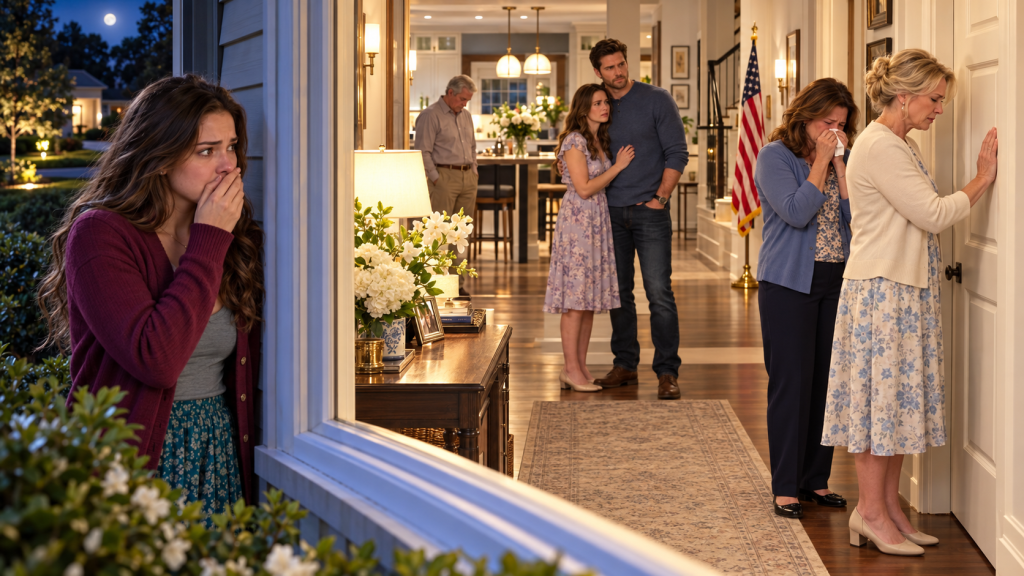
But as I passed the hallway window, I stopped.
Inside, Suzanne Lockheart stood outside my bedroom door.
My mother stood beside her, pressing a tissue to her eyes.
Avery held Mitch’s arm.
My father leaned against the kitchen doorway, staring at the floor.
Suzanne placed her palm against my bedroom door.
“May I say a prayer here?” she asked.
My mother nodded.
“Of course.”
Suzanne lowered her head.
“Lord, we remember Stacey tonight. We remember a young life taken far too soon. We ask that her memory continue to bring comfort to those who loved her.”
My heart began pounding.
Young life?
Taken too soon?
I gripped the windowsill.
Suzanne continued.
“Bless the family who carries her loss every day, and bless the work being done in her name.”
I stared through the glass.
My mother began crying.
Not silently.
She made the kind of broken, theatrical sound I’d heard at funerals.
Avery stepped forward and wrapped an arm around her.
“We love you, Mrs. Williams.”
My mother whispered, “Thank you, sweetheart.”
And Mitch stood there.
My brother, who had known me since birth.
My brother, who had watched me leave the house hundreds of times.
My brother, who had once whispered that he was sorry.
He stood there while his fiancée prayed for his very much alive sister.
He said nothing.
I backed away from the window.
For several minutes, I couldn’t move.
The night air felt too cold.
I thought perhaps I’d misunderstood.
Maybe the prayer was symbolic.
Maybe they were mourning the person I’d been before the hospital.
Maybe there was some bizarre explanation that would make sense once I heard it.
I waited until the Lockhearts left.
Then I waited another forty minutes until the upstairs lights went dark.
Just before midnight, I entered through the back door.
The alarm code still worked.
The kitchen smelled of roasted chicken and expensive perfume.
Crystal glasses stood beside half-empty coffee cups.
A white tablecloth covered the dining table.
Near the center sat a silver picture frame, half wrapped in tissue paper.
I moved closer.
Inside was my senior-year photograph.
The one my mother had removed from the hallway eight years earlier.
Below the picture was a silver plate engraved with six words.
IN LOVING MEMORY OF STACEY WILLIAMS.
Underneath were two dates.
My birthday.
And the date I had been discharged from the hospital.
For several seconds, I couldn’t understand what I was seeing.
Then the meaning reached me.
According to the people who visited my family, I had died at eighteen.
According to my parents, the day I returned from the hospital was the day my life ended.
I picked up the frame.
A folded letter slipped from behind it.
The envelope bore the seal of the Lockheart Family Foundation.
I unfolded the paper.
“Dear Mr. and Mrs. Williams, we are pleased to confirm the continuation of our annual financial assistance in honor of your late daughter, Stacey Williams.”
I read farther.
There was a reference to the Stacey Williams Recovery Initiative.
A statement about community outreach.
An annual amount.
$75,000.
My mouth went dry.
Seventy-five thousand dollars.
Every year.
For eight years.
I stared at the paper, trying to make the numbers mean something other than what they appeared to mean.
Then a floorboard creaked behind me.
“Stacey?”
I turned.
My father stood in the hallway wearing pajama pants and a faded college sweatshirt.
His eyes moved from my face to the letter in my hand.
The color drained from his cheeks.
“You weren’t supposed to come home.”
For eight years, I had imagined finally confronting my parents.
I thought I would shout.
I thought I would cry.
Instead, my voice sounded strangely calm.
“Dad, why does this say I’m dead?”
He took a step toward me.
“Put that down.”
“Why?”
“It’s complicated.”
“Then explain it.”
He rubbed both hands over his face.
“Your mother should be here.”
“No.”
“Stacey—”
“You are standing here. You know what’s happening. Explain it.”
His gaze dropped to the foundation letter.
Something changed in his expression.
Fear replaced embarrassment.
“Where did you find that?”
“On the table.”
“Has anyone else seen it?”
I laughed.
It wasn’t a happy sound.
“That’s what you’re worried about?”
“Lower your voice.”
“Why does Suzanne Lockheart think I’m dead?”
My father closed his eyes.
“Because we told her you were.”
The room went completely silent.
I felt as if the floor had shifted beneath me.
“Why?”
He didn’t answer.
“Dad. Why?”
He pulled out a dining chair and sat down heavily.
“It wasn’t supposed to go this far.”
I remained standing.
He stared at his hands.
“When Mitch first brought Avery around, your mother didn’t know how to explain your hospital stay.”
“So she said I died?”
“No. Not at first.”
He swallowed.
“She said we’d suffered a terrible family tragedy.”
I stared at him.
“Suzanne misunderstood. She thought we’d lost you.”
“And you corrected her?”
My father’s silence answered for him.
I looked at the framed photograph.
“Tell me the rest.”
He spoke slowly, stopping often.
Suzanne Lockheart had devoted much of her life to charitable work.
When she believed the Williams family had lost a daughter after a mental health crisis, she offered her sympathy.
Then she offered something more.
The Lockheart Family Foundation was expanding its support for mental health outreach.
Suzanne proposed establishing a community initiative in my memory.
My parents were supposed to help coordinate educational programs, referral services, and local support activities.
At first, the proposed grant had been modest.
Then the funding increased.
Eventually, the foundation approved seventy-five thousand dollars annually for the initiative.
My mother and father were listed as its local administrators.
“And what happened to the money?” I asked.
Dad looked away.
“We used some of it.”
“For what?”
“Expenses.”
“What expenses?”
“Stacey, you wouldn’t understand the paperwork.”
I placed the letter on the table.
“Try me.”
He said nothing.
I looked toward the renovated kitchen.
The new granite countertops.
The expensive refrigerator.
The vacation photographs on the living-room mantel.
Mitch’s Jeep.
The thousands of dollars my parents had spent celebrating his engagement.
Then I thought about the four hundred dollars I’d paid in rent every month.
“Did you use the money for yourselves?”
Dad’s eyes filled with tears.
“Some of it.”
“How much?”
He shook his head.
“Dad.”
“I don’t know the exact amount.”
“Eight years.”
He covered his face.
“You let people believe I’d been dead for eight years.”
Footsteps sounded on the stairs.
My mother appeared wearing a silk robe.
“What is all this noise?”
Then she saw me.
Her eyes widened.
“Stacey! What are you doing here?”
I held up the frame.
She stopped.
For a moment, nobody moved.
Then her expression hardened.
“You had no right to go through our things.”
I looked at her in disbelief.
“Your things?”
“That was a private gift.”
“It has my name on it.”
“Stacey, lower your voice.”
“Why does everyone think I’m dead?”
She glanced at my father.
“What did you tell her?”
He stared at the table.
I stepped between them.
“No. You tell me.”
My mother drew herself upright.
“What happened eight years ago was extremely difficult for this family.”
“It was difficult for me. I was the one in the hospital.”
“Everyone suffered.”
“So you told people I died?”
She pressed her lips together.
“It started as a misunderstanding.”
“And you kept it going.”
“We were protecting your privacy.”
I looked at the foundation letter.
“By accepting seventy-five thousand dollars a year?”
Her face changed.
“That’s not your concern.”
“It’s literally in my name.”
“The foundation funded a charitable initiative.”
“And where is that initiative?”
My mother folded her arms.
“We’ve done plenty for this community.”
“Name one person you helped.”
She opened her mouth.
Then closed it.
For the first time in eight years, she couldn’t find a sentence that made me feel small.
I looked at both my parents.
“Does Mitch know?”
Neither answered.
“Does my brother know I’m supposed to be dead?”
My mother sighed.
“He knows there was an unfortunate misunderstanding.”
“Unfortunate?”
“Don’t be hysterical.”
That word did something to me.
It took me back to being eighteen, sitting on my bedroom floor after leaving the hospital, trying to explain how frightened and lonely I felt.
Every time I cried, my mother called me hysterical.
Every time I questioned her, she called me unstable.
I recognized the tactic now.
She wanted me to doubt my own reaction.
But there was nothing confusing about what I’d found.
They had erased me.
And then they had accepted money for the story of my disappearance.
I took my phone from my pocket.
My mother immediately stepped forward.
“What are you doing?”
“Taking pictures.”
“You absolutely will not.”
I photographed the frame.
Then the letter.
Then the envelope.
My father stood.
“Stacey, please.”
I looked at him.
“Did you ever think about telling the truth?”
His eyes were wet.
“Every day.”
“Then why didn’t you?”
He swallowed.
“Because your mother said we would lose everything.”
I waited.
He added, almost inaudibly, “And I was afraid she was right.”
There it was.
Not confusion.
Not protection.
Fear of losing money and social standing.
My father had watched me disappear every weekend because telling the truth might cost him something.
I walked upstairs.
My mother followed.
“Where are you going?”
“To get my medication.”
“You cannot just walk away from this conversation.”
I stopped in the hallway.
“Really?”
She stared at me.
I turned toward her.
“Because walking away is exactly what you’ve demanded of me for eight years.”
I unlocked my bedroom.
Inside, the room looked almost exactly as it had when I was eighteen.
My old curtains.
My school trophies.
The faded quilt my grandmother had made.
It wasn’t a bedroom anymore.
It was a storage room for a daughter they had publicly buried.
I opened my dresser and collected my medication.
Then I took my birth certificate, Social Security card, passport, and banking documents from the small fireproof box beneath my bed.
I packed my grandmother’s quilt.
Three books.
A photograph of Casey and me at sixteen.
And the yellow notebook in which I had recorded every weekend I’d been ordered to leave.
Eight years of dates filled its pages.
I carried everything downstairs.
My father stood beside the kitchen island.
My mother waited near the front door.
“You are not leaving in the middle of the night,” she said.
I looked at her.
“Watch me.”
“You have nowhere to go.”
That was the first thing she’d said all night that made me smile.
“I have somewhere.”
She reached for my bag.
“Stacey, think carefully. If you tell people about this, you could destroy your brother’s future.”
I pulled the bag away.
“You’re still worried about Mitch?”
“His wedding could be ruined.”
“My entire life has been built around protecting his relationship.”
“Don’t exaggerate.”
I looked directly into her eyes.
“I’ve spent eight years hiding so your friends wouldn’t know I was alive.”
She had no response.
I turned to my father.
“Did you know I kept hoping you’d ask me to stay?”
His mouth trembled.
“Stacey—”
“Every weekend, I hoped one of you would say, ‘Actually, she’s our daughter. She belongs here.’”
He lowered his head.
“You never did.”
I opened the door.
My mother spoke behind me.
“If you walk out now, don’t expect us to come begging.”
I looked over my shoulder.
“For the first time in my life, Mom, I’m not expecting anything from you.”
Then I walked away.
Ruth was awake when I returned.
She sat at the kitchen table beside a pot of tea.
One look at my face was enough.
“Oh, honey.”
I put my bag down.
Then I handed her my phone.
She examined the photographs without speaking.
When she reached the foundation letter, her expression turned grim.
“Did they tell these people you died?”
I nodded.
Ruth set the phone down carefully.
“Sit.”
I sat.
For the next hour, I told her everything.
The memorial service.
The framed photograph.
The money.
My father’s confession.
My mother’s anger.
When I finished, Ruth covered my hand with hers.
“Listen carefully. You are not responsible for what they did.”
I started crying.
Not because I was surprised.
Because nobody in my family had said anything so kind in years.
Ruth let me cry.
She didn’t interrupt.
She didn’t tell me to calm down.
She didn’t accuse me of being dramatic.
When I could finally speak again, I whispered, “I don’t want to go back.”
“Then don’t.”
“What if they come looking for me?”
Ruth looked toward the dark windows.
“Then they’ll learn that a grown woman is allowed to choose where she lives.”
The next morning was Easter Sunday.
While my parents attended church with the Lockhearts, I sat at Ruth’s kitchen table and made a list.
Close my old bank account.
Change my mailing address.
Transfer my phone number to an account I controlled.
Collect my employment records.
Find an attorney.
Most importantly, decide what kind of life I wanted.
Not what my parents wanted.
Not what Mitch needed.
What I wanted.
By noon, my phone had seventeen missed calls.
Six from my mother.
Four from my father.
Seven from Mitch.
I listened to one voicemail.
My brother sounded frantic.
“Stacey, please call me. Mom says you found some documents. You don’t understand the situation. Avery’s asking questions. Please don’t do anything until we talk.”
I deleted the message.
Then I turned off my phone.
On Monday, I visited my bank and moved my savings into a new account.
I also paid for a consultation with an attorney named Hannah Mercer.
She was in her early forties, with short auburn hair and a reputation for speaking plainly.
I showed her the photographs.
Then the yellow notebook.
Then eight years of text messages ordering me out of the house.
She examined everything.
Finally, she asked, “Are you financially dependent on your parents?”
“No.”
“Do they have access to your accounts?”
“Not anymore.”
“Good.”
I felt my shoulders relax.
“Can they stop me from leaving?”
“No. You’re twenty-six years old.”
“What about the foundation money?”
Her expression became serious.
“That requires careful investigation. We don’t know yet where the funds went, what the foundation was told, or which records were submitted.”
“Are you saying they might get away with it?”
“I’m saying we need evidence, not assumptions.”
She leaned forward.
“Stacey, your first responsibility is to protect yourself. The people who provided that funding deserve to know the truth, but we can make sure it’s handled properly.”
I nodded.
For the first time, I wasn’t acting out of panic.
I was making decisions.
Hannah helped me prepare a factual statement.
It explained who I was, that I was alive, and that I had never authorized a memorial program or representation that I had died.
We attached copies of my identification, the photographs, and the foundation letter.
Then we contacted the Lockheart Family Foundation.
Suzanne called Hannah’s office two days later.
She wanted to meet me.
I wasn’t sure I could bear it.
But Hannah offered to attend, and I agreed.
We met in a quiet conference room.
Suzanne entered carrying a leather folder.
Avery followed.
Both women looked nervous.
When Suzanne saw me, she stopped in the doorway.
“Oh, my goodness.”
Avery stared.
Then her hand flew to her mouth.
“The garden center.”
I nodded.
“You sold me the dogwood.”
“Yes.”
She looked from my face to Suzanne’s.
Then back again.
“You’re Stacey?”
“Yes.”
Avery lowered herself into a chair.
For a long moment, nobody spoke.
Suzanne’s eyes filled.
“We were told you died eight years ago.”
“I know.”
She pressed a hand over her heart.
“We held memorial services for you.”
“I know.”
“We established a program because we thought your family wanted to help other young people.”
I looked at her.
“I found out four days ago.”
Avery started crying.
Not loudly.
Just tears slipping down her cheeks.
“I asked Mitch about you once,” she whispered.
“What did he say?”
“He told me you were his little sister. He said losing you was the worst thing that ever happened to your family.”
I closed my eyes.
Hearing it hurt more than I expected.
My brother hadn’t merely allowed the lie.
He had repeated it.
Avery continued.
“I showed him the care note from the dogwood. I told him the woman at the nursery looked familiar.”
I opened my eyes.
“What did he say?”
“He said I was imagining things.”
Suzanne reached across the table.
“Stacey, I am so sorry.”
I looked at her.
“You didn’t do this.”
“No. But I trusted people I should have questioned.”
She opened her folder.
“The foundation’s annual grant was intended to support outreach services. Your parents submitted reports describing support groups, educational materials, and community referrals.”
“Did those things exist?”
“We’re examining that now.”
She hesitated.
“We also have records that may indicate some money went toward legitimate charitable expenses. But significant amounts are unaccounted for.”
Hannah nodded.
“Then we’ll cooperate with your review.”
Suzanne looked at me again.
“I want you to know something. You were never an embarrassment to us.”
Those words struck harder than any apology.
For eight years, my mother had insisted that the Lockhearts were too respectable to know me.
Now Suzanne was sitting across from me, looking genuinely devastated that we’d never met.
Avery wiped her cheeks.
“I would have wanted to know you.”
I smiled sadly.
“I think I would have liked that.”
She reached for my hand.
“Can I ask you something?”
“Of course.”
“Why didn’t you tell me at the nursery?”
I looked down.
“Because I’d spent so long being told I wasn’t supposed to exist around you that I forgot I had a choice.”
Avery began crying again.
After that meeting, everything changed quickly.
The foundation suspended payments to the program.
An independent accounting firm began reviewing eight years of records.
Hannah helped me prepare a sworn statement.
Investigators requested bank documents, invoices, and grant reports.
I learned things I wished I hadn’t.
Some of the money had paid for legitimate community events.
A few small workshops had actually taken place.
But large portions had been diverted.
There were invoices for services that could not be verified.
Payments to vendors connected to my father’s business.
Reimbursements for travel unrelated to the program.
Expenses described so vaguely that even the foundation’s accountants couldn’t determine their purpose.
My parents had also used their position as administrators to gain status in the community.
They attended charity dinners.
They appeared in local newsletters.
My mother received an award for her “strength in the face of unimaginable loss.”
I saw the photograph online.
She stood beside Suzanne, smiling beneath a banner with my name on it.
I remembered all the Saturdays she’d ordered me to leave.
And I realized she’d been living two lives.
In one, she was the grieving mother of a beloved daughter.
In the other, she was the woman who made that daughter hide her toothbrush in a car.
The investigation took months.
There were interviews and financial reviews.
Eventually, the foundation pursued civil action to recover improperly used funds.
Authorities also investigated the false records submitted in connection with the grants.
I won’t pretend the legal process was simple or satisfying.
There were delays.
Disagreements.
Documents nobody could locate.
Lawyers arguing over responsibility.
My father cooperated before my mother did.
According to records later disclosed during the proceedings, he admitted that he knew the foundation believed I had died.
He also acknowledged approving payments from the program account for expenses unrelated to its charitable purpose.
My mother insisted she had only wanted to preserve my dignity.
Even after everything, she couldn’t admit she’d been ashamed of me.
Mitch’s relationship with Avery collapsed within weeks.
She returned her engagement ring.
He called me the night it happened.
I answered because I wanted to hear what he would say.
“Stacey.”
His voice sounded exhausted.
“Avery left.”
I sat on Ruth’s porch watching the sun sink behind the orchard.
“I’m sorry you’re hurting.”
He was quiet.
Then he said, “You could have talked to me first.”
I looked across the rows of trees.
“Eight years, Mitch.”
“What?”
“You had eight years to talk to me.”
He breathed heavily into the phone.
“Mom said everything was under control.”
“Did you know Avery thought I was dead?”
Silence.
“Mitch.”
“Yes.”
I closed my eyes.
“Did you ever tell her otherwise?”
“No.”
“Why?”
His voice broke.
“Because by the time I realized how bad it was, I didn’t know how to fix it.”
I waited.
He added, “And I thought she’d leave me if she knew.”
That was the closest thing to an honest answer I’d ever heard from him.
“You were willing to lose your sister to keep your fiancée.”
“That’s not fair.”
“Neither was being erased.”
He began crying.
I felt sympathy.
But sympathy wasn’t forgiveness.
Before ending the call, I said something I had never said to him before.
“I love you, Mitch. But I don’t trust you.”
Then I hung up.
That summer, Ruth suffered a minor stroke.
She recovered well, but her doctor advised her to reduce the physical work around the farm.
I took time off to help.
We spent warm mornings sitting beneath the porch fan, sorting seed catalogs and discussing plans for the next planting season.
One afternoon, she surprised me.
“I’ve been talking to a friend in North Carolina.”
I looked up.
“About what?”
“A nursery.”
“What’s wrong with the nursery?”
“Nothing. That’s the point.”
She smiled.
“There’s a woman outside Asheville looking for someone to manage propagation and restoration projects. Small operation. Good people.”
I shook my head.
“Ruth, I can’t just move.”
“Why not?”
“My job. My friends. Everything.”
“Everything?”
I looked away.
She reached into a drawer and handed me a folded job advertisement.
“Don’t decide you’re trapped somewhere just because you’ve spent a long time there.”
I read it.
The position involved restoring damaged orchards, growing native trees, and working with local landowners.
It sounded like everything I loved.
I applied.
Two weeks later, I had a video interview.
A month after that, I drove to North Carolina for an in-person meeting.
The nursery sat between rolling hills and a narrow creek.
Rows of young trees stretched across the property.
There were greenhouses, propagation beds, and a weathered wooden office with a blue front door.
The owner, a woman named Elena Brooks, walked me through the grounds.
“We need somebody who doesn’t give up on a tree just because it looks rough,” she said.
I smiled.
“I learned from a woman who believes there’s usually something living beneath the bark.”
Elena laughed.
“Sounds like I’d get along with her.”
She offered me the job.
I accepted.
But before I left Alabama, there was one more thing I needed to do.
I went to the cemetery where my grandmother was buried.
For years, I’d carried the funeral program with my name missing from it.
I took it from my purse and unfolded it.
The paper had softened along the creases.
I sat beside her grave.
“Grandma, I don’t know whether you knew what they were doing.”
The wind moved through the grass.
“But I’m going somewhere new.”
I touched the headstone.
“I’m going to make a life you would recognize.”
Then I placed a small yellow rose beside her name.
I didn’t leave the funeral program.
I kept it.
Not because I wanted to hold on to the hurt.
Because I wanted to remember how far I’d come.
Two weeks later, I packed my car.
Ruth stood in the driveway with Casey beside her.
She hugged me.
“You’ll call when you get there?”
“Of course.”
“And when you start thinking nobody loves you?”
I laughed through tears.
“I’ll call you.”
“Good.”
Then she slipped a small package into my hand.
Inside was a cutting from the old peach tree she’d shown me when I was eighteen.
The tree everyone had thought was dead.
It had survived.
It had even produced fruit again.
“Take a piece of home with you,” Ruth said.
I looked at the cutting.
For the first time, the word home didn’t make me think of my parents’ house.
It made me think of Ruth’s kitchen.
Casey’s laughter.
Peach trees in the morning sun.
People who had made room for me without demanding that I become someone else.
I hugged Ruth again.
Then I drove away.
I changed my phone number shortly afterward.
Hannah retained a way to contact me about the legal proceedings.
Casey and Ruth had my new address.
My parents did not.
I didn’t announce my move online.
I didn’t leave a forwarding address that would take mail back to the Williams house.
And I asked the people I trusted not to share my location.
I wasn’t hiding from the world.
I was protecting the peace I’d finally found.
North Carolina changed me in ways I hadn’t expected.
At first, everything felt unfamiliar.
The mountains.
The cooler mornings.
The smell of wet leaves in autumn.
The way people greeted me without knowing my history.
Nobody introduced me as a tragedy.
Nobody asked why I’d embarrassed my family.
Nobody expected me to disappear when guests arrived.
At work, Elena trusted my judgment.
She gave me responsibility.
When I made mistakes, we discussed them and fixed them.
I kept waiting for someone to punish me for being imperfect.
They never did.
I rented a small cottage twenty minutes from the nursery.
It had a yellow front door and a porch overlooking a meadow.
The kitchen was tiny.
The floors creaked.
The bathroom needed repainting.
I loved every inch of it.
The first Saturday after moving in, I woke at seven.
I made coffee.
Watered the plants by the window.
Then I looked at the clock.
10:52.
For eight years, that hour had meant I should be leaving somewhere.
I stood in my kitchen with a mug in my hand.
Nobody texted me.
Nobody told me to hide.
Nobody asked me to take my car off the street.
I sat on the porch and watched a pair of bluebirds settle on the fence.
And I cried.
Not because I was sad.
Because I was allowed to stay.
Over the next year, I made friends.
Real friends.
People who invited me to dinner and looked disappointed when I couldn’t come.
People who remembered my birthday.
People who asked how I was and listened when I answered.
I joined a local gardening association.
I volunteered at a community orchard.
I began teaching weekend workshops on grafting and tree restoration.
One afternoon, a man named Daniel Reed attended a workshop with his teenage daughter.
He was a carpenter who built custom furniture and repaired old houses.
Afterward, he approached my demonstration table.
“My daughter says you’re the first person who’s ever made rootstock interesting.”
I laughed.
“That’s quite a compliment.”
He smiled.
“Would you like to get coffee sometime?”
I hesitated.
Not because I didn’t like him.
Because I’d spent so long believing there was something embarrassing about me that the idea of being wanted still felt unfamiliar.
Eventually, I said yes.
Daniel was patient.
He didn’t try to fix my history.
When I told him about my family, he listened.
Then he said, “You don’t have to convince me you deserved better.”
I fell in love with him slowly.
Not in the dramatic way people describe in movies.
It happened through ordinary things.
He brought soup when I was sick.
He remembered that I preferred tea in the evenings.
He listened when I spoke about Ruth.
He never used my medical history against me.
When I told him I needed a quiet weekend, he understood.
And when I invited him into my home, he treated it like somewhere precious.
Meanwhile, the situation in Alabama continued without me.
Through Hannah, I learned that the foundation had recovered part of the misused funding through a settlement and the sale of certain assets.
My parents were required to make additional restitution.
The investigation also resulted in criminal proceedings involving falsified grant documentation.
My father eventually accepted responsibility for his role.
My mother fought the allegations much longer.
There were consequences.
Their finances suffered.
Their social standing collapsed.
The house I’d once been forbidden to occupy during visits was eventually sold.
I learned these things from legal correspondence.
I didn’t celebrate.
For years, I thought seeing my parents lose everything would make me feel victorious.
Instead, I felt tired.
I hadn’t wanted their money.
I hadn’t wanted their humiliation.
I’d wanted them to tell people I was their daughter.
That had always been the simplest thing in the world.
And somehow it had been the one thing they refused to do.
In 2024, Avery sent me a message through Hannah.
She had finished her nursing education and begun working in pediatric care.
She wanted to apologize again.
I told Hannah she could share my email address.
Avery wrote a long letter.
She explained how difficult it had been to accept that Mitch had lied to her for years.
She had loved him.
She had expected to marry him.
But discovering that he could look her in the eyes and speak about his living sister as though she were dead had changed everything.
At the end, she wrote something I never forgot.
“I thought your family was grieving a daughter. I didn’t realize they were choosing to live without one.”
I read that sentence several times.
Then I replied.
I thanked her for telling the truth.
I told her I was doing well.
And I sent her a photograph of a flowering dogwood outside my cottage.
She answered immediately.
“Graft is good. Water deep the first summer. She’ll bloom.”
I smiled.
She still remembered.
We became friends.
Not close overnight.
But slowly, through occasional messages and phone calls.
When Ruth turned eighty, Avery sent her flowers.
Ruth was delighted.
“Imagine that,” she said when I told her.
“The girl they made you hide from turns out to be decent company.”
We laughed.
By 2025, I had helped restore several neglected orchards across western North Carolina.
Elena encouraged me to develop a small business specializing in tree rehabilitation and heritage fruit varieties.
I called it Green Beneath the Bark.
The name came from Ruth.
I started with weekend consultations.
Then small contracts.
Then larger restoration projects.
My reputation grew.
I hired two employees.
Daniel helped renovate a little building beside our main propagation area.
I filled it with old botanical prints, long worktables, and shelves holding jars of seeds.
Every morning, I unlocked the door and felt grateful.
Not because my life was perfect.
It wasn’t.
There were bills.
Difficult customers.
Late frosts.
Lost crops.
Days when old memories returned unexpectedly.
But they were ordinary problems.
They belonged to a life I had chosen.
By the spring of 2026, I had something my eighteen-year-old self could never have imagined.
A business.
A home.
People who loved me.
A future I was genuinely excited to live.
And I had made those things without asking my parents for permission.
Four years had passed since the Easter weekend when I discovered my own memorial photograph.
Four years without returning to the Williams house.
Four years without accepting a single phone call from my mother or father.
Then, in September 2026, a regional agricultural magazine published an article about my work.
A writer had visited our nursery to interview me about restoring damaged fruit trees.
The article included photographs of our orchards, a description of Green Beneath the Bark, and a short profile.
It mentioned my childhood in Alabama.
It mentioned Ruth.
And it included a photograph of me standing beside a mature peach tree, smiling with pruning shears in my hand.
The headline read:
THE WOMAN WHO BRINGS FORGOTTEN ORCHARDS BACK TO LIFE.
I didn’t think much about it.
Elena bought six copies.
Daniel framed one for my office.
Ruth cried when Casey read the article aloud to her.
Then, on a Thursday morning in October, an unfamiliar car pulled into the nursery parking lot.
I was inside the greenhouse checking young apple trees when one of my employees appeared.
“Stacey?”
I looked up.
“There’s a couple asking for you.”
“Customers?”
“They say they’re your parents.”
My hands went still.
For a moment, the greenhouse seemed completely silent.
Then I set down my pruning shears.
“Did they give you their names?”
“Margaret and Thomas Williams.”
I took a slow breath.
Four years.
It had taken them four years to find out where I went.
And now they were standing outside the peaceful life I’d built, expecting a door to open.
I told my employee I would handle it.
Then I called Daniel.
He answered immediately.
“Everything okay?”
“My parents are here.”
There was a pause.
“Do you want me to come?”
“Yes.”
“I’m on my way.”
I stepped outside.
My parents stood beside a silver sedan.
They looked older.
My father’s hair had turned almost entirely gray.
My mother wore a plain blue blouse and carried a handbag I didn’t recognize.
The expensive jewelry she once wore to every family event was gone.
When she saw me, she raised a hand to her mouth.
“Stacey.”
I stopped several feet away.
“Hello, Mom.”
She began crying.
Not delicately.
Not like she had outside my locked bedroom during Suzanne’s prayer.
This time, her shoulders shook.
“We finally found you.”
I looked at her.
“You weren’t supposed to.”
My father stepped forward.
“Sweetheart.”
I raised my hand slightly.
“Please don’t.”
He stopped.
His face crumpled.
“We’ve been trying to contact you.”
“I know.”
“Your old number stopped working. We didn’t know where you’d moved.”
“That was intentional.”
My mother wiped her cheeks.
“We saw the article.”
I nodded.
“Congratulations,” my father said.
His voice cracked.
“This place is beautiful.”
“Thank you.”
He looked toward the orchards.
“You did all this?”
“With a lot of help.”
My mother stared at the greenhouse, the rows of trees, and the employees moving between planting beds.
“I had no idea.”
That sentence almost made me laugh.
For eight years, she had lived in the same house as me and never asked what I did at work.
She didn’t know about the contractors who requested me.
She didn’t know about the certifications I’d earned.
She didn’t know I’d spent evenings studying orchard management.
She didn’t know the first thing about the person I’d become.
Now she was astonished that I had built something.
“Why are you here?” I asked.
My father looked at my mother.
She twisted the strap of her handbag.
“We wanted to see you.”
“Why now?”
“Because we finally know where you are.”
I studied her face.
“Mom, what do you want?”
She inhaled sharply.
“We want our daughter back.”
Those words should have made me happy.
For years, they were everything I’d wanted to hear.
Instead, I felt a quiet sadness.
“You don’t get to bring someone back after spending eight years pretending she was gone.”
My mother began crying harder.
“We made mistakes.”
I shook my head.
“A mistake is forgetting a birthday. A mistake is saying something cruel and apologizing afterward.”
She looked down.
“You told an entire community I was dead. You let strangers raise money in my memory. You made me disappear from my own home.”
My father’s eyes filled.
“I know.”
I turned to him.
“Do you?”
He nodded.
“I think about it every day.”
I studied the man who had once placed my keys beside the kitchen sink without looking up.
“Then you should understand why I’m not inviting you inside.”
My mother looked startled.
“We drove all this way.”
“I didn’t ask you to.”
“Stacey, we’re your parents.”
I held her gaze.
“Yes. You are.”
She waited.
I continued.
“And being my parents gave you the responsibility to protect me. It didn’t give you the right to erase me.”
For several seconds, nobody spoke.
Then my father reached into his jacket and took out a small envelope.
“I brought something.”
He offered it to me.
I hesitated before accepting it.
Inside was an old photograph.
I recognized it instantly.
I was six years old, sitting on my father’s shoulders at a county fair.
Mitch stood beside us holding a stuffed bear.
My mother was laughing.
We looked happy.
I remembered that day.
I remembered riding the carousel.
I remembered Dad buying us lemonade.
I remembered believing that nothing bad could happen as long as my parents were nearby.
My father spoke softly.
“I found this while we were packing the house.”
I looked up.
“We used to be happy.”
“Yes,” I said.
“We were.”
His eyes overflowed.
“I’m sorry I let you down.”
I waited.
He swallowed.
“I’m sorry I didn’t protect you. I’m sorry I lied. I’m sorry I cared more about keeping the peace with your mother than doing what was right.”
It was the first apology he’d ever given me without an excuse attached.
And because of that, I believed he meant it.
But believing his apology didn’t erase what happened.
“Thank you for saying that,” I replied.
My mother stepped closer.
“Then maybe we can start over.”
I looked at her.
“Mom, Dad apologized for what he did. Can you?”
She blinked.
“Of course I’m sorry.”
“For what?”
She frowned.
“For everything.”
“What specifically?”
Her face tightened.
“Must we go through every painful detail?”
I felt the old familiar pressure.
The expectation that I should stop asking questions because they made her uncomfortable.
“Yes,” I said quietly.
“If you want a relationship with me, we have to be able to talk about what happened.”
Her expression hardened.
“I don’t know what more you want. We lost our home. Our reputation. Your father’s health suffered. We’ve paid for our mistakes.”
There it was again.
The consequences they’d experienced.
The things they’d lost.
Their pain.
Their embarrassment.
I looked at her.
“You’re describing what happened to you.”
She stared.
“I’m asking whether you understand what you did to me.”
My mother looked away.
“I was trying to protect the family.”
I felt something inside me settle.
For four years, I’d wondered whether distance might change her.
Maybe time would soften her pride.
Maybe losing her social standing would make her understand what mattered.
But she was still protecting the same thing.
Her idea of the family.
A family in which I had never been allowed to occupy my rightful place.
I folded the photograph and placed it carefully back in the envelope.
“I’m glad you’re both alive and well enough to travel,” I said.
“But I can’t give you the relationship you’re asking for.”
My father’s shoulders sagged.
“Not ever?”
“I don’t know what the future holds.”
I looked at my mother.
“But I won’t return to being the person who accepts mistreatment because she’s afraid of being abandoned.”
A truck pulled into the parking lot.
Daniel stepped out.
He approached calmly and stopped beside me.
“You okay?”
I nodded.
My mother looked at him.
“Who are you?”
“Daniel.”
He offered no further explanation.
She glanced at his hand resting gently on my back.
“Are you Stacey’s husband?”
“Her fiancé,” he replied.
Her mouth fell open.
“You’re getting married?”
“Yes,” I said.
My mother stared at my left hand.
For the first time, she noticed the ring.
A simple gold band with a small emerald.
Daniel had chosen it because he knew I loved the color of new leaves in spring.
“Why didn’t you tell us?” she whispered.
I looked at her.
“Because you don’t know me anymore.”
My father covered his mouth.
My mother seemed unable to speak.
Daniel glanced at me.
“Would you like to go inside?”
“Yes.”
I turned toward my parents.
“I need you to leave now.”
My mother stepped forward.
“Stacey, please.”
I shook my head.
“Not today.”
She looked toward the office building.
“Can’t we at least see where you work?”
“No.”
It wasn’t revenge.
It wasn’t punishment.
It was a boundary.
For eight years, I had been made to leave a place where I belonged.
Now I had built a place of my own, and I was allowed to decide who entered it.
My father nodded slowly.
“I understand.”
He reached for my mother’s arm.
She resisted for a moment, then followed him toward the car.
Before opening the passenger door, he turned.
“I’m proud of you, Stacey.”
I looked at him.
A long time ago, those words would have meant everything.
Now they were simply words I could accept without needing them.
“Thank you, Dad.”
They drove away.
I stood beside Daniel until their car disappeared down the road.
Then he took my hand.
“How do you feel?”
I thought about it.
“Sad.”
He nodded.
“And?”
I looked across the nursery.
The rows of trees.
The greenhouses.
The mountains beyond the fields.
“Free.”
He squeezed my hand.
We went inside.
That evening, I called Ruth.
She was eighty years old now and still insisted on working in the orchard whenever Casey wasn’t looking.
“Guess who came to visit,” I said.
She listened while I told her everything.
When I finished, she was quiet for a moment.
Then she asked, “Did you tell them what you needed to say?”
“Yes.”
“Good.”
I smiled.
“You don’t sound surprised.”
“Sweetheart, I’ve watched you grow for twelve years. I know what happens when you finally get enough room.”
I looked out my kitchen window.
A small peach tree grew beside the fence.
It had come from the cutting Ruth gave me when I left Alabama.
The first year, it barely survived.
The second year, it produced new branches.
The third year, Daniel helped me plant it in a sunnier place.
That spring, it had bloomed.
“Ruth?”
“Yes, honey?”
“Do you remember that old tree you showed me when I was eighteen?”
“The one everyone thought was dead?”
“Yes.”
“Of course.”
I touched the window.
“My tree bloomed this year.”
Ruth laughed softly.
“I knew she would.”
A week later, I received a handwritten letter from my father.
He didn’t ask for money.
He didn’t ask me to call.
He didn’t tell me what my mother was suffering.
Instead, he described memories of me as a child.
The day I’d brought home a wounded bird.
The summer I’d tried to grow strawberries in a shoebox.
The afternoon I’d insisted we rescue a broken sapling from a roadside ditch.
Then he wrote:
“I spent years believing that keeping our family together meant avoiding conflict. I understand now that I kept our household comfortable by allowing you to suffer. I failed you. I don’t expect forgiveness, but I want you to know I am trying to become someone who would never make that choice again.”
I read it twice.
Then I placed it in a drawer.
I wasn’t ready to answer.
And for once, I didn’t force myself.
Avery visited in late October.
She brought homemade lemon cake and a tiny silver charm shaped like a dogwood flower.
We walked through the orchard together.
She told me she’d recently accepted a new position at a children’s hospital.
I told her about the upcoming wedding.
We laughed about the day we’d met at the garden center.
“I still can’t believe it,” she said.
“All those years, I thought you were gone.”
I looked at the trees around us.
“So did I, sometimes.”
She stopped walking.
“Do you ever wish you’d told me that day?”
I thought about it.
“Yes.”
Then I smiled.
“But I think we found each other when we were supposed to.”
Avery hugged me.
Before leaving, she handed me a small envelope.
Inside was a photograph of the dogwood she’d bought from me seven years earlier.
It stood in the church memorial garden, covered in white blossoms.
“The foundation changed the garden’s dedication,” she explained.
I looked at her.
“What do you mean?”
“It’s not a memorial for you anymore.”
“What is it?”
“A garden honoring people recovering from illness and hardship.”
My eyes filled.
Avery smiled.
“Mom said she wanted it to celebrate living people, not imaginary losses.”
I looked at the photograph again.
For years, that dogwood had grown in a garden dedicated to someone everyone believed was dead.
Now it bloomed for people who were still here.
People who were fighting.
People who were healing.
People who needed to know that struggling didn’t mean their stories were over.
I pressed the photograph against my chest.
“Tell Suzanne thank you.”
Avery nodded.
“I will.”
On the morning of my wedding, Ruth helped me fasten a small pearl bracelet around my wrist.
Casey adjusted my dress.
Avery arranged the flowers.
Elena checked that the outdoor ceremony space was ready.
And Daniel waited beneath an arbor covered in climbing roses.
There were no empty chairs reserved for my parents.
No awkward explanations.
No whispered apologies about why certain family members weren’t attending.
Just people who loved me.
People who knew my story and wanted me there anyway.
Before the ceremony, Ruth took my hands.
“You nervous?”
“A little.”
She smiled.
“Good things can make you nervous too.”
I laughed.
Then I looked toward the garden.
“Ruth, can I ask you something?”
“Anything.”
“When I came to your farm the first time, did you know I’d end up staying with you so often?”
She studied me.
“I hoped you’d keep coming back.”
“Why?”
“Because you needed somewhere you didn’t have to earn your place.”
My throat tightened.
“You saved my life.”
Ruth shook her head gently.
“No, sweetheart. You did the hard work. I just kept the porch light on.”
I hugged her.
Then she kissed my cheek.
“Now go marry that good man.”
I walked down the aisle with Ruth beside me.
Not because she was replacing anyone.
Because she was the person who had consistently shown up.
The person who’d given me shelter.
The person who’d taught me how to recognize life in something the world had already given up on.
When Daniel saw us, he smiled.
And for the first time in my life, I walked toward a family instead of away from one.
Later, during the reception, Casey stood to give a toast.
She held up her glass.
“I’ve known Stacey since we were children. And if there’s one thing I want everyone here to understand, it’s that she’s always been stronger than she believes.”
I shook my head, laughing.
Casey continued.
“But strength isn’t the most important thing about her. The most important thing is that after everything she’s experienced, she still knows how to make things grow.”
She looked at me.
“Trees. Friendships. Hope. Love.”
My eyes filled.
“And today, she’s surrounded by people who will never ask her to disappear.”
Everyone raised their glasses.
Daniel took my hand beneath the table.
I looked around.
Ruth was smiling through tears.
Avery sat beside Elena.
Casey was laughing.
Friends filled the tables beneath strings of warm lights.
Nobody was hiding me.
Nobody was ashamed.
Nobody had sent a text ordering me to be gone before eleven.
I belonged.
And that was enough.
A few days after our wedding, I was cleaning my office when I found the yellow notebook I’d kept for eight years.
Its pages were filled with dates.
Easter weekends.
Thanksgivings.
Birthdays.
Summer holidays.
Ordinary Saturdays.
Every mark represented a time I’d been told my presence was a problem.
I sat down and turned through the pages.
At the very back, beneath the final date from April 2022, I found one sentence I’d written years earlier.
Maybe next weekend they’ll let me stay.
I stared at those words.
Then I took out a pen.
Underneath, I wrote:
I found somewhere I never have to leave.
I closed the notebook.
For a moment, I considered throwing it away.
Then I decided to keep it.
Not as proof of what my parents had done.
I already knew the truth.
I kept it as proof of something else.
I had once been a frightened eighteen-year-old girl who believed her own family was ashamed of her.
I had spent eight years thinking love meant making myself smaller.
I had believed that if I stayed quiet, worked hard, paid rent, and never complained, eventually someone would tell me I was worth keeping.
But I had been worth keeping all along.
My parents just hadn’t understood it.
Outside my office window, the peach tree rustled in the autumn wind.
I walked out to examine it.
Near the base, the old graft union had healed into a strong, smooth trunk.
Its branches reached toward the sunlight.
And beneath the bark, hidden from anyone who didn’t know where to look, living green tissue continued carrying everything the tree needed to grow.
I thought about the woman I’d been on that first Saturday.
Eighteen years old.
Packing a duffel bag.
Trying not to cry while her mother told her she was an embarrassment.
I wished I could go back and stand beside her.
I wished I could tell her that one day she would own a business, marry a kind man, and have friends who considered her family.
I wished I could tell her she would stop waiting for permission to exist.
Most of all, I wished I could tell her this:
One day, your parents will come looking for you.
They will stand outside a place you built without them.
They will see the woman you became.
And you won’t need them to approve of her.
Because you will finally understand that their inability to love you properly was never a measure of your worth.
It was a measure of their limitations.
I stood beside that peach tree for a long time.
Then Daniel called from the porch.
“Stacey! Dinner’s ready!”
I turned toward our house.
Lights glowed through the windows.
Music drifted from the kitchen.
Someone who loved me was waiting at the table.
I smiled.
“Coming!”
And I went home.
Not because I had been given permission.
Not because somebody had finally decided I belonged.
But because this time, the house was mine.
The life was mine.
And nobody was ever going to make me disappear again.
💬THE END! THANK YOU FOR READING!