

“My mommy has been sleeping for three days.”
Those seven words brought an entire emergency room to a standstill.
The little girl who spoke them was only six years old.
Her sneakers were worn through at the toes.
Her oversized pink sweatshirt was stained with dirt.
Her small hands were covered in blisters.
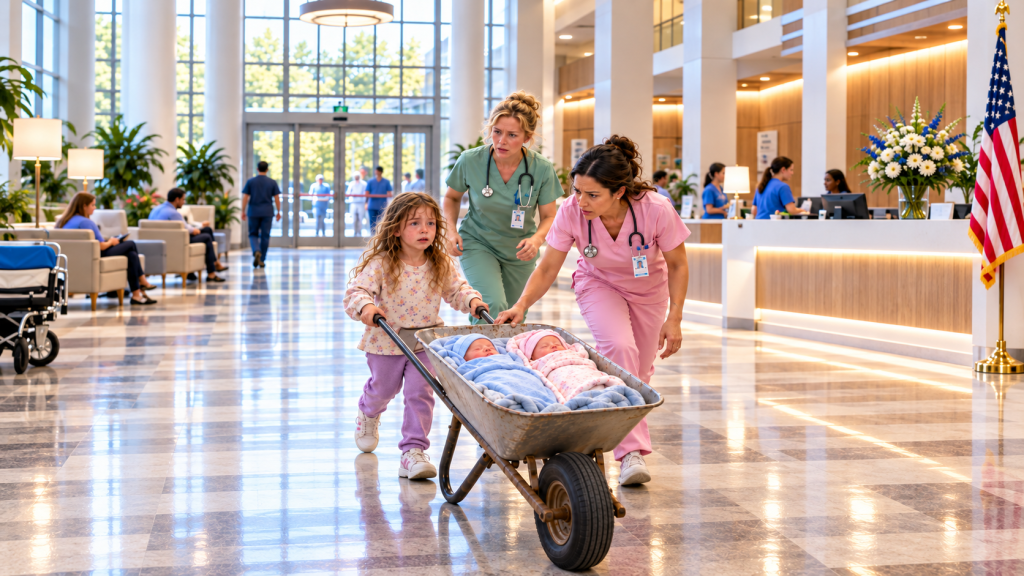
And behind her stood an old, rusted wheelbarrow carrying two newborn babies wrapped in mismatched towels.
She had pushed them nearly five miles.
Alone.
Through the cold morning air.
Past empty fields, unfamiliar roads, and passing cars whose drivers never imagined what she was carrying.
She hadn’t eaten a proper meal since the day before.
She could barely feel her fingers.
But she had refused to stop walking.
Because her mother wouldn’t wake up.
And her baby brother and sister were getting weaker.
What nobody in that emergency room knew was that the little girl had also carried something else.
A secret.
One that would eventually bring one of the wealthiest men in the county to his knees.
And when the truth finally came out, an entire family would discover that the smallest person among them had been the bravest all along.
The first person to notice the wheelbarrow was a receptionist named Margaret Ellis.
She had worked at St. Catherine’s Medical Center for twenty-three years.
During that time, she had seen almost everything.
Terrified parents.
Injured children.
Families arriving in tears.
People who had driven for hours because they had nowhere else to turn.
But she had never seen anything like the little girl standing just inside the emergency entrance at 10:42 on a Thursday morning.
The automatic doors had opened with their familiar mechanical whisper.
Then came a strange squeaking sound.
Margaret looked up from her computer.
At first, she thought someone had brought in a child’s toy.
Then she noticed the wheelbarrow.
Its left wheel wobbled.
Its handles were wrapped in faded blue tape.
Two tiny bundles lay nestled inside on top of a folded blanket.
A little girl stood behind it, breathing hard.
“Excuse me,” she whispered.
Margaret pushed back her chair.
“Sweetheart, are you lost?”
The girl shook her head.
“Are those babies?”
The girl nodded.
“Are they yours?”
“They’re my brother and sister.”
Margaret came around the counter.
Only then did she see how small the babies were.
One had a pink knitted cap.
The other wore a pale yellow one.
Their faces were flushed, and the little boy was making a weak, intermittent sound.
The baby girl was frighteningly quiet.
Margaret felt her stomach drop.
“Where is your mother, sweetheart?”
The little girl swallowed.
“At home.”
“Did she send you here?”
“No.”
“Where is she?”
The girl’s lips trembled.
Then she said the words Margaret would remember for the rest of her life.
“My mommy has been sleeping for three days.”
Margaret didn’t ask another question.
She turned toward the emergency doors.
“Nurse! I need help out here!”
Within seconds, two nurses appeared.
A third followed with a portable bassinet.
The first nurse, Hannah Cooper, crouched beside the wheelbarrow.
“Hello, sweetheart. What’s your name?”
“Lily.”
“That’s a beautiful name. I’m Hannah. Can I pick up your babies?”
Lily’s fingers tightened around the handles.
“Both?”
“Yes. Both.”
“Don’t take them far away.”
“I promise we’ll tell you where they’re going.”
Lily hesitated.
Then she slowly moved her hands.
Hannah lifted the baby girl while another nurse carefully took the boy.
Both infants were immediately carried toward the treatment area.
Lily tried to follow.
Her legs buckled.
Margaret caught her before she fell.
“Oh, honey.”
“I’m okay,” Lily whispered.
But she wasn’t.
Her palms were blistered.
Her cheeks were windburned.
Her lips were dry.
She looked as though she had been holding herself upright through determination alone.
A nurse brought her water.
Another brought crackers.
Lily reached for one, then stopped.
“Can the babies have some?”
“They’re being taken care of right now,” Hannah assured her.
Lily glanced toward the doors.
“Please don’t forget my sister. She’s the quiet one.”
Hannah placed a gentle hand on her shoulder.
“We won’t forget either of them.”
Only then did Lily take a bite.
Dr. Samuel Reed was the attending emergency physician that morning.
When he heard that two newborn infants had arrived in a wheelbarrow, he initially wondered whether someone had misunderstood the situation.
Then he entered the treatment room.
The twins were barely three weeks old.
Both were dehydrated.
The little boy was weak and hungry.
His sister was in more serious condition.
Her temperature was low, and she needed immediate stabilization.
The medical team moved quickly.
Warmers were prepared.
Fluids and carefully monitored feeding plans were arranged.
A neonatal specialist was called.
Nobody wasted time discussing how extraordinary the situation was.
There were two tiny lives in front of them.
And both needed help.
Outside the treatment area, Hannah returned to Lily.
“Can you tell me your mommy’s name?”
“Emily.”
“Emily what?”
“Emily Carter.”
“Do you know how old she is?”
“Twenty-nine.”
Hannah blinked.
“You’re very good at remembering.”
“Mommy told the doctor when we went for the babies.”
“Do you know where you live?”
Lily shook her head.
“Do you know the street?”
“It’s the road with the cows.”
Margaret pulled out a notepad.
“What color is your house?”
“White. But the porch is green.”
“Do you have neighbors?”
“Mr. Jenkins has the red tractor.”
Hannah and Margaret exchanged a glance.
“Did someone drive you here?”
“No.”
“You walked?”
Lily pointed toward the wheelbarrow.
“I pushed.”
Margaret stared at her.
“All the way?”
Lily nodded.
“Mommy said the hospital helps people. And the babies needed help.”
“How long were you walking?”
“I don’t know.”
“Was it dark when you left?”
“The sun was coming up.”
Margaret glanced at the clock.
It was nearly eleven.
Lily had been pushing the wheelbarrow for hours.
Hannah carefully examined the child’s hands.
“These must hurt.”
Lily shrugged.
“The wheel kept getting stuck.”
“Where?”
“In the rocks.”
“Did you fall?”
“One time. But I didn’t let the babies fall.”
Her voice was matter-of-fact.
That somehow made it worse.
Hannah swallowed.
“What happened when your mommy started sleeping?”
Lily stared at the floor.
“She said her head hurt.”
“When?”
“After she fed the babies.”
“And then?”
“She laid down.”
“Did she wake up again?”
“A little.”
“What did she say?”
Lily thought hard.
“She said, ‘Stay close, sweetheart.'”
“And after that?”
“She wouldn’t open her eyes.”
Hannah kept her voice steady.
“What did you do?”
“I brought her water.”
“That’s very thoughtful.”
“And cereal.”
Lily paused.
“I made it myself. But I spilled some.”
“That’s okay.”
“I put the bowl next to her.”
Hannah nodded.
“And then?”
“I shook her shoulder.”
Her voice became smaller.
“I said, ‘Mommy, the babies are crying.'”
A tear slipped down her cheek.
“But she didn’t answer.”
Lily had spent three days doing things no six-year-old should ever have to do.
She had dragged a chair to the kitchen counter.
She had filled cups with water.
She had tried to find clean diapers.
She had searched the pantry for food.
She had sat beside her mother’s bed, waiting for her to wake up.
Sometimes Emily made faint sounds.
Sometimes she moved an arm.
But she never truly regained awareness.
Lily didn’t understand what was happening.
She knew her mother had been tired since bringing the twins home.
She knew the babies cried at night.
She knew there had been worried conversations about money.
And she knew that sometimes, when Emily thought nobody was watching, she sat at the kitchen table and cried.
But Lily had never imagined that grown-ups could become so sick they couldn’t open their eyes.
At first, she thought her mother simply needed more sleep.
Then the babies began crying.
She tried everything she could remember seeing Emily do.
She rocked them.
She sang the lullaby her mother always sang.
She tucked towels around them.
She even held a bottle near her brother’s mouth.
But she didn’t know how to prepare infant formula correctly, and most of the supplies were kept too high for her to reach.
By the second night, she was frightened.
She sat on the bedroom floor with both babies beside her.
“Mommy,” she whispered.
No answer.
“Please wake up.”
She reached for her mother’s hand.
It was warm.
That reassured her a little.
She climbed onto the bed and curled beside Emily.
For a while, she watched the rise and fall of her mother’s chest.
Then she whispered something that would later break Daniel Brooks’s heart.
“I’ll be good tomorrow. I promise.”
Because in Lily’s young mind, perhaps her mother wasn’t waking up because Lily had done something wrong.
Maybe she had been too noisy.
Maybe she’d spilled cereal.
Maybe she’d forgotten to put her toys away.
She decided she would be extra good.
Then Mommy would wake up.
But morning came.
And Emily’s eyes remained closed.
By the third day, Lily’s baby sister had stopped crying as much.
At first, Lily thought that meant she was finally comfortable.
Then she noticed how weak her movements had become.
The little boy still made sounds.
But his sister barely responded.
Lily leaned over her.
“Wake up, Rosie.”
Nothing.
She touched the baby’s tiny hand.
“Rosie?”
The baby moved slightly.
Lily began to cry.
She ran to her mother’s room.
“Mommy! Rosie won’t wake up!”
Emily didn’t answer.
Lily shook her.
“Please, Mommy!”
Nothing.
That was when Lily remembered something.
Three months earlier, Emily had taken her to St. Catherine’s after she fell from a swing and hurt her wrist.
The doctors had been kind.
One nurse had given her a teddy bear.
And Emily had said, “Hospitals are where people help us when we’re really sick.”
Lily remembered the building.
She remembered the big blue sign.
And she remembered seeing ambulances parked outside.
She didn’t know how far away it was.
She only knew which direction they had driven.
There was no working phone in the house.
Emily’s mobile phone had stopped charging several days earlier, and Lily didn’t know where the spare charger was.
The nearest neighbor lived far down the road.
So Lily made the only plan she could imagine.
She would take the babies to the hospital.
Then she would ask the doctors to come get Mommy.
The old wheelbarrow had belonged to Lily’s grandfather.
It was kept behind the shed.
Emily used it to carry firewood and garden soil.
Lily dragged it toward the porch.
The first time she tried lifting the handles, she couldn’t move it.
The wheel was stuck in mud.
She pulled.
Pushed.
Pulled again.
Finally, it rolled forward.
She ran inside and collected the cleanest towels she could find.
She placed a folded blanket at the bottom.
Then she carefully carried the twins outside, one at a time.
She remembered that their heads needed support.
Emily had told her that newborn babies were delicate.
Lily tucked the towels around them, trying to make a safe nest.
The wheelbarrow wasn’t designed for infants, and the journey was terribly dangerous.
But Lily had no way of understanding all the risks.
She only knew she couldn’t leave them behind.
Before leaving, she went to her mother’s bedroom.
Emily lay motionless.
Lily stood beside her.
“Mommy, I’m taking the babies to the doctor.”
She waited.
“I’m going to bring somebody back.”
Still nothing.
Lily leaned down and kissed her mother’s forehead.
“Don’t be scared.”
Then she remembered the little brass key Emily had tied to a string around her neck.
“Never lose this, sweetheart,” Emily had told her.
“It’s the key that keeps our family safe.”
Lily tucked it beneath her sweatshirt.
Then she walked outside.
She closed the front door.
And she began pushing.
At first, the wheelbarrow rolled easily down the gravel driveway.
Then the road grew uneven.
The wheel rattled.
Every bump frightened her.
She stopped frequently to check the babies.
She walked slowly over potholes.
When she reached the narrow bridge near Miller’s Creek, she stopped and stared at the wooden boards.
Cars crossed that bridge every day.
Lily had never crossed it alone.
She waited until the road was empty.
Then she pushed.
Halfway across, the wheel caught between two boards.
Lily pulled so hard her shoulders hurt.
Nothing happened.
She put both feet against the ground and tried again.
The wheel suddenly came loose.
She stumbled forward.
The wheelbarrow tilted.
Lily screamed.
But she caught the handles before it overturned.
She stood shaking for several seconds.
Then she looked into the towels.
The babies were still there.
“Okay,” she whispered.
“It’s okay.”
She continued walking.
A truck passed her without stopping.
Then another.
The drivers likely assumed she was playing near a nearby farm.
Her small figure was partly hidden behind tall roadside grass.
Nobody realized what she carried.
At one point, she became so tired that she sat on the shoulder of the road.
She took off one shoe.
A blister had formed on her heel.
She stared at it.
Then she put the shoe back on.
“Just a little more,” she told the babies.
She didn’t know whether that was true.
But she needed to believe it.
Back at the hospital, Hannah was helping Lily sip water when the little girl suddenly remembered something.
“My key.”
She reached beneath her sweatshirt.
A brass key hung from a white string.
“Mommy says I can’t lose it.”
Hannah smiled gently.
“That’s okay. You still have it.”
But Lily shook her head.
“It’s for the front door.”
Hannah looked at Margaret.
Then she reached for the telephone.
Within minutes, emergency services were coordinating a search.
Daniel Brooks, a veteran paramedic, arrived in the waiting area with his partner, Alicia Monroe.
Daniel was forty-two.
He had spent nineteen years responding to emergencies.
He was calm under pressure.
Patient with frightened children.
And known among his colleagues for never forgetting the names of people he’d helped.
But when he saw Lily sitting beneath a hospital blanket with both hands wrapped in gauze, something tightened in his chest.
He had a daughter only one year older.
He crouched in front of her.
“Hi, Lily. I’m Daniel.”
She looked at the badge on his uniform.
“Are you a doctor?”
“I’m a paramedic. That means I help people before they get to the hospital.”
“Can you help my mommy?”
“That’s what we’re going to try to do.”
Lily immediately leaned forward.
“She’s in her bed.”
“Okay.”
“And she has a blue blanket.”
“All right.”
“She won’t eat.”
Daniel nodded.
“Can you tell me how to find your house?”
Lily explained about the cows.
The bridge.
The red tractor.
The long gravel driveway.
Daniel recognized some of the landmarks.
There were only a few properties along that stretch of county road.
He called dispatch.
Then he held out his palm.
“Can I borrow your key?”
Lily hesitated.
Her fingers closed around the brass.
“Mommy told me not to lose it.”
“I understand.”
“Will you bring it back?”
“Yes.”
She studied him.
Then she slowly pulled the string over her head.
The key dropped into his hand.
“Bring Mommy too.”
Daniel’s throat tightened.
“I’ll do everything I can.”
He stood.
And ran toward the ambulance.
The journey to the Carter farmhouse took thirteen minutes.
Daniel followed the route Lily had described.
Past the old feed store.
Over Miller’s Creek.
Beyond the pasture where black-and-white cows grazed.
Then he saw the red tractor.
“Left here,” he told Alicia.
They turned down a gravel road.
At the end stood a weathered white farmhouse with green porch railings.
An empty children’s bicycle leaned against the wall.
A pair of tiny rain boots sat near the front door.
The porch light was still on.
Daniel hurried up the steps.
He knocked.
“Emergency services!”
No response.
He used Lily’s key.
The door opened.
Inside, the house was painfully quiet.
A bowl of stale cereal sat on the kitchen counter.
An overturned chair stood near the cabinets.
Diapers were scattered across the living room.
A small pink blanket lay on the floor.
Everything told the same story.
A child had been trying desperately to manage a situation far beyond her understanding.
“Emily Carter!” Daniel shouted.
“Can you hear me?”
Alicia moved toward the hallway.
Then she called out.
“Daniel! Bedroom!”
Emily lay on a narrow bed.
She was pale.
Her breathing was shallow.
Her hair clung to her forehead.
An empty glass of water sat beside her.
Daniel immediately checked her vital signs.
“She’s alive.”
He looked at Alicia.
“Get the equipment.”
Emily was critically ill.
Her blood pressure was dangerously low.
She showed signs of severe dehydration, and Daniel was concerned about serious postpartum complications.
They began emergency care while arranging immediate transport.
Daniel knew that recently giving birth placed Emily at risk for conditions that could deteriorate rapidly.
He contacted medical control.
Then, while Alicia prepared the stretcher, he noticed something on the bedside table.
A folded piece of paper.
An old photograph.
And a small envelope addressed in shaky handwriting.
TO THE PERSON WHO FINDS MY CHILDREN.
Daniel didn’t touch it immediately.
He was focused on Emily.
But as he reached for a medical information card lying beside the envelope, the photograph slipped from the table.
He caught it before it reached the floor.
He glanced at the picture.
A younger Emily stood beside an older man wearing an expensive charcoal suit.
The man had silver hair.
A familiar face.
Daniel frowned.
He recognized him.
It was Charles Whitmore.
The founder of Whitmore Industries.
One of the richest businessmen in the county.
His company employed thousands.
His name appeared on hospital donation plaques, university buildings, and local news reports.
Daniel turned the photograph over.
On the back, in Emily’s handwriting, were twelve words.
“If anything happens to me, tell him the truth about his grandchildren.”
Daniel stared.
Grandchildren?
He looked back at Emily.
Then at the three children’s names written on a piece of paper taped beside the bed.
Lily Carter.
Oliver Carter.
Rosalie Carter.
He slipped the photograph and accompanying envelope into a transparent belongings pouch to remain with Emily.
He had no intention of interfering in a private family matter.
But something about the words troubled him.
If Emily had relatives who could be reached, the hospital needed to know.
Especially now.
He called to Alicia.
“Do we have next-of-kin information?”
“Nothing confirmed.”
Daniel looked once more at the photograph.
“Then we may have a lead.”
At St. Catherine’s, Lily sat in the pediatric waiting area beside Margaret.
A social worker named Grace Patterson had arrived.
Grace was experienced in helping children during family emergencies.
She brought crayons.
Paper.
And a small stuffed rabbit.
Lily accepted the rabbit politely.
Then asked, “When is Mommy coming?”
Grace sat beside her.
“The ambulance is bringing her to the hospital.”
“Is she awake?”
“Not yet, sweetheart.”
Lily looked down.
“Did I do something bad?”
Grace frowned.
“Why would you think that?”
“Because I left the house.”
“No, honey.”
“And I used the wheelbarrow without asking.”
Grace’s eyes filled.
“Lily, you were trying to help your family.”
“But Mommy says I’m not allowed near the road alone.”
“Your mommy wanted you safe.”
Lily nodded.
“I tried to keep the babies safe too.”
Grace gently placed her hand over Lily’s bandaged fingers.
“I know you did.”
For several minutes, Lily remained quiet.
Then she asked another question.
“Will Mommy be mad because the house is messy?”
Grace had to look away.
“No,” she whispered.
“She won’t be mad about that.”
Emily arrived at the hospital shortly after noon.
She was taken directly for emergency evaluation.
Blood tests and imaging helped doctors identify a severe postpartum infection that had progressed into sepsis.
Her condition was critical.
She required intensive treatment.
The medical team began antibiotics, fluids, and other supportive measures.
She was transferred to intensive care.
Dr. Reed spoke with the critical care physician.
There was no guarantee she would survive.
But she had reached the hospital alive.
And that mattered.
The twins were receiving specialized care in the neonatal unit.
Oliver responded well to treatment.
Rosalie remained fragile.
Both would need close observation.
Lily, meanwhile, had finally fallen asleep in a chair with the stuffed rabbit pressed against her chest.
Margaret covered her with a blanket.
For the first time in three days, the little girl was resting without being responsible for anyone else.
That afternoon, Daniel delivered Emily’s belongings to the hospital’s patient-services office.
He explained where he had found the letter.
A staff member reviewed the available emergency-contact information.
There was no phone number for Charles Whitmore.
But the photograph and note indicated a possible family connection.
The hospital’s social worker was authorized to pursue emergency family contact while protecting Emily’s privacy.
Grace carefully examined the envelope.
It had been sealed.
Given Emily’s inability to communicate and the urgent need to identify someone who could care for the children, the hospital followed its procedures for handling the possible next-of-kin information.
Inside was a short letter.
The handwriting was uneven.
Parts of the ink had blurred.
But the message was clear.
“If someone is reading this, I may not be able to speak for myself.
“My name is Emily Carter.
“I have three children: Lily, Oliver, and Rosalie.
“My father is Charles Whitmore.
“He doesn’t know about the twins.
“He doesn’t know how we’ve been living.
“He may refuse to believe you.
“But please tell him I never stopped being his daughter.
“And please don’t let my children grow up thinking they were unwanted.”
Grace read the letter twice.
Then she placed it carefully back inside the envelope.
The room was silent.
Margaret stood near the doorway.
Daniel folded his arms.
No one spoke for several seconds.
Finally, Grace said, “We need to find him.”
Charles Whitmore lived in a mansion on the northern edge of the county.
At sixty-eight, he remained chairman of Whitmore Industries.
He owned several properties.
Supported medical charities.
And appeared regularly in business magazines as a self-made success story.
People described him as disciplined.
Demanding.
Brilliant.
They rarely described him as warm.
His wife, Margaret Whitmore, had died seven years earlier.
Their only daughter, Emily, had disappeared from his life shortly after the funeral.
Publicly, Charles explained her absence by saying she preferred a private life.
Privately, he claimed she had abandoned her family.
The truth was more complicated.
And far more painful.
Emily had grown up surrounded by wealth but very little freedom.
Her father expected excellence.
Perfect grades.
Appropriate friends.
A prestigious career.
A husband from the right family.
Charles planned everything.
He believed that was what good fathers did.
Emily had once adored him.
As a child, she followed him through the gardens of their estate.
She waited outside his office with drawings.
She climbed onto his lap and asked him to tell stories about building the company.
He called her his little star.
But as Emily grew older, their relationship changed.
She wanted to become a teacher.
Charles wanted her in corporate finance.
She wanted to travel.
He wanted her close to home.
She fell in love with a mechanic named Nathan Carter.
Charles considered him unsuitable.
Nathan wasn’t wealthy.
He had no prestigious degree.
His parents operated a small repair shop.
But Nathan was kind.
He made Emily laugh.
He listened to her.
And when her mother became ill, he was the one who sat beside Emily through long hospital nights.
Charles never forgave her for choosing him.
At Margaret Whitmore’s funeral, the tension finally exploded.
Emily was twenty-two.
She stood outside the family chapel beside Nathan.
Charles approached them.
“I want to speak to my daughter alone.”
Emily shook her head.
“Whatever you have to say, Nathan can hear.”
Charles’s expression hardened.
“That man has no place in this family.”
“His name is Nathan.”
“I know his name.”
“Then use it.”
Charles glanced at Nathan.
“You think you can provide for her?”
Nathan remained calm.
“I love her, sir.”
Charles laughed bitterly.
“Love doesn’t pay bills.”
Emily stepped forward.
“Please stop.”
But Charles continued.
“If you marry him, don’t expect me to finance your mistakes.”
Emily stared at him.
“I’m not asking you to.”
“Then perhaps you should learn what life is like without my support.”
She took Nathan’s hand.
“Maybe I should.”
Charles pointed toward the driveway.
“Then go.”
For one terrible moment, he expected her to apologize.
Instead, Emily walked away.
He watched her leave.
And did nothing.
Six years passed.
Charles told himself Emily would eventually come back.
At first, he expected a call within days.
Then weeks.
Then months.
But Emily didn’t call.
She married Nathan in a small ceremony.
They moved into the farmhouse Nathan’s grandfather had left him.
A year later, Lily was born.
Charles knew about his granddaughter.
He had received a birth announcement.
A tiny photograph had arrived in the mail.
On the back, Emily had written:
“Her name is Lily Margaret Carter. I named her after Mom.”
Charles stared at that photograph for a long time.
Then he placed it inside a desk drawer.
He never answered.
His assistant later asked whether he wanted to send flowers.
Charles said no.
He told himself Emily had made her choice.
What he didn’t know was that Nathan died in a highway accident when Lily was three.
He didn’t know Emily spent months struggling with grief.
He didn’t know she worked evenings at a grocery store while teaching preschool during the day.
He didn’t know that, eventually, she began rebuilding her life with the quiet determination her mother had once admired.
And he didn’t know she had fallen in love again.
The twins’ father, Matthew Hayes, had been a local carpenter.
He was gentle with Lily.
He helped repair the old farmhouse.
He brought Emily flowers from roadside stands because he couldn’t afford expensive bouquets.
But four months before the twins were born, Matthew was killed in a construction accident.
The loss devastated Emily.
She was twenty-eight.
Pregnant.
Raising a six-year-old.
And suddenly alone again.
She considered calling her father.
Many times.
She even wrote letters.
But she never mailed them.
Because the last words he had said to her still haunted her.
“Then go.”
And because she couldn’t bear the possibility that he might reject her children too.
At 3:17 that afternoon, Charles Whitmore was sitting in his office reviewing a financial report when his assistant entered.
“Mr. Whitmore, there’s a call from St. Catherine’s Medical Center.”
Charles didn’t look up.
“Regarding the new pediatric wing?”
“No, sir.”
“Then what?”
“It’s about a woman named Emily Carter.”
His pen stopped moving.
For several seconds, he didn’t speak.
Then he slowly raised his head.
“What did you say?”
“Emily Carter.”
Charles reached for the telephone.
“Put them through.”
Grace Patterson introduced herself.
She explained that Emily was hospitalized in critical condition.
Charles listened without interrupting.
Then he asked, “What happened?”
Grace gave him the information she was permitted to share.
“Your daughter was found unconscious at home after her six-year-old child brought two newborn infants to our emergency department.”
Charles leaned back.
“Two newborn infants?”
“Yes, sir.”
He stared at the wall.
“Whose?”
There was a brief silence.
Then Grace answered.
“Emily’s children.”
Charles closed his eyes.
“Emily has three children?”
“Yes.”
He pressed his hand against his forehead.
“Where is she?”
“St. Catherine’s intensive care unit.”
“Is she going to survive?”
“We can’t promise that, Mr. Whitmore.”
Something in Charles’s chest seemed to collapse.
He stood so abruptly that his chair rolled backward.
“I’m coming.”
Charles arrived forty minutes later.
He entered the hospital through the main lobby wearing a tailored navy suit.
His driver followed closely.
Usually, when Charles Whitmore walked into a building, people recognized him.
They greeted him respectfully.
Sometimes they asked for photographs.
Sometimes they thanked him for charitable donations.
That afternoon, nobody cared who he was.
A nurse directed him toward the intensive care waiting area.
Grace met him there.
“Mr. Whitmore?”
“Where is my daughter?”
“We’ll take you to her shortly. First, there’s someone you should meet.”
Charles frowned.
“Who?”
Grace gestured toward the pediatric family room.
Through the glass window, Charles saw a small girl sitting on a couch.
She wore an oversized pink sweatshirt.
Her hair was tangled.
Both hands were wrapped in bandages.
She was drawing something with a green crayon.
Charles stopped walking.
The little girl lifted her head.
For one impossible moment, he thought he was looking at Emily as a child.
The same brown eyes.
The same narrow chin.
The same serious expression when concentrating.
Grace opened the door.
“Lily, sweetheart, there’s someone here to meet you.”
Lily looked up.
Charles stepped inside.
He had negotiated deals worth hundreds of millions of dollars.
He had stood before shareholders.
He had spoken to presidents of international corporations.
But suddenly, he couldn’t find a single word.
Lily studied him.
“Are you a doctor?”
Charles shook his head.
“No.”
“Are you here for Mommy?”
“Yes.”
Lily tilted her head.
“Do you know her?”
Charles swallowed.
“I’m her father.”
The little girl’s eyes widened.
“Grandpa?”
Charles froze.
She knew him?
“Your mother told you about me?”
Lily nodded.
“She said you have a big house.”
Charles managed a small smile.
“Yes.”
“And lots of books.”
“That’s true.”
“And you used to make pancakes shaped like stars.”
Charles felt the breath leave his lungs.
He hadn’t made those pancakes in more than twenty years.
His wife had teased him because the stars always came out crooked.
Emily used to ask for them every birthday.
Lily continued.
“Mommy said you were really good at it.”
Charles lowered himself onto one knee.
“Did she?”
“Yes.”
Then Lily asked the question that shattered him.
“Grandpa, are you mad at Mommy?”
Charles stared at her.
“Why would you ask that?”
“Because sometimes she gets sad when she talks about you.”
His eyes filled.
“No, sweetheart.”
He took a trembling breath.
“I’m not mad at her.”
Lily looked relieved.
“Good.”
She leaned closer.
“Because she really needs you.”
Grace accompanied Charles into the intensive care unit.
Emily lay surrounded by monitors and medical equipment.
She looked terribly small beneath the white blankets.
Her face was pale.
A nurse adjusted an intravenous line beside the bed.
Charles stopped in the doorway.
He had imagined seeing Emily again hundreds of times.
In some versions, she apologized.
In others, he forgave her.
Sometimes he imagined her arriving at his office with a husband and children, finally ready to admit she needed him.
But never like this.
Never motionless in a hospital bed.
Never while doctors spoke about organ function, infection, and uncertain recovery.
He approached slowly.
“Emily?”
She didn’t move.
He reached for her hand.
It was warm.
He remembered holding that same hand when she was five years old and afraid of thunderstorms.
He remembered teaching her to ride a bicycle.
He remembered how she used to run through the front door shouting, “Daddy, look!”
He remembered the day she left.
And how he had let pride become more important than love.
“Emmy,” he whispered.
It was the nickname he hadn’t spoken aloud in years.
“I’m here.”
His voice cracked.
“I’m sorry I took so long.”
The machines continued their steady sounds.
Charles bowed his head.
“I should have called.”
He squeezed her hand carefully.
“I should have come looking.”
A tear slipped down his cheek.
“I should have been your father.”
Later that evening, Dr. Reed and the intensive care team met with Charles.
They explained that Emily’s infection had become life-threatening.
The condition appeared to have developed after childbirth.
Untreated, it had progressed rapidly.
By the time paramedics reached her, she was critically ill.
Charles listened in silence.
Finally, he asked, “How long had she been unconscious?”
“We can’t determine the exact duration,” the doctor replied. “But her daughter described several days of severe illness.”
Charles looked at Grace.
“Several days?”
She nodded.
“During that time, Lily was alone with her mother and the twins.”
Charles pressed both hands against his knees.
“And nobody knew?”
“Apparently not.”
“Nobody checked on them?”
Grace spoke gently.
“Emily lived in a rural area. Her usual support contacts weren’t aware of what had happened.”
Charles looked toward the corridor.
“Where is Lily now?”
“Resting.”
“And the twins?”
“In neonatal care.”
He stood.
“I want to see them.”
The neonatal unit was softly illuminated.
Charles followed a nurse past several bassinets.
She stopped beside two tiny babies.
“These are Oliver and Rosalie.”
Charles stared through the clear bassinets.
Oliver had a soft tuft of dark hair.
Rosalie’s fingers curled near her cheek.
They were so small.
So fragile.
His grandchildren.
Children he hadn’t known existed until a few hours earlier.
The nurse explained that Oliver was improving.
Rosalie needed additional monitoring, but the medical team was cautiously encouraged by her response.
Charles placed his hand against the side of her bassinet.
“Hello, Rosalie.”
The baby moved slightly.
Charles smiled through tears.
“I’m your grandfather.”
Then he looked toward Oliver.
“And I’m yours too.”
He remained there for a long time.
Thinking about all the birthdays he had missed.
All the photographs he had never seen.
All the ordinary family moments he’d considered less important than winning an argument.
That night, Charles asked to see the wheelbarrow.
Margaret had arranged for it to be stored safely after the emergency.
She led him to a secure hospital storage area.
There it stood.
Old.
Rusty.
Small.
One wheel leaning slightly to the left.
The blue tape around the handles had begun peeling.
Charles stared at it.
“That’s what she used?”
Margaret nodded.
“Yes.”
“She pushed both babies in that?”
“Nearly five miles, according to the route emergency services reconstructed.”
Charles walked closer.
He touched one handle.
The metal was rough.
Then Margaret said quietly, “Her hands were badly blistered when she arrived.”
Charles closed his eyes.
He imagined Lily walking along the road.
Alone.
Trying to keep two infants alive.
He imagined her stopping to rest.
Wondering whether she would ever reach the hospital.
His knees weakened.
He sat down on a nearby bench.
For the first time in many years, Charles Whitmore began crying openly.
Not a few controlled tears.
Not the dignified sadness he had shown at public funerals.
He cried like a man finally understanding the true cost of his choices.
Margaret remained beside him.
She didn’t offer empty reassurance.
She simply let him grieve.
After several minutes, Charles whispered, “My daughter was struggling, and I had more money than I could ever spend.”
Margaret answered softly.
“Money wouldn’t have told you she was sick, Mr. Whitmore.”
He nodded.
“But love might have brought me to her door.”
The next morning, Lily woke in a pediatric observation room.
A nurse was changing the dressings on her palms.
Charles sat nearby.
He had spent the night at the hospital.
His suit jacket hung over the chair.
His silver hair was no longer perfectly combed.
When Lily saw him, she smiled.
“Grandpa.”
Charles immediately leaned forward.
“Good morning, sweetheart.”
“Did you bring Mommy?”
He swallowed.
“She’s here. The doctors are helping her.”
“Is she awake?”
“Not yet.”
Lily’s smile faded.
Charles took her hand.
“Would you like some breakfast?”
She nodded.
“Pancakes?”
A tearful smile appeared on his face.
“I think we can arrange pancakes.”
“Star ones?”
Charles laughed softly.
“I haven’t made those in a long time.”
“Mommy says you know how.”
“Then I suppose I’d better remember.”
Charles stayed for breakfast.
For the first time, he learned things about his granddaughter that every grandfather should have known.
Her favorite color was yellow.
She liked butterflies.
She hated peas.
She wanted to become a veterinarian.
She knew how to read simple books.
She liked drawing flowers for her mother.
She was afraid of thunderstorms but loved watching rain through the kitchen window.
She called Oliver “Ollie.”
And she called Rosalie “Rosie.”
She explained that her mother always kissed each child twice before bed.
“One kiss means I love you,” Lily said.
“And the other means I’ll always come back.”
Charles listened carefully.
“Your mother sounds wonderful.”
Lily nodded.
“She’s the best mommy.”
Then she looked down at her pancakes.
“Grandpa?”
“Yes?”
“Did you know we were poor?”
Charles went still.
“What makes you say that?”
“Mommy says we have to be careful with money.”
“I see.”
“Sometimes she says she’s not hungry so I can have more.”
Charles stared at her.
“Does she?”
Lily nodded.
“But I always save her some.”
He looked away.
His throat tightened.
For years, he had donated enormous sums to public charities.
He had attended galas.
Fundraisers.
Ceremonies.
He had financed scholarships for strangers.
All while his own daughter sometimes skipped meals.
He knew that charity mattered.
But he also understood that his public generosity had not excused his private absence.
And no check he wrote now could erase that.
That afternoon, Grace explained an important issue.
Lily and the twins needed safe, stable care while Emily recovered.
Charles offered immediately.
“They can stay with me.”
Grace appreciated his willingness.
But she explained that family placement required appropriate assessment and coordination with child welfare professionals.
The children’s needs were the priority.
Charles didn’t argue.
For once, he listened.
He provided documentation.
Answered questions.
Agreed to home visits.
And asked what else he could do.
Grace noticed the change.
He wasn’t asking people to make exceptions because he was wealthy.
He was asking how to become someone the children could safely depend on.
A temporary family-care arrangement was eventually approved while Emily remained hospitalized, with continuing oversight and support.
Charles prepared his home.
Not with extravagant gifts.
But with practical things.
Cribs.
Car seats.
Baby supplies.
Childproof locks.
A bedroom for Lily.
And a quiet space where the children could feel secure.
He hired experienced caregivers to assist, but he made one decision himself.
He would not hand responsibility for his grandchildren entirely to employees.
He would learn how to care for them.
Personally.
On Sunday afternoon, Daniel Brooks stopped by the hospital during his day off.
He wanted to check on the children.
He found Lily sitting at a table drawing a picture.
She looked up.
“Mr. Daniel!”
He smiled.
“Hey, superstar.”
She held up the stuffed rabbit.
“His name is Buttons.”
“That’s a good name.”
“Did you find Mommy?”
Daniel knelt beside her.
“Yes, Lily. We found her.”
“Was she scared?”
Daniel considered his answer.
“She was very sick, sweetheart. But we got her here so the doctors could help.”
Lily nodded.
Then she reached into the pocket of her sweatshirt.
She pulled out a folded piece of paper.
“I made you something.”
Daniel opened it.
It was a drawing.
A large white ambulance.
A small pink house.
And a man holding a brass key.
Above the ambulance, in uneven letters, Lily had written:
THANK YOU FOR BRINGING MY MOMMY.
Daniel stared at the paper.
His eyes filled.
He cleared his throat.
“Can I keep this?”
Lily smiled.
“Yes.”
He folded it carefully.
Then he noticed Charles watching from the doorway.
The two men exchanged a quiet nod.
Charles approached.
“You’re the paramedic who found my daughter.”
“Yes, sir.”
Charles extended his hand.
“Thank you.”
Daniel shook it.
“I’m glad we reached her.”
Charles hesitated.
“How can I repay you?”
Daniel looked toward Lily.
“Take care of her.”
Charles nodded.
“I intend to.”
On the fifth day after Lily arrived at the hospital, Emily opened her eyes.
At first, she didn’t understand where she was.
Everything appeared blurry.
She heard the rhythmic sounds of monitors.
She felt the unfamiliar weight of a hospital blanket.
A nurse noticed her stirring.
“Emily?”
Emily tried to speak.
Her throat was dry.
The nurse leaned closer.
“You’re at St. Catherine’s. You’ve been very ill.”
Emily blinked.
Then panic flashed across her face.
“My babies.”
The words barely came out.
“Where are my babies?”
The nurse reassured her immediately.
“They’re here. They’re being cared for.”
Emily tried to sit up.
“Lily.”
“She’s safe.”
“Oliver. Rosalie.”
“Both are receiving care.”
Emily began to cry.
She remembered lying down.
She remembered the pain.
The dizziness.
Lily calling her name.
Then nothing.
“How long?” she whispered.
“Several days.”
Emily covered her face.
“Oh, God.”
The nurse gently steadied her.
“Your daughter brought the twins to the emergency department. That’s how we learned you needed help.”
Emily stared.
“What?”
“Lily brought them here.”
“How?”
The nurse hesitated.
“With a wheelbarrow.”
Emily’s face went white.
“No.”
Tears spilled down her cheeks.
“No, she couldn’t have.”
The nurse explained what had happened.
The long walk.
The babies.
The emergency call.
The paramedics.
Emily listened in stunned silence.
Then she began sobbing.
Not because she was angry with Lily.
But because she understood what her little girl must have endured.
“She was alone.”
The nurse touched her shoulder.
“She’s safe now.”
Emily shook her head.
“She must have been so scared.”
When Charles entered Emily’s room later that afternoon, she was looking out the window.
He stopped at the doorway.
For several seconds, neither spoke.
Then Emily turned.
She stared at him.
“Dad?”
Charles nodded.
“Hello, Emmy.”
Her eyes filled immediately.
“What are you doing here?”
“I came as soon as they called.”
She looked away.
“I didn’t call you.”
“I know.”
“Who did?”
“The hospital.”
Emily stared at her hands.
Silence stretched between them.
Finally, Charles approached her bed.
“Emily, I know I have no right to expect you to welcome me.”
She didn’t answer.
“I know I failed you.”
Her lips trembled.
He continued.
“I spent six years waiting for you to apologize for living your own life.”
Emily looked up.
“And I spent six years thinking you didn’t want me.”
Charles’s face crumpled.
“That wasn’t true.”
“It felt true.”
“I know.”
She wiped her cheeks.
“Do you know how many times I picked up the phone?”
Charles nodded slowly.
“I should have called first.”
“When Nathan died, I almost came home.”
Charles closed his eyes.
“I didn’t know.”
“I know you didn’t.”
“Emily—”
“I wanted to tell you.”
Her voice broke.
“I wanted my dad.”
Charles reached toward her hand, then stopped.
He didn’t know whether she wanted his touch.
Emily looked at him.
Then slowly placed her hand in his.
He held it carefully.
“I’m here now.”
She began crying harder.
Charles bent forward.
“I’m so sorry, sweetheart.”
For a long time, neither said anything else.
They simply held each other’s hands.
And six years of silence finally began to break.
Emily’s recovery was gradual.
There were good days.
Difficult days.
Days when she was exhausted after speaking for only a few minutes.
Her doctors warned that recovering from severe sepsis could take time.
She would need follow-up care, rest, and help with the children.
Charles listened to every recommendation.
But Emily remained cautious.
She didn’t want her father’s wealth to become another form of control.
One evening, as they sat together, she said quietly, “Dad, I need you to understand something.”
“Anything.”
“I’m grateful you’re helping.”
Charles nodded.
“But I don’t want you deciding everything for me again.”
He lowered his gaze.
“You’re right.”
“I love my house.”
“I understand.”
“It’s old. And the roof leaks. And the kitchen is too small.”
A faint smile touched her lips.
“But it’s ours.”
Charles looked at her.
“Then it’s yours.”
Emily studied him.
“Really?”
“Really.”
She took a breath.
“And when I’m better, I want to go back to work.”
“Then you should.”
“I don’t want you making me feel incapable.”
Charles nodded.
“I won’t.”
She looked down.
“I need a father, not a boss.”
Those words stayed with him.
He had spent his life telling people what to do.
For the first time, he began learning that loving someone sometimes meant offering support without demanding control.
The twins continued improving.
Oliver gained strength.
Rosalie gradually became more alert.
The neonatal team monitored their feeding and growth.
Eventually, both were considered stable enough to leave specialized care.
Charles learned how to hold them.
At first, he looked terrified.
The nurse placed Oliver in his arms.
“Support his head, Mr. Whitmore.”
Charles adjusted his hands.
“Like this?”
“Exactly.”
The baby yawned.
Charles stared.
“He’s so small.”
“He is.”
“Am I holding him too tightly?”
“No.”
“Are you sure?”
The nurse smiled.
“You’re doing fine.”
Later, Rosalie fell asleep against his chest.
Charles remained motionless for nearly an hour.
When his assistant called about an important board meeting, he whispered, “Reschedule it.”
The assistant hesitated.
“Sir, the investors are already—”
“Then they can meet without me.”
He looked down at Rosalie.
“I have somewhere more important to be.”
Lily adjusted to staying at her grandfather’s house slowly.
The first night, she didn’t want to sleep in the enormous bedroom prepared for her.
It had soft curtains.
A new bed.
Shelves filled with books.
A basket of toys.
But it didn’t feel like home.
She stood in the doorway holding Buttons.
“It’s too big.”
Charles looked around.
“Would you prefer another room?”
She nodded.
“Can I sleep near the babies?”
After consulting the caregivers about a safe arrangement, Charles prepared a smaller bedroom near the nursery.
Lily seemed relieved.
But that night, she woke crying.
Charles hurried to her room.
“What’s wrong, sweetheart?”
She sat upright.
“I thought Mommy was sleeping again.”
He sat beside her.
“Your mommy is at the hospital getting stronger.”
“What if she doesn’t wake up tomorrow?”
Charles felt an ache in his chest.
“Then the doctors will keep helping her.”
Lily looked at him.
“Will you go away too?”
He froze.
The question was simple.
But beneath it lay all the fear of a child who had watched adults disappear from her life.
Her father had died.
Matthew had died.
Her mother had become unconscious.
And her grandfather was someone she had only just met.
Charles took her small hand.
“I’m not planning to go anywhere.”
“Promise?”
He thought carefully.
He didn’t want to make promises no human being could absolutely guarantee.
So he said, “I promise I’ll do my best to be here for you, every day I can.”
Lily considered that.
Then she leaned against him.
“Okay.”
He stayed until she fell asleep.
Over the following weeks, Charles changed in ways that surprised everyone around him.
His assistant noticed that he stopped scheduling meetings before breakfast.
His driver noticed that he sometimes chose to drive himself to the hospital.
His housekeeper noticed that he began making pancakes.
Terrible pancakes.
The first batch burned.
The second stuck to the pan.
The third resembled misshapen clouds.
But Lily watched from a kitchen stool with enormous interest.
“Grandpa, those aren’t stars.”
Charles examined the pancake in his spatula.
“I believe you’re right.”
“It looks like a potato.”
He laughed.
“An expensive potato.”
Lily giggled.
Charles turned the pancake over.
“Well, perhaps we could call it a shooting star.”
“That’s not what shooting stars look like.”
“Then I clearly need more practice.”
For the first time in years, laughter filled the Whitmore kitchen.
Not polite laughter at a dinner party.
Not employees laughing at a wealthy man’s jokes.
Real laughter.
The kind that made Charles forget his phone was ringing.
The kind he had missed without even realizing it.
But Emily’s return home brought challenges no one had anticipated.
Although her infection was under control, she was physically weak.
She tired easily.
Some days, she struggled to concentrate.
She worried constantly about the children.
And she experienced waves of guilt over what had happened.
One afternoon, Grace visited her hospital room.
Emily sat looking at Lily’s drawing of the ambulance.
“I should have called someone sooner.”
Grace sat beside her.
“You became seriously ill, Emily.”
“I knew I felt awful.”
“But you couldn’t have predicted exactly how quickly your condition would worsen.”
Emily shook her head.
“I should have made sure Lily knew how to call emergency services.”
“That’s something you can teach her now.”
Emily stared at the drawing.
“She’s only six.”
“I know.”
“She had to be the grown-up.”
Grace nodded.
“She carried responsibility no child should have to carry.”
Emily wiped her eyes.
“How do I make that right?”
“By making sure she doesn’t have to carry it again.”
Emily looked up.
Grace continued.
“She needs routines. Reassurance. Adults she can trust. She needs to know that being a child is enough.”
Emily held the paper against her chest.
“Then that’s what I’m going to give her.”
When Emily was finally discharged, Charles insisted on driving her home.
But not to his mansion.
To the farmhouse.
He had arranged for necessary repairs while respecting her wishes.
The roof had been inspected and repaired.
The faulty electrical outlets had been fixed.
The porch steps were made safe.
The refrigerator was stocked.
A reliable telephone connection had been restored.
And emergency contacts were posted beside the kitchen counter.
Emily stood in the doorway, looking around.
“Dad.”
Charles shifted nervously.
“I hope I didn’t overstep.”
She noticed the repaired window.
The clean curtains.
The new smoke detectors.
The familiar furniture still in its usual places.
He hadn’t transformed her home into something unrecognizable.
He had simply made it safer.
Emily smiled faintly.
“Thank you.”
Charles exhaled.
“You’re welcome.”
Then a little voice called from the hallway.
“Mommy!”
Lily came running.
Emily dropped carefully to her knees.
Her daughter flew into her arms.
For several seconds, neither spoke.
Lily buried her face against Emily’s shoulder.
Emily held her tightly.
“My baby.”
Lily began crying.
“Mommy, you woke up.”
Emily closed her eyes.
“Yes, sweetheart.”
“I brought the doctors.”
“I know.”
“I tried to wake you.”
“I know, baby.”
“I gave you water.”
Emily kissed her hair.
“I know.”
Lily pulled back.
“Are you mad?”
Emily stared at her.
“Mad?”
“Because I took the wheelbarrow.”
Emily’s face crumpled.
“Oh, Lily.”
She pulled her close again.
“No, sweetheart. I’m not mad.”
“But I went on the road.”
“You were scared, and you were trying to get help.”
Lily’s lower lip trembled.
“I thought you were going to sleep forever.”
Emily began crying.
“I’m so sorry you had to be afraid.”
Lily clung to her.
“Don’t sleep that long again.”
Emily kissed her forehead.
“I’ll do everything I can to stay healthy and ask for help when I need it.”
Lily held on for a long time.
And Charles, watching from the doorway, quietly turned away to wipe his eyes.
A few days later, Emily asked Daniel Brooks to visit.
She wanted to thank him personally.
Daniel arrived carrying a small gift bag.
Inside was a pair of pink gardening gloves.
Child-sized.
Soft.
With butterflies stitched across the back.
Lily examined them curiously.
“What are these for?”
Daniel smiled.
“For helping your mom in the garden someday. Not for pushing heavy wheelbarrows down the road.”
Lily giggled.
Emily looked at the gloves.
Then at Daniel.
“You found me.”
He nodded.
“Yes, ma’am.”
“My daughter told me you brought her key back.”
Daniel reached into his pocket.
He placed the brass key on the table.
“I promised her I would.”
Emily picked it up.
Her fingers trembled.
The key had belonged to Nathan’s grandfather.
For generations, it had opened the farmhouse door.
It represented every bit of home she had fought to preserve.
She looked at Daniel.
“Thank you for keeping your promise.”
He smiled gently.
“She’s a remarkable little girl.”
Emily looked toward Lily.
“She is.”
Then she grew serious.
“I don’t know what would have happened if she hadn’t found help.”
Daniel lowered his gaze.
“She made a brave decision with the information she had. But what matters now is that she has adults around her who can help keep her safe.”
Emily nodded.
“She does.”
Charles stood nearby.
“Yes,” he said quietly.
“She does.”
News of Lily’s extraordinary journey eventually spread through the community.
At first, it was a short hospital newsletter item shared with the family’s permission.
Then a local newspaper published her story.
The article described a six-year-old who had pushed her newborn siblings several miles to seek medical attention for her family.
Neighbors were stunned.
Some remembered seeing the little girl along the road.
One delivery driver recognized the wheelbarrow.
He contacted the family, deeply troubled that he hadn’t understood what he was seeing.
Emily reassured him.
“You didn’t know.”
But the story prompted conversations throughout the county about rural isolation, emergency access, and how easily struggling families could fall through the cracks.
A local organization began expanding outreach to families with newborns.
Volunteers organized transportation assistance.
The county reviewed ways to improve emergency-service information for isolated households.
Charles contributed funding.
But this time, he didn’t demand that the program carry his name.
He asked that it be called the Neighbor’s Door Initiative.
Its purpose was simple.
No family should feel completely alone during an emergency.
And no young child should have to travel miles to find help.
One morning, several weeks after Emily came home, Charles arrived at the farmhouse carrying an old wooden box.
He set it on the kitchen table.
Emily looked up from her tea.
“What’s that?”
“Something I should have given you years ago.”
He opened the lid.
Inside were photographs.
Birthday cards.
School drawings.
And small keepsakes from Emily’s childhood.
She reached into the box.
The first photograph showed her at seven years old, sitting on Charles’s shoulders during a Fourth of July parade.
The next showed her mother teaching her to bake.
Another showed Charles standing beside a lopsided birthday cake.
Emily laughed softly.
“Oh, Dad.”
Charles smiled.
“I was never much of a baker.”
She lifted a faded piece of paper.
It was a drawing of a house.
Above it, in childish handwriting, were the words:
MY DADDY IS MY HERO.
Emily stared at it.
“I thought you threw all this away.”
Charles shook his head.
“I couldn’t.”
“Why didn’t you tell me?”
He looked down.
“Because I was too stubborn to admit how much I missed you.”
Emily turned another photograph over.
On the back was a date.
And beside it, in her mother’s handwriting:
“Our little star, always loved.”
Emily’s eyes filled.
Charles reached into his jacket pocket.
He removed another photograph.
A tiny picture of newborn Lily.
The one Emily had mailed six years earlier.
“I kept this in my desk.”
Emily looked at him.
“You got it?”
He nodded.
“Yes.”
“You never answered.”
“I know.”
She took a shaky breath.
“That hurt, Dad.”
He lowered his head.
“I know it did.”
She stared at Lily’s newborn face.
Charles continued.
“I thought refusing to answer would prove a point.”
“And did it?”
He shook his head.
“No.”
A tear slid down his cheek.
“It only proved how much I had to learn.”
That summer, the family held a small gathering at the farmhouse.
Not a lavish event.
No reporters.
No business associates.
Just people who had helped them through the worst days of their lives.
Margaret Ellis came with a homemade apple pie.
Hannah Cooper brought flowers.
Grace Patterson stopped by after work.
Daniel and Alicia arrived with their families.
Dr. Reed made a brief appearance before his evening shift.
A few neighbors came too.
Including Mr. Jenkins, whose red tractor had helped Lily remember the road home.
Emily stood on the porch watching everyone arrive.
Oliver and Rosalie were growing stronger.
They slept in a double stroller nearby, each safely secured in a separate infant seat.
Lily wore a yellow dress.
Her hands had healed.
And she was laughing as she chased bubbles across the lawn.
Charles stood beside Emily.
“She’s happy,” he said.
Emily nodded.
“She deserves to be.”
They watched her for a moment.
Then Charles asked, “Do you think she’ll remember everything?”
Emily grew quiet.
“Some of it.”
“Do you think she’ll always be afraid?”
“I hope not.”
Emily watched Lily reach for another bubble.
“We’re helping her understand that grown-ups are responsible for keeping children safe. She doesn’t have to save everyone.”
Charles nodded.
Then Emily smiled.
“But I hope she remembers that when something is wrong, asking for help is brave.”
Later that afternoon, Margaret asked whether she could say a few words.
Everyone gathered near the porch.
Margaret stood holding a small framed photograph.
It showed Lily sitting in the hospital, wrapped in a blanket, Buttons the rabbit tucked beneath her arm.
“I’ve worked in emergency medicine for twenty-three years,” Margaret began.
“I’ve seen incredible acts of courage.”
She looked at Lily.
“But sometimes courage looks very different from what we expect.”
The gathering grew quiet.
“Sometimes it isn’t a firefighter running into a burning building.”
“Sometimes it isn’t a soldier standing on a battlefield.”
“Sometimes courage is a frightened little girl who knows something is wrong and refuses to stop looking for help.”
Emily wiped her eyes.
Margaret continued.
“When Lily arrived at our hospital, she had exhausted herself trying to protect her family.”
Her voice softened.
“But I want everyone here to remember something important.”
She looked toward Lily.
“Lily should never have had to carry that responsibility.”
Charles nodded.
“Her courage brought her family to safety. Our responsibility now is to make sure she can spend the rest of her childhood being exactly what she is.”
Margaret smiled.
“A little girl.”
Applause rose gently around the yard.
Lily looked confused.
Then she leaned toward Emily.
“Mommy, are they clapping for me?”
Emily knelt beside her.
“Yes, sweetheart.”
“Why?”
Emily smiled through tears.
“Because they’re glad you’re here.”
Lily considered that.
Then whispered, “I’m glad you’re here too.”
Emily hugged her.
After the gathering, Charles found Daniel standing near the old shed.
The wheelbarrow was still there.
Charles had offered to replace it months earlier.
Emily had agreed to get a safer garden cart for daily use, but she wanted to keep the old wheelbarrow.
Not because it had been suitable for transporting babies.
It hadn’t.
And not because she wanted Lily to relive that frightening journey.
But because the object represented a day when everything almost ended.
And somehow, everyone had been given another chance.
Charles approached Daniel.
“I’ve been thinking about what you told me at the hospital.”
Daniel turned.
“What was that?”
“When I asked how I could repay you.”
Daniel smiled faintly.
“I remember.”
“You told me to take care of Lily.”
“Yes.”
Charles looked toward the farmhouse.
“I’m trying.”
Daniel nodded.
“That’s all any of us can do.”
Charles was quiet for a moment.
“Do you know what I used to think made a man successful?”
Daniel shrugged.
“Money?”
“Partly. Power. Reputation. Being right.”
He looked down.
“I spent years making sure nobody could tell me what to do.”
“And now?”
Charles smiled.
“Now a six-year-old tells me when to put blueberries in pancake batter.”
Daniel laughed.
“Sounds like she’s a good teacher.”
Charles nodded.
“The best I’ve ever had.”
As autumn approached, Emily returned to part-time work.
She chose a schedule that allowed her to recover fully and spend time with the children.
Charles helped with childcare when needed.
Sometimes he drove Lily to school.
Sometimes he stayed at the farmhouse while Emily attended medical appointments.
He learned the twins’ routines.
He kept extra diapers in his car.
He even bought a children’s storybook about stars.
One Friday evening, Lily asked him to read it.
They sat on the porch swing beneath a soft orange sky.
Charles opened the book.
Lily leaned against his shoulder.
Halfway through, she interrupted him.
“Grandpa?”
“Yes?”
“Did Mommy forgive you?”
Charles stopped reading.
He looked down at her.
“Why do you ask?”
“Because you used to make her sad.”
He took a careful breath.
“Yes, sweetheart. I did.”
“Did you say sorry?”
“I did.”
“Did you mean it?”
Charles nodded.
“Very much.”
Lily thought about that.
“Mommy says sorry is something you have to show too.”
Charles smiled.
“Your mother is right.”
Lily rested her head against him.
“You’re doing better.”
Charles blinked back tears.
“Thank you.”
Then she pointed to the book.
“Now read the star part again.”
And he did.
The following December, Charles invited Emily and the children to spend Christmas at his home.
He had once hosted enormous holiday parties.
The mansion would be filled with business associates, expensive decorations, and elaborate catered dinners.
But that year, he canceled the formal celebration.
Instead, he invited only family and a few close friends.
He decorated the living room himself.
Poorly.
The tree leaned slightly.
Several ornaments hung in one crowded cluster.
The lights tangled twice.
Lily watched him struggle.
“Grandpa, you’re not very good at Christmas trees.”
Charles sighed.
“I’m beginning to suspect that.”
Emily laughed.
“Mom always did the decorating.”
Charles looked toward the mantel.
A photograph of his late wife stood there.
“She did.”
For a moment, sadness crossed his face.
Emily approached.
“She would have loved this.”
Charles smiled.
“Even the crooked tree?”
“Especially the crooked tree.”
They stood together, looking at the photograph.
Then Oliver began crying from the nursery.
Rosalie followed a moment later.
Charles lifted his head.
“That’s my cue.”
Emily grinned.
“You’re on baby duty.”
He hurried away.
Lily watched him go.
“Grandpa walks faster when the babies cry than when his phone rings.”
Emily smiled.
“He certainly does.”
Christmas morning brought another surprise.
Charles had prepared a small wooden chest for each child.
Inside were letters.
Not money.
Not expensive jewelry.
Letters.
He had written one for Lily.
And one for each twin.
He asked Emily to keep them until the children were older.
But Lily wanted hers read immediately.
Charles sat beside her beneath the tree.
“Are you sure?”
She nodded.
“Read it.”
He unfolded the paper.
“My dear Lily,
“Before I met you, I believed I understood what mattered most in life.
“I thought important things were measured in dollars, buildings, awards, and the respect of strangers.
“Then one afternoon, I met a little girl with bandages on her hands.
“She asked me whether I was angry with her mother.
“And in that moment, I realized how many years I had wasted.
“You didn’t know it, sweetheart, but you brought more than your brother and sister to safety.
“You brought me back to my family.
“You reminded me that love means showing up.
“That forgiveness must be earned through patience.
“And that no amount of success can replace the people waiting for us at home.
“I hope you never again have to be as brave as you were that day.
“I hope your childhood is filled with ordinary things.
“Pancakes.
“Stories.
“School plays.
“Birthday candles.
“And people who answer when you call.
“With all my love,
“Grandpa.”
When he finished, Emily was crying.
Lily stared at the paper.
Then she asked, “Can we have pancakes?”
Charles laughed through his tears.
“Of course.”
“Star ones?”
“Naturally.”
“And can Mommy help?”
Charles looked at Emily.
“I think that’s an excellent idea.”
One year after the emergency, St. Catherine’s Medical Center invited the family to a small appreciation ceremony honoring the medical staff and first responders involved in their care.
Emily initially hesitated.
She didn’t want Lily’s frightening experience turned into a spectacle.
But the event was private, and Lily said she wanted to see everyone who had helped.
So they attended.
Hannah hugged her.
Margaret nearly cried when she saw how much she’d grown.
Daniel knelt to ask about school.
Lily proudly told him she could now ride a bicycle without training wheels.
Then she reached into her backpack.
She handed him another drawing.
This one showed a house with a garden.
Three children.
A mother.
A grandfather.
And a man beside an ambulance.
Daniel laughed.
“Am I still in the picture?”
Lily nodded.
“Because you’re part of the story.”
His smile faded slightly.
He looked at Emily.
She smiled back.
“You always will be.”
After the ceremony, Lily wandered toward a framed display near the hospital entrance.
It contained photographs celebrating community volunteers and emergency responders.
Among them was an image of the old wheelbarrow.
A small plaque beneath it read:
A REMINDER THAT HELP MUST ALWAYS BE WITHIN REACH.
Lily stared at the photograph.
Charles came to stand beside her.
“Do you remember that wheelbarrow?”
She nodded.
“It was squeaky.”
He smiled.
“Very squeaky.”
“The wheel got stuck on the bridge.”
Charles felt his heart tighten.
“I know.”
Lily looked up.
“I was scared.”
He knelt beside her.
“I believe you.”
“Sometimes I thought I couldn’t push anymore.”
Charles took her hand.
“What kept you going?”
She thought for a moment.
Then answered simply.
“Rosie was too quiet.”
Charles blinked.
“And I wanted Mommy.”
He pulled her into a hug.
“I know, sweetheart.”
Lily wrapped her arms around his neck.
“Grandpa?”
“Yes?”
“I’m glad you came.”
He held her tighter.
“So am I.”
That evening, the family returned to the farmhouse.
Emily prepared dinner.
Charles set the table.
Oliver and Rosalie sat in their high chairs, babbling happily.
Lily helped place napkins beside the plates.
The house was warm.
The windows glowed with evening light.
Outside, rain tapped softly against the porch roof.
After dinner, Emily sat on the living-room floor with the twins.
Charles read a story aloud while Lily colored beside him.
Nothing extraordinary happened.
No emergency.
No dramatic phone call.
No frightening silence.
Just an ordinary evening.
And that was what made it extraordinary.
Because once, in that same house, a six-year-old girl had sat alone beside her unconscious mother, listening to hungry babies cry.
She had believed she was the only person who could save them.
Now there were people everywhere.
People who showed up.
People who answered.
People who stayed.
Years later, when Lily was old enough to fully understand what happened, she sometimes struggled with the attention her childhood story received.
People called her a hero.
They told her how brave she had been.
They said they couldn’t imagine doing what she’d done.
She was proud that her family survived.
But she didn’t always like remembering the fear.
Emily understood.
She never forced Lily to tell the story.
Instead, she reminded her that she was much more than the worst day of her childhood.
She was funny.
Creative.
Stubborn.
Kind.
A girl who loved animals and hated thunderstorms.
A girl who sometimes forgot homework and argued with her brother.
A girl whose life did not have to be defined by the emergency she survived.
At twelve, Lily began volunteering with her mother at a community family center.
At fourteen, she helped organize a neighborhood project teaching children how to recognize emergencies and contact trusted adults.
At sixteen, she spoke at a small county event about the importance of community support for isolated families.
She didn’t describe herself as a hero.
She said something simpler.
“I was little, and I was scared. I knew my mom needed help, but I didn’t know how to find it. I hope every kid has someone nearby they can call before things get that bad.”
The room fell silent.
Then the applause began.
Charles, now older and walking with a cane, stood in the front row.
His eyes filled with tears.
And Emily squeezed his hand.
On Lily’s eighteenth birthday, Charles gave her a final gift.
It wasn’t a car.
It wasn’t an expensive piece of jewelry.
It was a small velvet box.
Inside lay the old brass house key.
The white string had been replaced with a simple silver chain.
Beside it was a handwritten note.
“This key once opened the door to your mother’s house.
“It also helped open the door back to our family.
“May you always have a place where you are loved, safe, and welcome.
“Love, Grandpa.”
Lily held the key in her palm.
It was worn smooth from years of use.
She remembered carrying it beneath her pink sweatshirt.
She remembered placing it in Daniel’s hand.
She remembered begging him to bring her mother home.
And she remembered that he had.
Lily looked toward Emily.
Her mother stood nearby, smiling through tears.
Oliver and Rosalie, now teenagers, waited beside her.
Charles sat in his favorite armchair.
His silver hair was thinner.
His face bore more lines.
But his eyes were warm.
Lily crossed the room and hugged him.
“Thank you, Grandpa.”
He kissed her forehead.
“For what, sweetheart?”
“For coming back.”
Charles closed his eyes.
He held her carefully.
“No, Lily.”
His voice trembled.
“Thank you for helping me find my way home.”
That night, long after the birthday guests had departed, Emily found Lily sitting on the porch steps.
The farmhouse looked different now.
The roof was new.
The garden was full of flowers.
The porch railings had been repainted.
But the old shed still stood behind the house.
And inside it, the wheelbarrow remained.
Emily sat beside her daughter.
“Thinking about something?”
Lily nodded.
“That day.”
Emily didn’t ask which day.
She knew.
For several minutes, they listened to crickets in the grass.
Then Lily asked, “Mom, were you afraid when you woke up?”
Emily looked at her.
“Very.”
“Because you didn’t know where we were?”
“Yes.”
Lily stared at the stars.
“I thought you were never going to wake up.”
Emily took her hand.
“I know.”
“I thought if I stopped walking, Rosie might die.”
Emily’s eyes filled.
She turned toward her daughter.
“Lily, there’s something I’ve wanted you to understand for a long time.”
“What?”
“You saved us by finding help. But you were never supposed to be responsible for keeping us alive.”
Lily listened.
“You were a little girl in an impossible situation.”
Emily squeezed her hand.
“And I’m proud of how you responded. But I’m also sorry you had to go through it.”
Lily leaned against her mother.
“For a long time, I thought I had to make sure everybody was okay.”
Emily kissed her hair.
“You don’t.”
“I know that now.”
“Good.”
Lily smiled faintly.
“Grandpa helped.”
“He did.”
“And Daniel.”
“Yes.”
“And all the nurses.”
Emily nodded.
“So many people.”
Lily was quiet for another moment.
Then she asked, “Do you think Dad would have been proud?”
Emily knew she meant Nathan, the father Lily had lost when she was three.
She looked toward the stars.
“Oh, sweetheart.”
Her voice softened.
“He would have loved the person you’ve become.”
Lily wiped her eyes.
Then rested her head on Emily’s shoulder.
For a long time, they sat together without speaking.
No longer trying to outrun an emergency.
No longer listening for crying babies.
No longer wondering whether morning would come.
Just a mother and daughter.
Together.
Safe.
Home.
The world would always remember Lily Carter as the six-year-old who pushed a wheelbarrow nearly five miles to save her newborn brother and sister.
The newspapers would remember the extraordinary journey.
The hospital staff would remember her tiny bandaged hands.
Daniel Brooks would remember the brass key.
Charles Whitmore would remember the day he learned that his wealth meant very little compared with the family he had nearly lost forever.
And Emily would remember opening her eyes in a hospital bed and discovering that her little girl had somehow found help when no one else knew they needed it.
But Lily herself would remember something different.
She would remember the moment the nurse promised to care for both babies.
The moment Daniel promised to bring her mother.
The moment Emily finally opened her eyes.
And the moment her grandfather sat beside her and made crooked star-shaped pancakes.
Because sometimes the greatest miracle isn’t a dramatic rescue.
Sometimes it’s what happens afterward.
A father learns humility.
A daughter receives the apology she deserved.
A family finds its way back together.
A frightened child discovers that she no longer has to carry the world alone.
And an old house, once filled with silence and fear, becomes a place where laughter returns.
The wheelbarrow stayed in the shed for many years.
Its handles remained scratched.
Its wheel still squeaked.
The blue tape slowly faded.
But Emily never threw it away.
Not because she wanted to celebrate the suffering her daughter endured.
Not because she believed children should ever have to be that strong.
But because it reminded her of the day strangers became helpers.
The day pride gave way to love.
And the day her family was given a second chance.
One evening, years later, Charles stood beside the old wheelbarrow and ran his fingers along its handle.
Lily found him there.
“What are you doing, Grandpa?”
He smiled.
“Remembering.”
“What?”
He looked at her.
“How something so small could change so many lives.”
Lily laughed.
“Grandpa, it’s just a wheelbarrow.”
Charles shook his head.
“Not to me, sweetheart.”
He reached for her hand.
“Not to me.”
And together, they walked back toward the farmhouse, where Emily was calling everyone to dinner.
The porch light glowed.
The front door stood open.
And this time, no one had to travel miles to find someone who cared.
Everyone they needed was already home.
💬THE END! THANK YOU FOR READING!