

My mother leaned across the restaurant table, looked my thirteen-year-old adopted daughter straight in the eyes, and whispered, “We don’t sit with mistakes.”
I didn’t scream.
I didn’t throw my drink.
I didn’t make a scene.
I simply placed my glass on the table, stood up, and took my daughter’s trembling hand.
“We’re leaving.”
My mother rolled her eyes.
“Oh, Marlo, don’t be so dramatic.”
“You just called my daughter a mistake.”
“She knows what I meant.”
“No,” I replied quietly. “You know exactly what you meant.”
My father didn’t even look embarrassed.
My brother Chris stared at his phone.
And my daughter, Sole, sat frozen in her chair, fighting back tears.
I helped her put on her coat and walked her out of that restaurant.
I thought the worst part of the evening was watching a thirteen-year-old child wonder whether she deserved to belong in our family.
I was wrong.
At 10:14 that night, my father sent me a text.
“You’re still making our car payment tomorrow, right?”
Not a single question about Sole.
Not one apology.
Just money.
By midnight, I had canceled every voluntary payment I was making for my parents and brother.
But the next morning, I discovered something terrifying on Sole’s phone.
My family hadn’t simply arranged that dinner to humiliate her.
They had planned the entire confrontation.
And the documents they had secretly convinced my daughter to photograph revealed exactly why.
At the bottom of one document was my signature.
Except I had never signed it.
And beside it was a date.
Monday morning.
My family was preparing to take something far more valuable than my money.
They were trying to take control of my daughter’s future.
My name is Marlo Bennett.
I’m thirty-nine years old, and I own a small accounting firm in a quiet suburban town outside Columbus, Ohio.
For most of my adult life, I believed being a good daughter meant showing up whenever my family needed me.
If my parents couldn’t pay a bill, I helped.
If my younger brother lost another job, I helped.
If my mother needed money for medication, I paid without asking too many questions.
I told myself that was what families did.
They supported one another.
They forgave.
They made sacrifices.
What I didn’t understand was that in my family, I was the only person expected to sacrifice.
My brother Chris was the favorite.
He was thirty-five, divorced, and forever between jobs.
Our parents made excuses for everything he did.
When he dropped out of college, they said he hadn’t found his passion.
When he wrecked his car, they blamed the weather.
When he lost his third job in eighteen months, my father said his supervisor must have been unreasonable.
But when I worked sixty-hour weeks to build my business, my mother complained that I didn’t visit often enough.
When I bought my first house, she asked why I needed so much space.
When I divorced my husband after discovering he had been cheating, she suggested I might have been too focused on work.
Nothing I accomplished was ever enough.
Yet every accomplishment somehow made me more responsible for everyone else’s expenses.
I had lived with that arrangement for years.
Then Sole came into my life.
And everything changed.
I first met her when she was six years old.
She was sitting in a county social worker’s office, holding a purple backpack against her chest.
Her hair was arranged in two uneven braids.
She wore a yellow sweater and sneakers with untied laces.
When I introduced myself, she barely looked up.
“Hello, Sole. I’m Marlo.”
She nodded.
“It’s nice to meet you.”
Another nod.
Her social worker, Denise, had warned me that Sole didn’t trust adults easily.
She had moved between several foster placements.
Some had been brief.
Others had ended unexpectedly.
She had learned not to get comfortable anywhere.
When I asked what she liked to eat, she shrugged.
When I asked whether she preferred dogs or cats, she shrugged again.
But when I noticed a little drawing sticking out of her backpack, she finally looked at me.
“Did you draw that?”
She hesitated.
Then pulled out the paper.
It showed a little house with a blue roof and a red front door.
There were flowers beside the steps.
But no people.
“That’s beautiful,” I told her.
She looked down.
“It’s not real.”
“What isn’t?”
“The house.”
I studied the picture.
“Maybe it could be someday.”
She didn’t answer.
But she folded the drawing carefully and returned it to her backpack.
Three weeks later, she came to live with me.
I had prepared a bedroom with pale yellow walls, a bookshelf, and a comforter covered in tiny stars.
I bought art supplies and several stuffed animals.
I filled the kitchen with snacks.
I wanted everything to feel welcoming.
But on her first night, Sole refused to unpack.
She placed her purple backpack beside her bed and slept with her shoes nearby.
The next morning, I found her sitting at the kitchen table before sunrise.
“Couldn’t sleep?” I asked.
She shook her head.
“Are you hungry?”
A small nod.
I made pancakes.
She ate one carefully, then pushed the plate away.
“Would you like another?”
She looked surprised.
“Am I allowed?”
“Of course.”
She glanced at the refrigerator.
“Do I have to ask every time?”
I felt something tighten in my chest.
“No, sweetheart. You live here. If you’re hungry, you can tell me.”
She looked down.
“Okay.”
It took months for her to believe that she wasn’t going to be punished for ordinary mistakes.
The first time she spilled orange juice, she panicked.
She grabbed paper towels and began apologizing before I even reached the table.
“I’m sorry. I’m sorry. I didn’t mean to.”
I knelt beside her.
“Sole, look at me.”
She was trembling.
“It’s just juice.”
She stared at me.
“We can clean it up.”
“Are you mad?”
“No.”
“Are you going to send me away?”
I swallowed hard.
“No, sweetheart.”
She searched my face, trying to decide whether I meant it.
That night, after she fell asleep, I sat alone in the kitchen and cried.
Not because caring for her was difficult.
But because a little girl had learned to fear losing her home over a spilled drink.
From that day forward, I made sure she heard one thing as often as she needed.
She was safe.
She was wanted.
She belonged.
Eleven months after Sole moved in, her adoption became final.
During the hearing, the judge explained what adoption meant.
He told Sole that I would become her legal mother permanently.
She raised her hand.
The judge smiled.
“Yes, young lady?”
Sole looked nervous.
“Does permanent mean even when I’m bad?”
The courtroom became silent.
I felt tears filling my eyes.
The judge leaned forward.
“Permanent means your mother is your mother on good days and bad days.”
Sole looked at me.
I nodded.
“Forever, baby.”
She smiled.
It was the first time I had seen her smile without checking whether an adult approved.
After the hearing, we went for ice cream.
She chose strawberry.
I chose chocolate.
And while we sat outside beneath a bright blue sky, she asked whether she could officially call me Mom at school.
“You can call me Mom anywhere you want.”
She grinned.
“Okay, Mom.”
I will never forget the sound of those two words.
Unfortunately, my parents never shared my happiness.
My mother, Patricia, had always been obsessed with appearances.
She believed that respectable families looked a certain way.
Successful husbands.
Biological children.
Expensive houses.
Perfect Christmas photographs.
Adoption didn’t fit into the picture she had imagined for me.
When I first told her I was becoming a foster parent, she asked whether I had considered getting married again instead.
When I told her I was adopting Sole, she frowned.
“Do you know anything about her real family?”
I stared at her.
“She’ll be my real family.”
“You know what I mean.”
I did know.
That was the problem.
At first, I tried to believe my parents simply needed time.
Maybe they didn’t understand adoption.
Maybe they were uncomfortable with something unfamiliar.
Maybe they would change once they got to know Sole.
But every year, their behavior became more hurtful.
On Sole’s first birthday with us, my mother promised to attend.
Sole helped me decorate the dining room with purple balloons.
She wore a little dress covered in flowers.
She checked the window every few minutes.
“Is Grandma coming?”
“Soon, sweetheart.”
My mother never arrived.
When I called, she sounded annoyed.
“Oh, was that today?”
I reminded her that she had confirmed the date.
“Well, Marlo, I’ve been busy.”
Sole heard enough to understand.
That evening, after everyone else left, she quietly asked whether Grandma had forgotten because she wasn’t really related to us.
I told her no.
I wanted to believe it myself.
At Christmas, the differences became impossible to ignore.
My nephews Ethan and Oliver received expensive gifts.
One got a bicycle.
The other received a gaming console.
Sole unwrapped a bag containing discounted hand soaps and scented candles.
She was eight years old.
She still thanked my mother.
Later, she asked whether the candles were supposed to be for me.
I wanted to scream.
Instead, I bought her the watercolor set she had been hoping for and spent Christmas evening painting beside her.
But I knew presents weren’t the real issue.
It was the message behind them.
My mother wanted Sole to understand that she occupied a different place in our family.
My father was no better.
He rarely remembered her birthday.
He called her “that girl” when he thought I wasn’t listening.
Once, when Sole was nine, she overheard him telling Chris that he wished I had given him a biological grandchild.
That night, she came into my bedroom.
“Mom?”
“Yes?”
“Does Grandpa know my name?”
I looked up.
“Of course he does.”
She nodded slowly.
But something in her expression told me she didn’t believe it.
And deep down, neither did I.
Over the following years, I confronted my parents repeatedly.
My mother always insisted I was overreacting.
My father said I needed to respect my elders.
Chris told me I was turning Sole into a spoiled child by protecting her feelings.
Still, I kept trying.
I wanted my daughter to have grandparents.
I wanted her to enjoy birthdays, Christmas dinners, and family gatherings without wondering whether she belonged.
I convinced myself that another conversation might finally change things.
And while I was doing all that emotional work, I continued paying their bills.
My father’s car payment was four hundred and eighty dollars a month.
I paid approximately three hundred dollars toward their utilities.
Chris’s cell phone plan cost another ninety dollars.
My mother’s pharmacy expenses varied, but I had covered them for nearly three years.
Sometimes there were additional requests.
A repair bill.
An insurance deductible.
A new appliance.
I paid because I could.
I paid because they asked.
And I paid because I had spent my entire life believing a good daughter never said no.
One evening, when Sole was eleven, she saw me transferring money to my father.
“Mom, why do you always give Grandma and Grandpa money?”
“Because sometimes family helps each other.”
She thought for a moment.
“Do they ever help you?”
I opened my mouth.
Then closed it.
She waited.
Finally, she smiled.
“I’ll help you when I’m big.”
I reached across the table and squeezed her hand.
“You already help me.”
“How?”
“By being my daughter.”
She laughed.
But her question stayed with me.
Because I couldn’t remember the last time my parents had helped me without expecting something in return.
When I needed emergency surgery, they didn’t visit.
When my business struggled during its first year, they told me I should find a more reliable career.
When Sole was hospitalized with pneumonia, my mother complained that I had missed a family gathering.
Yet they somehow considered every dollar I earned available for their emergencies.
A month before the restaurant dinner, I finally confronted my mother.
We were sitting at her kitchen table.
She had just questioned whether children with difficult childhoods could ever become emotionally normal.
I put my coffee cup down.
“Mom, this stops now.”
She raised an eyebrow.
“What does?”
“The comments about Sole.”
“Oh, don’t start.”
“I’m serious.”
My father lowered his newspaper.
I continued.
“One more cruel remark. One more attempt to make her feel unwanted. And we’re done.”
My mother laughed.
“You’re threatening to stop visiting your own parents?”
“Yes.”
She stopped smiling.
I looked directly at her.
“And the money stops too.”
My father sat straighter.
“Now hold on.”
“No. You both need to understand this. I will not keep financing people who hurt my child.”
My mother stared at me for several seconds.
Then she stirred her coffee.
“Fine, Marlo.”
I thought she understood.
What I didn’t know was that she had already begun plotting a way around my decision.
Three weeks later, she called with an invitation.
She sounded unusually warm.
“Marlo, your father and I would love to take you and Sole to dinner.”
I hesitated.
“Why?”
“Because we’re family.”
I said nothing.
She sighed.
“We’ve been talking. Maybe we haven’t made enough effort with her.”
I felt a small flicker of hope.
“Mom, do you mean that?”
“Of course.”
She suggested Willow & Vine, one of Sole’s favorite restaurants.
She even said Sole could choose dessert.
When I told my daughter, she looked nervous.
“Do we have to go?”
“No, baby. It’s your decision.”
She thought for a moment.
“Grandma really wants me there?”
“That’s what she said.”
“Maybe she’s going to be nicer.”
I wanted that to be true more than anything.
So I agreed.
We arrived on Friday at six-thirty.
Sole wore a dark green sweater and the silver necklace I had given her for her birthday.
She had spent twenty minutes brushing her hair.
Before leaving the house, she looked in the mirror and asked, “Do I look okay?”
“You look beautiful.”
“Do you think Grandma will like my sweater?”
I smiled.
“Anyone would.”
We entered the restaurant together.
My parents were already seated.
Chris was there too.
That surprised me.
My mother hadn’t mentioned him.
“Marlo!” she called.
Then she looked at Sole.
“There’s my granddaughter.”
I nearly stopped walking.
It was the first time I could remember her saying those words so warmly.
Sole smiled.
For the first twenty minutes, everything seemed normal.
My mother asked about school.
My father mentioned Sole’s art classes.
Chris told a story about his sons.
Sole began relaxing.
Then my mother asked, “Sweetheart, do you ever wonder about your real parents?”
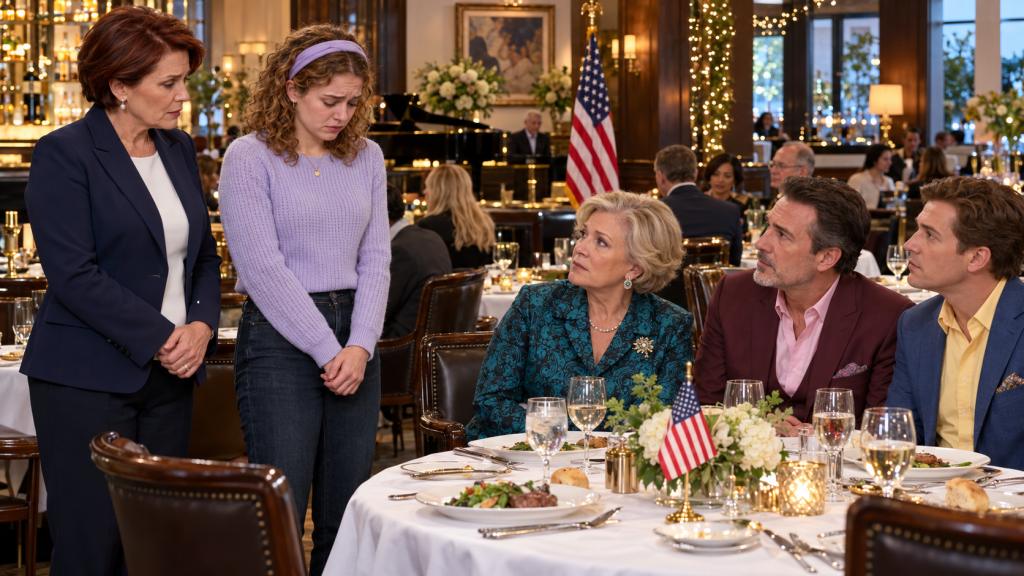
Sole froze.
I put down my fork.
“Mom.”
“What?”
“Don’t.”
She smiled innocently.
“It’s just a question.”
Sole looked at me.
Then she answered quietly.
“My real mom is sitting right here.”
I felt proud of her.
But my mother wasn’t finished.
“Oh, darling, you know what I mean.”
“Patricia,” I warned.
She ignored me.
“Sometimes children come into families under unfortunate circumstances. We all have to make the best of things.”
My father studied his menu.
Chris checked his phone.
I pushed my chair back.
“Enough.”
My mother leaned across the table.
She looked Sole directly in the eyes.
Then she whispered, “We don’t sit with mistakes.”
Sole went perfectly still.
I saw the color drain from her face.
Her fingers tightened around her napkin.
And I knew we were leaving.
I stood.
“Come on, sweetheart.”
My mother rolled her eyes.
“Oh, Marlo, don’t be dramatic.”
“You just called my daughter a mistake.”
“She knows what I meant.”
“No. You know what you meant.”
My father sighed.
“Can’t we have one peaceful dinner?”
I stared at him.
“You could have stopped this.”
He said nothing.
I took Sole’s hand and walked her toward the exit.
Outside, the air was bitterly cold.
She didn’t speak until we were inside the car.
Then she asked the question I will never forget.
“Mom, am I a mistake?”
I turned toward her.
“Never.”
“Not even a little?”
“Not for one second of your life.”
Her chin trembled.
I leaned closer.
“You are the best decision I ever made.”
She began crying.
I held her in the parking lot while cars passed and the restaurant lights glowed behind us.
I promised myself that night that my parents would never have another opportunity to make her feel that way.
When we got home, Sole curled up beneath two blankets on the couch.
I made her hot chocolate.
We watched half a movie.
Eventually, she fell asleep.
At 10:14, my phone buzzed.
My father.
“You’re still making our car payment tomorrow, right?”
I stared at the message.
Not a word about my daughter.
Not a single expression of regret.
Just money.
I opened my laptop.
Within minutes, I canceled the recurring payment for their car.
Then I removed the utility transfers.
I canceled Chris’s phone bill payment.
I revoked my payment authorization for the pharmacy account.
I removed my parents from the emergency credit card I had allowed them to use.
I changed my banking passwords and added additional security.
I checked every account carefully to make certain I was only withdrawing payments and permissions I had the right to cancel.
Then I blocked their numbers.
For the first time in years, I went to bed knowing I would no longer fund people who treated my daughter as disposable.
But the next morning, something happened that turned my anger into fear.
Sole was sitting at the kitchen counter when I came downstairs.
Her pancakes were untouched.
“Morning, sweetheart.”
“Morning.”
I sat beside her.
“Did you sleep okay?”
She shrugged.
Then she asked, “Mom, if Grandma told you something bad about me, would you believe her?”
My stomach tightened.
“What kind of thing?”
She stared at her plate.
“Just something.”
“Sole, nothing your grandmother says could ever make me stop loving you.”
She looked at me.
“Even if it was really bad?”
“Even then.”
Her eyes filled with tears.
But she quickly looked away.
A few minutes later, she went upstairs to shower.
She left her phone on the kitchen counter.
The screen lit up.
A message appeared from an unknown number.
“You ruined everything by telling your mother. Remember what happens if you show her the pictures.”
My heart began pounding.
Before the notification disappeared, another arrived.
“Tomorrow morning is your last chance to fix this.”
I stood frozen.
Someone was threatening my child.
When Sole returned, I showed her the messages.
Her face turned pale.
“Mom, please don’t be angry.”
I knelt in front of her.
“I’m not angry with you.”
She started crying.
“I wasn’t supposed to tell.”
“Tell me what?”
She shook her head.
I held her hands.
“Sweetheart, someone is threatening you. I need to know what’s happening so I can protect you.”
For several minutes, she couldn’t speak.
Then she unlocked her phone.
“There are more messages.”
She opened a hidden group conversation.
The participants were my mother, Chris, someone saved as “Family Attorney,” and Sole.
The messages dated back six weeks.
My hands trembled as I read them.
My mother had been contacting Sole secretly.
At first, the messages seemed harmless.
She asked about school.
She complimented Sole’s drawings.
She told her how much she missed her.
Then the conversations changed.
“Your mother has become selfish.”
“She’s refusing to help people who raised her.”
“You must understand that families have responsibilities.”
Chris had added, “Grandma and Grandpa could lose their car because your mom thinks you’re more important than everyone else.”
I felt sick.
My mother then began asking Sole questions about my home office.
Where did I keep important documents?
Did I leave my computer unlocked?
Did Sole know where the spare filing cabinet key was?
Had she ever seen paperwork relating to the money I had saved for her future?
I looked at my daughter.
“What did they ask you to do?”
She began sobbing.
“Grandma said Grandpa needed some insurance papers. She said he couldn’t get his medicine without them.”
“What papers?”
“The blue folder in your office.”
I knew the folder.
It contained copies of estate-planning documents, financial records, and paperwork relating to Sole’s trust.
I had established the trust shortly after adopting her.
Over the years, I contributed regularly.
I had also deposited proceeds from selling an investment property.
The trust held nearly four hundred and eighty thousand dollars.
The money was for Sole’s education, medical needs, housing, and future security.
My parents knew the account existed.
But they didn’t know its value.
At least, I hadn’t told them.
“Did you give Grandma pictures?” I asked.
Sole nodded.
“I’m sorry.”
I pulled her close.
“You are not in trouble.”
“She said you’d send me away if I didn’t help.”
My heart stopped.
“What?”
“She said you regretted adopting me.”
I couldn’t speak.
Sole continued crying.
“She said you were tired of being my mom. She said if I wanted to stay, I needed to prove I was grateful.”
I wrapped my arms around her.
“Baby, none of that is true.”
“She said you told her.”
“I never said those things.”
“Promise?”
“I promise.”
She buried her face against my shoulder.
When she finally calmed down, we looked at the messages together.
There were photographs attached.
One showed my signature on an old document.
Another showed a newly prepared form titled “Emergency Family Care and Financial Responsibility Authorization.”
My name appeared at the bottom.
Marlo Bennett.
The signature looked remarkably like mine.
But I had never signed it.
The document named my parents as temporary family representatives for Sole.
It referenced financial decisions related to her care.
Another paper claimed I was emotionally unstable and temporarily unable to manage my daughter’s needs.
Then I noticed the date.
Monday morning.
My mother and brother were preparing to submit documents claiming they should have authority over my daughter.
And they intended to use my reaction at the restaurant as evidence.
I scrolled farther down.
There were messages sent before dinner.
My mother had written:
“Remember the plan. Let Marlo get upset.”
Chris replied:
“She’ll walk out. She always does when the kid cries.”
Then my mother wrote:
“That will prove she can’t handle family disagreements.”
I felt the room tilt.
The dinner hadn’t been an accident.
It had been staged.
My mother had deliberately insulted Sole because she knew I would defend her.
She wanted me to leave.
She wanted witnesses.
She wanted a confrontation she could later twist into evidence that I was emotionally unstable.
And somehow, Sole’s trust fund was involved.
I called my attorney immediately.
Naomi Ellis had helped establish my business and prepare my estate documents.
When I explained what had happened, she asked me to send everything.
I forwarded the messages.
The photographs.
The suspicious forms.
The threats.
Twenty minutes later, she called.
“Marlo, where is Sole?”
“She’s home with me.”
“Keep her there.”
My stomach tightened.
“Naomi, what’s happening?”
“First, I need to confirm whether these documents are genuine.”
“They’re not. I never signed them.”
“I believe you. But we need to establish exactly who prepared them and what they intended to accomplish.”
She asked whether I had ever authorized my parents to make decisions regarding Sole.
“No.”
“Have you signed any emergency guardianship forms?”
“Absolutely not.”
“Have you recently amended the trust?”
“No.”
Naomi was silent for a moment.
“Then this is serious.”
I looked toward the living room.
Sole was sitting on the couch with Pepper curled against her legs.
“Can they take her?”
“Not simply by presenting paperwork like this. There are legal protections. But we need to act before they make any false claims or attempt to misuse these documents.”
Naomi instructed me to preserve every message.
She asked me not to confront my family.
She arranged an urgent meeting.
And before hanging up, she asked one final question.
“Marlo, how much is in Sole’s trust?”
I told her.
Nearly four hundred and eighty thousand dollars.
Naomi paused.
“That may explain everything.”
The next morning, we met at her office.
She had already contacted the attorney whose name appeared in the group chat.
His name was Graham Mercer.
He was a real lawyer.
But he had never represented my parents.
His office had not prepared those forms.
Someone had copied his letterhead and used his name without permission.
The phone number Sole had saved as “Family Attorney” wasn’t connected to his firm.
Naomi placed the printed document on her desk.
“Someone is impersonating an attorney.”
I stared at the page.
“Chris.”
“Possibly.”
I remembered my brother telling us years earlier that he had worked briefly as an assistant at a legal document preparation company.
He knew how forms looked.
He knew how to make paperwork appear official.
And he knew enough legal terminology to frighten someone unfamiliar with the process.
Naomi examined the documents.
“They appear to be attempting to establish a basis for temporary authority over Sole.”
“Why?”
“Because if your parents could somehow obtain legal standing to make decisions on her behalf, they might attempt to request money from the trust.”
I shook my head.
“But the trust has an independent trustee.”
“Exactly. They couldn’t simply take the money. Their plan has serious legal flaws.”
“Then why would they try?”
Naomi looked at me.
“Desperation. Ignorance. Or someone convinced them it would work.”
I thought about Chris.
His unpaid bills.
His unstable employment.
The loans my parents had been covering.
And suddenly, a much larger picture began forming.
My parents weren’t only angry that I had threatened to stop paying their bills.
They wanted access to the money I had saved for my daughter.
The same daughter they refused to treat as family.
I felt physically ill.
Naomi leaned forward.
“Marlo, I want you to understand something. This is not Sole’s fault. The people responsible are the adults who manipulated her.”
I nodded.
But I was already thinking about how frightened my daughter must have been.
For six weeks, she had carried messages telling her that I regretted adopting her.
She had been told that my parents might die if she refused to help.
She had been warned that she could lose her home.
And she had kept it all secret because she believed telling me would make those threats come true.
When we got home, I found Sole sitting at the dining room table with her sketchbook.
She looked up.
“Are you mad at me?”
I sat beside her.
“No, baby.”
“Did I do something really bad?”
I took her hand.
“You were pressured by adults who should have protected you. They lied to you. They frightened you. That responsibility belongs to them.”
She stared at me.
“Grandma said she loved me.”
I swallowed.
“I know.”
“Do people who love you do things like that?”
I didn’t want to give her an answer that would make the world seem simple when it wasn’t.
So I told her the truth.
“Sometimes people say they love us and still make harmful choices. But love doesn’t excuse hurting someone.”
She looked down.
“Do you still love Grandma?”
I thought for a long moment.
“She’s my mother, and I care about what happens to her. But I cannot trust her to treat us safely.”
Sole nodded.
Then she whispered, “I don’t want to see her again.”
I wrapped my arm around her.
“You don’t have to.”
That afternoon, I contacted Sole’s school.
I removed my parents and Chris from every approved pickup list.
I updated our emergency contacts.
I explained that no one outside the newly authorized list was permitted to take Sole from campus.
I also contacted the financial institution administering her trust.
The trustee agreed to require additional verification for any future request involving a change of authority or account access.
Naomi helped me file a report about the forged documents and threatening messages.
We provided copies of everything.
For the first time, I stopped trying to handle my family’s behavior privately.
I wasn’t going to protect their reputation at the expense of my daughter’s security.
On Monday morning, the day listed on the suspicious documents, I sat in Naomi’s office while she made several calls.
The court filing office confirmed that no valid order giving my parents authority over Sole existed.
The purported attorney denied involvement.
The financial institution confirmed that no money had been withdrawn from the trust.
I finally exhaled.
But Naomi remained serious.
“Marlo, this isn’t over.”
I looked at her.
“What do you mean?”
“Someone went to considerable effort to create these documents. We need to understand how far they intended to go.”
She was right.
And over the following weeks, the investigation revealed something I never could have imagined.
Chris was drowning in debt.
Not ordinary credit card debt.
Not a few late payments.
He had accumulated enormous losses through online gambling and personal borrowing.
He owed money to several lenders.
He had already convinced my parents to refinance their car.
He had drained much of their remaining savings.
And he was facing a deadline to repay a significant amount.
My parents had been helping him hide the situation.
When they ran out of money, they turned toward me.
But I had already warned them that their cruelty toward Sole would end my financial support.
So they needed another solution.
They knew Sole had a trust.
They knew I had saved for her education.
And they believed they could pressure or manipulate their way into controlling it.
Investigators eventually connected the fake attorney’s phone number to Chris.
They also found drafts of the documents on a computer he used.
The false allegations about my parenting had been carefully prepared.
My mother had contributed statements claiming I was emotionally unstable.
My father had provided information about our family finances.
And Chris had assembled the paperwork.
They had planned to argue that Sole needed temporary care with her grandparents because I was supposedly incapable of maintaining healthy family relationships.
The restaurant dinner was supposed to become their example.
My mother would insult Sole.
I would react.
Then they would describe my decision to leave as an irrational emotional outburst.
They had even discussed asking restaurant employees to confirm that I had walked out before the meal was finished.
They didn’t seem to understand that calmly removing a child from an abusive situation was not evidence of poor parenting.
They had mistaken their own cruelty for a useful legal strategy.
And they had underestimated how easily their messages could expose their intentions.
The most devastating discovery came when investigators reviewed the messages between my mother and Chris.
One message from Chris said:
“If we can get temporary control, we only need the first withdrawal.”
My mother asked:
“How much?”
Chris replied:
“Seventy-five thousand.”
Seventy-five thousand dollars.
That was the amount they hoped to obtain from my daughter’s future.
I remember staring at those words.
I couldn’t understand how people who had refused to buy her a proper birthday gift could feel entitled to the money I had spent years saving for her.
They didn’t want to be her grandparents.
They wanted to use her.
The realization changed something inside me permanently.
For years, I had believed my parents’ behavior was rooted in prejudice, selfishness, or emotional immaturity.
Those things were still true.
But now I understood that they were also willing to exploit a child’s deepest fear to solve an adult’s financial problem.
And no amount of family history could make that acceptable.
When Detective Mills asked whether I wanted to proceed with a formal complaint, I didn’t hesitate.
“Yes.”
He nodded.
“Are you certain?”
I looked at Sole’s photograph on my phone.
She was smiling beside a painting she had completed for school.
“I’ve never been more certain of anything.”
The following months were difficult.
My parents tried to contact me through relatives.
My mother told people I had become cruel and ungrateful.
My father claimed I had abandoned them financially.
Chris posted vague messages online about betrayal.
For a while, my phone filled with calls from relatives who believed their version of events.
My aunt Lorraine was the first to confront me.
“Marlo, your parents are struggling.”
“I know.”
“Your father could lose the car.”
“Then he needs to speak with the lender.”
She sounded shocked.
“That’s your answer?”
“Yes.”
“They raised you.”
“And I supported them financially for years.”
“You can’t just turn your back on family.”
I looked toward Sole, who was doing homework at the kitchen table.
“I’m not turning my back on family. I’m protecting my daughter.”
My aunt sighed.
“Your mother says you’ve become unstable.”
I almost laughed.
“Did she tell you she tried to use forged documents to gain control of Sole’s trust?”
Silence.
Then Lorraine whispered, “What?”
I explained what I could without interfering with the investigation.
By the time I finished, she sounded horrified.
“I didn’t know.”
“Most people don’t. They’ve only heard my mother’s story.”
A few days later, Lorraine called again.
This time, she apologized.
She told me my mother had been asking relatives for money and claiming she needed help with legal expenses.
She had also been telling people that Sole was emotionally troubled and that I was refusing professional help.
I felt a familiar surge of anger.
Even after everything, my mother was still trying to make my daughter responsible for her own behavior.
I told Lorraine I appreciated the apology.
Then I ended the call.
I no longer had the energy to defend myself to every relative who preferred gossip over facts.
Instead, I focused on Sole.
She began attending therapy again.
Her therapist helped her understand emotional manipulation and boundaries.
They talked about the difference between being responsible for your own actions and feeling responsible for someone else’s feelings.
At first, Sole struggled.
She repeatedly asked whether her grandparents were going to lose their home.
She worried that my father’s health would deteriorate without my money.
She wondered whether Chris’s problems were somehow connected to her.
One evening, she came downstairs after bedtime.
I was reading on the couch.
“Mom?”
I put down my book.
“What’s wrong?”
She stood in the doorway.
“If I hadn’t been adopted, would Grandma and Grandpa still have their money?”
I felt my heart break all over again.
“Come here.”
She sat beside me.
I wrapped an arm around her.
“Your grandparents’ financial problems existed long before this happened. Their choices caused those problems. You didn’t.”
“But Grandma said—”
“I know what she said.”
I turned toward her.
“Sweetheart, adults are responsible for managing their own money. You are not responsible for paying their bills. You are not responsible for keeping them happy. And you are certainly not responsible for protecting them from the consequences of hurting you.”
She leaned against me.
“I didn’t want anyone to get hurt.”
“I know.”
“That’s why I sent the pictures.”
I kissed the top of her head.
“I know, baby.”
She began crying softly.
And I held her until she fell asleep.
That night, I realized the worst damage my parents had caused wasn’t financial.
They had taught my daughter to feel guilty for existing.
They had convinced her that simply being loved by me took something away from everyone else.
I couldn’t change the past.
But I could make sure the rest of her childhood was different.
The legal investigation eventually led to formal consequences.
Chris faced charges connected to forgery and the fraudulent documents.
He initially denied everything.
Then investigators presented evidence linking him to the false attorney’s number and the documents.
He eventually admitted that he had prepared the paperwork.
But he insisted he never intended to take Sole away permanently.
As though planning to use her as a financial tool would somehow be acceptable if the arrangement were temporary.
My mother claimed she had simply been concerned about my emotional health.
She said I had become distant.
She argued that cutting off financial assistance demonstrated poor judgment.
But the messages showed her planning the restaurant confrontation before it happened.
They showed her instructing Sole to keep secrets.
And they showed her threatening a child with abandonment.
My father maintained that he hadn’t understood the details.
Yet his messages showed he knew the family was attempting to access money set aside for Sole.
The proceedings were neither quick nor simple.
There were interviews, document examinations, and hearings.
I learned that legal accountability rarely arrives with the dramatic certainty people imagine.
Eventually, Chris entered a plea agreement and received probation under supervision, along with financial and behavioral conditions.
Protective restrictions were established to prevent unwanted contact with Sole.
The disputed documents were formally rejected.
No money was taken from her trust.
And my family was prohibited from using the forged paperwork for any purpose.
When Naomi called to tell me the major proceedings had concluded, I sat quietly at my desk.
I expected to feel victorious.
Instead, I felt exhausted.
There was relief.
There was grief.
And there was a strange sadness for the family I had spent so many years trying to create.
Naomi seemed to understand.
“You did the right thing, Marlo.”
I looked out the window.
“I know.”
“Your daughter is safe.”
I nodded.
That was what mattered.
But safety was only the beginning.
Now we had to rebuild the parts of Sole’s confidence my family had damaged.
Spring arrived a few months later.
The trees outside our house began blooming.
Sole returned to her art classes.
She started inviting friends over again.
And little by little, I noticed changes.
She stopped checking her phone every few minutes.
She laughed more freely.
She began leaving her drawings on the coffee table instead of hiding them in her bedroom.
She stopped asking whether I was disappointed whenever she made a mistake.
One Saturday morning, I found her making pancakes.
Flour covered the kitchen counter.
There was batter on the floor.
Pepper was licking something beneath a chair.
Sole looked up when I entered.
“Oops.”
I looked around.
“What happened?”
“I think I used too much milk.”
I smiled.
“Looks like it.”
She hesitated.
Then started laughing.
“Can we order breakfast?”
I laughed too.
“Absolutely.”
We cleaned the kitchen together.
And for a moment, I remembered the little girl who had once been terrified after spilling orange juice.
Now she could make a mess and laugh about it.
That might have seemed like a small thing to anyone else.
To me, it was extraordinary.
A few weeks later, Sole’s school held its annual art exhibition.
She had been working on a painting for months.
But she wouldn’t let me see it.
“It’s a surprise,” she insisted.
On the evening of the exhibition, I walked into the school auditorium and searched for her name.
When I found her painting, I stopped.
It showed a small house.
A blue roof.
A red front door.
Three flowers beside the steps.
I recognized it immediately.
It was the house she had drawn when she was six.
The imaginary house she once said wasn’t real.
But this painting was different.
Two people stood on the porch.
A woman with dark hair.
A girl in a yellow sweater.
A small dog sat beside them.
Warm light glowed through the windows.
Above the door, Sole had painted a single word.
HOME.
I stood there with tears running down my cheeks.
Her art teacher approached.
“Beautiful, isn’t it?”
I nodded.
“She worked very hard on it.”
I could barely speak.
Sole appeared beside me.
“Mom, don’t cry.”
I laughed through my tears.
“I can’t help it.”
She slipped her hand into mine.
“Do you like it?”
“I love it.”
She looked at the painting.
“When I was little, I used to draw houses without people.”
“I remember.”
“Because I didn’t know who would live in them.”
I turned toward her.
“And now?”
She smiled.
“Now I know.”
I hugged her so tightly she complained I was embarrassing her.
But she was smiling the entire time.
That painting won second place.
I bought a frame the following weekend.
It hangs in our hallway today.
Every time I pass it, I remember that belonging isn’t something you can force.
It’s something you build through thousands of small moments.
Through showing up.
Through keeping promises.
Through making sure a child knows love doesn’t disappear when life becomes difficult.
Not long after the exhibition, my father tried to contact me through a cousin.
His car had been repossessed.
My parents were struggling to afford their expenses.
Chris couldn’t help.
The cousin told me they were considering selling their house.
I listened quietly.
Then I said, “I’m sorry they’re having financial difficulties.”
She paused.
“Are you going to help?”
“No.”
“Marlo, they’re your parents.”
“I know.”
“They’re getting older.”
“I know that too.”
She sighed.
“Don’t you feel guilty?”
I considered the question.
For years, guilt had controlled nearly every decision I made.
It had kept me paying bills I didn’t owe.
It had kept me attending gatherings where my daughter was unwelcome.
It had made me apologize for setting boundaries.
But I no longer confused guilt with responsibility.
“I feel sad,” I answered. “But their financial situation is theirs to resolve.”
The cousin was quiet.
Then she said, “I guess you’ve changed.”
I looked toward the living room, where Sole was laughing with her best friend.
“Yes,” I said. “I have.”
And for once, I was proud of that.
That summer, Sole and I took a trip to the coast.
We rented a small cottage with a blue front door.
She chose it because it reminded her of her painting.
We spent our mornings walking on the beach.
We collected shells.
We ate ice cream before dinner.
We watched movies when it rained.
For the first time in years, I went on vacation without worrying that my parents would interrupt with a financial emergency.
One evening, we sat beside the ocean watching the sunset.
Sole was sketching in a notebook.
After a while, she looked up.
“Mom?”
“Yes?”
“Do you miss Grandma and Grandpa?”
I watched the waves.
“Sometimes I miss the idea of what I wanted our family to be.”
She nodded thoughtfully.
“Do you miss them?”
I considered my answer.
“I miss a few good memories. But I don’t miss the way they treated us.”
She stared at the water.
“I don’t think I miss them.”
“That’s okay.”
“Is that mean?”
“No, sweetheart.”
She drew a little circle in the sand.
“Grandma always said family has to forgive.”
I took a breath.
“Forgiveness doesn’t mean allowing someone to keep hurting you.”
She looked at me.
“So even if I forgive her someday, I don’t have to see her?”
“Exactly.”
She smiled a little.
Then she returned to her sketchbook.
A few minutes later, she said, “I think I want to design houses when I grow up.”
“Really?”
“Yeah. I want to be an architect.”
I smiled.
“I think you’d be wonderful at that.”
She continued drawing.
“Not just big fancy houses.”
“What kind?”
“Houses where people feel safe.”
I looked away for a moment because my eyes had filled with tears again.
Then I told her, “Those are the best kind.”
When we returned home, I found an old wooden box while cleaning my office.
It had belonged to my grandmother Eleanor.
She died years before I adopted Sole.
Inside were photographs, birthday cards, and handwritten letters.
My grandmother had been one of the few people in my childhood who encouraged me to become my own person.
She celebrated my achievements without asking what they could do for anyone else.
She listened when I was upset.
And she never made me feel selfish for wanting a different life.
As I sorted through the letters, I found one she had written shortly after I opened my accounting firm.
The paper was yellowed.
Her handwriting was neat and slightly slanted.
I unfolded it carefully.
“Marlo, you have always tried to keep everyone comfortable. That is a beautiful quality, but I hope you learn that people who love you should never require you to suffer in order to feel secure.”
I stopped reading.
Tears blurred the page.
Then I continued.
“You are allowed to build a family that feels like home, even if it looks different from the family you were born into.”
I sat at my desk for a long time.
My grandmother had understood something I was only now beginning to accept.
I had spent years trying to prove my worth to people who measured love through obedience.
And while I was busy earning their approval, I nearly allowed them to destroy my daughter’s sense of belonging.
That evening, I showed Sole a photograph of Eleanor.
She studied it.
“She looks nice.”
“She was.”
“Would she have liked me?”
I smiled through tears.
“She would have adored you.”
Sole looked at the photograph again.
“Even though I’m adopted?”
I put my arm around her.
“Sweetheart, Grandma Eleanor would have loved you because you are you.”
Sole smiled.
Then she asked whether we could put the photograph beside her painting.
We did.
A year after the restaurant dinner, my mother sent a letter through her attorney.
It was longer than her previous attempts to contact me.
She acknowledged that some of her comments had been cruel.
She admitted that pressuring Sole had been wrong.
She wrote that financial stress and fear had clouded her judgment.
And she said she had begun attending counseling.
Then she asked whether we could consider rebuilding our relationship.
I read the letter twice.
For a moment, I felt the familiar pull of hope.
I imagined my mother finally understanding what she had done.
I imagined her apologizing sincerely to Sole.
I imagined a future where we might sit together without fear.
But then I remembered something important.
My mother’s desire for reconciliation didn’t create an obligation for Sole to participate.
Real change would have to happen whether or not we returned.
I discussed the letter with Naomi.
I also spoke with Sole’s therapist.
Then I made my decision.
I sent a short response through counsel.
“I hope you continue making progress. Sole and I will not be resuming contact.”
There was no dramatic confrontation.
No angry speech.
No long explanation.
Just a boundary.
And for the first time in my life, I didn’t feel guilty for keeping it.
Sole is fourteen now.
She’s taller than she was last year.
She wears her hair differently almost every week.
She has a growing collection of sketchbooks and insists she needs another set of colored pencils every time we visit an art supply store.
She complains about homework.
She laughs loudly with her friends.
She occasionally rolls her eyes when I remind her to take a jacket.
And she talks about the future without sounding frightened of it.
A few months ago, she asked me something that made me stop what I was doing.
“Mom, if you could go back to the day you adopted me, would you still do it?”
I looked at her.
“Of course.”
“Even knowing everything that happened?”
“Yes.”
“Even Grandma and Grandpa?”
I walked over and sat beside her.
“Sole, if I could go back to that courtroom a thousand times, I would choose you every single time.”
She smiled.
“Really?”
“Really.”
She leaned against my shoulder.
“Good. Because I’d choose you too.”
I hugged her.
And I thought about the little girl who had once asked whether permanent meant even when she was bad.
I thought about the restaurant.
The cruel whisper.
The trembling hands.
The messages on her phone.
The forged documents.
The threats.
And the moment I finally stopped allowing my family to dictate what love was supposed to look like.
For years, I believed that keeping the peace meant protecting everyone else’s feelings.
Now I understand that peace built on one person’s suffering isn’t peace at all.
It’s silence.
And I will never again ask my daughter to be silent so someone else can feel comfortable.
Last month, Sole surprised me with a request.
“Mom, can we go back to Willow & Vine?”
I stared at her.
“The restaurant?”
She nodded.
“Are you sure?”
“Yeah.”
I sat beside her.
“Why?”
She thought for a moment.
“Because I don’t want Grandma to own that memory.”
I felt something move in my chest.
Sole continued.
“I liked that restaurant before everything happened. I don’t want to be scared of it forever.”
So we made a reservation.
Just the two of us.
We arrived on a Friday evening.
The same warm lights hung over the patio.
The same hostess stand stood near the entrance.
The dining room smelled of bread and garlic.
For a moment, I remembered the terrible night when my daughter had been made to feel unwanted.
But then Sole squeezed my hand.
“Come on, Mom.”
We sat beside the window.
She ordered her favorite pasta.
I ordered mine.
We talked about school, her friends, and the architecture videos she’d been watching.
Nobody insulted her.
Nobody questioned whether she belonged.
Nobody made her feel she needed to earn her seat.
When dessert arrived, the waitress placed a large slice of chocolate cake between us.
“Are we celebrating something?” she asked.
Sole looked at me.
Then she smiled.
“Yeah.”
The waitress smiled back.
“What are we celebrating?”
Sole squeezed my hand.
“My mom and me.”
I laughed.
The waitress brought two spoons.
And for the first time, that restaurant became something other than the place where my daughter had been hurt.
It became the place where she reclaimed a happy memory.
On the drive home, Sole leaned against the window.
“Mom?”
“Yes, sweetheart?”
“Can we go back next year?”
“Of course.”
“And the year after?”
“Yes.”
“And when I’m grown up?”
I smiled.
“Especially when you’re grown up.”
She thought about it.
“Even if I have my own kids?”
“Then we’ll need a bigger table.”
She laughed.
And I laughed with her.
Because that was the future I had always wanted.
Not the perfect family photographs my mother used to obsess over.
Not expensive dinners where everyone pretended nothing was wrong.
Not relationships maintained through guilt and money.
Just a table where my daughter knows she is welcome.
A home where she can make mistakes without fearing abandonment.
A family where love is never used as a threat.
My mother once said, “We don’t sit with mistakes.”
She thought she was teaching Sole where she belonged.
Instead, she taught me where we didn’t.
We didn’t belong at a table where a child’s dignity was negotiable.
We didn’t belong in a family where love depended on financial support.
And we didn’t belong anywhere that required my daughter to feel grateful for being tolerated.
So I walked away.
I stopped the payments.
I protected her future.
And I finally built the peaceful family I had spent so many years looking for.
Sometimes, when I pass Sole’s painting in the hallway, I stop for a moment.
I look at the blue roof.
The red door.
The flowers.
The two people standing together on the porch.
And I remember the six-year-old girl who once told me that house wasn’t real.
If I could speak to that little girl now, I would tell her something.
The house was real.
The love was real.
The future was real.
She just hadn’t found it yet.
And I would tell her that one day, she would sit beside her mother in a restaurant and laugh over chocolate cake.
She would have friends who loved her.
She would have dreams worth chasing.
She would have a home filled with laughter, art supplies, and a dog who stole slippers.
And most importantly, she would never again have to wonder whether she was a mistake.
Because she wasn’t.
She never had been.
She was the daughter I had been waiting for.
And if I lived a thousand lives, I would choose her in every single one.
💬THE END! THANK YOU FOR READING!