

My seventeen-year-old daughter spent three days preparing a birthday dinner for twenty-three members of our family. Ten minutes before the guests were supposed to arrive, my father sent a message saying they’d decided to celebrate at an expensive restaurant instead. Adults only. Then they charged $1,327.90 to my business card for a dinner my daughter and I weren’t even invited to attend. I didn’t scream. I didn’t drive to the restaurant. I made one phone call that changed everything. Fifteen hours later, my parents and sister were pounding on my front door, demanding that I repair the damage to their reputations. But when my husband placed two documents on the hallway table, my sister went completely pale. Because the restaurant bill was only the beginning of what they’d done behind my back.
My name is Jenna Marlow. I’m forty-three years old, and for most of my adult life, I believed that keeping a family together meant being the person who forgave first, paid when things went wrong, and quietly swallowed every insult to avoid an argument.
My husband, Michael, used to tell me that I was confusing generosity with obligation.
I always told him he didn’t understand my family.
Looking back, I think he understood them better than I did.
Our daughter, Ava, was seventeen. She had my brown eyes, Michael’s stubborn chin, and the sort of quiet determination that made her seem older than she was.
Ever since she was small, she’d loved cooking.
Not the way most children enjoy decorating cupcakes or licking cake batter from a spoon. Ava loved everything about food, including the parts other people found tedious.
She liked measuring temperatures, comparing ingredients, studying techniques, and understanding why one method produced a better result than another.
When she was nine, she borrowed a cookbook from the library and insisted on preparing homemade pasta.
The kitchen looked like a flour factory had exploded.
The noodles were uneven, and the sauce was too salty.
But she carried those plates to the table as proudly as if she’d just opened her first restaurant.
Michael took a bite, smiled, and asked when he could make a reservation for her next dinner.
Ava never forgot that.
By fourteen, she’d enrolled in weekend culinary classes.
At sixteen, she’d entered a regional student cooking competition and placed second with a dish she’d developed herself.
She saved every certificate in a blue folder beside her bed.
Whenever school became overwhelming, she would open that folder and remind herself that there was something in the world she loved enough to work hard for.
Her dream was to attend culinary school, train in a professional restaurant, and eventually open a small place of her own.
My mother, Diane, didn’t approve.
She was sixty-six at the time, approaching her sixty-seventh birthday, and had very firm ideas about what made a career respectable.
According to Mom, respectable people worked in offices, wore professional clothes, and received regular salaries.
She thought cooking was something you did because your family needed dinner.
Not something you spent years learning to perfect.
Whenever Ava talked about culinary school, Mom would smile with the patience of someone listening to a child announce she wanted to become a princess.
“That’s a sweet dream,” she’d say. “But eventually you’ll need to choose something practical.”
My father, Robert, usually agreed.
“Restaurants fail all the time,” he liked to remind her. “You should study accounting. Then you’ll always have work.”
Ava never argued.
She just smiled politely and changed the subject.
But I noticed how quiet she became afterward.
My younger sister, Lauren, was another matter entirely.
Lauren was thirty-nine, married to a real estate broker named Scott, and raising two children, Mason and Chloe.
She’d spent most of her adult life chasing whatever business idea seemed fashionable at the moment.
First came a boutique clothing store.
Then an online wellness company.
Then a luxury gift-basket service.
Each venture began with expensive branding, professional photographs, and enthusiastic speeches about how successful she’d become.
Each one eventually collapsed.
And every time something went wrong, my parents expected me to help.
When the boutique couldn’t pay its rent, I covered two months.
When Lauren needed a new computer, I bought one.
When she wanted to launch her latest business, an event-planning company called Willow & White Events, I paid the graphic designer who created her logo.
I owned a successful interior design company called Marlow & Finch Interiors.
I’d built it over fourteen years, beginning with one client, a borrowed office, and an old laptop.
By the time Ava was seventeen, I employed eight people and had contracts with several residential developers.
We weren’t fabulously wealthy.
But Michael and I had worked hard enough to build a comfortable life.
My family interpreted that comfort as permission to ask for money whenever they needed it.
I paid for birthday dinners, anniversary gifts, family vacations, and emergencies that often turned out not to be emergencies.
Dad liked to say, “Jenna’s the responsible one.”
For years, I thought that was a compliment.
I didn’t realize it was also an excuse.
Three weeks before Mom’s birthday, Ava approached me while I was reviewing invoices at our kitchen island.
She was carrying her tablet and a notebook covered in colorful sticky notes.
“Mom, can I show you something?”
I looked up.
“Of course.”
She opened a beautifully designed menu.
At the top, she’d written:
Diane’s Sixty-Seventh Birthday Celebration.
Beneath it was a full five-course meal.
There were three appetizers, two main-course options, vegetables, fresh bread, and dessert.
She’d included alternatives for allergies and dietary restrictions.
At the bottom was a photograph of a three-layer cake decorated with lavender flowers and dark chocolate.
I looked from the menu to her hopeful face.
“Ava, what’s all this?”
“I want to cook Grandma’s birthday dinner.”
“All of it?”
She nodded.
“I’ve been planning it for almost two weeks.”
I scrolled through the menu.
Roasted duck with orange and thyme.
Herb-crusted salmon with lemon butter.
Wild mushroom risotto.
Honey-glazed carrots.
Rosemary potatoes.
Fresh dinner rolls.
A lavender and lemon cake filled with blackberry cream.
I was impressed before I even reached the preparation schedule.
She’d calculated cooking times, equipment requirements, ingredient quantities, and the order in which every dish would be prepared.
“Sweetheart, this is a lot of work.”
“I know.”
“Are you sure you want to do all this?”
Ava hesitated.
Then she said something that made my heart ache.
“Grandma never thinks I’m serious about cooking. Maybe if she sees me prepare a real dinner for the whole family, she’ll understand.”
I closed the tablet.
“Ava, you don’t need to prove anything to Grandma.”
“I know, Mom. But she’s always saying I should choose another career.”
Her eyes dropped.
“I just want her to be proud of me for once.”
That sentence should have warned me.
My daughter wasn’t simply planning a celebration.
She was building an opportunity to win approval from someone who’d spent years withholding it.
I should have told her to cook for people who already believed in her.
Instead, I remembered the grandmother who’d once taught me to bake cookies and convinced myself that Mom would surely appreciate the effort once she saw it.
So I agreed.
Michael agreed too.
We offered to buy the groceries, help with cleaning, and handle anything involving the house.
Ava insisted on doing the cooking herself.
For the next three weeks, our kitchen became her personal test restaurant.
Every evening after school, she practiced something.
One night, she made three versions of lemon butter sauce.
Another night, she experimented with lavender until she found a flavor that wouldn’t overpower the cake.
She tested the risotto twice because she wasn’t satisfied with the texture.
She called relatives to ask about allergies.
She checked whether Grandpa was still avoiding salt.
She even prepared a gluten-free dessert for a cousin who couldn’t eat the cake.
And she invited everyone personally.
Twenty-three invitations.
Twenty-three confirmations.
My parents accepted.
Lauren accepted for herself, Scott, and their children.
My uncles, aunts, and cousins all responded.
Dad called to ask whether he should bring wine.
Mom asked what she should wear.
Lauren wanted to know whether Ava could provide little printed menus because they would look nice in photographs.
Nobody mentioned another restaurant.
Nobody suggested that the plans might change.
On Friday morning, Ava started preparing stocks and sauces.
Saturday was devoted to cake layers, fillings, vegetables, and everything that could safely be made ahead.
By Sunday morning, our refrigerators were filled with labeled containers.
The kitchen counters were covered with neatly arranged ingredients.
Ava woke before six.
When I came downstairs, she was already standing beside the stove wearing her blue apron.
Her hair was tied back.
Her notebook was open.
A thermometer rested beside the cutting board.
“Good morning, Chef,” I said.
She grinned.
“Good morning, dishwasher.”
I laughed.
“Have you eaten?”
“Yes.”
“Are you sure?”
She held up a half-eaten piece of toast.
“See?”
At lunchtime, Michael came downstairs and found her checking the oven.
He saluted dramatically.
“Reporting for duty. What does the chef require?”
“Could you polish the wine glasses?”
“Yes, Chef.”
“And please don’t touch the cake.”
Michael placed a hand over his heart.
“You wound me.”
Ava laughed.
It was one of those ordinary, happy family moments that don’t seem important until something happens that makes you wish you could return to them.
By five-thirty, our dining room looked beautiful.
Twenty-three places were set around the main table and an adjoining table we’d arranged for the younger guests.
Each place had a handwritten name card.
Fresh flowers stood in short glass vases.
Cream-colored menus rested on the plates.
Ava had folded the napkins herself.
At Mom’s seat was a small wrapped box.
Inside was an engraved silver measuring spoon.
It read:
For the woman who taught me that every family needs a little sweetness.
Ava had saved part of her allowance to buy it.
She’d wrapped it in lavender paper and tied it with a white ribbon.
When I asked why she’d chosen that gift, she smiled.
“Grandma used to let me help make cookies when I was little. I thought she’d remember.”
At five-forty, Michael left to buy some additional sparkling water.
Our guests were expected at six.
Ava was in the kitchen piping dark chocolate letters onto the cake.
“Mom, do you think Grandma will like the lavender glaze?”
I smiled.
“She’ll love it, sweetheart.”
Then my phone buzzed.
A message appeared in our family group chat.
It was from Dad.
“We’ve decided to celebrate at Bellamy House Restaurant instead. Adults only. Hope everyone understands.”
I stared at the screen.
For a moment, I genuinely thought he’d sent the message to the wrong conversation.
I looked at the clock.
Five-fifty.
Ten minutes before the dinner.
I called him.
He answered with music and conversation in the background.
“Hello, sweetheart.”
“Dad, what restaurant?”
“Bellamy House. Beautiful place. Lauren arranged a private dining room.”
“You’re there now?”
“Yes, everyone’s getting seated.”
“Everyone?”
“Your mother, your sister, the family. Everyone.”
I turned slowly toward the dining room.
Twenty-three plates.
Twenty-three empty chairs.
“Dad, Ava’s been cooking for three days.”
He sighed.
“Jenna, plans change.”
“Ten minutes before dinner?”
“Your mother deserves a proper celebration. Lauren arranged something special.”
“Ava arranged something special.”
“Well, she’s only seventeen.”
I couldn’t believe what I was hearing.
“What does that have to do with anything?”
“Don’t be difficult. She can freeze the leftovers.”
“She made dinner for twenty-three people.”
“Then you’ll have food for the week.”
I heard laughter behind him.
Someone asked whether he’d finished ordering the champagne.
“Dad, did everybody know about this?”
He hesitated.
“Most people.”
“When did you decide?”
“Yesterday afternoon.”
I felt my stomach drop.
“Yesterday? And nobody told us?”
“We didn’t want to upset Ava before the party.”
“So you decided to upset her ten minutes before it instead?”
“Jenna, I’m not doing this right now.”
Then he hung up.
I stood in the hallway staring at my phone.
Ava called from the kitchen.
“Mom? Was that Grandpa?”
I didn’t answer.
Instead, I called my mother.
She picked up after several rings.
“Jenna, we’re just ordering.”
“Mom, why aren’t you coming?”
“Oh, honey, I thought your father explained.”
“He told me you’re at a restaurant.”
“Yes. Lauren arranged a lovely dinner.”
“Ava has been preparing your birthday meal for three days.”
Mom made a small impatient sound.
“Well, that was very sweet of her.”
“Then why aren’t you here?”
She lowered her voice, as though she were explaining something obvious to a particularly slow child.
“Jenna, she’s seventeen. We didn’t want to risk getting sick eating food prepared by a child.”
I felt the words like a slap.
“Ava has taken food-safety classes. She’s competed in culinary events. She designed an entire menu around everyone’s dietary restrictions.”
“That’s nice, but she’s not a real chef.”
“She’s your granddaughter.”
“Exactly. I don’t want her embarrassed if something goes wrong.”
“You think abandoning her dinner won’t embarrass her?”
“Don’t be dramatic.”
I closed my eyes.
Then I remembered something.
“Dad said it’s adults only.”
“Yes.”
“Then why are Lauren’s children there?”
Mom hesitated.
“Mason and Chloe are family.”
“So is Ava.”
“Jenna, please don’t turn this into something ugly.”
Something inside me went terribly still.
“It already is.”
Mom sighed.
“I refuse to have my birthday ruined by your attitude.”
She hung up.
A minute later, Lauren called.
I answered because I wanted to hear what explanation she’d invented.
“Seriously, Jenna?” she began. “Are you calling everyone and making a scene?”
“Ava cooked for twenty-three people.”
“And that’s adorable. But nobody wants to be a teenager’s test subject.”
“Then why did you accept the invitation?”
“Because we didn’t want to discourage her.”
“Lauren, you let her spend days preparing food you knew you wouldn’t eat.”
“It’s a learning experience.”
“What exactly is she supposed to learn?”
“That not everything revolves around her.”
I ended the call.
My hands were shaking.
Then I heard a quiet voice behind me.
“Mom?”
I turned.
Ava stood in the doorway holding her phone.
Someone had already posted a photograph in the family group chat.
Mom was seated beneath an enormous chandelier.
Dad was raising his glass.
Lauren sat beside Scott and their children.
A waiter stood nearby holding a silver tray.
Beneath the picture, a cousin had written:
Best birthday surprise ever!
Ava stared at the screen.
Then she looked toward the dining room.
“Mom, they really aren’t coming?”
I wanted to invent an excuse.
I wanted to tell her there’d been a terrible misunderstanding.
But she’d already seen the photograph.
“No, sweetheart.”
Her lower lip trembled.
“Did I do something wrong?”
“No.”
“Did Grandma hate the menu?”
“She never tasted it.”
Ava looked toward the kitchen.
“Maybe I made everything too complicated.”
“Sweetheart—”
“Maybe she thought it wouldn’t be good.”
She slowly reached behind her back and untied her apron.
“I guess I wasn’t good enough.”
Those words hurt worse than anything my parents had said.
I pulled her into my arms.
She tried to hold herself together.
But when I touched the back of her head, she began crying.
Not loudly.
Not dramatically.
Just quiet, exhausted sobs from a girl who’d spent three days trying to earn somebody’s love.
I held her until her breathing slowed.
Then my phone buzzed again.
A bank notification appeared on the screen.
Business credit card transaction approved.
Bellamy House Restaurant.
$1,327.90.
I blinked.
Then I opened the banking application.
The charge was real.
It had been made against the card belonging to my company, Marlow & Finch Interiors.
A card I used for legitimate business expenses.
A card that should never have been charged for my mother’s personal birthday dinner.
I recognized the restaurant because my company had sponsored a charity luncheon there the previous year.
Dad had helped coordinate the event.
The restaurant had kept our payment information associated with the corporate account.
Somehow, that information had been used again.
I checked the transaction twice.
Then I looked at my daughter.
She was standing beside the birthday cake, staring at the words she’d written so carefully.
Happy 67th, Grandma.
“We should throw everything away,” she whispered.
“No.”
She looked up.
“Mom?”
“We’re not throwing away three days of your hard work.”
“But nobody’s coming.”
I picked up my phone.
“Then we’re going to invite people who actually deserve to sit at this table.”
My first call was to Michael.
He answered from the grocery store parking lot.
“Did I forget something?”
“No. I need you to come home.”
He heard something in my voice.
“What happened?”
I told him everything.
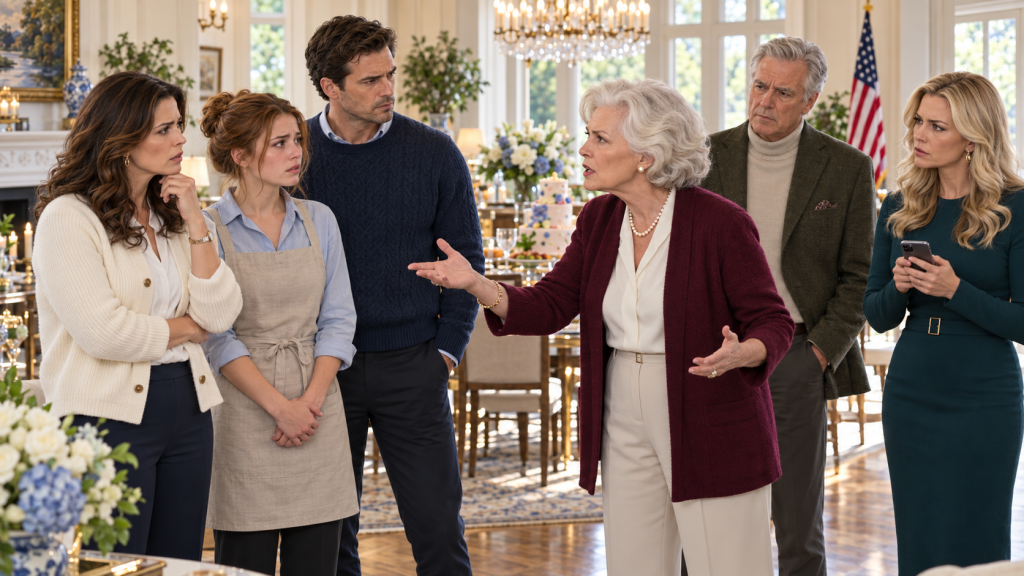
When I reached the part about Mom calling Ava a child who might make everyone sick, he went completely silent.
When I mentioned the restaurant charge, I heard him take a sharp breath.
“They used your business card?”
“Yes.”
“Without asking?”
“Yes.”
“Jenna, that’s not just rude.”
“I know.”
“Do you want me to call Robert?”
“No. Come home. Bring the water.”
There was a pause.
“What are we doing?”
I looked at twenty-three empty chairs.
“We’re having dinner.”
Michael didn’t ask another question.
“I’m on my way.”
Then I called our neighbors, Paul and Rebecca Harrison.
Rebecca answered.
“Jenna? Everything okay?”
I explained that Ava had prepared a full dinner, our guests had canceled, and we suddenly had plenty of available seats.
“Would you like to come?”
Rebecca didn’t hesitate.
“Absolutely. How many people can we bring?”
“Four would be wonderful.”
“We’ll be there.”
I called my friend Olivia, who coordinated volunteer events at the community center.
She listened, then said, “Give me ten minutes.”
I called Ms. Tanaka, Ava’s former culinary instructor.
When I explained, she became quiet.
“Jenna, is Ava all right?”
“She’s trying to be.”
“Tell her I’ll be there.”
Within fifteen minutes, enough people had accepted to fill every place.
Some were neighbors.
Some were friends.
Several were people from our community group.
A few knew Ava from school or volunteer projects.
None of them needed convincing that a carefully prepared meal was worth appreciating.
When Michael returned, Ava was sitting at the kitchen island looking miserable.
He placed the grocery bags down and kissed her forehead.
“Chef, are we still on schedule?”
She looked confused.
“Dad, nobody’s coming.”
He smiled.
“That’s not what I’ve heard.”
Five minutes later, the doorbell rang.
Then another car pulled into the driveway.
Then another.
Rebecca Harrison arrived carrying flowers.
Paul brought sparkling cider.
Olivia came with friends from the community center.
One neighbor brought folding chairs in case we needed extras.
People filled our entryway with laughter and conversation.
Ava looked terrified.
“Mom, what are you doing?”
“Giving people a chance to taste what you made.”
“But what if they don’t like it?”
“Then you’ll learn something. That’s what chefs do.”
She swallowed.
“They weren’t supposed to be my guests.”
I took both her hands.
“I know. But look at them.”
She turned toward the dining room.
People were admiring the menus.
Commenting on the flowers.
Asking questions about the food.
One older gentleman had already begun reading the menu aloud to his wife.
Ava’s shoulders slowly straightened.
“Okay,” she whispered.
Then she tied her apron back on.
“Let’s do this.”
The first course was a roasted beet salad with citrus, toasted walnuts, and honey dressing.
Ava had worried the dish was too simple.
But as the plates went around, the room gradually quieted.
Olivia took one bite and looked toward the kitchen.
“Who made this dressing?”
Ava hesitantly raised her hand.
Olivia smiled.
“It’s extraordinary.”
Rebecca nodded.
“I would pay good money for this.”
Ava blushed.
The next course included delicate pastry bites filled with mushrooms and herbs.
Then came the main dishes.
The duck had crisp skin and tender meat.
The salmon was perfectly cooked.
The risotto was rich without being heavy.
I watched Paul Harrison take one bite and slowly lower his fork.
“Jenna,” he said, “why didn’t you tell us your daughter was secretly running a restaurant?”
Everybody laughed.
Ava smiled shyly from the kitchen doorway.
Then Ms. Tanaka tasted the risotto.
She chewed thoughtfully.
Ava watched her with the nervous expression of a student awaiting an examination result.
Finally, Ms. Tanaka looked up.
“Ava, come here.”
My daughter approached.
“Yes, ma’am?”
“Why did you roast the mushrooms instead of sautéing them?”
Ava blinked.
Then she began explaining.
She talked about moisture, texture, caramelization, and how she wanted the mushrooms to contrast with the creamy rice.
As she spoke, her nervousness disappeared.
Her hands moved as she described the cooking process.
She stopped watching people’s faces for approval and started talking about something she genuinely loved.
Ms. Tanaka listened carefully.
Then she nodded.
“That was an intelligent decision. Very well executed.”
Ava’s face lit up.
It was the first time that evening I’d seen her smile without sadness behind it.
By dessert, people were already asking for recipes.
Ava removed the cake from the refrigerator.
She’d carefully covered the birthday message with chocolate decorations.
When I noticed, my throat tightened.
The woman she’d made the cake for hadn’t bothered to come.
But the cake itself was beautiful.
Three delicate layers.
Lavender glaze.
Lemon filling.
Dark chocolate curls.
Ava carried it into the dining room.
Michael stood first.
Then Olivia.
Then the Harrisons.
Within seconds, everyone was applauding.
My daughter stopped in the doorway.
Her eyes widened.
“Mom?”
I could barely speak.
“They’re thanking the chef.”
She covered her mouth with one hand.
Then she began crying again.
Only this time, she was smiling.
One of our unexpected guests was a woman named Camille Reed.
Olivia had invited her after hearing that we had extra seats.
Camille was a freelance food journalist and photographer who wrote for a regional publication called The County Table.
She’d arrived carrying a camera bag and had spent most of the evening quietly photographing the dishes.
After dessert, she approached Ava.
“Would you mind answering a few questions?”
Ava glanced nervously at me.
I nodded.
Camille asked about the recipes.
About the ingredients.
About Ava’s culinary classes.
About the first dish she’d ever made.
Ava told her about the disastrous homemade pasta she’d prepared when she was nine.
Camille laughed.
“Every good chef has a few disasters.”
Then she asked what had inspired the birthday menu.
Ava hesitated.
Finally, she said, “I wanted my grandma to know I was serious.”
Camille lowered her notebook.
“Does she support your cooking?”
Ava looked down.
“Not really.”
“Why did you prepare this dinner for her?”
Ava’s voice was barely audible.
“Because I thought maybe she’d be proud of me.”
The room around us seemed to become quieter.
Camille asked whether Ava would be comfortable with a short feature about the dinner.
She explained where it would be published and how the photographs might be shared.
Ava agreed, provided the article focused on her cooking rather than simply making fun of her relatives.
I showed Camille the invitation, the cancellation message, and the restaurant charge.
I also explained that we were disputing the charge and still trying to determine how the payment had been authorized.
Camille took notes carefully.
Before leaving, she shook Ava’s hand.
“Whatever happens with the article,” she said, “please keep cooking.”
Ava smiled.
“I will.”
By eleven-thirty, the house was quiet again.
Our guests had helped clear the plates.
There was almost no food left.
Ava stood at the sink, looking exhausted.
“Mom?”
“Yes?”
“Was it actually good?”
I turned toward her.
“Sweetheart, you saw everyone’s reaction.”
“I know. But maybe they were just being nice.”
Michael walked in carrying a stack of plates.
“Mr. Harrison ate three servings of risotto and asked whether you could cater Christmas.”
Ava laughed.
“He did?”
“He also asked whether you were accepting reservations for Thanksgiving.”
She smiled.
Then she hugged us both.
“Thank you for not letting me throw it away.”
I held her tightly.
“You made something worth sharing. We just found the right people.”
After she went upstairs, Michael and I sat at the kitchen table and reviewed the restaurant charge.
I called the bank’s fraud department.
The representative froze the business card, documented the disputed transaction, and explained how to submit supporting evidence.
She also advised us to review other charges and stored merchant authorizations.
I agreed.
When I hung up, Michael was watching me.
“What?” I asked.
“You’re very calm.”
I looked toward the stairs.
“I’ve spent my whole life arguing with my parents, begging them to understand how they hurt me. I’m not doing that anymore.”
He reached across the table.
“Then we do this properly.”
I nodded.
Neither of us knew that the restaurant charge was connected to something much bigger.
At 2:07 the next morning, my phone vibrated.
Camille had sent me a link.
Her article was already online.
The headline read:
Seventeen-Year-Old Chef Turns Family Rejection Into an Extraordinary Community Dinner.
The first photograph showed Ava standing beside the lavender cake, smiling as guests applauded.
Another showed the beautifully arranged plates.
A third showed the twenty-three guests who’d arrived after receiving our invitations.
The article praised Ava’s attention to detail, her technical skill, and the care she’d taken with dietary restrictions.
It also explained why the original dinner guests hadn’t arrived.
Camille didn’t publish my parents’ names.
She didn’t identify Lauren.
She didn’t include private financial information.
But she described how the original family guests had moved their celebration to a restaurant without informing the young cook until ten minutes before dinner.
And she mentioned the disputed restaurant charge.
By six-thirty, the story had spread through several local community groups.
By seven, people were leaving comments.
Some congratulated Ava.
Others criticized the relatives who’d abandoned her dinner.
Several restaurant owners asked whether she was looking for work experience.
Then someone noticed the photographs Lauren had posted from Bellamy House the previous evening.
She’d tagged the restaurant.
She’d tagged Mom and Dad.
She’d also written that Willow & White Events had organized an unforgettable birthday celebration.
People began comparing the dates.
The guest list.
The photographs.
It didn’t take long for our relatives to be identified.
At seven-forty, Lauren called.
I ignored it.
Dad called two minutes later.
I didn’t answer.
Mom left a voicemail.
“Jenna, this is completely unacceptable. People are saying terrible things about us. You need to contact that journalist immediately.”
There was no apology.
No question about how Ava was feeling.
Only concern about what strangers thought.
I saved the message.
At eight-ten, an email arrived in my business inbox.
It came from Nicola Hsu, the private-events manager at Bellamy House.
The subject line read:
Urgent Account Verification — Marlow & Finch Interiors.
I opened it.
Nicola explained that the disputed charge had prompted the restaurant to review the corporate account associated with my company.
During that review, she’d discovered two recent agreements bearing my business name.
She was requesting confirmation because the bank had indicated that the birthday dinner charge might not have been authorized.
The first attachment was a private dining agreement for Mom’s birthday.
At the bottom, beside the words Authorized Corporate Representative, was a signature that looked remarkably similar to mine.
But it wasn’t mine.
The second attachment concerned an upcoming event called the Harvest Table Benefit.
The agreement listed Willow & White Events as coordinator.
Marlow & Finch Interiors was named as the financial guarantor.
Estimated attendance was one hundred and twenty guests.
Then I saw the section labeled Featured Culinary Provider.
Ava Marlow.
Lead Chef.
My daughter.
Underneath was a signature that looked like hers.
I stared at it.
Ava had never signed a catering contract.
She had never agreed to cook for the Harvest Table Benefit.
And she’d certainly never authorized Lauren to represent her as a professional chef.
My hands started shaking.
I called Michael downstairs.
He read the documents in silence.
Then he pointed at the second agreement.
“Jenna, look at the payment schedule.”
I followed his finger.
A nine-thousand-dollar advance.
Another payment due before the event.
Additional expenses guaranteed by my company.
Michael looked at me.
“Your sister has been using your business and Ava’s name to get contracts.”
Before I could answer, someone began pounding on our front door.
Hard.
Again.
Again.
I looked at the clock.
Eight-fifty.
Exactly fifteen hours after Dad’s cancellation message.
Through the window, I saw my parents and Lauren standing on the porch.
All three looked furious.
I opened the door but didn’t invite them inside.
Dad didn’t even say hello.
“You need to fix this right now!”
Mom stepped forward.
“Do you have any idea what people are saying about us?”
Lauren held up her phone.
“My business is being destroyed because of your stupid article!”
I folded my arms.
“Camille wrote the truth.”
“You’re going to tell her she lied,” Lauren snapped.
“No.”
Dad glared at me.
“Jenna, don’t be stubborn. This has gotten out of control.”
I looked at him.
“Did you know Lauren had used my company card?”
He hesitated.
“We’ll discuss that later.”
“No. We’ll discuss it now.”
Mom made an impatient sound.
“Stop making everything about money.”
I almost laughed.
They’d spent more than thirteen hundred dollars of my company’s money on a dinner they hadn’t invited us to attend.
Yet apparently I was the unreasonable one for asking about it.
Then I heard footsteps behind me.
Ava had come downstairs.
She was wearing the same clothes she’d worn while serving dinner.
Mom saw her and immediately pointed.
“There she is.”
Ava stopped.
Mom’s voice became sharp.
“Young lady, you’re going to make a public apology. You will tell everyone your grandparents never insulted your cooking.”
Ava stared at her.
“But Grandma, you said you didn’t want to eat my food.”
“That is not what I said.”
“That’s exactly what you said,” I replied.
Mom ignored me.
“And you’re going to tell that journalist to remove those photographs. You’ve embarrassed the entire family.”
Ava’s eyes filled with tears.
“I didn’t ask her to hurt anyone.”
“You should have considered what would happen before telling strangers our private business.”
Michael appeared behind her.
He looked at Ava’s face.
Then at my mother.
And moved between them.
“Diane,” he said quietly, “you will not speak to my daughter that way.”
Mom lifted her chin.
“Stay out of this, Michael.”
“No.”
His voice was firm.
“This is our home. Ava did nothing wrong. If anyone owes an apology, it’s the people standing outside.”
Dad stepped forward.
“You’re turning against family now?”
Michael calmly placed the printed documents on the hallway table.
“Robert, would you like to explain these?”
Dad glanced down.
His expression changed immediately.
Lauren took one step backward.
Michael pointed to the signature on the first page.
“Someone signed Jenna’s name to a private dining agreement.”
Dad cleared his throat.
“That’s just restaurant paperwork.”
“No,” Michael replied. “It’s a financial authorization.”
Lauren rushed forward.
“That doesn’t matter. The card was already on file.”
I looked at her.
“So you knew you were charging my company?”
She froze.
Michael placed the second document beside the first.
“Then perhaps you’d like to explain this one.”
Lauren looked down.
All the color drained from her face.
“Where did you get that?” she whispered.
“The restaurant sent it to Jenna this morning.”
Ava moved closer.
She saw her name.
Then the signature.
Her voice trembled.
“Why does it say I’m the chef?”
Nobody answered.
She looked at Lauren.
“Aunt Lauren?”
Lauren forced a laugh.
“Sweetheart, it’s just promotional paperwork.”
Ava pointed to the page.
“But that’s not my signature.”
The hallway went completely silent.
Michael looked directly at Lauren.
“How many contracts have you signed using my wife’s business and my daughter’s name?”
For the first time in my life, my sister had no answer.
Lauren recovered first.
“You’re making it sound like I committed a crime.”
I looked at the signature beside Ava’s name.
“What would you call signing a seventeen-year-old girl’s name to a contract without her permission?”
“It wasn’t supposed to become an issue.”
“That wasn’t my question.”
Dad stepped forward.
“Jenna, this is a misunderstanding. Lauren was only trying to establish her business.”
“By using mine?”
He looked away.
Mom folded her arms.
“You’re making everything sound worse than it is.”
Ava stared at her.
“Grandma, you said I wasn’t a real chef. So why does Aunt Lauren’s contract say I am?”
Nobody answered.
Then Lauren said something that made my blood run cold.
“You weren’t actually supposed to cook, Ava. Your photographs were just there to help secure the booking.”
My daughter went completely still.
“My photographs?”
Lauren looked uncomfortable.
I picked up the agreement.
“Exactly what have you been selling using my daughter’s name?”
“Nothing. I just needed a culinary portfolio.”
“You used hers?”
“She takes pictures of everything she cooks. I didn’t think she’d mind.”
Ava’s eyes widened.
“Those pictures are for my school applications.”
Lauren shrugged.
“Well, they’re good pictures.”
I couldn’t believe the casual arrogance.
My sister had spent months telling Ava that cooking wasn’t a serious career.
Yet apparently her talent was valuable enough to use when Lauren needed to impress potential clients.
Michael opened the front door wider.
“This conversation is finished. You need to leave.”
Dad shook his head.
“We’re not going anywhere until Jenna agrees to fix that article.”
“No,” I said.
Lauren glared at me.
“You have no idea what you’ve done to my business.”
I held up the contract.
“I think we’re about to find out what you’ve done to mine.”
For a moment, she looked genuinely frightened.
Then she turned and hurried toward her car.
Mom followed, still complaining about humiliation and disrespect.
Dad remained on the porch.
“Jenna,” he said quietly, “please don’t make this worse.”
I looked at him.
“Then tell me how much you knew.”
He didn’t answer.
That silence told me more than any confession could have.
I closed the door.
Ava sat down on the bottom stair.
She was staring at her name on the document.
“Mom, can they make me cook at that event?”
I knelt beside her.
“No, sweetheart. You never agreed to anything.”
“But they signed my name.”
“And we’re going to deal with that.”
She looked toward the front door.
“Why would they do this?”
I wanted to give her an explanation that would hurt less.
I couldn’t.
“Because they thought they could use something you worked hard for without asking.”
Her eyes filled again.
“That’s what hurts the most. They told me I wasn’t good enough to serve dinner to our own family. But they thought my food was good enough to sell to strangers.”
Michael sat beside her.
“That contradiction belongs to them, Ava. It doesn’t say anything about your ability.”
She leaned against him.
For several minutes, the three of us sat there without speaking.
Then Ava asked for her laptop.
She opened the Willow & White Events website.
What we found made everything worse.
There was a page advertising luxury private dining experiences.
Under the heading Our Culinary Team, my daughter’s photograph appeared.
She was wearing the white chef’s jacket we’d bought for her school competition.
Beneath it was a paragraph describing her as a promising young culinary specialist whose work brought creativity and sophistication to exclusive events.
There were photographs of dishes she’d prepared at home.
Her rosemary chicken.
Her handmade ravioli.
Her chocolate tart.
Her strawberry mille-feuille.
Even the birthday cake she’d practiced two weeks earlier appeared in a promotional gallery.
Ava clicked through the images slowly.
“I gave Aunt Lauren these pictures because she said she wanted to show Grandma.”
I felt something inside me collapse.
Lauren hadn’t merely borrowed a photograph.
She’d built a business offering around work my daughter had created.
Michael took screenshots of every page.
I photographed the agreements and saved copies in several places.
Then I called Caroline Brooks, the attorney who’d helped establish my company.
Caroline had known me for nearly twelve years.
She also knew that I had a habit of rescuing my family from financial trouble.
When I explained what had happened, she listened carefully.
Then she asked me to send everything.
The contracts.
The bank notification.
The group messages.
The original invitations.
The website screenshots.
And the emails from Bellamy House.
An hour later, she called back.
“Jenna, we need to handle this carefully.”
My stomach tightened.
“How serious is it?”
“Someone appears to have used your company’s identity and signatures without authorization. We need to verify the documents and establish exactly what commitments were made.”
“Could my company be responsible for the gala?”
“We’ll formally dispute the authorization and notify everyone involved. But I don’t want you communicating with your sister about the contracts without keeping records.”
I nodded, although she couldn’t see me.
“What about Ava?”
“She’s a minor, and you’ve told me she never agreed to provide services. We’ll make that clear immediately.”
“Can you make Lauren stop using her photographs?”
“We can demand their removal and address any other unauthorized uses.”
Caroline paused.
“Jenna, I also want you to review every financial arrangement you’ve had with your parents or sister over the past several years.”
I looked at Michael.
“Why?”
“Because the restaurant had your card details, someone used your signature, and your sister believed she could present your company as a guarantor. We need to understand how much access they had.”
After the call, Michael and I spent the afternoon reviewing records.
What began as a search for one restaurant transaction turned into an uncomfortable examination of years of family expenses.
There were legitimate payments I’d approved.
Birthday gifts.
Emergency loans.
Help with Lauren’s failed businesses.
But there were also small charges I’d barely noticed at the time.
A hotel deposit.
A private event consultation.
A floral arrangement.
Several purchases marked as business expenses, although I couldn’t immediately identify a business purpose for them.
Not all were necessarily unauthorized.
Some might have involved arrangements I’d forgotten.
But seeing them together made me realize how carelessly I’d allowed family and company finances to overlap.
Michael sat beside me while I created a detailed list.
Finally, he asked a question.
“Jenna, when was the last time your parents paid for something without expecting you to contribute?”
I stared at the screen.
I couldn’t remember.
That realization was almost as painful as the documents.
For years, I’d believed generosity meant never keeping score.
But my family had been keeping score.
They’d simply decided my side of the ledger didn’t matter.
The next morning, Caroline contacted the restaurant and the nonprofit organizing the Harvest Table Benefit.
The nonprofit’s director, Margaret Ellis, called me personally.
She was horrified.
“We believed Ava had agreed to participate,” she explained.
“She hadn’t.”
“Lauren gave us a portfolio. She told us your daughter was developing an exclusive menu under professional supervision.”
I closed my eyes.
“She never asked Ava.”
Margaret was silent.
Then she said, “I’m so sorry.”
She explained that the foundation had paid Willow & White a nine-thousand-dollar advance.
The gala was supposed to raise money for after-school educational programs.
Lauren had promised a sophisticated dining experience featuring a talented young chef.
The foundation believed that featuring a seventeen-year-old culinary student would fit beautifully with its mission of supporting young people’s ambitions.
That detail nearly broke my heart.
Lauren had taken something genuinely good and twisted it into an opportunity to collect money.
Margaret asked whether she could speak with Ava.
I checked with my daughter first.
Ava agreed.
I handed her the phone.
She listened for a while.
Then she said something that made me proud.
“I would have loved to help with something like that. I just wish somebody had asked me.”
Margaret’s voice softened.
“That’s completely understandable, sweetheart.”
Ava took a breath.
“Please don’t cancel your fundraiser because of me.”
“We won’t,” Margaret promised. “We’ll find another way.”
After the call, Ava sat quietly at the table.
Then she asked, “Mom, can I still help them somehow?”
I stared at her.
“Ava, after everything that’s happened?”
She nodded.
“They help kids who can’t afford classes and activities. That’s important.”
I reached across the table.
“You don’t owe them anything.”
“I know. But I want to.”
There it was again.
The difference between my daughter and the people who’d hurt her.
Ava didn’t see generosity as a transaction.
She didn’t want to punish strangers for something Lauren had done.
She simply wanted to help.
I told her we’d discuss it after the legal situation was clearer.
Meanwhile, the situation with Lauren continued to deteriorate.
Caroline sent formal notices disputing the signatures and demanding that Willow & White stop presenting my company or Ava as participants in its events.
The nonprofit canceled Lauren’s contract and began seeking repayment of its advance.
Bellamy House cooperated with the review of its payment records.
The bank investigated the birthday charge and eventually reversed it.
Lauren’s business pages began losing clients.
Not because I posted accusations or organized a campaign.
I didn’t.
But clients had started asking questions about the photographs, the advertised culinary team, and whether the company had permission to use the work displayed on its website.
Lauren couldn’t give satisfactory answers.
She removed Ava’s pictures.
Then the culinary-services page disappeared.
A week later, she temporarily closed the Willow & White website.
Mom called repeatedly.
I stopped answering.
Her messages became increasingly bitter.
“You’re destroying your sister over a misunderstanding.”
“Family should help family.”
“Ava needs to learn forgiveness.”
Then one afternoon, she left a voicemail that made me realize she still understood nothing.
“I can’t believe you’re letting a teenager dictate what happens to this family.”
I played it for Michael.
He shook his head.
“She’s angry because Ava finally has a voice.”
That evening, I sat with my daughter at the kitchen table.
“Ava, I need to ask you something.”
She looked up from her homework.
“Okay.”
“If Grandma called tomorrow and apologized, would you want to see her?”
She thought carefully.
“Would she mean it?”
“I don’t know.”
“Then I don’t know either.”
I nodded.
Ava continued.
“I don’t hate her, Mom. I just don’t want to keep trying so hard.”
I reached for her hand.
“You don’t have to.”
She looked relieved.
And I realized that for years, I’d been asking my daughter to accept the same treatment I’d accepted.
Not directly.
Not intentionally.
But every time I’d excused a cruel remark, every time I’d told her Grandma didn’t mean it, I’d taught her that peace mattered more than her feelings.
That stopped now.
Three weeks after the birthday dinner, Dad came to our house alone.
He rang the bell instead of pounding on the door.
When I opened it, he stood holding a small envelope.
“Can we talk?”
I hesitated.
Then I stepped onto the porch and closed the door behind me.
He looked tired.
There were dark circles beneath his eyes.
“Your mother doesn’t know I’m here,” he admitted.
“Why?”
“Because she thinks you owe us an apology.”
I folded my arms.
“And you?”
He looked down.
“I think we owe Ava one.”
For the first time in weeks, I felt something shift.
Dad handed me the envelope.
Inside was a cashier’s check for $1,327.90.
“The bank already reversed the charge,” I said.
“I know. Caroline explained the proper way to handle repayment. I wanted you to know I was trying to make it right.”
“Money isn’t the only problem, Dad.”
He nodded.
“I know.”
“Then tell me what happened.”
He stared out toward the driveway.
Finally, he admitted that Lauren had suggested moving Mom’s celebration to Bellamy House several days beforehand.
She’d told them the restaurant would provide better photographs for her event-planning portfolio.
Dad had agreed.
He’d assumed I would pay because, as he put it, I always handled family celebrations.
“And Ava?” I asked.
His shoulders sagged.
“We thought she’d be disappointed for a little while.”
“A little while?”
“We didn’t understand how much work she’d done.”
“You watched her plan the menu. She called you about your dietary restrictions. You knew.”
He swallowed.
“You’re right.”
I waited.
Then he said, “I was wrong, Jenna.”
Those words were harder for him than I think he expected.
But they didn’t erase what he’d done.
“Did you know Lauren was using my company’s name?”
He hesitated.
“I knew she had some old event documents.”
“What kind of documents?”
“She said they were templates.”
“And you didn’t think to ask me?”
He looked ashamed.
“Lauren said you wouldn’t mind.”
I studied his face.
“That’s the problem, Dad. You all decided I wouldn’t mind before you ever asked.”
He nodded slowly.
“I know.”
For several minutes, neither of us spoke.
Then he asked whether he could apologize to Ava.
I told him it would be her decision.
He accepted that.
It wasn’t reconciliation.
But it was the first conversation we’d had in years in which he didn’t demand that I solve everything.
Lauren’s response was very different.
She sent me a long email accusing me of betrayal.
She claimed I’d ruined her chance to become financially independent.
She blamed Camille’s article.
She blamed the bank.
She blamed the nonprofit for overreacting.
And she blamed Ava for being too sensitive.
Nowhere in the email did she acknowledge forging signatures or using photographs without permission.
At the bottom, she wrote:
“I hope you’re happy. You’ve destroyed my future just to make your daughter feel special.”
I read it once.
Then I forwarded it to Caroline.
I didn’t reply.
Months earlier, I would have written paragraphs defending myself.
I would have tried to convince Lauren that I loved her.
I would have reminded her of everything I’d done to help.
But something had finally become clear.
People who benefited from my silence were never going to celebrate my boundaries.
And that was their problem to solve.
By the beginning of winter, the financial review had uncovered the extent of the unauthorized arrangements.
Lauren had relied on copied signatures and old corporate details to represent my business as a sponsor.
My father’s cooperation had helped her access historical event information.
The disputed obligations were formally challenged, and the organizations involved acknowledged that neither Ava nor Marlow & Finch had knowingly authorized the new agreements.
The nonprofit pursued repayment of its advance.
Lauren eventually entered a repayment arrangement as part of resolving the dispute, while the authorities reviewed the documents and the circumstances in which they’d been signed.
I didn’t know what every legal consequence would be.
I didn’t pretend to.
What mattered was that my company was no longer being presented as responsible for Lauren’s business.
Our accounts were secured.
Our payment authorizations were updated.
And my daughter’s name was removed from promotions she had never approved.
Meanwhile, something remarkable was happening in Ava’s life.
Camille’s article had brought her work to the attention of Daniel Ortega, the owner of a respected local restaurant called Hearth & Vine.
He contacted us to ask whether Ava might be interested in visiting his kitchen.
He wasn’t offering fame.
He wasn’t promising a television appearance or an instant career.
He offered something far more valuable.
An opportunity to learn.
Daniel invited Ava to shadow his team during a preparation shift.
Then he arranged a supervised, paid weekend training position that complied with the rules for someone her age.
On her first morning, Ava woke at five-thirty.
She put on her chef’s jacket, checked her notebook, and packed her equipment.
I drove her to the restaurant.
Before getting out of the car, she looked at me.
“Mom, what if I’m not good enough?”
I smiled.
“Then you’ll learn what you need to improve.”
She thought about that.
Then she laughed.
“That’s actually a good answer.”
I watched her walk through the back entrance.
She looked young.
Nervous.
Determined.
And completely alive.
For the next several months, Ava worked harder than I’d ever seen her work.
She peeled vegetables.
Prepared ingredients.
Cleaned equipment.
Practiced knife skills.
Learned to work efficiently under pressure.
Some days, she came home exhausted.
Some days, she was frustrated because she’d made a mistake.
Once, she cried after struggling with a complicated pastry technique.
But every time, she got up the next morning and tried again.
She was discovering something her grandparents had never understood.
Professional cooking wasn’t simply about preparing something delicious.
It required discipline, patience, organization, humility, and the willingness to keep learning.
Daniel didn’t praise her constantly.
He corrected her.
He challenged her.
He expected her to listen.
And when she improved, he told her exactly why.
Ava loved every minute.
In February, Hearth & Vine hosted a community tasting evening featuring dishes created by its young trainees under professional supervision.
Ava developed a dessert inspired by the lavender lemon cake she’d made for Grandma’s birthday.
This time, she added a blackberry filling and adjusted the glaze.
She called it New Beginnings.
Michael and I attended.
So did the Harrisons.
Olivia came.
Camille came with her camera.
Ms. Tanaka sat near the front.
Several people from the unexpected birthday dinner returned to support her.
When Ava stepped out to explain her dessert, she looked around the room.
Her eyes found us.
She smiled.
Then she began describing her dish with a confidence I hadn’t seen the previous summer.
Afterward, Daniel approached our table.
“Your daughter has real potential,” he said.
I felt tears sting my eyes.
“Thank you.”
He shook his head.
“She earned that. Don’t thank me.”
Ava joined us a few minutes later.
She was holding an envelope.
“Mom, Dad, I have something to show you.”
Inside was an acceptance letter from a culinary training program she’d applied to.
She’d also received a partial merit scholarship.
I read the letter twice.
Then I hugged her.
Michael wrapped his arms around both of us.
Ava laughed.
“You’re crushing my jacket.”
I didn’t care.
For a moment, I remembered her standing beside that untouched birthday cake, whispering that she wasn’t good enough.
Now she was standing in a professional restaurant, holding proof that people who understood her craft believed she had a future.
No birthday gift could ever have meant more.
That spring, the Harvest Table Benefit finally took place.
The foundation had found a new caterer and reorganized the event.
Ava asked whether she could volunteer to help with one of the youth cooking demonstrations.
Margaret welcomed her.
The foundation made clear that Ava was volunteering by choice, with our permission, and was not connected to Lauren’s former contract.
I stood at the back of the room while Ava taught a group of teenagers how to prepare a simple, affordable pasta dish.
She was patient.
She answered every question.
When one boy became frustrated because his dough kept tearing, she gently showed him how to adjust it.
“Everybody makes mistakes,” she told him. “That’s how you learn what works.”
I smiled.
Those words sounded familiar.
After the demonstration, Margaret thanked Ava publicly for supporting the program.
The audience applauded.
But Ava seemed happiest when the boy who’d struggled with his dough came back to show her his finished pasta.
“Look,” he said proudly. “I did it.”
Ava beamed.
“You absolutely did.”
Watching them, I understood that my daughter had gained something beyond confidence.
She’d discovered how much joy there was in helping someone else believe in themselves.
Dad attended the event too.
He’d asked permission beforehand.
Ava had agreed that he could come, provided there was no pressure to discuss the family dispute.
He stood quietly near the back.
Afterward, he approached her.
I stayed nearby.
He cleared his throat.
“Ava, I owe you an apology.”
She looked at him.
He continued.
“I promised to come to your grandmother’s birthday dinner. You worked very hard, and I didn’t show up. Then I made excuses instead of admitting I was wrong.”
Ava’s expression remained serious.
“I’m sorry,” he said. “You deserved better from me.”
She nodded.
“Thank you, Grandpa.”
He looked relieved.
“Would you ever let me taste something you make?”
Ava considered the question.
“Maybe someday.”
He accepted that answer.
There was no dramatic embrace.
No instant return to normal.
But when Dad left, Ava told me she was glad he’d apologized.
I was glad too.
Mom never offered the same kind of apology.
She continued sending occasional messages about how unfairly she’d been treated.
She said people at church were asking questions.
She complained that relatives were choosing sides.
She insisted her birthday had become a source of humiliation.
Eventually, I wrote her one final message.
“Mom, I love you, but I will not allow you to mistreat Ava or use my finances without permission. If you want a relationship with us, it has to begin with acknowledging what happened and respecting our boundaries.”
She didn’t respond.
For the first time in my life, I didn’t chase after her silence.
I didn’t send flowers.
I didn’t arrange a lunch.
I didn’t ask Dad to intervene.
I simply let her make her choice.
Lauren and I remained estranged.
I hoped she’d eventually take responsibility for what she’d done.
But I stopped confusing hope with obligation.
Her financial problems were hers to address.
Her business decisions were hers to repair.
And her relationship with my daughter could not be restored through demands or excuses.
One evening, almost a year after the birthday dinner, I found Ava in the kitchen making chocolate soufflés.
She was humming softly while measuring ingredients.
Her chef’s jacket hung over a chair.
Her culinary-school folder lay open beside her notebook.
I watched her for a moment.
“Need a dishwasher?”
She grinned.
“Always.”
I began washing the mixing bowls.
After a while, Ava opened a drawer and took out a small wrapped box.
I recognized the lavender paper immediately.
It was Grandma’s birthday gift.
The engraved silver measuring spoon.
Ava had kept it all those months.
“I found this when I was organizing my room,” she said.
I looked at her.
“Do you want to give it to Grandma someday?”
She shook her head.
“No.”
She unwrapped it carefully.
Then she placed it in my hand.
“I want you to have it.”
I stared at the engraving.
For the woman who taught me that every family needs a little sweetness.
“Ava, sweetheart, you bought this for Grandma.”
“I know.”
She smiled.
“But you’re the one who taught me what family is supposed to feel like.”
My throat tightened.
She continued.
“You showed up for me when everybody else decided I wasn’t worth showing up for.”
I pulled her into my arms.
For a long moment, neither of us spoke.
Then she laughed against my shoulder.
“Besides, somebody has to taste all my terrible experiments.”
I wiped my eyes.
“I volunteer.”
She smiled.
“Good. Because I think I overbaked the soufflés.”
We both laughed.
That night, after Ava had gone upstairs, I sat alone in the dining room.
The same table stood beneath the chandelier.
The same chairs surrounded it.
The same windows overlooked our garden.
I remembered twenty-three empty places.
The untouched birthday cake.
My daughter’s trembling voice when she asked why nobody had come.
And the bank notification that had made me realize just how far my family was willing to go.
For most of my life, I’d believed that family loyalty meant absorbing every insult, paying every bill, and forgiving every betrayal.
But that night taught me something different.
Family isn’t measured by shared blood.
It’s measured by the people who show up.
The people who see your effort.
The people who celebrate your successes without needing to take credit for them.
The people who don’t make you prove that you’re worthy of kindness.
My parents lost the unquestioning access they’d always had to my money and my forgiveness.
Lauren lost the ability to use my reputation and my daughter’s talent without permission.
And I finally lost my fear of disappointing people who had never been afraid to disappoint me.
As for Ava, she learned that rejection from the wrong people doesn’t determine your worth.
Sometimes it simply clears the table for the people who belong there.
Twenty-three relatives didn’t come to her dinner.
Twenty-three other people did.
And those unexpected guests helped her realize that her dream was worth pursuing.
Whenever someone asks what happened to that $1,327.90 restaurant bill, I tell them the charge was reversed, the unauthorized agreements were challenged, and our business accounts were secured.
But the most valuable thing we recovered wasn’t money.
It was my daughter’s confidence.
Because on the night her grandmother refused to taste her cooking, Ava thought she’d failed.
What she didn’t know was that her real future was just beginning.
And every time I see her put on that blue apron, open her notebook, and step into the kitchen with a smile, I’m reminded of one simple truth.
You cannot force people to appreciate the love you put into something.
But you can stop serving it to people who are determined to leave your table empty.
💬THE END! THANK YOU FOR READING!