

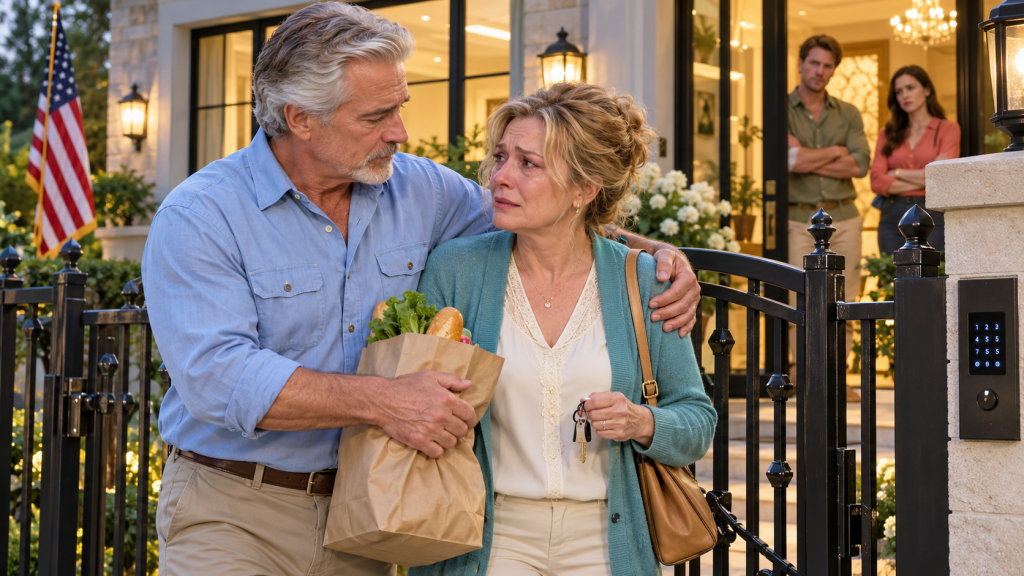
After working a long, exhausting shift, I returned home to find my wife of thirty-eight years standing helplessly outside our locked gate. She was holding a small grocery bag, her eyes filled with tears.
“Tom,” she whispered, her voice trembling. “Ethan says this house belongs to him now. He told me to get out.”
I felt my entire body go cold.
Without raising my voice, I took the bag from her shaking hands and led her toward a side entrance our son had apparently forgotten existed.
“Don’t worry, sweetheart,” I told her. “Tonight, Ethan is going to learn exactly who owns this house—and who has the authority to tell someone to leave.”
What I didn’t tell Linda was that our son had just made a mistake much bigger than changing the locks.
And by the time the evening was over, the people celebrating inside our living room would discover that their carefully arranged future had already begun falling apart.
My name is Thomas Bennett, although everyone who knows me calls me Tom.
I’m sixty-three years old, and for most of my adult life, I’ve believed that a man’s greatest responsibility is protecting the people who trust him.
I never expected the greatest threat to my wife’s happiness would come from the son we had raised together.
That Thursday had started like any other exhausting workday.
I managed maintenance operations at a regional medical center, a job that involved everything from broken elevators to emergency generator inspections. An unexpected electrical problem had kept me working nearly four hours beyond my scheduled shift.
By the time I drove home, my shoulders ached, my hands were dirty, and all I wanted was a hot shower and dinner with Linda.
I remember thinking about the chicken soup she had promised to make.
She always added extra noodles because she knew I liked them.
It was such an ordinary thought.
And perhaps that’s why the sight of her standing outside our gate struck me so deeply.
Linda wasn’t the kind of woman who complained easily.
She had endured difficult pregnancies, financial problems, serious illness, and the death of both her parents without losing her gentle spirit.
But that afternoon, she looked defeated.
Her gray cardigan was hanging loosely from her shoulders. Her hair, usually carefully brushed, had been disturbed by the wind.
A grocery bag rested against her hip.
And her eyes were fixed on the security keypad like she was waiting for it to explain why she no longer belonged in her own home.
“Linda?”
When she turned toward me, she tried to smile.
That hurt more than the tears.
“Honey, what happened?”
She opened her mouth, then closed it again.
I approached and took her trembling hands.
“Talk to me.”
“Ethan changed the code.”
I looked at the gate.
“What?”
“He said Ashley and he have decided it’s time for us to move somewhere smaller.”
I waited for her to continue.
“He told me we’re getting older and that maintaining this house isn’t practical anymore. Then he said it should belong to them because they’re going to inherit it eventually.”
I stared at her in disbelief.
“Where is he?”
“Inside.”
“And Ashley?”
“She’s there too.”
Linda glanced toward the house, where warm yellow light shone through our living room windows.
“They told me to take whatever personal belongings I needed and leave before you came home.”
My jaw tightened.
“Did he actually say that?”
She nodded.
“He said I should stop being difficult. Ashley told me there are nice retirement communities nearby and that we should be grateful they’re willing to help us find one.”
For a moment, I couldn’t speak.
Linda and I had purchased that property twenty-nine years earlier.
Back then, the house was a weather-beaten farmhouse surrounded by neglected land.
The roof leaked.
The plumbing barely worked.
There were cracks in the foundation and weeds taller than our little boy.
But Linda had stood in the overgrown front yard, looked at the enormous oak tree beside the porch, and whispered, “Tom, I can see us growing old here.”
We spent years making that dream real.
I repaired the roof myself.
Linda stripped wallpaper, painted rooms, and planted gardens.
Every dollar we could spare went into improving the place.
Sometimes we had to choose between buying new furniture and fixing something essential.
We always chose the repairs.
When Ethan turned twelve, he helped me build the wooden garden bench where Linda liked to sit in the evenings.
When he graduated from high school, we celebrated beneath the same oak tree.
When he married Ashley, Linda decorated the backyard with hundreds of white flowers so they could have the beautiful wedding they couldn’t otherwise afford.
And now that same son had decided we were no longer welcome.
I walked to the keypad and entered the code.
The small screen flashed red.
ACCESS DENIED.
I tried again.
ACCESS DENIED.
Linda looked away.
“He said you wouldn’t be able to get in either.”
I turned toward her.
“How long have you been standing out here?”
“Not very long.”
“Linda.”
She hesitated.
“Almost two hours.”
My stomach dropped.
Two hours.
My wife had a heart condition.
Her medication was in the grocery bag.
And our son had left her outside in the afternoon heat, refusing to let her enter the home she’d spent nearly three decades caring for.
“Did you take your medicine?”
She shook her head.
“I was supposed to take it with lunch, but I couldn’t get inside to get water.”
Something inside me changed.
Until that moment, I’d been angry.
Now I was frightened.
Not for myself.
For her.
I took the grocery bag, put my arm around her, and guided her away from the gate.
“Come with me.”
“Tom, please don’t make him angry.”
I stopped.
Those words disturbed me almost as much as what Ethan had done.
“Linda, has he been threatening you?”
She lowered her eyes.
“He’s been under a lot of pressure lately.”
“That isn’t what I asked.”
Her silence told me enough.
I kissed her forehead.
“We’ll talk about everything once you’re safe inside.”
Then I led her toward a narrow path behind the hedges.
Most visitors didn’t know about the old side entrance.
It had originally been a service gate used by the previous owners. Years earlier, I’d repaired the hinges and installed a separate mechanical lock.
I’d kept one key on my work ring.
Ethan probably hadn’t noticed the entrance since he was a teenager.
I unlocked it, guided Linda through, and carefully closed it behind us.
Then we crossed the garden toward the kitchen.
As we approached, I heard laughter through an open window.
Ashley was speaking.
“Once we get rid of that awful furniture, this place will look completely different.”
Ethan laughed.
“I know. The living room needs to be gutted.”
“And your parents’ bedroom,” Ashley continued. “I want a bigger bathroom and a proper dressing room.”
“What about the rose garden?”
“We can put a swimming pool there.”
I felt Linda stiffen beside me.
She had planted some of those roses with her mother before the older woman passed away.
I squeezed her hand.
“We’re going inside.”
The kitchen door opened with the familiar click I’d heard thousands of times.
Linda stepped inside first.
I set her grocery bag on the counter, filled a glass with water, and made sure she took her prescribed medication as directed.
Her hands were still trembling.
“Sit here for a minute,” I told her. “Please.”
Then I walked into the living room.
Ethan stood near the fireplace holding one of my best whiskey glasses.
Ashley was stretched comfortably across Linda’s favorite armchair with a laptop on her knees.
There were printed architectural plans scattered across our coffee table.
Two wine bottles stood beside the television.
And someone had removed the framed photograph of Linda’s parents from the mantel.
Ethan looked up.
His smile disappeared.
“Dad?”
Ashley sat upright.
For several seconds, neither of them moved.
Then Ethan frowned.
“How did you get inside?”
I looked around the room.
“That’s an interesting question to ask the owner of a house.”
His expression hardened.
“You weren’t supposed to be home yet.”
“I work here in town, Ethan. I don’t need permission to come home.”
Ashley closed her laptop.
“Tom, before you get upset, maybe we should all sit down and discuss this like adults.”
I glanced at the empty space on the mantel.
“Where’s the photograph of Linda’s parents?”
Ashley exchanged a look with Ethan.
“We put some of the older decorations in storage,” she said.
“Storage?”
“Just temporarily.”
“Where?”
“In the garage.”
I nodded.
Then I looked directly at my son.
“Why did you lock your mother outside?”
Ethan sighed like I was asking something unreasonable.
“Dad, you’re making it sound worse than it was.”
“Answer the question.”
“We’re trying to make a necessary transition.”
“A transition?”
“You and Mom can’t keep living like this forever.”
“Like what?”
“In this enormous property. You’re getting older. Eventually somebody has to make decisions.”
I studied the man standing before me.
He was thirty-two years old.
Same dark hair I’d had at his age.
Same stubborn jaw.
But I didn’t recognize the expression in his eyes.
It was the look of someone who had already convinced himself that taking something was justified because he wanted it badly enough.
“Your mother was outside for almost two hours,” I said.
Ethan shifted uncomfortably.
“She could have gone to a café.”
“She’s sixty-one years old and has a heart condition.”
“She wasn’t in any danger.”
“You don’t get to decide that.”
Ashley stood.
“Look, Tom, you’re being emotional. Ethan is your only child. This house is going to be his anyway.”
I turned toward her.
“Is it?”
She blinked.
“Of course.”
“Who told you that?”
“Well, obviously, when you and Linda are gone—”
“I’m standing right here, Ashley.”
Her face reddened.
“I didn’t mean it like that.”
“But you said it exactly like that.”
Ethan stepped between us.
“Dad, enough. Ashley’s right. We’ve talked about this for months. Mom just refuses to accept reality.”
I looked toward the kitchen doorway.
Linda had appeared there, one hand resting against the frame.
“Ethan,” she said softly, “I never agreed to give you our home.”
He rolled his eyes.
“Mom, we went through this.”
“No,” she whispered. “You told me what you wanted. That’s not the same as asking.”
For the first time, I saw genuine irritation cross his face.
“Why are you doing this? We were trying to avoid a huge argument.”
I almost laughed.
He had locked his mother out of her home and now seemed offended that she was upset.
I reached into my pocket and pulled out my phone.
“There’s someone we need to invite into this conversation.”
Ashley crossed her arms.
“Who?”
“Our attorney.”
Ethan frowned.
“What attorney?”
“Richard Coleman.”
A flicker of recognition crossed his face.
Richard had handled our estate planning for years.
I pressed his number.
He answered on the second ring.
“Tom?”
“Richard, it’s time. Please bring the documents we discussed.”
There was a brief pause.
“Has something happened?”
“Our son changed the gate code and ordered Linda out of the house.”
Richard’s voice became very serious.
“Is Linda safe?”
“She is now.”
“Don’t sign anything, don’t give anyone any original documents, and don’t let them destroy any records. I’m coming.”
I ended the call.
Ashley laughed nervously.
“This is ridiculous. You’re bringing a lawyer into a family disagreement?”
“No,” I replied. “I’m bringing a lawyer into a property dispute.”
Ethan took another sip of whiskey.
“You can call whoever you want, Dad. It won’t change the fact that I’m your legal heir.”
I looked him straight in the eye.
“Ethan, do you actually know what the word heir means?”
His jaw tightened.
Before he could respond, his phone began ringing.
He glanced at the screen.
His expression changed instantly.
“Why is the bank calling me?”
He hesitated, then answered.
I couldn’t hear the person on the other end, but I watched my son’s face slowly lose its color.
“What do you mean the application has been flagged?”
Ashley froze.
Ethan listened.
“No, that’s not possible. We already submitted everything.”
Another pause.
“Who’s questioning the signatures?”
He looked at me.
For the first time that evening, he seemed genuinely afraid.
I folded my arms.
“Something wrong, son?”
He ended the call without answering.
Then headlights swept across the living room windows.
A black sedan pulled into the driveway outside our gate.
Richard Coleman climbed out carrying a thick leather briefcase.
Linda looked toward me.
She recognized him immediately.
Ethan stared at the approaching figure as if the ground beneath his feet had begun to move.
And I knew the real confrontation was only beginning.
I went to the kitchen and told Linda to remain seated while I let Richard through the side entrance.
He was sixty-eight, with silver hair, a careful way of speaking, and the kind of calm expression that made people pay attention without him ever raising his voice.
He had known our family for twenty years.
He attended our anniversary dinners, sent Christmas cards, and had once helped Ethan appeal an unfair college scholarship decision.
But that evening, he wasn’t visiting as a family friend.
He was there to protect two clients.
“Linda?” he asked as soon as he entered.
“I’m all right, Richard.”
He studied her pale face.
“Are you sure?”
She nodded.
Richard turned to me.
“Show me what’s happening.”
We entered the living room together.
Ethan immediately straightened.
“Mr. Coleman, there’s been a misunderstanding.”
Richard set his briefcase on the dining room table.
“I certainly hope so, Ethan.”
Ashley stepped forward.
“We’ve simply been discussing a transfer of the property. Tom and Linda are being unreasonable.”
Richard removed his glasses.
“A transfer?”
“Yes,” Ashley said confidently. “An early inheritance.”
Richard looked at me.
“Tom, have you authorized any transfer of this property?”
“No.”
“Linda?”
She shook her head.
“No.”
Richard turned back toward Ashley.
“Then there is no authorized transfer.”
Ethan laughed without humor.
“You can’t just say that. We’ve already started the paperwork.”
Richard nodded slowly.
“That’s precisely what concerns me.”
He opened his briefcase and removed a folder.
Before showing us anything, he asked both Ethan and Ashley to sit down.
Neither obeyed.
That didn’t seem to bother him.
“Fourteen years ago,” Richard began, “Thomas and Linda Bennett created the Bennett Family Living Trust.”
Ethan waved his hand.
“I know about the trust.”
“Apparently not well enough.”
Richard slid a certified copy of the property deed across the table.
“The house and surrounding land were transferred into the trust. Tom and Linda serve as its current trustees. They retain full authority over the property under the trust agreement.”
Ashley leaned forward.
“But Ethan is the beneficiary.”
“He is presently named as a remainder beneficiary,” Richard replied. “That does not make him the owner. Nor does it give him the authority to evict the trustees, borrow against the property, or sell it.”
Ethan’s face tightened.
“You’re splitting hairs.”
“No,” Richard said evenly. “I’m explaining an essential legal distinction.”
He tapped the deed.
“Your parents are alive. They’re capable of managing their affairs. They have not resigned as trustees. They have not appointed you to act for them.”
Then he looked directly at Ethan.
“And they have not given you their house.”
The room became silent.
Linda stood beside me, staring at the documents.
When we’d established the trust, we’d done it for ordinary reasons.
We wanted to make things easier if one of us became seriously ill.
We wanted to avoid unnecessary complications when the other passed away.
Most importantly, we wanted to preserve our right to live in the home we’d built together for as long as we chose.
Ethan had never shown much interest in the details.
Whenever I tried discussing estate planning, he would shrug.
“Dad, that’s depressing. We can talk about it later.”
Apparently, he’d become very interested once he started thinking the house was already his.
Ashley broke the silence.
“Fine. Then they can just sign the property over now.”
I looked at her.
“Why would we do that?”
“Because it’s sensible.”
“For whom?”
“For the family.”
“Linda and I are part of the family, Ashley.”
She pressed her lips together.
Richard removed another document from the folder.
“There’s something else we need to discuss.”
Ethan’s eyes moved toward the page.
His expression changed.
Richard placed it on the table.
It was a photocopy of a loan application.
Across the top were the words COMMERCIAL PROPERTY SECURED CREDIT FACILITY.
The requested amount was three hundred and twenty thousand dollars.
I stared at the figure.
“What is this?”
Richard looked at Ethan.
“Would you like to explain?”
Ethan didn’t answer.
Ashley glanced toward the kitchen.
“That’s business paperwork. It has nothing to do with this argument.”
“On the contrary,” Richard said. “It lists the Bennett property as proposed collateral.”
I slowly picked up the document.
Near the bottom was my name.
Thomas Edward Bennett.
Beside it appeared a signature that was supposed to be mine.
Except I hadn’t signed it.
Beneath my name was Linda’s.
Her signature was there too.
I felt the blood drain from my face.
“Linda, did you sign this?”
She approached the table and studied the page.
“No.”
Her voice was barely audible.
“I’ve never seen it before.”
Richard nodded.
“I didn’t think so.”
Ethan stepped forward.
“Those are preliminary forms. Nothing has been finalized.”
“That’s fortunate,” Richard replied.
I stared at my son.
“Did you forge our signatures?”
He looked away.
Ashley spoke quickly.
“Don’t use words like that. We were trying to get financing for improvements that would increase the property’s value.”
“Three hundred and twenty thousand dollars?” I asked.
“Renovations are expensive,” she snapped.
I looked around our living room.
The house was comfortable, well maintained, and completely paid for.
Linda and I had made the final mortgage payment six years earlier.
We’d celebrated with homemade apple pie and a photograph of the cancelled loan statement.
Now my son appeared to be trying to borrow hundreds of thousands of dollars against that same house without asking us.
I turned back toward Ethan.
“Tell me this isn’t what it looks like.”
He rubbed his forehead.
“Dad, you don’t understand the opportunity.”
“Then explain it.”
He looked at Ashley.
She nodded encouragingly.
Ethan took a breath.
“We’re working with an investment group. They’re developing luxury rental properties. They needed us to provide collateral for our share of the project.”
“Our share?” I repeated.
“We could make serious money.”
“With our house?”
“Eventually, it would benefit everyone.”
I stared at him.
“Who was going to be responsible if the project failed?”
He didn’t answer.
“Ethan.”
“The investment was supposed to be safe.”
“That’s not what I asked.”
Ashley crossed her arms.
“Successful people take risks, Tom.”
I turned toward her.
“Successful people take risks with their own property.”
Richard raised one hand.
“There’s more.”
He reached into his briefcase and removed a second document.
This one was labeled CERTIFICATION OF TRUST.
It stated that Ethan Bennett had been appointed successor trustee and was authorized to execute property-related transactions.
The certification was dated three weeks earlier.
It supposedly contained my signature and Linda’s.
I studied the page.
Then I looked at Richard.
“That’s false.”
“I know.”
“How?”
“Because the trust amendment it references doesn’t exist. And because you called my office about a very different estate-planning matter last month.”
I remembered that conversation.
Three weeks earlier, Ethan had asked me to guarantee a business loan.
He’d been vague about the amount.
When I refused, he became angry and accused me of not believing in him.
The argument bothered me enough that I contacted Richard.
I asked whether Ethan could somehow use his future inheritance as security for a loan.
Richard assured me that he couldn’t do so under the trust’s existing terms.
He also suggested reviewing our documents because Ethan’s increasingly aggressive questions about ownership were concerning.
At the time, I thought I was being overly cautious.
Now I understood why Richard had sounded uneasy.
“Two days ago,” he continued, “I received a notification through a property-record monitoring service associated with your estate file.”
Ethan suddenly looked up.
Richard continued.
“Someone had requested documents and initiated preliminary financing inquiries involving this parcel. I contacted the lender’s fraud department after receiving a copy of the purported trustee certification for review.”
I stared at my son.
“You knew they were investigating?”
Ethan’s mouth opened, but no words came out.
Richard nodded toward his phone.
“The lender told me earlier today that the application had been placed on hold pending independent verification. They were reviewing the signatures and the authority claimed by the applicants. I tried reaching you, Tom, but your work phone went straight to voicemail.”
I remembered the phone sitting in my locker while I worked in the hospital’s restricted mechanical rooms.
By the time I collected it, I had been so tired I hadn’t even checked the missed calls.
Richard’s expression remained serious.
“Nothing I’ve seen indicates that a loan has been funded against your property. But attempted misuse of these documents is a serious matter, and we need to establish exactly what was submitted.”
Ashley stared at him.
“So you’re saying the bank won’t release the money?”
“I am saying it has stopped processing the application until its concerns are resolved.”
She sank back onto the couch.
Ethan looked as though he might be sick.
But what disturbed me most wasn’t the paperwork.
It was the realization that our son had planned this.
He hadn’t simply lost his temper with Linda.
He’d arranged financing, produced false documents, and begun treating our home as a business asset he could control.
The changed gate code was only the visible part of a much larger betrayal.
I placed the papers down.
“Ethan, I want you to tell me the truth.”
He stared at the carpet.
“How much money do you owe?”
Ashley turned toward him sharply.
“Don’t.”
That single word told me there was more.
I looked from one to the other.
“How much?”
Ethan swallowed.
“It’s complicated.”
“Give me a number.”
He rubbed both hands over his face.
“About ninety thousand.”
Linda gasped.
I stood perfectly still.
“Ninety thousand dollars?”
“Maybe a little more.”
Ashley closed her eyes.
Richard leaned forward.
“Ethan, are these debts related to the proposed property investment?”
He hesitated.
“Some of them.”
“Have you accepted money from anyone based on a representation that you control this house?”
Ethan said nothing.
Richard waited.
Finally, my son whispered, “Yes.”
The word seemed to hang in the air.
I looked at the architectural drawings spread across our coffee table.
Suddenly, they no longer looked like harmless renovation ideas.
They looked like evidence of a future someone was trying to build by taking ours away.
“Who gave you money?” I asked.
Ethan glanced at Ashley again.
She stood abruptly.
“We are not answering any more questions without our own lawyer.”
Richard nodded.
“That would be wise.”
His calmness seemed to irritate her.
“And none of this changes the fact that they’re too old to manage such valuable property responsibly.”
Linda flinched.
I felt my temper rising, but before I could respond, Richard spoke.
“Age alone doesn’t remove someone’s property rights, Ashley.”
Then he closed the folder.
“Tom, Linda, would you prefer to speak privately?”
I looked at my wife.
She was staring at Ethan with an expression I would remember for the rest of my life.
Not anger.
Not even fear.
Just heartbreak.
“Yes,” I told Richard. “We would.”
We went into the kitchen.
I pulled out a chair for Linda and sat beside her.
For a moment, she said nothing.
Then she covered her face with both hands.
“How did we get here, Tom?”
I had no answer.
Because I remembered a very different Ethan.
I remembered the little boy who used to wait by the window when I worked late.
The boy who brought his mother dandelions because he thought every flower was precious.
The child who once saved his allowance for three months to buy Linda a birthday necklace.
It wasn’t expensive.
The chain turned her neck green after a few weeks.
She kept it anyway.
Even now, it rested in a small velvet box inside her dresser.
I remembered teaching Ethan how to ride a bicycle, helping him with mathematics homework, and watching him cry when our old golden retriever died.
There had been goodness in him.
There had been kindness.
Somewhere along the way, though, we’d begun confusing love with rescue.
Whenever Ethan made a mistake, Linda and I rushed to soften the consequences.
When he damaged his first car, we helped pay for the repairs.
When he lost his college scholarship after repeatedly skipping classes, we paid the remaining tuition.
When his first business failed, we covered six months of rent.
When he married Ashley, we contributed nearly twenty thousand dollars toward the wedding and honeymoon.
We told ourselves we were helping him establish a stable future.
Instead, we may have taught him that every problem could be solved by reaching into his parents’ pockets.
Richard sat across from us.
“Tom, there’s something I need you both to understand. None of those past gifts gave Ethan any legal claim to the house.”
I nodded.
“I know.”
“But family situations like this can involve pressure that doesn’t appear in documents. Has he been trying to make either of you sign anything?”
Linda slowly lowered her hands.
I turned toward her.
“Honey?”
She hesitated.
“About a month ago, Ethan brought me a folder.”
My chest tightened.
“What folder?”
“He said it was for insurance and property maintenance. He told me that if anything happened to you, he needed authorization to handle the house.”
Richard leaned forward.
“Did you sign it?”
Linda shook her head.
“No. I wanted to read it first.”
“What happened then?”
Her eyes filled with tears.
“He got angry.”
I gently touched her arm.
“Tell us.”
“He said I didn’t trust him. He said I was treating him like a stranger.”
She paused.
“Then Ashley told me I was being selfish because they were trying to plan for our future.”
Richard asked whether she still had the folder.
“No. Ethan took it back.”
“Did he threaten you?”
Linda hesitated again.
Then she nodded.
“He said if we didn’t cooperate, he might have to prove we weren’t capable of managing our affairs.”
I felt as if someone had struck me.
“What?”
“He told me people our age sometimes lose the right to make decisions when they refuse to accept help.”
Richard’s expression darkened.
“Did he mention guardianship or a medical evaluation?”
“Yes.”
Linda looked at me.
“I didn’t tell you because I thought he’d calm down. I didn’t want you and Ethan to fight.”
I wrapped my arm around her shoulders.
She continued in a broken voice.
“Tom, he said if you got angry enough, you might have another heart scare from all the stress. He made me feel like keeping peace was my responsibility.”
I closed my eyes.
For months, Linda had been carrying this burden alone.
She’d been frightened that defending herself would cause a family breakdown.
And our son had used that fear against her.
Richard gave us a moment.
Then he said, “We can document these statements. More importantly, neither of you should sign anything Ethan presents. If someone contacts you about financial or medical authority, refer them to my office.”
I nodded.
“And the house?”
“The deed and trust are clear. We’ll take additional steps to protect the property records and notify the appropriate parties about the questionable documents.”
Linda looked at him.
“Can Ethan really take our home?”
“Not merely because he expects to inherit it. But fraudulent paperwork can create complications, and that’s why we’re going to address every document carefully.”
I squeezed her hand.
“Did you hear that, sweetheart?”
She nodded.
“It’s still ours.”
“It always was.”
For several minutes, we sat quietly.
Then something occurred to me.
“Richard, Ethan said someone had already given him money. What happens if he promised our house as security?”
Richard sighed.
“That depends on exactly what he represented and to whom. We need copies of every agreement.”
I stood.
“Then it’s time he told us everything.”
When we returned to the living room, Ashley was whispering furiously into her phone.
She stopped speaking the moment she saw us.
Ethan stood near the fireplace, staring at the architectural drawings.
I looked directly at him.
“Who gave you the money?”
He swallowed.
“Dad—”
“Who?”
After a long silence, he answered.
“A man named Victor Hale.”
Richard’s expression changed.
I noticed immediately.
“You know him?”
Richard nodded slowly.
“I know the name.”
He looked at Ethan.
“Tell me exactly what Mr. Hale believes he purchased.”
Ethan turned pale.
And that’s when our son finally admitted that the loan application wasn’t the only transaction he’d arranged behind our backs.
Ethan slowly lowered himself into the armchair.
For the first time since I’d entered the house, he looked like a frightened child rather than an arrogant grown man.
But I wasn’t going to rescue him from the consequences of his own decisions.
Not this time.
“Victor Hale owns a development company,” Ethan began. “He wants to build luxury homes on large properties outside town.”
I nodded.
I’d heard about developers buying older estates in our area.
Property values had increased dramatically over the previous decade, especially after a new highway made the commute into the city easier.
Our land, which had once been considered ordinary rural property, was now worth far more than we’d paid for it.
That didn’t make us wealthy in the way Ashley imagined.
Our savings were modest.
Most of our net worth was tied up in the home itself.
But the property had become valuable enough to attract attention.
Ethan continued.
“Victor came to see the land a couple of months ago. He said we could divide the rear acreage into residential lots.”
I stared at him.
“You brought a developer onto our property without telling us?”
“Dad, it was just an evaluation.”
“Did he enter our house?”
Ethan looked away.
Ashley interrupted.
“We showed him around because we were discussing the potential value. There’s nothing wrong with that.”
“Without our permission?”
She didn’t answer.
Richard leaned forward.
“Ethan, what agreement did you sign?”
My son rubbed his forehead.
“An option agreement.”
Richard’s expression became grim.
“For what?”
“To purchase part of the property if the financing came through.”
I looked at him.
“How much did Victor pay you?”
Ethan hesitated.
“Forty-eight thousand dollars.”
Linda pressed a hand against her chest.
“You took money for our land?”
Ethan nodded.
“It was supposed to be an advance.”
“An advance against something you didn’t own,” Richard said.
Ethan’s eyes filled with frustration.
“You keep saying that like I was trying to rob them!”
Richard didn’t raise his voice.
“Ethan, you accepted money based on authority your parents say they never gave you. The consequences of that are not something you can dismiss because you consider yourself their future heir.”
Ashley suddenly stood.
“Victor knew the situation. He knew Ethan was going to inherit everything.”
“That doesn’t mean Victor knew the documents were unauthorized,” Richard replied.
She fell silent.
I looked at my son.
“Where’s the forty-eight thousand dollars?”
He stared at the floor.
“Gone.”
The word hit harder than I expected.
“Gone where?”
“Debt payments. Credit cards. A business loan. Some expenses.”
I looked around the room at the wine bottles, renovation plans, and expensive leather handbag resting on our couch.
For years, Ethan and Ashley had presented themselves as successful young professionals.
They drove a luxury SUV.
They took vacations we never could have afforded at their age.
They posted photographs from expensive restaurants.
Whenever I asked how business was going, Ethan said everything was wonderful.
Now I understood.
Much of their lifestyle had been financed by borrowed money.
And when those bills came due, they’d turned toward the one asset they believed would save them.
Our home.
Richard held out his hand.
“I need to see a copy of that agreement.”
Ethan looked at Ashley.
She hesitated, then opened her laptop.
After several minutes, she printed the document using the wireless printer in my office.
I stared at the paper as Richard read it.
The agreement described a proposed purchase involving four acres of our property.
It contained representations that Ethan had authority to act for the trust.
And it included language requiring vacant possession before a planned closing.
I read that phrase twice.
Vacant possession.
I looked toward Linda.
Then back at Ethan.
“Is that why you locked your mother out?”
He didn’t answer.
“Were you trying to make the house vacant?”
Ashley spoke before he could.
“We were trying to make the transition easier.”
I felt my hands curl into fists.
“A transition is when someone chooses to move.”
She looked away.
“What you planned,” I continued, “was to force two people out of their home because you needed money.”
Ethan finally raised his voice.
“We weren’t going to leave you homeless!”
“Then where exactly were we supposed to go?”
He hesitated.
“There are places.”
“What places?”
Ashley reached into her handbag and removed a brochure.
It showed a retirement community about forty minutes away.
The cover featured smiling elderly couples walking beside a pond.
At the bottom was a handwritten note.
Two-bedroom unit. Availability next month.
Linda stared at it.
“Ethan, you picked somewhere for us to live without even asking?”
He looked miserable.
“Mom, I thought you’d like it.”
She shook her head.
“You thought I’d like leaving my home?”
He said nothing.
Then Linda did something I hadn’t expected.
She walked slowly toward the mantel.
She looked at the empty space where her parents’ photograph had stood for years.
“Do you remember your grandmother, Ethan?”
He frowned.
“Of course.”
“Do you remember how she used to make you cinnamon toast when you visited?”
His expression softened slightly.
“Yes.”
“She helped me plant the first rosebushes in this garden.”
Linda’s voice trembled.
“She was already sick then. We didn’t know how little time we had left.”
Ethan looked uncomfortable.
“Mom—”
“She told me that every home should have something living that the people inside could care for together.”
Linda wiped her eyes.
“After she died, I planted another rosebush every year on her birthday.”
She turned toward Ashley.
“And you were going to replace them with a swimming pool.”
Ashley looked down.
For once, she had nothing to say.
Linda faced our son.
“You didn’t just decide to take a building, Ethan. You decided that everything we loved about our life was disposable.”
I could see him struggling for an answer.
But he never found one.
Richard carefully gathered the papers.
“I’m going to advise Tom and Linda to preserve these documents and report the suspected falsifications. Anyone who paid money based on an inaccurate representation will need to be dealt with through proper legal channels.”
Ethan looked up sharply.
“You’re going to call the police?”
Richard was quiet for a moment.
“Potential criminal conduct has to be taken seriously.”
Ashley shook her head.
“You’d really do that to your own son, Tom?”
I looked at her.
“Would I protect my wife from someone who threatened her and tried to take her home?”
She didn’t answer.
“Yes,” I said. “I would.”
Ethan rose from the chair.
“Dad, please. Let’s talk about this tomorrow.”
“We are talking about it now.”
“I’ll fix everything.”
“How?”
“I’ll call Victor. I’ll explain.”
“You can start there.”
He looked hopeful.
Then I continued.
“But first, you and Ashley are leaving.”
The hope vanished.
“What?”
“You heard me.”
“Dad, this is my home too!”
“No, Ethan. It was your childhood home. You were always welcome here because we loved you.”
I paused.
“But being welcome is not the same as being entitled to ownership.”
Ashley gave an incredulous laugh.
“You can’t seriously kick us out.”
I turned toward her.
“You were comfortable doing exactly that to Linda.”
She opened her mouth, then closed it.
Ethan looked at Richard.
“Can he do this?”
Richard replied carefully.
“Your parents have made clear that your permission to visit has been withdrawn. If you believe you have any independent right to occupy the property, you should discuss it with your attorney. But you haven’t shown me any such right.”
Ethan stared at him.
Then he looked at me.
“Dad, you’re choosing a house over your own son.”
That sentence almost broke me.
Because it was exactly the kind of accusation I’d feared hearing someday.
But I looked at Linda.
Her eyes were swollen from crying.
Her cardigan was still dusty from sitting beside the gate.
And I knew the truth.
“No, Ethan,” I said quietly. “I’m choosing not to sacrifice your mother to protect you from your decisions.”
He looked away.
Ashley started gathering her belongings.
Her movements were sharp and angry.
She slammed the laptop closed and stuffed the brochures into her handbag.
“This family is unbelievable,” she muttered.
I didn’t respond.
I asked Ethan to return our gate remote and the spare house keys we’d given him.
He hesitated before placing them on the coffee table.
I took a photograph of the returned items and asked Richard to witness the exchange.
Then I told them to collect their personal belongings.
They had their own condominium across town and had only been visiting that afternoon, so there was no question of leaving them without a place to sleep.
Ashley headed toward the hallway.
Ethan stayed behind.
For a moment, he looked at the floor.
Then he spoke quietly.
“Dad, I didn’t think it would come to this.”
I studied him.
“What did you think would happen?”
He shook his head.
“I thought eventually you’d understand.”
“Understand what?”
“That I was trying to build something.”
I felt a deep, weary sadness.
“Son, you can’t build a future by stealing someone else’s security.”
His eyes reddened.
I wanted to put a hand on his shoulder.
I wanted to tell him everything would be all right.
But I’d spent too many years doing exactly that.
So I stood still.
Ashley returned carrying a small suitcase and a garment bag.
“Let’s go, Ethan.”
He looked toward the kitchen.
“Mom?”
Linda approached slowly.
For a second, I wondered whether she’d ask us to forget everything.
She had always been the one who encouraged forgiveness.
Instead, she looked at Ethan and said something so simple that he seemed unable to bear it.
“I waited outside for you to open the gate.”
His face crumpled.
“I know.”
“I knocked, Ethan.”
He lowered his eyes.
“I heard you.”
The room became completely silent.
Linda nodded as though a terrible question had finally been answered.
Then she turned away.
I walked Ethan and Ashley to the door.
Richard accompanied us.
Once they had left, I used the manual control inside the garage to release the electronic gate.
Their car drove slowly toward the road.
For a moment, Ethan stopped beside the entrance.
He looked back at the house.
I wondered whether he remembered learning to ride his bicycle along that same driveway.
Then Ashley said something from the passenger seat.
He drove away.
When the taillights disappeared, I closed the gate.
And for the first time in nearly thirty years, I realized that protecting our home might mean keeping our own son outside it.
Richard stayed another hour.
He helped us organize the documents, save copies of relevant messages, and outline the immediate steps we needed to take.
He warned us not to destroy or alter any paperwork and not to make informal promises to anyone claiming to have an interest in the property.
He also suggested installing a fresh security code that Ethan couldn’t guess.
Before leaving, he placed a hand on my shoulder.
“Tom, the legal side may take time. But don’t let that make you forget about Linda.”
I nodded.
“I won’t.”
After he left, I checked every downstairs door and window.
Then I found Linda sitting at the kitchen table.
The chicken soup she’d prepared that morning was still in the refrigerator.
I warmed two bowls.
We ate quietly.
Halfway through dinner, Linda put down her spoon.
“Do you think we failed him?”
I looked at her.
It was the question I’d been asking myself all evening.
“I think we made mistakes,” I said.
She nodded slowly.
“We gave him so much.”
“We did.”
“Maybe too much.”
“Maybe.”
She stared toward the window.
“He used to be such a sweet boy.”
I reached across the table and took her hand.
“He still has the ability to become a decent man. But he has to choose it himself.”
Tears rolled down her cheeks.
“What if he never does?”
I didn’t lie to her.
“Then we will have to learn to live with that.”
She squeezed my hand.
For the next several minutes, we said nothing.
Outside, a breeze moved through the rosebushes.
The house was quiet again.
But peace was not the same as safety.
And by the following morning, I would discover just how much damage Ethan and Ashley had already caused.
At eight the next morning, Richard called.
“Tom, we’ve uncovered another problem.”
I was standing in the kitchen making coffee.
Linda had finally fallen asleep after a restless night, and I didn’t want to wake her.
“What happened?”
“Victor Hale’s office has provided copies of additional correspondence. Ethan represented that you and Linda had agreed to relocate voluntarily.”
I stared out the window.
“What?”
“He sent written statements claiming you were preparing to move into assisted living and wanted him to handle the sale.”
My stomach tightened.
“That’s completely false.”
“I know. But there’s more. Ashley appears to have contacted a moving company and arranged for a crew to visit the property on Saturday.”
I gripped the counter.
“Saturday?”
“Yes. The company believed it was preparing an estimate for a family relocation.”
I glanced toward the calendar.
Saturday was only two days away.
They hadn’t intended to give us time to make a decision.
They had intended to create a situation where everything was already arranged and resistance would seem pointless.
Richard continued.
“I’ve contacted the moving company and informed them that neither owner authorized the work. I’ve also requested preservation of the relevant communications.”
“Thank you.”
“Tom, I strongly recommend making a formal report today. There is enough here that these documents should not remain merely a family dispute.”
I looked toward the hallway where Linda was sleeping.
“All right.”
That afternoon, we met Richard at his office.
He had assembled a detailed file containing the trust documents, property records, loan application, disputed signatures, and copies of the communications available to us.
Linda gave a statement about being locked outside.
She described the threats about her ability to manage her affairs.
She explained how Ethan had pressured her to sign documents she didn’t understand.
I watched her speak.
At first, her voice trembled.
Then it grew steadier.
By the end, she was sitting upright, answering every question with the calm confidence I’d always admired.
When we left the office, she took my hand.
“I should have spoken up sooner.”
“You spoke up when it mattered.”
She looked at me.
“I don’t want to be afraid in my own home again.”
“You won’t have to face this alone.”
Over the next several weeks, the truth emerged piece by piece.
The bank confirmed that the disputed financing had not been completed.
A title review showed that the trust still held the property and no authorized sale had occurred.
Richard helped us place appropriate alerts on the property records, formally dispute the questionable paperwork, and ensure future inquiries would be directed through legitimate channels.
Victor Hale’s company pursued its claim against Ethan for the money he’d accepted.
It also cooperated in resolving the unauthorized property agreement once the defects in Ethan’s claimed authority became clear.
And then came another discovery.
Ashley had been far more involved than she’d admitted.
Messages and financial records showed that she had helped prepare paperwork, supplied electronic copies of documents, and repeatedly encouraged Ethan to pressure us.
One message particularly disturbed me.
It had been sent the night before Linda was locked outside.
Ashley had written, “If you let your mother back down again, we’re finished. Make them understand the house isn’t theirs forever.”
Ethan had replied, “I’ll take care of it tomorrow.”
I read that exchange several times.
For a while, I had wanted to blame Ashley for changing our son.
But the truth was more painful.
She had encouraged him.
He had agreed.
He was responsible for his own choices.
When Ethan called me three weeks later, I almost didn’t answer.
His name appeared on my phone while I was working in the garage.
I stared at it until the ringing nearly stopped.
Then I picked up.
“Dad?”
His voice sounded unfamiliar.
Tired.
Defeated.
“Hello, Ethan.”
There was a long silence.
“Ashley moved out.”
I closed my eyes.
“I’m sorry to hear that.”
“She says everything is my fault.”
I didn’t respond.
“We’re getting divorced,” he continued.
I leaned against my workbench.
“Have you spoken to your attorney?”
“Yes.”
“Then listen to the advice you’re being given.”
He was quiet.
Finally, he whispered, “Are you ever going to forgive me?”
I looked through the garage window.
Linda was outside, carefully pruning one of her rosebushes.
She’d started spending more time in the garden again.
Slowly, the color was returning to her face.
“Ethan,” I said, “forgiveness isn’t the same as pretending nothing happened.”
“I know.”
“Do you?”
His breathing became uneven.
“I messed everything up.”
“Yes, son. You did.”
“I didn’t think Mom would be outside that long.”
I felt something tighten in my chest.
“You heard her knocking.”
He began crying.
“I know.”
“You knew she needed her medication.”
“I know, Dad.”
“And you left her there.”
He couldn’t answer.
For a moment, I remembered the little boy who used to cry when he accidentally stepped on an insect.
Then I reminded myself that the man on the phone was responsible for what he’d done.
“I love you, Ethan,” I said.
He started sobbing harder.
“But love doesn’t mean I can protect you from the truth.”
We ended the call quietly.
I stood in the garage for a long time afterward.
That evening, I told Linda about our conversation.
She listened without interrupting.
Then she said, “I want him to get better, Tom.”
“So do I.”
“But I’m not ready to see him.”
I nodded.
“Then we won’t.”
Six months passed.
Ethan’s financial situation deteriorated.
The condominium was sold as part of resolving debts connected to his failed business ventures and separation.
He moved into a small rented apartment.
He took a job managing inventory at a warehouse and began making payments under agreements reached with creditors.
The criminal investigation into the false financial documents continued.
Eventually, his case was resolved through a negotiated plea that included supervised probation, restitution obligations, and court-ordered requirements.
Ashley faced separate scrutiny for her involvement.
None of it was the outcome we’d wanted for our only child.
But neither Linda nor I could undo the choices that had led there.
We gave truthful statements when requested.
We didn’t exaggerate.
We didn’t seek revenge.
And we didn’t use our savings to make Ethan’s accountability disappear.
During that time, something unexpected happened to our marriage.
We grew closer.
For years, we’d organized so much of our emotional lives around Ethan’s problems that we had barely noticed how exhausting it had become.
Now we began doing simple things together again.
We took morning walks.
We visited friends we’d neglected.
We drove to the coast one weekend and spent an entire afternoon sitting beside the ocean, talking about everything except money and family obligations.
Linda started volunteering at a community garden.
I helped her build raised planting beds for older residents who couldn’t comfortably kneel.
Sometimes, while we worked, she’d smile at me in a way I hadn’t seen for years.
Not the polite smile she used when she was worried.
A genuine one.
One evening, Richard visited us to finalize changes to our estate plan.
We had decided that Ethan would no longer be the automatic recipient of everything we’d built.
We weren’t making that decision to punish him.
We were making it because inheritance should never be confused with permission to exploit someone.
Our revised plans protected the surviving spouse first and gave us flexibility to support causes important to us, including a local housing charity and the community garden Linda loved.
Any future benefit for Ethan would depend on decisions made under those plans, not on demands he could enforce while we were alive.
After Richard left, Linda and I sat on the porch.
“Do you think we’re being too harsh?” she asked.
I considered the question carefully.
“No. I think we’re finally being responsible.”
She rested her head against my shoulder.
“I still love him.”
“I do too.”
“I always will.”
“I know, sweetheart.”
We sat together until the sky turned dark.
Nearly a year after that terrible Thursday, a letter arrived.
It was from Ethan.
He didn’t ask for money.
He didn’t mention the house.
He didn’t blame Ashley.
Instead, he described the work he’d been doing, the counseling he’d attended, and the things he’d begun to understand about responsibility.
He admitted that he’d spent years measuring success by what he owned.
He wrote about being ashamed of the way he’d treated his mother.
And near the end, he said something that brought tears to my eyes.
“I used to think you and Mom owed me a good life because I was your son. I’m beginning to understand that you already gave me one. What I did with it was supposed to be my responsibility.”
Linda read the letter twice.
Then she folded it carefully.
For several days, she said nothing.
Finally, one Sunday morning, she asked whether Ethan might be willing to meet us somewhere.
Not at the house.
Not yet.
Just for coffee.
I contacted him.
He agreed immediately.
We met at a quiet café near the park.
When Ethan walked in, I hardly recognized him.
He was thinner.
His expensive watch was gone.
He wore ordinary jeans and a faded blue shirt.
But the biggest difference was in his expression.
For the first time in years, he wasn’t trying to impress anyone.
He approached our table slowly.
“Hi, Mom.”
Linda stood.
He hesitated.
Then she opened her arms.
They embraced.
I watched my grown son cry against his mother’s shoulder.
It didn’t erase what had happened.
It didn’t make him trustworthy overnight.
But it was a beginning.
We talked for almost two hours.
There were awkward silences.
There were tears.
There were things that couldn’t be repaired by a single apology.
Before leaving, Ethan looked at Linda.
“Mom, I know I don’t deserve to ask this, but will you ever feel safe around me again?”
She thought about it.
Then she answered honestly.
“I hope so, Ethan. But that will take time. And you have to respect that.”
He nodded.
“I will.”
As we stood to leave, he turned toward me.
“Dad, I don’t expect you to change the estate plan.”
I studied him.
“Good.”
He gave a small, sad smile.
“I just hope that someday you’ll want me around because I’m your son. Not because you feel obligated to help me.”
I placed a hand on his shoulder.
“That’s the relationship I’ve wanted all along.”
We parted outside the café.
There were no grand promises.
No instant reconciliation.
Only three people who had finally stopped pretending that love meant never saying no.
That evening, Linda and I returned home just as the sun began settling behind the oak trees.
The roses were blooming.
The windows glowed with the warm light of a house that had survived nearly three decades of laughter, loss, arguments, celebrations, and ordinary days.
Linda paused beside the iron gate.
For a moment, she looked at the keypad.
I knew what she was remembering.
I stepped closer.
“Are you all right?”
She nodded.
Then she smiled.
“Do you remember the day we first saw this place?”
“Of course.”
“You told me the roof was terrible, the plumbing was worse, and buying it would probably be the biggest mistake of our lives.”
I laughed.
“That sounds like me.”
“And I told you I could imagine us growing old here.”
I took her hand.
“You were right.”
She looked toward the house.
“We really did build something beautiful, didn’t we?”
I glanced at the rose garden, the old porch, the windows we’d replaced together, and the oak tree where we’d celebrated so many milestones.
“Yes, sweetheart. We did.”
She entered the new security code.
The gate opened.
Then she stopped and turned toward me.
“Tom?”
“Yes?”
“Thank you for coming home that day.”
I felt my throat tighten.
“Linda, I was always coming home.”
She squeezed my hand.
“I know. But you reminded me it was still my home too.”
I kissed her forehead.
“It always will be.”
Then we walked through the gate together.
And as it closed behind us, I finally understood something I’d spent most of my life learning.
A house isn’t made valuable by the price someone is willing to pay for it.
Its true value lives in the years spent building it, the sacrifices made to protect it, and the people who fill it with love.
Our son had mistaken our generosity for weakness.
He had mistaken an expected inheritance for ownership.
And for one terrible afternoon, he had convinced his own mother that she no longer belonged in the place she’d worked a lifetime to create.
But he had been wrong.
About the house.
About the law.
And most importantly, about us.
Because Linda and I had never needed our son’s permission to live our own lives.
We had built that home with our hands, paid for it with our labor, and filled it with our memories.
And while we still hoped Ethan would become the man we’d once believed he could be, our future would no longer depend on keeping him happy at the expense of our own peace.
That night, after dinner, Linda placed her mother’s photograph back on the mantel.
Then she opened the kitchen window to let in the fragrance of the roses.
I watched her moving comfortably through the rooms she loved.
There was no fear in her eyes now.
No hesitation.
No need to ask anyone whether she belonged.
And I knew that whatever challenges tomorrow might bring, we would face them together.
Just as we had for thirty-eight years.
Because the greatest inheritance we could ever leave our son wasn’t a valuable house or a bank account.
It was the lesson he had finally begun to understand.
Love is a gift. Respect is a responsibility. And nobody has the right to claim someone else’s lifetime of sacrifice simply because they expect to inherit it.
💬THE END! THANK YOU FOR READING!