

After my wife passed away, I threw her sixteen-year-old son out of our house because he wasn’t my biological child. I told myself that I had already done enough for him, that I had no obligation to raise someone else’s son, and that I deserved to start my life over. He walked away carrying an old backpack, and I never asked where he went. Ten years later, a mysterious woman invited me to an exhibition by one of the country’s most famous young artists. When I arrived, I discovered that the artist was the very boy I had abandoned. But his success wasn’t the most shocking part. Behind a locked door, he showed me a medical report, an old photograph, and a letter from his mother. What I learned that afternoon would destroy everything I had believed about my marriage, my stepson, and the night I sent him away.
My name is Martin Hale, and I am sixty-two years old.
For most of my adult life, I believed I was a reasonable man.
I worked hard, paid my bills, kept my promises, and never depended on anyone for anything.
I owned a small commercial flooring business that I had built from nothing. By the time I turned forty, I had twelve employees, a comfortable house, and enough savings to stop worrying about unexpected expenses.
I considered myself successful.
I also considered myself a good husband.
Looking back, I understand that there is a terrible difference between being a man who fulfills his responsibilities and being a man who knows how to love.
Unfortunately, I learned that difference much too late.
I met my wife, Claire, when I was forty-two.
She was thirty-three, worked as a librarian at a public elementary school, and had a six-year-old son named Noah.
The first time I saw her, she was standing in the checkout line at a grocery store, trying to balance three shopping bags while a little boy beside her insisted that a box of cookies belonged in the cart.
Claire was laughing.
Not the polite sort of laughter people use when they want to impress someone.
She laughed with her entire face.
I remember thinking that I hadn’t heard anyone laugh that freely in years.
When one of her bags split open, oranges rolled across the floor.
I helped gather them.
Noah, who had enormous brown eyes and untidy dark hair, looked at me suspiciously.
“Are you going to keep our oranges?” he asked.
Claire blushed.
“Noah!”
I laughed.
“Only if your mother doesn’t pay me a finder’s fee.”
The boy considered that seriously.
Then he handed me an orange.
“There. That’s your fee.”
It was such a ridiculous little exchange that I remembered it for weeks.
I saw Claire again at the same grocery store the following Saturday.
This time, I asked for her telephone number.
She hesitated.
“I should tell you something,” she said.
“I have a child.”
“I noticed.”
“And we’re a package deal.”
I smiled.
“Then I suppose I’ll have to buy more oranges.”
She laughed.
That was how it began.
During the first few months, Claire was careful about introducing me into Noah’s life.
We went to parks, museums, and inexpensive restaurants.
Sometimes Noah came along.
Sometimes he stayed with Claire’s friend, Teresa Ortiz, who lived two streets away.
I learned that Noah liked dinosaurs, chocolate milk, and drawing pictures of houses.
He carried a little notebook everywhere.
While other children ran around playgrounds, Noah often sat beneath a tree drawing.
One afternoon, I asked why he kept drawing houses.
He looked up at me.
“Because houses are supposed to keep people safe.”
I didn’t think much about the answer.
Children said strange things.
Claire, however, became unusually quiet.
Later that evening, when Noah was asleep, I asked about his father.
She stared at her tea.
“He isn’t in our lives.”
“Did he leave?”
“Something like that.”
“Does Noah ever see him?”
“No.”
I could tell she didn’t want to continue.
And because I had never been particularly comfortable with emotional conversations, I let the matter drop.
That was my first mistake.
Not because I had a right to demand every painful detail of her past.
But because I mistook silence for simplicity.
I assumed that whatever had happened was finished.
I never considered that some people remain frightened of things long after those things appear to be over.
Two years after we met, Claire and I married in a small garden ceremony.
Noah was six when we first met, and eight on our wedding day.
He wore a little navy suit and carried the rings in a wooden box.
Just before the ceremony, he approached me.
“Martin?”
“Yes?”
“Does this mean you live with us forever?”
I smiled.
“That’s usually how marriage works.”
He nodded thoughtfully.
Then he asked a question that still haunts me.
“Does forever include me?”
I looked down at him.
“Of course.”
His face lit up.
He ran toward Claire, shouting, “He said yes!”
At the time, I thought he was simply excited about the wedding.
Now I understand that he had been asking something far more important.
He wanted to know whether he was finally safe.
For the next eight years, we lived together in a two-story house on Willow Lane.
From the outside, we looked like an ordinary family.
There were family photographs in the hallway.
There were birthday cakes and Christmas decorations.
There were weekend trips to the mountains and summer barbecues in the backyard.
I paid for Noah’s school supplies, clothes, medical appointments, and extracurricular activities.
When he needed a bicycle, I bought one.
When he needed braces, I paid the orthodontist.
When his computer broke, I replaced it.
I believed those things proved that I was doing my part.
And perhaps, in a practical sense, they did.
But there were other things I never gave him.
When Noah came home with a drawing he was proud of, I usually glanced at it and said, “Looks good.”
When he asked whether I wanted to watch his school presentation, I told him I had work.
When he wanted to learn how to repair something in the garage, I told him not to touch my tools.
Claire noticed.
Of course she noticed.
One evening, when Noah was eleven, she found me watching television.
“Martin, did you see the picture Noah made for you?”
“Which picture?”
“The one he left on your desk.”
“Oh. The building?”
“It’s our house.”
I shrugged.
“He’s always drawing our house.”
She sat beside me.
“Have you noticed that in almost every drawing, he puts you standing near the front door?”
I shook my head.
“Maybe because that’s where I usually park.”
Claire didn’t smile.
“He wants you to notice him.”
“I do notice him.”
“Paying attention to someone isn’t the same as buying them things.”
I became defensive.
“Claire, I work twelve hours a day. He has everything he needs.”
She looked at me for a long moment.
“Not everything.”
Then she stood and walked away.
I remember being irritated.
I had married a woman with a child. I had opened my house to them. I had taken on expenses that weren’t legally mine.
What more did anyone expect?
It took me ten years to understand the answer.
They had expected me to love him.
And I had spent those years treating love as an unreasonable additional expense.
Despite my distance, Noah kept trying.
He made me birthday cards.
He waited in the kitchen when I came home late.
He asked questions about my work, even though I could tell the answers bored him.
When he was thirteen, he built a crooked wooden birdhouse in school and gave it to me.
“For your garage,” he said.
I examined the uneven roof.
“It won’t survive a serious rainstorm.”
His smile faded.
“Oh.”
I meant the comment as practical advice.
He heard it as rejection.
The birdhouse remained on a shelf in the garage for years.
I never hung it outside.
There were good moments, too, although I barely recognized them at the time.
Once, during a winter storm, our electricity went out.
Claire lit candles while Noah and I searched the garage for flashlights.
We ended up sitting on the kitchen floor eating crackers and canned peaches.
Noah began telling absurd ghost stories.
I laughed so hard at one of them that I spilled peaches on my shirt.
For the rest of the evening, he sat close beside me.
The next morning, when the electricity returned, he asked whether we could have another candlelit dinner.
I told him not to be ridiculous.
I was always doing that.
Taking moments that could have become memories and dismissing them because they seemed inconvenient.
Then came the morning everything changed.
It was a Tuesday in early November.
Claire was forty-three.
She stood in our kitchen wearing a pale-blue sweater, searching for her car keys.
Noah had already left for school.
I was drinking coffee and checking work emails.
“Don’t forget the groceries,” she reminded me.
“Milk, bread, eggs, and those tomatoes I like.”
I nodded without looking up.
“And Martin?”
“What?”
She walked over, kissed my cheek, and placed a hand on my shoulder.
“Try to come home early tonight. Noah has something he wants to show us.”
I sighed.
“Another drawing?”
“Please.”
There was something strange in her voice.
Almost pleading.
I looked at her.
“Fine. I’ll try.”
She smiled.
“Thank you.”
Those were among the last words she ever said to me.
Less than three hours later, Claire collapsed in the parking lot outside the library.
A coworker found her unconscious.
An ambulance rushed her to the hospital.
Doctors told me she had suffered a catastrophic cerebral hemorrhage.
They did everything they could.
But by the following morning, my wife was gone.
I remember standing beside her hospital bed, staring at her face.
She looked as though she had simply fallen asleep.
I kept expecting her to open her eyes and complain about the uncomfortable pillow.
Instead, a nurse gently asked whether there was anyone she could call.
I said no.
Then I remembered Noah.
He was sixteen.
He had spent the night at Teresa’s house because I hadn’t known how to bring him into that hospital room.
When I finally told him, he didn’t cry immediately.
He looked at me as if I had spoken in a language he didn’t understand.
“No,” he whispered.
“I’m sorry.”
“No, she was making dinner tonight.”
I couldn’t answer.
“She said she’d help me finish something.”
He took a step backward.
“She promised.”
Then his knees buckled.
I caught him before he hit the floor.
For perhaps thirty seconds, he clung to me.
His whole body shook.
I held him awkwardly, one hand between his shoulder blades.
I remember thinking that I had no idea what to say.
Eventually, Teresa came into the room and took him into her arms.
He cried against her shoulder.
I stood beside the window.
And somehow, even then, I failed to understand that the boy and I had lost the same person.
The funeral took place four days later.
It rained throughout the ceremony.
Noah stood beside me wearing a black suit that had suddenly become too small for him.
He held a folded sheet of paper.
When the minister invited family members to speak, Noah walked to the front.
His hands trembled as he unfolded the paper.
“My mother used to tell me that a home isn’t made of walls,” he began.
He stopped.
Took a breath.
And tried again.
“She said a home is made of the people who make room for you.”
I stared at the floor.
“She always made room for me,” he continued. “Even when she was tired. Even when she was sad. Even when she didn’t have enough money or time.”
His voice broke.
“I don’t know how to be in a world without her.”
He couldn’t finish.
Teresa helped him back to his seat.
I remember feeling embarrassed by the intensity of his grief.
That admission makes me ashamed now.
But it is the truth.
I had always been taught that men should control their emotions.
Noah’s sorrow was raw, uncontrollable, and visible.
And instead of recognizing it as love, I treated it as weakness.
After the funeral, our house became unbearable.
Claire’s slippers remained beside the bed.
Her reading glasses sat on the kitchen counter.
A half-finished novel rested on her nightstand.
Sometimes I entered a room and thought I smelled her perfume.
Then I remembered she was gone.
Everywhere I looked, I saw pieces of a life that had ended without asking my permission.
Noah became quieter.
He stopped eating dinner with me.
He spent hours in his bedroom.
Sometimes, late at night, I heard him moving around upstairs.
Once I found him sitting at the kitchen table with one of Claire’s sweaters pressed against his face.
I stood in the doorway.
“What are you doing?”
He startled.
“Nothing.”
“Then go to bed.”
He folded the sweater carefully.
“Sorry.”
I said nothing.
I didn’t sit beside him.
I didn’t ask whether he wanted to talk about his mother.
I simply turned away.
A week later, I found several unfinished paintings spread across the dining room table.
One showed Claire standing in our kitchen, sunlight falling across her face.
It was so realistic that for a moment I couldn’t breathe.
I covered it with a newspaper.
When Noah came downstairs, he moved the paper aside.
“Why did you cover it?”
“I don’t want to see that every time I walk into the room.”
He stared at me.
“It’s Mom.”
“I know who it is.”
“I was making it for her birthday.”
His voice was barely audible.
I looked at the painting again.
Claire was smiling.
The sight made something inside me twist painfully.
“Put it away.”
Noah gathered the canvases without arguing.
I thought that was the end of it.
But grief doesn’t disappear when someone orders it out of sight.
It simply finds another place to live.
Over the following weeks, the distance between us became a wall.
I stopped asking where he went after school.
He stopped telling me.
I left money on the counter for groceries.
He cooked simple meals for himself.
Sometimes we passed in the hallway without speaking.
I convinced myself that he resented me.
I told myself he was ungrateful.
I began noticing every little thing he did wrong.
A wet towel on the bathroom floor.
A glass left in the sink.
Music playing after ten at night.
One evening, I found the garage door open and accused him of being careless.
He said he had been looking for a box of Claire’s Christmas decorations.
“Why?”
“I wanted to find the little angel she always put on the tree.”
“It’s November.”
“I know.”
“Then leave the decorations alone.”
He looked at me with exhausted eyes.
“Why does everything I do make you angry?”
I had no answer.
Because the answer would have required me to admit something ugly.
His presence reminded me of Claire.
His smile resembled hers.
The way he tilted his head when confused resembled hers.
Sometimes he even used the same expressions.
I couldn’t bear those reminders.
And rather than confront my own grief, I began blaming him for it.
The argument happened on a Thursday evening.
I had returned from work after a difficult day.
A major customer had threatened to cancel a contract, and one of my employees had damaged expensive equipment.
I was already angry when I entered the house.
The hallway smelled of paint.
In the living room, Noah had placed a large canvas on an easel.
It showed Claire sitting beneath the apple tree in our backyard.
Beside her was a young boy.
And behind them, standing near the porch, was a man.
Me.
I stopped walking.
“What is this?”
Noah turned around.
“I finished it.”
“Finished what?”
“The painting Mom wanted me to show you.”
I looked at the canvas.
The three of us were standing beneath a beautiful summer sky.
Claire was smiling.
Noah’s younger self was holding her hand.
And I was standing slightly apart.
There was a space between me and the others.
I noticed it immediately.
“Why am I so far away?”
Noah hesitated.
“That’s how I remembered it.”
Something hot and unreasonable rose in my chest.
“So now you’re painting pictures to make me look like a bad person?”
His expression changed.
“What?”
“Is that what this is? Some kind of accusation?”
“No. Martin, I just—”
“I’ve done everything for you, and this is how you thank me?”
He shook his head.
“I wasn’t trying to—”
“Your mother is gone, Noah. You need to accept that.”
His face went white.
“I know she’s gone.”
“Then stop filling the house with these pictures!”
He stared at me.
For the first time in weeks, anger flashed across his face.
“She’s my mother.”
“She was my wife!”
The room fell silent.
Then Noah said something I will remember until the day I die.
“She was the only person who never made me feel unwanted.”
I heard the words.
I understood what he meant.
But pride is a terrible thing when it gets between a man and the truth.
Instead of listening, I shouted.
“Then maybe you should find somewhere else to live!”
Noah froze.
I could still have stopped.
I could have apologized.
I could have admitted that I was angry and frightened and didn’t know how to live without Claire.
Instead, I walked closer.
“Pack your things and get out.”
His lips parted.
“Martin?”
“You’re sixteen. You’re old enough to figure things out.”
He stared at me.
“Where am I supposed to go?”
“I don’t care.”
My voice sounded strange, even to me.
Cold.
Hard.
Almost unfamiliar.
“You’re not my biological child. You’re nothing to me.”
For several seconds, he didn’t move.
Then he nodded.
Not because he agreed.
Not because he accepted what I had said.
But because something inside him had finally stopped fighting.
“Okay,” he whispered.
He went upstairs.
Twenty minutes later, he came down carrying an old blue backpack.
He had changed into jeans, sneakers, and a gray hooded sweatshirt.
He held a rolled canvas under one arm.
I stood beside the front door.
For one foolish moment, I thought he would apologize.
Instead, he glanced toward the kitchen.
“Can I take Mom’s photograph from the refrigerator?”
I shrugged.
“Take whatever you want.”
He removed the photograph carefully.
It showed Claire and Noah at the beach, both laughing as a wave crashed around their ankles.
He slipped it into his backpack.
Then he looked at me.
“She told me you would take care of me.”
I said nothing.
“She really believed that.”
I looked away.
He waited another moment.
Then he opened the door.
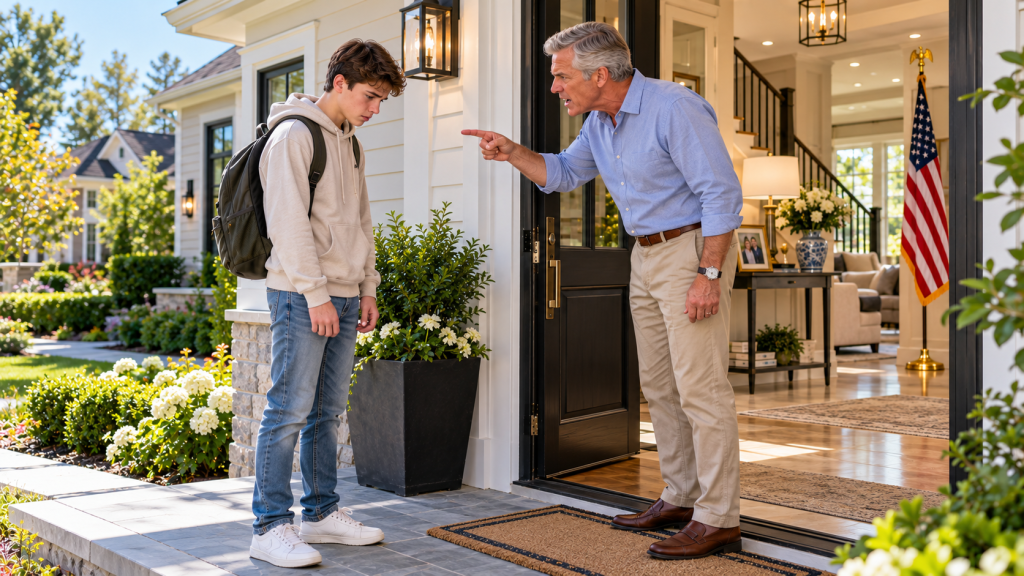
Outside, rain was beginning to fall.
The porch light flickered above him.
“Goodbye, Martin.”
I didn’t answer.
He walked down the driveway.
At the sidewalk, he turned around once.
I saw his face beneath the streetlight.
Even now, I don’t know whether he was waiting for me to call him back.
Perhaps he was.
Perhaps he was giving me one final chance to become the man his mother believed I could be.
I closed the door.
And I let him disappear into the rain.
For the first hour, I felt relief.
The house was quiet.
No footsteps upstairs.
No paints scattered across the dining table.
No reminders of Claire’s son.
I poured myself a drink and sat in front of the television.
I told myself that he probably had friends he could stay with.
I told myself teenagers were resourceful.
I told myself I had already spent ten years supporting him.
But at eleven that night, I walked past his bedroom.
The door was open.
His bed was made.
On the desk sat a jar of brushes, a sketchbook, and a small wooden birdhouse he had apparently taken down from my garage shelf.
Underneath it was a note.
I picked it up.
The handwriting was his.
“I thought you might want this someday. I fixed the roof.”
I turned the birdhouse over.
He had repaired the crooked wooden panels and carefully sealed the cracks.
For some reason, my throat tightened.
I put it down.
Then I turned off the light and went to bed.
I did not call him.
Not that night.
Not the following morning.
Not the next week.
Three months later, I sold the house on Willow Lane.
I told the real estate agent I wanted a fresh start.
I packed Claire’s belongings into boxes.
I donated most of her clothes.
I stored a few photographs in the attic of my new house.
Noah’s paintings were gone.
His bedroom furniture went to charity.
I found his old school reports and threw them away.
The little birdhouse was placed in a cardboard box marked MISCELLANEOUS.
Then I moved across town.
Within a year, I had expanded my business.
Within three years, I was earning more money than ever.
I traveled, bought a new car, renovated my home, and developed a routine that required very little from anyone else.
People occasionally asked whether I had children.
“No,” I answered.
And after a while, I almost believed it.
Sometimes, usually late at night, I remembered Noah.
I wondered whether he had graduated from school.
Whether he had found a job.
Whether he still painted.
Once, while driving past a bus station, I saw a teenage boy with a blue backpack standing in the rain.
My heart jumped.
I slowed the car.
Then the boy turned around.
It wasn’t Noah.
I drove away.
I could have searched for him.
I knew his birthday.
I knew his full name.
I knew where he had gone to school.
Teresa Ortiz still lived in the same neighborhood.
But every time I considered contacting someone, I found an excuse.
He probably hated me.
He probably didn’t want to see me.
He was an adult now.
He had his own life.
The truth was much simpler.
I was afraid of discovering what had happened after he left.
Because if something terrible had happened, I would have to admit that I had sent a grieving child into the world without protection.
And I wasn’t ready to face that.
Ten years passed.
Then, on a Wednesday afternoon in October, my office telephone rang.
My receptionist had already gone home.
I answered.
“Martin Hale.”
A woman spoke.
“Mr. Hale, my name is Mara Bell. I’m calling from the Bellmont Gallery.”
I frowned.
“I’m not interested in buying art.”
She gave a small, nervous laugh.
“I’m not selling anything. I’m organizing a special exhibition opening this Saturday.”
“Then I’m afraid you’ve called the wrong person.”
“Someone specifically requested your presence.”
I leaned back.
“Who?”
“The artist is Elias Vale.”
The name meant nothing to me.
Mara continued.
“He’s become one of the most talked-about young painters in the country. His recent collection was featured in several major museums.”
“Good for him.”
“Mr. Hale, I really think you should come.”
I was about to end the conversation.
Then she said something that made my blood run cold.
“Wouldn’t you like to know what happened to Noah?”
I gripped the telephone.
“What did you say?”
There was a pause.
“Noah Vale. He was sixteen when he left your home ten years ago.”
I stood so quickly my chair rolled backward.
“Who are you?”
“My name is Mara Bell.”
“How do you know Noah?”
“He’s the artist.”
I felt my heartbeat in my throat.
“That’s impossible.”
“His professional name is Elias Vale. He chose Elias from his mother’s favorite book. Vale was her maiden name.”
I couldn’t speak.
Mara softened her voice.
“He’s asked me to tell you that there’s something you need to see.”
“Why now?”
“I think that’s a question you should ask him.”
She gave me the gallery address.
Before hanging up, she added one final sentence.
“Mr. Hale, please don’t come expecting this to be easy.”
For the next three days, I barely slept.
I searched the internet for Elias Vale.
His paintings appeared everywhere.
Dark city streets.
Lonely train stations.
Children standing outside locked doors.
Empty bedrooms.
Windows glowing warmly in houses that seemed impossible to reach.
One painting showed a single blue backpack sitting on a bus station bench.
The title was “First Night.”
I stared at it for a long time.
Then I found an interview.
The journalist had asked the artist where his inspiration came from.
His answer was simple.
“I paint the places where people have to decide whether they will let someone in.”
Below the interview was a photograph.
A young man stood beside a large canvas.
He had dark hair, serious brown eyes, and a small scar beneath his chin.
I knew that scar.
Noah had gotten it at twelve after falling from his bicycle.
I had driven him to the emergency room.
For an instant, I remembered him sitting beside me with a towel pressed against his chin.
He had asked whether the stitches would hurt.
I had told him to be brave.
He had reached for my hand.
I had allowed him to hold it.
And now, ten years later, there he was.
A grown man.
A celebrated artist.
A stranger.
On Saturday morning, I drove to the gallery.
I arrived forty minutes early.
The building stood in a restored factory district, with tall windows and black iron doors.
Outside, elegant cars lined the street.
Inside, employees were arranging flowers and adjusting spotlights.
A woman in a charcoal suit approached me.
“Mr. Hale?”
I nodded.
“I’m Mara.”
She offered her hand.
Her expression was polite, but guarded.
“Thank you for coming.”
“Where is he?”
“He’s preparing upstairs.”
“Can I see him?”
“First, he’d like you to see the exhibition.”
I looked around.
“Why?”
“Because the paintings explain things he doesn’t know how to say.”
She led me through the first gallery.
There were dozens of canvases.
Most were enormous.
On one wall hung a painting of a little boy standing between two adults.
The woman held his hand.
The man stood with his back turned.
The painting was titled “Almost.”
In another, an eleven-year-old boy held a crooked wooden birdhouse.
His face was hopeful.
A shadow stretched across the garage floor.
The title was “Something I Made for You.”
My stomach tightened.
I continued walking.
A painting showed a kitchen table illuminated by candlelight.
Three figures sat around it, laughing.
I remembered the storm.
The canned peaches.
The ghost stories.
I stopped in front of the canvas.
For the first time in ten years, I could hear Noah’s laughter clearly.
“Did he remember all of this?” I whispered.
Mara stood beside me.
“He remembers more than you might think.”
We entered the final gallery.
At the far end was a massive portrait of Claire.
She sat beside a young boy beneath our backyard apple tree.
The painting was so beautiful that I stopped breathing.
Her eyes were exactly as I remembered them.
Her mouth curved into the same gentle smile.
Her hand rested protectively on Noah’s shoulder.
Beneath the canvas was a small brass plaque.
“The Mother Who Stayed.”
My knees weakened.
I reached for a nearby bench.
Then I heard a voice behind me.
“You came.”
I turned.
Noah stood a few feet away.
He was taller than I remembered.
His shoulders were broader.
He wore a simple black shirt with his sleeves rolled up.
His face had matured, but his eyes were unmistakable.
For a moment, I saw the sixteen-year-old boy standing beneath the porch light.
“Noah.”
He nodded.
“Hello, Martin.”
His voice was calm.
Not warm.
Not cruel.
Just calm.
I took a step toward him.
“I don’t know what to say.”
“I imagined that might happen.”
“I’m sorry.”
The words escaped before I could stop them.
He looked at me for several seconds.
Then he said, “You haven’t seen everything yet.”
He turned toward a small door near the back of the gallery.
“Come with me.”
I followed him into a private room.
Inside were several paintings that hadn’t been included in the public exhibition.
All of them showed our old house.
The kitchen.
The staircase.
The hallway.
The front door.
And the bedroom where Noah had spent his final night as a member of our family.
Against the opposite wall stood a narrow wooden cabinet.
Noah took a key from his pocket.
“Before we talk about what happened that night,” he said, “there’s something my mother wanted you to know.”
He unlocked the cabinet.
Inside lay a yellowed envelope.
I recognized Claire’s handwriting immediately.
My name was written across the front.
He placed it on the table.
“She gave me this shortly before she died.”
I stared at the envelope.
“Why didn’t she give it to me?”
Noah looked down.
“She was going to.”
“Then why didn’t she?”
“Because she thought we had more time.”
I slowly opened it.
Inside were three things.
An old photograph.
A medical report.
And a handwritten letter.
I picked up the photograph first.
It showed Claire standing outside a small brick apartment building.
She looked younger.
Frightened.
Beside her stood a man I had never seen.
He was holding a toddler.
Noah.
I turned the photograph over.
Written in blue ink were the words:
“Peter Rusk. The last photograph before we escaped.”
I looked at Noah.
“Escaped?”
He said nothing.
My hands began trembling.
I unfolded the medical report.
Across the top was the name of a cardiology clinic.
Below it was Noah’s name.
The report was dated two weeks before Claire died.
Several medical terms were unfamiliar to me.
But one line was unmistakable.
“Hypertrophic cardiomyopathy. Further risk assessment and ongoing specialist care recommended.”
I read it twice.
Then a third time.
“What is this?”
Noah watched me carefully.
“A heart condition.”
I looked up.
“You were sick?”
“Yes.”
“When?”
“When you told me to leave.”
The room seemed to tilt.
“Noah, I didn’t know.”
“I know.”
“Why didn’t anyone tell me?”
He glanced at the envelope.
“Read her letter.”
I unfolded the pages.
Claire’s handwriting filled both sides.
At the top, she had written:
“My dearest Martin, there are things I have been too frightened to tell you, and I pray that when you read this, there will still be time for us to do what is right.”
I continued reading.
And with every sentence, the world I thought I remembered began to fall apart.
“Martin, when we first met, I told you that Noah’s father had disappeared from our lives. That wasn’t the whole truth.
His name was Peter Rusk.
He was my first husband, and he was the most frightening person I have ever known.
At first, Peter was charming. He brought me flowers, wrote beautiful letters, and made promises about the family we would have.
But after Noah was born, everything changed.
Peter became controlling and unpredictable.
He monitored my telephone calls. He decided whom I could visit. He took money from my purse and accused me of hiding things from him.
Sometimes he frightened me so badly that I slept with my bedroom door locked.
I stayed because I was afraid of what he would do if I left.
Then one winter night, when Noah was barely four years old, Peter became angry because our little boy had spilled juice on the carpet.
He locked Noah outside in the cold.
When I tried to bring him inside, Peter pushed me against the wall.
I called the police.
That night, I finally understood that staying would not protect my son.
It would destroy him.
With help from a women’s shelter and an attorney, I obtained a protective order. Peter was later imprisoned after another violent incident.
Noah and I moved away and began again.
I never told you the details because I was ashamed of how long I had stayed, and because I wanted Noah to have a childhood that wasn’t defined by his father’s cruelty.
But there is something else.
Peter suffered from a hereditary heart condition.
He died from complications of that illness while in custody.
For years, I prayed Noah would never develop it.
Recently, after he became dizzy during basketball practice, I took him to a specialist.
The tests confirmed that he has hypertrophic cardiomyopathy.
The doctors are still determining the risks and the treatment he will need.
He is frightened, Martin.
He’s afraid that having his father’s illness means he will somehow become like his father.
I’ve told him that sickness doesn’t make someone cruel and that a child never inherits responsibility for a parent’s actions.
But he needs more than reassurance from me.
He needs a father who will stand beside him.
I know you have sometimes found it difficult to connect with Noah.
I know you never expected to become a parent.
But I need you to understand something.
When you married me, you didn’t simply marry a woman who happened to have a child.
You entered the life of a little boy who had already learned what rejection feels like.
And despite everything, he opened his heart to you.
You may not realize this, but he loves you.
He watches for your car every evening.
He remembers your favorite meals.
He tells his teachers about your business.
He still keeps the flashlight you gave him during that winter storm because he says it reminds him of the night we were all happy together.
I’ve been afraid to tell you about his diagnosis because I know how much pressure you’ve been under lately.
But hiding it is wrong.
I want us to sit down together this weekend, explain the diagnosis, and make a plan.
Whatever happens, I need you to promise me one thing.
Don’t ever make Noah believe he has to earn the right to belong.
He has spent too much of his life trying to prove he deserves a home.
Love him, Martin.
Not because he is mine.
Because he is a child who needs you.
And because, whether you understand it yet or not, you have already become his family.
With all my love,
Claire.”
I reached the bottom of the letter.
Then I read it again.
My eyes blurred.
The pages trembled so violently that I had to put them on the table.
For years, I had believed Claire’s final secret was something she had concealed to protect herself.
Instead, she had been trying to protect Noah.
The medical report lay beside the photograph.
I looked at the date again.
Two weeks before her death.
Two weeks before I told her son that he meant nothing to me.
I raised my head.
“Noah, did you know about your condition when I threw you out?”
He nodded.
“Mom had told me.”
“Why didn’t you tell me?”
He looked toward the paintings.
“Because you were already angry that I was there.”
I covered my mouth.
He continued in that same quiet voice.
“I heard you telling someone on the telephone that you didn’t know what you were going to do with me after Mom died.”
I closed my eyes.
I remembered the conversation.
A business associate had called to offer condolences.
I had complained about being left with a teenager.
I had said that I never signed up to raise someone else’s child alone.
I hadn’t known Noah was listening.
“I thought if you knew I was sick,” he continued, “you’d think I was even more trouble.”
“Noah…”
“So I kept quiet.”
He looked at the photograph of his biological father.
“Mom told me Peter used to get angry whenever someone needed something from him. She said he made people feel guilty for existing.”
He paused.
“After she died, I started wondering whether maybe I really was too much for people.”
I felt something inside my chest collapse.
“That’s not true.”
“I know that now.”
Those four words hurt more than an accusation.
Because he hadn’t known it then.
And I had done everything I could to convince him otherwise.
I pulled out a chair.
“Please tell me what happened after you left.”
Noah was silent for a long time.
Then he walked to a painting covered by a white cloth.
He removed it.
The canvas showed a bus station late at night.
A teenager sat on a wooden bench, holding a blue backpack against his chest.
Through the station windows, rain streaked across the glass.
A clock above the entrance showed 11:47.
The painting was titled “The Night Nobody Came.”
Noah stood beside it.
“That’s where I went.”
I couldn’t take my eyes off the lonely figure.
“I walked for almost two hours,” he said. “I didn’t have enough money for a hotel, and I didn’t want to go to the police because I thought they would send me straight back.”
“Why didn’t you go to Teresa?”
“I thought about it.”
He swallowed.
“But she had been helping Mom so much during those last months. She was exhausted. And I didn’t want her to think I was another problem she had to solve.”
I shook my head.
“She would have taken you in.”
“I know that now, too.”
He gave a sad little smile.
“But I was sixteen, Martin. I didn’t know very much about anything.”
He told me he had thirty-eight dollars in his backpack.
He bought a bottle of water and a sandwich from a vending machine.
Then he sat beneath the station clock and waited.
“For what?” I whispered.
He looked at me.
“For you.”
I couldn’t move.
“I thought you’d realize you were angry and come looking for me.”
He lowered his eyes.
“Every time a car pulled into the parking lot, I looked up.”
My throat closed.
“I kept telling myself, ‘He’ll come after he’s calmed down.'”
Noah stared at the painting.
“After midnight, I stopped watching the cars.”
I wanted to say something.
Anything.
But no apology could change that scene.
No words could travel backward through ten years and rescue the boy waiting beneath that clock.
Noah continued.
“Somewhere around two in the morning, my chest started feeling strange. My heart was beating too fast. I got dizzy.”
He sat on the bench in the private gallery.
“I remembered what the doctor had told Mom. I tried to breathe slowly, but I was scared.”
“What happened?”
“A woman found me.”
He looked toward the gallery door.
“Her name was Evelyn Brooks. She volunteered with an organization that helped homeless teenagers.”
I listened without interrupting.
“She asked whether I needed assistance. I told her I was fine.”
He smiled faintly.
“She didn’t believe me.”
Evelyn offered him food and asked whether he had somewhere safe to sleep.
When he tried to stand, he became so dizzy that he nearly collapsed.
She called for medical help.
He was taken to a hospital, where doctors evaluated his heart symptoms and contacted social services because he was a minor without a safe place to stay.
“They asked for my guardian’s name,” Noah said.
I felt a terrible chill.
“What did you tell them?”
“Martin Hale.”
He looked directly at me.
“I gave them your telephone number.”
My breath caught.
“The hospital tried to call?”
“Yes.”
I suddenly remembered something.
A few days after Noah left, I had received several calls from an unfamiliar number.
I hadn’t answered.
Then a woman had left a voicemail asking me to return an urgent call concerning a minor.
I had assumed it was a school administrative problem.
I had deleted the message.
I gripped the edge of the table.
“They called me,” I whispered.
Noah nodded.
“More than once.”
I stared at him.
“Did they tell you?”
“Eventually.”
“What did you think?”
His expression became distant.
“I thought you’d decided you were finished being responsible for me.”
I wanted the floor to open beneath me.
That was exactly what I had decided.
I had not been confused.
I had not been unreachable.
I had simply refused to consider that his life might still require something from me.
“Did you think I was dead?” I asked.
Noah looked surprised.
“No.”
“Then what did you think?”
He considered the question.
“I thought I was alone.”
There it was.
The consequence of my decision, reduced to five words.
Not a dramatic accusation.
Not an angry speech.
Just the truth.
I had made a child believe he was alone in the world.
Evelyn Brooks helped him through the next several weeks.
She contacted the appropriate services, worked with his school, and made sure he received follow-up medical care.
Eventually, an arrangement was made for him to stay with a family willing and approved to care for him.
Evelyn and her husband, David, became the people who helped him rebuild his life.
“They didn’t know me,” Noah said.
“Why did they do it?”
He gave me a strange look.
“Because I needed help.”
I looked away.
It was the simplest answer imaginable.
And it revealed everything that had been wrong with me.
I had spent ten years asking what I owed Noah.
Evelyn had met him once and asked what he needed.
Noah told me that she had a small guest room with yellow curtains.
David repaired bicycles and taught mathematics at a community college.
They had raised two daughters who were already adults.
Their house smelled of coffee, old books, and cinnamon.
On the first evening, Evelyn placed fresh sheets on the guest bed.
Noah stood awkwardly in the doorway.
“How long can I stay?”
She smiled.
“Tonight, you can stay tonight. Tomorrow, we’ll work out tomorrow.”
He stared at the bed.
“Do I have to pay you?”
She looked confused.
“No, sweetheart.”
“Do I have to do chores?”
“You can help around the house, like everyone else.”
“What happens if I make a mistake?”
Evelyn stopped smiling.
Then she walked over, crouched slightly so she could look directly into his eyes, and said, “Making a mistake doesn’t make you homeless.”
Noah paused.
“That was the first night I slept without keeping my backpack beside me.”
I lowered my head.
For several moments, neither of us spoke.
Then I asked about his heart.
He explained that the condition required regular specialist monitoring.
At seventeen, after further evaluation identified significant risk of dangerous heart rhythms, doctors recommended an implantable cardioverter-defibrillator.
He underwent the procedure during his final year of high school.
Evelyn stayed beside him before surgery.
David took time off work to bring him home.
“They were both there when I woke up,” Noah said.
His voice softened.
“Evelyn held my hand until I fell asleep again.”
I stared at the faint outline beneath his shirt where the device had been implanted.
I had never imagined that while I was expanding my business and planning vacations, Noah had been lying in a hospital bed facing surgery.
I had never imagined someone else holding the hand I had refused to reach for.
“What if something had happened?” I whispered.
Noah looked at me steadily.
“Something did happen, Martin.”
I nodded slowly.
He was right.
I had been thinking only about whether he had survived.
But survival wasn’t proof that no harm had been done.
He had survived a betrayal that should never have happened.
After his recovery, he returned to school.
He struggled at first.
He had missed classes.
He was embarrassed by the attention.
He was frightened about his health.
Sometimes he woke in the night convinced that his heart would stop.
Sometimes he became angry for no reason he could explain.
And sometimes he cried because he missed his mother.
Evelyn found him an art therapist.
She encouraged him to paint whatever he couldn’t put into words.
“At first, I painted our old house,” Noah said.
“Over and over.”
“Why?”
“Because I couldn’t understand how a place that had been my home for ten years could stop being my home in twenty minutes.”
He looked toward the covered canvases.
“I thought if I painted it enough times, maybe I could figure out the exact moment I stopped belonging.”
I shut my eyes.
“Noah, please.”
He stopped.
“Did I say something wrong?”
“No. It’s just…”
I couldn’t finish.
He nodded.
“I know it’s painful.”
Then he said something that made me feel smaller than I ever had in my life.
“It was painful for me, too.”
For years, I had treated my discomfort as the most important emotion in every room.
Now I was being asked to sit with someone else’s pain without demanding that he make it easier for me.
I forced myself to remain quiet.
Noah continued his story.
At eighteen, he won a regional art competition.
A painting of a child standing outside a brightly lit house caught the attention of a college admissions officer.
He received a scholarship to study fine arts.
At nineteen, one of his paintings was displayed in a university exhibition.
At twenty-one, he sold his first major collection.
At twenty-three, an independent gallery offered him a solo show.
At twenty-four, an international collector purchased one of his paintings for a sum that would have stunned the boy who once counted thirty-eight dollars at a bus station.
His career grew quickly.
Magazines interviewed him.
Museums requested his work.
Collectors began waiting months for new paintings.
But he didn’t spend his success trying to impress the people who had rejected him.
Instead, he began funding housing programs and art classes for young people who had experienced homelessness.
He established a nonprofit organization called The Open Door.
I stared at him.
“The Open Door?”
He nodded.
“It’s what Mom always used to say.”
I remembered Claire standing in our kitchen.
A home is made of the people who make room for you.
The words struck with almost physical force.
Noah walked toward another painting.
It showed a modest house with yellow curtains.
On the porch stood an older woman holding a plate of food.
Beside her was a man carrying a toolbox.
“They’re Evelyn and David,” he explained.
I studied their faces.
They looked ordinary.
Kind.
The sort of people you might pass in a supermarket without noticing.
And yet those two strangers had changed the entire direction of Noah’s life.
“They became your parents,” I whispered.
He looked at the painting.
“They became my family.”
I nodded.
I deserved that answer.
He continued.
“Evelyn says people sometimes assume she and David rescued me.”
His expression softened.
“But she hates that word.”
“Why?”
“Because she says children aren’t projects. They shouldn’t have to become successful or impressive to deserve a safe home.”
I looked at the expensive paintings surrounding us.
Suddenly, their value seemed irrelevant.
Noah had not become worthy of love because he was famous.
He had always been worthy.
The success simply made it impossible for me to continue pretending he had been nothing.
“Why did you invite me here?” I finally asked.
Noah folded his arms.
“For a long time, I didn’t want you to know anything about my life.”
“That would have been fair.”
“When I was eighteen, I thought about writing you a letter. I wanted to tell you I had graduated. I wanted you to know someone had helped me.”
“What stopped you?”
He hesitated.
“I kept imagining you reading it and throwing it away.”
I lowered my eyes.
“Then when my first exhibition opened, I thought maybe you’d hear about it somehow.”
“I didn’t.”
“I know.”
He walked toward the window.
“Eventually, I stopped wondering whether you would be proud of me.”
He stood with his back to me.
“But something happened last year.”
I waited.
“Evelyn’s granddaughter asked me to help with a school project. She wanted to interview someone about childhood memories.”
He smiled sadly.
“One of the questions was, ‘Who taught you the most important lesson of your life?'”
I swallowed.
“What did you tell her?”
“I said my mother taught me that love makes room.”
He turned around.
“And you taught me what happens when it doesn’t.”
I couldn’t speak.
“I realized I’d spent years painting that night, but I’d never really stopped carrying it.”
He gestured toward the gallery.
“This exhibition is called The Space Between Us. It’s about the people who disappear from our lives, and the people who choose to stay.”
He paused.
“I wanted you to see what happened.”
“To punish me?”
“No.”
“Then why?”
His eyes glistened.
“Because for ten years, you were the only person who never had to look at what you did.”
The words settled between us.
He wasn’t wrong.
I had avoided the past by changing addresses, throwing away photographs, and pretending the boy had simply grown up somewhere else.
Noah had spent those same years living with the consequences.
I sat down.
“I’m ashamed of myself.”
He nodded.
“You should be.”
I accepted it.
No excuses.
No arguments.
No explanation about how much I had loved Claire.
Because loving Claire had never justified hurting her child.
“I wish I could go back,” I whispered.
Noah looked at me.
“So do I.”
Then he added, “But neither of us can.”
I covered my face with my hands.
For the first time since Claire died, I cried without trying to hide it.
Not because I expected Noah to comfort me.
Not because I wanted him to forgive me.
But because I had finally stopped defending the man I had been.
I cried for Claire.
For the boy who had waited at the bus station.
For the hospital calls I hadn’t returned.
For the birthdays, graduations, and ordinary afternoons I had missed.
And for the terrible realization that Noah’s childhood had ended partly because I had refused to behave like an adult.
When I finally looked up, Noah was standing near the door.
“I have to get ready,” he said.
“The exhibition opens soon.”
I nodded.
“Of course.”
I wiped my face.
“Noah, before I leave, there’s something I need to ask.”
He waited.
“Can you ever forgive me?”
He looked at me for a long time.
Then he said, “I don’t know.”
The answer hurt.
But it was honest.
“I’ve spent years trying to understand why you could stop loving me so easily,” he continued.
I shook my head.
“Noah, I…”
He raised his hand.
“Please don’t tell me you loved me in your own way. I spent my childhood trying to make that explanation enough.”
I fell silent.
He took a breath.
“I don’t hate you anymore. I don’t want anything bad to happen to you.”
A tear slid down his cheek.
“But I don’t know whether I can ever trust you.”
I nodded.
“You don’t have to.”
He looked surprised.
I continued.
“You don’t owe me forgiveness. You don’t owe me another chance. And you certainly don’t owe me a place in your life.”
My voice shook.
“I should have been the adult who protected you. I failed. Nothing that happened to me afterward changes that.”
For the first time since I arrived, something in his expression softened.
Only slightly.
But I noticed.
“Thank you for saying that,” he whispered.
Then he opened the door.
Mara was waiting outside.
Noah walked away to prepare for the exhibition.
I remained in the private room for several minutes.
On a nearby shelf stood a small photograph of Claire.
Beside it was a newer photograph of Noah standing between Evelyn and David.
All three were smiling.
I looked at the picture.
I was grateful to those strangers.
And ashamed that their kindness had been necessary.
As I prepared to leave, Mara returned.
“Mr. Hale?”
I turned.
“Yes?”
“There’s one more thing Noah asked me to show you.”
She led me to a narrow hallway.
At the end was a small painting.
Unlike the others, it was unfinished.
It showed the front porch of our old house.
The door stood partly open.
A dim light glowed inside.
And on the steps sat a little wooden birdhouse.
My breath caught.
“Why did he paint that?”
Mara studied the canvas.
“He told me it was something he made for a person he desperately wanted to impress.”
I stared at the birdhouse.
I remembered the note beneath it.
I fixed the roof.
The painting had no title.
Below the canvas was a blank brass plaque.
Mara spoke softly.
“He said he hasn’t decided what to call it yet.”
I stood there for so long that the first guests began arriving in the next room.
Then I walked outside.
The afternoon sunlight was bright.
People laughed on the sidewalk.
Cars moved through the streets.
The world continued as though nothing extraordinary had happened.
But something inside me had changed.
For ten years, I had told myself I had no son.
That day, I understood that I had once been given the chance to become a father.
And I had thrown it away.
I drove to the cemetery.
Claire’s grave was beneath a large oak tree.
I hadn’t visited in nearly two years.
The headstone was covered with fallen leaves.
I knelt and brushed them away.
Then I placed the yellowed photograph of her and Noah beside the stone.
“I found him, Claire,” I whispered.
My voice broke.
“He’s alive.”
The words sounded ridiculous.
Of course he was alive.
But I had spent so long refusing to find out that discovering the truth felt like receiving news from another world.
“He’s become a wonderful man.”
I swallowed.
“He paints, just like you always said he would.”
I stared at her name.
“And he was sick.”
The wind moved through the branches.
“I didn’t know.”
Then I stopped.
Because ignorance wasn’t the real problem.
I had chosen not to know.
I had chosen not to ask.
I had chosen not to be there.
“I’m sorry,” I whispered.
I waited for some sense of relief.
It never came.
The next morning, I went into my garage.
I pulled down the dusty cardboard boxes that had followed me from Willow Lane.
Most contained old tax documents, kitchen utensils, and forgotten tools.
In the fourth box, wrapped in newspaper, I found the birdhouse.
It was smaller than I remembered.
The roof was uneven.
A little blue paint remained around the entrance.
I turned it over.
On the bottom, Noah had written his initials.
N.V.
And beneath them, in the careful handwriting of an eleven-year-old, were four words.
“For Martin, with love.”
I sat on the garage floor.
For nearly an hour, I held that birdhouse.
I remembered Noah’s hopeful expression when he gave it to me.
I remembered how quickly I had criticized it.
And I wondered how many times I had mistaken a child’s attempt to love me for an interruption.
That evening, I wrote Noah a letter.
Not an email.
Not a message asking whether he wanted to have lunch.
A handwritten letter.
I filled six pages.
Then I read them.
Most of what I had written was about myself.
How lonely I had been.
How hard Claire’s death had been.
How I didn’t know how to raise a teenager.
How I had been overwhelmed.
I tore the pages in half.
The next morning, I started again.
This time, I wrote about what I had done.
I told him that I remembered the exact words I had used.
I told him that I knew he had been a child.
I told him that he had never been responsible for my grief.
I apologized for ignoring the calls from the hospital.
I acknowledged that refusing to search for him afterward had been another choice, not an accident.
I didn’t ask him to forgive me.
I didn’t ask him to contact me.
I ended the letter with one sentence.
“You were never nothing, Noah. I was the one who failed to understand your worth.”
I placed it in an envelope and mailed it to the gallery.
Three weeks passed.
There was no reply.
I continued working.
But things that had once seemed important no longer satisfied me.
I found myself watching fathers and sons in restaurants.
I noticed teenagers waiting outside schools.
I listened when employees mentioned their children.
One afternoon, a young worker named Daniel told me he needed to leave early because his daughter had a school performance.
My first instinct was to complain.
Then I remembered Claire asking me to come home early.
I looked at Daniel.
“Go.”
He blinked.
“Really?”
“Yes.”
“Thank you, sir.”
“And Daniel?”
He turned.
“Don’t miss it.”
That evening, I went online and researched The Open Door.
Noah’s organization operated several programs supporting young people who had experienced homelessness or family instability.
They offered temporary accommodation referrals, counseling connections, tutoring, and art workshops.
The photographs on the website showed teenagers painting murals, preparing meals, and smiling beside volunteers.
I stared at the faces.
Some were sixteen.
Some were younger.
I wondered how many had heard the same words I had said to Noah.
You’re nothing to me.
I contacted the organization and asked whether they needed volunteers.
The coordinator sent me an application.
I completed it.
After the required screening and orientation, I began helping with maintenance at one of their community centers.
I repaired broken cabinets.
I assembled shelves.
I replaced damaged flooring.
At first, I thought financial donations would be more useful than my time.
I offered a large contribution.
The coordinator thanked me and explained that contributions were welcome, but money wouldn’t replace the need for reliable volunteers.
So I kept coming.
Every Wednesday afternoon, I arrived carrying a toolbox.
For several weeks, nobody there knew my connection to Noah.
I preferred it that way.
I didn’t want special treatment.
And I didn’t want anyone to think I was using the organization to force my way into his life.
One afternoon, while I was repairing a damaged cabinet, a boy approached me.
He was about fifteen.
His name was Jordan.
He watched silently for several minutes.
Then he asked, “Can I help?”
I handed him a screwdriver.
“Sure.”
He worked carefully.
After a while, he said, “My dad used to fix stuff.”
I nodded.
“Was he good at it?”
“Yeah.”
“Do you see him much?”
Jordan shrugged.
“Not anymore.”
I didn’t ask why.
We worked for another ten minutes.
Then he accidentally stripped a screw.
He froze.
“I’m sorry.”
“It’s all right.”
“I messed it up.”
“We’ll replace it.”
He stared at me.
“You’re not mad?”
“No.”
He looked suspicious.
I smiled gently.
“It’s a screw, Jordan. There are more in the box.”
Something changed in his face.
He relaxed.
Then he asked whether he could come back the following week.
I said yes.
When he walked away, I stood alone in the workshop.
I realized how many times Noah must have approached me with that same nervous hope.
How many times had he wanted nothing more than to stand beside me and learn something?
How many times had I made him regret asking?
The thought stayed with me all evening.
Over the next several months, I learned more about the young people who visited the center.
Some had lost parents.
Some had escaped unsafe homes.
Some had been rejected after family conflicts.
Others had simply fallen through gaps in systems that were supposed to protect them.
None of them needed to prove they were extraordinary.
They needed safety, patience, and people who followed through.
I began understanding that consistency could be a form of love.
Not the dramatic kind that makes headlines.
The ordinary kind.
Showing up when you say you will.
Listening before you speak.
Remembering what matters to someone.
Apologizing when you’re wrong.
Staying when things become difficult.
One Wednesday afternoon, nearly six months after the exhibition, I was carrying a box of paint supplies into the workshop when I heard a familiar voice.
“Martin?”
I turned.
Noah stood in the doorway.
He wore jeans and a dark-green sweater.
For a moment, I couldn’t speak.
Then I set down the box.
“Hello, Noah.”
He looked around the workshop.
“I heard you’d been volunteering here.”
I nodded.
“Yes.”
“Why?”
The question was fair.
I considered my answer carefully.
“Because I should have learned a long time ago how to be useful without expecting something in return.”
He studied me.
“Are you doing this for me?”
I shook my head.
“You were the reason I started. But these kids are the reason I keep coming.”
Noah looked toward the workbench.
On it lay a half-finished wooden shelf.
“Did you build that?”
“Jordan helped.”
“I know Jordan.”
“He’s a good kid.”
“He is.”
We stood in silence.
Then Noah approached the shelf.
“Looks sturdy.”
I smiled faintly.
“I learned to check the roof before criticizing the workmanship.”
He glanced at me.
For a moment, I thought he might laugh.
Instead, his eyes filled with tears.
He looked away.
“I got your letter.”
My heart began pounding.
“I didn’t know whether you would read it.”
“I read it.”
I nodded.
“That’s all I hoped.”
He ran his fingers along the edge of the shelf.
“I kept it in my studio.”
I swallowed.
“Thank you.”
He looked at me.
“I’m still angry.”
“You have every right to be.”
“Some days I think about what you said, and it feels like I’m sixteen again.”
I nodded.
“I understand.”
“No, Martin.”
His voice sharpened.
“You don’t.”
I accepted the correction.
“You’re right. I don’t.”
He took a slow breath.
“But I’ve been working through it.”
I waited.
“And I think maybe I want to stop being afraid of what happens if I let someone matter to me.”
My eyes stung.
“Noah…”
“I’m not saying everything is okay.”
“I know.”
“And I can’t pretend we’re the family we should have been.”
“I wouldn’t ask you to.”
He nodded.
Then he reached into his pocket and pulled out a folded paper.
“I found something in Mom’s things a few months ago.”
He handed it to me.
It was a photocopy of a page from Claire’s old journal.
The date was from the year before her death.
I recognized her handwriting.
“Noah and Martin spent the evening fixing the kitchen sink. Noah talked about it for hours afterward. He said Martin let him hold the flashlight and explained how the pipes worked. I wish Martin knew how little it takes to make this boy happy. He doesn’t need perfection. He just needs to feel included.”
I covered my mouth.
I barely remembered that evening.
To me, it had been an ordinary household repair.
To Noah, it had been something worth celebrating.
He watched me read.
“Mom gave me a lot of things,” he said quietly. “But she couldn’t give me memories that never happened.”
I nodded.
“I know.”
He hesitated.
“Maybe we can make a few now.”
I looked up.
His face was serious.
Cautious.
Still wounded.
But there was something else there.
A small opening.
Not forgiveness.
Not yet.
Possibility.
“I would like that,” I whispered.
He nodded.
“Coffee next week?”
I smiled through my tears.
“Anywhere you want.”
We met the following Thursday at a quiet café.
I arrived twenty minutes early.
Noah came exactly on time.
We ordered coffee.
For the first half hour, we talked about ordinary things.
His studio.
My business.
The weather.
A book Evelyn had recommended.
I asked about David and learned he had retired from teaching.
I asked about Noah’s health, careful not to pry.
He told me he attended regular cardiology appointments and had learned how to manage his condition.
Some days he still felt anxious.
But he had built a life he loved.
“I’m glad,” I said.
He smiled slightly.
“Me too.”
Then he asked about Claire.
Not about her death.
About her life.
He wanted to know what made her laugh before they met.
What she was like on our first date.
Whether she had ever wanted to travel.
I told him everything I could remember.
I described the grocery store and the oranges.
He laughed.
“I remember that!”
“You do?”
“I thought you were stealing our groceries.”
I laughed too.
For a moment, the years between us seemed less heavy.
Then I told him about the first time Claire invited me to dinner.
She had tried to make lasagna.
It burned.
We ate sandwiches instead.
Noah smiled.
“She was terrible at lasagna.”
“Absolutely terrible.”
We laughed again.
Then his expression softened.
“I miss her.”
“I do too.”
This time, I didn’t turn away from his grief.
I sat with him.
We talked about Claire until the café began closing.
When we stood to leave, Noah surprised me.
“Martin?”
“Yes?”
“Thank you for telling me those stories.”
I nodded.
“Anytime.”
He hesitated.
Then he stepped forward and hugged me.
It wasn’t a long hug.
And it wasn’t the desperate embrace of a child begging someone to stay.
It was the cautious embrace of a grown man deciding whether he could allow someone another chance.
I held him gently.
When he stepped back, we were both crying.
Neither of us pretended otherwise.
Over the following year, our relationship developed slowly.
Sometimes we had coffee.
Sometimes we walked through the park.
Occasionally he invited me to visit his studio.
He showed me new paintings and explained what inspired them.
I learned that he loved jazz music, hated mushrooms, and drank far too much coffee.
I learned that he was patient with his assistants but impatient with himself.
I learned that he still kept a photograph of Claire beside his easel.
I learned that he called Evelyn every Sunday.
I learned that David had taught him how to change a tire, file taxes, and repair a leaking faucet.
Every new detail reminded me of a part of his life I had missed.
At first, those reminders filled me with regret.
Eventually, I learned to listen without making his memories about my absence.
He deserved to celebrate the people who had stayed.
I had no right to resent them.
One evening, Noah invited me to dinner at Evelyn and David’s house.
I nearly refused.
I was frightened of meeting the people who had raised the boy I had abandoned.
But Noah said, “I think it’s time.”
So I went.
Evelyn opened the door.
She was a small woman with silver hair and kind eyes.
For a moment, she simply looked at me.
Then she stepped aside.
“Come in, Martin.”
David shook my hand.
His grip was firm.
Dinner was awkward at first.
I didn’t know what to say.
I expected resentment.
Perhaps I even wanted it.
Anger would have been easier to understand than the quiet dignity with which they treated me.
After dinner, Evelyn asked me to help carry dishes into the kitchen.
As I placed a plate beside the sink, I turned toward her.
“Mrs. Brooks, I owe you something I can never repay.”
She continued rinsing a cup.
“You don’t owe me anything.”
“You took care of Noah.”
“Yes.”
“When I wouldn’t.”
She dried her hands.
Then she looked directly at me.
“Martin, Noah didn’t need us to be extraordinary people.”
I nodded.
“He needed someone to stay.”
I looked down.
“I know.”
She paused.
“I was angry with you for a long time.”
“I understand.”
“But Noah has worked very hard to build a life that isn’t controlled by what happened to him.”
Her voice softened.
“If you truly want to be part of that life, don’t ask him to keep proving he’s forgiven you.”
I nodded.
“I won’t.”
“And don’t disappear again when things become uncomfortable.”
The words struck deeply.
“I won’t,” I promised.
Evelyn studied me.
Then she placed a clean towel in my hand.
“Good. Now dry the dishes.”
I laughed through tears.
It was such an ordinary request.
And somehow, it felt like the beginning of something.
A few months later, The Open Door announced plans to renovate an old building into a larger community center.
The property had been vacant for years.
Its roof leaked.
The windows needed replacing.
The flooring was damaged.
The heating system barely worked.
When I heard about the project, I offered my company’s services.
Not as a favor that required recognition.
Not as a condition of my relationship with Noah.
Simply because I knew how to do the work.
The organization accepted after reviewing the proposal like any other.
My employees and I spent several weekends repairing floors and helping contractors prepare the building.
Noah visited often.
Sometimes he painted murals with the young people.
Sometimes he worked in the office.
Sometimes he simply brought coffee and sandwiches.
One Saturday, I found him standing in a doorway, studying a newly installed wooden frame.
“What’s wrong?” I asked.
He smiled.
“Nothing.”
“Then why are you staring at it?”
He ran his hand along the wood.
“I was thinking about something Mom used to say.”
“A home isn’t made of walls?”
He looked surprised.
“You remember?”
I nodded.
“I remember now.”
He smiled.
“She would have loved this place.”
“Yes,” I said.
“She would.”
The center opened the following spring.
There were art studios, classrooms, counseling rooms, and a welcoming common area.
At the entrance stood a large painted door.
It was bright yellow.
Above it, in simple black letters, were the words:
“Everyone deserves somewhere safe to begin again.”
Noah gave a speech at the opening ceremony.
He thanked Evelyn and David.
He thanked the volunteers.
He thanked the social workers, teachers, donors, and young people who had helped shape the organization.
Then he spoke about his mother.
“She taught me that a home should never be something a child has to earn,” he said.
I stood at the back of the crowd.
My eyes filled with tears.
“When I was young, I lost my home,” he continued. “But people who didn’t owe me anything made room for me. They didn’t ask whether I would become successful. They didn’t ask whether I could repay them. They simply believed I deserved safety.”
He paused.
“That’s what this building is for.”
The room erupted in applause.
I clapped until my hands hurt.
After the ceremony, I found Noah standing outside beneath the yellow entrance sign.
He smiled when he saw me.
“Hey.”
“That was a wonderful speech.”
“Thanks.”
We stood together watching families enter the building.
Then Noah reached into his bag.
“I brought something for you.”
He handed me a small framed painting.
It showed a wooden birdhouse hanging beneath the branches of an apple tree.
Sunlight touched the roof.
A tiny bird stood at the entrance.
I stared at it.
“Noah…”
“I remembered the one I made when I was eleven.”
I nodded.
“I still have it.”
He looked surprised.
“You do?”
“It’s in my garage.”
He was quiet.
Then he said, “I thought you threw it away.”
“I almost did.”
My voice shook.
“But I didn’t.”
He studied me for a moment.
Then he smiled.
“Would you bring it next week?”
“Of course.”
“I think we should put it in the garden here.”
I looked at the new community center.
“Are you sure?”
“Yeah.”
He glanced toward the children playing nearby.
“Maybe it’ll remind someone that little things matter.”
The following Wednesday, I brought the birdhouse.
The blue paint had faded.
The roof was still slightly crooked.
But the structure was sound.
Noah and I carried it into the garden.
Together, we chose a low branch on an apple tree recently planted by the volunteers.
I climbed a ladder and secured the birdhouse.
Noah stood below, holding the tools.
When I finished, I stepped down.
We stood beside each other looking at it.
For a moment, neither of us spoke.
Then Noah said quietly, “I really wanted you to like it when I made it.”
I turned toward him.
“I know.”
He shook his head.
“No. I don’t think you did.”
I accepted that.
“You’re right.”
I looked back at the birdhouse.
“I didn’t understand what you were giving me.”
He waited.
“You weren’t giving me a badly built birdhouse.”
My throat tightened.
“You were giving me a chance to spend time with you.”
Noah’s eyes filled.
I continued.
“And I wasted it.”
He looked toward the tree.
Then he said, “We’re spending time together now.”
I nodded.
“Yes.”
“And that’s something.”
I smiled through tears.
“It is.”
Another year passed.
We continued meeting.
There were still difficult conversations.
There were days when Noah needed distance.
There were moments when something I said reminded him of the past.
Sometimes he became quiet.
Sometimes he told me directly that he didn’t want to talk.
I learned to respect those boundaries.
I learned that rebuilding trust wasn’t something I could rush simply because I was eager to be forgiven.
A year of kindness could not erase ten years of absence.
Nor could it erase the night that had changed his life.
But I could make different choices in the present.
And eventually, Noah began making room for me in small ways.
He called when he had good news.
He asked for my opinion about repairing an old studio building.
He invited me to a birthday dinner.
He sent photographs when he traveled.
Sometimes he called for no particular reason at all.
Those ordinary moments became more precious to me than anything I had ever owned.
One evening, almost two years after the exhibition, Noah invited me to his studio.
He had finished a new painting.
When I arrived, the canvas stood beneath a large skylight, covered with a white sheet.
Noah looked nervous.
“I’ve been working on this for months.”
I smiled.
“Can I see?”
He nodded.
Then he removed the sheet.
The painting showed a kitchen on a winter evening.
Three people sat on the floor surrounded by candles.
A woman laughed.
A little boy held a flashlight.
And a man sat beside them, smiling as he spilled canned peaches on his shirt.
I covered my mouth.
It was the night of the power outage.
The night I had almost forgotten.
The night Noah had remembered for the rest of his life.
The colors were warm.
The candlelight glowed.
Every face seemed alive.
I stepped closer.
“It’s beautiful.”
Noah stood beside me.
“I used to think that was the happiest night of my childhood.”
I looked at him.
“Was it?”
He considered the question.
“It was one of them.”
I nodded.
He continued.
“For a long time, I hated remembering it.”
“Why?”
“Because I couldn’t understand how someone who had laughed with me like that could later tell me I meant nothing.”
I shut my eyes.
“I’m sorry.”
“I know.”
He looked at the painting.
“But I’ve been thinking about something.”
“What?”
“That night was real.”
I nodded.
“The way you treated me afterward was real, too. One doesn’t cancel the other.”
“No.”
He took a breath.
“But I don’t want the worst night of my life to erase every good memory that came before it.”
I looked at him.
He smiled faintly.
“And I don’t want it to decide every good thing that might come afterward.”
Tears spilled down my face.
“Noah, I don’t deserve how kind you’ve been.”
He shook his head.
“This isn’t about what you deserve.”
He looked back at the painting.
“It’s about what kind of person I want to be.”
We stood together in silence.
Then he reached for a small envelope on the table.
“I found another letter from Mom.”
My heart jumped.
“Another one?”
He nodded.
“This one wasn’t hidden. It was tucked inside an old cookbook Evelyn kept safe for me.”
He handed it to me.
It was a short note Claire had written after our family vacation to the mountains.
The handwriting was familiar.
The paper smelled faintly of old books.
I read it slowly.
“Today Noah asked whether Martin would still love him when he grew up.
I told him love doesn’t end when a child becomes an adult.
He said he hoped Martin would teach him how to build a house someday.
I wish Martin knew how much that boy believes in him.
Sometimes I worry that Noah will spend too much of his life waiting to be chosen.
I hope one day he understands that love should never require begging.
And I hope Martin learns that being a father isn’t about blood.
It’s about showing up.”
I lowered the letter.
For a long time, I couldn’t speak.
Then Noah placed a hand on my shoulder.
“She really loved you, Martin.”
I nodded.
“She did.”
“And she believed you could be better.”
I looked at him.
“She was right about what I could have been.”
He said nothing.
I continued.
“But I don’t want to spend the rest of my life talking about what I could have done.”
My voice shook.
“I want to do what I can now.”
Noah smiled.
“Then keep showing up.”
I nodded.
“I will.”
That evening, before I left, I asked whether I could take a photograph of the painting.
Noah laughed.
“You can do better than that.”
He turned the canvas around.
On the back, written carefully in black ink, were the words:
“For Martin. A memory worth keeping.”
Below them was his signature.
Noah Vale.
I stared at the inscription.
“You’re giving this to me?”
He nodded.
“Yes.”
I couldn’t speak.
He smiled.
“Consider it a new beginning.”
I held the painting carefully as we walked toward my car.
Before I opened the trunk, I turned to him.
“Noah?”
“Yeah?”
“There’s something I’ve wanted to say for a long time.”
He waited.
I looked into the eyes of the boy I had once abandoned.
“You were my son long before I understood what that meant.”
His expression changed.
I continued.
“I know I can’t claim the years I missed. Evelyn and David were there when I wasn’t. And I will always be grateful to them.”
I swallowed.
“But if you’ll allow me, I’d like to spend whatever years I have left being someone you can count on.”
Noah looked down.
For several moments, he said nothing.
Then he stepped forward.
He put his arms around me.
And for the first time in twelve years, he rested his head against my shoulder the way he had when he was a frightened sixteen-year-old boy.
I held him.
Not awkwardly.
Not impatiently.
But with the tenderness I should have shown him all those years ago.
After a while, he whispered, “Okay, Martin.”
I closed my eyes.
“Okay.”
Then he stepped back.
He smiled through tears.
“Just don’t forget the coffee next Thursday.”
I laughed.
“I wouldn’t miss it.”
And I meant it.
Today, I am sixty-two years old.
My business is smaller because I no longer want to spend every waking hour working.
I volunteer twice a week.
I have learned to cook meals that don’t come out of a can.
I have learned to listen without preparing a defense.
And I have learned that when someone asks for your attention, they may be offering you something far more valuable than whatever task you think is being interrupted.
Noah is twenty-eight now.
His paintings hang in museums and private collections.
His foundation continues to help young people find support and safety.
He lives in a small house near his studio, with a garden full of flowers and a dog that has apparently decided I am its favorite human.
He still calls Evelyn every Sunday.
He still visits David for advice.
And sometimes, when he has had a difficult day, he calls me.
Not because he has to.
Because he wants to.
I don’t take those calls for granted.
Not one of them.
The painting of our candlelit kitchen now hangs above my fireplace.
Every morning, when I walk into the living room, I see Claire laughing.
I see Noah holding the flashlight.
And I see the man I once was.
Sometimes I wish I could step into that painting.
I wish I could put down the peaches, turn toward the little boy beside me, and say all the things I failed to say.
That I was proud of him.
That his drawings were beautiful.
That I loved his silly ghost stories.
That I was grateful he had made room for me in his life.
That he was never a burden.
That he was family.
But paintings cannot change the past.
Neither can apologies.
All we can do is recognize the harm we’ve caused, take responsibility, and choose what kind of people we will become afterward.
Last Sunday, Noah invited me to lunch.
We ate sandwiches on his back porch while his dog slept beneath the table.
At one point, he looked toward the apple tree in his garden.
“Martin, do you remember the first time we met?”
I smiled.
“The oranges?”
He laughed.
“Yeah.”
“You accused me of stealing them.”
“I was six. I had to protect Mom.”
I chuckled.
“You certainly did.”
He grew quiet.
Then he said, “I think she would be happy that we found our way back.”
I looked at the garden.
“I hope so.”
He took a sip of coffee.
Then, almost casually, he said something I had never expected to hear again.
“Dad, can you help me fix the gate next weekend?”
For a second, I thought I had imagined it.
Dad.
One small word.
A word I had not earned through biology.
A word I had once been offered and thrown away.
I looked at him.
He was studying the gate, apparently unaware of what he had just said.
Or perhaps he knew exactly what he was doing.
I didn’t ask.
I didn’t want to turn the moment into a demand for explanation.
I simply smiled.
“Of course, son.”
He smiled back.
And we continued eating lunch.
There was no dramatic music.
No miraculous disappearance of the past.
No promise that every wound had healed.
Just a father and son sitting together on a quiet afternoon, discussing a broken gate.
For most of my life, I had believed that the greatest things a man could leave behind were money, property, and a successful business.
I know better now.
The greatest thing we can give another person is the certainty that they will not be abandoned simply because life becomes difficult.
I learned that lesson from the boy I once told was nothing to me.
The boy who became a man without my help.
The man who had every reason to close the door forever.
And who, when he was ready and on his own terms, chose to open it just enough for me to begin learning how to stay.
I cannot change the night Noah walked into the rain carrying his blue backpack.
I cannot give him back the years when he needed a father and found strangers instead.
But when he calls now, I answer.
When he needs me, I show up.
And when he opens his door, I never forget what a privilege it is to be invited inside.
Because the most horrifying truth I discovered at that exhibition wasn’t that Noah had inherited a dangerous illness, or that his biological father had been a cruel man, or even that my stepson had become a famous artist.
It was that a frightened sixteen-year-old boy, who had already survived more than any child should, had been waiting for me to prove his mother right about love.
And I had failed him.
The miracle wasn’t that he had become successful.
The miracle was that he had found people who loved him when I refused to.
And the greatest gift of my remaining years is not that he eventually called me Dad.
It is that I finally understand what being one requires.
💬THE END! THANK YOU FOR READING!