

My thirteen-year-old son sold his beloved guitar to buy a wheelchair for a classmate whose broken chair had become the favorite joke of the school bullies. I thought his sacrifice was the most extraordinary thing I would ever witness as a mother. But two mornings later, two police officers knocked on our door with a wealthy stranger carrying my son’s missing guitar. I grabbed Alejandro’s hand, terrified that he had somehow gotten himself into trouble. Then one officer said, “Ma’am, your son isn’t under arrest. Someone wants to thank him.” What happened next uncovered a secret that had been buried for three years, exposed someone we trusted, and changed the lives of more children than I could have imagined.
My name is Victoria Ramirez, and until that week, I believed I understood almost everything about my thirteen-year-old son.
I knew he hated mushrooms, even when I chopped them so finely that they practically disappeared into spaghetti sauce.
I knew he pretended not to care about his grades but secretly checked the school’s online portal every afternoon.
I knew he still slept with the faded blue blanket his grandmother had made him when he was a baby, although he kept it carefully hidden beneath his regular comforter.
And I knew he loved his guitar more than almost anything in the world.
What I didn’t know was that my quiet, thoughtful boy had been carrying a burden much bigger than his thirteen years.
I discovered the missing guitar on a Wednesday afternoon while looking for dirty socks.
That is how most important investigations begin in my house.
Alejandro had assured me that his bedroom was clean, which, in his vocabulary, meant there was a narrow path between the door and his bed without the risk of stepping on something sharp.
I entered with a laundry basket balanced against my hip.
Three shirts were hanging from his desk chair. A towel lay abandoned beside the closet. Two socks had somehow ended up beneath a stack of science textbooks.
I was reaching for them when something caught my eye.
The guitar stand beside his desk was empty.
At first, I assumed he had moved the instrument to the closet.
But the closet contained only clothes, shoes, a basketball, and enough forgotten school papers to start a small recycling business.
The black guitar case was missing, too.
I checked beneath the bed, although I knew perfectly well that a full-sized guitar was unlikely to be hiding among the dust and missing pencils.
Then I walked downstairs.
Nothing.
The guitar was gone.
To understand why that frightened me, you need to know what that instrument meant to our family.
Three years earlier, when Alejandro turned ten, my husband, Gabriel, and I had bought him a beautiful acoustic guitar.
It had a warm honey-colored wooden body, a dark fretboard, and a sound so rich that even the simplest notes seemed to fill the entire house.
It cost more than we could comfortably afford.
We had spent weeks comparing prices, watching demonstration videos, and discussing whether buying such an expensive instrument for a ten-year-old was responsible.
Gabriel finally settled the argument.
“Vicky,” he told me, “some children find the thing they love early. When they do, we should help them hold on to it.”
He had smiled and added, “Besides, he’s been playing that plastic toy guitar since he was five. I think we’ve heard enough.”
I laughed, and we bought it.
Alejandro cried when he opened the birthday box.
Not the loud crying of a disappointed child, but the quiet, overwhelmed tears of someone who had received something he hadn’t dared hope for.
Gabriel recorded the entire moment on his phone.
Six months later, my husband died from a sudden heart attack.
He was forty-two.
One ordinary morning, he kissed me goodbye, reminded Alejandro about his math homework, and left for work.
By evening, our world had collapsed.
For weeks afterward, Alejandro barely spoke.
He stopped playing outside.
He pushed his food around his plate.
He began sleeping with the bedroom light on.
Then, one evening, I heard music coming from upstairs.
He was playing the song Gabriel used to hum while making breakfast.
The melody wasn’t perfect.
Some notes were wrong, and his fingers stumbled over the chords.
But I sat on the stairs and cried because, for the first time since the funeral, something beautiful had returned to our house.
From that day forward, the guitar became more than an instrument.
It was Alejandro’s connection to his father.
He practiced every afternoon.
Sometimes he repeated the same four measures for nearly an hour, driving me so crazy that I would call upstairs and ask whether the song had an ending.
He always laughed.
“Almost got it, Mom!”
He polished the wood carefully.
He changed the strings with the concentration of a surgeon.
He wouldn’t even let his friends touch it unless they washed their hands first.
The same child who abandoned wet towels on his bed treated that guitar as though it belonged in a museum.
And now it had disappeared.
When Alejandro arrived home from school, I waited until he had dropped his backpack beside the kitchen counter.
“Sweetheart, where’s your guitar?”
His expression changed immediately.
He stopped reaching for an apple.
“Why?”
“Because it’s missing.”
He lowered his eyes.
I felt my stomach tighten.
“Alejandro?”
There was a long silence.
Then he whispered, “I sold it, Mom.”
For a moment, I couldn’t understand the words.
“You did what?”
“I sold my guitar.”
I stared at him.
“You sold the guitar your father and I bought you?”
He nodded without looking up.
A lecture began arranging itself in my mind.
There were several excellent opening sentences, a strong middle section about responsibility, and what promised to be a very memorable conclusion.
But before I could begin, he said something that stopped me completely.
“Elena needed a wheelchair.”
I blinked.
“What?”
“Elena. From my class. Her wheelchair was falling apart.”
I knew Elena Whitmore.
She was a bright, cheerful girl who had joined Alejandro’s class two years earlier.
She had thick brown hair, expressive hazel eyes, and a wonderful smile.
She loved books about astronomy and frequently won school science competitions.
I had met her several times at parent conferences and school events.
I knew she used a wheelchair because of an accident when she was little.
What I hadn’t realized was how difficult her daily life had become.
Alejandro leaned against the kitchen counter.
“The wheels kept getting stuck,” he explained. “One of the brakes barely worked, and the seat was tearing apart.”
“Didn’t the school know?”
“They knew.”
“Then why wasn’t something done?”
He shrugged helplessly.
“Everybody kept saying they were working on it.”
He paused before adding, “But that’s not even the worst part.”
I waited.
“Some kids laugh at her.”
The words came out quietly.
“They imitate the squeaking sounds her chair makes. They call her a broken shopping cart.”
My chest tightened.
Alejandro stared at the floor.
“Last Thursday, her wheel got stuck near the cafeteria doors. Everybody was rushing to lunch, and two boys started laughing. One of them told her she should come with a warning sign.”
I closed my eyes.
“Elena tried to laugh like she thought it was funny,” he continued. “But when they walked away, she just looked down.”
His voice broke slightly.
“I saw her crying later, Mom. She didn’t know I was there.”
I reached for his hand.
He kept talking.
“She missed lunch twice because her chair was so hard to move. Sometimes she doesn’t even want to go to school.”
“Did she tell a teacher?”
“Yeah. They said they would deal with the bullying.”
“And did they?”
“Not really.”
He took a deep breath.
“Last week, I asked Elena why she didn’t get a new wheelchair.”
“What did she say?”
“She said her mom was saving money, but hospital bills kept coming.”
I knew that feeling.
After Gabriel died, there were months when I could barely sleep because I was calculating how to pay the mortgage, the electricity bill, the groceries, and Alejandro’s school expenses from one paycheck.
I worked as an administrative assistant at a medical clinic.
The salary was steady, but there was never much left after the essentials.
I understood what it meant to need something important and not have the money for it.
Still, I couldn’t understand what Alejandro had done.
“How much did you sell your guitar for?”
“I wanted twelve hundred dollars.”
“And?”
“Mr. Keller offered eight hundred fifty.”
I nearly dropped the apple I was holding.
“Mr. Keller from church?”
He nodded.
“Sweetheart, you arranged to sell something that valuable without telling me?”
“He asked if I was sure.”
“How many times?”
“Four.”
That sounded exactly like Walter Keller, a retired music teacher who played guitar at our church.
But I would have preferred to be present for at least one of those four opportunities.
“Why didn’t you ask me first?”
Alejandro finally looked up.
“Because you would’ve tried to find another way.”
“Of course I would have.”
“I know.”
“Then why didn’t you let me?”
His answer was so simple that I had no immediate response.
“Because Elena needed help now.”
He swallowed.
“You would’ve called people and compared prices and waited for answers. And maybe that would’ve worked. But she was still going to school every day in that broken chair.”
He paused.
“Dad always said that if you see somebody drowning, you don’t stand on the shore discussing who should buy the life jacket.”
I felt tears gathering in my eyes.
Gabriel really had said that.
He used to repeat it whenever someone in the neighborhood needed help.
I hadn’t heard those words spoken aloud in years.
Alejandro rubbed his sleeve across his forehead.
“I found a chair through the hospital’s rehabilitation department. It’s a refurbished model they checked and adjusted. They said it would fit Elena after they measured her, and it cost eight hundred twenty dollars.”
“What about the rest of the money?”
“I paid the delivery fee.”
He looked nervous again.
“Mom, please don’t be mad.”
I sat down.
For several seconds, I couldn’t speak.
My son had sold the last expensive gift his father had given him.
He had traded something filled with precious memories for something another child desperately needed.
And he had done it without expecting applause, attention, or a reward.
Finally, I said, “Alejandro, I wish you had come to me first.”
“I know.”
“And you should never arrange an expensive sale online without my permission.”
“I know.”
“But sweetheart…”
My voice trembled.
“I am so proud of the person you’re becoming.”
His eyes filled with tears.
“Really?”
“Really.”
He stepped forward, and I wrapped my arms around him.
He was getting tall enough that his chin nearly reached my shoulder.
But in that moment, he felt like the little boy who used to climb into my lap after a bad dream.
I held him tightly.
Then I whispered, “Your dad would have been proud of you, too.”
That was when Alejandro finally cried.
The next morning, he appeared in the kitchen carrying a cup of tea.
My son had never voluntarily made me tea before.
I looked at him suspiciously.
“What do you want?”
He smiled sheepishly.
“The wheelchair’s ready.”
I laughed despite myself.
“And you need a ride?”
“Please?”
I set down my breakfast.
“Get your shoes.”
At the hospital, a rehabilitation specialist showed us the chair, explained the safety adjustments, and confirmed that Elena would need a proper fitting before using it regularly.
Alejandro listened to every instruction.
He asked about the brakes, the wheels, and the seat cushion.
He wanted to know how to keep the chair in good condition.
Watching him, I realized this hadn’t been a sudden decision.
He had researched carefully.
He had thought about Elena’s needs.
He had been planning to help her for longer than I knew.
On the drive to her house, however, his confidence began to disappear.
He stared through the windshield.
“What if she gets embarrassed?”
“Why would she?”
“Because she might think I’m feeling sorry for her.”
I considered that.
“Then tell her the truth.”
“What truth?”
“That you saw a problem and wanted to help. But remember, she gets to decide whether she wants the chair.”
He nodded.
“And don’t make it sound like she owes you anything.”
“I wouldn’t.”
“I know, sweetheart.”
Elena lived in a modest yellow house at the end of a quiet street.
There were flowerpots beside the front steps and a small wooden ramp leading toward the doorway.
Alejandro carried the paperwork while I helped move the boxed chair from the car.
When he rang the doorbell, Elena answered in her old wheelchair.
I heard the squeaking before I saw her.
“Hey, Alejandro!”
She smiled.
Then her eyes moved toward the box.
“What’s that?”
My son suddenly looked as though he had forgotten every word in the English language.
“Um…”
I gently nudged him.
He took a breath.
“I got something for you.”
Elena frowned.
“For me?”
“Yeah. It’s a wheelchair.”
She went completely still.
Her mother, Jillian, appeared behind her.
“What’s going on?”
Alejandro looked from one of them to the other.
“Your chair’s been giving you trouble,” he said. “And the hospital had one that would work better. We brought it so you could try it.”
Elena stared at him.
“You bought me a wheelchair?”
He nodded.
“But those are expensive.”
“It’s refurbished.”
“That doesn’t mean it’s cheap.”
My son looked at me helplessly.
I knew he didn’t want the attention.
But I also knew that withholding the truth would only create confusion.
“He sold his guitar, Elena.”
Silence.
Jillian covered her mouth.
Elena’s eyes widened.
“Your guitar?”
Alejandro shrugged.
“Yeah.”
“The one your dad gave you?”
He nodded again.
For a long moment, Elena didn’t speak.
Then she whispered, “Why would you do that?”
My son looked genuinely puzzled.
“Because you needed a wheelchair.”
Tears spilled down Elena’s cheeks.
“But you loved that guitar.”
“I still do,” he admitted.
Then he smiled.
“But I didn’t need it as much as you needed this.”
Jillian started crying.
She stepped forward and held Alejandro’s shoulders.
“You have no idea what you’ve done for my daughter.”
Alejandro turned bright red.
“It’s okay, Mrs. Whitmore.”
“No, sweetheart. It isn’t just okay.”
Her voice trembled.
“It’s extraordinary.”
We spent the next hour arranging the fitting appointment, checking the hospital paperwork, and making sure Elena felt comfortable with the new chair.
She tested the wheels on the porch with the cautious concentration of someone who had learned not to trust equipment too easily.
Then she pushed forward.
The movement was smooth.
No squeaking.
No sticking.
No painful struggle to turn.
Elena stopped, looked down at the chair, and smiled.
It was the kind of smile that changes an entire room.
“It’s quiet,” she whispered.
Alejandro laughed.
“That’s a good thing, right?”
She laughed, too.
“The best thing.”
When we finally left, Jillian followed me to the car.
Her eyes were still wet.
“Victoria, I don’t know how I’ll ever repay you.”
“You don’t have to.”
“But he gave up something so important.”
I looked through the windshield at Alejandro, who was sitting in the passenger seat trying very hard not to look emotional.
“He made his choice,” I said. “All I did was drive.”
Jillian took my hand.
Then she said something I didn’t understand until much later.
“It’s strange. We applied for help so many times, but we were always told there was nothing available.”
“Through the hospital?”
“And through the school. There was supposed to be some kind of charity assistance, too. But the applications kept disappearing.”
I frowned.
“What charity?”
She shook her head.
“It’s a long story.”
I didn’t press her.
I wish now that I had.
Because that small conversation was the first warning that Elena’s broken wheelchair was not simply the result of financial hardship.
Something was terribly wrong.
And someone had been working very hard to keep the truth hidden.
We went home that afternoon believing the important part of the story was over.
I made Alejandro his favorite chicken enchiladas.
He helped wash the dishes without being asked.
Before bed, he stood in his bedroom doorway and looked at the empty guitar stand.
I watched him from the hallway.
“Do you regret it?” I asked gently.
He was quiet for a moment.
“I miss it.”
I nodded.
“That’s understandable.”
He touched the wooden stand.
“But no, Mom. I don’t regret it.”
Then he went to bed.
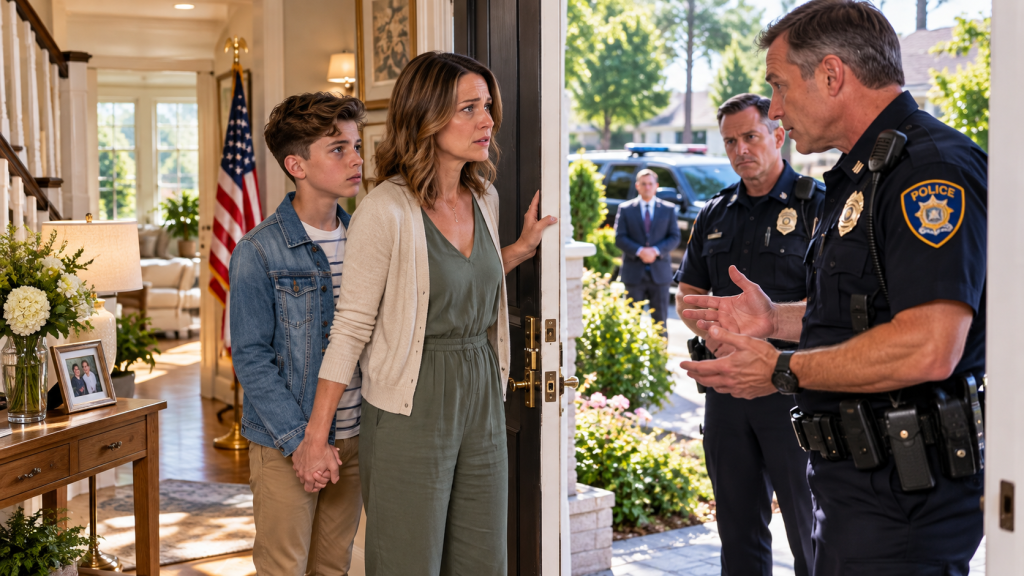
The following morning, at exactly eight seventeen, someone knocked on our front door so hard that I nearly dropped my coffee.
When I opened it, two uniformed police officers were standing on the porch.
Behind them stood a tall, silver-haired man wearing an expensive gray suit.
And in his hand was a black guitar case.
I recognized the case immediately.
My heart began racing.
“Can I help you?”
The older officer nodded politely.
“Are you Victoria Ramirez?”
“Yes.”
“I’m Officer Daniels. This is Officer Cooper.”
Alejandro appeared behind me.
The moment he saw the uniforms, his face went pale.
I instinctively grabbed his hand.
“What happened?” I demanded. “What did my son do?”
Officer Daniels raised his palm reassuringly.
“Ma’am, your son isn’t under arrest.”
I swallowed.
“Then why are you here?”
He glanced toward the silver-haired stranger.
“Someone wants to thank him.”
The man stepped forward.
His eyes moved toward Alejandro.
“Are you the young man who bought my granddaughter a wheelchair?”
Alejandro nodded nervously.
The stranger drew a slow breath.
“My name is Richard Whitmore.”
Then he lifted the guitar case.
“And I believe this belongs to you.”
Alejandro looked at the case as though he couldn’t believe his eyes.
“That’s my guitar,” he whispered.
Richard nodded.
“Mr. Keller told me you sold it to help Elena. When I explained who I was, he agreed to let me buy it back.”
He carefully opened the case.
Inside lay the beautiful honey-colored guitar Gabriel had given our son.
Alejandro stepped forward and gently touched the strings.
For a moment, nobody spoke.
Then Richard said, “But returning your guitar isn’t the only reason I came.”
Something in his voice made me uneasy.
Officer Daniels looked at me.
“Mrs. Ramirez, we’re investigating a possible misuse of charitable funds. Mr. Whitmore believes your son may have unknowingly helped uncover it.”
I stared at him.
“What charitable funds?”
Richard removed a thick envelope from his briefcase.
“Three years ago, I established a fund to help my granddaughter and other children who require mobility equipment. Until yesterday, I believed Elena had been receiving that assistance.”
My stomach tightened.
“She hasn’t,” I said.
“I know that now.”
He opened the envelope.
Inside were copies of financial statements, invoices, and what appeared to be hospital equipment records.
Richard pointed to one document.
“According to these records, Elena received a replacement wheelchair fourteen months ago.”
I shook my head.
“That’s impossible.”
“That’s what Jillian told me yesterday.”
He placed another paper on the porch railing.
“According to this one, her wheelchair underwent extensive repairs six months ago.”
Alejandro stepped closer.
“But her chair was broken six months ago.”
Richard nodded gravely.
“And that’s why the police are involved.”
I looked toward Officer Daniels.
“Are you saying somebody stole money meant for Elena?”
“We have reason to believe funds were diverted,” he answered. “We’re still establishing the full extent of what happened.”
Richard swallowed.
“There’s something worse.”
He turned another page toward me.
I saw a familiar name at the bottom.
Margaret Hargrove.
The principal of Alejandro’s school.
I stared at the signature.
“No.”
Richard watched my face.
“You know her?”
“Everyone knows her.”
Mrs. Hargrove had been principal for almost twelve years.
She organized charity auctions, spoke at church gatherings, and regularly reminded parents that the school community was one big family.
She had personally thanked me for volunteering at last year’s Christmas fundraiser.
She had even given Alejandro a certificate for good citizenship.
And she was the person who had told Elena’s mother that no financial assistance was available.
Alejandro stared at the paperwork.
“Mom,” he whispered, “that’s the woman I asked for help.”
I turned toward him.
“What?”
He looked frightened.
“Last month. I went to her office because Elena’s wheelchair kept breaking.”
“What did she say?”
“She said the school couldn’t afford to help every student who wanted something new.”
My heart sank.
Richard closed his eyes.
Officer Cooper exchanged a glance with Daniels.
Alejandro continued.
“I told her it wasn’t something Elena wanted. It was something she needed.”
“And?”
“She told me to stop interfering in another family’s private problems.”
Richard gripped the porch railing.
For the first time, the wealthy, composed stranger looked genuinely shaken.
“Mrs. Ramirez,” he said quietly, “I think we need to talk.”
I invited them inside.
Alejandro carried his guitar case into the living room, but he didn’t open it again.
He placed it carefully beside the couch and sat close to me.
Richard explained that Elena was his only granddaughter.
Her father, Adrian, had been Richard’s son.
Seven years earlier, Adrian had died in the same terrible automobile accident that left Elena unable to walk.
Jillian had lost her husband.
Elena had lost her father.
And Richard had lost his only child.
“After the funeral, I handled my grief badly,” he admitted.
He stared at his hands.
“I buried myself in work. I convinced myself that paying bills was the same thing as being there for my family.”
Jillian had been struggling financially.
Richard had offered help, but their relationship was strained.
He wanted Elena moved to a private rehabilitation facility several hours away.
Jillian believed her daughter needed to remain close to home, friends, and school.
They argued.
Both said things they regretted.
Eventually, communication became painfully infrequent.
Richard established the Whitmore Family Mobility Fund and instructed his foundation’s local coordinator to ensure Elena received everything she needed.
That coordinator worked closely with the school district.
Her name was Margaret Hargrove.
“She sent me regular reports,” Richard explained. “Photographs of purchased equipment, invoices, progress summaries. Every quarter, I signed another authorization.”
I frowned.
“Did you ever actually speak to Jillian?”
His silence answered before his words did.
“No,” he admitted.
“Why?”
He looked ashamed.
“Because I was a coward.”
The room grew still.
“I told myself Jillian didn’t want me involved. Mrs. Hargrove reinforced that belief. She said direct contact would upset the family, that all communication should go through the assistance program.”
He shook his head.
“I should have called. I should have driven to that house. Instead, I trusted reports because reports were easier than facing my own failures.”
I thought about Jillian’s exhausted expression.
The repaired clothes she wore.
The way she had cried when Alejandro delivered the chair.
All that time, money had supposedly been arriving.
And someone had made certain she never saw it.
“How much money?” I asked.
Richard hesitated.
“The preliminary review shows more than eighty thousand dollars allocated specifically to Elena’s care over three years.”
I felt the blood drain from my face.
Eighty thousand dollars.
Jillian had been working additional shifts at a pharmacy.
She had delayed repairs to her car.
She had borrowed money to pay for Elena’s therapy.
And somewhere, according to those records, tens of thousands of dollars had disappeared.
Richard continued.
“The records also show funds assigned to other children. We don’t yet know how many of those payments were legitimate.”
Officer Daniels spoke carefully.
“We have investigators reviewing the financial trail. We would appreciate copies of your son’s purchase paperwork and any communication he had regarding Elena’s previous equipment problems.”
I looked toward Alejandro.
He was staring at his shoes.
“Sweetheart, did you keep anything from when you asked Mrs. Hargrove for help?”
He nodded.
“I emailed her.”
Officer Daniels straightened.
“Do you still have it?”
“Probably.”
“Would you mind showing your mother?”
Alejandro retrieved his phone.
He opened his school email and scrolled.
Then he handed it to me.
The message was dated twenty-three days earlier.
He had written politely, explaining that Elena’s wheelchair was unsafe and asking whether the school could help her obtain a replacement.
The reply was short.
The school had no available funding for replacement mobility equipment.
Students should refrain from discussing another student’s private medical circumstances.
I read it twice.
Then I handed the phone to Officer Daniels.
Richard looked away.
For a moment, I thought he was going to cry.
Then my son spoke.
“Mr. Whitmore?”
Richard looked up.
“Yes, Alejandro?”
“If you had all that money for Elena, why didn’t anybody help her?”
There was no anger in his voice.
That made the question hurt even more.
Richard took a long breath.
“Because some people may have been dishonest, and because I failed to check that my help was reaching her.”
Alejandro considered that.
Then he asked, “Can you make sure she gets what she needs now?”
Richard’s eyes filled.
“Yes,” he whispered. “I can.”
The officers stayed another twenty minutes.
They explained that there was an active investigation and asked us not to confront anyone or share the documents publicly.
They also asked Alejandro to preserve his emails.
Before leaving, Officer Daniels crouched slightly so he could speak to my son at eye level.
“You did something important,” he said.
Alejandro looked embarrassed.
“I just bought a wheelchair.”
The officer smiled.
“Sometimes that’s how important things begin.”
After everyone left, our house felt strangely quiet.
Alejandro carried his guitar upstairs.
A few minutes later, I heard a single chord.
Then another.
He played the melody Gabriel used to hum while making breakfast.
I stood at the bottom of the stairs and cried.
Not because the guitar had returned.
But because my son had reminded me so powerfully of the man we had lost.
That afternoon, I called Jillian.
She answered on the third ring.
“Victoria?”
“Are you sitting down?”
She gave a nervous laugh.
“Should I be?”
“I think so.”
I told her about Richard’s visit, the officers, and the financial records.
At first, she said nothing.
Then I heard a chair scrape across the floor.
“Eighty thousand dollars?”
“That’s what Richard said.”
Her breathing changed.
“No. That’s not possible.”
“I wish I could tell you otherwise.”
She began talking quickly.
She had applied for assistance repeatedly.
Mrs. Hargrove had always handled the paperwork.
Sometimes she said applications were incomplete.
Sometimes she claimed the program had run out of money.
Other times, she told Jillian that Elena’s medical records didn’t qualify her for additional support.
“I thought I was doing something wrong,” Jillian whispered.
My eyes burned.
“You weren’t.”
“She made me feel like I was asking for too much.”
I looked toward Alejandro’s bedroom.
He had spent weeks worrying about a classmate’s broken wheelchair.
Meanwhile, adults responsible for helping had apparently been telling Elena’s mother that nothing could be done.
Jillian suddenly became quiet.
Then she said, “Victoria, there’s something else.”
“What?”
“Two months ago, Mrs. Hargrove asked me to sign a form confirming that Elena had received all the equipment allocated to her.”
I gripped the phone.
“Did you sign it?”
“No. I told her I couldn’t sign something that wasn’t true.”
“What did she say?”
“She said it was just an administrative requirement.”
My heart began pounding.
“And?”
“I refused.”
Jillian swallowed.
“She became angry. She told me that families who made these programs difficult were often the first to lose eligibility.”
I closed my eyes.
“Jillian, you need to tell the police.”
“I will.”
There was a pause.
Then she whispered, “I keep thinking about Alejandro.”
“What about him?”
“If he hadn’t bought that wheelchair, I wouldn’t have called Richard to thank him.”
I looked through the window.
The afternoon sun was falling across our small backyard.
“No,” I said softly. “Maybe you wouldn’t have.”
That evening, Alejandro asked whether Elena knew about the investigation.
“Her mother is going to explain what’s happening,” I told him.
He nodded.
Then he asked, “Will people at school be angry with her?”
I hesitated.
“Why would they?”
“Because sometimes when something bad happens, everybody blames the person who talks about it.”
The wisdom of that frightened me.
I sat beside him.
“Elena hasn’t done anything wrong.”
“I know.”
“And neither have you.”
He stared at the floor.
“I just don’t want things to get worse for her.”
I put my arm around his shoulders.
“Then we’ll do everything we can to make sure they don’t.”
Unfortunately, things did get worse before they got better.
On Monday morning, Alejandro came home looking exhausted.
He dropped his backpack beside the kitchen table and went straight upstairs.
That wasn’t like him.
I followed.
He was sitting on his bed, staring at his phone.
“Sweetheart?”
He quickly turned the screen off.
I sat beside him.
“What happened?”
“Nothing.”
I gave him the look every mother develops after approximately seven thousand conversations with a child who insists nothing is wrong.
He sighed.
“People are talking.”
“About what?”
“Me. Elena. The wheelchair.”
My chest tightened.
“Who?”
He handed me his phone.
Someone had posted a message in a school group chat claiming that Alejandro had bought Elena a wheelchair because he wanted attention.
Another message said Elena had manipulated him into selling his father’s guitar.
A third accused Jillian of pretending to be poor to get charity.
I felt anger rising so quickly that I had to put the phone down.
“Who started this?”
“I don’t know.”
Alejandro rubbed his eyes.
“Some kids are saying Elena should be embarrassed.”
I forced myself to speak calmly.
“What does Elena say?”
“She told them she didn’t ask me to sell anything.”
“She’s right.”
“I know.”
He looked miserable.
“But now she’s upset because I gave up my guitar, and everybody keeps making it sound like she did something wrong.”
I took a deep breath.
“Listen to me. You did something generous. Elena accepted it. Neither of you owes strangers an explanation.”
He nodded, but I could tell he wasn’t convinced.
Then he said something that broke my heart.
“Maybe I should’ve just kept the guitar.”
I pulled him close.
“Would you have felt better watching Elena struggle every day?”
“No.”
“Then don’t let cruel people decide what your kindness was worth.”
That night, I saved screenshots of the messages.
The next morning, I contacted the school district.
I didn’t accuse anyone of a crime.
I simply reported the bullying and asked that the children be protected while the investigation continued.
The district representative promised to look into it.
But before noon, I received a phone call from Mrs. Hargrove herself.
“Victoria,” she said brightly. “I understand you’ve been concerned about some misunderstandings at school.”
Her voice sounded exactly as it always had.
Warm.
Professional.
Almost grandmotherly.
I gripped my phone.
“I’m concerned that children are being harassed.”
“Teenagers can be unkind,” she replied. “But we should be careful not to encourage unnecessary drama.”
I stared at the wall.
“Unnecessary drama?”
“You know how rumors spread.”
I remained silent.
Then her tone changed.
“I also heard that Alejandro had some visitors at home last week.”
My heart skipped.
“What visitors?”
“Oh, I’m sure you know.”
For a second, neither of us spoke.
Then she continued.
“I’d hate for your son to become involved in adult matters that he doesn’t understand.”
I felt cold.
“Mrs. Hargrove, my son is concerned about his classmate.”
“Of course. And that’s admirable.”
She gave a small laugh.
“But children sometimes misunderstand complicated financial arrangements.”
I looked at the screenshots on my desk.
“Then I’m sure the proper authorities will be able to clarify everything.”
Her silence lasted several seconds.
When she spoke again, the warmth was gone.
“I would advise you to be very careful, Victoria.”
I straightened.
“Careful about what?”
“About allowing your family to become part of a story that could damage innocent people’s reputations.”
I ended the call.
My hands were shaking.
For several minutes, I sat motionless.
Then I called Officer Daniels.
He listened without interrupting.
“Did she threaten you directly?” he asked.
“Not exactly.”
“Tell me her exact words.”
I repeated everything I could remember.
He asked me to write it down immediately, along with the time of the call.
“Mrs. Ramirez,” he said, “please don’t confront her. If she contacts you again, preserve whatever you can.”
I agreed.
Then I asked the question that had been bothering me since Richard’s visit.
“Do you really think she stole all that money?”
He paused.
“I’m not able to discuss our evidence. But I can tell you that we’re taking this very seriously.”
Three days later, Elena’s mother called me again.
This time, she sounded frightened.
“Victoria, someone came to my house.”
“Who?”
“A woman from the charity office. She said she was updating our records.”
My stomach tightened.
“What did she want?”
“She brought paperwork.”
“What kind?”
“Forms saying Elena had received equipment, repairs, and therapy services.”
I stood up.
“Did you sign anything?”
“No.”
Relief washed through me.
“Good.”
“She kept insisting the records were only being corrected. When I asked why they showed things Elena never received, she said there had been a computer error.”
“What happened next?”
“I told her I wanted copies.”
“And?”
“She said I wasn’t allowed to keep them.”
Jillian’s voice trembled.
“I told her to leave.”
“Did you get her name?”
“Yes. Linda Mercer.”
I wrote it down.
Then Jillian whispered, “Victoria, I think someone is trying to make me sign away the truth.”
I immediately called Officer Daniels again.
The following week, investigators obtained more records from the charity and the school district.
Richard hired an independent accountant to examine the fund’s disbursements.
What they found was worse than anyone expected.
Over three years, the Whitmore Family Mobility Fund had authorized payments for wheelchairs, repairs, accessibility modifications, and therapy services for multiple students.
Some purchases were legitimate.
But many invoices led to a small medical equipment company that barely appeared to exist.
Its business address was a rented mailbox.
Several listed telephone numbers were disconnected.
And the person who had approved many of the payments was Margaret Hargrove.
I learned these details gradually through conversations with Richard and Jillian, and later through official proceedings.
At the time, all I knew was that the situation was growing more serious.
One afternoon, Richard called me.
“Victoria, I need to ask you something.”
“Of course.”
“Did Alejandro ever mention another student whose wheelchair needed repairs?”
I thought for a moment.
“Yes. I think he mentioned a boy named Noah.”
Richard exhaled.
“His family was supposed to receive equipment funding last year.”
“What happened?”
“They never received it.”
My heart sank.
“Are there more?”
“That’s what we’re trying to establish.”
A few days later, Richard arranged a meeting with several families at a community center.
The investigators handled their interviews separately, but he wanted to hear directly from people the foundation had supposedly helped.
Jillian invited me to accompany her.
When we arrived, seven families were waiting.
I recognized two parents from school.
One mother held a thick folder containing years of medical paperwork.
Another father had brought his daughter’s damaged walker.
A woman named Teresa explained that she had been told her son’s application was denied because the charity had exhausted its budget.
A father named Marcus said he had paid for accessibility repairs himself after waiting almost a year for an approved grant.
Then Jillian spoke.
She explained how Elena’s wheelchair had deteriorated.
How her daughter had struggled through school hallways.
How Alejandro had sold his guitar to help.
There was silence around the table.
Then Teresa began to cry.
“My son stopped going to the park,” she whispered. “His old mobility equipment couldn’t handle the paths anymore. They told us there wasn’t enough money.”
Richard sat completely still.
His face looked gray.
Finally, he spoke.
“I established this fund because I knew children needed help. I believed the money was reaching them.”
He paused.
“I was wrong.”
Nobody answered immediately.
Then Marcus said, “Mr. Whitmore, we’re not here because we want your apology.”
Richard looked up.
“We want to know how this happened.”
Richard nodded.
“And you deserve that answer.”
Something changed in that room.
Until then, the families had been isolated.
Each believed their struggle was private.
Each thought their application had simply been rejected.
Now they understood they might all have been affected by the same deception.
And their determination to find answers became impossible to ignore.
Two weeks later, Mrs. Hargrove was placed on administrative leave.
The district announced an independent review of the school’s charitable assistance programs.
Linda Mercer was suspended from her position at the charity office.
Investigators continued reviewing invoices, bank transactions, and application records.
The news spread quickly.
Some parents were furious.
Others insisted there had to be an innocent explanation.
Mrs. Hargrove had spent years building a reputation as a devoted educator.
She had sponsored student events, attended church services, and posed for photographs beside children holding oversized donation checks.
People struggled to reconcile that image with the allegations.
I understood why.
I had trusted her, too.
But then something happened that removed any remaining doubt from my mind about how much Elena had suffered.
One evening, Jillian invited Alejandro and me to dinner.
Elena was waiting at the kitchen table when we arrived.
Her new wheelchair stood beside her.
She had placed a little blue ribbon on the side of the frame.
Alejandro noticed immediately.
“What’s that?”
Elena smiled.
“A decoration.”
“Why blue?”
“Because it’s my favorite color.”
He grinned.
“Good reason.”
During dinner, the children talked about school, science projects, and a teacher who apparently believed assigning homework over a three-day weekend was a moral duty.
For a while, everything felt normal.
Then Elena asked to speak to me privately.
We moved into the living room.
She looked down at her hands.
“Mrs. Ramirez, can I tell you something?”
“Anything, sweetheart.”
“Before Alejandro bought the chair, I was starting to hate going to school.”
My heart hurt.
She continued.
“Not because I couldn’t walk. I’ve used a wheelchair for years. That’s just how I get around.”
She paused.
“I hated feeling like I had to apologize every time I needed help.”
I listened.
“When my chair got stuck, everybody stared. Some people laughed. Teachers told me to be patient.”
Her eyes filled.
“Sometimes I wished I could disappear.”
I reached toward her, then stopped, letting her decide whether she wanted comfort.
She took my hand.
“But when Alejandro brought that chair, he didn’t act like I was helpless.”
“What did he do?”
“He asked me whether it worked.”
She smiled through her tears.
“He was more worried about the brakes than about me thanking him.”
I laughed softly.
“That sounds like Alejandro.”
Elena nodded.
“He made me feel normal again.”
Then she became serious.
“I don’t want everyone to think he’s a hero and I’m just some poor girl he rescued.”
I squeezed her hand.
“What do you want them to think?”
“That people should help each other. And that schools should already be safe for kids like me.”
I looked at her with admiration.
“You’re absolutely right.”
She wiped her cheeks.
“And I want to help fix things.”
“Fix what?”
“The school.”
I tilted my head.
“Elena?”
“The ramps. The automatic doors. The hallways that are too narrow.”
Her expression brightened.
“I’ve been drawing ideas.”
She showed me a notebook filled with sketches.
There were diagrams of safer ramps, redesigned doorways, accessible desks, and equipment storage areas.
Some drawings were simple.
Others included measurements and detailed notes.
At thirteen, Elena had already begun thinking like an engineer.
I was astonished.
“Have you shown these to anyone?”
“Not yet.”
“Why not?”
She shrugged.
“Mrs. Hargrove said building improvements weren’t in the budget.”
I felt anger flicker again.
Then I smiled.
“Well, perhaps it’s time someone looked at your ideas.”
The next day, I called Richard.
When I told him about Elena’s notebook, he became quiet.
Then he said, “Would she be willing to show me?”
“She’d love that.”
He arrived at Jillian’s house the following Saturday.
For the first time in years, grandfather and granddaughter sat together without a disagreement, a charity representative, or an old argument standing between them.
Elena spread her drawings across the table.
Richard examined each page carefully.
He asked questions.
He listened to the answers.
He didn’t tell her what to design or insist that money could solve everything.
And something beautiful happened.
They began learning how to speak to each other again.
At one point, Elena showed him a drawing of a wider entrance with an automatic door.
Richard smiled.
“Your father loved designing things.”
Elena looked up.
“Really?”
“He was always taking apart radios and rebuilding bicycles. Your grandmother used to say he would either become an engineer or destroy every appliance in our house.”
Elena laughed.
Jillian stood in the kitchen doorway, quietly wiping tears from her cheeks.
Later, Richard asked whether Elena would help develop recommendations for accessibility improvements at the school.
She stared at him.
“You mean actually help?”
“Of course.”
“Not just take a picture with me?”
Richard looked startled.
Then his expression softened.
“No pictures unless you want them.”
She smiled.
“Okay.”
It was the first real beginning their family had experienced in years.
But the investigation was far from over.
One Friday afternoon, Officer Daniels called.
“Mrs. Ramirez, we’re preparing to interview several witnesses. Would Alejandro be comfortable meeting with us again, with you present?”
I agreed.
At the station, an investigator showed us copies of Alejandro’s emails.
She asked him to describe his conversation with Mrs. Hargrove.
He spoke quietly but clearly.
He remembered the date because he had gone to her office immediately after lunch.
He remembered the chair squeaking outside her door.
He remembered her telling him that the school couldn’t buy expensive equipment every time a student complained.
Then the investigator asked one question that made him hesitate.
“Did Mrs. Hargrove ever mention the Whitmore Family Mobility Fund?”
Alejandro frowned.
“Yes.”
My heart skipped.
“What did she say?” the investigator asked.
“She said the foundation had already done more than enough for Elena.”
The investigator exchanged a glance with Officer Daniels.
Alejandro continued.
“She told me that sometimes families kept asking for things even after they’d been helped.”
I covered my mouth.
That was how Mrs. Hargrove had justified doing nothing.
She had implied that Jillian and Elena were ungrateful.
She had turned their desperate need into something shameful.
The investigator thanked Alejandro and ended the interview.
Outside, my son walked silently beside me.
At the car, he stopped.
“Mom?”
“Yes?”
“Do you think she knew Elena was struggling?”
I looked at him.
“I think the investigation will tell us what she knew.”
He stared at the pavement.
“Because she looked right at me when I told her.”
I put my hand on his shoulder.
“I know.”
His voice became very small.
“She could’ve helped.”
I had no answer that could make that truth less painful.
The following month, investigators executed search warrants at the charity office and a property connected to the equipment company.
The financial review eventually identified more than two hundred thousand dollars in suspicious payments across several years.
Some money had passed through accounts controlled by Linda Mercer.
Other transfers were connected to a company owned by a relative of Mrs. Hargrove.
The invoices described wheelchairs, ramps, repairs, and therapy equipment.
But many of the items had never been delivered.
Several documents contained signatures that families said were not theirs.
Others listed equipment serial numbers that did not match the supposed purchases.
The evidence took months to assemble.
There were bank records, interviews, electronic messages, and accounting reports.
Eventually, criminal charges were filed.
Mrs. Hargrove was accused of theft, fraud, and document falsification.
Linda Mercer faced related charges for her role in processing the payments.
I watched the news report from my living room.
Alejandro sat beside me.
The photograph of Mrs. Hargrove appeared on the television.
He stared at it for a long time.
Then he asked, “Mom, why would someone take money from kids who need wheelchairs?”
I wish I had possessed an answer worthy of his question.
Instead, I said, “Sometimes people convince themselves that what they want matters more than what someone else needs.”
He looked at me.
“That’s horrible.”
“Yes, sweetheart. It is.”
He thought for a moment.
“Do you think she ever felt bad?”
“I don’t know.”
Then I added, “But feeling bad wouldn’t undo what happened. People still need to be held responsible.”
He nodded.
That night, I found him sitting on his bedroom floor with his guitar beside him.
He wasn’t playing.
He was looking at an old photograph of Gabriel.
I sat down.
“What are you thinking about?”
“Dad.”
I smiled sadly.
“What about him?”
“He always helped people.”
“Yes, he did.”
“Remember when he fixed Mrs. Peterson’s porch steps?”
I laughed.
“He spent an entire Saturday on those steps.”
“And she tried to pay him.”
“She certainly did.”
Alejandro smiled.
“He told her to make cookies instead.”
I laughed again.
“She made enough cookies to feed the entire neighborhood.”
He looked at the guitar.
“Mom, I thought I was losing Dad’s present forever when I sold this.”
My eyes filled.
“I know.”
“But when I saw Elena moving in her new chair, it felt like Dad was there.”
I put my arm around him.
He continued.
“I don’t know how to explain it.”
“You don’t have to.”
For a while, we sat quietly.
Then I told him something I had never said aloud.
“After your dad died, I was so afraid that I wouldn’t know how to raise you by myself.”
Alejandro looked up.
“Really?”
“Every day.”
“Why?”
“Because I thought I had to become two parents. I worried that I wouldn’t teach you everything he would have taught you.”
He frowned thoughtfully.
Then he said, “But Dad already taught me a lot.”
I smiled through tears.
“Yes. He did.”
“And you taught me the rest.”
I held him so tightly that he started laughing.
“Mom, I can’t breathe.”
“Too bad,” I whispered. “I’m keeping you.”
For the first time in months, I went to bed feeling that maybe I had been worrying about the wrong things.
I had spent years afraid that Alejandro was growing up without enough.
Not enough money.
Not enough opportunities.
Not enough of the father he missed.
But somehow, despite all those losses, his heart had grown bigger.
The criminal case continued through the winter.
Some of the missing money was eventually recovered.
Richard’s foundation worked with independent administrators to provide immediate assistance to affected families, without waiting for the court proceedings to end.
Jillian received help with Elena’s outstanding medical expenses.
Elena was fitted for a customized wheelchair better suited to her long-term needs.
The refurbished chair Alejandro had purchased remained available for her use until the new one arrived.
Later, with Elena’s agreement and the rehabilitation department’s help, it was prepared for another child who needed temporary equipment.
When Alejandro heard that, he grinned.
“So it gets to help somebody else?”
“Exactly,” Jillian told him.
He looked delighted.
“That’s awesome.”
Richard also made changes to the foundation.
Independent audits became mandatory.
Families could contact the organization directly.
Every approved payment required confirmation that the equipment or service had actually been received.
And no single school employee could control the application process.
One evening, Richard asked me to meet him for coffee.
I arrived expecting him to discuss the charity.
Instead, he handed me an envelope.
Inside was a check.
I looked at the amount and nearly dropped it.
Ten thousand dollars.
“Richard, I can’t accept this.”
He smiled gently.
“It’s for Alejandro.”
I shook my head.
“He didn’t sell his guitar because he wanted money.”
“I know.”
“Then you understand why I can’t take it.”
Richard studied me.
“I’ve spent most of my life believing money could solve problems.”
I remained silent.
“Your son taught me something I should have learned decades ago.”
He looked out the window.
“Money can buy a wheelchair. But it can’t buy the courage to notice someone else’s suffering.”
I pushed the envelope back toward him.
“Then use it to help children who are still waiting.”
He smiled.
“That’s what I hoped you’d say.”
Together, we arranged for the donation to support emergency mobility equipment requests.
Richard asked whether Alejandro would help choose a name for the program.
My son thought about it for an entire weekend.
Then he announced his decision.
“The Open Door Fund.”
I raised an eyebrow.
“Why that?”
He shrugged.
“Because everybody should be able to get where they need to go.”
Richard loved the name.
And so the Open Door Fund was established.
Its first grant helped a nine-year-old boy named Benjamin obtain a wheelchair after his family experienced a sudden insurance coverage delay.
The second provided accessibility equipment for a little girl returning home after surgery.
The third helped repair a mobility device belonging to a high school student whose family couldn’t afford the replacement parts.
Alejandro never asked for the children’s names.
He only wanted to know whether they had received what they needed.
As spring approached, the school district announced a major accessibility review.
This time, Elena was invited to participate.
Not as a symbol.
Not as a photograph for a fundraising brochure.
But as a student with practical experience and ideas worth hearing.
She brought her notebook to the first meeting.
She had spent weeks preparing.
She pointed out doorways that were too difficult to open, hallways that became dangerously crowded, and ramps whose slopes made independent movement exhausting.
An architect reviewed her drawings.
A physical therapist added recommendations.
Teachers and students contributed suggestions.
For the first time, Elena felt that her school wasn’t merely discussing her needs.
It was listening to her.
One afternoon, she came to our house waving a folder.
“Alejandro! Guess what!”
He looked up from his guitar.
“What?”
“They approved the new automatic doors near the science wing!”
He grinned.
“Seriously?”
“And they’re changing the cafeteria entrance!”
“That’s great!”
She looked at him.
“Remember when my chair got stuck there?”
He nodded.
“I remember.”
She smiled.
“Maybe the next student won’t have to worry about that.”
Alejandro set down his guitar.
“That’s the whole point, right?”
Elena nodded.
“Exactly.”
The bullying did not disappear overnight.
Some students continued making cruel remarks.
But the school introduced clearer reporting procedures and stronger accountability for harassment.
The two boys who had mocked Elena’s wheelchair were required to participate in meetings addressing their behavior and the harm they had caused.
One apologized sincerely.
The other took longer.
Elena accepted the apology she believed was genuine.
She also made it clear that forgiveness did not mean pretending nothing had happened.
“I don’t need everyone to like me,” she told Alejandro.
“I just need them to treat me like a person.”
He nodded.
“Fair enough.”
By the end of the school year, something else had changed.
Elena and Alejandro had become inseparable friends.
They worked on science projects together.
They argued about music.
They exchanged terrible jokes.
And every Friday afternoon, Elena came over to listen to Alejandro practice guitar.
Sometimes she read while he played.
Sometimes she sang along.
Sometimes she told him his timing was terrible.
He would pretend to be offended.
“You don’t appreciate art.”
“I appreciate music,” she’d reply. “That’s why I’m complaining.”
Their laughter filled the house.
And every time I heard it, I thought about how close we had come to missing something wonderful.
The court case finally reached its conclusion nearly a year after the police first knocked on our door.
Mrs. Hargrove and Linda Mercer entered guilty pleas to charges connected with the diversion of charitable funds and falsified financial records.
The court ordered restitution and imposed criminal sentences.
The exact amount the families would ultimately recover remained uncertain.
Some of the money had already been spent.
But the truth was no longer hidden behind rejected applications and fabricated invoices.
At sentencing, several affected families gave statements.
Jillian spoke about the missed therapy appointments, the broken equipment, and the embarrassment Elena had experienced while struggling through school.
Marcus described the money his family had borrowed.
Teresa spoke about her son’s isolation.
Richard acknowledged that his failure to oversee the foundation had made the deception easier to conceal.
He did not excuse himself simply because others had committed the crimes.
I respected him for that.
Alejandro didn’t attend.
He had a school music recital that afternoon.
When I asked whether he wanted to hear about the hearing afterward, he shook his head.
“Not really, Mom.”
“Why?”
“Because Elena’s doing okay now.”
He hesitated.
“And I don’t want Mrs. Hargrove to be the biggest part of this story.”
I looked at him.
“What do you want the biggest part to be?”
He smiled.
“The good stuff.”
That evening, I watched my son perform onstage.
He sat beneath the warm auditorium lights with his beloved guitar resting across his knees.
For a moment, I could almost see Gabriel standing beside him.
Alejandro played the song his father used to hum while making breakfast.
He had been practicing it for weeks.
This time, every note was clear.
Every chord landed perfectly.
When the music ended, the audience applauded.
I stood with tears streaming down my face.
Elena was sitting beside Jillian in the front row.
She clapped louder than anyone.
Richard stood behind them, smiling.
Afterward, Alejandro found me in the lobby.
“How was it?”
I laughed.
“Terrible.”
His eyes widened.
“Mom!”
I hugged him.
“It was beautiful, sweetheart.”
He smiled.
Then he looked past me.
Elena was approaching in her new wheelchair.
“Your timing was actually good tonight,” she announced.
Alejandro placed a hand dramatically over his heart.
“That’s the nicest thing you’ve ever said to me.”
She laughed.
Richard stepped forward.
“Alejandro, would you mind if I asked you something?”
“Sure.”
“Would you perform at our foundation’s annual community evening?”
My son hesitated.
“Is it a big event?”
“Not terribly big.”
I raised an eyebrow at Richard.
He smiled sheepishly.
“All right. Perhaps slightly big.”
Alejandro laughed.
Then he asked, “Would Elena be there?”
“Of course.”
“Could she talk about her school designs?”
Richard looked at his granddaughter.
Elena grinned.
“I’d love to.”
Alejandro nodded.
“Then okay.”
The event took place three months later.
There were doctors, teachers, local businesses, families, and community volunteers.
Several children who had received equipment through the newly reorganized foundation attended with their parents.
Richard gave a short speech.
He spoke about accountability, responsibility, and the difference between giving money and making sure it actually helps.
Then he invited Elena onto the stage.
She spoke confidently about accessibility.
She explained that a wheelchair didn’t make someone less capable, but inaccessible buildings and careless attitudes could make ordinary tasks unnecessarily difficult.
She talked about school hallways, classroom layouts, and the importance of including people with disabilities when designing solutions.
The audience listened closely.
When she finished, everyone applauded.
Then Richard introduced Alejandro.
My son walked onto the stage with his guitar.
He looked nervous.
He adjusted the microphone twice.
Then he cleared his throat.
“I’m not really good at speeches.”
The audience laughed gently.
He glanced toward Elena.
“I just wanted my friend to be able to get around school without her chair breaking.”
He paused.
“A lot of people keep saying I made a big sacrifice.”
His fingers rested on the guitar strings.
“But I got my guitar back.”
He looked toward Richard.
“And Elena got a chair that works.”
He smiled shyly.
“I guess I think the important thing is that there were other kids who needed help, too.”
The room became quiet.
Alejandro swallowed.
“My dad used to tell me that if you see somebody drowning, you don’t stand around discussing who should buy the life jacket.”
My eyes filled instantly.
“He said you help first, and then you figure out the rest.”
Alejandro looked down.
“I miss my dad a lot.”
His voice trembled.
“But I think he’d be happy that something he taught me helped somebody else.”
Then he began to play.
It was the same song he had performed at the recital.
The melody Gabriel loved.
As the music filled the room, I looked around.
Jillian was crying.
Richard wiped his eyes.
Elena watched Alejandro with a smile that seemed to hold every difficult day they had survived.
And I realized that the guitar had become something different.
It still carried memories of Gabriel.
But now it also carried the story of a boy who had been willing to give it away.
After the event, Richard approached me.
“Victoria, I want to show you something.”
He led me to a display near the entrance.
There was a photograph of Alejandro and Elena beside the new wheelchair.
Underneath were the words:
“Kindness Begins When Someone Decides Not to Look Away.”
I stared at the photograph.
Richard stood beside me.
“Your son changed more lives than he’ll ever understand.”
I shook my head gently.
“He didn’t do it alone.”
“No,” Richard agreed.
Then he smiled.
“But he reminded the rest of us where to begin.”
Life eventually settled into a new rhythm.
Alejandro continued playing guitar.
Elena continued drawing plans for more accessible buildings.
Jillian found a better-paying position with hours that allowed her more time with her daughter.
Richard began visiting every Sunday.
Sometimes he brought groceries.
Sometimes he brought flowers.
Most importantly, he brought himself.
He learned Elena’s favorite foods.
He attended school events.
He listened when Jillian disagreed with him.
And he slowly became the grandfather his granddaughter had needed all along.
Their relationship wasn’t repaired by a single apology or an expensive gift.
It took time.
It took honest conversations.
It took Richard showing up even when there was nothing impressive to offer.
One Sunday afternoon, Jillian told me something that stayed with me.
“Do you know what changed everything for Richard?”
I smiled.
“Alejandro?”
She shook her head.
“Not exactly.”
I looked confused.
“He told me that watching Alejandro give up something precious made him realize how much he had been holding on to his own pride.”
She glanced toward the backyard, where the children were laughing.
“He had enough money to help us for years. But he wasn’t willing to risk hearing that I was still angry with him.”
I understood.
“Sometimes giving money is easier than giving your heart,” I said.
Jillian nodded.
“Exactly.”
That summer, on what would have been Gabriel’s forty-sixth birthday, Alejandro and I visited the cemetery.
We brought flowers.
The afternoon was warm, and the trees moved gently in the breeze.
Alejandro knelt beside the headstone.
“Hey, Dad.”
I stood a few steps away.
He placed his hand against the stone.
“A lot happened this year.”
He smiled sadly.
“I sold the guitar you gave me.”
My throat tightened.
“But don’t worry. I got it back.”
He paused.
“I think you would’ve liked Elena.”
The wind stirred the flowers.
“She likes science and makes fun of my music.”
I laughed through my tears.
Alejandro continued.
“I helped her get a wheelchair. And then some people found out that money meant for kids had been stolen.”
He stopped for a moment.
“It’s a long story.”
I covered my mouth to keep from crying aloud.
“But things are getting better now.”
He touched the headstone again.
“I tried to do what you taught me.”
Then he whispered, “I hope you’re proud of me.”
I stepped forward and knelt beside him.
“He is, sweetheart.”
Alejandro looked at me.
“How do you know?”
I brushed a tear from his cheek.
“Because I knew your father. And I know what kind of person he wanted you to become.”
We stayed there a long time.
Before leaving, Alejandro placed a small guitar pick beside Gabriel’s headstone.
It was blue.
The same color as the ribbon Elena had tied to her first replacement wheelchair.
When we got home, Alejandro went upstairs.
A few minutes later, music drifted through the house.
I stood in the kitchen washing dishes, listening to the familiar chords.
I remembered the day I had discovered the empty guitar stand.
I remembered the anger rising in my throat.
I remembered how close I had come to scolding my son before understanding why he had sold something so precious.
And I wondered how often adults mistake children’s compassion for foolishness simply because they haven’t yet learned to think with the same generosity.
Alejandro had not understood bank records.
He hadn’t understood charitable foundations or financial fraud.
He hadn’t known that a respected principal might be concealing years of dishonesty.
He had seen a friend struggling.
He had seen other children laughing.
And he had asked himself one simple question.
What can I do?
That question had sent him looking for a wheelchair.
It had led him to sell his most treasured possession.
It had brought Richard back into his granddaughter’s life.
It had exposed missing funds.
It had helped other families finally receive assistance.
And it had reminded an entire community that kindness means very little if it never becomes action.
Almost a year and a half after the day the guitar disappeared, I was cleaning Alejandro’s room again.
There were clothes on the chair.
Socks beneath the bed.
A towel abandoned beside the closet.
Some things, apparently, never change.
But the guitar was exactly where it belonged.
Resting on its stand beside his desk.
Above it hung a framed photograph.
In the picture, Alejandro and Elena were laughing together.
He held his guitar.
She sat proudly in her wheelchair.
Behind them stood Richard, Jillian, and me.
On the back of the frame, Elena had written a small note.
I turned it over and read the words.
“You didn’t give me a reason to be grateful for my life, Alejandro. I already loved my life. You helped make one part of it easier, and you reminded everyone else that I deserved that help. Thank you for seeing me as your friend.”
I stood there for several minutes, holding the frame.
Then Alejandro appeared in the doorway.
“Mom?”
I looked up.
“Yeah, sweetheart?”
“Why are you crying?”
I laughed and wiped my cheeks.
“Because apparently your room is so messy that it’s emotionally overwhelming.”
He grinned.
“You say that every week.”
“And every week, it’s true.”
He came over and saw the photograph.
His expression softened.
“Elena gave me that yesterday.”
“It’s beautiful.”
He nodded.
Then he reached for his guitar.
“Mom, can I play you something?”
“Of course.”
He sat on the edge of his bed and began playing a melody I didn’t recognize.
It was gentle and hopeful.
When he finished, I smiled.
“What song is that?”
“I wrote it.”
My eyebrows rose.
“You did?”
He nodded.
“What’s it called?”
He looked toward the photograph.
“An Open Door.”
I felt tears filling my eyes again.
He laughed.
“Mom, you’re crying again.”
“I know.”
He shook his head.
“You’re impossible.”
I sat beside him.
“Maybe.”
Then I kissed the top of his head.
“But I am very lucky.”
That night, after Alejandro went to sleep, I stood outside his bedroom and listened to the quiet.
For years, I had believed my greatest responsibility was making sure my son had everything he needed.
Food.
Shelter.
Education.
Safety.
Opportunities.
And those things mattered.
Of course they mattered.
But my son had taught me that raising a good person isn’t only about what you manage to give them.
Sometimes it’s about what they learn to give others.
I once believed that the most valuable thing in Alejandro’s room was a beautiful guitar worth more than a thousand dollars.
I was wrong.
The most valuable thing had been living in that room all along.
It was the heart of a thirteen-year-old boy who saw another child struggling and decided that her dignity mattered more than his most treasured possession.
And every time I hear him playing that guitar now, I remember something Gabriel told me shortly before he died.
“Vicky, we won’t be able to protect our son from every difficult thing in life. But if we teach him to be kind, he’ll always know how to bring a little light into somebody else’s darkness.”
For a long time, I thought those were simply beautiful words.
Now I understand them.
My son gave away a guitar.
A girl regained her freedom to move through the world with greater ease.
A grandfather found his way back to his family.
A community discovered an ugly truth.
And children who had been forgotten finally received the help they deserved.
It all began because one boy refused to laugh when everyone else did.
He chose to care.
And sometimes, that single choice is enough to open a door that has been closed for far too long.
💬THE END! THANK YOU FOR READING!