

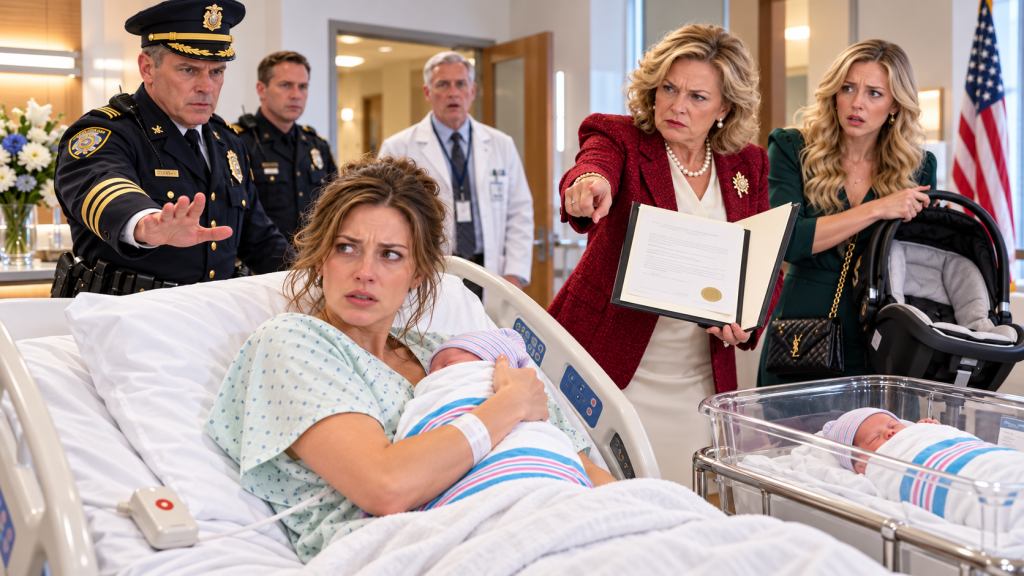
Six hours after delivering my twins by emergency C-section, my mother-in-law walked into my hospital room carrying adoption papers and announced that she was taking my newborn daughter home with her. She believed I was an unemployed freeloader who had trapped her successful son into marriage. What she didn’t know was that I had spent the last eleven years serving as a judge. And when the police chief arrived, recognized me, and examined the documents she had brought, he discovered something that turned an already horrifying family confrontation into a criminal investigation.
My name is Rachel Bennett. I was thirty-eight years old when the happiest day of my life nearly became the worst.
My son, Noah, had been born at 9:14 that morning.
His twin sister, Lily, arrived two minutes later.
Both babies were healthy, although their delivery had been considerably more difficult than anyone expected.
After nearly eighteen hours of labor, Lily’s heart rate had dropped suddenly, and my obstetrician decided an emergency C-section was necessary.
I remembered the bright operating room lights, the anesthesiologist reassuring me, and my husband, Daniel, holding my hand while the doctors worked.
Then I heard Noah cry.
Two minutes later, Lily joined him.
I had never experienced anything like the overwhelming relief that flooded through me when the nurse announced that both babies were breathing normally.
Daniel cried.
Actually, he sobbed so hard that the nurse handed him tissues.
He kissed my forehead and whispered, “You did it, sweetheart. They’re perfect.”
For one beautiful moment, I believed everything difficult was behind us.
I had no idea the real nightmare was waiting outside my hospital room.
By midafternoon, I was resting in a spacious private recovery suite.
The room had been arranged through my physician because my position sometimes attracted unwanted public attention.
A small security arrangement had been made to protect my privacy, particularly after an unpleasant incident involving a defendant’s relative several months earlier.
My family knew none of those details.
My husband knew, of course.
But his mother, Patricia, had spent three years insisting that I was an unemployed woman who enjoyed spending her son’s money.
I had stopped correcting her long ago.
My career was not something I discussed casually.
As a judge, I had presided over criminal proceedings, complex civil disputes, and cases involving vulnerable families.
I had learned that professional boundaries were necessary, especially when relatives believed personal connections entitled them to favors.
When Daniel and I married, we agreed that my work would remain separate from family gatherings.
He worked as a financial consultant and understood my reasons.
Or at least I believed he did.
Patricia interpreted my silence as proof that I had no career.
She once told her friends that Daniel had married a woman who probably couldn’t manage a grocery store cash register.
I heard her.
I simply walked away.
I thought ignoring her insults was the mature response.
But that afternoon, lying in a hospital bed with two newborn babies, I discovered how dangerous her contempt had become.
Daniel had stepped out to collect a few things from home and check on our dog.
He promised to return within an hour.
I was exhausted, heavily medicated, and still unable to move comfortably.
Noah slept against my chest.
Lily rested in the transparent bassinet beside me.
Then the door swung open.
Patricia entered without knocking.
My sister-in-law, Melissa, followed her.
Patricia wore a tailored cream jacket, expensive jewelry, and an expression that suggested she had arrived to inspect something disappointing.
Melissa carried an empty infant carrier.
That should have frightened me immediately.
Instead, I assumed she had brought it as a gift.
Patricia looked around my private suite and pursed her lips.
“So this is where Daniel’s money goes.”
I stared at her.
“Hello to you, too, Patricia.”
She ignored the greeting.
“You don’t deserve a VIP room. Women who actually contribute to their families should receive privileges like this.”
I was too tired to respond.
Melissa walked toward Lily’s bassinet.
She leaned over my daughter, smiling strangely.
“She’s even prettier than the pictures.”
I instinctively shifted Noah closer.
“Please wash your hands before touching either baby.”
Melissa straightened.
Patricia laughed.
“Listen to her. Six hours into motherhood, and she’s already giving orders.”
Then she dropped a thick folder onto my blanket.
“Sign these.”
I looked down.
“What are they?”
“Temporary guardianship documents. Eventually adoption papers.”
For several seconds, I genuinely thought I had misunderstood.
“Adoption?”
Patricia crossed her arms.
“Melissa can’t have children. You have two. Nobody needs two babies at once.”
Melissa nodded.
“I’ve always wanted a daughter. And I’ve already chosen her name.”
My mouth went dry.
“What name?”
“Claire.”
I turned toward Lily.
“My daughter’s name is Lily.”
Melissa gave a small, impatient sigh.
“Names can be changed.”
Something cold moved through my chest.
Patricia pulled a pen from her purse.
“Stop being selfish. Melissa has suffered enough. You should be grateful that someone in this family is willing to help you.”
I looked from the pen to the carrier in Melissa’s hand.
“You brought that here because you expected to leave with my baby?”
“Of course,” Melissa replied.
She said it as casually as if she were collecting a package.
I pressed the regular nurse-call button.
Patricia caught my wrist.
“No nurses. Sign first.”
Her fingers tightened.
Pain shot through my arm.
“Take your hand off me.”
“Or what?”
I looked down at the folder.
The top page carried my full legal name.
My address.
My date of birth.
And beneath a paragraph describing my supposedly voluntary decision to surrender parental responsibility, there was a signature.
It looked remarkably like mine.
But I had never signed it.
I turned another page.
There was a statement claiming that I had experienced a psychiatric emergency during pregnancy.
Another alleged that I was unable to provide a safe home for two newborn children.
A third included a supposed authorization from my husband.
Then I saw a document labeled as an emergency placement order.
A judge’s signature appeared at the bottom.
My heartbeat accelerated.
“Where did you get these?”
Patricia smiled.
“From someone who understands how these things work.”
“Who?”
“That’s none of your business.”
I looked directly at her.
“You forged my signature.”
For the first time, her confidence faltered.
Only briefly.
Then she leaned closer.
“You’re exhausted, Rachel. You won’t remember half of what you signed today.”
I kept my voice steady.
“I remember everything.”
Melissa reached toward Lily.
“Mom, let’s just take her. We can sort this out afterward.”
“Do not touch my daughter.”
My voice was louder than I intended.
Noah startled against my chest.
I slipped my free hand beneath the blanket and pressed the emergency panic button clipped to the side of the bed.
Patricia laughed.
“You’re calling security over a family disagreement?”
I looked her straight in the eye.
“Yes.”
The door opened less than two minutes later.
Two hospital security officers entered, followed by a nurse and three police officers who had already been nearby.
Patricia immediately released my wrist.
Then she transformed.
Her angry expression disappeared, replaced by an expression of wounded concern.
“Thank goodness,” she announced. “My daughter-in-law is having some kind of breakdown.”
I couldn’t believe what I was hearing.
“She’s refusing to let us help with the babies,” Patricia continued. “She’s confused and aggressive. We’re terribly worried about her.”
One officer approached my bed.
“Ma’am, can you tell me what’s happening?”
Before I could answer, Melissa began crying.
“My mother just wanted to help. Rachel has been acting strangely ever since the surgery.”
I looked at the officer.
“That woman physically restrained me. They came here to remove my daughter without permission. The folder contains forged documents.”
Patricia shook her head sadly.
“See? She’s paranoid.”
The officer looked between us.
“Everyone needs to remain calm.”
“I am calm,” I said.
My voice was quiet, but I could feel anger rising beneath it.
Another officer moved toward the folder.
Then a fourth man appeared in the doorway.
Police Chief Raymond Ellis.
I recognized him immediately.
We had worked together professionally for years.
He was at the hospital for a previously scheduled security meeting when the infant-abduction alert reached the hospital’s security department.
He had come upstairs after learning that officers were responding to a dispute involving newborn children.
Chief Ellis stepped into the room.
His gaze traveled across Patricia, Melissa, the empty infant carrier, and the two babies.
Then he saw me.
He stopped.
“Judge Bennett?”
The room fell completely silent.
Patricia gave a sharp laugh.
“Judge? Her? She doesn’t even have a job.”
Chief Ellis ignored her.
“Your Honor, are you all right?”
“No,” I answered. “But my children are safe, and I intend to keep them that way.”
He approached carefully.
“Can you tell me what happened?”
I pointed toward the folder.
“Those women attempted to remove my daughter using documents I did not sign.”
Chief Ellis opened the folder.
His expression changed as he read.
Then he turned another page.
All the color drained from his face.
“Where did this come from?”
Patricia lifted her chin.
“Our family attorney prepared everything.”
Chief Ellis held up a document.
“Whoever prepared this claims it’s an emergency order issued by Judge Leonard Price.”
“Exactly,” Patricia said triumphantly. “So you see, everything is legal.”
Chief Ellis stared at her.
“Judge Price died eighteen months ago.”
Nobody moved.
Melissa stopped crying.
Patricia’s mouth opened, then closed.
I knew Leonard Price.
He had mentored me early in my judicial career.
I had attended his funeral.
And now someone had placed his signature on a document supposedly issued that very morning.
Chief Ellis slowly lowered the page.
“This isn’t a misunderstanding.”
He turned to the officers.
“Secure the documents. Separate these two women and obtain their statements. Nobody is removing either child from this room.”
Patricia’s composure shattered.
“You can’t treat us like criminals!”
Chief Ellis looked at her.
“A deceased judge cannot issue custody orders.”
Then he glanced at the forged signature attributed to me.
“And a mother cannot be declared to have surrendered her newborn because someone brought a folder into her hospital room.”
Patricia pointed at me.
“She’s manipulating you because of her fancy title!”
Chief Ellis didn’t raise his voice.
“Her title has nothing to do with her right to protect her children.”
Those words stayed with me.
Because for the first time that afternoon, someone was speaking to me as a mother rather than as an inconvenience.
A nurse named Caroline came to my side.
“Mrs. Bennett, would you like me to take your son so you can rest?”
I shook my head.
“Not yet.”
She nodded and remained beside me.
Melissa suddenly moved toward the bassinet.
“Wait! You don’t understand. Lily is supposed to come with me.”
One of the security officers stepped between them.
“Ma’am, move away from the baby.”
Melissa’s face twisted.
“But she’s mine!”
“No,” I whispered.
My voice cracked.
“She’s not.”
Patricia reached for her daughter.
“Melissa, stop talking.”
That single sentence told me there was much more to the story.
The officers escorted both women into separate rooms for questioning.
As soon as they left, my strength vanished.
I began shaking so badly that Caroline called my physician.
I had held myself together through the confrontation, but my body had reached its limit.
Noah started crying.
Lily woke and joined him.
Caroline carefully helped settle them.
Then she pulled a chair beside my bed.
“Your babies are safe,” she told me. “And we’re changing the access arrangements immediately.”
I nodded, unable to speak.
Ten minutes later, Daniel called.
I watched his name appear on my phone.
For a moment, I couldn’t answer.
When I finally did, he sounded cheerful.
“Hey, sweetheart. I’m leaving the house now. Do you need anything?”
I closed my eyes.
“Your mother tried to take Lily.”
Silence.
“What?”
“She came with Melissa. They brought an infant carrier and forged adoption papers.”
Another silence.
Then Daniel said something I would remember for the rest of my life.
“Rachel, please don’t overreact. Mom has been emotional about Melissa.”
I stared at the phone.
“Don’t overreact?”
“I just mean there might be an explanation.”
“Your mother grabbed my wrist while your sister tried to take our daughter.”
“Okay. Okay. I’ll be there soon.”
I heard something else in his voice.
Not surprise.
Fear.
And when he added, “Please don’t tell the police anything until I get there,” the feeling grew stronger.
I slowly lowered the phone.
Chief Ellis was still standing nearby.
He had heard enough to understand.
“Judge Bennett?”
I looked up.
“I think my husband knew.”
The chief didn’t respond immediately.
Then he said, “We’ll find out.”
He wasn’t making a promise based on my title.
He was making a promise based on the evidence lying in front of him.
While the hospital secured the room, my mind drifted backward through three years of marriage.
I first met Daniel at a charity fundraiser.
He was charming, patient, and unusually attentive.
He asked questions about my interests without demanding to know my job title.
When I told him I worked in public service, he smiled.
“Then you probably have more interesting stories than I do.”
Our relationship developed slowly.
He learned about my career after several months, once I trusted him.
He seemed proud of me.
He attended my judicial appointment ceremony and once told me that watching me work made him admire my sense of fairness.
When we married, I believed I had chosen a partner who respected my independence.
But Patricia never approved.
She wanted Daniel to marry a woman from what she called “an established family.”
Melissa had been her favorite example.
Melissa was five years younger than Daniel and had always been treated as the delicate center of the household.
Whatever Melissa wanted, someone was expected to provide.
When she wanted a new car, Patricia helped persuade Daniel to contribute.
When she wanted to start a boutique, Daniel invested money.
When the boutique closed after eleven months, Patricia blamed the economy.
Melissa had married a man named Andrew, but their relationship deteriorated after years of infertility treatments.
I felt genuine sympathy for her.
I knew how painful it could be to desperately want a child.
I had experienced two pregnancy losses before conceiving the twins.
Only Daniel and my physician knew how frightening those months had been.
Melissa knew we had struggled, but I never discussed the details.
I understood her grief.
I simply never imagined she would decide that my daughter should become the solution.
During my pregnancy, Patricia made increasingly uncomfortable comments.
At my baby shower, she examined a photograph from the ultrasound.
“Two babies,” she said. “That’s excessive for a first-time mother.”
I laughed awkwardly.
“I didn’t exactly place an order.”
She didn’t smile.
“Melissa would give anything for one.”
I remember reaching for another glass of water.
“She’s been through a lot.”
Patricia studied me.
“Sometimes people receive blessings they don’t deserve.”
I pretended not to hear.
Later, Melissa asked whether I had considered letting relatives raise one of the babies temporarily.
I assumed she was joking.
“Not unless somebody invents an extra twenty-four hours in the day,” I replied.
She didn’t laugh.
Another time, Patricia suggested naming my daughter Claire.
“Melissa has always loved that name.”
I told her we had already chosen Lily.
She appeared offended.
I thought it was another petty attempt to control a decision that didn’t belong to her.
Now I realized those conversations had been something else.
They had been preparation.
Daniel arrived at the hospital forty minutes after his phone call.
I heard him arguing with security outside.
“That’s my wife in there!”
The door opened after his identity was confirmed.
He entered looking pale and disheveled.
His eyes found Noah, then Lily.
He visibly relaxed.
“Thank God.”
I watched him carefully.
“Did you know?”
He looked at me.
“Know what?”
“That your mother intended to take our daughter.”
He rubbed his forehead.
“Rachel, it’s complicated.”
My heart sank.
Those three words frightened me more than any denial could have.
“Then explain.”
He dragged a chair beside the bed.
“Melissa has been in a terrible place emotionally. After her last treatment failed, she started saying life wasn’t worth living.”
I felt a flicker of concern.
“Then she needed professional help.”
“I know.”
“Not someone else’s baby.”
He looked away.
“Mom thought that because we had twins, maybe there was a way to help.”
I stared at him.
“And what did you tell her?”
“I told her it wasn’t that simple.”
“That wasn’t my question.”
He swallowed.
“I told her we could discuss arrangements after the birth.”
For a moment, the room seemed to tilt.
“Arrangements?”
“Just temporary care. If you were overwhelmed.”
“You knew they wanted Lily?”
He said nothing.
I felt something inside me begin to fracture.
“Daniel, look at me.”
He reluctantly lifted his eyes.
“Did you give your mother permission to approach me about surrendering our daughter?”
“No. Not exactly.”
“Did you sign anything?”
His expression answered before he spoke.
I pressed my hand over my incision, struggling to breathe through the sudden pain.
“Daniel.”
He looked down.
“Mom brought me a document last week.”
I couldn’t speak.
“She said it was an emergency family care agreement. Just in case something went wrong during delivery.”
“And you signed it?”
“I thought it was temporary.”
“Did you read it?”
He hesitated.
That was the moment I understood.
My husband had signed a document concerning our children without discussing it with me.
Then he had kissed me goodbye, held my hand through surgery, and celebrated their birth as if everything were normal.
I looked at Lily sleeping peacefully.
“Get out.”
“Rachel, please.”
“Get out of my room.”
He reached toward my hand.
I pulled away.
“You are not touching me.”
“She’s my daughter too.”
My voice dropped.
“Then why did you help someone try to take her?”
He began crying.
I had seen Daniel cry at our wedding.
I had seen him cry when we lost our second pregnancy.
But this time, his tears didn’t move me.
They frightened me.
Because I could no longer tell whether he was crying from remorse or because the plan had failed.
Chief Ellis returned before Daniel could offer another explanation.
He had asked a detective named Angela Morales to lead the investigation.
Because I was a sitting judge, he wanted every decision documented carefully and independently.
I appreciated that.
I didn’t want special treatment.
I wanted the truth.
Detective Morales entered with a small notebook.
“Mrs. Bennett, I’m sorry to question you so soon after surgery.”
“Ask whatever you need.”
She glanced toward Daniel.
“Mr. Bennett, we need to speak with you separately.”
Daniel stiffened.
“Am I being arrested?”
“Not at this moment. But we need your statement.”
He looked at me one last time.
I turned toward the window.
After he left, Caroline brought Lily closer so I could see her.
My daughter stretched one tiny hand above her head.
Her fingers opened and closed.
I had spent months imagining the first days of motherhood.
I pictured quiet feeding sessions, visitors bringing flowers, and Daniel learning how to change diapers.
Instead, I was providing evidence in an attempted infant-removal investigation.
Detective Morales sat down.
“Let’s start with the documents.”
She showed me photographs of the pages.
I identified my genuine signature from a comparison document and explained the differences.
Whoever had forged it had copied the general shape but missed certain details.
The final stroke of my surname was wrong.
The spacing was unnatural.
And one document claimed I had signed at 7:10 that morning.
At 7:10, I had been under medical observation, preparing for surgery.
Hospital records could establish exactly where I was.
Another page said I had attended a voluntary guardianship consultation three days earlier.
That was impossible.
I had been admitted to the hospital for monitoring on that date.
Detective Morales listened without interruption.
Then she showed me something I hadn’t noticed.
Attached to the false psychiatric statement was a short narrative supposedly supplied by Daniel.
It claimed I had become emotionally unstable during pregnancy.
It alleged that I sometimes behaved irrationally when challenged.
And it stated that our family had agreed Melissa would be better suited to raise one child.
I read it twice.
“Did Daniel write this?” I asked.
“We’re investigating.”
I looked at the bottom.
There was his signature.
Unlike mine, it appeared genuine.
A strange calm settled over me.
I had spent years evaluating evidence.
I knew the difference between suspicion and proof.
But reading those words felt like discovering that the man beside whom I slept had been quietly building a case against me.
“Please preserve everything,” I said.
“We will.”
“And ask the hospital to preserve security footage.”
“Already requested.”
I looked toward the bassinet.
“Also, nobody enters this room without my explicit permission.”
Detective Morales nodded.
“That arrangement is being put in place.”
Then she paused.
“There’s something else.”
I looked back.
“Your mother-in-law says she hired a private adoption consultant.”
“What consultant?”
“A woman named Celia Ward.”
The name meant nothing to me.
“She’s claiming Ward assured her these documents were sufficient.”
I stared at the detective.
“Has anyone verified that?”
“Not yet.”
That answer was honest.
I appreciated it more than empty reassurance.
Over the next several hours, the investigation began revealing just how deliberate the plan had been.
The hospital’s security cameras showed Patricia and Melissa arriving together shortly before three o’clock.
Melissa carried the infant carrier.
Patricia held the folder.
They did not stop to purchase flowers.
They did not visit the gift shop.
They went directly to the maternity floor.
At the nurses’ station, Patricia apparently claimed that Daniel had approved a change in Lily’s care arrangements.
A nurse refused to provide information and directed them to speak with the baby’s parents.
They waited until the nurse became occupied with another patient.
Then they entered my room.
The footage captured their arrival and departure, but there was another recording Patricia hadn’t considered.
When the alarm was activated, the security system preserved audio from the room’s emergency communication device.
The recording was limited, but it captured several critical statements.
Melissa saying she had already chosen Lily’s new name.
Patricia demanding I sign.
My repeated refusal.
And Melissa suggesting they simply take the baby and resolve the paperwork afterward.
When Detective Morales described the recording, I closed my eyes.
Part of me was relieved.
Another part felt sick.
The truth was no longer something I needed to persuade people to believe.
It existed independently of me.
At approximately seven that evening, a hospital administrator came to explain an additional privacy problem.
Someone had accessed my medical records without authorization.
A patient-services employee named Joan Kessler had viewed my chart earlier that day.
She had no legitimate reason to do so.
She was also a longtime acquaintance of Patricia.
According to the access records, she had opened information about my delivery, room assignment, and discharge planning.
The hospital immediately suspended her access pending investigation.
That explained how Patricia knew exactly where to find me.
It also raised a terrifying question.
How much of my medical information had she obtained?
I thought about the false psychological assessment.
The medication listed on the forms.
The precise time of delivery.
Someone had used private information to make a fabricated story appear believable.
I had spent my professional life protecting people’s rights.
Now my own privacy had been violated while I was physically unable to defend myself.
That evening, a hospital social worker named Elena visited me.
She was gentle, direct, and careful not to make assumptions.
“I want to make sure you understand something,” she said. “These papers do not give anyone permission to remove your children.”
I nodded.
“I know.”
She hesitated.
“Sometimes families use pressure after childbirth. They tell mothers they’ve already agreed to things or that they have no choice.”
I thought of Patricia’s voice.
You’re exhausted. You won’t remember signing.
Elena continued.
“Being tired, recovering from surgery, or needing help with twins doesn’t make someone unfit to parent.”
That sentence broke something loose inside me.
Until then, I had been trying so hard to remain composed that I hadn’t allowed myself to feel what had happened.
I started crying.
Not the controlled tears I occasionally shed during sad films.
I cried so hard that my incision hurt.
Elena stayed.
She didn’t tell me to be strong.
She didn’t suggest forgiveness.
She simply handed me tissues and waited.
When I could finally speak, I whispered, “I almost let her convince me that needing help meant I was failing.”
Elena shook her head.
“You had major surgery this morning. You need care, not judgment.”
I looked at Noah and Lily.
They were sleeping side by side in their bassinets.
I had never loved anyone so completely.
And I had never felt so vulnerable.
At nine that night, my phone rang again.
It was Walter, my father-in-law.
Walter had always been quiet around Patricia.
He rarely challenged her publicly.
For years, I mistook that silence for agreement.
His voice trembled.
“Rachel, I heard what happened.”
“Then you know Patricia is being questioned.”
“Yes.”
He paused.
“I need to tell you something.”
I waited.
“Last Sunday, I heard Patricia talking with Melissa about taking Lily home.”
My stomach tightened.
“What exactly did you hear?”
“Patricia said that once the papers were signed, you wouldn’t be able to change your mind.”
I gripped the blanket.
“And what did you say?”
“I told her it was wrong.”
“Did you tell Daniel?”
Another silence.
“Yes.”
The room seemed to grow colder.
“When?”
“Monday morning.”
I closed my eyes.
Four days before the delivery.
Daniel had known for four days.
Walter continued.
“Daniel told me he would handle it. He said not to upset you while you were pregnant.”
I couldn’t answer.
“I’m sorry, Rachel.”
“Why didn’t you tell me yourself?”
His voice cracked.
“Because I have spent thirty-six years avoiding arguments with my wife. And I convinced myself Daniel would stop her.”
For the first time, I heard him take responsibility without making excuses.
“I was wrong.”
I looked at my children.
“Yes, Walter. You were.”
He didn’t argue.
Then he said something unexpected.
“I have messages.”
I sat straighter.
“What messages?”
“Patricia uses my tablet sometimes. Her conversations with Melissa were synchronized to it. I saw them after the police called.”
My pulse quickened.
“Don’t delete anything.”
“I won’t.”
“Give them to Detective Morales.”
“I already called the police station.”
I closed my eyes again.
A small part of me wanted to thank him.
A larger part wished he had found his courage before my daughter was placed in danger.
The next morning, Daniel requested permission to visit.
I refused.
He sent flowers.
I asked the nurses to remove them.
Then he sent a message.
Rachel, I never wanted to lose Lily. I thought Mom was arranging temporary help. Please believe me.
I stared at those words for a long time.
Then I typed a reply.
If you wanted to keep Lily safe, you should have told me what was happening.
I didn’t send anything else.
By then, both twins had passed their newborn examinations.
Noah had a surprisingly strong appetite.
Lily made tiny squeaking noises whenever someone adjusted her blanket.
Caroline joked that my daughter already had opinions.
I smiled for the first time since the confrontation.
But sleep was difficult.
Every time I closed my eyes, I imagined Melissa lifting Lily from her bassinet.
I imagined Patricia walking through the hospital corridor with my baby.
I imagined waking up and discovering that my daughter was gone.
I knew those images were fears, not memories.
But knowing that didn’t make them disappear.
The hospital arranged additional support and helped me begin recovering from both the surgery and the emotional shock.
I accepted it.
That was another lesson I hadn’t expected motherhood to teach me so quickly.
Strength didn’t mean pretending I needed nothing.
It meant recognizing when help was necessary.
Two days later, Detective Morales returned with developments.
Celia Ward, the supposed adoption consultant, had been located.
She operated an unlicensed family-placement business under several different names.
Her website promised discreet solutions for complicated custody situations.
She had previously worked as a legal assistant but was not an attorney.
Investigators found that Patricia had paid her eighteen thousand dollars.
The payment came from an account connected to Daniel.
I stared at the detective.
“Daniel paid her?”
“That’s what the records initially indicate.”
I felt my hands go numb.
Eighteen thousand dollars.
My husband had spent eighteen thousand dollars arranging something that involved our daughter.
Without mentioning it to me.
Detective Morales continued.
“Mr. Bennett claims his mother told him the money was for legitimate legal advice and support for his sister.”
“Did he know the paperwork included adoption?”
“He acknowledges knowing adoption was being discussed.”
I looked away.
There it was.
Not a misunderstanding.
Not an innocent family conversation.
My husband had known his mother was discussing the adoption of our newborn daughter.
And instead of telling me, he had helped finance the process.
The detective placed another photograph in front of me.
It showed a printed message exchange between Patricia and Celia.
Patricia had written:
The mother will resist. She’s stubborn and likes controlling everything. Her husband is supportive, but we need the paperwork finished before she leaves the hospital.
Celia replied:
We can prepare the forms. Make sure the family is unified.
Patricia answered:
Don’t worry. She doesn’t understand legal matters.
I almost laughed.
It was such a grotesque irony.
Patricia had spent years mocking my intelligence, yet she had trusted someone who apparently believed a dead judge’s signature could make a fake custody order legitimate.
Then Detective Morales showed me another message.
This one was from Melissa.
I want the girl. Not the boy. Mom says Rachel will be too exhausted after surgery to argue.
I read that sentence repeatedly.
Not the boy.
As though Noah and Lily were items on a shelf.
As though one could be selected and the other discarded.
The detective studied my face.
“Would you like to stop?”
“No.”
My voice surprised even me.
“I want to know everything.”
The investigation uncovered that Melissa had prepared a nursery in her home.
There was a white crib.
A pink rocking chair.
A changing table.
A wardrobe filled with newborn dresses.
Above the crib, decorative wooden letters spelled CLAIRE.
Photographs recovered from her phone showed the room had been completed nearly three weeks before my delivery.
Three weeks.
While I was attending prenatal appointments, worrying about complications, and folding tiny clothes, my sister-in-law was preparing a bedroom for the daughter she intended to take from me.
She had even arranged for a photographer to visit the following weekend.
In one message, she told a friend she would soon be bringing home a baby girl.
When the friend asked about adoption, Melissa replied that everything was being handled privately.
The more I learned, the less I recognized the people I had married into.
I remembered Melissa bringing me soup during my second trimester.
I remembered Patricia touching my stomach at a family dinner and asking whether Lily moved more than Noah.
I remembered Daniel smiling when Melissa offered to organize a baby shower.
Had those gestures been genuine affection?
Or had they been part of their plan?
I hated that I couldn’t tell anymore.
On the fourth day, my obstetrician approved my discharge.
I was still sore and moving slowly.
I couldn’t drive.
I couldn’t comfortably lift anything heavier than my babies.
And I faced the prospect of returning home without trusting my husband.
My closest friend, Natalie, came to collect us.
Natalie was an attorney too, though she practiced in an entirely different field.
She had known me since law school.
She arrived carrying two car seats, a diaper bag, and an expression that suggested she was prepared to argue with anyone who crossed our path.
“You’re coming home with me,” she announced.
I shook my head.
“I want to go to my own house.”
“Then I’ll stay with you.”
“Natalie, you have work.”
“And you have two newborns and a husband who apparently forgot what marriage means.”
For the first time in days, I laughed.
It hurt my incision.
But I laughed.
Natalie helped me arrange for my sister, Rebecca, to travel from Denver.
Rebecca was a pediatric nurse and the most practical person I knew.
She arrived the next afternoon, examined my refrigerator, made a shopping list, and informed me that I would not be proving my independence by skipping meals.
Within hours, the house felt different.
There were clean bottles on the counter.
Extra diapers stacked beside the changing table.
Warm food waiting in the kitchen.
And someone who came when I called, not because I was incapable, but because they loved me.
Daniel had moved into a hotel at my request.
Through an attorney of my own, I arranged temporary boundaries regarding contact while the investigation proceeded.
I was painfully aware that Daniel was also the twins’ father.
His parental rights were not something I could erase because I was angry.
But his role in the attempted transfer had to be examined before unsupervised access could feel safe.
I made certain any legal decisions involving our family would be handled by independent professionals and courts.
I would not use my judicial position to influence the process.
I had spent too many years insisting that the law must apply equally to everyone.
That principle mattered even when I was the person who had been hurt.
A week after the twins were born, Detective Morales called with another revelation.
Patricia had apparently believed Celia Ward could arrange for a false psychological evaluation that would make my refusal irrelevant.
Investigators had found drafts of a statement claiming I was experiencing severe postpartum confusion.
Some portions had been written before I even delivered the babies.
I sat motionless, listening.
“Before they were born?”
“Yes.”
“How could anyone describe postpartum symptoms before the delivery?”
“That contradiction is part of the evidence.”
I looked at the date on my calendar.
Only seven days had passed since the birth.
Seven days since Patricia entered my room.
But the scheme had been taking shape for weeks.
Maybe months.
I began to understand that the most frightening element wasn’t Patricia’s cruelty.
It was the way she had surrounded that cruelty with official-looking paperwork.
She had tried to turn her personal wishes into something that appeared inevitable.
She had assumed I would be frightened, exhausted, and intimidated enough to surrender.
Perhaps she had also assumed that her son would protect her from consequences.
For years, he had.
That was about to change.
At the end of the second week, Daniel asked to speak with me.
My attorney advised that I could decline.
But I wanted answers that no police interview could fully provide.
We arranged a conversation in my living room with Natalie present.
Daniel looked terrible when he arrived.
He had lost weight.
His clothes hung loosely.
Dark circles surrounded his eyes.
When he saw the two bassinets beside the couch, his expression crumpled.
“Can I see them?”
I nodded.
“From there.”
He approached slowly.
Noah was awake, making tiny movements with his mouth.
Lily slept with one hand resting near her cheek.
Daniel covered his face.
“I’m so sorry.”
I waited.
He sat opposite me.
“Mom told me Melissa was having another breakdown after her fertility treatment failed.”
“I know.”
“She said Melissa needed hope.”
“Hope doesn’t require stealing my child.”
He nodded.
“I understand that now.”
I looked at him steadily.
“Did you understand it when you signed those papers?”
He swallowed.
“Mom said they were just preliminary.”
“Did you read them?”
“Not carefully enough.”
“Daniel, you work in finance. You review contracts for a living.”
His eyes filled.
“I know.”
“Then explain why you suddenly stopped reading when the document concerned your daughter.”
He opened his mouth.
Nothing came out.
I waited.
Finally, he whispered, “Because I didn’t want to argue with my mother.”
That admission hurt more than the excuses.
He continued.
“Every time I told her no, she said I was abandoning Melissa. She reminded me how much my sister had suffered. She said we could give Melissa something no amount of money could buy.”
“And you believed her?”
“I wanted everyone to be happy.”
I stared at him.
“You wanted everyone to be happy, so you were willing to make one of our children disappear from our home?”
“No!”
His voice rose.
Natalie shifted slightly.
Daniel lowered his head.
“I never thought it would go that far.”
I shook my head.
“You signed a document. You paid for a consultant. You knew your mother was preparing adoption papers.”
“I thought you would refuse.”
“Then why didn’t you tell me?”
He began crying again.
And eventually, he said the words I had feared.
“Because I knew you would stop it.”
Silence filled the room.
He looked horrified by his own confession.
I felt tears burn behind my eyes.
But my voice remained steady.
“That is the answer, Daniel.”
He shook his head.
“No, Rachel, please. I didn’t mean—”
“You didn’t tell me because you knew I would protect our daughter.”
He reached toward me.
I moved back.
“You made a decision about my child behind my back because you wanted to avoid disappointing your mother.”
“Our child,” he whispered.
I nodded.
“Yes. Our child. Which is why your betrayal is worse.”
He bowed his head.
For several minutes, nobody spoke.
Then Daniel looked up.
“What happens to us?”
I glanced toward the bassinets.
“I don’t know what happens to your relationship with the children. That will depend on your actions and what the appropriate court determines.”
His face tightened.
“And our marriage?”
I took a slow breath.
“I know enough to say I cannot continue it as it was.”
He began pleading.
He promised counseling.
He promised never to allow Patricia near our children.
He promised to tell investigators everything.
But there was something painfully familiar about those promises.
For years, he had asked me to overlook his mother’s insults.
He had asked me to be patient.
To be understanding.
To keep the peace.
And every time I did, Patricia grew bolder.
I finally understood that peace purchased through silence was not peace.
It was permission.
“Daniel,” I said softly, “I needed a husband who would stand beside me when someone threatened our children.”
“I know.”
“You stood beside the threat instead.”
He closed his eyes.
That ended the conversation.
A month later, the investigation led to formal criminal charges against Patricia and Celia Ward.
The exact charges reflected the evidence prosecutors believed they could prove, including document forgery, conspiracy, and offenses related to the attempted unlawful removal of my daughter.
Melissa was also charged in connection with her participation.
The case was assigned to an independent prosecutor outside the ordinary channels in which I worked.
I had no involvement in the decisions.
I was a complainant and witness.
Nothing more.
Daniel was investigated separately.
His signatures, financial transfers, and messages were examined.
He cooperated, but cooperation didn’t erase what he had done.
At the same time, our family-law attorneys worked through temporary parenting arrangements, financial disclosures, and the beginning of a separation.
I wasn’t interested in making dramatic public statements.
I wanted stability.
I wanted my children to grow up without becoming symbols in a war between adults.
Most of all, I wanted to sleep without wondering whether someone was planning to take them.
The criminal proceedings attracted local attention.
Reporters discovered that the alleged victim was a sitting judge.
Several outlets attempted to contact me.
I declined every interview.
Patricia, however, had no such restraint.
Before her attorney persuaded her to stop talking, she told an acquaintance that I had used my position to destroy an innocent family.
She insisted she was merely trying to help her daughter become a mother.
Then she claimed I had promised Lily to Melissa and changed my mind after the birth.
That final accusation nearly broke me.
I had carried Lily for months.
I had felt her turn and stretch beneath my ribs.
I had whispered her name while folding tiny blankets.
And now Patricia was telling people I had treated my daughter like something I could casually give away.
I wanted to respond publicly.
I wanted to show everyone the messages.
I wanted the world to know what she had done.
But my attorney reminded me that public arguments could complicate the case.
So I stayed quiet.
And I let the evidence speak.
During that period, Walter visited several times.
He never arrived without asking permission.
He brought groceries, fresh flowers, and once, a tiny stuffed elephant for Noah.
At first, I was uncomfortable around him.
He had known too much and said too little.
But he never asked me to forgive Patricia.
He never suggested the situation was a misunderstanding.
One afternoon, while Rebecca fed Lily in the kitchen, Walter sat across from me.
“I’ve spent most of my marriage telling myself Patricia doesn’t mean the cruel things she says,” he admitted.
I waited.
“When she hurt someone, I said she was emotional. When she controlled Daniel, I said she was worried about him. When she humiliated Melissa’s husband, I said she was protective.”
He stared at his hands.
“I taught my children that the easiest way to survive their mother was to give her whatever she wanted.”
I thought about Daniel’s confession.
Because I didn’t want to argue with my mother.
Walter shook his head.
“I didn’t know how much damage that was doing until she tried to take your baby.”
His eyes filled with tears.
“I should have called you when I heard the plan.”
“Yes,” I said.
“I know.”
He nodded.
Then he looked at Noah sleeping nearby.
“I can’t change what I failed to do. But I can stop protecting her from the consequences.”
For the first time, I believed Walter might actually change.
He later provided a full statement and preserved the messages from his tablet.
He moved into a separate apartment while deciding what to do about his own marriage.
I didn’t tell him what choice to make.
That was his responsibility.
But I was grateful that someone in Daniel’s family had finally chosen honesty over appearances.
Meanwhile, Melissa’s situation became increasingly complicated.
Her attorney initially claimed that she had been manipulated by Patricia.
There was some truth to that.
Patricia had always encouraged Melissa to believe that her suffering entitled her to extraordinary accommodations.
But Melissa was thirty-four years old.
She had decorated a nursery.
She had chosen a name.
She had packed an infant carrier.
She had entered my hospital room knowing I had not agreed to surrender Lily.
And she had moved toward the bassinet after I explicitly refused.
Those were her decisions.
Several months later, Melissa agreed to cooperate with investigators and acknowledge her role.
Through her attorney, she sent me a letter.
I didn’t open it immediately.
It sat on my desk for nearly a week.
Eventually, after the twins were asleep, I read it.
Melissa wrote about the years of unsuccessful fertility treatments.
She described the humiliation she felt whenever friends announced pregnancies.
She admitted that she had become obsessed with the belief that motherhood was the only way her life could have meaning.
She also admitted that Patricia had reinforced that belief.
Then came the sentence that mattered.
I convinced myself that because you had two babies and I had none, taking one would somehow make things fair.
I read it again.
At least she finally understood the terrible reasoning behind her actions.
But the next paragraph was more difficult.
I knew you didn’t agree. I knew Lily was your daughter. I just wanted her so badly that I stopped caring what you wanted.
I sat in the quiet room, listening to the soft breathing of my children through the monitor.
For the first time, I felt something besides anger toward Melissa.
I felt sadness.
Not because she had been denied my daughter.
But because her grief had become so distorted that she couldn’t recognize another woman’s humanity.
I didn’t answer the letter.
Not then.
I wasn’t ready.
Over the following months, my life settled into a routine that was both exhausting and unexpectedly beautiful.
Noah developed a habit of waking just as I finished feeding Lily.
Lily learned to smile first.
Noah followed several days later.
Rebecca returned to Denver after helping us establish a schedule, but Natalie remained my emergency contact and unofficial supplier of coffee.
I hired a qualified nanny for daytime support when I resumed limited professional duties.
I also began counseling.
Not because Patricia had been correct about my mental health.
But because what happened had frightened me, and I deserved a place to process it without pretending otherwise.
There were difficult nights.
Sometimes I woke convinced I had heard the hospital alarm.
Sometimes I checked Lily’s crib three times before returning to bed.
Other nights, I found myself staring at Daniel’s old coffee mug in the kitchen, wondering how a marriage could unravel so completely in a single afternoon.
Of course, it hadn’t unraveled in one afternoon.
That was simply when I finally saw the damage.
The cracks had been forming for years.
Every excuse Daniel made for Patricia.
Every insult he asked me to ignore.
Every time I swallowed my discomfort so dinner wouldn’t be ruined.
Every time he chose convenience over honesty.
The hospital confrontation exposed what had already been weakening our marriage.
And no amount of regret could change that.
When the twins were four months old, our separation progressed toward divorce.
Daniel had begun individual counseling.
He had also accepted that any parenting arrangements needed to follow the independent family court’s orders rather than his family’s wishes.
He was permitted structured contact under temporary conditions, with safeguards while the concerns surrounding his conduct were assessed.
Over time, he became more consistent.
He arrived when scheduled.
He learned the babies’ feeding routines.
He stopped making excuses for Patricia.
I appreciated those changes.
But appreciation was not the same as reconciliation.
One afternoon, while he was visiting the twins under the agreed arrangements, he looked at me and said, “I finally understand why you don’t trust me.”
I remained silent.
He continued.
“I thought being a good husband meant keeping my family from fighting.”
I looked at him.
“And now?”
“Now I think it meant protecting the people who trusted me.”
I nodded.
“That would have been a good place to start.”
He accepted the words without arguing.
It wasn’t a triumphant moment.
There was no shouting.
No dramatic speech.
Just two people acknowledging that something precious had been damaged.
The criminal case eventually reached a resolution.
Celia Ward faced serious consequences for preparing and facilitating false documents.
Investigators had also examined her work with other clients after discovering irregularities in her records.
The forged order bearing Judge Price’s signature became particularly important evidence.
Patricia could no longer claim she had simply misunderstood a legitimate legal process.
She had seen warnings.
She had received explanations.
And when she encountered resistance, she had deliberately tried to overcome it through deception.
Melissa’s cooperation and acknowledgment of wrongdoing were considered in her case.
Her outcome involved court-imposed conditions, ongoing treatment, and restrictions on contacting our family.
Patricia remained far less willing to accept responsibility.
At one proceeding, she claimed I had humiliated her by refusing to share my professional identity.
She said that if she had known I was a judge, she never would have approached me the way she did.
I heard about that statement afterward.
And it disturbed me more than almost anything else she said.
Because it revealed that she still hadn’t understood.
She wasn’t sorry for trying to take a child from her mother.
She was sorry she had chosen a mother with enough knowledge and support to resist her.
I thought about women who didn’t have those advantages.
Women who had no legal training.
Women without money for attorneys.
Women whose families pressured them while they were frightened and exhausted after childbirth.
What would Patricia have done to someone she believed had no power at all?
That question stayed with me.
It eventually shaped something positive that came out of the ordeal.
After discussing appropriate boundaries with legal and ethics advisers, I began privately supporting an independent nonprofit that helped new parents understand their rights and obtain legal assistance when facing coercion.
I did not use my judicial office to direct its cases.
I did not ask anyone for special favors.
I simply contributed resources and encouraged others to support the organization.
I wanted more mothers to know that being exhausted did not mean surrendering control over their children.
And I wanted more families to understand that adoption must be built on informed, lawful consent, not intimidation.
On the twins’ first birthday, I hosted a small party in our backyard.
Nothing extravagant.
Just a few close friends, Rebecca and her family, Natalie, Walter, and the people who had helped us through the hardest year of my life.
There were yellow balloons.
A homemade cake.
Two tiny birthday crowns that neither child wanted to wear.
Noah spent most of the afternoon trying to pull the tablecloth.
Lily discovered that frosting could be smeared across both hands and cheeks.
Everyone laughed.
I took more photographs than I could reasonably organize.
For the first time in a year, I felt completely present.
Not waiting for another phone call.
Not reviewing another document.
Not wondering what Patricia might do next.
Just watching my children enjoy their birthday.
Walter approached while I was wiping frosting from Lily’s chin.
“She’s getting so big,” he said.
I smiled.
“Too fast.”
He watched her for a moment.
Then he said, “Patricia sent something.”
My smile faded.
He immediately raised a hand.
“I haven’t brought it. I wouldn’t do that without asking.”
I looked at him.
“What is it?”
“A letter.”
I was quiet.
“She says she wants to explain.”
I looked down at Lily.
My daughter was busy trying to grab a balloon ribbon.
I gently moved it out of her reach.
“Does she want to apologize?”
Walter hesitated.
“She says she does.”
“Does she acknowledge what she tried to do?”
He looked away.
“Not really.”
I nodded.
“Then I’m not interested.”
Walter accepted my answer.
He didn’t pressure me.
He didn’t tell me she was getting older or that family was important.
He simply said, “I understand.”
And that was enough.
Later that afternoon, Daniel arrived for his scheduled birthday visit.
His presence was carefully arranged, and everyone knew the boundaries.
He brought two small books.
One had pictures of animals.
The other was about a little bear learning to walk.
Noah immediately tried to chew the corner of the bear book.
Daniel laughed.
Lily crawled toward him and offered him a toy.
I watched from across the patio.
There was a time when seeing the three of them together would have broken my heart.
Now I could acknowledge the complexity without allowing it to consume me.
Daniel was their father.
His actions had hurt us.
His relationship with them would depend on continued responsibility and safety.
And I no longer needed to pretend our marriage could be restored simply because I wished the past had been different.
After everyone left, Natalie helped me carry the presents inside.
The twins were sleepy and sticky.
My kitchen looked as though a small bakery had exploded.
I sat at the table, exhausted.
Natalie poured two cups of tea.
“You survived a year,” she said.
I smiled.
“We survived.”
She glanced toward the baby monitor.
“They’re lucky to have you.”
I shook my head.
“I’m lucky to have them.”
Natalie studied me.
“Do you ever think about how differently things could have gone?”
I looked toward the hallway.
“Every day.”
She waited.
I thought about the hospital room.
The empty infant carrier.
The papers on my blanket.
Patricia’s fingers wrapped around my wrist.
The terrible moment when Melissa announced that she had already renamed my daughter.
Then I remembered Chief Ellis standing in the doorway.
Judge Bennett?
For months, people had focused on that part of the story.
They asked whether Patricia had been shocked to discover my profession.
They wanted to know whether she regretted insulting a judge.
They seemed fascinated by the idea that the woman she had dismissed as useless actually held a respected position.
But that wasn’t the most important part.
Because what if I hadn’t been a judge?
What if I had truly been unemployed?
What if Daniel had paid every bill?
What if I had never attended law school or walked into a courtroom?
Would Patricia have been entitled to take Lily then?
Of course not.
My daughter didn’t belong to me because of my job.
She didn’t belong to me because I understood legal procedures.
She didn’t belong to me because a police chief recognized my face.
She was my child.
And that should have been enough.
I looked at Natalie.
“The thing that scares me most isn’t what Patricia thought about my career.”
“What is it?”
“She thought there were circumstances under which I didn’t deserve to keep my own baby.”
Natalie’s expression softened.
I continued.
“She believed that because I needed help, because I was recovering from surgery, because Melissa was unhappy, she could simply decide my daughter belonged somewhere else.”
Natalie nodded slowly.
“She was wrong.”
“Yes.”
I watched the baby monitor.
Noah had fallen asleep.
Lily was still moving one small foot beneath her blanket.
“And I think that’s what I want them to know one day,” I said. “That nobody gets to decide their worth based on what someone else wants from them.”
Natalie smiled.
“They’ll know.”
That night, after the kitchen was clean and the house was quiet, I went upstairs.
I checked Noah first.
He was sleeping with his mouth slightly open.
Then I leaned over Lily’s crib.
She stirred.
Her eyes opened briefly.
I placed one finger against her tiny palm.
She wrapped her hand around it.
For a moment, I remembered the first time she held my finger in the hospital.
I had been lying beneath bright lights, frightened and exhausted, while a nurse brought her close to my cheek.
She was so small.
So warm.
So completely unaware of the world she had entered.
I had whispered, “Hello, Lily. I’ve been waiting for you.”
Now, one year later, she looked up at me and smiled sleepily.
I leaned down and kissed her forehead.
“Nobody gets to choose who you belong to,” I whispered. “You belong to yourself, sweetheart. And I’ll always be your mother.”
She closed her eyes again.
I stood there for another minute, listening to the soft rhythm of her breathing.
Then I turned off the nursery light.
For so long, I had believed strength meant enduring disrespect without responding.
I thought silence was dignity.
I thought keeping peace was kindness.
And I thought loving someone meant giving them endless chances to become better.
But motherhood had taught me something different.
Sometimes love means saying no.
Sometimes protecting your family means confronting the people who claim to love it.
And sometimes the strongest thing you can do is refuse to surrender what matters, even when everyone around you insists that you should.
Patricia entered that hospital room believing I was powerless.
She thought she could intimidate an exhausted mother, forge a few documents, and walk away with a newborn baby.
She didn’t know I was a judge.
But in the end, that was never the reason she failed.
She failed because she underestimated a mother’s willingness to protect her children.
And because, for the first time in that family, someone refused to sacrifice an innocent person just to keep Patricia happy.
My children are growing up in a quieter home now.
Not a perfect one.
There are sleepless nights, scattered toys, and moments when I wonder whether I’m doing anything correctly.
But there is laughter.
There is safety.
There is honesty.
And nobody has to earn their place in our family by making someone else feel important.
I sometimes think about the pen Patricia placed beside those adoption documents.
She expected me to pick it up and sign away my daughter.
Instead, I pressed an emergency button.
That single choice changed everything.
It exposed a fraud, ended a marriage, forced a family to confront its darkest habits, and taught me that boundaries are not acts of cruelty.
They are acts of protection.
And whenever I hear Noah laughing in the next room or feel Lily’s small arms reaching for me, I know I made the right choice.
Because the most important title I will ever hold isn’t the one printed outside my courtroom.
It’s the one two little voices are beginning to say whenever they see me.
Mommy.
And that is a title nobody will ever take away from me.
💬THE END! THANK YOU FOR READING!