

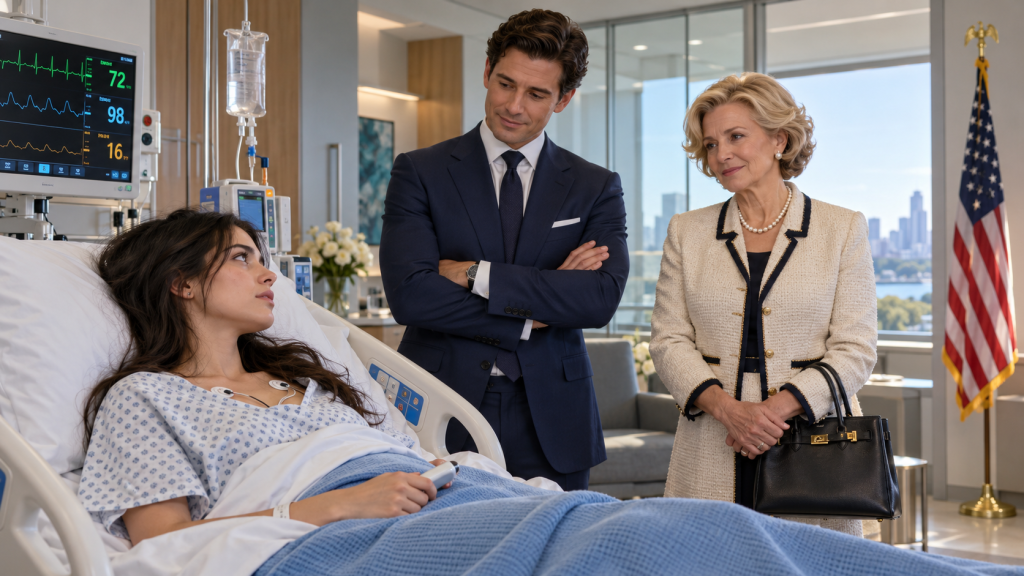
The doctor told me I had only three days left to live. My mother-in-law smiled and whispered, “Perfect. Then this house will finally be mine.” My husband laughed beside her. “And I’ll finally marry Jennifer.” They thought I was too weak to fight back. But after they left my hospital room, I picked up my phone and called the one person Daniel believed was dead. “Dad,” I whispered, “it’s time.” His answer made my blood run cold. “I’ve been waiting for your call.”
My name is Eleanor Bennett Mercer. I am forty-two years old, and until that Thursday afternoon, I believed the worst thing my husband could do was stop loving me.
I was wrong.
There are betrayals that break your heart, and there are betrayals that make you question whether the person sleeping beside you ever intended to let you live.
Mine began in a private hospital room overlooking the city of Boston.
The windows were enormous. Afternoon sunlight spilled across the polished floor, and a vase of white lilies stood beside my bed.
Daniel had brought those flowers that morning.
I remembered thinking how thoughtful it was.
Now, whenever I remember their scent, I think about how close I came to dying while the people responsible waited impatiently for my funeral.
Dr. Harris stood near the foot of my bed, holding a tablet. His expression was grave.
“Eleanor, your heart is under extraordinary strain,” he explained. “Your recent episodes have become increasingly dangerous. Based on the information available, I’m concerned you may have only seventy-two hours before a catastrophic event.”
The room seemed to tilt.
“Three days?” I whispered.
He nodded slowly.
“We’re continuing treatment, but I need you to understand the seriousness of your condition.”
I looked at Daniel.
We had been married for seven years.
For seven years, I had cooked his favorite meals, celebrated his promotions, listened to his worries, and believed the promises he made whenever he kissed my forehead before leaving for work.
I expected him to cry.
I expected him to hold me.
At the very least, I expected him to look frightened.
Instead, he checked his watch.
His mother, Margaret, stood beside the window wearing a cream designer suit and a pearl necklace I had purchased for her sixtieth birthday.
When Dr. Harris stepped outside to speak with a nurse, Margaret approached my bed.
“Only three days?” she asked.
I nodded.
Her lips curved into a smile.
“Perfect. Then this house will finally be mine.”
For a moment, I thought I had misunderstood.
“What?”
“The house, Eleanor. Your mother’s house. You know how much I’ve always admired it.”
I stared at her.
My mother had left me a beautiful six-bedroom home in Beacon Hill.
It was old, elegant, and filled with memories that mattered more to me than anything money could buy.
Margaret had spent years commenting on its marble fireplaces, its garden courtyard, and its estimated market value.
I had mistaken her obsession for admiration.
Daniel moved closer.
“Mother has a point,” he said.
I looked at him helplessly.
“Daniel, the doctor just told me I’m dying.”
“And we’re discussing practical matters,” he replied. “There’s no reason to make this emotional.”
Margaret nodded approvingly.
“You should sign the property transfer tomorrow. That will save everyone unnecessary complications.”
“Transfer?”
“To me, obviously.”
I tried to sit up, but pain tightened across my chest.
Daniel watched without moving.
“You have no children,” he said. “Someone should benefit from that house when you’re gone.”
“Someone?”
“Mother.”
Margaret smiled as though we were discussing a birthday present.
“And Jennifer deserves a proper home after the wedding.”
The name struck me harder than the doctor’s diagnosis.
Jennifer Hale.
Daniel’s twenty-nine-year-old secretary.
The woman who regularly called him after midnight because supposedly important clients needed immediate attention.
The woman whose perfume I had smelled on his jacket.
The woman he told me I was imagining things about.
“What wedding?” I asked.
Daniel exchanged a glance with his mother.
Then he laughed.
“Oh, Eleanor. Don’t look so surprised.”
My fingers tightened around the hospital blanket.
“Daniel?”
He sighed impatiently.
“Jennifer and I have been together for almost two years. We were going to wait until everything was settled, but now there isn’t much point pretending.”
I could barely breathe.
“You’re planning to marry her?”
“Yes.”
“After I die?”
“Obviously.”
“And you’re telling me this now?”
He shrugged.
“It’s not as though you can do anything about it.”
Margaret leaned toward me.
“Be reasonable, dear. Daniel deserves happiness. You’ve been sick for months.”
I looked at the man I had loved.
“Did you ever love me?”
He smiled without warmth.
“Love doesn’t pay mortgages.”
Then he kissed his mother on the cheek, picked up his phone, and walked toward the door.
Margaret followed.
“Have the documents ready tomorrow,” she called over her shoulder. “I don’t want any unpleasantness during your final days.”
The door closed.
And I was alone.
For several minutes, I couldn’t move.
The heart monitor continued its steady electronic rhythm.
Outside, nurses passed in the corridor, pushing carts and speaking softly.
Somewhere down the hallway, someone laughed.
Life continued as though mine hadn’t just been dismantled.
Then something changed inside me.
The tears stopped.
My breathing slowed.
And I remembered a conversation I had avoided for three years.
I reached for my phone.
There was one number Daniel had never seen.
One name saved under a meaningless label.
I pressed call.
A man answered on the second ring.
“Eleanor?”
His voice was deep, familiar, and calm.
“Dad.”
A silence followed.
He knew something was wrong.
“Tell me.”
I stared at the closed hospital door.
“Daniel knows I’m dying. He and Margaret are already planning to take the house. And he’s marrying Jennifer.”
My father didn’t interrupt.
“Dad,” I whispered, “it’s time.”
He released a long breath.
“I’ve been waiting for this call.”
I closed my eyes.
“Bring the folder.”
“I already have it.”
“Everything?”
“Everything we discussed. And something you haven’t seen.”
My pulse quickened.
“What?”
His voice became colder.
“Eleanor, do not sign anything. Do not accept any medication brought by your husband. And do not let anyone discharge you from that hospital.”
“Why?”
“Because I no longer believe your condition is entirely natural.”
My fingers went numb.
“What are you saying?”
“I’ll explain when I arrive.”
“Dad—”
“Listen carefully. If Daniel comes back, ask for hospital security. If anyone mentions transferring you to another facility, refuse until your independent physician examines you.”
I swallowed.
“Are you coming?”
“I’m already on my way.”
Then he said something I would never forget.
“Your husband thinks he’s waiting for you to die. Tonight, we’re going to find out who helped him believe that was possible.”
The call ended.
I stared at the phone.
For seven years, Daniel had believed he married a quiet woman with a modest inheritance and no influential relatives.
He knew I had lost my mother.
He knew the old house belonged to me.
He believed my father had died years earlier.
He had never questioned that assumption.
My parents had divorced when I was young, and I had grown up using my mother’s surname.
When Daniel asked about my father early in our relationship, I told him that part of my life was long gone.
He assumed I meant death.
By the time I realized how comfortable he was with that belief, I had begun noticing things that made me reluctant to correct him.
My father was very much alive.
His name was Arthur Vale.
And although Daniel had never connected me to him, Arthur Vale was one of the most influential private investors on the East Coast.
But wealth wasn’t the reason I had called him.
I had called because my father was the only person who knew how frightened I had become of my own marriage.
Three years earlier, I had discovered Daniel secretly borrowing money against financial assets he had no right to control.
When I confronted him, he apologized, cried, and promised it was a misunderstanding.
I wanted to believe him.
So I did.
Then came the missing statements.
The unexplained business trips.
The woman who always seemed to answer his office phone.
And finally, the strange questions about my mother’s house.
At first, I thought Daniel was merely becoming selfish.
Later, I started keeping copies of everything.
My father had begged me to leave.
I told him I needed proof.
Perhaps I was stubborn.
Perhaps I was ashamed to admit how completely I had misjudged the man I married.
Whatever the reason, I had remained in the marriage longer than I should have.
But I had not remained unprepared.
I maintained an independent lawyer.
I kept my inherited property legally separate.
I updated my estate documents after discovering Daniel had accessed an old copy of my will without permission.
And I saved every suspicious message, statement, and document.
Still, nothing had prepared me for what happened that night.
At exactly 11:47 p.m., my hospital door opened.
A woman in blue scrubs entered carrying a small black envelope.
She looked about fifty, with silver-threaded dark hair and thoughtful brown eyes.
“Mrs. Mercer?”
“Yes.”
“My name is Rebecca Collins. I’m a nurse manager assisting the hospital’s patient-safety team.”
She closed the door behind her.
“Your father asked me to make sure you received this.”
I stared.
“You know my father?”
“I know his attorney. And I know someone has been asking unusual questions about your medical records.”
She handed me the envelope.
Inside were photographs.
The first showed Daniel and Jennifer entering a private medical building together.
The second showed Jennifer leaving the same building carrying a paper bag.
The third showed Daniel speaking to a woman I recognized immediately.
Miriam Bell.
My home healthcare assistant.
Miriam had been hired six months earlier to help organize my medication and appointments after my heart symptoms became difficult to manage.
She was always cheerful.
Always punctual.
Always telling me to rest.
I had trusted her.
My throat tightened.
“What does Miriam have to do with this?”
Rebecca’s expression changed.
“We need to review how your medications were being managed before admission.”
I pulled another sheet from the envelope.
It contained a copy of my prescription history.
Several entries didn’t match what I remembered.
There were changes I had never discussed with my cardiologist.
There were authorization notes bearing a signature that looked unfamiliar.
And there was a document claiming I had repeatedly refused treatment.
I hadn’t.
I had followed every instruction I received.
“Who wrote this?” I asked.
“That’s part of what we’re investigating.”
Before I could respond, footsteps sounded outside.
Rebecca looked at her phone.
Then at me.
“Your father is here.”
The door opened again.
A tall man in a charcoal suit stepped inside.
His hair had become almost entirely silver since I last saw him in person.
His shoulders seemed slightly narrower.
But his eyes were exactly as I remembered.
“Daddy.”
The word escaped before I could stop it.
Arthur Vale crossed the room in three steps.
He leaned over my bed and wrapped his arms around me.
For one moment, I wasn’t a dying woman.
I was a frightened little girl being held by the father who used to carry me upstairs when I fell asleep on the couch.
“I’m here,” he whispered.
I began crying.
Not because of Daniel.
Not because of the house.
Because after holding myself together for so long, I finally had someone beside me who wasn’t waiting for me to disappear.
My father waited until I had calmed down.
Then he introduced the two people who had accompanied him.
Naomi Brooks, a respected attorney who had been managing my personal trust.
And Dr. Samuel Bennett, an independent cardiac specialist.
Dr. Bennett had no family relationship to me despite our shared surname.
He had spent the previous several hours reviewing the information my father provided.
His expression was serious.
“Eleanor,” he said gently, “I want to be careful about what I tell you. Your condition is dangerous, and I won’t minimize that. But there are inconsistencies in the records used to evaluate your prognosis.”
I stared at him.
“What inconsistencies?”
“Several medication changes and symptom reports require verification. Some of the information may have been entered without appropriate authorization.”
“Does that mean I’m not dying?”
He hesitated.
“It means we have reason to question whether the current assessment represents your actual underlying condition. We need new tests and immediate monitoring.”
Hope was almost painful.
I had spent hours accepting that I would never see another Christmas.
Never walk through my mother’s garden again.
Never hear rain against the windows of my house.
And now someone was telling me the future might not be gone after all.
My father took my hand.
“There’s something else.”
Naomi opened her briefcase.
She removed a thick folder and placed it on the bedside table.
On the front was my name.
Beneath it, in large letters, were the words:
LIFE INSURANCE — EIGHT MILLION DOLLARS.
My breath caught.
“What is that?”
Naomi looked at me carefully.
“A life insurance policy application submitted using your personal information.”
I shook my head.
“I don’t have an eight-million-dollar policy.”
“Someone applied for one.”
She turned the pages.
A copy of my signature appeared near the bottom.
It looked almost perfect.
Except for one detail.
Whoever had copied it had used the version of my signature I stopped using after my mother’s death.
I always wrote my middle initial now.
This signature didn’t have it.
“That’s forged,” I whispered.
“We believe so.”
I looked at the beneficiary section.
Jennifer Hale.
For a moment, the letters blurred.
“Jennifer?”
Naomi nodded.
“The application and beneficiary designation are under review. There are serious questions about their validity.”
My father reached for another document.
“Daniel also tried to establish a separate authority to manage your property if you became incapacitated.”
I stared at the paper.
It purported to give him control over my financial decisions.
I had never signed it.
The room suddenly felt colder.
“He wasn’t just waiting for me to die,” I said.
Nobody answered.
They didn’t need to.
I looked at my father.
“How long have you known?”
His jaw tightened.
“I knew Daniel had financial problems. I knew he had been moving money through accounts connected to Jennifer. We were investigating. But I didn’t know about the medical records until your condition deteriorated.”
“Why didn’t you tell me?”
“I warned you about what I could prove. I couldn’t accuse him of interfering with your treatment without evidence.”
His expression softened.
“I also knew you would protect him if I came to you with suspicion alone.”
That hurt because it was true.
I remembered the countless times I defended Daniel.
He’s under pressure.
He didn’t mean it.
He’s just worried about money.
He loves me in his own way.
Now those excuses sounded like something another woman might say.
Then my father’s phone vibrated.
He read the message.
His face changed.
“Arthur?” Naomi asked.
He turned the screen toward her.
She inhaled sharply.
I pushed myself higher against the pillows.
“What happened?”
My father looked at me.
“Daniel is coming back tonight.”
“Why?”
“He believes you’re being transferred to a private hospice facility tomorrow.”
I stared.
“Nobody told me that.”
“I know.”
He paused.
“And he’s bringing Miriam Bell.”
My stomach twisted.
“Why?”
My father closed the folder.
“Because Miriam knows what happened to your medication.”
For the next twenty minutes, the room became a quiet center of activity.
Hospital administration was notified.
My medications were secured for an independent review.
Dr. Harris was asked to return.
A patient advocate joined us.
And hospital security received instructions that no one could remove me or alter my treatment decisions without proper authorization and medical review.
I watched everything happen from my bed.
For the first time in months, people were asking me what I wanted.
Not Daniel.
Not Margaret.
Me.
At 12:26 a.m., Daniel arrived.
I heard his voice before I saw him.
“This is ridiculous! I’m her husband!”
A security officer answered calmly.
“Sir, you’ll need to wait while we verify the request.”
Then came Margaret’s familiar voice.
“Do you know who we are? My daughter-in-law is dying. We’re trying to help her!”
I closed my eyes.
Even now, they were performing concern.
A few moments later, Daniel entered the room with Margaret, Jennifer, and Miriam.
Jennifer wore a fitted burgundy coat and carried a handbag that probably cost more than most people’s monthly rent.
Margaret’s pearls gleamed beneath the fluorescent lights.
Miriam stood behind them, pale and visibly uncomfortable.
Daniel stopped when he saw my father.
“Who are you?”
My father remained seated.
“Arthur Vale.”
Daniel frowned.
The name clearly meant something.
He looked at my father again.
“Arthur Vale?”
“Yes.”
“The investor?”
My father nodded.
Daniel’s gaze moved from him to me.
“What is he doing here?”
I answered quietly.
“He’s my father.”
The silence was extraordinary.
Margaret blinked.
“Your father is dead.”
“No,” I said. “You assumed he was.”
Daniel looked between us.
“That isn’t possible.”
My father stood.
“What’s impossible, Daniel? That Eleanor has family? Or that someone finally arrived who won’t let you speak for her?”
Daniel’s face reddened.
“Eleanor, what have you been telling these people?”
“The truth.”
Jennifer stepped forward.
“This is all very dramatic, but we came because Daniel is arranging the best possible care for his wife.”
I looked at her.
“You mean the woman whose husband you’re planning to marry?”
Her confident expression faltered.
Margaret immediately intervened.
“Eleanor, don’t start making accusations. You’re ill. You’re confused.”
I pressed the call button.
Rebecca entered with the patient advocate.
“I’m not confused,” I said. “And I don’t consent to being discharged or transferred by my husband.”
Daniel smiled tightly.
“Sweetheart, you’re exhausted.”
“Stop calling me that.”
His expression hardened.
“Eleanor.”
I pointed toward the document folder he carried.
“What’s in there?”
He hesitated.
“Necessary paperwork.”
“Let me see.”
“It’s complicated.”
“Then explain it.”
Jennifer looked toward the door.
Margaret shifted her handbag from one arm to the other.
Daniel finally pulled out several forms.
Among them was a request for transfer to a private care facility.
And another document.
A power of attorney.
Bearing my forged signature.
I looked at him.
“When did I sign that?”
“Last month.”
“Where?”
“At home.”
“Who witnessed it?”
He opened his mouth.
Nothing came out.
My father stepped beside the bed.
“That’s interesting,” he said. “Because Eleanor was in Connecticut with me on the date listed.”
Daniel’s eyes widened.
I watched the realization spread across his face.
He had never considered that I might have proof.
Naomi approached.
“The document is disputed, Daniel. The hospital has been notified. Any attempt to use it will be challenged.”
Margaret lifted her chin.
“You people have no right to interfere in private family business.”
My father turned toward her.
“Mrs. Mercer, you’ve been demanding my daughter’s house since the moment you heard she might die.”
Margaret went pale.
“I don’t know what you’re talking about.”
“Then perhaps you’d like to explain why a transfer agreement naming you as the new owner was prepared before the physician delivered his prognosis.”
The room fell silent.
Daniel looked at his mother.
Jennifer stared at the floor.
Margaret recovered first.
“I was simply trying to protect family property.”
“My daughter’s property,” Arthur corrected.
“She’s married!”
“Yes. That doesn’t give you the right to take what belongs to her.”
Miriam suddenly made a sound.
It was barely louder than a sob.
Everyone turned.
She was standing near the door, gripping the strap of her handbag so tightly her knuckles had turned white.
Daniel’s expression sharpened.
“Miriam, don’t.”
That was the moment I knew.
Whatever had happened, she was involved.
I looked directly at her.
“Miriam, did you change my medication?”
Tears immediately filled her eyes.
Daniel stepped toward her.
“Don’t answer that. She’s being manipulated.”
But Miriam shook her head.
“I can’t do this anymore.”
Jennifer seized her arm.
“Miriam, remember what we discussed.”
The patient advocate moved forward.
“Please don’t touch her.”
Miriam pulled away.
Then she looked at me.
“Mrs. Mercer, I’m so sorry.”
My chest tightened.
“For what?”
Her voice broke.
“I knew something was wrong with the medication schedule.”
Daniel shouted her name.
A security officer stepped into the doorway.
Miriam kept speaking.
“I was told your specialist had approved changes. Jennifer sent me instructions. Daniel said the doctor had already signed off.”
Jennifer’s face drained.
“That’s a lie.”
Miriam began crying.
“I asked for written confirmation. They gave me copies of prescriptions. But when you got worse, I called the clinic.”
I could barely hear over the pounding in my ears.
“And?”
“The clinic said they hadn’t authorized some of those changes.”
I stared at her.
“Why didn’t you tell me?”
She covered her mouth.
“Daniel said he’d ruin me. He said nobody would believe me, and I’d lose my license. He told me he would make sure my son couldn’t get the financial help he needed.”
My father stepped forward.
“Did you preserve those messages?”
Miriam nodded.
“I have everything.”
Daniel suddenly lunged toward the handbag she was holding.
Security stopped him before he reached her.
He struggled for a moment.
“She’s lying! She’s trying to blame me!”
The officer instructed him to step back.
I watched the man who had laughed at my death sentence now trembling with fear.
And something astonishing happened.
I felt no desire to comfort him.
None.
I simply asked Miriam one final question.
“Did you know I could die?”
Her tears spilled down her cheeks.
“Not at first. But after your second hospitalization, I became afraid that you might.”
I closed my eyes.
The room disappeared for a moment.
I remembered swallowing pills Daniel handed me with a glass of water.
I remembered Jennifer smiling at me during an office Christmas party.
I remembered Margaret telling me that I was becoming forgetful and should let other people handle my affairs.
I remembered apologizing to all of them.
For being tired.
For needing help.
For asking too many questions.
When I opened my eyes, Daniel was staring at me.
“Eleanor, listen—”
“No.”
“You don’t understand.”
“I understand more than you think.”
He took another step.
“We can work this out.”
I looked at him for a long time.
Then I said the words he had never expected to hear.
“I don’t want to work anything out with you.”
Naomi approached the security officers.
“I’m requesting that this visit end. My client needs medical care, and the hospital has serious concerns to investigate.”
Daniel pointed at me.
“You think your rich father can buy your way out of this?”
My father answered before I could.
“No, Daniel. Money can’t erase what you’ve done.”
Then he looked at me.
“But it can ensure my daughter has independent counsel, proper treatment, and the chance to tell her story.”
Daniel was escorted outside.
Margaret followed, shouting threats about lawsuits.
Jennifer left without another word.
Miriam remained with the hospital’s compliance staff to give a formal statement.
When the door finally closed, my body began shaking.
My father reached for my hand.
“Eleanor?”
I looked at him.
“I trusted them.”
“I know.”
“I let them into my home.”
“I know.”
“I thought they were taking care of me.”
His eyes filled with tears.
He pressed my hand between both of his.
“You don’t have to defend them anymore.”
That was the first time I allowed myself to understand that the greatest danger might not have been my illness.
It might have been the people managing it.
The following morning, I underwent another round of examinations.
The independent cardiologist worked with the hospital team to compare my current condition against the original records.
Several results contradicted the history that had been presented as evidence of irreversible deterioration.
My heart was genuinely damaged.
I had a serious underlying condition that would require lifelong treatment.
But the sudden decline over the preceding months appeared inconsistent with its expected progression.
The specialists also discovered evidence suggesting I had received medication that did not match the treatment plan originally established by my cardiologist.
Nobody promised a miracle.
Nobody told me I was suddenly healthy.
But by Friday afternoon, Dr. Bennett sat beside my bed and delivered news I had been terrified to hope for.
“Eleanor, I cannot guarantee your recovery. You’re still at significant risk. But I don’t believe we have enough evidence to conclude that you have only three days to live.”
I stared at him.
“What does that mean?”
“It means we’re treating the immediate complications and reassessing your long-term options.”
I began crying.
He offered me a tissue.
“Your condition requires close attention, but there are reasons to be cautiously optimistic.”
For the first time since Thursday, I looked out the window and wondered whether I might see spring again.
My father stood beside the glass.
He was looking at his phone.
I noticed his expression.
“What is it?”
He hesitated.
“The insurance company has been contacted. They’re reviewing the application and suspected fraud.”
“And Daniel?”
“Naomi has filed the necessary reports. Investigators are collecting evidence.”
I nodded.
There was something he wasn’t telling me.
“Dad.”
He turned.
“What?”
“Tell me everything.”
He sat beside my bed.
Then he opened the folder again.
“Daniel’s company has been losing money for nearly eighteen months.”
I frowned.
“He told me business was excellent.”
“He lied.”
My father showed me financial statements obtained through legitimate business records and the investigation.
Daniel was a senior executive at a real estate investment firm called Crestmont Development.
He had always appeared successful.
Expensive suits.
Luxury vehicles.
Elaborate client dinners.
But the company had become dangerously overextended.
Several major projects were behind schedule.
Private investors were demanding repayment.
And Daniel had personally guaranteed obligations he could no longer satisfy.
“How much?” I asked.
My father looked at me.
“More than four million dollars.”
I stared.
“That can’t be right.”
“Unfortunately, it is.”
He turned another page.
“There are also substantial transfers to accounts associated with Jennifer.”
I looked at the numbers.
Designer boutiques.
Luxury travel.
An apartment in Back Bay.
A vehicle lease.
And payments to a consulting company that appeared to have no legitimate business purpose.
“Jennifer has been receiving money from the company?” I asked.
“Investigators believe she may have participated in concealing the transfers.”
I remembered Daniel complaining that I spent too much money on flowers for our garden.
He once lectured me for buying an expensive coat.
He had called me irresponsible for donating to the animal shelter my mother supported.
All that time, he had been funding a second life.
My father continued.
“Daniel also made preliminary arrangements for a loan secured by your house.”
I shook my head.
“He can’t do that. The house belongs to me.”
“He needed your signature.”
I looked toward the folder.
The forged power of attorney.
The proposed property transfer.
Suddenly, Margaret’s eagerness made perfect sense.
They hadn’t simply been dreaming about the house.
They had already begun planning what to do with it.
“Margaret was going to take ownership,” I said slowly. “Then use it to cover Daniel’s debts.”
My father nodded.
“And Jennifer would eventually live there.”
I felt sick.
My mother had spent forty years making that house a home.
She planted roses in the courtyard.
She measured my height against a kitchen doorway.
She kept my childhood drawings in a wooden box beneath her bed.
She used to tell me that the house would always be somewhere I could return to, regardless of what happened in the world.
And Daniel planned to turn it into collateral for his mistakes.
I looked at my father.
“There’s something else, isn’t there?”
He didn’t answer immediately.
Then he said, “Crestmont is negotiating with a major private investment group to rescue the company.”
I frowned.
“So?”
“The investment group is controlled by Vale Holdings.”
My mouth fell open.
“Your company?”
“Yes.”
“Daniel doesn’t know?”
“He knows the group’s name. He doesn’t know my involvement, and he certainly doesn’t know you’re my daughter.”
I sat very still.
My father’s businesses had always been complicated, with investments managed through separate partnerships and subsidiaries.
I had never taken much interest in their day-to-day operations.
But now I understood the significance.
Daniel needed my father’s company to survive.
And he had just threatened the daughter of the man whose approval could save his career.
“Are you going to destroy him?” I asked.
My father looked at me thoughtfully.
“I won’t make a business decision simply because he’s hurt you. But I will make sure the people responsible for that investment see the evidence relevant to their decision.”
I nodded.
I didn’t want revenge purchased with money.
I wanted the truth exposed.
I wanted the law to deal with the people who had forged my signature and interfered with my treatment.
Most of all, I wanted Daniel to understand that I was not a piece of property he could dispose of when it became inconvenient.
By Saturday morning, the second day of my supposed final seventy-two hours, I was strong enough to sit in a chair beside the window.
My father arrived carrying coffee and a small package.
Inside was a framed photograph.
My mother and I stood in our garden on my twenty-fifth birthday.
She was laughing.
I had flour on my cheek because we had spent the morning baking a cake.
My father set the picture on the bedside table.
“I found this in your mother’s old desk.”
I smiled through tears.
“She always hated photographs.”
“Only when she knew someone was taking them.”
I touched the frame.
My mother, Ruth Bennett, had been a schoolteacher.
She had never cared about expensive clothes or impressive people.
She believed character mattered more than status.
When my parents divorced, she refused to live on my father’s money.
She raised me in the house her own parents had left her.
She taught me that financial independence was not about being rich.
It was about having choices.
I wished she could have been there.
She would have known exactly what to say.
My father sat beside me.
“Your mother made me promise something before she died.”
I looked at him.
“What?”
“She said that if you ever needed help, I was to give it without making you feel indebted to me.”
I swallowed.
“She said that?”
He nodded.
“She knew how proud you were.”
A small laugh escaped me.
“I wonder where I got that.”
He smiled.
Then his expression became serious.
“Eleanor, there’s another reason I came as quickly as I did.”
I waited.
“Three months ago, you sent Naomi copies of Daniel’s financial documents.”
“Yes.”
“One of those documents contained the name of a medical consulting company.”
I frowned.
“I remember.”
“We originally thought it was connected to Crestmont’s finances. But it was also involved in the handling of certain records used to support your insurance application.”
My blood went cold.
“Daniel was preparing this three months ago?”
My father nodded.
“We don’t yet know exactly when the plan began. But these documents suggest it wasn’t a decision made after your latest hospitalization.”
I stared at the photograph of my mother.
Three months earlier, Daniel had taken me away for a romantic weekend in Vermont.
He booked a beautiful hotel.
Ordered flowers.
Held my hand over dinner.
And told me how grateful he was that we still had each other.
I remembered thinking our marriage was finally getting better.
Now I wondered whether he had already decided how it would end.
That afternoon, Naomi returned with an update.
A judge had granted an emergency order preserving the disputed property and preventing the forged documents from being relied upon pending further proceedings.
My ownership of the house was not in question.
My mother had left it to me through a properly established trust arrangement, and the estate documents had been updated years earlier.
Margaret had no ownership interest.
Daniel could not simply sign it over.
And the attempted transfer was now part of the investigation.
When Naomi finished explaining, I leaned back against the pillows.
“So Margaret isn’t getting the house.”
“No,” Naomi replied. “Not through those documents.”
A small smile appeared on my face.
For the first time in two days, I felt something besides fear.
Then Naomi handed me her tablet.
“There is a message from Daniel.”
I hesitated before reading it.
Eleanor, please don’t let your father make this worse. Everything has been misunderstood. I never wanted you to get hurt. Jennifer and I made mistakes, but we can fix them. Think about our marriage. Think about the good years. Please call me before you do something we’ll both regret.
I read it twice.
Then I asked Naomi to save it.
I didn’t respond.
Ten minutes later, another message arrived.
You know I love you. Please don’t let strangers come between us.
I almost laughed.
Strangers.
My father was a stranger.
My lawyer was a stranger.
The doctors trying to save my life were strangers.
But the woman sleeping with my husband was apparently family.
I turned off the phone.
By Saturday evening, the story had begun to unravel beyond the hospital.
Miriam had provided investigators with messages and documents from her employment.
Records of my medication purchases were being compared with what had actually been prescribed.
Hospital compliance officers discovered irregular access to portions of my medical file.
And the insurance company confirmed that it had serious concerns about the authenticity of the application.
Then something happened that even my father hadn’t expected.
Jennifer contacted Naomi.
She wanted to talk.
Not to apologize.
Not because she suddenly developed a conscience.
Because Daniel had begun blaming her.
According to Jennifer, Daniel had told his attorneys that she was responsible for the insurance paperwork, the financial transfers, and the medical arrangements.
She claimed he had assured her everything was legal.
Naomi warned me that Jennifer’s account had not been verified.
I understood.
But I wanted to hear what she had to say.
A supervised meeting was arranged for Sunday, provided my doctors believed I was well enough.
Sunday.
The third day.
The day I was supposed to die.
I barely slept that night.
Not because I believed the prediction was certain to come true.
But because fear doesn’t disappear simply because someone offers hope.
Every time the monitor changed rhythm, I wondered whether my heart was about to stop.
Every time a nurse entered, I searched her expression for bad news.
At four in the morning, my father found me awake.
He sat beside me without saying anything.
After several minutes, I whispered, “Are you scared?”
He stared at his hands.
“More than I’ve ever been.”
I looked at him.
“You don’t seem scared.”
“I’ve spent my life learning how to hide it.”
His voice cracked.
“But when I heard what the doctor told you, I realized I could lose you before I had done enough to repair the years we wasted.”
My parents’ divorce had left deep wounds.
For a long time, I blamed my father for choosing business over family.
We had spent years speaking only on birthdays and holidays.
After my mother died, we slowly began rebuilding our relationship.
I had never told Daniel about that reconciliation.
Partly because it was private.
Partly because I had begun to suspect that money interested him more than people.
And partly because I wanted something in my life that belonged only to me.
Now I wondered whether keeping that secret had saved me.
I reached for my father’s hand.
“You came when I called.”
“Of course.”
“Even after everything?”
He looked almost offended.
“Eleanor, you could call me after twenty years of silence, and I’d still come.”
I began crying.
He kissed my forehead.
“Try to rest. We have a long day ahead.”
Sunday morning arrived with pale sunlight and a light autumn rain.
I was alive.
Those words became the first thought in my mind.
I was alive.
My heart was still fragile.
My treatment was ongoing.
The doctors continued to monitor me closely.
But I had survived the second night.
And now I was beginning the third day with something I hadn’t possessed on Thursday.
A future.
At eleven, Jennifer arrived with her attorney.
She looked nothing like the confident woman who had stood beside Daniel’s mother.
Her hair was tied back.
There was no expensive jewelry.
Dark circles surrounded her eyes.
She stood near the door until I nodded toward a chair.
“Sit.”
She obeyed.
For several seconds, nobody spoke.
Then Jennifer whispered, “I’m sorry.”
I looked at her.
“For what?”
She swallowed.
“Everything.”
“That’s a very big word.”
Her eyes filled with tears.
“I know.”
“Were you having an affair with my husband?”
“Yes.”
“Did you know he was married?”
“Yes.”
“Did you know he planned to use my house to solve his financial problems?”
She hesitated.
“Yes.”
I felt my chest tighten.
“Did you know he was trying to make money from my death?”
Jennifer began crying.
Her lawyer touched her arm.
She took a breath.
“I knew about the insurance.”
I stared at her.
“And the forged signature?”
She lowered her eyes.
“I knew you hadn’t signed the beneficiary form.”
I looked away.
There was no satisfaction in watching her cry.
I had once imagined confronting Jennifer about the affair.
In those imaginary conversations, I was always angry.
I shouted.
She apologized.
Daniel begged me to forgive him.
But now the affair seemed almost insignificant compared with everything else.
I turned back.
“Did you help interfere with my medication?”
Jennifer wiped her cheeks.
“Daniel told me the medical changes were necessary. He said you were getting confused and needed someone to coordinate things.”
“Did you believe him?”
“At first.”
“And later?”
She didn’t answer.
I waited.
Finally, she whispered, “Later, I stopped asking questions.”
Those words chilled me.
Not because they proved everything.
But because they showed how easily someone could choose convenience over another person’s safety.
I leaned forward.
“Jennifer, you watched me get weaker.”
She began sobbing.
“You visited me at Christmas. You hugged me in my kitchen. You ate dinner at my table.”
“I know.”
“You watched me struggle to climb the stairs.”
She covered her face.
“I know.”
“And you still planned to move into my house?”
No answer.
I sat back.
“Whatever you decide to tell investigators, tell the truth. Not for Daniel. Not for me. Because someone nearly died.”
Jennifer nodded.
Naomi ended the meeting.
As Jennifer stood, she reached into her handbag and removed a sealed envelope.
“My attorney has copies,” she said. “But I wanted you to know what it is.”
Naomi accepted it.
Inside were printed messages.
One exchange took place six weeks before my hospitalization.
Jennifer had written:
What if Eleanor gets better?
Daniel’s reply was brief.
Then we lose everything.
My hands turned cold.
Another message appeared below.
Jennifer had asked whether Margaret knew about the financial plan.
Daniel replied:
Mother knows what matters. She’ll handle the house.
I set the pages down.
There are moments when the truth is so ugly that your mind refuses to accept it all at once.
I had reached one of those moments.
I looked at Jennifer.
“Did Daniel ever say he wanted me dead?”
She stared at the floor.
Then whispered, “He said things would be easier when you were gone.”
The words settled between us.
I had nothing else to ask.
After Jennifer left, Naomi explained that the messages would be authenticated and reviewed by investigators.
They could support the existing allegations, but they did not replace the need for a proper investigation.
I appreciated that she never promised instant justice.
After everything Daniel had done, I wanted facts more than dramatic declarations.
At two that afternoon, my father received a call.
It was from Crestmont’s board chair.
An emergency meeting had taken place.
The company had learned of the investigation concerning Daniel’s alleged financial misconduct and the irregular transactions connected to Jennifer.
Daniel had been placed on administrative leave.
His access to corporate accounts and records was suspended.
The proposed investment agreement with Vale Holdings had been paused.
My father listened carefully.
Then he thanked the caller and ended the conversation.
He looked at me.
“Daniel’s company is taking steps to protect itself.”
I nodded.
“Does he know you’re involved?”
“Yes.”
I imagined his face.
The shock.
The anger.
The terrible realization that the quiet wife he underestimated was connected to the one man he had hoped would rescue his failing business.
But the connection wasn’t what mattered most.
Daniel’s own choices had put him in that position.
I hadn’t made him cheat.
I hadn’t made him forge documents.
I hadn’t made him treat my life like an obstacle.
He had done those things himself.
That afternoon, Margaret attempted to visit me.
I refused.
She left a voicemail instead.
Her voice was different from the one I knew.
Gone was the commanding tone.
Gone was the arrogance.
“Eleanor, dear, this has all gotten terribly out of hand. Daniel is under enormous stress. You know how men can be when they’re worried about finances. Nobody meant any harm. Please, call me. We are family.”
I listened without expression.
Then I saved the recording.
Two hours later, she left another.
This time, she was furious.
“You ungrateful girl! After everything our family has done for you, you’re trying to ruin my son’s life! That house should have been ours! You have no idea what you’re doing!”
I listened to that one twice.
Then I asked Naomi to preserve it as well.
By six o’clock Sunday evening, exactly seventy-two hours after my hospital admission, I was still alive.
The sky outside had turned amber.
Rain clung to the windows.
My father sat in the armchair reading a newspaper he hadn’t turned a page of in twenty minutes.
I watched the clock.
Six-oh-one.
Six-oh-two.
Six-oh-three.
Nothing happened.
No dramatic collapse.
No sudden darkness.
Just the steady sound of the monitor and the quiet voices of nurses outside.
I began laughing.
My father looked up.
“What?”
I couldn’t answer.
I was laughing and crying at the same time.
He came to my side.
“Eleanor?”
“Three days,” I whispered.
He looked at the clock.
Then he understood.
He wrapped his arms around me.
I cried against his shoulder.
Not because I was cured.
I wasn’t.
Not because the danger had passed completely.
It hadn’t.
But because the deadline that had seemed like a sentence had passed, and I was still here to see another evening.
For the first time in months, I allowed myself to believe I might get to live.
The following weeks were difficult.
Recovery didn’t happen like it does in movies.
I didn’t suddenly climb out of bed, put on a beautiful dress, and walk into a courtroom to deliver a perfect speech.
I had weak days.
Painful days.
Days when I could barely walk the length of a hallway.
I underwent additional cardiac treatment, careful monitoring, and rehabilitation.
My doctors worked to establish a safe long-term medication plan and address the complications caused by the earlier irregularities.
Some damage couldn’t be undone.
There were limitations I would have to accept.
But my condition gradually stabilized.
And as my strength returned, the investigation expanded.
Evidence gathered from the medical records, pharmacy documentation, electronic communications, and financial transactions led investigators to examine several possible criminal offenses.
Miriam cooperated with authorities.
Jennifer provided documents through her attorney.
The insurance company referred its findings to investigators.
And Crestmont hired independent auditors to examine Daniel’s handling of company funds.
Within two months, Daniel faced criminal charges related to financial fraud, forged documents, and his alleged role in the interference with my medical care.
The medical allegations required extensive expert review.
I understood that charges were not convictions.
I also understood that the process might take a long time.
But I no longer felt compelled to protect him from the consequences.
My divorce attorney filed the necessary papers.
We requested protective measures.
And I made one decision that surprised everyone.
I refused to return to the Beacon Hill house immediately.
My father offered to have it cleaned, secured, and restored.
But I wasn’t ready.
For too long, those rooms had been filled with Daniel’s voice.
I remembered him standing in the kitchen, telling me my symptoms were probably anxiety.
I remembered Margaret inspecting the dining room as though she were evaluating furniture she intended to inherit.
I remembered Jennifer sitting on my sofa, smiling while I served her tea.
Even the garden felt contaminated by those memories.
So I stayed in a smaller house my father owned near the coast.
It overlooked a quiet stretch of water.
Every morning, I sat on the porch wrapped in a blanket, watching seabirds skim the surface.
Sometimes I cried.
Sometimes I felt angry.
Sometimes I felt nothing at all.
And sometimes, unexpectedly, I felt happy.
Not the enormous happiness of some grand victory.
Just the ordinary happiness of drinking warm coffee in the sunshine.
Of receiving a message from an old friend.
Of waking up without hearing Daniel complain that I had slept too late.
Of being able to choose what happened next.
My father visited almost every day.
He never tried to take over my life.
He asked what I needed.
Sometimes the answer was help.
Sometimes it was company.
And sometimes it was simply silence.
One morning, while we walked slowly along the shore, he asked whether I regretted marrying Daniel.
I considered the question.
“Yes,” I said eventually. “But not because I think loving someone makes me foolish.”
My father waited.
“I regret how many times I ignored what I already knew.”
He nodded.
“That’s a difficult distinction.”
I looked out at the water.
“I kept hoping the man I married would come back.”
“Maybe the man you thought you married was never entirely real.”
I stopped walking.
That possibility had haunted me.
All those anniversaries.
All those vacations.
All those evenings sitting together on the couch.
Had Daniel ever loved me?
Or had he loved the security of my home and the convenience of my devotion?
I would never know.
And eventually, I realized I didn’t need to.
His actions had answered the question that mattered.
He wasn’t safe for me.
That was enough.
Three months after my hospitalization, I received a letter from Margaret.
It arrived in a pale blue envelope with her name embossed across the top.
I almost threw it away.
But curiosity made me open it.
She wrote that she was lonely.
Daniel’s legal troubles had damaged the family’s reputation.
Friends had stopped calling.
The country club had become uncomfortable.
She claimed she never intended to hurt me.
She said she simply wanted to make sure the house remained in the family.
Then came the final paragraph.
If you can find it in your heart to forgive us, perhaps we can discuss a reasonable arrangement. I would be willing to accept a smaller property instead of your mother’s house. After all, I have been through so much.
I stared at the page.
Then I began laughing.
Not bitterly.
Not hysterically.
Just with genuine disbelief.
Even now, Margaret believed she was entitled to compensation for the consequences of her behavior.
I placed the letter in a folder and sent a copy to Naomi.
I didn’t answer.
A week later, I learned that Margaret had hired her own attorney after investigators began examining her involvement in the attempted property transfer.
Her confidence had finally met reality.
But the moment that affected me most came from someone I hadn’t expected.
Miriam Bell wrote me a letter.
Unlike Margaret, she asked for nothing.
She described her shame.
She told me about the fear that had stopped her from speaking sooner.
She acknowledged that her silence had placed me in danger.
And she ended with a sentence I read several times.
I don’t expect forgiveness. I only hope you live long enough to have all the years I helped put at risk.
I sat with that letter for a long time.
Miriam had betrayed my trust.
She had failed to protect me when she knew something was wrong.
But she had also eventually told the truth despite the consequences.
I wasn’t ready to forgive her.
Perhaps I never would be.
Still, I appreciated that she understood forgiveness wasn’t something she could demand.
Winter passed slowly.
I grew stronger.
I attended medical appointments, continued rehabilitation, and learned to recognize my limitations without treating them as failure.
In February, my doctors gave me permission to resume more ordinary activities.
I could travel short distances.
I could walk farther.
I could plan for a future that no longer seemed entirely uncertain.
That was when I decided to return to the house.
I asked my father to come with me.
We arrived on a cold Saturday morning.
The old brick facade looked exactly as it always had.
The black front door.
The brass knocker.
The climbing ivy along the side wall.
For a moment, I couldn’t move.
My father stood beside me.
“We can leave,” he said.
I shook my head.
“No. I’m ready.”
I unlocked the door.
The house smelled faintly of furniture polish and old books.
Everything had been cleaned.
Daniel’s belongings were gone.
The rooms looked familiar and strange at the same time.
I walked through the entrance hall.
Past the staircase.
Past the dining room.
Into the kitchen.
And there, beside the window, I saw the small wooden box my mother used to keep her handwritten recipes.
I opened it.
Inside were cards written in her careful handwriting.
Apple pie.
Sunday roast.
Lemon cake.
And beneath them, an envelope with my name.
I stared.
I had never seen it before.
My father approached.
“What is it?”
I opened the envelope.
The letter was dated six months before my mother’s death.
My darling Eleanor,
If you’re reading this, perhaps you’ve finally gotten around to sorting through my kitchen. I know you. You’ll keep every chipped cup and old recipe card because you think throwing something away means forgetting me.
It doesn’t.
A home isn’t the walls around you. It isn’t the furniture, the garden, or the things we spend years collecting.
A home is where you feel safe enough to be yourself.
If this house ever stops being that place, change it. Sell it. Paint every wall purple if you want to.
And if someone tries to convince you that love means giving up your peace, remember that love should never require you to disappear.
I love you, always.
Mom.
By the time I finished reading, tears were running down my face.
My father quietly stepped away.
I sat at the kitchen table and held the letter against my chest.
For months, I had believed Daniel had stolen something irreplaceable from me.
My sense of safety.
My memories.
The meaning of my mother’s house.
But sitting there, surrounded by the ordinary things she had loved, I realized something.
He hadn’t taken the house.
He had only made me afraid to come home.
And fear did not have to own those rooms forever.
That afternoon, I opened every curtain.
I asked my father to help me move the dining table closer to the windows.
I carried Daniel’s abandoned office chair to the garage.
And I called a decorator about repainting the upstairs bedroom.
Not because I needed luxury.
Because I needed change.
By spring, the house looked different.
The heavy curtains Margaret had insisted were elegant were gone.
The dark furniture Daniel preferred had been replaced with lighter pieces.
Fresh flowers stood in the hallway.
The garden was replanted.
And the room Daniel once used as an office became a reading room filled with my mother’s books.
I also made another decision.
I established a charitable fund in my mother’s name to help patients facing financial difficulties during serious cardiac treatment.
It wasn’t a grand gesture designed to impress anyone.
It was simply something meaningful I could do with part of the inheritance my mother had protected for me.
My father offered to contribute.
I accepted.
For once, I allowed him to help without insisting I could do everything alone.
The legal proceedings continued.
Daniel’s professional life had collapsed under the weight of the investigation.
Crestmont terminated his employment after its internal review.
The proposed investment never proceeded.
Several civil claims were filed concerning disputed transactions.
Jennifer faced her own legal consequences for her role in the fraudulent financial documents.
Miriam’s cooperation became an important part of the investigation into the medical irregularities.
And Margaret’s attempted involvement in obtaining my property remained under scrutiny.
Daniel tried repeatedly to contact me.
At first, his messages were angry.
Then apologetic.
Then desperate.
He claimed he had never wanted me to die.
He claimed Jennifer had manipulated him.
He claimed Margaret had pressured him.
He claimed financial problems had pushed him into decisions he didn’t understand.
Every explanation had one thing in common.
Nothing was ever his fault.
Finally, through his attorney, he requested a meeting.
He wanted to speak to me before the next court hearing.
Naomi advised me that I had no obligation to agree.
For several days, I considered refusing.
Then I realized there was one thing I wanted.
Not an explanation.
Not an apology.
I wanted to look him in the eyes without feeling afraid.
So I agreed to a brief meeting at my attorney’s office, with counsel present.
Daniel arrived wearing a gray suit that hung loosely around his shoulders.
He looked older.
His face was thinner.
His confident smile was gone.
When he saw me, he stopped.
For a moment, I saw the man who had once stood beside me at our wedding.
Then I remembered the hospital.
The laughter.
The property transfer.
Jennifer.
And the three days he had so eagerly counted down.
“Eleanor,” he whispered.
I sat across from him.
“Daniel.”
His eyes filled with tears.
“You look well.”
“I’m improving.”
“I’m glad.”
I didn’t respond.
He stared at his hands.
“I’ve made terrible mistakes.”
“Yes.”
“I don’t expect you to understand.”
“I understand enough.”
He looked up.
“I never thought things would go this far.”
I studied him.
“Which things?”
He hesitated.
“The finances. The documents. Everything.”
“And my medication?”
His attorney shifted beside him.
Daniel looked away.
“I’ve been advised not to discuss the medical allegations.”
I nodded.
“Then don’t.”
He leaned forward.
“Eleanor, I need you to know that our marriage wasn’t all a lie.”
I felt a strange sadness.
There had been a time when I would have given anything to hear those words.
Now they sounded empty.
“Maybe not,” I said.
He swallowed.
“I did love you.”
I looked directly at him.
“Then why did you laugh when the doctor told me I was dying?”
His face crumpled.
He opened his mouth.
Closed it.
Then whispered, “I don’t know.”
I leaned back.
“I think you do.”
He began crying.
“I was scared. I was in debt. Everything was falling apart.”
“And I became a solution.”
He covered his face.
“I never meant—”
“Daniel.”
He looked up.
“You didn’t lose me because you fell in love with someone else. You lost me because you stopped seeing me as a person.”
Tears ran down his cheeks.
I continued.
“You treated my illness like an inconvenience. My inheritance like a prize. My death like a deadline.”
He began shaking his head.
“Please—”
“And when you thought I had three days left, you didn’t spend one of them trying to comfort me.”
His crying became louder.
“You spent them trying to take my house.”
He couldn’t answer.
I stood carefully.
The room became very quiet.
“I came here because I wanted you to see that I’m alive.”
He looked at me through tears.
“And I want you to understand something.”
I paused.
“The woman you thought was too weak to fight back isn’t coming back to you.”
Then I walked out.
My father was waiting in the reception area.
He rose when he saw me.
“How did it go?”
I considered the question.
Then I smiled.
“It’s finished.”
He offered his arm.
I took it.
Outside, the afternoon sun warmed the sidewalk.
People hurried past carrying shopping bags and coffee cups.
A young couple laughed beside a parked bicycle.
A delivery driver argued with someone over the phone.
The world was wonderfully ordinary.
And I was still part of it.
By the end of that year, the divorce was finalized.
The criminal and civil proceedings followed their own course, and I learned to stop measuring my life by the pace of court dates and legal filings.
I gave testimony when required.
I answered questions truthfully.
I preserved every relevant document.
Then I returned to building a life that no longer revolved around Daniel.
My father and I began having Sunday dinners.
Sometimes we cooked.
Sometimes we ordered food and pretended we’d made it.
He told me stories about my childhood that I’d forgotten.
I told him how much I had missed him.
We argued occasionally, because we were still ourselves.
But we never allowed an argument to become another year of silence.
I also reconnected with friends I had gradually stopped seeing during my marriage.
Some admitted they had worried about me.
One old friend told me that Daniel had once called her and insisted I was too fragile to attend a reunion.
Another said Margaret had repeatedly described me as unstable and forgetful.
I listened without surprise.
They had spent years preparing people to doubt me.
But those same people were now learning the truth.
The following Mother’s Day, I hosted lunch in the Beacon Hill garden.
My father came.
So did my closest friends.
We ate beneath the climbing roses my mother had planted.
There was laughter.
Music.
Fresh lemonade.
And a lemon cake made from the recipe in her wooden box.
At one point, I stepped away from the table and stood beside the garden gate.
The sunlight filtered through the leaves.
Somewhere nearby, a church bell rang.
I thought about that terrible Thursday afternoon.
About Dr. Harris telling me I had three days.
About Margaret smiling.
About Daniel laughing.
About Jennifer waiting to take my place.
For so long, I had wondered how people who claimed to love me could become so cruel.
Now I understood that I didn’t need to solve that mystery to move forward.
Their greed belonged to them.
Their lies belonged to them.
Their consequences belonged to them.
My life belonged to me.
My father approached, carrying two glasses of lemonade.
“What are you thinking about?” he asked.
I accepted one.
“Three days.”
His expression softened.
He knew exactly what I meant.
We stood together in silence for a moment.
Then I smiled.
“They thought three days would be enough to take everything from me.”
My father looked toward the house.
“And instead?”
I watched my friends laughing around the table.
I looked at the roses.
The open windows.
The warm afternoon sunlight.
And the home my mother had left me.
“Instead,” I said, “three days were enough for me to discover who I needed to become.”
He raised his glass.
“To your mother.”
I touched mine against his.
“To Mom.”
Then I walked back toward the table.
And as I sat among people who loved me without wanting anything in return, I realized something I wished I had understood years earlier.
Surviving betrayal doesn’t mean pretending it never happened.
It doesn’t mean becoming cold.
It doesn’t mean spending the rest of your life proving that the people who hurt you were wrong.
Sometimes survival means opening your curtains again.
Sometimes it means finding the courage to trust your own judgment.
Sometimes it means accepting help.
And sometimes it means looking at a person who once controlled your happiness and realizing their opinion no longer has any power over you.
Daniel had believed my life was ending.
Margaret had believed my home was already hers.
Jennifer had believed she was about to inherit the future I had built.
They had counted down the hours.
They had prepared the documents.
They had made their plans.
But they had forgotten one thing.
I was still alive.
And I was never going to let them decide what that life was worth.
That evening, after my guests had gone, I sat alone in the garden with my mother’s letter.
A gentle breeze moved through the roses.
For the first time, I could read her words without crying.
A home is where you feel safe enough to be yourself.
I folded the letter carefully and slipped it back into its envelope.
Then I looked toward the kitchen, where warm light shone through the windows.
My phone vibrated.
It was a message from my father.
Don’t forget our dinner next Sunday. And please don’t try to cook everything yourself.
I laughed and typed back.
Only if you promise not to burn the potatoes again.
His reply came immediately.
No promises.
I placed the phone on the table and smiled.
There was no grand celebration.
No crowd applauding.
No dramatic announcement.
Just an ordinary evening in the home where I had once believed I would never return.
I had medical appointments ahead.
I had difficult memories that might never disappear completely.
I still had days when my heart needed rest and my mind needed reassurance.
But I also had plans.
I wanted to travel.
I wanted to see the ocean in winter.
I wanted to plant more roses.
I wanted to make new memories in rooms that had held too much sorrow.
And perhaps, someday, I might love someone again.
Not because I needed someone to save me.
But because I had finally learned what love should feel like.
Safe.
Kind.
Honest.
Free.
Before going inside, I looked up at the evening sky.
“Mom,” I whispered, “I kept the house.”
The breeze moved gently through the garden.
I smiled.
“And I kept myself.”
Then I closed the garden gate, stepped into the warmth of my home, and began the rest of my life.
Because the greatest victory wasn’t watching Daniel lose everything he tried to steal.
It was discovering that after everything he had done, he had failed to take the one thing that mattered most.
My future.
💬THE END! THANK YOU FOR READING!