

“I want the house, the company, full custody of the children, and every dollar she’s hiding,” my husband announced in divorce court.
Then he squeezed my younger sister’s hand beneath the table, believing I was too devastated to notice.
I noticed everything.
My name is Claire Bennett. I was thirty-eight years old, married for fourteen years, and apparently surrounded by people who believed kindness was another word for stupidity.
My husband, Daniel, sat across from me in an expensive navy suit. Beside him sat my younger sister, Vanessa, wearing the diamond earrings I had bought her for Christmas.
Behind them were my parents, Evelyn and Robert Mercer, looking less like a grieving family and more like spectators waiting for an execution.
Daniel had been sleeping with Vanessa for eighteen months.
I discovered their affair through hotel receipts, deleted messages, and a photograph taken during a weekend he supposedly spent attending a business conference.
But the affair wasn’t what destroyed me.
It was discovering that the people I trusted most had spent months planning to take everything from me afterward.
Our house was worth $2.4 million. My technology consulting company generated nearly $3 million in annual revenue. Our children, eleven-year-old Sophie and eight-year-old Ethan, were the center of my universe.
Daniel wanted all three.
And my parents wanted me to surrender them without a fight.
My mother leaned toward me.
“Claire, don’t destroy your sister’s future,” she whispered. “Just give him what he wants.”
I stared at her.
“Her future?”
“She made a mistake,” my father interrupted. “You can start over. Vanessa is younger. She deserves happiness.”
For one terrible second, I remembered being seven years old, giving Vanessa my birthday presents because she cried until Mother demanded it.
Apparently, nothing had changed.
Daniel’s attorney slid a proposed settlement across the table.
The document transferred control of my company, ownership of our home, and primary custody of our children to Daniel.
In exchange, I would receive $50,000.
Fourteen years of marriage.
A company I had built from nothing.
The house where I had rocked my babies to sleep.
And someone had decided all of that was worth fifty thousand dollars.
Vanessa smiled.
“You’ll be fine, Claire. You’ve always been good at starting from nothing.”
Daniel leaned back confidently.
“Sign it. Stop embarrassing yourself.”
I looked at my parents, my sister, and the man who had once promised to love me forever.
Then I smiled.
“Fine.”
Their relief was immediate.
My mother actually clasped her hands together.
Daniel exchanged a victorious glance with Vanessa.
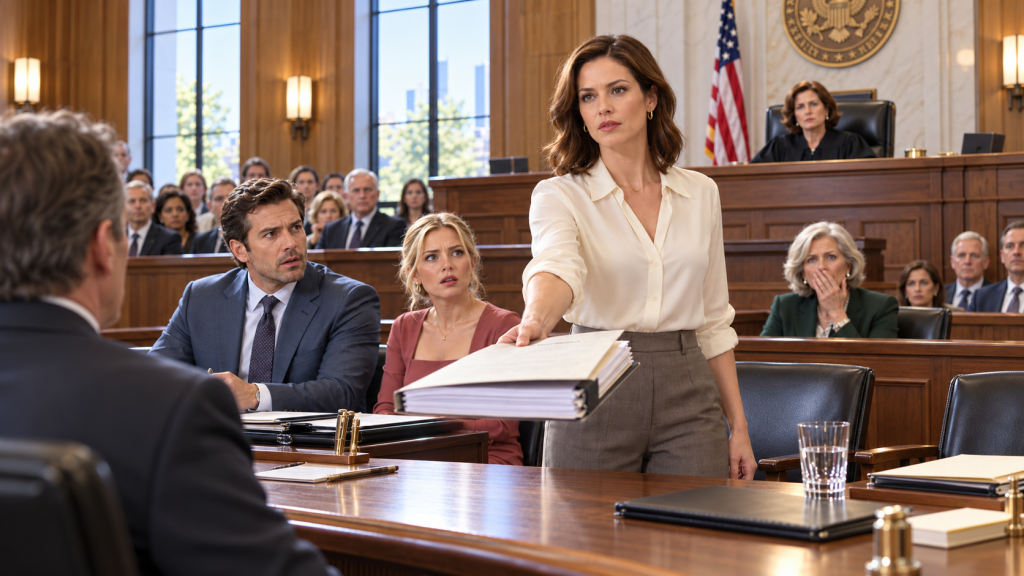
But when I placed the proposed settlement before Judge Margaret Holloway, her expression changed.
“Mrs. Bennett,” she said carefully, “are you certain?”
“Absolutely, Your Honor. I’m certain the court needs to see what my husband has been hiding before anyone discusses a settlement.”
I reached into my handbag.
Daniel’s smile disappeared.
Because three weeks earlier, I had discovered something far worse than adultery.
And unlike my marriage, the evidence hadn’t disappeared.
I pulled a thick envelope from my handbag and handed it to the court clerk.
“Three weeks ago, I discovered Daniel had secretly transferred $1.8 million from our joint investment accounts into a company registered under Vanessa’s name.”
Daniel shot to his feet.
“That’s a lie!”
Judge Holloway raised her hand.
“Sit down, Mr. Bennett.”
I continued calmly.
“He also forged my signature on company documents and attempted to use our children’s education trust as security for a personal loan.”
Vanessa’s face turned pale.
My mother grabbed my father’s arm.
Daniel’s attorney began examining the documents with an expression that suggested he was seeing them for the first time.
“Your Honor,” I said, “the supporting financial records have already been provided to opposing counsel, along with statements from the bank and an independent forensic accountant.”
The judge studied the first page.
Her expression hardened.
“Mr. Bennett, did you authorize these transfers?”
Daniel swallowed.
“Claire knew about the arrangements.”
“Then perhaps,” the judge replied, “you can explain why her signature appears on documents dated during her hospitalization.”
The courtroom went silent.
Vanessa suddenly stood.
“Daniel, you told me she signed everything!”
My father whispered, “What have you done?”
But I wasn’t finished.
Because the final document in that envelope revealed who had helped Daniel steal from me.
And that person was sitting directly behind him, pretending to be innocent.
It was my mother.
Her name appeared beneath the forged signature.
Her official notary seal had been stamped across the page.
And the date beside her signature was the day I had been unconscious in a hospital bed.
Judge Holloway looked from the document to my mother.
“Mrs. Mercer, is this your notarial signature?”
My mother’s hands began trembling.
“I don’t understand.”
“It’s a straightforward question.”
My mother looked at Daniel.
He refused to meet her eyes.
Then she looked at me.
For the first time in my life, she seemed uncertain that I would rescue her.
“Claire,” she whispered, “please.”
I didn’t answer.
I had spent thirty-eight years answering that word.
Please give your sister your favorite toy.
Please let Vanessa wear your graduation dress.
Please don’t mention that she ruined your birthday.
Please lend her money.
Please forgive her.
Please understand.
Now she was asking me to forgive something that could have destroyed my children’s future.
And I had finally learned how to say no.
The judge turned to Daniel’s attorney.
“Counsel, I want to understand precisely when your client learned of these allegations.”
The attorney, Mr. Whitaker, adjusted his glasses.
“Your Honor, I was informed this morning that Mrs. Bennett disputed certain asset transfers. I was not aware that the documents included an allegation of forgery or a potentially improper notarization.”
Daniel leaned toward him.
“She’s twisting everything.”
Mr. Whitaker didn’t respond.
My own attorney, Maya Chen, rose beside me.
“Your Honor, we have filed an emergency application to preserve the marital assets, restrict unauthorized financial transfers, and protect the interests of the minor children. We are not asking the court to adjudicate possible criminal offenses today. We’re asking that the financial records be preserved and that no disputed document be treated as authentic without examination.”
Judge Holloway nodded.
“Then we will address those requests before discussing any proposed settlement.”
Daniel turned toward me.
The hatred in his eyes was unmistakable.
“You planned this.”
I looked straight at him.
“Yes.”
And for once, I didn’t apologize for being prepared.
Six months earlier, I would never have believed such a courtroom scene possible.
At that time, I still thought I had a happy marriage.
Not a perfect marriage.
Daniel and I argued about ordinary things. He left dishes in the sink. I answered work emails too late at night. He complained about how often I traveled, and I complained that he rarely attended our children’s school activities.
But I believed those were problems couples could solve.
I believed marriage meant showing up even when things were difficult.
I had met Daniel when I was twenty-two, working as a junior systems analyst at a small software company.
He was charming, funny, and effortlessly confident.
On our third date, we sat in a twenty-four-hour diner discussing what we wanted from life.
I told him I dreamed of running my own business.
He reached across the table and took my hand.
“Then I’ll be the man cheering loudest when you do.”
I believed him.
We married two years later in my grandmother’s garden.
I wore a simple ivory dress.
Daniel cried when I walked down the aisle.
For years, whenever marriage became difficult, I remembered that moment and convinced myself the man who cried at our wedding was still somewhere inside the man standing before me.
But people can change.
Sometimes they reveal who they always were.
When Sophie was born, I was working from home, taking freelance consulting projects while she napped.
Two years later, I officially launched Bennett Technology Solutions.
I began with a secondhand laptop, a rented office smaller than our pantry, and enough savings to survive four months.
My grandmother, Margaret Mercer, had left me an inheritance before she died.
She had specifically arranged for that money to belong to me.
I used part of it to launch the business.
It was the last great gift she gave me.
Grandma Margaret had understood me in ways my parents never had.
She used to say, “Claire, being generous doesn’t mean leaving your own door unlocked for people who keep stealing from you.”
At nineteen, I thought she was simply talking about my sister borrowing my clothes.
At thirty-eight, I finally understood.
My company grew slowly.
During the first year, I barely paid myself.
During the second, we landed three substantial clients.
By the fifth year, I had twenty employees.
By the eighth, we were consulting for regional healthcare networks, manufacturing companies, and financial institutions.
Daniel loved telling people his wife owned a successful business.
At dinner parties, he would place his arm around my shoulders and say, “She’s the brains in this family.”
I used to blush.
Later, I realized that he liked my success most when it made him look important.
The problems began when Daniel left his marketing job.
He said he wanted to become an independent business consultant.
I supported him.
I even helped him set up an office at home.
But the consulting contracts never materialized.
There was always some reason.
A client changed direction.
An investor withdrew.
The economy was uncertain.
Eventually, Daniel started describing himself as an adviser to my company.
He attended dinners with clients.
He introduced himself to people as a co-founder.
Once, I heard him tell a potential investor that he’d built the company from the ground up.
I confronted him privately afterward.
“Daniel, you know that’s not true.”
He laughed.
“It’s just an expression. Don’t be so sensitive.”
I let it go.
That became the pattern of our marriage.
He crossed a line.
I explained why it hurt.
He called me dramatic.
I convinced myself keeping the peace mattered more than winning an argument.
Meanwhile, Vanessa remained a constant presence in our lives.
She was four years younger than me, beautiful, impulsive, and astonishingly skilled at turning her problems into everyone else’s responsibilities.
At twenty-six, she borrowed money to open a boutique.
It closed within a year.
At twenty-nine, she convinced my father to finance a luxury car.
At thirty-one, she moved into an apartment she couldn’t afford.
Whenever she needed money, my parents called me.
“She’s finding herself,” Mother would say.
Apparently, finding herself was an expensive occupation.
I paid her rent twice.
I covered a medical bill.
I helped settle one of her credit cards.
When she turned thirty-three, I bought her diamond earrings for Christmas because she had admired them in a jewelry store.
She hugged me and said, “You’re the best sister in the world.”
A year later, she was wearing those earrings in divorce court while holding my husband’s hand.
I sometimes wonder when their affair began emotionally.
Was it during the summer barbecue when Daniel and Vanessa disappeared together for nearly an hour?
Was it when she began visiting our house every Friday while I worked late?
Was it during the family vacation when she insisted Daniel teach her how to paddleboard, laughing every time he caught her around the waist?
I don’t know.
The first confirmed hotel reservation was eighteen months before our court hearing.
But betrayal rarely announces its starting date.
By the time I noticed the first real warning sign, they were already comfortable lying to me.
Daniel had begun guarding his phone.
He changed his password.
He took calls outside.
He started buying expensive shirts, wearing cologne I’d never smelled before, and going to the gym at strange hours.
When I asked whether something was wrong, he said I was imagining things.
“Claire, you’re always working. Maybe you should spend more time on our marriage instead of looking for problems.”
I accepted that accusation longer than I should have.
Then came the hospital.
Four months before the divorce hearing, I developed severe abdominal pain during a client meeting.
I tried to finish my presentation.
Halfway through, I collapsed.
An ambulance took me to the hospital, where doctors discovered that my appendix had ruptured.
I needed emergency surgery.
The infection was serious.
I spent several days under heavy sedation and additional time recovering from complications.
Daniel visited.
My parents visited.
Vanessa even sent flowers.
My mother sat beside my bed while I drifted in and out of consciousness.
She held my hand and promised to take care of everything.
At the time, I was grateful.
Later, I discovered she had photographed the identification documents in my handbag.
She had also used that period to help Daniel obtain the signatures he needed.
Not my real signatures.
Copies and imitations.
During the divorce investigation, an independent handwriting examiner concluded that multiple signatures on the disputed papers were highly inconsistent with my known writing.
The date of one purported notarization was especially damning.
Hospital records showed that I had been under medical supervision, unable to attend the appointment described in the document.
The notarial certificate claimed I had personally appeared before my mother in her home office.
I hadn’t left the hospital.
And yet my mother had stamped the document anyway.
At first, I didn’t know any of this.
I went home after my hospitalization believing I’d survived the worst thing that could happen to me that year.
Daniel was unusually attentive.
He brought me tea.
He ordered my favorite soup.
He told me not to worry about the company.
“Everything’s handled,” he said.
Those words would eventually make my skin crawl.
The first crack appeared because of a woman named Olivia Grant.
Olivia was my company’s finance director and one of the most meticulous people I had ever met.
We had worked together for nine years.
She was the sort of person who noticed if a monthly report contained a number that didn’t match by seventeen cents.
One Thursday afternoon, she came into my office and closed the door.
“Claire, I need to ask you something.”
I looked up.
“What’s wrong?”
“Did you approve a change in the company’s ownership records while you were hospitalized?”
I frowned.
“No.”
Olivia placed a document on my desk.
My name appeared at the bottom.
Above it was a statement authorizing the transfer of a controlling ownership interest to a holding company associated with Daniel.
I stared at it.
“Where did this come from?”
“A packet Daniel sent to our outside accounting firm. They forwarded it to me when they couldn’t reconcile the changes.”
I examined the signature.
It looked remarkably similar to mine.
But something was wrong.
I have always made the final letter of my first name with a small upward loop.
That signature ended in a straight line.
I picked up the document.
“I didn’t sign this.”
Olivia’s face tightened.
“That’s what I was afraid of.”
There were supposed minutes from a board meeting attached.
The minutes said I had approved the restructuring.
But no such meeting had taken place.
In fact, on the date listed, I had been recovering from surgery.
Olivia had refused to recognize the ownership change without independent confirmation.
Her caution may have saved the company.
She also told me something else.
“Daniel asked our technology administrator whether he could get full access to the finance system.”
My stomach dropped.
“What did you tell him?”
“That he’d need authorization from you.”
“And?”
“He said you were too sick to make decisions.”
I remembered Daniel sitting beside my hospital bed, telling me to rest.
I remembered his reassuring smile.
Suddenly, I felt nauseated.
Olivia sat across from me.
“Claire, there’s more.”
She showed me emails in which Daniel had described himself as the company’s incoming chief executive.
He had spoken to two potential investors about a merger.
He had even discussed replacing Olivia.
“Why didn’t you tell me sooner?” I asked.
She looked genuinely hurt.
“I was trying to verify what was happening. And until you returned, Daniel kept saying you had authorized everything.”
I took a deep breath.
“Don’t confront him.”
Olivia nodded.
“What do you want me to do?”
“Preserve everything.”
That evening, I drove home as though nothing had happened.
Daniel was cooking pasta.
Vanessa was sitting at the kitchen island drinking wine.
The children were upstairs finishing homework.
“Surprise,” Daniel said cheerfully. “Your sister came over.”
Vanessa raised her glass.
“Thought you could use some company.”
I looked from one of them to the other.
They seemed perfectly comfortable.
For the first time, I wondered how many lies could exist inside an ordinary kitchen.
I smiled.
“How thoughtful.”
Then I went upstairs and called Maya Chen, an attorney who had helped with business agreements years earlier.
I told her what Olivia had found.
Maya was silent for several seconds.
“Claire, you need to assume the situation may be more serious than a dispute over company management.”
She advised me to preserve all records, avoid alerting Daniel, and arrange a confidential meeting.
The next morning, I entered her office carrying the ownership documents.
Within forty minutes, Maya had identified multiple irregularities.
“This isn’t something we should dismiss as a misunderstanding,” she said.
Then she asked a question I hadn’t expected.
“Have you reviewed your personal investment accounts recently?”
I had not.
Daniel handled most household investment transactions.
I managed the company and our regular expenses.
That arrangement had seemed practical.
Now it felt terrifying.
With Maya’s guidance, I requested complete account records from the bank.
Three days later, I learned that $1.8 million had been transferred out over several months.
The money had gone through multiple transactions before reaching an entity called Meridian Holdings LLC.
Meridian Holdings had been registered under Vanessa’s name.
When I saw her signature on the company formation documents, my hands began shaking.
My sister.
Not just my husband.
My sister was connected to the disappearance of nearly two million dollars.
The next discovery was worse.
Daniel had submitted paperwork attempting to change the trusteeship of Sophie and Ethan’s education trust.
He also tried to use trust assets to support a business loan.
The financial institution had flagged the request because it required additional authorization.
The loan had not been completed.
But the attempt was documented.
I sat in Maya’s office staring at the paperwork.
“Why would he do this?”
Maya leaned forward.
“I can’t tell you what his intentions were. But these documents suggest an effort to control assets before you could object.”
I wanted to scream.
Instead, I asked, “Can we stop him?”
“Yes,” she said. “But we need to move carefully.”
For the next two weeks, my life became an exercise in pretending.
I made breakfast.
I packed lunches.
I kissed my children goodnight.
I listened while Daniel complained that I was distracted.
And after everyone went to sleep, I reviewed bank statements with Maya and a forensic accountant named Samuel Price.
Samuel reconstructed the transfers.
He identified the accounts receiving the money and the documents used to authorize withdrawals.
Some funds remained traceable.
Some had already been spent or moved again.
One payment had gone toward a luxury condominium deposit.
Another had paid off debts associated with Vanessa.
A third had been routed to an account Daniel described as a business investment reserve.
The more we uncovered, the clearer the plan became.
Daniel wasn’t simply preparing to leave me.
He was preparing to make it difficult for me to fight back.
Then I found the hotel receipts.
They were stored in an old email account Daniel had apparently forgotten was still synchronized to our shared desktop.
The first reservation was in Chicago.
Then Miami.
Then New York.
All booked for two guests.
Several coincided with weekends Daniel claimed to be attending conferences.
One hotel confirmation included Vanessa’s full name.
I stared at the screen for nearly an hour.
Then I found a photograph.
Daniel stood beside Vanessa on a hotel balcony, his arm wrapped around her waist.
She was kissing his cheek.
Both were smiling.
The timestamp showed the picture had been taken on our thirteenth wedding anniversary.
That weekend, Daniel had sent me flowers.
He’d included a note.
I wish I could be there. You’re my whole world.
I printed the photograph.
I placed it beside the financial documents.
And for the first time, I cried.
Not because I wanted Daniel back.
Not because I was surprised people cheated.
I cried because I realized how thoroughly I had been deceived.
I thought about Vanessa sitting at my kitchen table, asking about my marriage.
I thought about my mother saying Daniel was a wonderful husband.
I thought about the money I had given my sister to help her through difficult times.
Most of all, I thought about my children.
What kind of person would risk the money set aside for their education?
What kind of father would use their future as security for his own plans?
I cried until my throat hurt.
Then I washed my face, checked on Sophie and Ethan, and went downstairs to finish reviewing the records.
The next evening, Daniel told me he wanted a divorce.
He sat at our dining room table, looking strangely satisfied.
“I’ve been unhappy for a long time,” he announced.
I sat across from him.
“Is there someone else?”
He didn’t even blink.
“No.”
Another lie.
He continued.
“I think the children should live primarily with me.”
I stared at him.
“Why?”
“Because you’re always busy.”
“I take them to school. I attend their appointments. I help with homework. I’m home for dinner almost every evening.”
“You’re emotionally unavailable.”
I nearly laughed.
The man who had been spending weekends in hotel rooms with my sister was accusing me of being absent.
Then he leaned forward.
“And we need to discuss the company.”
There it was.
The real conversation.
He said he had contributed years of support and deserved control.
He claimed he had sacrificed his career for my ambitions.
He suggested I could start a smaller consulting practice after the divorce.
He spoke as though the company were furniture we could divide.
I listened.
Then I asked, “Have you already spoken to an attorney?”
“Yes.”
“Have you prepared a settlement?”
He hesitated.
“We have some ideas.”
I nodded.
“I’ll get representation.”
His expression darkened.
“Claire, don’t make this ugly.”
That sentence followed me for weeks.
Don’t make this ugly.
As though he hadn’t already shattered our marriage.
As though the ugliness began only when I refused to surrender.
Two days later, my mother invited me to lunch.
She chose an expensive restaurant near her home.
When I arrived, Vanessa was already seated beside her.
I almost turned around.
“Claire,” Mother said brightly. “Sit down.”
Vanessa refused to meet my eyes.
I put my handbag on the chair.
“What is this?”
My mother sighed.
“We need to discuss the family.”
I looked at Vanessa.
“Is there something you want to tell me?”
She swallowed.
Mother reached for her hand.
“Before anyone says something hurtful, I want you to remember that love can happen unexpectedly.”
I felt the last fragile hope inside me break.
So they knew.
My mother knew about the affair.
My sister knew I was about to discover it.
And they had invited me to lunch as though they were arranging a surprise birthday party.
“How long?” I asked.
Vanessa whispered, “Claire—”
“How long?”
“Eighteen months.”
I nodded slowly.
“And Mom?”
Mother straightened.
“I only found out recently.”
That was another lie.
The forensic timeline would later establish that she had notarized a disputed asset-transfer document several months earlier.
But I didn’t confront her.
Not yet.
I asked Vanessa, “Did you ever think about Sophie and Ethan?”
Her eyes filled with tears.
“Of course I did.”
“While you were sleeping with their father?”
Mother slammed her hand on the table.
“Enough.”
Several diners turned.
She lowered her voice.
“Your sister has suffered terribly over this.”
I stared at her.
“She’s suffered?”
“She didn’t plan to fall in love.”
“Neither did I plan to have my husband cheat on me.”
Vanessa began crying.
My mother handed her a tissue.
Then she looked at me with open disappointment.
“Claire, you’ve always been the strong one. You can survive this.”
I stood.
“Maybe I can. But that doesn’t mean I should have to make it easier for the people who caused it.”
Mother’s expression hardened.
“Don’t be selfish.”
I left without ordering lunch.
That evening, my father called.
“Your mother is upset.”
I was folding Ethan’s pajamas.
“I’m sorry to hear that.”
“She says you were cruel to Vanessa.”
I closed my eyes.
“Dad, Vanessa has been having an affair with my husband for a year and a half.”
He sighed.
“People make mistakes.”
“Eighteen months isn’t a mistake.”
“She’s younger than you.”
“She’s thirty-four.”
“Claire, you have a successful career. You’ll recover. Vanessa doesn’t have the same advantages.”
I looked around the bedroom.
At the framed photographs.
At the laundry basket.
At the little dinosaur Ethan had left beside my pillow.
“You mean the advantages I worked for?”
My father said nothing.
Then he delivered the sentence I would remember for the rest of my life.
“Sometimes the person who has more needs to give more.”
I hung up.
For years, I had believed I owed my family endless understanding because I was successful.
That night, I finally saw the truth.
My parents didn’t see me as the daughter who had worked hard.
They saw me as the daughter who existed to absorb everyone else’s consequences.
And they expected that arrangement to continue forever.
Maya advised me to remain focused.
“Don’t give them a warning about the financial evidence,” she said. “Let the records speak.”
She arranged for Samuel to complete his preliminary forensic report.
We also contacted the financial institutions involved and took steps to protect company access.
Olivia worked with our technology team to review permissions and preserve relevant system records.
The company’s governing documents prohibited ownership changes without specific approvals.
The disputed transfer had not been accepted into the official company records.
That was an enormous relief.
But the family-owned accounts were more complicated.
Money had already moved.
We needed court orders, bank cooperation, and a clear trail of evidence.
Meanwhile, Daniel began building a custody narrative.
He told relatives that I was unstable.
He described my long working hours as neglect.
He suggested my hospitalization had caused emotional problems.
I learned this from a cousin who called to ask whether I was receiving treatment.
“What treatment?” I asked.
She sounded embarrassed.
“Daniel said you weren’t coping.”
I thanked her and documented the conversation.
The worst moment came when Sophie asked me whether I was going to abandon her.
We were washing dishes.
She stood beside me, drying a plate with a blue towel.
“Mom?”
“Yes, sweetheart?”
“Dad said you might move away after the divorce.”
My hands froze beneath the water.
“What?”
“He said you might have to live somewhere smaller, and maybe you wouldn’t want us there because you’d be working all the time.”
I turned off the faucet.
Then I knelt in front of her.
“Sophie, listen carefully. I am not leaving you or your brother. Ever.”
Her eyes filled with tears.
“Promise?”
“I promise I will always be your mother, and I will do everything I can to be there for you. None of this is your responsibility.”
She threw her arms around me.
I held her until her breathing steadied.
That night, I told Maya what had happened.
She documented it and urged me to arrange counseling for the children.
She also reminded me that whatever Daniel had done, the children should never be forced to choose sides.
I agreed.
I was furious with their father.
But I refused to turn my children into weapons.
Three weeks later, we walked into divorce court.
Daniel believed he had already won.
He believed my parents would pressure me into surrendering.
He believed Vanessa would become the new mistress of our home.
He believed I was too emotionally devastated to understand the financial documents.
He was wrong about every one of those things.
And now, in the courtroom, Judge Holloway was staring at my mother’s notary seal.
“Mrs. Mercer,” the judge asked, “were you aware Mrs. Bennett was hospitalized on the date shown here?”
My mother looked down.
“I knew she’d had surgery.”
“Were you physically present when she signed this document?”
My mother’s lips parted.
Daniel suddenly interrupted.
“Your Honor, this isn’t relevant to our divorce.”
The judge looked directly at him.
“Mr. Bennett, the authenticity of documents used to transfer substantial assets is unquestionably relevant to the financial issues before this court.”
His attorney placed a hand on his arm.
Daniel sat back.
The judge returned her attention to my mother.
“Mrs. Mercer, I will not require you to answer questions without the opportunity to obtain legal advice. But I strongly suggest you preserve any records relating to these documents.”
My mother began crying.
Not loudly.
Just enough to make my father reach for her hand.
A familiar scene.
My mother in distress.
My father comforting her.
Vanessa looking wounded.
And me, expected to make everything better.
But this time, the judge wasn’t interested in their performance.
Maya explained the evidence supporting our request for temporary financial protections.
The judge reviewed the filings and questioned both attorneys.
After a recess, she issued temporary orders restricting unauthorized transfers of disputed assets and requiring the parties to preserve financial and electronic records.
She also authorized further financial examination and scheduled additional proceedings.
The court did not decide ownership, custody, or criminal responsibility that day.
Those issues required evidence, testimony, and proper legal process.
But Daniel’s proposed settlement was going nowhere.
When the hearing ended, my mother approached me in the corridor.
“Claire, can we talk?”
“No.”
She recoiled.
“I’m your mother.”
“I know.”
“You can’t let strangers investigate your own family.”
I stared at her.
“Strangers didn’t forge my signature.”
Her face collapsed.
“Daniel said it was just paperwork.”
I felt something inside me go still.
“So you knew?”
She glanced around.
“Not here.”
“Did you know I hadn’t signed?”
“Claire, please understand. He told me you had agreed to the arrangements and that the papers were a formality.”
“Then why didn’t you call me?”
Her silence was an answer.
I continued.
“You knew I was in the hospital. You knew I couldn’t have appeared before you at home. You stamped those documents anyway.”
Tears rolled down her cheeks.
“I was trying to protect the family.”
“Which family?”
She looked confused.
I took a step back.
“Because you weren’t protecting mine.”
My father approached.
“Your mother made a mistake.”
I looked at him.
“Dad, if someone steals from me, it’s a mistake. If Vanessa sleeps with my husband, it’s a mistake. If Mom falsely notarizes documents, it’s a mistake.”
He opened his mouth.
I stopped him.
“But when I refuse to accept it, suddenly I’m the one destroying the family.”
Neither answered.
I walked away.
Daniel was waiting near the elevator.
Vanessa stood beside him, her makeup streaked.
“You’ve made everything worse,” he hissed.
I pressed the elevator button.
“Have I?”
“You could have settled this quietly.”
“You mean you could have taken everything quietly.”
He leaned closer.
“You think you’re clever because you found some documents?”
I looked at him.
“No, Daniel. I think I was foolish because I trusted you.”
Vanessa stepped forward.
“Claire, I didn’t know about the education trust.”
I turned to her.
“Did you know about the investment transfers?”
She hesitated.
“Daniel said it was money he was entitled to.”
“Did you ask why it needed to go through your company?”
“He said it was for tax purposes.”
“Did you ask why it was being hidden from me?”
Her expression changed.
And there it was.
The moment she realized that even pretending innocence had become difficult.
“Claire, I loved him.”
I nodded.
“Then you should have asked him to leave his marriage honestly before starting one with you.”
The elevator doors opened.
I stepped inside.
For the first time in months, I felt something other than grief.
I felt free enough to tell the truth.
The weeks that followed were brutal.
Daniel moved into an apartment.
Vanessa initially stayed with him.
My parents stopped speaking to me except through hostile messages.
My mother sent long texts describing how much she had sacrificed to raise me.
My father accused me of humiliating the family.
Neither asked how Sophie and Ethan were coping.
The children began seeing a therapist named Dr. Elena Ruiz.
Sophie was angry.
Ethan was confused.
Both missed having their father at home, even though his visits had become inconsistent.
One afternoon, Ethan asked whether Dad had left because he had broken the television.
I stared at him.
“What television?”
“The one in the playroom. I knocked it over last month.”
My heart broke.
I pulled him onto my lap.
“Sweetheart, none of this happened because of anything you did.”
“Not even a little?”
“Not even a little.”
He buried his face in my shoulder.
That evening, I sat alone in the kitchen after both children were asleep.
I looked at the place where Daniel used to sit.
I remembered him teaching Sophie to ride a bicycle.
I remembered Ethan falling asleep on his chest.
I remembered all the birthdays, vacations, and lazy Sunday mornings.
Those memories hadn’t disappeared simply because Daniel had betrayed us.
That was one of the hardest things about divorce.
The person who hurt you could also be the person who helped create some of your happiest memories.
I didn’t know how to reconcile those truths.
So I stopped trying.
I let myself grieve the good things without pretending the bad things hadn’t happened.
At work, the investigation continued.
Samuel discovered that Meridian Holdings had not been established for legitimate consulting work.
It had almost no genuine business activity.
Its primary purpose appeared to be receiving funds and acquiring assets.
A luxury condominium had been reserved using money traceable to our investment accounts.
Vanessa had already begun choosing furniture.
Emails recovered during the legal discovery process showed Daniel discussing how they would renovate the place.
One message from Vanessa made my stomach twist.
Once Claire signs, we can finally stop pretending. I want the house too, though. The kids already know me.
Daniel’s reply was worse.
The house is easier if she loses custody. Her lawyer won’t fight forever once the money is gone.
I read those words three times.
He wasn’t merely trying to end our marriage.
He had planned to use financial pressure to make me give up my children.
That was the moment my grief turned into absolute determination.
I sent the emails to Maya.
Then I went upstairs and sat beside Sophie while she worked on a science project.
She was building a model of the solar system.
She had painted Jupiter too purple and was arguing that Saturn’s rings needed more glitter.
I helped her glue tiny stars onto the background.
She laughed when one stuck to my cheek.
And I thought about how close Daniel had come to turning our entire future into a negotiation.
I promised myself that whatever happened in court, I would never stop fighting for a fair and safe arrangement for my children.
A month after the first hearing, Vanessa called me.
I nearly ignored the phone.
But I answered.
“Claire?”
Her voice sounded small.
“What do you want, Vanessa?”
“Can we meet?”
“Why?”
“I need to explain.”
I almost said no.
Instead, I agreed to meet at a coffee shop near Maya’s office.
Vanessa arrived wearing sunglasses and carrying a handbag that cost more than my first car.
She removed the glasses.
Her eyes were swollen.
“Daniel’s changed,” she said.
I studied her.
“He hasn’t changed. You’re simply seeing things from a different position.”
She looked down.
“He’s angry all the time.”
“I’m sure he is.”
“He says everything is your fault.”
I waited.
“He told me the company was practically his,” she continued. “He said you were controlling and wouldn’t let him have what he’d earned.”
I said nothing.
“He told me your marriage was over long before we got together.”
“Was it?”
She shook her head.
“I don’t know anymore.”
I watched her twist the handle of her handbag.
Then she whispered, “I think he’s been using me.”
I almost felt sorry for her.
Almost.
“Vanessa, did you believe that a man who lied to his wife for eighteen months would always tell you the truth?”
She began crying.
“I thought he loved me.”
I looked out the window.
For a moment, I saw us as children.
Vanessa was six, sitting on my bedroom floor, crying because she’d broken my favorite music box.
Mother had told me to forgive her.
I’d hugged her and said it didn’t matter.
But it had mattered.
Just like all the other things I’d been told not to care about.
I turned back.
“You were my sister.”
“I still am.”
“No,” I said quietly. “Being related to someone and behaving like family aren’t the same thing.”
She reached across the table.
I moved my hand away.
“Claire, please.”
I stood.
“If you want to make things right, tell the truth to the investigators and stop helping Daniel hide assets.”
She looked frightened.
“What happens if I do?”
“I don’t know.”
“Will you protect me?”
I stared at her.
Even now.
Even after everything.
She was asking me to carry the consequences of her decisions.
“I won’t lie for you, Vanessa.”
I left her sitting there.
Three days later, Maya called with an unexpected development.
Vanessa had retained her own attorney.
Through that attorney, she offered to provide records concerning Meridian Holdings.
It was not a sudden transformation into a noble person.
She was worried about her own legal exposure.
But the records were useful.
They showed that Daniel had directed most of the company’s financial activity.
They also showed that Vanessa had signed certain account-opening documents and approved several transfers.
Her claim that she knew nothing was not entirely credible.
Still, the information helped Samuel locate money that had been moved through additional accounts.
The condominium purchase had not closed.
A substantial portion of the deposit was eventually preserved under court supervision.
Other funds remained tied up in the financial investigation.
But the most painful discovery had nothing to do with the money.
Among the documents Vanessa provided was an email from my mother to Daniel.
It was dated two weeks before he announced the divorce.
Claire will fight at first. She’s stubborn about the children and the business. Robert and I will speak to her. She always gives in eventually.
I read it once.
Then again.
My mother had not merely reacted badly after the affair was exposed.
She had helped plan how to pressure me.
Another email described the proposed settlement.
Fifty thousand should be enough for her to get established again. She doesn’t need that enormous house by herself.
I stared at the words.
By herself.
As though Sophie and Ethan were already gone.
As though my mother had decided I would have no children in my home before a judge had heard a single argument.
Maya watched my expression.
“Claire?”
I handed her the page.
“Please keep that with the evidence.”
Then I excused myself and went to the restroom.
I locked myself inside a stall and cried.
I had expected betrayal from Daniel.
I had begun accepting betrayal from Vanessa.
But discovering my mother had helped design my destruction was something different.
It felt as though my entire childhood had been rewritten.
Every time I’d been told to share.
Every time I’d been called selfish.
Every time I’d sacrificed something to keep the peace.
I wondered whether my parents had ever seen me as a whole person.
Or whether they had loved me most when I was useful.
When I finally emerged, Maya was waiting with a glass of water.
“You don’t have to be strong every second,” she said.
I managed a tired smile.
“Everyone keeps telling me I’m strong.”
“Then they should remember strong people still need support.”
I took the water.
It was such a simple kindness that I nearly cried again.
For the next several months, I began rebuilding my life in small, ordinary ways.
I stopped checking Daniel’s social media.
I hired a reliable operations manager so I could spend more time with the children.
I started having breakfast with Sophie and Ethan every morning instead of eating while answering emails.
On Fridays, we ordered pizza and watched movies.
Some nights were happy.
Others ended in tears.
Ethan sometimes asked why Dad couldn’t come home.
Sophie became quiet whenever Vanessa’s name was mentioned.
Dr. Ruiz helped them understand that adults could make harmful decisions without those decisions being the children’s responsibility.
I also began seeing a therapist.
At first, I felt embarrassed.
I owned a successful company.
I managed difficult clients.
I could negotiate contracts worth millions.
Why couldn’t I manage my own emotions?
My therapist asked me a question during our third session.
“Claire, what would you say if your daughter came to you after someone treated her the way your family treated you?”
I answered immediately.
“I’d tell her she deserved better.”
My therapist waited.
I looked at the floor.
Then I began to cry.
Because I knew what she was asking.
And I knew I had spent my entire life refusing to offer myself the protection I would give my daughter without hesitation.
The legal proceedings moved slowly.
There were document requests, depositions, hearings, and endless conversations about valuations.
Daniel’s first attorney eventually withdrew from representing him.
His new attorney took a more cautious approach.
The disputed asset transfers were investigated separately from the divorce proceedings.
My mother’s notarization was reported to the appropriate authorities.
A formal review of her notarial conduct began.
She contacted me several times, asking me to withdraw my complaint.
I explained that I could not simply erase evidence or control what investigators decided.
She didn’t like that answer.
“You’re choosing revenge over family,” she said in one voicemail.
I saved it.
Then I stopped listening to the others.
My father tried a different approach.
One Saturday afternoon, he appeared at my front door.
I was watering the flowers.
He looked older than I remembered.
“Can I come in?”
I hesitated.
“The children are with Daniel for their scheduled visit.”
“I came to see you.”
I led him onto the back patio.
We sat beneath the maple tree where Sophie had once hung a bird feeder.
For several minutes, he said nothing.
Then he cleared his throat.
“Your mother isn’t doing well.”
I looked at him.
“I’m sorry she’s having a difficult time.”
He nodded.
“She may lose her notary commission.”
“That will be determined by the authorities.”
“She thought she was helping.”
I put down my glass.
“Dad, why are you here?”
He looked startled.
“I’m your father.”
“I know. But every time you contact me, it’s about Mom or Vanessa. You’ve never once asked what happened to me.”
He stared at his hands.
I continued.
“Do you know Sophie has nightmares? Do you know Ethan thought the divorce was his fault? Do you know Daniel tried to move the children’s education money?”
He winced.
“Claire—”
“Do you know how close he came to taking control of the company that pays the salaries of forty-three people?”
My father looked up.
Forty-three employees.
That was what the company had grown to.
Forty-three people with rent, mortgages, children, and lives of their own.
Daniel’s scheme hadn’t threatened only me.
It had threatened everyone who depended on that business.
My father swallowed.
“I didn’t understand how far things had gone.”
“But you knew they were going somewhere.”
He looked away.
I waited.
Finally, he whispered, “Your mother said you would be fine.”
I felt my chest tighten.
“And that was enough?”
He didn’t answer.
I stood.
“Grandma Margaret once told me something about you.”
My father looked surprised.
“She said you loved keeping peace so much that you’d let other people pay for it.”
His face changed.
I had never told him that before.
“She was wrong about a lot of things,” he said.
“Maybe.”
I walked toward the door.
“But she wasn’t wrong about that.”
He left without asking to see the children.
For weeks afterward, I thought about that conversation.
I wished he had shouted.
I wished he had accused me of something outrageous.
Instead, he had looked ashamed.
And that was almost harder.
Because a small part of me still wanted him to become the father I needed.
But wanting something did not make it real.
During the next custody hearing, the court considered evidence from both parents, the children’s therapist, and a court-appointed professional who had evaluated the family circumstances.
Daniel argued that my work schedule made me an unsuitable primary caregiver.
Maya presented school attendance records, medical appointments, childcare arrangements, and evidence of my involvement in the children’s daily lives.
We also submitted messages showing Daniel had made misleading statements to Sophie about my intentions.
The court took those concerns seriously.
It also considered Daniel’s relationship with the children separately from his misconduct toward me.
That distinction mattered.
I didn’t want the children to believe they had to hate their father to love me.
I wanted them safe.
I wanted them heard.
And I wanted decisions made around their needs rather than anyone’s wounded pride.
The temporary custody arrangement kept the children primarily with me.
Daniel received structured parenting time under conditions designed to reduce conflict and prevent further pressure on the children.
When the judge explained the temporary arrangement, Daniel looked furious.
Outside the courtroom, he confronted Maya.
“This is ridiculous. Claire works more than I do.”
Maya remained calm.
“The court has considered the evidence, Mr. Bennett.”
He pointed toward me.
“She manipulated this whole thing.”
I didn’t respond.
I was no longer interested in convincing him of facts he had decided not to accept.
One evening, about seven months after the divorce began, Sophie came into my bedroom holding a photograph.
It showed Daniel and me on our wedding day.
“Mom?”
I put down my book.
“Yes?”
“Were you happy with Dad?”
I looked at the photograph.
We were laughing.
His arms were wrapped around my waist.
My grandmother stood behind us, smiling.
“Yes,” I said. “I was happy with him for a long time.”
Sophie sat beside me.
“Then why did he stop loving you?”
I took a moment.
“I don’t know exactly what happened inside his heart. But I do know he made choices that hurt our family.”
She studied the picture.
“Does that mean you wish you never married him?”
I looked at my daughter.
At the freckles across her nose.
At the thoughtful eyes that looked so much like mine.
“No,” I said.
She frowned.
“Why?”
“Because if I hadn’t married him, I wouldn’t have you or Ethan.”
She leaned against my shoulder.
“And you would have missed us?”
“More than anything in the world.”
She smiled a little.
Then she placed the photograph back in the drawer.
“Okay.”
That single word held more peace than anything I’d felt in months.
The financial investigation eventually produced several significant results.
The bank records, electronic communications, and ownership documents established that Daniel had taken steps to move assets without valid authorization.
The company’s attempted ownership transfer was rejected as invalid, leaving control of Bennett Technology Solutions where it belonged.
Some of the diverted funds were returned or secured.
Other amounts became the subject of repayment claims and restitution proceedings.
There was no magic courtroom moment when every dollar reappeared.
There were legal fees.
Accounting fees.
Lost time.
Exhausting meetings.
And a great deal of uncertainty.
But the evidence had given us a way to protect what remained and pursue what had been taken.
My mother lost her notary commission following the investigation into the false certification.
Daniel and my mother also faced further legal scrutiny over their roles in the disputed documents.
Vanessa’s attorney negotiated cooperation regarding records associated with Meridian Holdings.
I didn’t celebrate those developments.
I had never dreamed of seeing my mother investigated or my marriage dissected in legal filings.
But I refused to confuse the consequences of their decisions with cruelty on my part.
The process was painful.
It was also necessary.
Then, almost a year after Daniel first demanded a divorce, we returned to Judge Holloway’s courtroom for the final stages of our case.
The courtroom looked exactly as it had before.
Same polished benches.
Same high windows.
Same clock on the wall.
But I was not the same woman.
I wore a navy dress and a simple silver necklace.
No expensive jewelry.
No attempt to impress anyone.
Maya sat beside me, her files neatly organized.
Daniel sat across the aisle.
He looked tired.
His expensive suit hung differently from his shoulders.
Vanessa was not beside him.
They had separated several weeks earlier.
According to what she had told her attorney, their relationship had collapsed under arguments about money, blame, and the ongoing investigation.
I wasn’t surprised.
A relationship built around lying to someone else had struggled when the lies became inconvenient.
My parents were not present.
I had learned they would not attend, and I was grateful.
The divorce negotiations had become more realistic.
Independent valuations established the company’s financial position and the marital interest, if any, subject to equitable division.
My original inherited investment and the company’s ownership history were carefully documented.
Daniel could no longer pretend that he automatically deserved control simply because he had been married to me.
The negotiated financial resolution, subject to the judge’s approval, preserved my ownership and management of the company.
The house was awarded to me through the property settlement, with offsets and disputed claims accounted for under the agreement.
Daniel’s obligation to repay certain funds was addressed separately.
I would not receive every dollar immediately.
But I would keep the home where Sophie and Ethan had grown up.
And I would keep the company I had built.
Most importantly, the final parenting plan established the children’s primary residence with me and provided an arrangement for Daniel’s parenting time with safeguards tailored to their circumstances.
The judge reviewed the terms carefully.
Then she looked at both of us.
“This court’s concern is not which party feels most wronged. It is whether the orders are lawful, equitable, and, regarding the children, in their best interests.”
Daniel stared straight ahead.
Judge Holloway continued.
“The record reflects serious financial disputes and conduct that made resolution considerably more difficult. Neither party should mistake the conclusion of this divorce for a determination of every issue under investigation elsewhere.”
I listened without moving.
Then came the words I’d been waiting nearly a year to hear.
The divorce was granted.
Fourteen years of marriage ended in a few formal sentences.
I thought I would feel triumphant.
Instead, I felt an enormous sadness.
Not because I wanted Daniel back.
But because I remembered the young woman who had stood in my grandmother’s garden believing her love story would last forever.
I wished I could tell her that the ending would hurt.
I wished I could warn her.
But I also wished I could tell her that she would survive.
Daniel rose as the hearing ended.
For a moment, I thought he would leave without speaking.
Instead, he approached me.
“Claire.”
I turned.
He looked at Maya, then back at me.
“Can we talk privately?”
I shook my head.
“Anything you need to discuss can go through our attorneys or the parenting communication system.”
He exhaled sharply.
“After fourteen years, that’s all I get?”
I looked at him.
“You had fourteen years to speak honestly to me.”
He flinched.
For a moment, his expression softened.
“I didn’t think it would end like this.”
“Neither did I.”
He glanced toward the courtroom doors.
“Vanessa’s gone.”
“I know.”
“She blamed me for everything.”
I waited.
Then he said something I never expected.
“I thought if I had the company and the house, I’d finally feel like I’d accomplished something.”
I studied him.
He seemed genuinely exhausted.
But exhaustion was not accountability.
“So you tried to take away what I accomplished?”
He looked down.
“I was angry.”
I nodded slowly.
“Daniel, being unhappy doesn’t give you permission to destroy someone else.”
He swallowed.
“I know.”
I couldn’t tell whether he really understood.
Maybe someday he would.
But that was no longer my responsibility.
“I hope you become the father Sophie and Ethan need,” I said.
Then I walked away.
Outside, Maya stopped beside me on the courthouse steps.
The afternoon sun was warm.
Traffic moved along the street.
People hurried past carrying briefcases and coffee cups.
The world continued as if nothing important had happened.
Maya smiled.
“How are you feeling?”
I thought about it.
“Strange.”
“That’s understandable.”
“I spent so long fighting to protect my life that I forgot what it might feel like to actually live it.”
She touched my arm.
“Then perhaps that’s what comes next.”
I laughed softly.
“For once, I hope the next chapter is boring.”
Maya laughed too.
“Boring can be wonderful.”
That evening, I went home and found Sophie and Ethan waiting in the kitchen with Olivia.
She had offered to pick them up after school.
On the counter sat a chocolate cake.
The frosting was crooked.
Someone had written WE LOVE YOU MOM in bright blue letters.
Ethan ran toward me.
“Mom! We made cake!”
Sophie followed more slowly.
“Olivia helped. A lot.”
Olivia smiled.
“I supervised the structural engineering.”
I laughed.
Then I hugged all three of them.
For the first time in nearly a year, I didn’t feel as though I were holding my breath.
We ate cake before dinner.
Ethan got frosting on his nose.
Sophie insisted we take pictures.
Later, after the children went to bed, I sat alone on the patio.
The air smelled of cut grass and jasmine.
I looked up at the stars.
And I thought about my grandmother.
I wished she were there.
I wished I could tell her about everything.
About Daniel.
About Vanessa.
About my parents.
About the forged documents and the courtroom and the months when I felt as though my entire world was collapsing.
I could almost hear her voice.
Claire, being generous doesn’t mean leaving your own door unlocked.
I smiled through tears.
“You were right, Grandma.”
But life didn’t become perfect after the divorce.
Real healing didn’t arrive wrapped in a court order.
There were difficult conversations with the children.
There were financial matters still being resolved.
There were mornings when I woke up feeling angry about the years I’d lost.
There were nights when I missed the idea of being married, even though I didn’t miss the marriage I’d actually had.
I learned that recovering from betrayal wasn’t a straight road.
Some days I felt confident.
Other days a familiar song or an old photograph would bring everything back.
I stopped judging myself for that.
I let the feelings come and go.
I focused on the things I could control.
My company.
My children.
My home.
My choices.
Six months after the divorce was finalized, Bennett Technology Solutions signed its largest client contract to date.
The agreement would support expansion into two additional states.
At the celebration dinner, Olivia raised a glass.
“To Claire,” she said. “Who built something worth protecting.”
My employees applauded.
I stood there with tears in my eyes.
For years, I had measured success in contracts, revenue, and growth.
But that night, I understood something different.
The most valuable thing I’d built wasn’t just a company.
It was a team of people who had trusted one another when things became difficult.
Olivia had been brave enough to question suspicious paperwork.
Our accounting department had preserved evidence.
Our employees had continued doing their work despite the uncertainty.
And the business had survived because it was stronger than any one person’s ambition.
I thanked them.
Then I went home before ten because Ethan had a soccer game the next morning.
That was the kind of success I wanted now.
Enough work to feel proud.
Enough time to enjoy my children.
Enough peace to sleep at night.
I also made changes to the way the company operated.
No single person could authorize major ownership changes without independent review.
Financial controls were strengthened.
Sensitive documents required additional verification.
I hired outside advisers to audit our procedures.
Not because I expected everyone to betray me.
But because I had learned that trust and accountability could exist together.
One afternoon, while reviewing the new policies, Olivia asked whether I regretted ever hiring Daniel as an occasional consultant.
I thought about the question.
“Yes,” I admitted. “But I regret ignoring my instincts more.”
She nodded.
“You trusted your husband.”
“I did.”
“That isn’t inherently wrong.”
“No,” I said. “But I kept trusting him after the evidence told me to ask questions.”
Olivia smiled sadly.
“There’s a difference.”
I carried that lesson into the rest of my life.
I stopped automatically agreeing when someone asked for money.
I stopped explaining every decision to relatives who believed they were entitled to approve my choices.
I stopped calling selfishness generosity just because it came from people I loved.
Those changes were not always comfortable.
But they were peaceful.
One Sunday afternoon, my father called again.
I hadn’t spoken to him in months.
I considered ignoring the call.
Then I answered.
“Hello, Dad.”
His voice sounded quiet.
“Claire. Thank you for picking up.”
“What do you need?”
He hesitated.
“I wanted to apologize.”
I leaned against the kitchen counter.
“For what?”
“For not protecting you.”
I closed my eyes.
He continued.
“I knew your mother was involved in the paperwork. I didn’t know every detail, but I knew enough to ask questions. And I chose not to.”
I said nothing.
“I told myself Vanessa needed help. I told myself you were capable of surviving anything.”
He paused.
“But the truth is, I let your sister’s needs become more important than your rights.”
My throat tightened.
It was the first honest thing he’d said about the situation.
“I was wrong,” he whispered.
I looked through the kitchen window.
Ethan was playing in the backyard.
Sophie sat beneath the maple tree reading a book.
“Dad, I appreciate you saying that.”
“Can we start over?”
I took a breath.
“I don’t know.”
He was silent.
“I can’t pretend nothing happened,” I continued. “And I won’t expose the children to more pressure or manipulation.”
“I understand.”
“If we rebuild any relationship, it will happen slowly. And it will require consistency, not just an apology.”
He exhaled.
“That’s fair.”
It was the beginning of a possible conversation.
Not forgiveness.
Not reconciliation.
Just a door left slightly open.
And for once, I was the one deciding how far it would open.
My mother took much longer to contact me.
When she finally did, she sent a handwritten letter.
It arrived in a cream-colored envelope.
The handwriting was familiar.
I recognized the shape of every letter.
I sat at the kitchen table and read it.
She wrote about her childhood.
About how she had always feared Vanessa would be left behind.
About how she believed I was naturally more capable and independent.
She said she’d thought she was helping the weaker child.
Then came a sentence that made me stop.
I did not realize that by protecting Vanessa from every consequence, I was teaching her that you were someone she could hurt without losing anything.
I read it twice.
My mother had never acknowledged that before.
She continued.
I believed you would always forgive us because you always had. I understand now that I used your love as an excuse to avoid doing what was right.
I cried while reading those words.
But I didn’t call her.
An apology could matter without erasing the consequences.
I placed the letter in a drawer.
Perhaps someday I would answer it.
Perhaps not.
For the moment, I needed more than words.
As for Vanessa, I heard about her occasionally through mutual acquaintances.
She had moved into a smaller apartment.
The boutique she wanted to open never materialized.
Her financial situation was complicated by the legal proceedings involving Meridian Holdings.
She had returned to work and was apparently trying to stabilize her life.
I did not take pleasure in her struggles.
But I did not rescue her either.
That distinction took me a long time to learn.
I could wish her well without paying her bills.
I could hope she became a better person without inviting her back into my home.
I could acknowledge that she was my sister without pretending she had acted like one.
One evening, she sent me a message.
Claire, do you think we’ll ever be sisters again?
I stared at it.
Then I typed a response.
We will always be related, Vanessa. But a real relationship requires trust, honesty, and respect. I can’t promise that trust will return. What you do next is your responsibility.
She replied several minutes later.
I understand.
I hoped she did.
But I no longer needed to find out immediately.
The children’s relationship with Daniel also changed gradually.
He began attending the parenting sessions recommended during the custody process.
He followed the communication guidelines more consistently.
At first, Sophie was reluctant to spend time with him.
Ethan was more eager.
I learned not to force their feelings into neat categories.
Some days they missed him.
Some days they were angry.
Sometimes they laughed about something funny he’d done and then suddenly became quiet.
I reminded them that they were allowed to love their father.
They were also allowed to feel hurt.
Both feelings could exist.
Daniel eventually apologized to Sophie for telling her I might abandon them.
She told me about it afterward.
“Dad said he was wrong.”
I nodded.
“How did that feel?”
She considered.
“Good. But I’m still mad.”
“That’s okay.”
“Can I be mad and still go bowling with him?”
I smiled.
“Of course.”
She looked relieved.
I realized then that my most important job was not to make my children feel one particular way about their father.
It was to give them enough safety to understand their own feelings.
And as the months passed, our house slowly became happy again.
Not the forced happiness I used to perform when Daniel came home irritated.
Not the kind of happiness that required me to ignore disrespect.
Real happiness.
The sound of Ethan laughing too loudly at cartoons.
The smell of pancakes on Saturday morning.
Sophie’s friends leaving their shoes all over the hallway.
Music playing while we cleaned the kitchen.
Simple things.
Beautiful things.
Things I had almost lost.
On the second anniversary of the day I discovered the forged ownership documents, I found myself cleaning out an old storage box in my bedroom.
Inside were photographs from my wedding.
A honeymoon itinerary.
Birthday cards.
Letters Daniel had written during our early years.
At the bottom was the small notebook I’d carried when I first started my business.
The pages were filled with calculations, client ideas, and messy sketches.
On the first page, I’d written a sentence when I was twenty-eight.
Build something that gives your family freedom.
I sat on the floor holding that notebook.
I had achieved that goal.
Just not in the way I originally imagined.
Freedom wasn’t having a perfect marriage.
It wasn’t owning an expensive house.
It wasn’t proving to my parents that I was worthy of love.
Freedom was knowing I could make decisions without fear.
Freedom was having boundaries.
Freedom was teaching my children that love should never require them to surrender their dignity.
I placed the notebook on my desk.
Then I carried the wedding photographs into the closet.
I didn’t burn them.
I didn’t tear them apart.
They were part of my history.
But they no longer deserved the most visible place in my present.
That evening, Sophie came downstairs carrying a permission slip.
Her class was organizing a school project about family traditions.
She needed to write about something meaningful in our home.
“What should I choose?” she asked.
I thought about our Friday movie nights.
Our homemade birthday cakes.
The ridiculous dance parties Ethan insisted on having while we cooked dinner.
Then Sophie surprised me.
“I think I want to write about how we tell the truth now.”
I looked at her.
“What do you mean?”
She sat on the kitchen stool.
“Before, everybody pretended things were okay even when they weren’t. Now, if somebody’s sad or angry, we can talk about it.”
My eyes filled with tears.
She continued.
“That’s a tradition, right?”
I nodded.
“Yes, sweetheart. I think that’s a wonderful tradition.”
She smiled and began writing.
I watched her for a moment.
Then I looked around the kitchen.
The same kitchen where Daniel had served pasta while hiding an affair.
The same kitchen where I’d sat alone reviewing financial statements.
The same kitchen where I’d cried after learning my parents had helped betray me.
It looked different now.
There were colorful drawings on the refrigerator.
A grocery list covered in Ethan’s handwriting.
A vase of flowers Sophie had picked from the garden.
Nothing extraordinary.
Yet everything felt changed.
Because the house no longer held a family built around secrets.
It held a family learning to live honestly.
Later that night, after the children were asleep, I stepped onto the patio with a cup of tea.
The stars were bright.
A cool breeze moved through the trees.
I thought about the first day in divorce court.
Daniel demanding my house.
My company.
My money.
My children.
Vanessa smiling in the earrings I’d bought her.
My parents whispering that I should sacrifice my future to protect hers.
And then I remembered the moment I said one simple word.
“Fine.”
They had thought it meant surrender.
They had thought I was agreeing to disappear quietly so they could rearrange my life around their happiness.
They didn’t understand that I had finally stopped asking their permission to protect myself.
I hadn’t won because I was crueler than they were.
I hadn’t won because I destroyed their lives.
I had survived because I gathered evidence, sought help, protected my children, and stopped allowing guilt to make my decisions.
The consequences that followed belonged to the people who had made those choices.
Not to me.
My phone vibrated on the patio table.
It was a message from Olivia.
Just received confirmation. The new client agreement is fully executed. Congratulations, Claire. You should be proud.
I smiled and typed back.
We all should be.
Then I set the phone down.
For once, I had no desire to check another email.
No need to defend myself.
No urgent crisis to solve.
Inside, my children were sleeping peacefully.
My company was growing.
My home was safe.
And my future belonged to me.
I looked toward the sky and whispered the words I wished someone had told me when I was seven years old.
“You don’t have to give away everything you love just because someone else wants it.”
A few minutes later, I heard footsteps.
Sophie stood in the doorway, wrapped in her favorite blanket.
“Mom?”
“What’s wrong, sweetheart?”
“Nothing. I couldn’t sleep.”
She came outside and sat beside me.
For a while, we watched the stars.
Then she rested her head against my shoulder.
“Mom, are you happy?”
I thought about everything we’d endured.
The betrayal.
The courtroom.
The tears.
The fear of losing everything.
And the quiet, beautiful life we were building on the other side.
I put my arm around her.
“Yes, Sophie.”
She looked up.
“Really?”
I kissed the top of her head.
“Really.”
She smiled.
“Good. Because you deserve to be happy too.”
I held her closer.
For most of my life, I had believed my value came from what I could give other people.
My time.
My money.
My forgiveness.
My sacrifices.
But sitting there beneath the stars with my daughter, I finally understood something my grandmother had tried to teach me.
Love isn’t measured by how much pain you’re willing to tolerate.
Family isn’t defined only by blood.
And forgiveness does not require surrender.
The people who truly love you don’t demand that you destroy yourself so they can live comfortably.
They want you to have a future too.
My husband had wanted the house, the company, the children, and every dollar he could take.
My sister had wanted my marriage and the lifestyle that came with it.
My parents had wanted me to accept the injustice quietly.
But none of them had expected me to choose myself.
That was their mistake.
Because after everything they tried to take, the most important thing I recovered wasn’t my money, my company, or even my home.
It was my right to decide what happened next.
And this time, nobody else was holding the pen.
💬THE END! THANK YOU FOR READING!