

My mother told security I was “just the disappointing sister” and asked them to move me away from the front row at my brother’s Navy SEAL Trident ceremony. My father laughed, my brother warned me not to embarrass him, and I said nothing. Then his commander crossed the entire tent, stopped in front of me, and saluted. Minutes later, a man officially dead for twelve years stepped out of a government vehicle and walked straight toward me.
My name is Emily Carter.
And for sixteen years, my family believed I was the greatest disappointment they had ever produced.
I was thirty-nine years old, unmarried, childless, and supposedly a college dropout who made a living doing mysterious government contracting jobs.
My younger brother, Ryan, was everything I wasn’t.
At least, according to our parents.
He was handsome, athletic, disciplined, and ambitious.
And on that bright California morning, he was about to receive one of the most respected insignia in the United States military.
The Navy SEAL Trident.
I had flown across the country to witness his achievement.
Not because my parents invited me.
They hadn’t.
Not because Ryan had personally asked me to attend.
He hadn’t done that either.
I came because sixteen years earlier, I had made a promise to a frightened seventeen-year-old boy sitting outside an emergency room.
I had promised my little brother that whenever something truly mattered, I would find a way to come back.
And despite everything that had happened between us, I intended to keep that promise.
Even if he no longer remembered it.
The ceremony was held at Naval Amphibious Base Coronado.
Rows of white chairs stood beneath a large ceremonial tent overlooking the training grounds.
The morning air carried the smell of saltwater, freshly cut grass, and sunscreen.
Families gathered in beautiful dresses and pressed suits.
Mothers clutched flowers.
Fathers adjusted their ties.
Children waved small American flags.
Everywhere I looked, there were photographs being taken, proud embraces, and tears of happiness.
I arrived wearing a simple black dress, low heels, and a silver watch that had stopped working years earlier.
The watch had belonged to someone I couldn’t talk about.
Someone whose name had been classified for more than a decade.
I wore it whenever I needed reminding that surviving something wasn’t the same as escaping it.
My mother noticed the dress before she noticed me.
“Emily.”
Her voice contained no warmth.
She looked me up and down.
“Of all the things you could have worn, you chose black?”
“Good morning, Mom.”
“Your brother is celebrating the biggest accomplishment of his life. Couldn’t you at least try to look happy?”
“I am happy for him.”
She pursed her lips.
“You’ve always had a strange way of showing it.”
My father stood beside her in a charcoal suit, one hand resting proudly on Ryan’s shoulder.
Richard Carter had spent thirty-five years telling people he worked in defense logistics.
He had retired early, bought a house overlooking the water in Virginia Beach, and become something of a respected figure in our community.
He liked polished shoes, expensive watches, and introductions that included professional titles.
He liked success.
More importantly, he liked other people knowing his family was successful.
Except when it came to me.
“Well, look who finally decided to appear,” he said.
I kissed his cheek.
“Hello, Dad.”
“Still doing that consulting work?”
“Yes.”
He chuckled.
“Sixteen years of consulting and you still can’t explain what you actually do.”
“It’s complicated.”
“Everything about your life is complicated, Emily.”
My mother laughed softly.
It was the kind of laugh people used when they wanted to pretend cruelty was affectionate teasing.
I had heard it all my life.
Then my cousin Madison appeared.
She was holding a phone and wearing an enormous engagement ring.
“Emily! I almost didn’t recognize you.”
She looked past me.
“Did you come alone?”
“Yes.”
“Oh.”
That one syllable carried an entire judgment.
“How brave.”
I could have told her I wasn’t particularly interested in marriage.
I could have told her that loneliness and being alone were not the same thing.
But I’d learned long ago that explaining myself to my relatives was like pouring water into a bucket with no bottom.
Nothing stayed.
Instead, I asked where I should sit.
Madison glanced toward the front row.
“Those seats are reserved for immediate family.”
“I know.”
She blinked.
“Well, I meant supportive immediate family.”
Behind her, my father smiled.
My mother pretended to straighten her necklace.
I felt the familiar tightening beneath my ribs.
Not anger.
Not even surprise.
Just the old exhaustion of realizing that time had changed almost everything in my life except the way my family saw me.
Then Ryan approached.
He looked impressive in his dress uniform.
For a moment, the little boy I remembered disappeared beneath the confident expression of a trained warrior.
He had our father’s dark hair and our mother’s blue eyes.
But when he saw me, his smile faded.
“You came.”
“I told you I would.”
He glanced toward our parents.
“Listen, Emily. Today’s important.”
“I know.”
“There are senior officers here. People who’ve helped me get through training.”
“I’m proud of you, Ryan.”
He lowered his voice.
“Then please don’t embarrass me.”
I stared at him.
The words hurt more than I expected.
This was the same boy who once refused to sleep unless I checked beneath his bed for monsters.
The boy whose bicycle I had carried three miles after he crashed into a drainage ditch.
The teenager who cried in my arms after our father called him weak for quitting his first football team.
I had defended him so fiercely that Dad hadn’t spoken to me for three days.
Now Ryan couldn’t even meet my eyes.
“What exactly would embarrass you?” I asked quietly.
He shifted.
“You know how Mom and Dad get when you start talking about your work.”
“I wasn’t planning to talk about my work.”
“Good.”
He hesitated.
“Just let today be about me, okay?”
Something inside me went very still.
“Of course.”
He nodded and walked away.
I watched him rejoin our parents.
My mother immediately fixed his collar.
My father patted his shoulder.
Madison raised her phone for another picture.
They looked like the perfect American family.
And I stood several feet away, feeling like a stranger who had accidentally wandered into their celebration.
A uniformed security officer approached when I tried to sit in the second seat of the front row.
“Ma’am, may I verify your seating assignment?”
“Certainly.”
I handed him the invitation on my phone.
Before he could inspect it, my mother interrupted.
“She’s just the disappointing sister. You can move her farther back. We need these seats for family.”
The officer looked uncomfortable.
I saw his eyes move from my mother to the seating chart in his hand.
Then he looked at me again.
Something about his expression changed.
“Your name, ma’am?”
“Emily Carter.”
He checked the chart twice.
“Emily Carter?” he repeated.
“Yes.”
He straightened.
“Ma’am, please remain here.”
My mother frowned.
“Didn’t you hear me?”
“Yes, ma’am. I did.”
He lowered his voice.
“But I have specific instructions regarding Commander—”
I touched his arm lightly.
“It’s all right. There’s no need.”
He stopped immediately.
For one brief second, he looked genuinely alarmed.
Then he stepped back.
“Understood, ma’am.”
My mother rolled her eyes.
“Honestly, Emily. You make everything difficult.”
I said nothing.
What else could I say?
That the officer had nearly revealed a secret my parents had been mocking for sixteen years?
That the woman they considered a failure had spent more nights in classified command centers than in her own apartment?
That I had spent the previous eleven months coordinating a multinational security operation whose conclusion had been approved less than six hours earlier?
None of that belonged in this moment.
This was Ryan’s day.
I intended to protect it.
The ceremony began shortly afterward.
Commander Nathaniel Hayes stepped onto the platform.
He was tall, broad-shouldered, and carried himself with the quiet authority of a man who had spent years learning when to speak and when silence was more powerful.
I recognized him immediately.
He had been a lieutenant commander the last time I saw him.
Back then, we’d stood in a freezing operations room halfway around the world, watching a satellite feed that showed a convoy disappearing into mountains.
He’d had blood on his sleeve.
I’d had stitches across my palm.
And neither of us had slept in forty-three hours.
Today, he wore dress whites.
Our eyes met briefly.
He gave me the smallest possible nod.
I returned it.
Nobody in my family noticed.
Hayes began speaking about sacrifice.
About discipline.
About the long and punishing journey required to earn the Trident.
He spoke about the families who supported the men standing before us.
My mother began crying.
Dad wrapped an arm around her shoulders.
Madison recorded everything.
I watched my brother stand proudly among the other graduates.
And despite the pain of our earlier exchange, I felt something warm expand inside my chest.
Ryan had worked hard.
He had endured physical exhaustion, uncertainty, failure, and months of demanding training.
He had earned his place.
Whatever our relationship had become, nothing could take that away from him.
Then Hayes said something that made me look up.
“Some forms of service are recognized immediately. Others remain unseen for years. But neither sacrifice nor courage disappears simply because the world does not know its name.”
His gaze moved across the audience.
It stopped on me.
I knew what was coming.
Still, my heart began pounding.
Hayes handed his notes to another officer.
Then he stepped down from the platform.
My father sat straighter.
For one ridiculous moment, I saw him prepare to stand, apparently believing the commander was approaching to congratulate him on raising such an accomplished son.
Hayes passed him.
He passed my mother.
He passed Madison.
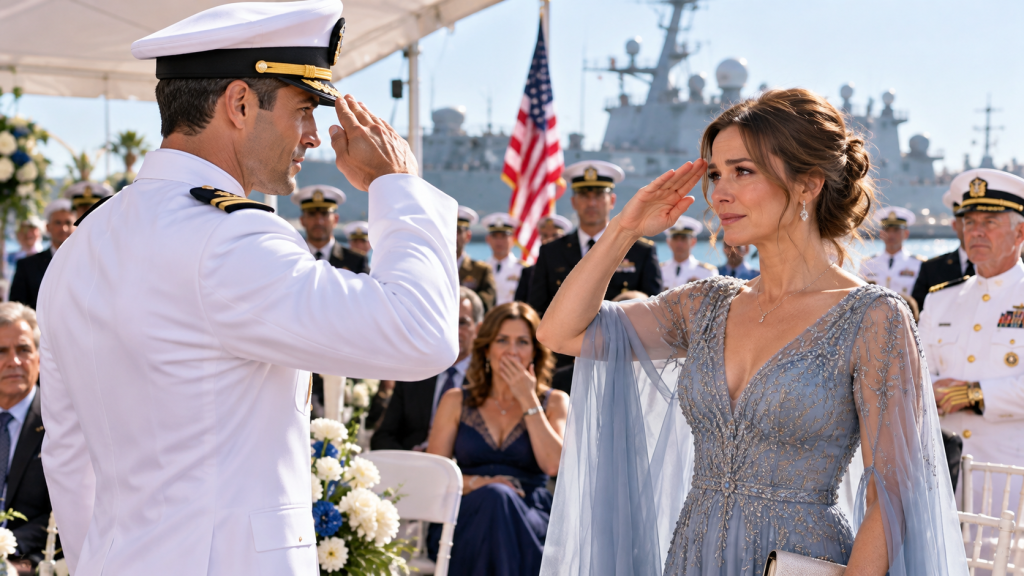
Then he stopped directly in front of my chair.
His heels came together.
His spine straightened.
And he raised his right hand in a precise military salute.
The entire tent went silent.
I stood automatically.
I returned the salute.
“Commander Carter,” he said.
My mother’s mouth fell open.
Ryan turned so sharply that the man beside him glanced over.
Hayes lowered his hand.
“Ma’am, we’ve been waiting.”
My father found his voice first.
“Waiting for what?”
Hayes didn’t answer him.
He gestured toward an empty chair beside the stage.
A white card rested against its back.
COMMANDER EMILY A. CARTER, UNITED STATES NAVY.
My mother stared at it.
Then at me.
Then back at the chair.
“Commander?” she whispered.
Ryan took one step out of formation.
“Emily isn’t a commander.”
Hayes turned toward him.
“Petty Officer Carter, I suggest you remember where you are.”
Ryan stopped moving.
His face had gone pale.
Hayes leaned closer to me.
“They arrived twenty minutes ago.”
My stomach tightened.
“Both?”
“Both.”
For a moment, I forgot the hundreds of people surrounding us.
The smell of ocean air disappeared.
The music faded.
I was no longer standing in California.
I was back in a dark mountain valley twelve years earlier, listening to a man fight for every breath.
Hayes continued quietly.
“The Pentagon authorized the disclosure at 0530.”
I swallowed.
“How much?”
“Everything authorized for public release. The rest goes to the investigators today.”
Behind me, Dad whispered, “What disclosure?”
But before I could answer, a black government vehicle entered through the checkpoint.
Two additional vehicles followed.
Senior officers near the platform rose immediately.
The first vehicle stopped beside the ceremonial tent.
Its rear door opened.
A man stepped out.
He was older than I remembered.
His hair had turned almost completely white.
He used a cane, and his left leg dragged slightly with every step.
But I recognized his posture.
His shoulders.
The way he paused before looking at a crowd.
I would have recognized him anywhere.
My fingers curled against my scarred palm.
The man removed his sunglasses.
A ripple of disbelief traveled across the first few rows.
My father stood halfway out of his chair.
“No,” he whispered.
The man walking toward us was Admiral Thomas Vance.
Twelve years earlier, the government had announced that he was dead.
A memorial service had been held.
A folded American flag had been presented to his daughter.
His photograph had appeared in newspapers across the country.
His name had been carved into a memorial wall.
And now he was standing less than twenty feet away from me.
He stopped in front of Hayes.
The commander saluted.
Vance returned it.
Then the admiral turned toward me.
For several seconds, neither of us spoke.
I could see the faint white scar running beneath his jaw.
I remembered exactly how he’d received it.
I remembered the smoke.
The gunfire.
The blood.
I remembered pressing my hands against his chest while he whispered that his daughter couldn’t grow up without him.
Finally, he extended his hand.
“Emily.”
My throat tightened.
“Admiral.”
He smiled faintly.
“You still sound like you’re reporting for duty.”
“You still look like you’re ignoring medical advice.”
A quiet laugh escaped him.
Then he took my hand in both of his.
“You kept your promise.”
I looked into his tired eyes.
“I wasn’t sure I had.”
“I’m standing here because of you.”
The words nearly broke me.
Before I could respond, Vance turned toward Hayes.
“Proceed with the authorized disclosure.”
My mother grabbed my wrist.
“Emily, what is going on? Who are you?”
I gently removed her hand.
“The same person I was when you asked security to move me.”
Her eyes filled with confusion.
But I had no time to explain.
Because the second vehicle door opened.
A woman stepped out carrying a sealed folder.
She wore a gray suit and dark sunglasses.
Her hair was shorter than I remembered.
There were new lines around her mouth.
But I recognized her immediately.
Dr. Sarah Kessler.
A civilian intelligence analyst.
One of the finest minds I had ever known.
And the second person officially killed alongside Admiral Vance twelve years earlier.
My breath caught.
Sarah looked toward my parents.
Her expression hardened when she saw my father.
Then she leaned close enough for only me to hear.
“He knows.”
I felt the blood drain from my face.
“What?”
“He received the warning yesterday,” she whispered. “And we have proof.”
My eyes moved toward Dad.
For the first time that morning, he wasn’t smiling.
He was staring at Sarah with an expression I had never seen before.
Not surprise.
Recognition.
And fear.
Sarah tightened her grip on the folder.
“Emily, your father has been lying to you for far longer than you realize.”
I looked back at her.
“What exactly does he know?”
She hesitated.
Then she gave me an answer that changed everything.
“He knows why they tried to kill us twelve years ago.”
I wanted to believe I had misunderstood her.
I wanted to believe she was talking about some harmless detail from the operation.
But Sarah Kessler was not a woman who exaggerated.
She had spent her career identifying patterns other people overlooked.
If she said my father knew, she had evidence.
And that frightened me more than seeing a dead admiral return to life.
“Sarah,” I whispered, “are you certain?”
She nodded once.
“His authorization appears on the original movement orders. We recovered the unaltered records three weeks ago.”
I looked at my father again.
He was reaching into his jacket.
His movements were small, almost casual.
But I recognized the way his eyes kept searching for the nearest exit.
“Hayes,” I said.
The commander followed my gaze.
“I see him.”
“Don’t make a scene.”
“We have it covered.”
Two men in civilian suits moved quietly toward the side of the tent.
My father slipped his hand out of his jacket.
He looked at me.
For the first time in my life, Richard Carter appeared genuinely afraid of his daughter.
Admiral Vance noticed.
His expression darkened.
But he said nothing.
Instead, he placed one hand on my shoulder.
“Emily, the truth is coming out today. But those sailors have earned their celebration. Let’s give them that first.”
I nodded.
He was right.
Whatever my father had done, Ryan and the other graduates deserved to finish their ceremony without having it completely swallowed by a scandal.
Vance returned to the platform.
Commander Hayes addressed the audience.
“Ladies and gentlemen, we have the unexpected honor of welcoming Admiral Thomas Vance, whose survival and protected status have been formally acknowledged by the Department of Defense this morning.”
People began whispering.
Several phones rose into the air.
Hayes waited.
“His presence is connected to the public recognition of Commander Emily Carter, an intelligence officer whose service included leadership in a highly classified rescue and protection operation. The circumstances of that service prevented her from receiving public acknowledgment until today.”
I heard my mother gasp.
My father’s face had turned gray.
Ryan stood absolutely still.
Hayes continued.
“Commander Carter’s citation will be released through the appropriate channels. I ask everyone to remember that today’s primary honor belongs to the sailors who have earned their Tridents.”
Then he turned toward the graduates.
The ceremony resumed.
I barely heard the next several minutes.
My mind had already traveled twelve years into the past.
Back to the day everything changed.
I had been twenty-seven.
An intelligence officer with more determination than experience, serving on a joint task force overseas.
My family believed I was working as a civilian contractor.
That wasn’t entirely accidental.
When I left college at twenty-three, Dad had told everyone I lacked the discipline to finish anything difficult.
What he never bothered to learn was that I had left my original university because I had decided to enlist in the Navy.
I completed my degree later through military-supported education, earned my commission, and began working in intelligence.
I didn’t tell my parents.
At first, it was because Dad had made his contempt for my decision unmistakable.
He considered enlisted service beneath the career he had imagined for me.
Later, when my assignments became sensitive, maintaining a limited explanation of my employment protected both my work and the people around me.
I never set out to live a lie.
But eventually, silence became easier than trying to convince people who were determined to misunderstand me.
Ryan was different then.
He wrote to me constantly.
He told me about school, girlfriends, football, and his dreams.
He called whenever Dad criticized him.
And whenever he asked where I was, I told him the same thing.
“Somewhere boring.”
He never believed me.
“You’re probably a spy,” he joked once.
I laughed.
“Then I’d be a very bad one if I told you.”
I remembered the way he’d laughed too.
For years, that sound was one of the few things that kept me connected to home.
Then came Operation Lantern.
It began with a missing shipment.
A shipment that was supposed to contain communications equipment and replacement components for authorized military programs had been redirected through three private companies.
At first, the discrepancy looked like ordinary corruption.
Inflated invoices.
False inventory numbers.
Duplicate shipping documents.
But Sarah Kessler discovered that certain restricted components were appearing in the hands of organizations that should never have possessed them.
The same serial numbers appeared again and again.
Some had been altered.
Others had been erased from official records.
The trail led through a network of subcontractors, private shipping companies, and intermediaries with connections inside the defense establishment.
And one of those companies was called Alder Ridge Defense Solutions.
My father had been a senior logistics executive there.
At the time, I didn’t know his division was involved.
Alder Ridge was enormous.
It employed thousands of people.
Its name appeared on countless government contracts.
I had no reason to believe my father’s specific department was connected to the missing equipment.
At least, that’s what I told myself.
Admiral Vance was among the first senior officers to recognize the significance of Sarah’s findings.
He was already known for his stubbornness.
He disliked shortcuts, distrusted convenient explanations, and had an unfortunate habit of asking questions that made powerful people uncomfortable.
When he discovered that the shipments were connected to unauthorized transfers of sensitive technology, he demanded a comprehensive investigation.
Within forty-eight hours, someone tried to stop him.
The admiral was traveling through a mountainous region with a small security team when his convoy was ambushed.
Sarah was in the second vehicle.
They had been carrying evidence intended for a secure briefing.
The attack was fast.
Precisely timed.
And far too well coordinated to have been the work of ordinary criminals.
Whoever planned it knew the convoy’s exact route.
They knew when it would leave.
They knew how many vehicles were traveling.
And they knew which vehicle contained the admiral.
I was in a temporary operations center when the emergency transmission arrived.
The first words I heard were almost unintelligible.
“Convoy compromised. Multiple casualties. Request immediate extraction.”
Then the transmission cut out.
I recognized the location.
Two days earlier, I had reviewed the alternate evacuation routes in that region.
There was a service road leading toward an abandoned communications facility.
It wasn’t on the standard maps.
But I knew where it was.
I alerted the response commander and relayed the information.
Within minutes, our available rescue assets were moving.
I could have remained in the operations center.
My orders did not require me to enter the danger area.
But the communications were failing, the terrain was difficult, and the rescue team needed someone who understood the local routes and intelligence.
I volunteered to accompany the forward element.
I still remember the smell when we arrived.
Burning rubber.
Hot metal.
Diesel fuel.
Dust.
One vehicle had rolled onto its side.
Another was burning.
The third was wedged against a rock wall, its windshield shattered.
We found Sarah first.
She had a broken arm and a deep cut above her eyebrow.
She was trying to pull a wounded security officer away from the wreckage.
“Where’s Vance?” I shouted.
She pointed toward the overturned vehicle.
I ran.
The admiral was trapped beneath twisted metal.
His left leg was crushed.
Blood soaked his uniform.
When I reached him, he was conscious.
Barely.
“Lieutenant,” he rasped.
“Sir, don’t talk.”
“Sarah?”
“Alive.”
His eyes closed briefly.
Then he grabbed my sleeve.
“My daughter.”
I pressed a field dressing against his wound.
“Sir, help is coming.”
“She’ll think I abandoned her.”
“You’re not going anywhere.”
He shook his head.
“Promise me.”
I leaned closer.
His voice was almost gone.
“Don’t let my daughter grow up without me.”
I looked at the man bleeding beneath my hands.
I knew how serious his injuries were.
But something about the terror in his eyes made me forget every professional boundary.
“I promise,” I whispered.
And then gunfire erupted again.
One of the men providing cover shouted for us to move.
Our extraction route had been compromised.
The attackers were returning.
For the next twenty minutes, time stopped behaving normally.
I remember shouting coordinates.
I remember helping cut the admiral free.
I remember dragging Sarah through smoke.
I remember a young sailor named Eli Torres kneeling beside me as we lifted Vance onto a stretcher.
Eli was twenty-four.
He had a wife named Rebecca and a newborn son he had only held twice.
He kept a photograph of them tucked inside his vest.
When we reached the service road, an explosion threw me against the rear of a damaged vehicle.
A jagged piece of metal sliced across my palm.
I felt the pain.
Then I forgot it.
Because Eli was down.
I crawled toward him.
He looked at me.
For a moment, his expression was almost apologetic.
“Ma’am,” he whispered. “Keep moving.”
I tried to stop the bleeding.
He pushed my hand away.
“Get them out.”
I wanted to argue.
I wanted to tell him nobody was being left behind.
But I could hear the rescue helicopter approaching.
And I could see the admiral losing consciousness.
Eli understood something I wasn’t ready to accept.
We couldn’t save everyone.
That was the worst lesson I ever learned in uniform.
The rescue team evacuated Vance, Sarah, and the surviving personnel.
Eli died before the final aircraft departed.
I carried his photograph home.
For years, I could still remember every detail of the baby’s face.
That night, the admiral underwent emergency surgery.
The doctors managed to save his life.
But within days, we discovered the ambush had been arranged by people with access to information that should have remained protected.
Our investigation had penetrated a network far more powerful than we understood.
Some of the people directing it occupied positions of public trust.
Others controlled private corporations with billions of dollars in contracts.
Our original evidence had been partially destroyed.
The surviving records were insufficient to identify everyone responsible.
And two of the most important witnesses were now targets.
Vance and Sarah.
A senior security team made an extraordinary decision.
Their deaths would be announced while they were moved into a tightly controlled witness-protection arrangement connected to the ongoing investigation.
The public record would show that both had died following the ambush.
Only a small number of authorized officials would know otherwise.
It was never meant to last twelve years.
But the investigation spread.
Evidence disappeared.
Witnesses changed their stories.
People who had initially agreed to cooperate suddenly refused to speak.
Every time we got close to the people at the top, another layer of protection appeared.
And as the years passed, keeping the admiral and Sarah alive required maintaining the deception.
I became one of the officers responsible for coordinating their protection and the continuing investigation.
I changed assignments.
Worked under restricted personnel records.
Spent holidays in windowless rooms.
Missed birthdays.
Missed family celebrations.
Missed Ryan’s college graduation.
And watched my parents transform my absence into proof that I didn’t care about them.
There were times I wanted to tell them everything.
Especially Ryan.
But I couldn’t.
A careless conversation could expose people whose lives depended on our silence.
I thought that someday, when the investigation ended, my family would understand.
I was wrong about that too.
By the time I was promoted to commander, my parents had stopped asking when I was coming home.
Instead, they asked why I still hadn’t found a husband.
Why I didn’t own a large house.
Why I didn’t have children.
Why I couldn’t be more like Ryan.
I had survived attacks, buried friends, and spent years trying to dismantle a criminal network that had cost innocent people their lives.
But at Thanksgiving, my mother still introduced me as her daughter who “never really found her direction.”
And my father would smile as if that explained everything.
I let them.
For a long time, I told myself their opinions didn’t matter.
But standing beneath that tent in Coronado, watching their shocked expressions, I realized how deeply their rejection had wounded me.
Not because I needed them to admire my rank.
But because they had never needed evidence of failure before deciding I was one.
The ceremony concluded with applause.
Ryan received congratulations from his fellow graduates.
Families rose and rushed forward.
But my parents remained frozen beside their chairs.
Admiral Vance approached me again.
“Commander, we need to move.”
I glanced at Ryan.
He stood several yards away, watching us.
For a moment, our eyes met.
I wanted to tell him I was proud of him.
I wanted to embrace him.
But two plainclothes investigators were already approaching my father.
Vance followed my gaze.
“The investigation team has secured the records,” he said. “Your father’s presence here wasn’t a surprise.”
My stomach dropped.
“You knew he was coming?”
“We knew he would attend his son’s ceremony. We didn’t know what he would do once he discovered we were alive.”
Sarah stepped closer.
“Emily, there’s something else.”
She opened her folder.
Inside was a photograph.
It showed a much younger version of my father standing beside a man in a dark suit outside a private airfield.
I knew the man.
Everyone involved in Operation Lantern knew him.
His name was Victor Sloane.
Officially, he was a retired security consultant.
Unofficially, he had been the financial architect behind the illegal transfers we’d spent twelve years investigating.
He had avoided prosecution repeatedly.
Not because he was innocent.
But because witnesses disappeared and records were altered before investigators could establish the complete case.
The photograph had been taken six weeks before the ambush.
My father and Sloane were shaking hands.
“Where did you get this?” I asked.
“From the recovered archive,” Sarah replied.
She turned another page.
A shipping manifest appeared.
Beneath the authorization box was a signature.
Richard M. Carter.
I recognized his handwriting.
I had seen that signature on school forms, birthday checks, mortgage papers, and Christmas cards throughout my childhood.
My voice came out barely above a whisper.
“What was he authorizing?”
Sarah’s eyes filled with sadness.
“The change in movement schedules that exposed Admiral Vance’s convoy.”
The world seemed to tilt.
“No.”
“Emily—”
“No. He worked in logistics. He might have signed something without knowing what it meant.”
“I wanted to believe that too.”
She produced another document.
An internal message.
It had been recovered from an archived company communications system.
The sender was my father.
The recipient was Victor Sloane.
The message was dated forty-eight hours before the ambush.
The revised route is confirmed. The primary passenger will be traveling with the package. Payment must clear before departure.
I couldn’t breathe.
For twelve years, I had remembered Eli Torres’s final words.
For twelve years, I had wondered who betrayed our convoy.
And now I was holding evidence that my own father had helped arrange the attack.
I gripped the photograph so tightly it bent beneath my fingers.
“Are you telling me my father knew they were going to kill those people?”
Sarah didn’t answer immediately.
That silence told me more than words could.
“There’s another message,” she said.
I shook my head.
I didn’t want to see it.
But she placed the document in my hand.
It had been sent the morning after the attack.
My father had written:
The situation is worse than expected. Tell me the witnesses are dead.
I read those words three times.
Then I looked across the tent.
My father was speaking urgently to one of the investigators.
His face was red.
His hands moved angrily.
For years, I’d believed he was simply disappointed in me.
Now I wondered whether his contempt had been something else entirely.
A defense.
A way to keep me distant.
Because somewhere beneath his expensive suits, his carefully arranged family photographs, and his speeches about honesty, Richard Carter had been living with a secret that could destroy him.
And I had spent sixteen years getting closer to uncovering it.
“Why didn’t anyone tell me?” I whispered.
Vance answered.
“Because until recently, we couldn’t prove his intent. The early records showed authorization, but not who knowingly arranged the ambush. The recovered archive changed that.”
I looked at him.
“You suspected my father?”
“For years. But suspicion isn’t proof.”
I felt sick.
“Did you keep me on the investigation because of him?”
“No,” Vance said firmly. “Your assignment predated the discovery of his involvement. Once the conflict became clear, you were removed from decisions involving him.”
I remembered.
Two years earlier, my superiors had reassigned me from a particular financial investigation.
They had told me the case required an independent team.
I had been furious.
Now I understood.
Vance’s expression softened.
“Emily, I owe you an apology. You spent years carrying a burden without knowing how close the source of it was to your own home.”
I looked down at the scar across my hand.
Then I asked the question that terrified me most.
“Did my father know I was there that day?”
Sarah looked away.
Vance’s jaw tightened.
And before either could answer, a familiar voice came from behind us.
“Yes.”
I turned.
My father stood several feet away.
Two investigators remained beside him.
My mother was crying.
Ryan stood behind her, his new Trident glinting beneath the afternoon sun.
Dad looked directly at me.
“I knew you were involved, Emily.”
He swallowed.
“But I didn’t know you were going to survive.”
For several seconds, I couldn’t move.
I had imagined many things about the day our investigation finally ended.
I had imagined relief.
Vindication.
Perhaps even peace.
But I had never imagined standing before my father and hearing him admit that he knew I might die.
“You knew?” I repeated.
He lowered his eyes.
“Not at first.”
“Then when?”
He glanced toward the investigators.
“After the convoy was attacked, Sloane called me. He said a rescue team was being sent into the area. He mentioned your name.”
I stared at him.
“And you said nothing?”
“I didn’t know what to do.”
“You could have warned someone!”
His expression twisted.
“By then, it was too late.”
“No, Dad. It wasn’t too late. The attackers returned after the rescue began. Eli Torres died in that second attack.”
My voice cracked.
“He was twenty-four years old. He had a wife and a baby.”
Dad looked away.
“He wasn’t supposed to die.”
The words struck me like a physical blow.
I took one step toward him.
“Who was supposed to die?”
He said nothing.
I asked again.
“Who, Dad?”
His mouth opened.
Then closed.
Finally, he whispered, “The admiral.”
Behind me, Sarah inhaled sharply.
My mother made a small, broken sound.
Ryan stared at our father as though he had never seen him before.
Dad began talking quickly.
He said Alder Ridge had been struggling financially.
He claimed he had been pressured into approving certain shipments.
At first, it was only paperwork.
Then there were payments.
Then favors.
By the time he understood the scale of the operation, he claimed he was too deeply involved to escape.
“They threatened us,” he insisted. “They knew where we lived. They knew your mother’s routine. They knew Ryan’s school.”
I listened without interrupting.
“They told me the admiral was going to expose everything. If he did, I would go to prison. We’d lose the house. Your mother would have nothing.”
“So you helped them kill him?”
“I was protecting my family!”
“No,” I said.
The word came out quietly.
But it silenced him.
“You were protecting your reputation. Your money. Your comfortable life.”
His face hardened.
“You have no idea what I sacrificed for this family.”
I looked at the expensive watch on his wrist.
The tailored suit.
The polished shoes.
Then I thought of Rebecca Torres, opening the door to uniformed officers carrying news that her husband would never return.
I thought of a little boy growing up with nothing but photographs of his father.
“You want to talk about sacrifice?” I asked.
My father didn’t answer.
“You bought your beautiful house with money connected to an operation that killed people. Then you spent years telling me I was the family disappointment.”
His eyes filled with anger.
“Watch your tone.”
I almost laughed.
Even now.
Even with federal investigators standing beside him.
Even with his crimes exposed.
My father still believed he could order me back into the role of obedient daughter.
“No,” I said. “You don’t get to do that anymore.”
He looked startled.
“You don’t get to demand respect while refusing to show it. You don’t get to call yourself a good father because you paid bills and bought Christmas presents.”
I stepped closer.
“And you don’t get to pretend you did this for me.”
His voice dropped.
“Emily, please.”
I had waited almost forty years to hear my father plead with me.
I never imagined it would feel so empty.
Sarah approached us.
“Richard, there’s one more thing we need to discuss.”
She held up a document.
“Yesterday afternoon, a message was sent from a device registered to one of your consulting accounts. It warned Victor Sloane that Admiral Vance and I were alive.”
My father went still.
“The message included the time and location of this ceremony,” Sarah continued. “And it identified Emily as the officer connected to our protection.”
I stared at him.
“You told Sloane I was here?”
Dad said nothing.
“After everything he did, you told him where to find me?”
“I didn’t know what he was planning.”
I shook my head.
“You keep saying that.”
An investigator stepped forward.
“Mr. Carter, we need you to accompany us.”
Dad took a step backward.
My mother reached toward him.
“Richard, tell them it’s a misunderstanding.”
He ignored her.
Instead, he looked at Ryan.
“Son, you understand. Everything I did was for this family.”
Ryan remained motionless.
Dad extended his hand.
“Ryan?”
My brother slowly removed the ceremonial cap he was holding.
Then he said something I will remember for the rest of my life.
“You taught me that a Carter never runs from responsibility.”
Dad nodded desperately.
“Exactly.”
Ryan’s eyes glistened.
“So stop running.”
My father stared at him.
Ryan continued.
“You told me being a man meant keeping your word, protecting people who couldn’t protect themselves, and standing up for what was right.”
He glanced at me.
“Emily did those things.”
Then he looked back at Dad.
“You didn’t.”
My father tried to step past him.
Ryan didn’t touch him.
He simply stood in his way until the investigators approached.
Dad looked from Ryan to me.
For one moment, I thought he might apologize.
Instead, he whispered, “You destroyed this family, Emily.”
I felt the final piece of my childhood break.
“No, Dad.”
My voice was steady.
“I just stopped helping you hide what you did.”
The investigators escorted him toward a waiting vehicle.
He walked past the same rows of chairs where he’d laughed at me less than two hours earlier.
People stared.
My mother sank into a chair.
Madison lowered her phone.
And the man who had spent his life obsessed with appearances left the ceremony unable to control what anyone thought of him.
I watched until the vehicle disappeared.
Only then did I realize I was shaking.
Admiral Vance placed a hand on my shoulder.
“Emily.”
I turned toward him.
His face was filled with concern.
“You don’t have to hold everything together right now.”
Those words nearly undid me.
For years, people had relied on me to remain calm.
To make decisions.
To carry information I couldn’t share.
To keep moving when everything inside me wanted to stop.
But nobody had ever told me I was allowed to fall apart.
I looked toward the empty road.
Then I whispered, “He knew, Admiral.”
Vance nodded.
“He knew Eli was going to die.”
“We don’t know that he knew Eli specifically would be killed.”
“But he knew what those people were capable of.”
“Yes.”
I covered my mouth.
Twelve years of grief seemed to rise all at once.
I thought of Eli’s photograph.
His little boy.
The letters I’d written to Rebecca that never felt sufficient.
I had spent more than a decade searching for the people responsible.
And one of them had been sitting across from me at Thanksgiving dinner, complaining that I wasn’t successful enough.
Vance waited beside me.
He didn’t offer empty assurances.
He didn’t tell me everything would be fine.
He simply stayed.
And somehow, that mattered more.
Eventually, I wiped my face.
“What happens now?”
“Your father will face the evidence in court. Sloane was taken into custody at a private airfield earlier this morning. The remaining suspects are being handled through separate operations.”
I closed my eyes.
“So it’s really over?”
“The investigation isn’t over. But the part that required Sarah and me to remain hidden has ended.”
He looked toward the ocean.
“For the first time in twelve years, I can go home.”
His voice broke on the final word.
And suddenly, I remembered his daughter.
“Grace,” I whispered.
He nodded.
“She’s here.”
I looked at him in surprise.
“Where?”
“In the visitors’ building. Her aunt brought her after the disclosure was authorized.”
My chest tightened.
“How old is she now?”
“Nineteen.”
Nineteen.
The little girl who had been seven when her father’s flag was folded and handed to her had become a young woman.
She had spent twelve years believing he was buried somewhere beneath a military headstone.
And now she was waiting to meet a man who had watched her grow up from a distance.
“Are you ready?” I asked.
Vance looked at me.
“No.”
It was the first time I’d ever heard him admit fear so openly.
“What if she hates me?”
I looked at his cane.
The scars beneath his jaw.
The exhaustion in his eyes.
“Then let her,” I said gently. “She’s earned the right to be angry.”
He swallowed.
“And what if she never forgives me?”
“Then you keep showing up anyway.”
He studied my face.
I gave him a small smile.
“That’s what fathers are supposed to do.”
We walked together toward the visitors’ building.
Sarah accompanied us.
At the entrance, a young woman stood beside an older lady.
She had dark brown hair and the admiral’s unmistakable eyes.
Grace Vance.
I recognized her immediately.
She was holding a faded photograph.
A photograph of herself as a child, sitting on her father’s shoulders at a beach.
When she saw him, she stopped breathing.
Vance froze.
For twelve years, he had survived gunshot wounds, hidden under another identity, and endured the crushing loneliness of watching his daughter grow up through carefully protected photographs and reports.
But standing before her seemed harder than any of it.
“Gracie,” he whispered.
She didn’t move.
He took one uncertain step forward.
“Sweetheart.”
Tears began sliding down her cheeks.
“You were alive?”
His face crumpled.
“Yes.”
“All this time?”
“Yes.”
She looked at him with such terrible pain that I had to turn away.
“I buried you,” she whispered.
Vance lowered his head.
“I know.”
“I talked to your grave.”
His hands trembled.
“I know.”
“I graduated high school without you. I learned to drive without you. I had birthdays where I wished you would come back.”
Vance began crying.
There was no dignity left in his expression.
Only grief.
“I wanted to come home every single day.”
Grace shook her head.
“But you didn’t.”
“No.”
“Why?”
He explained as much as he could.
The threats.
The people who still wanted him dead.
The danger to anyone connected to him.
He didn’t present those things as excuses.
He simply told her the truth.
When he finished, Grace stared at him for a long moment.
Then she whispered, “I’m still angry.”
“You should be.”
“I don’t know how to forgive you.”
“You don’t have to decide today.”
She looked down at the photograph in her hands.
Then slowly, she stepped forward.
Vance opened his arms.
And his daughter embraced him.
He held her as if she might disappear.
I stood beside Sarah with tears running down my face.
I had saved the admiral’s life twelve years earlier.
But I couldn’t give his daughter those missing years.
Nothing could.
All I could do was be grateful that they still had time to build something new.
As we left them alone, Sarah slipped her arm through mine.
“You know,” she said softly, “he talked about you constantly.”
I glanced at her.
“Vance?”
She nodded.
“He kept saying that when the truth finally came out, he wanted your family to understand what kind of woman you’d become.”
I gave a bitter little laugh.
“Apparently, they got a fairly dramatic explanation.”
Sarah squeezed my arm.
“You deserved something gentler.”
I didn’t know how to answer.
Because for the first time in years, I wasn’t certain what I deserved.
Only what I was no longer willing to accept.
When I returned to the reception area, Ryan was waiting outside.
He had changed out of his dress uniform.
His Trident was safely pinned to the uniform jacket hanging over his arm.
For a moment, neither of us spoke.
Then he said, “Can we talk?”
I nodded.
We walked toward a quieter section of the base.
The ocean glittered beyond the fence.
A helicopter passed overhead.
Ryan stopped beside a bench.
He looked strangely young.
Almost like the teenager who had once called me because he was afraid to tell Dad he’d failed a chemistry exam.
“I don’t know where to start,” he admitted.
“Neither do I.”
He looked at the ground.
“Are you really a commander?”
“Yes.”
“For how long?”
“Several years.”
“And you were an intelligence officer before that?”
“Yes.”
He exhaled.
“Why didn’t you tell me?”
I sat on the bench.
“Some of my assignments couldn’t be discussed. And after a while, I didn’t know how to explain the distance between us.”
Ryan sat beside me.
“I thought you didn’t care.”
I turned toward him.
“Ryan—”
“You missed my graduation. My commissioning celebration when I enlisted. My birthday dinners. When I called you, half the time you didn’t answer.”
His voice shook.
“Mom said you’d always been jealous of me.”
I stared at him.
“She said what?”
He nodded.
“She told me you couldn’t stand the fact that I was doing something meaningful with my life.”
Pain swept through me.
For years, I’d imagined Ryan distancing himself because he had simply grown closer to our parents.
Now I understood that they had spent those same years shaping the way he saw me.
“Ryan,” I whispered, “I was never jealous of you.”
He looked at me.
“I know that now.”
“I was proud of you when you joined the Navy. I was proud when you decided to pursue special warfare. I was proud every time I heard you’d passed another difficult stage.”
“You knew?”
I smiled sadly.
“Some things aren’t difficult to find out when you know where to ask.”
He looked down at his hands.
“Did you ever come to any of my events?”
I hesitated.
Then nodded.
“Your high school graduation.”
His head snapped up.
“You were there?”
“I stood near the back. I couldn’t stay afterward.”
“Why?”
“I had to leave for an assignment that evening.”
He covered his face.
“I remember looking for you.”
“I know.”
“I thought you hadn’t bothered.”
I swallowed.
“I’m sorry.”
Ryan shook his head.
“No. I’m the one who’s sorry.”
His voice broke.
“Today, I told you not to embarrass me.”
I said nothing.
He looked at me.
“I let Mom humiliate you. I let Dad laugh at you. I stood there while Madison treated you like you weren’t family.”
Tears gathered in his eyes.
“And I didn’t say anything.”
He swallowed hard.
“I’m supposed to be training to protect people. And I couldn’t even stand up for my own sister.”
I felt my throat tighten.
“Ryan, you earned your Trident. Nothing about today changes that.”
“But it changes how I see myself.”
I reached for his hand.
He gripped mine.
“I don’t want you to admire me because of my rank,” I said.
He looked confused.
“I wanted you to respect me when you thought I was nobody.”
The words hung between us.
Ryan lowered his head.
“I know.”
For a long time, we sat in silence.
Then he noticed the scar across my palm.
He touched it gently.
“Is this from that rescue?”
“Yes.”
“Does it still hurt?”
“Sometimes.”
He nodded.
Then he whispered, “I’m glad you survived.”
I looked toward the ocean.
“So am I.”
He leaned forward and embraced me.
At first, I sat stiffly.
Then I wrapped my arms around him.
And for a brief moment, I felt as though I had gotten my little brother back.
Not completely.
We had too many years to repair.
Too many conversations we’d never had.
But there was something genuine in that embrace.
Something worth protecting.
When Ryan finally pulled away, he smiled through his tears.
“Congratulations, Commander Carter.”
I smiled back.
“Congratulations, Petty Officer Carter.”
He laughed.
And that was the moment I knew our relationship might survive what our father had done.
Not because we could erase the past.
But because we were finally willing to acknowledge it.
My mother approached us just before we left.
She looked exhausted.
Her makeup had run.
Her pearl necklace hung crookedly against her blouse.
She stopped several feet away.
“Emily.”
I stood.
“Mom.”
She stared at me.
“I don’t know what to say.”
For once, I believed her.
She looked toward the building where my father had last been questioned.
“Did you really not know what he was doing?”
“No.”
She pressed her fingers to her lips.
“I lived with that man for forty-two years.”
I waited.
“And I didn’t know him.”
I wanted to comfort her.
Part of me instinctively wanted to put my arms around her and tell her everything would be all right.
But another part of me remembered every dinner where she had ridiculed my choices.
Every birthday she had forgotten.
Every Christmas where she asked when I would finally give her something to be proud of.
My father’s crimes did not erase her behavior.
“Mom,” I said gently, “I believe you didn’t know about his work.”
She nodded desperately.
“But you knew how he treated me.”
Her expression changed.
“You heard him call me a failure. You heard him mock my education, my job, my relationships. You watched him turn Ryan against me.”
Tears filled her eyes.
“I didn’t realize—”
“You didn’t ask.”
She went silent.
“You never asked if I was happy. You never asked whether I was safe. You never asked why I was gone so often.”
My voice began trembling.
“You just decided I was disappointing.”
My mother began crying.
“I was wrong.”
I looked at her.
For years, those were the words I had wanted to hear.
But now that she’d spoken them, I realized an apology couldn’t automatically repair sixteen years of rejection.
“Thank you for saying that,” I replied.
She stepped closer.
“Can we start over?”
I looked at Ryan.
Then back at her.
“We can try.”
Hope flickered across her face.
“But things will have to change.”
She nodded.
“No more jokes about my life. No more comparisons. No more pretending it doesn’t hurt when you humiliate me.”
“I understand.”
“And Mom?”
“Yes?”
“The next time someone calls me the disappointing sister, I need you to remember that I deserved your defense even before you knew I was a commander.”
She covered her mouth.
Then nodded through her tears.
“I will.”
I hoped she meant it.
But I had learned that change was measured in actions, not promises.
And I was finally willing to give myself the time to find out.
The months that followed were unlike anything I had ever experienced.
The return of Admiral Vance became national news.
Reporters gathered outside military installations.
Former colleagues who had attended his memorial struggled to understand how a man publicly declared dead could suddenly reappear.
The government released carefully reviewed information about the long-running corruption investigation and the protected-witness arrangements.
Some records remained classified.
Others were provided to prosecutors.
Victor Sloane faced charges connected to the illegal transfers and the conspiracy that led to the ambush.
My father faced charges of his own.
The evidence against him was devastating.
Financial records showed millions moving through companies connected to the unauthorized transactions.
Recovered communications established that he had knowingly supplied operational information.
Further messages showed he had continued communicating with Sloane long after the attack.
He had not simply made one terrible decision.
He had made hundreds.
Again and again, whenever he had a chance to stop, he chose to protect himself.
Eventually, he entered a guilty plea to several serious offenses as part of an agreement requiring his cooperation in the remaining prosecutions.
I testified about what I had witnessed during the rescue and its aftermath.
It was one of the hardest things I had ever done.
Not because I was afraid of my father.
But because I had spent my entire childhood wanting his approval.
And now I was sitting in a courtroom, telling the truth about actions that had cost people their lives.
When I finished, he looked at me.
For one brief moment, I saw something that might have been regret.
But he never apologized.
Not to me.
Not to Rebecca Torres.
Not to the families whose loved ones never came home.
I eventually accepted that the apology might never come.
And more importantly, I accepted that I didn’t need it to move forward.
My father’s guilty plea did not heal the wound he’d caused.
But it meant I no longer had to organize my life around his refusal to acknowledge the truth.
Six months after the ceremony, I attended another gathering.
This one was smaller.
Quieter.
And far more meaningful to me.
The Navy had arranged a formal presentation of a valor decoration whose original recommendation had remained classified.
Admiral Vance attended.
So did Sarah.
Several officers who had served during Operation Lantern were present.
And seated in the front row were two people I had never expected to see together again.
My mother.
And Ryan.
This time, nobody asked me to move.
Nobody questioned whether I belonged.
But the most important person in the room wasn’t wearing a uniform.
She was sitting near the aisle beside a young man with his father’s eyes.
Rebecca Torres.
And her son, Daniel.
Daniel was twelve now.
The same age as the mission that had taken his father.
When I saw him, I nearly lost my composure.
He had Eli’s dark hair.
His smile.
Even the same slightly crooked front tooth.
Rebecca approached me before the presentation.
She placed a small photograph in my hand.
It showed Eli holding his newborn son.
“He would have been proud of you,” she said.
I shook my head.
“He should be here.”
Her eyes filled.
“Yes,” she whispered. “He should.”
I looked at Daniel.
He stood beside his mother, holding a folded piece of paper.
Then he stepped forward.
“Commander Carter?”
I knelt slightly so we were closer to eye level.
“Yes?”
“My mom told me you tried to save my dad.”
My throat tightened.
“I did.”
“She said you never forgot him.”
“Never.”
He unfolded the paper.
It was a drawing.
A helicopter hovering above mountains.
Beneath it, in careful handwriting, were the words:
THANK YOU FOR BRINGING HIS STORY HOME.
I pressed the paper against my chest.
For the first time in years, I cried without trying to hide it.
Because that little boy understood something my father never had.
A person’s worth couldn’t be measured by money, status, or the admiration of strangers.
It was measured by what they were willing to do when someone else needed them.
During the ceremony, the citation described courage under fire.
Leadership.
Determination.
The successful extraction of wounded personnel under extraordinary circumstances.
But when I stepped to the microphone, I didn’t talk about myself.
I spoke about Eli.
About the other men who never returned.
About Sarah’s determination to uncover the truth.
About Admiral Vance’s years of sacrifice.
And about the families who had carried grief without knowing why.
Then I looked toward Ryan.
He was sitting perfectly straight.
His hands rested on his knees.
His eyes were wet.
“Service,” I said, “is not always visible. And courage doesn’t always receive applause. Sometimes the people making the greatest sacrifices are the ones whose stories nobody knows.”
I paused.
“But we should never require someone to prove they’re extraordinary before treating them with ordinary kindness.”
My mother’s face crumpled.
Ryan lowered his head.
And I knew they understood.
Not everything.
Not the nights I still woke from nightmares.
Not the guilt I carried for Eli.
Not the loneliness of spending years unable to tell anyone where I was.
But enough.
Enough to begin treating me as a person rather than a disappointment.
After the ceremony, Grace Vance found me in the hallway.
She looked happier than she had in Coronado.
Her father was walking slowly behind her, leaning on his cane.
They had spent months getting to know each other again.
It hadn’t been easy.
There had been arguments.
Tears.
Difficult conversations about everything he’d missed.
But he had kept showing up.
Grace had just started college.
And the admiral was helping her move into her dormitory the following week.
“He’s terrible at shopping,” she whispered to me.
I smiled.
“Really?”
“He bought enough laundry detergent for an entire apartment building.”
Vance approached.
“I heard that.”
Grace laughed.
“Good.”
Then she looked at me.
Her expression grew serious.
“Emily, I wanted to thank you.”
“You don’t have to.”
“Yes, I do.”
She took my hand.
“I know you couldn’t bring him home when I was little. I know you tried.”
My eyes burned.
“But because you saved him, I get to know him now.”
She smiled through her tears.
“And that’s more than I thought I’d ever have.”
I hugged her.
For the first time since Operation Lantern, the promise I’d made in that dark mountain valley didn’t feel like a failure.
I couldn’t give Grace back her childhood.
But I had helped give her a future with her father.
And sometimes, that had to be enough.
A year after the Trident ceremony, Ryan invited me to dinner.
Just the two of us.
No parents.
No cousins.
No complicated expectations.
He was stationed on the West Coast and had found a small seafood restaurant overlooking the harbor.
When I arrived, he was already waiting.
He stood and pulled out my chair.
I smiled.
“Very formal, Petty Officer.”
He grinned.
“I’m trying to impress a commander.”
We ordered dinner.
Talked about work within the boundaries we could share.
Laughed about our childhood.
He told me he’d started keeping a photograph of us together in his apartment.
Not the formal picture from the ceremony.
An old photograph.
One taken when he was eight and I was nineteen.
In it, Ryan sat on my shoulders at a county fair, laughing so hard his eyes were closed.
I remembered that day.
Our father had been furious because Ryan spilled lemonade down the front of his new shirt.
I’d taken my brother away from the argument and bought him another cup.
He had spent the rest of the afternoon holding my hand.
“Why that picture?” I asked.
Ryan grew quiet.
“Because that’s who you were before I let everyone convince me you were something else.”
I looked at him.
He swallowed.
“I can’t change how I treated you.”
“No.”
“But I can make sure it doesn’t happen again.”
I smiled.
“That would mean a lot.”
He reached into his pocket.
Then he placed something on the table.
A small silver bracelet.
I recognized it immediately.
I’d given it to him on his seventeenth birthday.
It carried a tiny engraved compass.
On the back were five words.
I’LL ALWAYS FIND MY WAY BACK.
My breath caught.
“You kept this?”
He nodded.
“All these years.”
“I thought you threw it away.”
“I almost did.”
He looked ashamed.
“Dad told me it was cheap. He said it proved you couldn’t afford a proper present.”
I closed my eyes.
Of course he had.
“But I couldn’t throw it away,” Ryan continued.
“Why?”
“Because I remembered what you told me when you gave it to me.”
I looked at him.
He smiled faintly.
“You said that no matter where life took us, I would always have a sister who came back when it mattered.”
Tears filled my eyes.
“I meant it.”
“I know.”
He pushed the bracelet toward me.
“I wanted to give it back.”
I shook my head.
“Ryan, it’s yours.”
“I know.”
He smiled.
“But I’d like you to wear it for a while. Until I can give you something better.”
I picked it up.
The tiny compass caught the light.
I fastened it around my wrist, beside the old silver watch that had belonged to Eli.
For the first time in years, those two objects didn’t feel like reminders of what I had lost.
They felt like reminders of what I’d managed to keep.
My mother and I continued working on our relationship.
Slowly.
She began calling without asking about marriage.
She asked about my interests.
My friends.
My health.
She learned to listen when I told her I couldn’t discuss something.
Sometimes she slipped into old habits.
Sometimes I had to remind her that comparison wasn’t affection.
But she apologized without arguing.
And she made an effort to change.
I didn’t pretend the years of hurt had disappeared.
I simply allowed the possibility that the future didn’t have to look like the past.
As for my father, I eventually stopped waiting for a letter that might contain an apology.
I had spent enough of my life hoping he would become someone different.
I no longer wanted to waste the years ahead chasing an approval he had never freely given.
One evening, nearly two years after that unforgettable morning in Coronado, I sat alone on the balcony of my apartment.
The ocean stretched beyond the buildings.
A warm breeze moved through the trees.
My phone rang.
It was Ryan.
“Hey, Em.”
“Hey, little brother.”
He laughed.
“I’m almost forty, you know.”
“You’ll still be little when you’re eighty.”
He told me about his latest assignment.
Then about a promotion he’d been recommended for.
I congratulated him.
We talked for nearly an hour.
Just before hanging up, he grew quiet.
“Emily?”
“Yes?”
“Can I ask you something?”
“Of course.”
“Do you ever wish you’d told us who you really were?”
I looked down at the silver bracelet.
For a long time, I considered his question.
Then I answered.
“I used to.”
“Not anymore?”
I shook my head, even though he couldn’t see me.
“No.”
“Why?”
I watched the waves break against the shore.
“Because I spent so many years believing that if people knew what I’d accomplished, they would finally respect me.”
I paused.
“But I’ve learned something.”
“What?”
“The people who love you shouldn’t need a title, a medal, or a uniform before they decide you’re worthy of kindness.”
Ryan was silent.
Then he whispered, “You’re right.”
I smiled.
“You know what I remember most about your Trident ceremony?”
“What?”
“Not the salute.”
“Really?”
“Not the admiral arriving. Not Dad being taken away. Not even the moment everyone realized I was in the Navy.”
“What, then?”
I looked toward the fading sunlight.
“You telling me you were proud of me.”
He didn’t speak for several seconds.
Then his voice broke.
“I am proud of you, Emily.”
I closed my eyes.
And for the first time in my life, those words felt enough.
Not because I needed them to define me.
But because they were finally being offered freely.
After we ended the call, I sat outside for a long time.
I thought about the woman who had arrived at Coronado wearing a plain black dress.
The woman whose mother called her a disappointment.
Whose father laughed at her.
Whose little brother asked her not to embarrass him.
That woman had believed the most important thing about the day would be whether her family finally learned who she was.
But she’d been wrong.
The most important thing was what she learned about herself.
I had spent sixteen years carrying other people’s secrets.
I had spent nearly four decades carrying other people’s expectations.
And somewhere along the way, I had forgotten that I was allowed to live a life that belonged to me.
I was allowed to be unmarried.
To have no children.
To love my work.
To grieve my losses.
To make mistakes.
To grow older without apologizing for choices other people didn’t understand.
I was allowed to be proud of the life I’d built even if nobody ever applauded it.
And I was allowed to walk away from anyone who insisted that my worth depended on their approval.
That day at Coronado, my mother had tried to move me away from the front row.
She thought I hadn’t earned the right to sit beside my family.
But the truth was, I had belonged there all along.
Not because I was a commander.
Not because an admiral saluted me.
Not because a classified operation had finally been acknowledged.
I belonged because I was a daughter.
A sister.
A human being.
And those things should have been enough.
I glanced down at the faint scar across my palm.
Once, it had reminded me of a terrible day in the mountains.
Now, it reminded me of something else.
Surviving isn’t just about making it out alive.
Sometimes surviving means refusing to become the person other people’s cruelty tries to make you.
My father had tried to bury the truth.
My mother had tried to explain away my life.
My brother had allowed himself to believe their version of me.
But none of them had been able to change who I really was.
As the last sunlight disappeared beyond the water, I touched the little compass around my wrist.
Then I whispered the words I had once spoken to a frightened teenage boy.
“I’ll always find my way back.”
And this time, I understood their meaning differently.
For years, I thought they meant finding my way back to my family.
But in the end, the person I had needed to find my way back to most was myself.
Because the greatest victory of my life wasn’t the day the world finally discovered who Commander Emily Carter was.
It was the day I finally stopped believing I was the disappointing sister.
💬THE END! THANK YOU FOR READING!