

I told my daughter I couldn’t babysit over the bank holiday because I had cataract surgery scheduled.
She texted, “You’re choosing yourself over your grandkids.”
I didn’t argue. I didn’t beg. I just let the kettle whistle until the house went quiet.
A week later, her husband was pounding on my porch at 7 a.m., after the bank called about a £19,400 debt.
The message came at 4:47 on a Thursday afternoon, just as my old electric kettle began to tremble on the kitchen counter.
Rain had been threatening all day, pressing a grey dampness against the window, and the whole kitchen smelled of lemon washing-up liquid, old wood, and the tea towel I had left too near the sink.
My daughter’s name appeared on my phone.
Caroline.
I dried my hands, opened the message, and read the line that made something inside me go perfectly still.
“You’re choosing yourself over your own grandchildren, and that’s a hill you want to die on. Fine.”
The kettle clicked off behind me.
I did not reply.
I am sixty-eight years old. I spent forty-one years sorting post, walking routes in weather that made your bones ache, and raising Caroline on overtime, cheap dinners, school concerts after double shifts, and mornings when I smiled at her through exhaustion because children should not have to know how tired their mothers are.
All I had said was no to one bank holiday weekend.
Three days.
Caroline and her husband, Wade, wanted a break away with another couple from his office. They expected me to keep Hudson, who was four, and baby May, who was eight months old and still waking in the night.
I adore those children.
I would crawl over broken glass for them.
But I had cataract surgery booked for Tuesday.
My pre-op appointment was Saturday at 7:00 a.m., and the woman at the eye clinic had been plain with me: rest, no strain, no heavy lifting, no sleepless nights with a baby on one hip and a small boy tearing through the back garden.
So I had said, gently, “Darling, could you ask Wade’s mum, or move the trip back a week?”
Caroline did not ring.
She did not ask whether I was frightened.
She did not ask who was taking me home after surgery.
She sent that text.
I made tea with water that had already gone lukewarm and stood by the sink drinking it because sitting at my own kitchen table felt suddenly too lonely.
An hour later, my phone buzzed again.
For one foolish second, I thought it might be Caroline saying sorry.
It was Wade.
No message.
Just a screenshot.
A bank transfer reversal.
The £800 I had sent two weeks before to help with Hudson’s preschool fees had been cancelled, as if my help was an unwanted parcel being sent back.
That was when I understood this was not one angry daughter lashing out.
They had discussed it.
The message. The money. The silence.
They had made a little plan and called it boundaries.
The next morning, I drove to their house anyway.
Their car was in the drive. Wade’s truck was there too. Hudson’s little tricycle lay sideways on the grass, one blue handlebar buried in the damp lawn.
I rang the bell.
Inside, I heard children’s television. I heard Hudson talking to himself in that soft sing-song way he uses when he is building imaginary roads on the carpet.
Then I heard Caroline say something low.
Hudson went quiet.
They knew I was standing there.
They waited me out.
I stayed on that front step far too long, my hand still near the bell, my cardigan damp at the cuffs.
Then I drove to the supermarket, bought milk I did not need and frozen peas I already had, and sat in the car park for forty minutes before I could turn the key again.
When I got home, a brown envelope was propped against my door.
Caroline’s handwriting was on the front.
Inside was a typed letter.
Typed.
Somehow, that hurt more than shouting.
It said they had been reflecting on our “family dynamic.” It said I had created a “transactional relationship with money.” It said they needed “healthier patterns” and space to work things out “as a family unit.”
Caroline does not say family unit.
Caroline says, “We’ll manage, Mum.”
Wade had put those words in her mouth, or someone had put them in his, and my daughter had signed beneath them anyway.
Caroline and Wade.
Like a closed account.
I read it in the hall with the door pressing cold against my hip.
Then I went to the bench Royce built for me years ago, sat down, and laughed.
Not because any of it was funny.
Because my body could not find another sound.
When the laugh ran out, the fridge hummed. The clock ticked. One slow drip fell in the sink as if the house itself was keeping count.
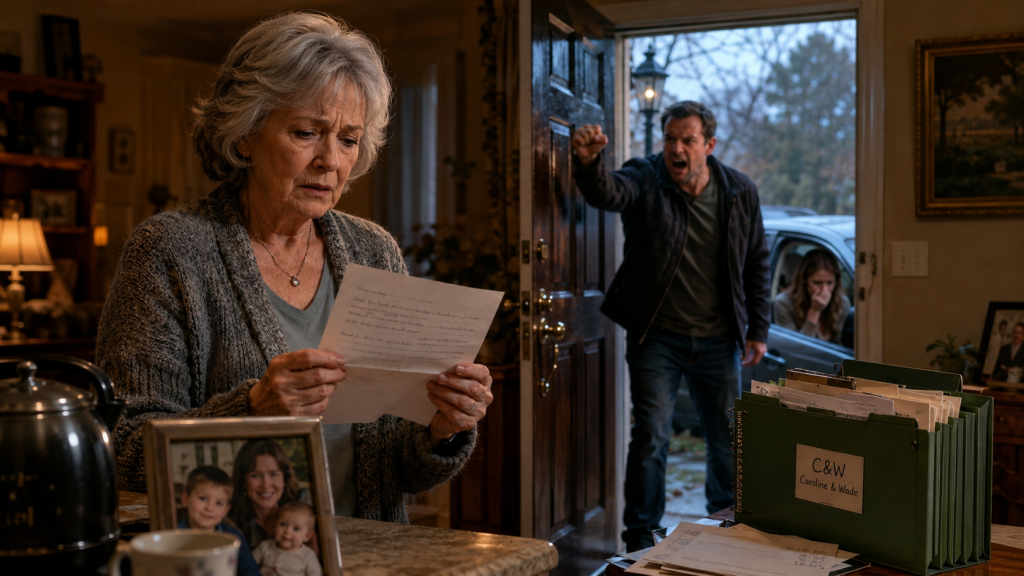
That was when I went to the spare-room cupboard and pulled down the green accordion file Royce had labelled long ago.
C&W.
Caroline and Wade.
Royce started that file after we co-signed Caroline’s first car loan and she let it slide into collections without telling us.
“Margaret,” he had said, “we are not keeping this to punish her. We are keeping it so we remember the truth when love starts editing our memory.”
I carried the file to the kitchen table.
There were bank printouts. Receipts. Hospital statements. Preschool screenshots. A cashier’s cheque for an old deposit. Help with the house. Help with the truck. Help with treatment. Help with a funeral.
Thirteen years of yes, stacked in paper and ink.
I added the known amounts on the back of a supermarket receipt.
£73,420.
That did not include petrol, groceries, birthday notes tucked into cards, emergency babysitting, school pick-ups, bottles in the night, or all the small rescues people forget once they are safely on the other side of them.
I had been useful for so long that they had mistaken me for something automatic.
There is a kind of love that disappears when you perform it too reliably. People stop seeing the sacrifice and start treating it like a direct debit.
For one sharp minute, I wanted to ring Caroline and read every line aloud.
I wanted to say, “Your father knew this day might come.”
I wanted to make her hear what thirteen years of being loved sounded like on paper.
I did not.
I closed the file.
Then I rang Royce’s old solicitor, Otis Beaman, whose office still sat above the dry cleaners.
“Otis,” I said, my voice steadier than I felt, “it’s Margaret. I need to talk about my will, my power of attorney, and a few other matters.”
He did not ask me to explain.
He simply said, “Tuesday at two?”
I looked at the green file on the table.
“I’ll be there.”
That Tuesday, I walked into his office carrying thirteen years of receipts, bank records, statements, screenshots, and one typed letter signed by my daughter as though I were an inconvenience to be managed.
Otis took one look at my face, pulled over his yellow pad, and said, “Start with the money.”
So I did.
I started with the £800 reversal. Then the preschool fees. Then the car loan. Then the deposit. Then the typed letter.
Otis wrote slowly, the way a man writes when he already recognises trouble but is waiting for paper to give it a name.
When I finished, he removed his glasses and rubbed the bridge of his nose.
“Margaret,” he said carefully, “have you checked your credit file recently?”
I frowned.
“No. Why would I?”
“Because if someone has had access to your information, old statements, your National Insurance number, utility bills, or bank details, they may have done more than ask you for help.”
A coldness spread through me that had nothing to do with the rain outside.
“You think they used my name?”
“I think we should find out before we assume anything.”
The next morning, I requested copies of everything.
Credit file. Bank history. Loan searches. Utility checks.
At first, nothing obvious appeared.
Then, buried beneath a finance search from six months earlier, I saw it.
A personal loan application.
£19,400.
Approved.
The address was mine.
The phone number was not.
The email address was one I did not recognise.
But the linked emergency contact was Caroline.
My Caroline.
I read it three times before the words made sense.
My hands went numb.
For a moment, I was not angry.
I was not even sad.
I was simply old.
Old in a way I had never felt before.
Old enough to realise the child I had carried, fed, protected, and forgiven had allowed my name to become a tool.
Otis told me not to confront them yet.
“Let the bank speak first,” he said. “Let them investigate. Do not warn anyone who may destroy evidence.”
So I waited.
I had my cataract surgery on Tuesday morning.
My neighbour, Elsie, drove me home. She made me soup, taped the plastic shield over my eye, and scolded me for trying to wash a mug.
“You sit,” she said. “For once in your life, Margaret, sit.”
So I sat.
The house was quiet.
Too quiet.
I thought of Hudson’s little roads across my carpet. May’s warm baby weight against my chest. Caroline as a girl, sleeping with one hand curled under her cheek.
I cried then.
Not loudly.
Just enough to wet the collar of my dressing gown.
A week later, at 7:00 in the morning, the phone rang.
I was standing in the hall with one eye still blurred from surgery and the clear shield taped over the other.
It was the bank.
The woman on the line said my name carefully.
Then she said the amount.
£19,400.
“Mrs. Whitmore, we are calling regarding a suspected fraudulent loan opened in your name.”
Before I could ask the second question, someone hit my front door hard enough to rattle the glass.
Once.
Twice.
Then Wade’s voice came through the porch, sharp and panicked.
“Margaret, open the door.”
I looked from the phone in my hand to the green accordion file sitting on the hall table.
And through the narrow glass, I saw my son-in-law raise his fist again.
I did not open the door.
Not right away.
I stood there with the phone pressed to my ear while Wade struck the porch again and shouted my name like I was the one who had stolen something.
The bank woman asked, “Mrs. Whitmore, are you safe?”
That question told me more than the £19,400 ever could.
“Please stay on the line,” I whispered.
Wade yelled that it was all a misunderstanding, that Caroline was crying, that I had to help before everything got worse.
Then he said the sentence that turned my blood cold.
“You were never supposed to find out this soon.”
My hand tightened around the green accordion file.
I opened the door only as far as the chain would allow.
Wade’s face was pale. His shirt was half-buttoned. His hair looked like he had been dragging his hands through it all night.
“You need to call them and say you approved it,” he hissed.
Behind him, Caroline sat in the car, crying into her hands.
For one foolish second, the mother in me rose up.
My baby was crying.
My instinct was to go to her.
Then I remembered the typed letter.
The transfer reversal.
The silent house while I stood on her step.
The £19,400.
“What did you do?” I asked.
Wade looked over his shoulder, then leaned closer.
“We had bills. You know how hard it’s been. You were helping anyway.”
“I did not give permission.”
“You would have,” he snapped. “If Caroline had asked properly, you would have said yes.”
That was the moment the last soft thread between us broke.
Because he was right about the old me.
The old me might have cried, scolded, then paid.
The old me might have said, “For the children.”
The old me might have let them turn my life into collateral one more time.
But that woman had sat alone with a lukewarm cup of tea and learned what she was worth to them.
“No,” I said.
Wade’s mouth opened.
I spoke into the phone.
“Yes, I can confirm he is here. Yes, he is asking me to lie to the bank.”
Wade’s face changed.
He stepped back from the door.
“Margaret,” he said, quieter now.
I closed the door.
Then I called Otis.
By noon, the bank had frozen the account.
By the end of the week, their investigators had traced the application IP address to Caroline and Wade’s house. The email account had been created on Wade’s laptop. The repayment direct debit had been scheduled to begin after my surgery, when they thought I would be too confused or tired to notice.
But the cruelest part was not the money.
It was the uploaded ID scan.
My passport.
The one Caroline had borrowed months earlier because she said she needed to confirm details for a family holiday booking that never happened.
When Otis showed me the copy, I sat in his office and felt every year of my life settle on my shoulders.
“She was part of it,” I said.
Otis did not soften the truth.
“Yes.”
Caroline called me that evening.
I let it ring.
Then she texted.
“Mum, please. Wade handled most of it. I didn’t understand how serious it was.”
Then another.
“We were desperate.”
Then another.
“Think of the kids.”
There it was again.
The key they always used for my lock.
The kids.
I typed slowly, because my eye still ached when I looked at the screen too long.
“I am thinking of them. That is why I will not teach them that love means stealing from family.”
I did not send more.
The police became involved because the bank required it.
I did not enjoy that.
People imagine there is satisfaction in consequences. There is not. There is only the heavy knowledge that someone you love has finally reached the line you can no longer move.
Moments came when I nearly weakened.
When Hudson left me a voicemail saying, “Nanny, why can’t we come over?” I had to sit down.
When Caroline sent a photo of May holding the knitted rabbit I made, I cried until my good eye stung.
But I did not call.
I did not rescue.
Otis updated my will. My house would go into a trust for the grandchildren, protected until they were adults. Caroline could not touch it. Wade could not borrow against it. No one could sell it to settle “temporary problems.”
I changed my power of attorney to Elsie and my nephew Daniel.
I changed the spare key box.
I changed the bank passwords.
I changed the habit of answering every demand like it was a duty.
Three weeks later, Caroline came alone.
No Wade.
No children.
Just my daughter on the porch in the rain, looking smaller than she had in years.
I opened the door with the chain on.
Her face crumpled when she saw it.
“You don’t trust me?”
I looked at her for a long time.
“I love you,” I said. “But no. I do not trust you.”
She started crying.
“I’m sorry, Mum.”
I had waited so long for those words that I thought they would feel bigger when they arrived.
They did not.
They were just words.
Wet. Late. Shaking.
“Are you sorry you did it,” I asked, “or sorry the bank called?”
She covered her mouth.
That was answer enough.
I closed my eyes.
“Caroline, I raised you. I know your silences.”
She whispered, “What happens now?”
“Now you tell the truth. To the bank. To the police. To yourself. And you get help.”
“What about us?”
I thought of Royce. His careful handwriting on the green file. His warning that love edits memory.
Then I said the hardest sentence of my life.
“There is no us until there is honesty.”
She left in the rain.
Months passed.
The legal process moved slowly, as all painful things seem to. Wade blamed Caroline. Caroline blamed pressure. The bank recovered part of the money. The rest became evidence, statements, meetings, and long afternoons in rooms where people asked me to describe betrayal in tidy sentences.
My eye healed.
The world became brighter after surgery.
Sharper.
Cruelly so, at times.
I could see dust on the mantel. The fine cracks in the hallway paint. The faint blue veins on my hands.
I could also see the truth.
I had not lost my family because I said no to babysitting.
I had found out what had been happening because I finally said no.
Caroline is still my daughter.
Nothing will change that.
Hudson and May are still my grandchildren, and every birthday card I send goes through Otis now, into accounts Wade cannot access.
Maybe one day Caroline will become someone I can open the door to without a chain.
Maybe one day she will understand that boundaries are not letters you type to punish an old woman before stealing from her.
Maybe one day she will teach her children better than she behaved.
But as for me, I am no longer ashamed of choosing myself.
I chose my sight.
I chose my safety.
I chose my home.
And after sixty-eight years of giving until people forgot I was a person, I finally chose the one woman who had been waiting longest for my protection.
THE END! THANKS FOR WATCHING!