

At my grandmother’s will reading, my mother dug her nails into my arm and whispered, “If you get a single penny, I’ll make sure you regret it.” The lawyer read the first five pages. Everything visible went to her. Then he paused, pulled one document from the back of the folder, and said, “There’s an amendment filed three days before her death.” My mother went pale.
Because Nana’s last words to me were about a blue velvet box no one else knew existed.
My name is Sarah Whitaker, and for most of my life, my grandmother was the only person in my family who made me feel wanted.Nana lived in a little blue cottage off a county road in New Jersey.
Nothing fancy. A porch with a faded American flag.
Tomato plants growing in old coffee cans.
Banana bread cooling by the kitchen window. A round table with one crooked leg where I learned that one bad report card did not mean I had a bad life. My parents hated that I loved her house. They loved polished things. Clean cars.
Perfect holiday photos.
Quiet children.
Nice zip codes.
They believed love was something you photographed, not something you practiced.
Nana loved real things.
Warm food.
Honest words.People who showed up when it mattered.
When I was seven, I spilled grape juice on my mother’s white sofa. She made me stand in the hallway for two hours while she cried about how I ruined everything.
That night, Nana picked me up.
She did not ask why I was quiet.
She just put a plate of buttered toast in front of me and said, “Some people care more about furniture than children. That does not make the child less valuable.”
I never forgot that.
When I was twelve, my father forgot my school concert because he had dinner with a client.
Nana sat in the front row alone, clapping like I had played at Carnegie Hall.
When I was seventeen and my mother called me dramatic for crying after my first heartbreak, Nana held me on her porch swing and said, “Pain is not weakness, baby. It is proof something mattered.”
She was my safe place.
My proof that not everyone in my bloodline was cold.
So when Nana got sick, I came home as fast as I could.
By then, I was twenty-nine, living in a small apartment two towns over, working at a public library, and still trying to build a life that did not require my parents’ approval.
Nana had been diagnosed with heart failure the year before, but she never acted afraid.
She still joked with the mailman.
Still watered her tomatoes.
Still called me every Sunday evening to ask if I had eaten something besides cereal.
Then one morning, my cousin sent me a text.
Nana’s in the hospital. Thought you should know.
Not my mother.
Not my father.
My cousin, who heard it from someone at church.
I called my mother immediately.
She answered on the fourth ring.
“Why didn’t you tell me Nana was in the hospital?”
A pause.
Then that tired, superior sigh she always used when she wanted me to feel like a problem.
“Because she needs peace, Sarah. Not drama.”
“I’m coming.”
“No, you’re not.”
I laughed because I thought she was being ridiculous.
Then I heard my father in the background say, “Tell her the doctors asked us to limit visitors.”
My mother repeated it, word for word.
“The doctors asked us to limit visitors.”
That was the first lie.
At St. Catherine’s Medical Center, the nurse at the front desk told me I was not on the approved visitor list.
“My grandmother wants to see me,” I said.
The nurse looked uncomfortable.
“I’m sorry. Her medical proxy has restricted access.”
My father.
Of course.
I spent two days in the cafeteria drinking cold coffee and watching elevators open for everyone but me.
My mother passed me once near the gift shop.
She wore a cream coat and carried a bouquet she had probably chosen because it photographed well.
When she saw me, she did not look surprised.
She looked annoyed.
“You need to stop embarrassing yourself,” she said.
“I just want to see her.”
“She’s too weak.”
“Did she say that?”
My mother’s face hardened.
“You always were selfish.”
That word used to break me.
Selfish.
Ungrateful.
Difficult.
Dramatic.
My parents used those words so often they became the walls of my childhood.
But that day, sitting under fluorescent hospital lights with my hands shaking around a paper coffee cup, something inside me shifted.
I stopped asking permission.
On the third night, I waited for shift change.
A security guard left his desk.
A food service cart rolled through a side door.
I followed at a distance, heart pounding so hard I could hear it in my ears.
It felt absurd, sneaking into a hospital room like I was committing a crime by loving my own grandmother.
When I found her room, the lights were dim.
Machines hummed softly beside the bed.
Nana looked smaller than I had ever seen her.
Her silver hair was brushed back from her face.
Her hands rested on the blanket, thin and pale.
For one terrible second, I thought I had come too late.
Then I whispered, “Nana.”
Her eyes opened.
Slowly.
But they opened.
And when she saw me, her mouth trembled into the smallest smile.
“I knew you’d come,” she breathed.
I moved to her side so quickly my knees nearly buckled.
“I’m sorry,” I whispered. “They wouldn’t let me in.”
Her fingers closed around mine.
Weak, but certain.
“Not your fault.”
I tried not to cry.
I failed.
Nana looked past me toward the door, then back at my face.
Her voice dropped so low I had to lean close to hear.
“Don’t let them win, Sarah.”
A chill moved through me.
“What?”
Her eyes sharpened.
It was the clearest I had seen her since I entered the room.
“Check the blue velvet box.”
I wiped my face with my sleeve.
“What blue velvet box?”
She swallowed, struggling.
“In the pantry. Bottom shelf. Behind the flour tin.”
“Nana, what is in it?”
Footsteps sounded in the hallway.
Her hand tightened around mine.
“Promise.”
“I promise.”
Her eyes filled with tears.
“You were the only one who loved me without wanting something.”
Before I could answer, the door opened.
My father stood there.
For a moment, nobody moved.
Then his face went cold.
“Sarah,” he said.
Like my name was a warning.
I leaned down and kissed Nana’s forehead.
“I love you,” I whispered.
Her lips moved.
I think she said, “I know.”
Then my father took my arm and walked me out like I was a stranger who had wandered into the wrong room.
Two days later, Nana was gone.
I did not find out from my parents.
I found out from my mother’s Facebook post.
A polished little paragraph about “a beloved mother passing peacefully surrounded by family.”
Surrounded by family.
I read that line three times with my phone shaking in my hand.
They had kept me from her room.
Then they used her death as a performance.
I wanted to scream.
Instead, I drove to Nana’s cottage.
The house looked exactly the same and completely different.
The tomatoes were still tied to their stakes.
The porch chair still faced the road.
The flag still moved gently in the wind.
But Nana was not behind the screen door calling, “You hungry, baby?”
I used the spare key she kept under the ceramic frog by the steps.
Inside, the house smelled like dust, lavender soap, and something sweet that had faded but not disappeared.
I stood in the kitchen for a long time.
Then I remembered.
The pantry.
Bottom shelf.
Behind the flour tin.
My hands shook as I moved the old tin aside.
At first, I saw nothing.
Then my fingers brushed velvet.
I pulled out a small blue box, soft with age, the kind used for jewelry.
But when I opened it, there was no necklace.
No ring.
No pearls.
There were letters.
Bank records.
A small flash drive.
A folded photograph of Nana and me on her porch when I was about eight, both of us laughing with flour on our faces.
And beneath the photograph, a handwritten note.
Sarah,
If you are reading this, they have already started lying.
I am sorry I could not protect you from them sooner.
But I protected what I could.
Take this to Mr. Caldwell.
Do not let your mother touch it.
Do not be afraid of the truth.
Love,
Nana
I sat on the pantry floor and cried into my hands.
Not the loud kind of crying.
The silent, broken kind.
Because even at the end, when she was weak and dying, Nana had still been thinking of me.
Six days later, my parents invited me to the will reading.
Not because they wanted me there.
Because they wanted me to watch them win.
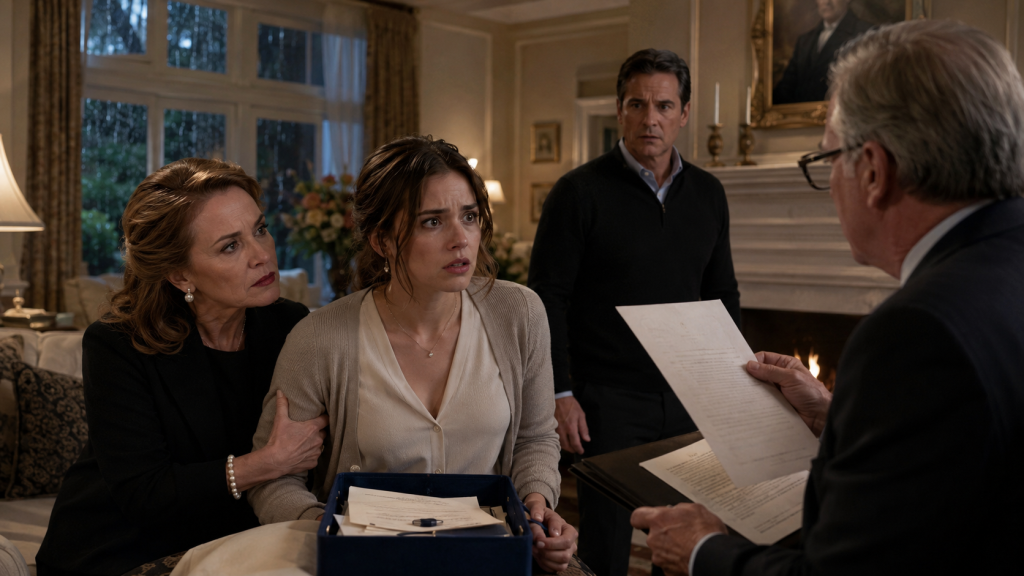
It was held in my parents’ living room, the same spotless room where I had spent half my childhood being told not to touch anything, not to speak too loudly, not to embarrass them.
My mother wore black cashmere and pearl earrings.
My father stood near the fireplace with one hand in his pocket, calm as ever.
Across from us, Mr. Caldwell opened Nana’s will.
He was an older man with silver glasses and a careful voice.
Before he read a word, my mother leaned close.
Her nails dug into my arm.
“If you get a single penny,” she whispered, “I’ll make sure you regret it.”
Years ago, that would have made me shrink.
That day, I only thought of Nana’s note.
Do not be afraid of the truth.
Mr. Caldwell began reading.
The first page was formal.
The second gave my parents authority over the main bank accounts.
The third gave my mother Nana’s visible personal belongings.
The fourth gave my father control over the sale of certain property.
The fifth made it clear that almost everything my parents had circled for years was going to them.
My mother’s grip loosened.
A small smile touched her mouth.
My father let out a quiet breath.
Then Mr. Caldwell stopped.
It was not a long pause.
But it changed the room.
He looked at the folder again.
Then at the papers beneath the will.
My mother’s smile faded.
“Is there a problem?” my father asked.
Mr. Caldwell lifted one document from the back of the file.
“There appears to be an amendment,” he said, “filed three days before Mrs. Whitaker’s death.”
My mother went still.
My father stepped away from the fireplace.
And I felt Nana’s last words burn through me.
The blue velvet box.
Mr. Caldwell looked at me.
Then he looked at my mother.
He cleared his throat.
“I, Eleanor Whitaker, being of sound mind, revoke all prior instructions regarding my cottage, private heirlooms, personal papers, secondary accounts, and any items stored in the blue velvet box located in my pantry.”
My mother’s face drained of color.
“What box?” she snapped.
No one answered.
Mr. Caldwell continued.
“I leave the above-named property and materials solely to my granddaughter, Sarah Whitaker.”
The room became so quiet I could hear rain tapping against the windows.
My mother stood halfway.
“That is impossible. My mother was dying. She didn’t know what she was signing.”
Mr. Caldwell did not flinch.
“The amendment was witnessed by two hospital staff members and notarized. Mrs. Whitaker also recorded a video statement the same day.”
My father’s jaw tightened.
“What video?”
That was when I reached into my bag and placed the blue velvet box on the coffee table.
My mother stared at it like it was a loaded gun.
Inside were the letters.
The records.
The flash drive.
And Nana’s note.
My voice shook, but I still said, “She told me to check it.”
My mother lunged toward the table.
My father caught her wrist before she could touch the box.
“Margaret,” he warned.
But his voice was not calm anymore.
It was afraid.
Mr. Caldwell picked up the flash drive.
“With your permission, Sarah.”
I nodded.
He connected it to his laptop.
A moment later, Nana’s face appeared on the screen.
She was in her hospital bed.
Pale.
Tired.
But her eyes were clear.
My breath caught.
For a few seconds, she simply looked into the camera.
Then she spoke.
“My name is Eleanor Whitaker. This is my final statement regarding my estate.”
My mother covered her mouth.
Nana continued.
“My daughter, Margaret, and my son-in-law, Richard, have attempted to isolate me from my granddaughter Sarah during my illness. They have lied to hospital staff. They have pressured me about my money, my house, and my belongings. I am recording this because I am afraid they will try to destroy the truth after I am gone.”
My father whispered, “Turn that off.”
Mr. Caldwell did not move.
Nana’s voice trembled, but it did not break.
“Sarah never asked me for a dime. She came because she loved me. Margaret and Richard came with papers. They came with questions about accounts. They came with realtors’ names.”
My mother began to cry.
Not soft tears.
Angry ones.
“This is cruel,” she said. “This is manipulation.”
On the screen, Nana took a slow breath.
“The cottage is Sarah’s. The private account at Garden State Community Bank is Sarah’s. The letters and documents in the blue velvet box are Sarah’s. If anything happens to the box, I want my attorney to pursue legal action.”
Then Nana looked straight into the camera.
And somehow, it felt like she was looking at me.
“Sarah, baby, I am sorry I let them make you feel unwanted. You were never unwanted by me. You were the best part of my life.”
I pressed my hand to my mouth.
My mother turned on me.
“You poisoned her against us.”
For the first time in my life, I did not defend myself.
I did not beg her to understand.
I did not try to make her love me.
I simply looked at her and said, “No. You did that yourself.”
My father sank into the armchair.
The video ended.
The room stayed silent.
Mr. Caldwell removed the flash drive carefully.
“There is more,” he said.
My mother’s head snapped up.
“What do you mean, more?”
He opened the folder again.
“The records in the box appear to document withdrawals from Mrs. Whitaker’s accounts over several years. Some of those withdrawals were signed under power of attorney.”
My father’s face changed.
Not sadness.
Not grief.
Calculation.
Mr. Caldwell looked at him.
“Mr. Whitaker, I recommend you retain counsel.”
My mother whispered, “Richard?”
He did not answer her.
And that told me enough.
Over the next three months, everything came apart.
My parents tried to contest the amendment.
They claimed Nana was confused.
The hospital witnesses testified she was alert.
They claimed I manipulated her.
The video proved I had barely been allowed near her.
They claimed the blue velvet box was fabricated.
Mr. Caldwell produced Nana’s handwritten note, dated and witnessed by her neighbor, Mrs. Alvarez.
Then the bank records came forward.
Thousands of dollars.
Then tens of thousands.
Transfers labeled as medical expenses that never reached the hospital.
Checks written for “home care” to companies that did not exist.
My father had taken the money.
My mother had known.
For years, they had treated Nana like a burden while quietly draining what she had built.
And when she realized it, she used the last strength she had to stop them.
The cottage became mine in September.
I did not sell it.
My parents expected me to.
They thought I would take the money and leave the past behind.
But that little blue house was not just property.
It was the only place that ever felt like home.
The first weekend after the papers cleared, I drove there with a box of cleaning supplies, a sleeping bag, and Nana’s old recipe book.
The porch needed paint.
The garden was overgrown.
The kitchen faucet leaked.
The coffee cans were rusted.
But when I opened the windows, sunlight poured across the floor like a blessing.
Mrs. Alvarez came by with a casserole and hugged me so hard I almost dropped it.
“She wanted you here,” she said.
“I know.”
“No, honey,” she said, touching my cheek. “She really wanted you here.”
That night, I baked banana bread from Nana’s recipe.
I burned the edges.
I cried when I smelled it.
Then I sat at the crooked kitchen table and ate a slice warm from the pan.
For the first time in months, the house did not feel empty.
It felt waiting.
My parents never apologized.
People like them rarely do.
My father took a plea deal after the financial investigation.
My mother sold their big house and moved somewhere smaller, where I imagine she still tells people I betrayed the family.
Maybe she believes it.
Maybe she has to.
The last time she called me, she did not say hello.
She said, “You ruined us.”
I looked out Nana’s kitchen window at the tomato plants I had replanted in new coffee cans.
“No,” I said quietly. “Nana told the truth.”
My mother laughed bitterly.
“You think that makes you better than me?”
I thought about the little girl standing in the hallway over spilled grape juice.
The teenager crying on the porch swing.
The grown woman sitting outside a hospital room, begging to be allowed to say goodbye.
Then I thought about Nana’s voice.
You were never unwanted by me.
“No,” I said. “It makes me free.”
I hung up.
That was two years ago.
Now the cottage is blue again, freshly painted, with white trim and flower boxes under the windows.
The American flag on the porch is new, but I kept the old one folded in Nana’s cedar chest.
The tomato plants grow every summer.
The kitchen still smells like banana bread on Sundays.
Sometimes neighborhood kids come by after school because I started a little free library near the mailbox.
I help them pick books.
I give them cookies.
And whenever one of them looks unsure, or ashamed, or afraid they are too much trouble, I hear Nana’s voice come through mine.
“One bad day does not mean you have a bad life.”
The blue velvet box sits on the top shelf of my bedroom closet now.
I do not open it often.
I do not need to.
Its secret already did what Nana meant it to do.
It did not just give me a house.
It gave me back the truth.
My mother thought inheritance meant money.
My father thought it meant control.
But Nana knew better.
Inheritance is not always the thing written on the first five pages.
Sometimes it is the hidden document.
The last message.
The proof someone loved you enough to fight for you after they were gone.
And sometimes, it is a little blue cottage off a county road in New Jersey, where a girl who was never wanted finally learns she was chosen all along.
THE END! THANKS FOR WATCHING!