

My son was taking me to France for my retirement, and at the airport, my eight-year-old granddaughter slipped a piece of paper into my hand. Only one word was written on it. RUN. My name is Eleanor Bennett. I am sixty-eight years old, a retired school secretary from Brooklyn, and until that morning at John F. Kennedy International Airport, I truly believed a mother could forgive almost anything her child did. Then my son Matthew proved me wrong.
He had told everyone he was taking me to France to enjoy my retirement.
“A fresh start for Mom,” he said.
“A beautiful apartment near Paris.”
“Better doctors.”
“Peace.”
He said it so often, and with such a polished smile, people believed him before I even opened my mouth.
The neighbors called me lucky.
My church friends said I had raised a wonderful son.
Even my cousin Ruth told me, “Not many children would do that for their mother.”
I smiled and nodded because what else could I do?
Telling the truth was complicated when I didn’t even know the truth myself.
I only knew something felt wrong.
It started six weeks earlier, after I sold my little brick house in Brooklyn.
I had lived there for thirty-nine years.
I raised Matthew in that house.
I buried my husband from that house.
I knew every creak in the stairs, every crack in the sidewalk, every neighbor’s dog by its bark.
Selling it was not my idea.
Matthew said the stairs were dangerous.
He said the neighborhood was changing.
He said I was lonely.
He said France would be beautiful.
“You deserve something better, Mom,” he told me, sitting at my kitchen table with papers spread out between us.
I should have questioned the papers more carefully.
But he was my son.
My only child.
The boy who used to fall asleep against my shoulder during thunderstorms.
The boy I worked double shifts to put through college.
The boy I defended even when his father said he had learned how to smile his way out of consequences.
So when Matthew said, “Just sign here, Mom. It makes the transfer easier,” I signed.
When he said, “This one is for international medical access,” I signed.
When he said, “This one lets me handle your banking while we travel,” I signed.
Each signature felt smaller than suspicion.
Each smile from him made me feel foolish for doubting.
But Lily knew.
My granddaughter Lily was eight years old, small for her age, with brown curls and quiet eyes that always seemed to notice what grown-ups tried to hide.
She had been different for weeks.
She stopped running into my arms when she visited.
She stopped asking me to read her stories.
Instead, she sat at my kitchen table drawing the same picture again and again.
A house with a crossed-out window.
A black square by the door.
A stick figure inside.
No sun.
No flowers.
No path leading away.
One afternoon, while Matthew was outside taking a phone call, I sat beside her.
“That’s an interesting house, sweetheart. Whose house is it?”
Her pencil froze.
Then she whispered, “It’s where they don’t let you leave.”
My stomach tightened.
“Who doesn’t let you leave?”
She looked toward the window, where Matthew stood with his back to us, speaking sharply into his phone.
Then she bent over the drawing and colored the black square darker.
“Nobody,” she said.
That night, I barely slept.
The next morning, Matthew arrived with plane tickets.
“We leave Friday,” he said.
“Friday? That soon?”
“Everything is arranged.”
I looked at the ticket.
New York to Paris.
One-way.
“Matthew, this says one-way.”
He smiled.
“Because you’re not visiting, Mom. You’re moving. We talked about this.”
No, we had not.
Not clearly.
Not honestly.
But when I opened my mouth to say that, his expression changed.
Just slightly.
The smile stayed.
His eyes hardened.
“Don’t make this difficult,” he said softly.
At the airport, he held the passports.
Mine, his, and Lily’s.
His wife had died three years earlier, and since then Lily had lived mostly in Matthew’s shadow, quiet and watchful.
He said bringing her to France would help us all heal.
But Lily did not look like a child going on a beautiful trip.
She looked like a child being forced to carry a secret too heavy for her small body.
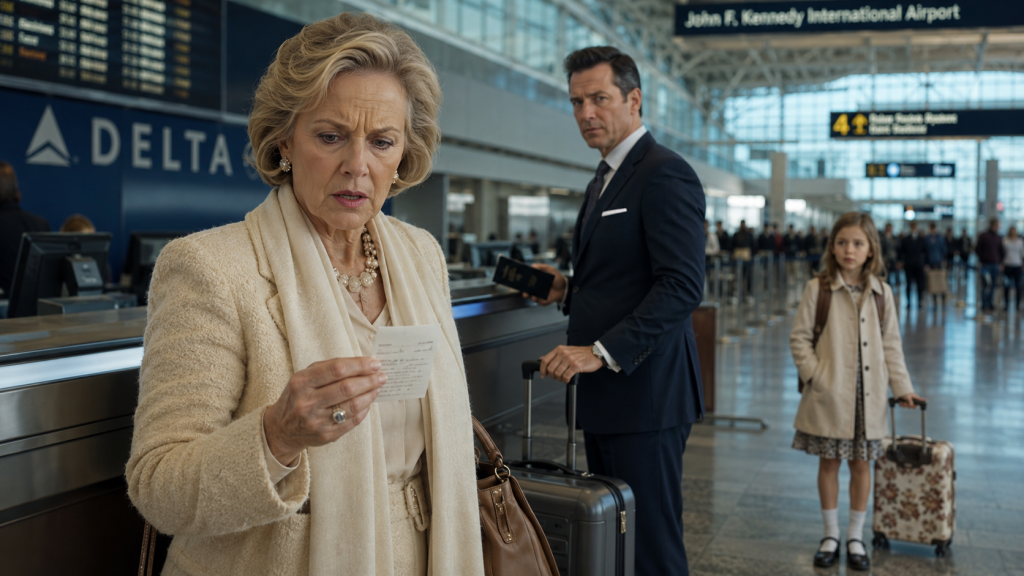
We stood near the airline counter, surrounded by rolling suitcases and announcements echoing through the terminal.
Matthew smiled at the agent.
He smiled at strangers.
He smiled at anyone watching.
Then Lily slipped beside me and pushed a folded piece of paper into my palm.
“Grandma,” she whispered, barely moving her lips. “Read it when he isn’t looking.”
Before I could ask anything, Matthew turned.
“Mom, let’s go. It’s almost time to check in.”
I opened my hand just enough to see the purple pencil mark.
RUN.
For one moment, the whole airport went silent in my head.
People moved around me.
A baby cried.
Someone laughed too loudly near the coffee stand.
A suitcase wheel squeaked against the floor.
But all I could see was my granddaughter’s pale little face.
“What do you have there?” Matthew asked, walking toward me too quickly.
I closed my fist.
“Nothing. A sticker Lily gave me.”
His smile did not reach his eyes.
“Mom, don’t start with your antics. The flight to Paris won’t wait.”
He gripped my arm.
Not hard enough to bruise in public.
Just hard enough to remind me who was controlling the moment.
“Walk,” he said.
I looked down at Lily.
Her lips trembled.
Her hand pressed against her coat pocket like there was something else hidden there.
And suddenly, after sixty-eight years of being polite, careful, and afraid of making scenes, I made one.
I bent forward and pressed a hand to my stomach.
“Oh,” I gasped.
Matthew’s fingers tightened.
“What now?”
“I don’t feel well.”
“Again?”
“I need the bathroom.”
He leaned close, his voice low enough that no one else could hear.
“If you make us miss this flight, I swear to God—”
I looked up at him.
“You want me to be sick right here?”
His jaw flexed.
A woman nearby glanced over.
Matthew released my arm at once and gave her a charming little smile.
“My mother gets nervous when she travels,” he said.
Then he turned back to me.
“Five minutes.”
I nodded and shuffled toward the restroom.
Slowly at first.
Then faster when I turned the corner.
Inside, I locked myself in the last stall and unfolded the note fully.
Under the word RUN, Lily had written more.
Dad sold your house.
France is not vacation.
He said they will keep you there.
He said you won’t come back.
The paper shook in my hands.
My knees weakened so badly I had to sit on the closed toilet lid.
I read it again.
Then again.
Keep you there.
Won’t come back.
My mind flew back to the papers.
The one-way ticket.
The strange phone calls.
The way Matthew had started answering questions for me.
The way he told people I was confused when I disagreed with him.
Then my phone buzzed.
A message from an unknown number appeared.
Mrs. Bennett, this is Carla from next door. Don’t get on that plane. Police are at your house. Matthew forged your signature. Call me now.
For a moment, I forgot how to breathe.
Carla lived beside me for twenty-two years.
She knew the shape of my life better than my own relatives did.
I called her with trembling fingers.
She answered immediately.
“Eleanor? Thank God. Where are you?”
“JFK. Matthew is here. Lily is with us. What is happening?”
Carla’s voice broke.
“He sold your house under a power of attorney. But Eleanor, I saw the buyer yesterday. He said the whole sale closed two weeks ago. Matthew told him you were already in assisted care overseas.”
My blood went cold.
“I never agreed to that.”
“I know. That’s why I called your attorney friend from church. He pulled the paperwork. Eleanor, your signature is on documents dated last month, but you were at my house that day for my birthday dinner.”
I closed my eyes.
The room seemed to tilt.
Outside the stall, the restroom door opened.
Matthew’s voice cut through the air.
“Mom?”
I pressed the phone to my chest.
His footsteps moved across the tile.
“Mom, open the door.”
Carla whispered, “Are you with him?”
“He’s outside the stall.”
“Listen to me. Police are on their way to the airport. Do not go with him. Make noise if you have to.”
Matthew knocked hard.
“Open. The. Door.”
I looked at Lily’s note in my lap.
For the first time, I understood that my granddaughter had not just warned me.
She had saved me.
I stood slowly.
My hands stopped shaking.
“No,” I said.
The restroom went silent.
Matthew laughed once.
“What?”
“I said no.”
“Mom, stop acting crazy.”
That word.
Crazy.
He had used it so easily lately.
At the bank.
At the realtor’s office.
On the phone with doctors.
Crazy was a convenient word when a man needed his mother to stop sounding believable.
I raised my voice.
“I am not getting on that plane.”
A woman washing her hands turned toward us.
Matthew lowered his voice.
“You are embarrassing yourself.”
“No,” I said, louder. “You are embarrassing yourself.”
The door slammed as he pushed into the stall area.
“Open the door before I drag you out.”
That was his mistake.
Because the woman by the sink heard him.
So did the airport cleaner.
So did a mother standing by the changing table with her baby.
The woman by the sink stepped forward.
“Sir, you need to leave this restroom.”
Matthew snapped, “This is my mother.”
“And she told you no.”
I unlocked the stall door.
Matthew stood there, red-faced, one hand outstretched.
For years, I had looked at him and seen my little boy.
That morning, I finally saw the man he had become.
Greedy.
Cruel.
Desperate.
And afraid.
Behind him, Lily appeared at the restroom entrance, sobbing silently.
“Grandma,” she cried.
I walked past Matthew and opened my arms.
She ran into them so hard I nearly stumbled.
Matthew reached for her.
“She is my daughter.”
Lily screamed.
Not cried.
Screamed.
“Don’t let him take me!”
The whole terminal seemed to turn.
Two TSA officers were there within seconds.
Matthew’s face changed again.
The charming mask came back, but it was cracked.
“My mother is confused,” he said smoothly. “My daughter is upset. We’re going to miss an international flight.”
I held up Lily’s note.
Then my phone.
“My neighbor says police are already involved. My son forged my signature and is trying to take me out of the country against my will.”
Matthew laughed.
“She’s paranoid.”
But Lily pulled something from her coat pocket.
A second folded paper.
She handed it to the officer.
Inside was a page she had torn from Matthew’s desk.
It was a printed email.
I saw only part of it before the officer took it.
The words were enough.
Facility confirmation.
Long-term placement.
Private wing.
No outside contact without guardian approval.
My chest tightened.
Guardian.
That was what the papers had been for.
Not travel.
Not medical care.
Control.
Matthew had not been taking me to France.
He had been removing me.
The police arrived fifteen minutes later.
Matthew kept talking.
That was always his talent.
He talked about stress.
My age.
My memory.
His sacrifices.
His concern.
Then one officer asked me three questions about the date, the president, and where I lived.
I answered all of them.
Then he asked Matthew why my house had been sold without my knowledge.
For once, my son had no polished answer.
They arrested him at Gate 12.
People stared as they led him away.
He looked back at me with hatred so raw it made my stomach turn.
“You did this,” he said.
I held Lily tighter.
“No,” I answered. “You did.”
For a while after that, everything was paperwork, lawyers, police statements, and long nights where Lily slept beside me because she woke up crying.
The house sale was frozen.
The forged documents were exposed.
The so-called French retirement apartment turned out to be a private elder facility outside Paris, expensive and restrictive, arranged under a guardianship petition Matthew had started quietly.
He had planned everything.
Sell my house.
Move the money.
Put me somewhere far away.
Tell everyone I was happy.
And because I was old, widowed, and trusting, he thought no one would question it.
But he forgot one thing.
Children hear what adults think they hide.
Lily had heard him on the phone.
She had seen the papers.
She had watched him put my passport in his coat pocket.
And my brave little granddaughter, with her purple pencil and shaking hands, had done what no adult managed to do in time.
She warned me.
Matthew went to prison.
Not for as long as I wanted.
Not for as long as Lily deserved.
But long enough for the world to see what he was.
I got my house back.
The first night Lily and I returned, the place smelled dusty and cold.
The buyers had not moved in yet, but the rooms felt violated, like strangers had already walked through my memories and priced them.
Lily stood in the doorway of my bedroom and whispered, “Can we stay?”
I knelt in front of her.
“You and me?”
She nodded.
“If you want to.”
Her little chin trembled.
“I don’t want to live with him again.”
I pulled her into my arms.
“You won’t.”
It took months of court hearings, but eventually I was granted custody.
Matthew fought it, of course.
Not because he wanted Lily.
Because losing her meant losing the last thing he could control.
The judge spoke to Lily privately.
When she came out, she climbed into my lap even though she was getting too big for it.
The judge looked at Matthew and said, “This child does not feel safe with you.”
That sentence did what no punishment could.
It told the truth in public.
Now, three years later, Lily is eleven.
She draws houses differently.
There are windows now.
Open ones.
Flowers by the door.
A yellow sun in the corner.
Sometimes, she draws two people on the porch.
One small.
One old.
Holding hands.
I framed one of those pictures and hung it in the kitchen, right above the table where Matthew once made me sign away my life.
Every morning, I make tea there.
Every afternoon, Lily comes home from school and drops her backpack by the chair even though I tell her not to.
Every Friday night, we bake chocolate-chip cookies and watch old movies under the same quilt my husband’s mother made before Matthew was born.
I still think about that airport sometimes.
The noise.
The lights.
The folded note in my palm.
The way one purple word saved the rest of my life.
RUN.
People imagine courage as something loud.
A speech.
A fight.
A door slammed in someone’s face.
But sometimes courage is an eight-year-old girl hiding a note in her coat pocket.
Sometimes it is an old woman pretending to have a stomach ache.
Sometimes it is saying no in a public restroom when your own child is outside the door demanding obedience.
I used to believe motherhood meant forgiving everything.
Now I know better.
Love without truth is not love.
Family without safety is not family.
And a son who calls his betrayal concern is still a betrayer.
Matthew tried to take my home, my money, my freedom, and my voice.
But he forgot that I had spent my whole life teaching children how to read.
And my granddaughter gave me the most important lesson of all.
When someone you love hands you the truth, even if it is written in purple pencil on a torn piece of paper, you listen.
Then you run.
And you don’t look back.