

Dad bought the annuity in 2008. Three hundred thousand dollars. He told me about it every Christmas, usually after dinner, when the kids were running around the living room with wrapping paper stuck to their socks and my wife was packing leftovers into containers. He would lower his voice like he was sharing a secret. “When I’m gone,” he would say, tapping two fingers against his coffee mug, “that money is for the grandkids. Not for anyone else. Their college. Their first homes. Their future.”
I heard it so many times that it became part of our family tradition. Turkey. Pie. Dad telling me about the annuity. Then in January, he died. And all those old Christmas conversations came back to me like ghosts. I waited two weeks before calling the insurance company. I did not want to sound greedy. I did not want to be the son who started asking about money before the flowers had even wilted on his grave. But Dad had been clear. That money was not really for me. It was for his grandchildren. So I called. The woman on the phone was polite at first. She asked for the contract number, Dad’s full name, his date of birth, and the date of death. I answered everything with the numb, empty voice I had been using since the funeral.
Then she went quiet. It was not a normal silence. It was the kind of silence people make when they realize they are about to say something that will hurt you.
“I’m sorry,” she said carefully. “You are not the current beneficiary.”
I sat up straight.
“What?”
“The beneficiary was changed in 2022.”
My hand tightened around the phone.
“To who?”
Another pause.
“Debra Mitchell.”
My stepmother.
For a few seconds, I could not hear anything except the refrigerator humming across the kitchen.
Debra had married my father seven years after my mother died. I had never hated her. I had tried not to. She was polite in public, cold in private, and always careful to make sure Dad’s money was described as “their money” after the wedding.
But the annuity had existed long before Debra.
Dad bought it when my mother was still alive in every meaningful way inside his heart, even if she had already been gone for twenty years.
“That’s impossible,” I said.
“I can only tell you what the records show.”
“When was it changed?”
“May 17, 2022.”
My stomach turned.
Dad had been diagnosed with Alzheimer’s in March of 2022.
Two months earlier.
By May, he was already forgetting what year it was. He asked me why my son wasn’t in kindergarten anymore, even though my son was sixteen. He looked at my daughter and called her by my mother’s name. Some mornings, he asked when his first wife was coming home from the grocery store.
My mother had died in 1988.
I told the woman on the phone that something was wrong.
She gave me the name of the financial advisor who had submitted the beneficiary change.
Martin Hale.
I knew the name.
Dad had used him for years.
He was the kind of man who wore expensive watches and spoke in a calm voice that made bad news sound reasonable.
I called him the same afternoon.
His assistant tried to send me to voicemail, but I kept calling until he finally picked up.
“Your father was competent when he signed,” Martin said before I had even finished explaining.
The sentence sounded rehearsed.
Too clean.
Too ready.
“My father thought it was 1997,” I said.
“I understand this is emotional.”
“No, you don’t understand. He asked for my dead mother every day.”
“Your father had moments of confusion,” Martin said. “That does not automatically mean he lacked capacity.”
Capacity.
There it was.
The word that turns grief into paperwork.
I asked if Debra had been present when the form was signed.
He said, “I don’t recall.”
I asked if a doctor had evaluated Dad that day.
He said, “That was not required.”
I asked if he had any notes from the meeting.
His voice changed.
Just slightly.
“We keep standard records.”
“Then I want them.”
“You’ll need legal authority for that.”
So I got it.
It cost me four thousand two hundred dollars just to file the first motion in probate court. Four thousand two hundred dollars before anyone had even agreed to look at the truth.
My wife thought I was losing myself.
Maybe I was.
I spent nights at the kitchen table surrounded by folders. Death certificate. Diagnosis papers. Old Christmas cards. Dad’s handwriting from before the disease. Dad’s handwriting from after.
There was a difference.
Before, his signature was bold, slanted, confident.
After, it shook like a branch in the wind.
Debra called me once during those first weeks.
I almost did not answer.
When I did, she sighed like she was the one being mistreated.
“You’re embarrassing the family,” she said.
“The family?”
“Your father wanted me taken care of.”
“My father wanted his grandchildren taken care of.”
“That was before he realized who was actually there for him.”
I closed my eyes.
There it was.
The speech.
The widow speech.
The loyal-wife speech.
The I-was-there-when-you-weren’t speech.
“You mean after you moved him away from everyone?” I asked.
She went quiet.
Because that was exactly what had happened.
After Dad’s diagnosis, Debra sold their small house near us and moved him forty minutes away into a gated retirement community. She said it was safer. She said it was quieter. She said it was better for him.
But suddenly, my kids could not drop by after school.
I had to schedule visits.
Phone calls went through her.
Doctor appointments happened without me.
Every time I tried to get closer, Debra became the wall.
“You’re bitter,” she said.
“And you’re hiding something.”
She laughed once.
A small, ugly sound.
“Good luck proving it.”
Then she hung up.
For three months, my life became court dates and waiting rooms.
Martin Hale’s attorney fought every request. They claimed privacy. They claimed professional privilege. They claimed Dad had expressed a clear desire to provide for his surviving spouse.
But the judge was not impressed.
At the second hearing, she looked over the medical records and asked one simple question.
“If the decedent had a documented Alzheimer’s diagnosis two months before this change, why were no additional safeguards taken?”
Martin’s attorney started talking in circles.
The judge ordered the original documents produced.
Not copies.
Originals.
And the meeting notes.
Two weeks later, my attorney called.
“You need to come in,” she said.
Her voice was careful.
Like the woman from the insurance company.
Like people always sound before they hand you the knife.
I drove to her office in the rain.
The documents were spread across the conference table when I arrived.
The beneficiary change form.
The advisor notes.
The witness certification.
At first, I saw Dad’s signature.
My chest tightened.
It was worse than I expected.
The letters barely connected. His first name leaned downward. His last name looked like it had been copied by someone trying to remember the shape of it.
Then my attorney slid the meeting notes toward me.
Martin Hale had written them in blue ink.
Client appeared tired. Debra answered most background questions. Client needed reminder of current year. Client confused but cooperative. Proceeded with beneficiary change per spouse request.
Per spouse request.
Not per client request.
Per spouse request.
I read the sentence again and again until the words stopped looking real.
Client confused but cooperative.
Cooperative.
Like Dad was a child being guided through a task.
Like his confusion was an inconvenience, not a warning.
My attorney tapped the final page.
“There’s more.”
I looked down at the witness line.
The judge had wanted to know who was in the room when Dad supposedly agreed.
The witness name was printed neatly beneath the signature.
For a moment, I did not understand what I was seeing.
Then my whole body went cold.
The witness was my brother.
Ryan.
My younger brother.
The one who had stood beside me at Dad’s funeral.
The one who had cried into his hands when the folded flag from Dad’s military service was placed beside the urn.
The one who told me, “At least Dad isn’t confused anymore.”
I stared at his name until my attorney asked if I needed water.
I did not answer.
Because suddenly, everything rearranged itself.
Ryan had been broke for years.
Bad investments.
Credit cards.
A failed contracting business.
Debra had always liked him more than she liked me because Ryan was easier. Softer. Quicker to accept a free dinner, a small check, a favor wrapped in guilt.
I called him from the parking lot.
He answered on the third ring.
“Hey,” he said. “What’s up?”
“You witnessed Dad’s beneficiary change.”
Silence.
Not confusion.
Not surprise.
Silence.
“Ryan.”
He exhaled shakily.
“I can explain.”
My heart dropped so hard it felt physical.
“You knew?”
“I didn’t know what it was.”
“Your name is on the witness line.”
“Debra said it was just estate paperwork.”
“You watched Dad sign away the grandchildren’s money.”
“He wasn’t signing away anything. She said she needed access to handle his care.”
“Dad was confused.”
“He had good days.”
“Did he know what year it was?”
Ryan did not answer.
“Did he know Mom was dead?”
Still nothing.
Then he said the worst thing he could have said.
“Debra promised she would help me.”
I closed my eyes.
There it was.
Not a misunderstanding.
Not a mistake.
A price.
“How much?” I asked.
He started crying.
I almost laughed from the pain of it.
“How much, Ryan?”
“Twenty thousand,” he whispered.
Twenty thousand dollars.
That was what it took.
My brother had sold our father’s last promise for twenty thousand dollars.
I hung up before I said something I could never take back.
At the next hearing, Ryan was subpoenaed.
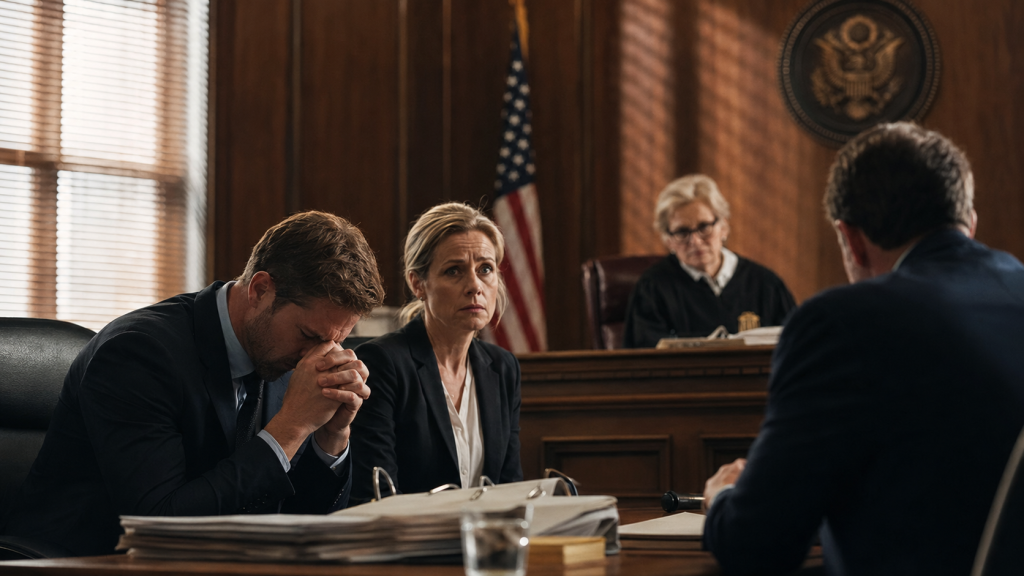
He walked into court looking like a man who had not slept in days. Debra sat across the aisle in black, dressed like a widow in a movie, dabbing at dry eyes with a tissue.
Martin Hale sat behind her.
His expensive watch flashed every time he moved his wrist.
The judge asked Ryan whether Dad understood the beneficiary change.
Ryan looked at Debra.
Just once.
That was all it took.
The judge noticed.
So did everyone else.
My attorney stood.
“Mr. Mitchell, did Debra Mitchell offer you money before or after you witnessed the document?”
Debra’s attorney objected.
The judge overruled.
Ryan’s lips trembled.
“After.”
My attorney waited.
“How much money?”
Ryan swallowed.
“Twenty thousand dollars.”
The courtroom changed.
You could feel it.
Even the air seemed to pull back.
Debra whispered, “Ryan, don’t.”
The judge’s eyes lifted.
“Mrs. Mitchell, do not speak.”
Ryan began to cry then. Not loudly. Not dramatically. Just broken little breaths as he admitted that Dad did not understand the form. That Debra had told him to sign as witness. That Martin Hale had said it would be “cleaner” if a family member was present.
Cleaner.
That word made the judge put down her pen.
Martin’s face went pale.
Debra’s tissue froze halfway to her cheek.
For the first time since January, I felt something other than grief.
Not victory.
Not yet.
But oxygen.
The judge ordered the beneficiary change suspended pending investigation. She referred the matter for review of financial exploitation. Martin Hale’s notes were entered into evidence. Ryan’s testimony was recorded.
Debra walked past me after court, her perfume sharp and expensive.
“You destroyed your brother,” she hissed.
I looked at her.
“No,” I said. “You bought him.”
She had no answer for that.
Six months later, the court ruled that Dad lacked capacity when the beneficiary change was executed. The 2022 change was voided. The original beneficiary designation was restored.
Me.
But when the insurance company finally released the funds, I did not feel rich.
I felt tired.
I put the money into three separate accounts for my children, exactly as Dad had wanted. College. Housing. Future.
Not one dollar went into my checking account.
Not one dollar paid back my legal fees.
My wife asked if I regretted spending so much to fight.
I thought about Dad at Christmas, tapping his mug.
I thought about him asking for my mother.
I thought about “confused but cooperative.”
Then I said, “No.”
A week after the ruling, I drove to the cemetery alone.
Dad’s headstone was still new, the grass around it thin and uneven. I stood there with my hands in my coat pockets, feeling foolish for wanting to talk to stone.
But I did anyway.
“I fixed it,” I said.
The wind moved through the trees.
For a second, I remembered him before the disease.
Strong hands.
Loud laugh.
The way he carried my sleeping children from the car like they weighed nothing.
“I’m sorry it got ugly,” I whispered. “But you were right. It was for them.”
I placed three small envelopes at the base of his grave.
One for each grandchild.
Inside each was a copy of the account statement and a note in my handwriting.
Your grandfather kept his promise.
That night, my oldest son came into the kitchen while I was washing dishes.
He was seventeen, almost the same age I had been when my mother died.
He said, “Mom told us what Grandpa did.”
I turned off the water.
“He loved you.”
“I know.”
Then he hugged me.
Not quickly.
Not like teenagers usually do.
He held on.
And for the first time since Dad died, I cried.
Because the money had never been the real inheritance.
The real inheritance was proof.
Proof that my father had loved them even when his mind was being stolen.
Proof that a promise could survive greed, illness, betrayal, and a signature written by a trembling hand.
Debra tried to appeal.
She lost.
Martin Hale lost his license.
Ryan moved out of state.
He sends birthday cards to my kids now, always with no return address. They do not ask about him much. I do not know if forgiveness will ever come. Maybe someday. Maybe not.
But every Christmas, after dinner, when the house gets loud and warm and messy, I take out Dad’s old coffee mug.
The same one he used when he told me about the annuity.
I fill it, set it near the tree, and tell my children the truth.
Not the court version.
Not the paperwork version.
The real version.
Their grandfather made a promise.
Other people tried to steal it.
And in the end, the promise won.
THE END! THANKS FOR WATCHING!