

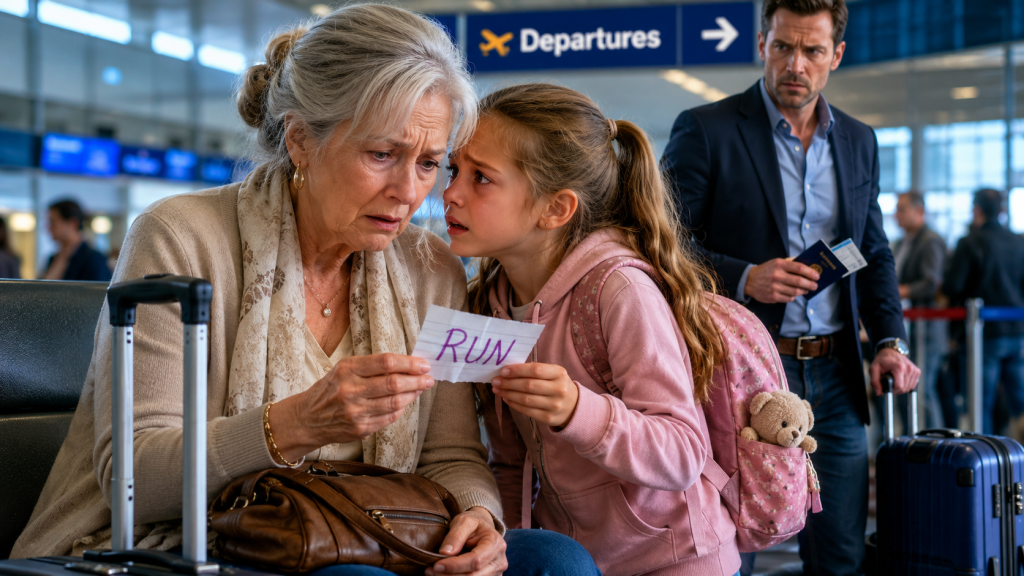
My son was taking me to France for my retirement, and at the airport, my 8-year-old granddaughter slipped a piece of paper into my hand. One word was written on it. RUN. At first, I thought it was a child’s game. Lily loved mysteries. She loved hiding notes under pillows, drawing secret maps, and whispering things like, “Grandma, the couch is lava.” But this was different. Her hand was cold when she pressed the paper into my palm. Her eyes were wet. And when she whispered, “Read it when Daddy isn’t looking,” her voice shook like she was afraid the walls could hear her. We were standing inside John F. Kennedy International Airport in New York, surrounded by rolling suitcases, loud announcements, crying babies, and people rushing toward gates.My son, Matthew, stood at the airline counter with our passports in his hand.
He had that smile on his face. The public smile. The one he used at church. At family dinners. At the bank. Around neighbors. The smile that said, I am a good son. I take care of my mother.But behind closed doors, that smile disappeared. “Mom,” he called. “Come on. We’re almost ready.” I opened my hand just enough to see the purple pencil mark.
RUN.
My heart dropped into my stomach.
I looked at Lily.
She was staring at the floor, her little shoulders stiff, as if she had just done something dangerous.
“What’s that?” Matthew asked suddenly.
He was walking toward me.
Too fast.
I closed my fist.
“Nothing,” I said. “Just a little sticker Lily gave me.”
Matthew looked at his daughter.
Lily didn’t lift her head.
He smiled, but his eyes went sharp.
“Mom, don’t start with your antics,” he said softly. “The flight to Paris won’t wait.”
Paris.
For months, he had talked about Paris as if he were giving me heaven.
A beautiful apartment.
Better doctors.
Quiet mornings by the gardens.
A peaceful retirement.
“You shouldn’t live alone anymore,” he kept saying. “You’re getting older. You need help.”
I was seventy-two, not helpless.
I still cooked my own meals. Paid my own bills. Walked to the bakery on weekends. I had arthritis in my left hand and a bad knee when it rained, but I was not a burden.
Still, after my husband died, Matthew started coming around more.
At first, I was grateful.
He brought groceries. Fixed the porch light. Helped me organize papers after I decided to sell my house in Brooklyn.
Then the “help” became control.
He answered my phone before I could reach it.
He told the bank teller I got confused easily.
He stood over me while I signed documents he said were for travel, taxes, insurance, and “making things easier.”
Whenever I asked questions, he sighed.
“Mom, you don’t trust your own son?”
Those words always made me feel guilty.
So I signed.
Then Lily started acting strange.
She stopped running into my arms when I visited. She watched her father before speaking. She drew the same picture over and over.
A little house.
A black square beside the door.
A window crossed out with an X.
When I asked what it was, she whispered, “It’s where they don’t let you leave.”
I thought she meant a story from school.
Now, standing in that airport with RUN sweating inside my palm, I knew she meant something real.
Matthew gripped my arm.
“Mom. Walk.”
His fingers dug into my skin.
I looked at his hand. Then at Lily. Then at the crowd.
Witnesses.
That was the only reason he wasn’t yelling.
I took a deep breath and placed my free hand on my stomach.
“I don’t feel well.”
His jaw tightened.
“Again?”
“I need the bathroom.”
“We don’t have time.”
“I’m going to be sick.”
A woman nearby glanced at us.
Matthew noticed.
His face changed instantly.
“Of course, Mom,” he said loudly, smiling for the woman. “Take your time.”
But his hand did not move.
“I’ll come with you.”
“No,” I said quickly. “Please get Lily some water. I’ll be right out.”
He stared at me.
For a moment, I saw the real Matthew.
Cold. Angry. Calculating.
Then he smiled again.
“Five minutes.”
He released my arm.
I walked toward the restroom with my suitcase rolling behind me.
Every step felt too loud.
I could feel his eyes on my back.
When I reached the restroom entrance, I didn’t go in.
I moved behind a group of tourists wearing matching jackets, slipped past a woman pushing a stroller, and turned toward the exit.
My hands trembled as I unfolded Lily’s note.
Under RUN, in tiny purple letters, she had written:
Daddy sold your house. France is not a trip. He said you won’t come back. He said the place has locks.
For a second, the airport tilted.
I grabbed the handle of my suitcase to stay standing.
My house.
My little blue house with the white fence.
The house my husband and I had paid off together.
The house where I raised Matthew.
The house where Lily learned to bake cookies.
Sold.
I had known Matthew was pushing me to move, but he told me the sale money was being held safely until I settled in France.
He said everything was in my name.
He said I could come back anytime.
He lied.
Then I heard him shout.
“Mom!”
I looked up.
Matthew was moving through the crowd, pulling Lily by the wrist.
His smile was gone.
I did not think.
I ran.
Not fast. Not gracefully. I was a seventy-two-year-old woman with a bad knee and one suitcase.
But I moved as if every year of my life depended on it.
“Mom!” Matthew shouted again. “Stop!”
People turned.
I pushed toward the airport exit and saw a security officer standing near the doors.
I went straight to him.
“Please,” I said, breathless. “I need help.”
The officer looked at Matthew approaching behind me.
“Ma’am, what’s going on?”
“My son is trying to take me out of the country against my will.”
Matthew arrived seconds later.
He laughed.
Actually laughed.
“Officer, I’m sorry. My mother gets confused when she’s stressed. We’re traveling to France for her retirement.”
“I am not confused,” I said.
Matthew’s face stayed calm, but his voice lowered.
“Mom, don’t embarrass yourself.”
The officer stepped between us.
“Sir, give her some space.”
Matthew lifted both hands.
“Of course. I’m just worried about her. She signed everything. She agreed.”
The word signed made my stomach twist.
I looked at Lily.
She was crying silently.
The officer noticed.
He crouched slightly.
“Are you okay, sweetheart?”
Lily looked at her father.
Matthew’s eyes warned her.
Then she looked at me.
Something inside that little girl broke open.
“No,” she whispered.
Matthew snapped, “Lily.”
The officer stood straight.
“Sir, do not speak to her like that.”
Lily reached into her backpack and pulled out a folded drawing.
The same house.
The crossed-out window.
The black square near the door.
Only this time, there were words at the bottom.
Grandma’s room in France. Daddy said she can’t leave until papers are done.
My knees nearly gave out.
Matthew’s face turned white.
“She’s eight,” he said quickly. “She makes things up.”
The officer called for another officer.
Within minutes, we were taken to a small security room away from the crowd.
Matthew kept trying to speak for me.
“She’s elderly.”
“She forgets things.”
“She signed power of attorney.”
“She gets paranoid.”
Every sentence was polished.
Every word sounded practiced.
Then the officer asked me one simple question.
“Ma’am, do you want to board that flight?”
I looked at Matthew.
For the first time in years, I did not soften my voice for him.
“No.”
Matthew exhaled sharply.
“Mom, after everything I’ve done for you?”
I turned to the officer.
“I want a lawyer. And I want my granddaughter away from him until someone asks her the truth without him standing there.”
Matthew slammed his hand on the table.
“This is insane.”
The officers moved quickly then.
One took him into the hallway.
Another stayed with me and Lily.
The moment Matthew was gone, Lily ran into my arms.
“I’m sorry, Grandma,” she sobbed. “I heard him talking to Aunt Denise. He said once you got on the plane, nobody would believe you. He said the doctors there would sign papers. He said your money was already moved.”
My blood went cold.
“What money, baby?”
“The house money,” she whispered. “And Grandpa’s account.”
My husband’s account.
The one I hadn’t touched since his funeral.
The officer’s expression changed.
This was no longer a confused old woman and a worried son.
This was fraud.
By that evening, I was not on a plane to Paris.
I was sitting in a police station with a cup of terrible coffee and a social worker beside Lily.
Matthew was in another room.
His story had started falling apart the moment they checked the documents.
The “travel forms” I had signed included a power of attorney I didn’t understand.
The house sale had already been completed.
The money had been moved into an account Matthew controlled.
The France apartment did exist, but it was not a retirement apartment.
It was a private care facility outside the city.
Locked doors.
Limited visitors.
No independent phone access for new residents under “medical review.”
The black square in Lily’s drawing was not imagination.
It was a keypad lock.
When the detective told me, I felt something inside me go quiet.
Not sadness.
Not fear.
Something harder.
My own son had tried to erase me.
Not kill me.
Not all at once.
Just remove me from my life.
From my home.
From my money.
From my granddaughter.
From every place where I could still say no.
The next few weeks were ugly.
Matthew’s wife, Claire, called me cruel.
She said I had destroyed the family.
My sister said maybe there was a misunderstanding.
A neighbor asked if I was sure, because Matthew had always seemed so devoted.
That is the terrible thing about people like my son.
They are kindest in front of an audience.
But paperwork does not smile.
Bank records do not pretend.
Emails do not love their mothers.
The investigation found everything.
Messages between Matthew and a lawyer friend.
Discussions about declaring me mentally unfit.
A payment to someone connected to the French facility.
A note in his own calendar that said:
MOM FLIGHT — FINALIZE TRANSFER AFTER ARRIVAL.
Final.
That word hurt more than I expected.
My son had made me a task to complete.
Not a mother.
A task.
Because of Lily’s note, the flight was stopped.
Because of Lily’s courage, my lawyer froze the remaining funds.
Because of one purple pencil word, the police found enough to charge Matthew with financial exploitation, fraud, and attempted unlawful confinement.
I did not celebrate.
People think justice feels like victory.
Sometimes it feels like sitting in your kitchen at midnight, staring at an empty chair, wondering when the little boy who used to bring you dandelions became the man who tried to steal your life.
But I survived.
I moved into a smaller apartment near Prospect Park.
Not as big as my house.
Not filled with as many memories.
But the locks are mine.
The keys are mine.
The phone rings, and I answer it myself.
Lily visits every Saturday.
We bake cookies.
She draws pictures again, but now they are different.
Houses with open windows.
Gardens.
A little girl holding an old woman’s hand.
One afternoon, she asked me, “Grandma, are you mad I told?”
I put down the mixing spoon and knelt in front of her.
“My darling girl,” I said, “you did not ruin the family.”
Her lips trembled.
“You saved me.”
She cried then, and so did I.
Months later, I was called to court.
Matthew stood in front of the judge in a navy suit, looking smaller than I remembered.
For the first time, there was no public smile.
His lawyer said he had been under stress.
He said he thought he was doing what was best.
He said caring for an aging parent can be overwhelming.
The judge listened.
Then she asked Matthew one question.
“Why did your daughter write the word RUN?”
Matthew had no answer.
That silence told the whole story.
When it was my turn to speak, I did not yell.
I did not call him a monster.
I only unfolded Lily’s note.
The purple pencil had faded a little, but the word was still there.
RUN.
I held it up.
“This is the moment I realized my granddaughter was braver than every adult who ignored the warning signs. My son did not try to help me retire. He tried to bury me alive in another country while I was still breathing.”
The courtroom was silent.
Even Matthew looked down.
I don’t know if shame finally found him, or if he was only sorry he failed.
Maybe I will never know.
What I do know is this.
Evil does not always arrive shouting.
Sometimes it carries your luggage.
Sometimes it books your ticket.
Sometimes it calls itself love.
Sometimes it says, “It’s for your own good,” while tightening its hand around your arm.
And sometimes, salvation is not a police siren or a heroic speech.
Sometimes it is an 8-year-old girl with a purple pencil, risking everything to write one word.
RUN.
I still keep that note in a frame beside my bed.
People ask why I would frame something so frightening.
I tell them the truth.
Because that little piece of paper was not a warning.
It was a door.
And because of Lily, I walked through it before it locked behind me forever.
THE END! THANKS FOR READING!