

When I walked through my mother-in-law’s gate, my son was sitting on the patio eating from his lap. My daughter stood beside him holding her paper plate with both hands because there was supposedly no chair for her either. My mother-in-law smiled and said they had run out. Through the open kitchen door, I could see three empty chairs. I did not argue. I took my children and left.They said I was overreacting. Three hours later, the first phone call came in, and by the time the third one ended, every comfortable thing that family had built on my back had started to split.👇
The first sound I remember was not music.
It was the dry bend of Lily’s paper plate under her fingers.
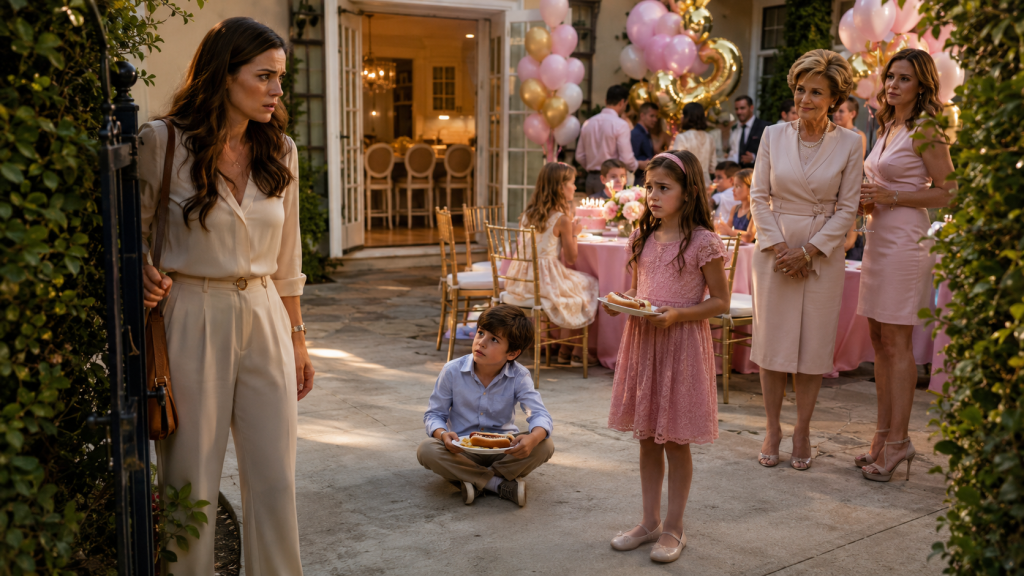
I had parked along Gloria’s curb because the driveway was already packed with SUVs and folding chairs stacked near the garage.
Chloe’s birthday balloons bobbed over the fence, pink and gold, bright enough to make the whole backyard look cheerful from the street.
Then I opened the gate and saw my children beside the trash cans.
Noah had folded himself onto the warm concrete with his knees up, trying to balance a hot dog in his lap like he had been told not to make trouble.
He was six. He had ketchup on one thumb and the serious little face he wore when adults made him nervous.
Lily stood behind him with her plate held flat in both hands.
She was nine, and she had already learned the awful math of a room.
Who gets welcomed.
Who gets watched.
Who gets told to be easy.
Across the patio, Chloe sat under the balloon arch at the decorated table.
Matching napkins.
Party favors.
A cake with frosting flowers.
Every other child had a chair.
Vanessa saw me and put on that bright smile people use when they want cruelty to sound like a scheduling problem.
“We ran out of chairs,” she said. “They’re totally fine on the ground.”
Gloria kept adjusting candles on the cake like the camera angle mattered more than the two children standing outside the circle.
I looked through the open kitchen door.
Three empty chairs sat in a neat row, cushions clean, pushed under the table like they were being saved for someone better.
For half a second, the backyard went thin and quiet.
Forks stopped near mouths.
A red plastic cup crinkled in somebody’s hand.
One neighbor stared down at the grass so hard you would think the lawn had started talking.
Nobody offered to move.
That told me everything.
I took Noah’s plate before it slid.
I touched Lily’s shoulder.
“Are we going home?” she whispered.
“Yes,” I said.
Vanessa laughed under her breath.
“Sarah, don’t be dramatic.”
Gloria finally looked up and repeated, “There weren’t enough chairs.”
I did not ask why the three empty ones did not count.
I did not raise my voice.
I did not drag those chairs into the yard and make them admit what they had done in front of everyone.
Sometimes the loudest answer is refusing to beg for basic decency.
I walked out with my children.
No one followed.
In the car, Noah kept rubbing the edge of his booster seat with his thumb.
Lily stared out the window and would not blink.
I made it two blocks before my hands started shaking so badly I pulled over beside a mailbox with a peeling flag sticker on the side.
“Mommy,” Noah asked, “did I do something wrong?”
Lily answered before I could.
“No,” she said, and her voice broke. “They were wrong.”
That was the moment my heart cracked in a place anger could not reach.
I sat there with the engine running and realized I was not only angry at Gloria and Vanessa.
I was angry at myself.
For twelve years, I had translated disrespect into excuses.
Gloria was old-fashioned.
Vanessa was sensitive.
Michael hated conflict.
His family was complicated.
They were stressed.
They did not mean it like that.
But humiliation is personal when it is served to your children on paper plates.
For twelve years, I had been useful.
I brought food after Gloria’s knee surgery.
I handled forms when she almost lost her house.
I sat beside Vanessa at my kitchen table with tax returns spread between us after her small business loan got denied.
I covered utility bills quietly because I did not want the kids hearing grown people fight over money.
They called me family when the folders were open.
They called me dramatic when my children needed chairs.
Michael always said his mother meant well.
Vanessa was just jealous because my life looked stable.
I should not take everything personally.
But there, in that car, with my son asking if he had done something wrong, I finally understood something.
The people who love you do not need to be taught that your children deserve seats.
At 5:18 p.m., my phone rang from the bank.
I let it go because Noah was still sniffling.
At 5:41, the branch manager called.
That one made my stomach tighten.
I had known Mr. Harris for eight years.
He did not call on a Saturday unless something had already gone sideways.
At 6:03, a number tied to the county clerk’s office appeared on my screen.
By the time we pulled into our driveway, the notifications were stacked like warning lights.
Three missed calls.
Two voicemails.
One email with the subject line:
URGENT: SIGNATURE VERIFICATION REQUIRED.
I got the children inside.
I set two real chairs at our kitchen table.
Then I made grilled cheese while they sat quietly, still wearing the shame his family had handed them.
Only after they were eating did I open my laptop.
The email loaded slowly.
Loan modification request.
Notarized authorization page.
Scanned signature dated Tuesday at 10:14 a.m.
My throat went cold before the attachment even finished opening.
Because at the bottom of the page, under the notary stamp, was my name.
Sarah Whitman.
Except I had not signed it.
On Tuesday at 10:14 a.m., I had been at Noah’s school, sitting beside his teacher while she showed me his reading folder.
I clicked the voicemail from the bank.
Mr. Harris’s voice was careful.
Too careful.
“Sarah, I’m sorry to bother you on a weekend, but we need you to confirm whether you authorized a loan modification connected to Gloria Whitman’s property. There are concerns about the signature page.”
Gloria’s property.
My mother-in-law’s house.
The same house I had helped save two years earlier when she cried at my kitchen table and said she would never forget what I did.
My phone buzzed again.
Michael.
I answered without speaking.
“Sarah,” he said quickly, “before you get upset, Mom was desperate.”
My whole body went still.
“You knew?”
Silence.
Then he said the sentence that ended something inside me.
“It was just paperwork. You were going to help anyway.”
I looked toward the kitchen where my children sat in real chairs, eating quietly.
“No,” I said. “I was going to help family. But today, your family showed me exactly what I am to them.”
“Don’t make this about the party.”
“It became about the party when my children were treated like leftovers beside trash cans.”
He sighed like I was being difficult.
“Mom didn’t mean it.”
“Then why were there chairs in the kitchen?”
He did not answer.
That silence was louder than any confession.
Then the third call came from the notary.
Her first words made my knees weaken.
“Mrs. Whitman, I think your signature was forged.”
I sat down slowly.
The notary, a woman named Denise, explained that Gloria and Vanessa had come into her office earlier that week with documents already prepared.
They claimed I had signed in advance because I was too busy to come in person.
Denise had refused to stamp it without speaking to me.
Then Vanessa got angry.
Gloria cried.
Michael arrived ten minutes later and said there must be a misunderstanding.
Somehow, the stamped page still ended up in the loan packet.
But Denise had felt uneasy.
She had checked the security footage.
She had checked her appointment log.
And now she was calling me before the bank moved forward.
“Did you authorize anyone to sign for you?” she asked.
“No,” I said.
“Did you give verbal permission?”
“No.”
“Did your husband?”
My hand tightened around the phone.
“I don’t know what my husband did.”
There was a pause.
Then Denise said, gently, “You need to protect yourself.”
I thanked her, but my voice sounded far away.
After I hung up, I opened the folder in my filing cabinet where I kept everything Gloria had ever asked me to handle.
Mortgage statements.
Tax notices.
Utility shutoff warnings.
A handwritten promise from Gloria saying she would repay the $18,000 I had used from my emergency fund to catch up her arrears.
She never did.
Michael had told me not to embarrass her by asking.
I had believed him because I wanted peace.
But peace built on silence is not peace.
It is a hostage situation with nicer curtains.
At 7:12 p.m., Gloria called.
I let it ring.
At 7:14, Vanessa called.
I let that ring too.
At 7:20, Michael came home.
He walked into the kitchen and stopped when he saw the paperwork spread across the table.
Lily looked up from her plate.
Noah stopped chewing.
Michael smiled too quickly.
“Kids, go watch TV for a minute.”
“No,” I said.
He blinked.
“Sarah.”
“No more sending them away so adults can lie comfortably.”
Lily’s eyes widened.
Michael lowered his voice.
“You’re scaring them.”
I almost laughed.
His family had left them beside trash cans at a birthday party, but I was scaring them by putting papers on a table.
I sent the children upstairs only after I kissed their foreheads and told them they had done nothing wrong.
When they were gone, Michael dragged a hand down his face.
“This got out of control.”
“No,” I said. “This got exposed.”
He dropped into the chair across from me.
The irony nearly made me sick.
There he was, sitting comfortably, in a chair, after telling me I was dramatic for wanting that same dignity for our children.
“Mom was going to lose the house,” he said.
“She already almost lost it once. I fixed that.”
“I know.”
“With my money.”
“I know.”
“And now she forged my name?”
“She panicked.”
“Did you help her?”
His eyes moved away.
There it was.
Not a confession.
A coward’s version of one.
“I told Vanessa where the paperwork was,” he said quietly.
My mouth went dry.
“What paperwork?”
“The old folder. The one with your signature samples from the refinance.”
For a moment, I could not understand the words.
Then they landed.
He had given them access.
My husband had opened the door.
Not because he thought it was legal.
Not because he thought it was right.
Because he assumed I would clean up the mess like I always did.
“You gave them my signature,” I said.
“I thought they were just using it as reference until they could talk to you.”
“You thought a forged signature needed reference?”
He looked ashamed.
Not enough to fix anything.
Just enough to want me to stop looking at him.
The next morning, I called Mr. Harris and told him plainly that I had not signed the document.
I sent proof of where I had been Tuesday morning.
I gave him Denise’s number.
Then I called an attorney.
By noon, Gloria had received notice that the loan modification was frozen.
By two, Vanessa’s business account was flagged because she had submitted supporting documents claiming my income as part of the household guarantee.
By four, Michael’s phone would not stop buzzing.
His mother.
His sister.
His uncle.
His cousin.
Everyone suddenly remembered my number too.
I became cruel.
Ungrateful.
Overreacting.
I was ruining an old woman.
I was breaking up the family.
I was punishing everyone over a chair.
That was the story they wanted.
A chair.
Because a chair sounded small.
A chair made me sound petty.
They did not want to say forged signature.
They did not want to say stolen trust.
They did not want to say they had used my stability while treating my children like an inconvenience.
So I let them talk.
Then I sent one group text.
I attached the forged document.
I attached Denise’s written statement.
I attached proof of the $18,000 Gloria still owed me.
Then I wrote:
“This is not about chairs. The chairs only showed me what you thought we deserved.”
No one replied for twelve minutes.
Then Michael’s aunt Linda wrote:
“Gloria, what did you do?”
That was the first crack.
The second came from Vanessa’s husband, Mark, who called me privately.
He sounded exhausted.
“She told me you agreed to co-sign,” he said.
“I didn’t.”
“I know that now.”
Then he said something that turned my stomach.
“Sarah, there are other documents.”
By evening, Mark was sitting at my kitchen table with a folder of his own.
Vanessa had borrowed money against her business using household projections that included “family investment support.”
My name appeared on two planning documents.
Not legally binding, but enough to make banks believe I was involved.
Gloria had listed me as a financial contact without permission.
Michael had known about some of it.
Not all.
Enough.
That night, after the children were asleep, Michael stood in our bedroom doorway.
“I messed up,” he said.
I folded a shirt and placed it in a suitcase.
“Yes.”
“Where are you going?”
“I’m not going anywhere. You are.”
His face changed.
“Sarah, don’t do this.”
“I didn’t do this.”
He looked at the suitcase like it had betrayed him.
“They’re my family.”
I turned to him.
“And what are Lily and Noah?”
He opened his mouth.
Nothing came out.
For twelve years, I had waited for him to choose us clearly.
Not quietly.
Not privately.
Not later.
Clearly.
He never did.
The next week was ugly.
Gloria cried to anyone who would listen.
Vanessa posted vague quotes online about betrayal.
Michael slept at his cousin’s house and sent long messages about counseling, forgiveness, and stress.
I answered only what concerned the children.
The bank opened an internal review.
Denise filed a formal report.
My attorney sent letters that made everyone suddenly careful with their words.
Gloria’s house did not disappear overnight.
Vanessa did not go to jail dramatically at sunrise.
Real life is rarely that clean.
But the comfort ended.
The easy access to my money ended.
The assumption that I would absorb every consequence ended.
For the first time, Gloria had to sit across from people who did not melt when she cried.
For the first time, Vanessa had to explain her paperwork to someone who was not afraid of making Thanksgiving awkward.
For the first time, Michael had to understand that silence is a decision.
Two months later, Chloe’s mother, Vanessa, left a box on my porch.
Inside were Lily’s birthday gifts from the party.
Unopened.
A card sat on top.
It said:
“I’m sorry they didn’t have chairs.”
I stood there for a long time holding that card.
Not because it fixed anything.
Because even then, she still could not write, “I’m sorry we refused to give your children chairs.”
There is a difference.
That evening, I took Lily and Noah to a small restaurant downtown.
Nothing fancy.
Just a place with warm lights, checkered floors, and booths where nobody asked whether they belonged.
The hostess smiled and said, “Table for three?”
I looked at my children.
Lily squeezed my hand.
Noah leaned against my side.
“Yes,” I said. “Table for three.”
She led us to a booth near the window.
Noah slid in first.
Lily sat across from him.
I watched them settle into their seats like children should, without earning them, without begging, without standing beside trash cans at the edge of someone else’s celebration.
Halfway through dinner, Noah looked up from his fries.
“Mommy?”
“Yes, baby?”
“Are we still a family?”
My chest tightened.
I reached across the table and took his small hand.
“Yes,” I said. “We are the family that stayed kind. And we are the family that finally stood up.”
Lily smiled for the first time in days.
Outside, the streetlights flickered on.
My phone buzzed in my purse.
Michael again.
I did not answer.
Not because I hated him.
Because for once, my peace did not have to wait until everyone else was comfortable.
People later said everything fell apart because I walked out of a birthday party.
They were wrong.
Everything fell apart because I finally stopped holding together what had been built on my silence.
And it started with three empty chairs.
Three simple empty chairs that proved my children had never been forgotten by accident.
They had been placed exactly where that family thought they belonged.
Outside the circle.
Beside the trash.
Waiting to be grateful for scraps.
But that day, I stopped teaching my children to accept crumbs from people sitting at full tables.
I took their hands.
I walked through the gate.
And by the time the truth came calling, I was already gone.
THE END! THANKS FOR WATCHING!