

My parents threw me out for refusing to abort my baby at nineteen. For ten years, they never knew why I said we would all regret it. Then I came back with my son. And one sentence changed everything. I was nineteen years old, terrified, and barely three weeks pregnant when I finally told my parents. The moment the words left my mouth, I knew my life was about to change.
We were sitting in the living room of our modest Ohio home. My hands shook as I held the positive pregnancy test between my fingers. My mother stared at it in disbelief. My father slowly leaned forward in his recliner, his face turning hard. “Who’s the father?” he asked.
I swallowed. “I can’t tell you.”
The room went silent.
“What do you mean you can’t tell us?” my mother snapped. “Are you covering for someone? Is he married? Twice your age?”
“It’s complicated,” I whispered. “But I can’t end this pregnancy. I can’t. And if I do… it won’t just affect me. It’ll affect all of us.”
The second those words came out, everything exploded.
My father jumped to his feet so fast his chair slammed into the wall.
“Don’t play games with us!” he shouted. “As long as you live under my roof, you follow my rules. Either you get rid of that baby, or you get out!”
“Dad, please,” I begged. “I can’t explain right now, but one day you’ll understand—”
“Get out.”
His voice was ice cold.
“Dad—”
“Now.”
Within an hour, I was standing on the front porch with a duffel bag and nowhere to go.
My mother stood behind the screen door crying.
But she never stopped him.
And just like that, I was nineteen, pregnant, homeless, and completely alone.
I left Ohio shortly afterward.
I changed my phone number.
Started over in another state.
And I kept my baby.
His name was Leo.
The next ten years were the hardest of my life.
I worked two jobs.
Took classes at community college.
Studied after midnight and slept whenever exhaustion allowed it.
There were days I did not know how we would survive.
There were nights I stood in the grocery store with seven dollars in my pocket, choosing between diapers and dinner.
There were mornings I cried in the shower because it was the only place Leo could not hear me.
But every time I looked at him, I found a reason to keep going.
Leo was bright.
Kind.
Far too observant for his age.
He learned to read early. He asked questions most adults avoided. He had a quiet way of studying people, as if he could see the truth under their words.
And as the years passed, his questions became harder to avoid.
“Why don’t we ever visit Grandpa and Grandma?”
I would always say, “It’s complicated.”
He never pushed.
Not until his tenth birthday.
That morning, I made him chocolate chip pancakes and stuck one candle in the top because he said ten candles looked “too dramatic.”
He laughed when I sang.
Then, after breakfast, he became quiet.
“Mom?”
“Yes, baby?”
“Can I meet them? Just once?”
I froze with a plate in my hands.
“Meet who?”
He looked down at the table.
“Your parents.”
The plate felt heavy in my fingers.
I had spent ten years building a wall between my past and my son. Not because I wanted to punish my parents forever, but because I could not bear the thought of Leo looking at them and wondering why they had not wanted him.
“Why now?” I asked softly.
He shrugged, but his eyes were serious.
“Because I’m ten. And I know there’s something you don’t tell me.”
I sat across from him.
For a moment, all I could see was the newborn I had held in a cheap hospital blanket, promising him I would never let anyone make him feel unwanted.
But he was not a newborn anymore.
He was a boy with questions.
And maybe he deserved answers.
So we packed a small overnight bag.
We got in the car.
And we drove eight hours back to Ohio.
The whole drive, my hands stayed tight on the steering wheel.
Every mile brought back something I thought I had buried.
The gas station where my dad used to buy me hot chocolate after school.
The diner where my mom and I had shared pie after my first breakup.
The church parking lot where Daniel had taught me how to change a tire.
Daniel.
Even after ten years, his name still hurt.
He had been my older brother’s best friend first.
Then he became family.
After his parents died, my parents let him move into our spare room. He ate dinner at our table, fixed the gutters with my dad, helped my mom carry groceries, and called my parents “Mom” and “Dad” in that teasing way that made everyone laugh.
He was three years older than me.
Kind.
Patient.
The first person who ever made me feel safe.
By the time I turned nineteen, Daniel and I were in love.
Not loud love.
Not reckless love.
The quiet kind.
The kind that grew in late-night talks and shared coffee and the way he always walked on the street side of the sidewalk.
We had planned to tell my parents.
We were going to wait until he came back from a weekend trip.
But Daniel never came back.
A drunk driver crossed the center line just outside Columbus.
Daniel died before the ambulance arrived.
Two weeks later, I found out I was pregnant.
I was still grieving.
My parents were grieving too.
They had lost the boy they had treated like a son.
And I was terrified that if I told them Daniel was the father, they would see my pregnancy as another wound, not a blessing.
So when they asked, I froze.
I told myself I would explain later.
But later never came.
My father gave me a choice.
And I chose Leo.
Now, ten years later, I stood on the same porch where I had once held a duffel bag and cried until my throat burned.
The house looked smaller.
Older.
The paint on the railing had peeled.
The flower boxes my mother loved were empty.
Leo stood beside me, holding my hand.
“Are you okay?” he asked.
I looked at him and tried to smile.
“I’m trying to be.”
Then I knocked.
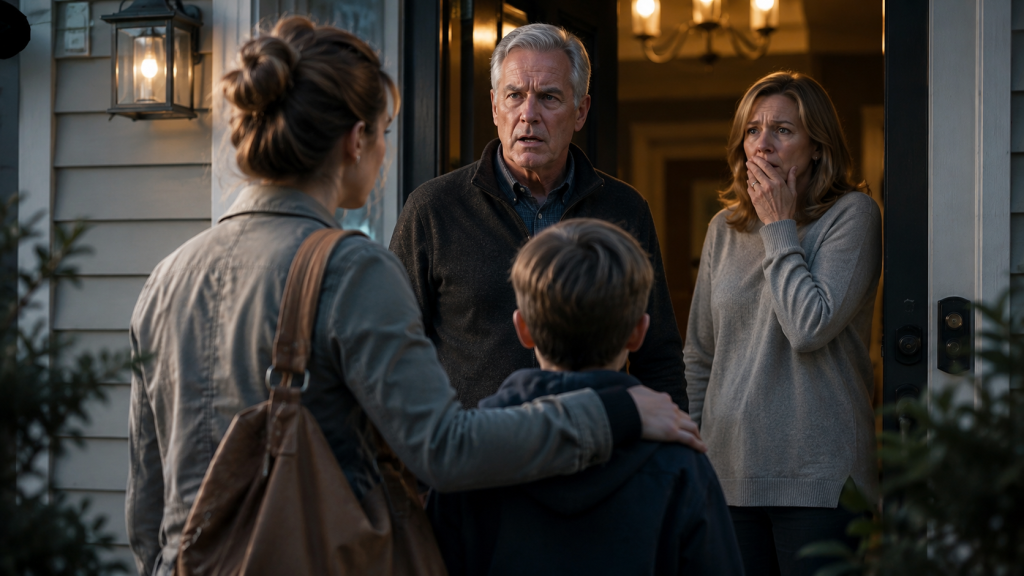
A few seconds later, the door opened.
My father stared at me as though he had seen a ghost.
His hair was mostly gray now. His shoulders looked narrower than I remembered.
“Emma?”
My mother appeared behind him.
Then her eyes landed on Leo.
She gasped.
Nobody spoke.
Ten years of silence stood between us.
Finally, I took a deep breath.
“I need to tell you the truth.”
My father’s expression tightened.
“The truth about Leo.”
My mother’s hand flew to her mouth.
“And the real reason I couldn’t get rid of him.”
The color drained from both of their faces.
Their eyes locked on my son.
Then, for the first time since I arrived, their hands started shaking.
My father gripped the doorframe like his legs might fail him.
“What do you mean?” he asked.
But his voice was no longer angry.
It was afraid.
Leo moved slightly closer to me.
My mother whispered, “Emma, tell us.”
I reached into my purse and pulled out the envelope I had carried for ten years.
The paper was soft at the edges from being opened too many times.
Inside was Leo’s hospital bracelet.
A copy of his birth certificate.
A photograph of Daniel holding me at a Fourth of July barbecue.
And the DNA report I had ordered when Leo was a baby, not because I doubted it, but because I knew one day I might need proof.
“Leo’s father wasn’t some random man,” I said.
My voice shook.
“He wasn’t married. He wasn’t dangerous. He wasn’t someone I was ashamed of.”
I looked at my father.
“He was Daniel.”
My mother made a sound like the air had been knocked from her lungs.
My father took one step back.
“No.”
“Yes.”
“That’s not possible.”
“It is.”
My mother pressed both hands to her mouth as tears filled her eyes.
“Daniel?” she whispered.
Leo looked up at me.
“Mom?”
I squeezed his hand.
“This is what I needed to tell you too.”
My father stared at Leo as if seeing him for the first time.
And maybe he was.
The curve of his mouth.
The dark lashes.
The careful, gentle eyes.
Daniel’s eyes.
My mother stepped forward slowly.
“Emma… why didn’t you say something?”
I laughed once, but there was no joy in it.
“When? When Dad screamed at me to get out? When you stood behind the door crying but said nothing? When I was sleeping in a shelter at nineteen with morning sickness and twenty-six dollars?”
My mother began to sob.
“I didn’t know.”
“You didn’t ask,” I said.
The words were quiet, but they hit hard.
My father looked down.
For the first time in my life, I saw shame on his face.
“I thought…” he began.
“You thought the worst of me.”
He closed his eyes.
“I was angry.”
“You were grieving,” I said. “So was I. But you had each other. I had nobody.”
Leo’s hand tightened around mine.
My mother lowered herself onto the porch step as if her legs could not hold her anymore.
“He was Daniel’s son,” she whispered. “All this time, Daniel had a son.”
“Yes,” I said. “And you had a grandson.”
The silence that followed was heavier than anger.
My father looked at Leo.
“What’s your name?” he asked softly.
Leo hesitated.
“Leo Daniel Hayes.”
My mother broke completely.
She covered her face and cried into her hands.
My father turned away, one hand pressed to his mouth.
I could tell that one sentence had done what ten years of silence could not.
It had made them understand.
Not everything.
But enough.
Leo looked at them with the innocent confusion of a child watching adults collapse under a truth he had only just learned.
“Was my dad a good person?” he asked.
My mother looked up through her tears.
“Oh, sweetheart,” she said. “He was one of the best people I ever knew.”
My father nodded, his voice rough.
“He was family.”
Leo blinked.
“Then why didn’t you want me?”
The question broke something in all of us.
My father’s face crumpled.
He stepped onto the porch and lowered himself to Leo’s height.
“I was wrong,” he said.
Leo watched him carefully.
“I was cruel. I was angry. And I made your mother pay for pain that was not her fault.”
His voice cracked.
“I didn’t know who you were. But that doesn’t excuse what I did.”
Leo looked at me.
I did not tell him what to feel.
That choice belonged to him.
My father swallowed.
“I am so sorry, Leo.”
Then he looked at me.
“And I am sorry, Emma. More than I can ever say.”
For ten years, I had imagined that apology.
Sometimes I thought it would heal me.
Sometimes I thought I would throw it back in his face.
But standing there, I realized apologies do not erase the past.
They only open a door to whatever comes after.
My mother stood and reached for me.
Then she stopped herself.
Like she finally understood she had no right to touch me without permission.
“Can I hug you?” she whispered.
I looked at her.
The woman who had cried but stayed silent.
The mother I had missed even when I hated missing her.
Slowly, I nodded.
She wrapped her arms around me and sobbed into my shoulder.
“I should have stopped him,” she cried. “I should have come after you.”
“Yes,” I whispered.
Because forgiveness could not begin with pretending.
“Yes, you should have.”
Her arms tightened.
Behind her, my father was still kneeling in front of Leo.
He reached into his shirt pocket and pulled out an old photograph from his wallet.
The edges were worn thin.
It was Daniel, smiling beside my father in the driveway, both of them covered in sawdust from building the back deck.
My father handed it to Leo.
“This was your dad.”
Leo took the picture with both hands.
For the first time, he saw more than a name.
He saw a face.
He stared at the photo for a long time.
Then he whispered, “I look like him.”
My father’s eyes filled again.
“Yes,” he said. “You do.”
We did not become a family again that day.
Real life is not that simple.
There were still ten years missing.
Ten birthdays.
Ten Christmas mornings.
Ten years of scraped knees, school plays, fevers, rent payments, and lonely nights they had not been there for.
They could not get those years back.
Neither could I.
But we sat together on the porch until the sun went down.
My mother brought out lemonade because she did not know what else to do.
My father asked Leo about school, his favorite books, whether he liked baseball.
Leo answered politely at first.
Then more openly.
By evening, he was sitting beside my father, showing him photos of his science fair project on my phone.
And I watched them with an ache in my chest I could not name.
Grief.
Relief.
Anger.
Love.
All of it tangled together.
Before we left, my father stood by my car and said, “Can we see him again?”
I looked at Leo.
He nodded.
“Maybe,” I said.
My father accepted that.
For once, he did not demand.
He did not command.
He simply nodded and said, “We’ll wait.”
On the drive back, Leo was quiet for almost an hour.
Then he said, “Mom?”
“Yes?”
“I’m glad you kept me.”
My vision blurred.
I pulled the car onto the shoulder because I could not see the road.
Then I turned to my son, the boy I had lost everything to protect.
“I never regretted you,” I said.
He reached for my hand.
“Not even when it was hard?”
I kissed his knuckles.
“Especially when it was hard.”
Months passed.
My parents did not rush us.
They called every Sunday.
At first, the calls were awkward.
Then softer.
My mother sent Leo books.
My father mailed him Daniel’s old baseball glove with a letter tucked inside.
Leo read it three times.
The next summer, we visited again.
This time, my parents had planted flowers in the front boxes.
This time, my mother had framed a photo of Leo beside Daniel’s picture on the mantel.
And this time, when I stood on that porch, I did not feel like the girl who had been thrown away.
I felt like the woman who had returned with the truth.
My father opened the door before I knocked.
He looked at me, then at Leo, and his eyes filled.
“Welcome home,” he said.
I did not know if Ohio would ever be home again.
But Leo smiled.
And for him, I stepped inside.
THE END! THANKS FOR READING!