
At 1:07 a.m., my daughter collapsed on my porch with blood on her sleeve and terror in her eyes. “Mom,” Lily whispered, clutching my wrist like she was five years old again, “please don’t make me go back to my husband’s house.” For one frozen second, I could not breathe.
Lily was twenty-eight, proud, stubborn, and strong enough to hide pain behind a smile because she thought silence was dignity. But that night, her lip was split, her cheek was purple, and her wedding ring hung loose on her trembling finger. I dragged her inside, locked the door, and called an ambulance.
“Who did this to you?” I asked. She shook her head violently. “They said no one would believe me. They said I was losing my mind.”
“They?” Her eyes flew toward the window.
“Grant. His mother. All of them.”
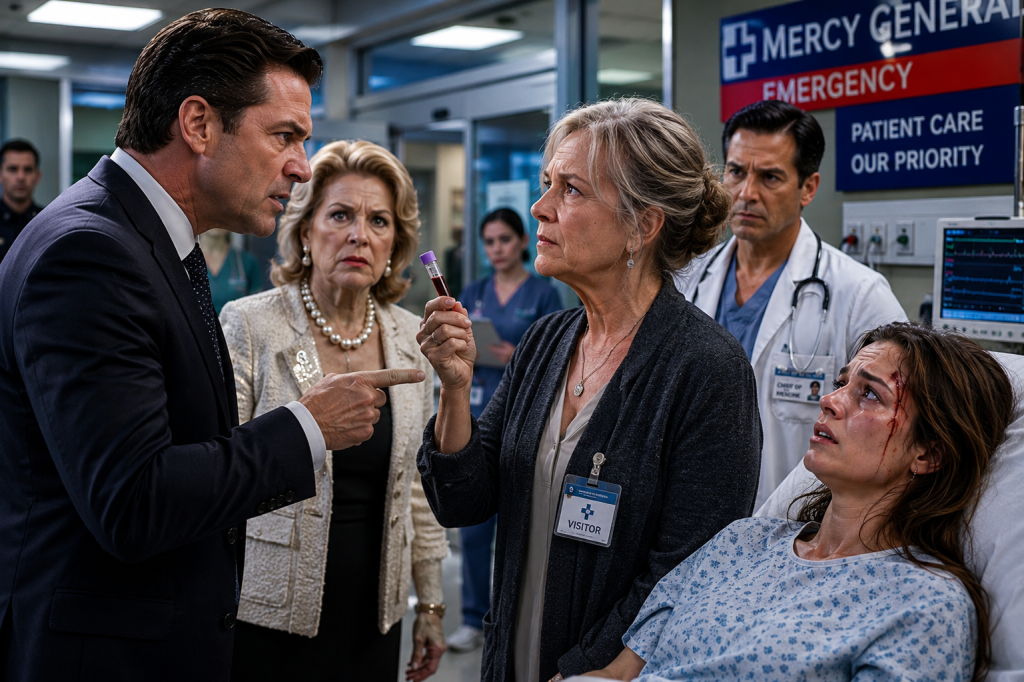
By the time we reached Mercy General Hospital, Lily was barely conscious. Dr. Patel stitched her lip, checked her ribs, and ordered bloodwork.
Then Grant Holloway arrived.
He walked into the emergency room wearing a tailored black coat and the calm face of a man who had rehearsed every lie before saying it.
“My wife is emotional,” he told the nurse. “She slipped and fell down the stairs.”
Behind him, his mother Vivian dabbed at dry eyes with a silk handkerchief.
“Poor thing,” Vivian murmured. “The pregnancy made her unstable.”
Pregnancy.
I turned to Lily.
Her face broke apart.
Dr. Patel stepped into the room, his expression heavy. “Mrs. Holloway, I’m very sorry. The baby didn’t survive.”
The room went silent except for Lily’s shattered sob.
Grant lowered his head, pretending grief. But I saw the tiny release in his jaw.
Relief.
Then his voice turned cold.
“Doctor, my wife is clearly having a psychotic break. I refuse any further invasive testing, including toxicology or blood work. I’m transferring her to Ridgeview Wellness Center immediately.”
That was when I knew.
He wasn’t only trying to control her.
He was hiding something.
Vivian stepped close to me and whispered, “Take your broken daughter home, Helen. Teach her not to threaten important families.”
I stared at her pearls, her perfect makeup, her polished cruelty.
For years, the Holloways had called me “the little bakery widow.” They thought I was harmless because I sold cupcakes, smiled at customers, and lived quietly in the house my husband Thomas left me.
They had no idea that before the bakery, I spent twenty-two years as a senior forensic auditor for the state attorney’s office.
I had followed hidden money through fake companies, dismantled fraud rings, and built financial maps complicated enough to make federal agents sweat.
Grant needed Lily’s trust fund by morning.
And he thought I was just a baker who would cry beside her bed.
When he touched Lily’s shoulder and said, “Come home, sweetheart,” I stepped between them.
“No,” I said.
His smile narrowed. “Excuse me?”
I looked him dead in the eye.
“You touched my daughter once. Now I touch everything you own.”
Grant’s face changed.
For the first time that night, the perfect Holloway mask slipped, and I saw fear underneath the money.
“You don’t know what you’re doing,” he hissed.
“Actually,” I said, pulling out my phone, “I know exactly what I’m doing.”
Before leaving Lily’s room, I had sent three things to an old contact at the state attorney’s office: a photo of Lily’s injuries, a recording of Vivian threatening me, and the name of the offshore company Grant thought no one had connected to him.
Dr. Patel quietly stepped beside me.
“Mrs. Holloway signed consent for full testing before her husband arrived,” he said.
Grant spun toward him. “You had no right.”
Then the Chief of Medicine entered with two security guards behind her.
“Mr. Holloway,” she said, “your wife’s bloodwork shows sedatives that were never prescribed to her.”
Vivian’s hand flew to her pearls.
Grant whispered, “Mother, be quiet.”
But it was too late.
Two detectives walked down the hallway toward Lily’s room.
Lily squeezed my hand weakly. “Mom,” she cried, “they tried to make me sign everything over tonight.”
I bent close and kissed her forehead.
“Then tonight,” I whispered, “we make them sign their confession.”
Grant stepped backward as Detective Ramirez entered the room.
“Grant Holloway,” she said, “we need you to come with us.”
He laughed once, sharp and ugly. “Do you know who my family is?”
“Yes,” Ramirez replied. “That’s why fraud division is already at your house.”
Vivian gasped.
Grant’s eyes snapped to me.
“What did you do?”
I lifted my phone.
“I remembered numbers.”
For months, Lily had told me little things that never felt right. Grant checking her mail before she saw it. Vivian bringing her special herbal tea every night. A new lawyer asking Lily to sign “routine marriage documents.” A trust officer who suddenly stopped returning her calls.
Alone, each thing seemed small.
Together, it formed a pattern.
And patterns had been my job.
While Lily slept under hospital care, I sat in the family waiting room with my laptop open and built the map Grant never expected me to see.
The Holloways were drowning.
Their luxury properties were mortgaged twice. Their charity foundation was moving money into shell companies. Their wine import business was a front for debt payments. And Grant had borrowed from men who did not sue when they wanted their money back.
They collected.
Lily’s trust fund was the lifeboat.
My daughter had been drugged, beaten, frightened, and nearly locked inside a private wellness center so Grant could force her signature before sunrise.
By 4:30 a.m., the detectives had enough to request emergency protection.
By 6:00 a.m., Lily’s trust account was frozen.
By 7:15 a.m., Grant’s lawyer arrived wearing a suit worth more than my car and a smile that belonged on a snake.
“This is a family misunderstanding,” he said.
I looked at him over my coffee.
“No. This is attempted coercion, financial exploitation, assault, and poisoning.”
His smile faded.
“You should be careful with accusations.”
I opened my folder.
“I am.”
Inside were bank transfers, forged authorization forms, text messages Lily had secretly forwarded to me weeks earlier, and a lab report showing exactly what had been in her system.
The lawyer did not speak again.
Two days later, Lily woke fully.
She looked smaller in the hospital bed, but her eyes were clear.
“I should have told you sooner,” she whispered.
I took her hand. “You survived. That is enough.”
She cried then, not the terrified crying from my porch, but the broken relief of someone who finally understood she was safe.
The investigation moved fast because wealthy men make mistakes when they think everyone is afraid of them.
Grant had forged Lily’s consent on investment transfers.
Vivian had ordered sedatives under the name of a housekeeper.
Their family attorney had prepared emergency trust documents before Lily even “fell.”
And Ridgeview Wellness Center had a private room reserved under Lily’s name, with paperwork labeling her delusional, unstable, and dangerous.
They were going to bury her alive in plain sight.
But Grant’s biggest mistake was underestimating the woman he called a bakery widow.
Three weeks later, I walked into court beside my daughter.
Grant was there in a gray suit, jaw tight, pretending dignity. Vivian sat behind him, pale and silent for once.
The judge reviewed the evidence.
The hospital report.
The toxicology results.
The forged documents.
The financial records.
Then he looked at Lily.
“Mrs. Holloway, do you wish to return to your husband’s residence?”
Lily lifted her chin.
Her voice shook, but it did not break.
“No, Your Honor. I want my life back.”
The judge granted the protection order, froze all Holloway access to Lily’s accounts, and referred the financial evidence for criminal prosecution.
Grant slammed his hand on the table.
“This is my wife!”
The judge’s eyes hardened.
“She is not your property.”
For the first time since she arrived on my porch, Lily smiled.
It was small.
It was tired.
But it was real.
Months passed.
Grant lost his company first. Then the foundation. Then the house with the marble staircase where Lily had been told she was crazy every time she cried.
Vivian tried to disappear to Europe, but detectives met her before boarding.
The Holloway name, once printed in glossy magazines beside charity galas and champagne towers, became a headline about fraud, abuse, and greed.
Lily moved into my house while she healed.
Some nights, she woke screaming.
Some mornings, she sat at the kitchen table without speaking.
I did not rush her.
I made tea she trusted.
I baked blueberry muffins.
I sat beside her until silence stopped feeling like fear.
One afternoon, she removed her wedding ring and placed it in an envelope.
“What are you going to do with it?” I asked.
She looked toward the sunlight coming through the bakery window.
“Sell it,” she said. “And donate the money to women who need a way out.”
I hugged her then, and for the first time in a long time, my daughter hugged me back like she believed tomorrow existed.
Six months later, Lily stood beside me at the grand reopening of my bakery.
We had renamed it Lily & Helen’s.
The sign above the door was painted soft blue, the same color as the blanket she had wrapped around herself the morning she finally slept without nightmares.
People came from all over town.
Some came for cupcakes.
Some came because they had read the headlines.
Some came quietly, with bruises hidden under sleeves and questions they were afraid to ask.
Lily always noticed them.
She would step around the counter, offer coffee, and say, “You can sit here as long as you need.”
One rainy evening, after closing, she stood beside me on the porch where she had collapsed that night.
The boards had been scrubbed clean.
The blood was gone.
But I remembered.
Mothers always remember.
Lily slipped her hand into mine.
“I thought I was going to die there,” she said softly.
I swallowed hard.
“So did I.”
She looked at me. “You saved me.”
I shook my head.
“No, sweetheart. You got yourself to my door. I only opened it.”
She leaned her head on my shoulder.
Across the street, the bakery lights glowed warm against the rain.
For years, the Holloways thought power meant money, lawyers, locked gates, and fear.
But they were wrong.
Power was a daughter finding the strength to run.
Power was a mother who knew where to look.
Power was a doctor who refused to be bullied.
Power was a truth so carefully hidden that once it surfaced, it destroyed every lie around it.
And every night after that, before I locked the bakery door, I looked at the porch and remembered the promise I made when Grant touched my daughter’s shoulder.
He thought he owned her.
He thought he owned all of us.
But he forgot one thing.
A mother with nothing left to fear is more dangerous than any wealthy family with everything to lose.
THE END! THANKS FOR WATCHING!