

At 85 years old, my bicycle was stolen, and I saw it advertised online like it was just some piece of junk. I arranged a meeting under the pretense of being a buyer, though the thief had no idea I had taught Taekwondo for forty years. He arrived at the park smiling.
He had my bike. My bike. The same one I used to go get bread, groceries, and my morning coffee. The same one my late husband, Arthur, gave me before he passed away. And he still had the nerve to say, “Morning, granny. Are you the one who wants to take a look at it?”
Granny.
It almost made me feel tender.
Almost.
I was sitting on a bench in Lincoln Park with oversized glasses sliding down my nose, a gray shawl wrapped around my shoulders, and a cane I did not even need resting against my knee.
I only brought the cane to look more harmless.
More fragile.
More like one of those old ladies street punks think they can fool without consequences.
But age only wrinkled my face.
It never softened my backbone.
Two days earlier, my bicycle had been stolen outside the farmers market. I had left it chained to the rack while I bought tomatoes, onions, fresh basil, and a block of sharp cheddar from Mrs. Henderson’s stall.
When I came back out, the bicycle was gone.
Only the broken lock remained on the pavement.
I stood there for a long moment, staring at the empty space where it should have been.
People walked around me.
Cars passed.
A little boy licked ice cream from his fingers.
But all I could see was Arthur’s hand on the handlebar, smiling at me the day he brought it home.
“So you never have to depend on anyone, Betty,” he had said.
Arthur and I were married for fifty-eight years. He was not a rich man. He did not buy me diamonds or fancy vacations. But he bought me things with meaning.
That bicycle meant freedom.
After he died, it became part of my morning routine. I would ride to the bakery and buy one small loaf of bread. Then I would stop by the corner café and order one black coffee, even though the young girl behind the counter always tried to convince me to add cream.
I rode that bike through grief.
Through loneliness.
Through winters that made my knees ache.
Through mornings when I missed Arthur so badly I could barely breathe.
So when some thief cut the lock and took it, he did not just steal metal and rubber.
He stole memory.
My granddaughter, Lily, found the advertisement online the next afternoon.
“Grandma,” she said, standing in my kitchen with her phone in her hand. “Isn’t this your bike?”
I was making soup. The spoon froze in my hand.
She turned the phone toward me.
There it was.
My bicycle.
Photographed against a graffiti-covered wall like some dirty old thing he had dragged out of an alley.
The front basket was loose.
The seat was patched with black duct tape.
The little silver bell leaned slightly to one side.
And on the frame, just below the handlebar, was the small sticker of the Virgin Mary I had placed there myself after Arthur’s funeral.
The advertisement read:
“Used bike. Good condition. Must sell ASAP. Cash only.”
ASAP.
Of course he needed to sell it quickly.
Thieves always prefer speed over sense.
Lily looked at me carefully. “Grandma, we should call the police.”
I wiped my hands on a dish towel.
“We will.”
But not yet.
First, I wanted to see the face of the person who thought stealing from an old woman was easy money.
I messaged him from Lily’s account.
“Hello, young man. I am interested in the bike. Can you show it to me tomorrow?”
He replied in under one minute.
“Yeah, boss. Cash only.”
Boss.
If he only knew.
I barely slept that night.
Not because I was afraid.
Because I was angry.
At 85, a woman has seen enough life to know which battles are worth fighting. I had buried my parents, my brothers, my husband, and most of my friends. I had survived illness, betrayal, hospital rooms, unpaid bills, disrespectful relatives, and neighbors who thought old age meant silence.
But having some punk steal my husband’s last gift to me and try to sell it back like junk?
That burned.
The next morning, I dressed carefully.
Beige cardigan.
Long skirt.
Comfortable shoes.
Gray shawl.
Oversized glasses.
And the cane.
When Lily saw me, she put both hands on her hips.
“Grandma, absolutely not.”
I looked at her through the mirror. “Absolutely yes.”
“You are not meeting a thief in a park.”
“I am meeting a seller.”
“Grandma.”
I turned around and smiled.
She hated that smile. She said it meant I had already made up my mind.
“Listen to me,” she said. “This could be dangerous.”
I patted her cheek.
“Sweetheart, I taught danger how to bow.”
She stared at me.
Sometimes younger people forget that old women were not born old.
Before I was a grandmother, I was an instructor.
Not of knitting.
Not of painting.
Not of gentle stretching in a community center.
Taekwondo.
For forty years, I ran a small dojang two blocks from the train station. I taught little girls how to shout from their bellies. I taught nervous boys how to stand straight. I taught bullies how to lower their eyes. I taught battered mothers how to stop apologizing for existing.
I was not strong because I was large.
I was strong because I knew where balance lived in the body.
And how quickly it could be taken away.
Still, I let Lily call the police before we went.
She gave them the advertisement, the meeting place, and the time.
“Let them handle it,” she whispered.
“They can handle the paperwork,” I said. “I will handle the lesson.”
Lincoln Park was quiet that morning. A few joggers passed along the path. A man fed pigeons near the fountain. A woman pushed a stroller under the trees.
I sat on the bench exactly where I said I would be.
Lily hid behind a tree farther down the path, pretending to read her phone.
Five minutes later, he appeared.
Young.
Maybe twenty.
Black baseball cap.
White sneakers.
Fake gold chain shining at his throat.
And both hands on my bicycle.
He rolled it toward me as if it belonged to him.
I felt my chest tighten.
There was mud on the tires.
A new scratch on the basket.
But the little bell was still there.
So was the Virgin Mary.
He stopped in front of me and smiled.
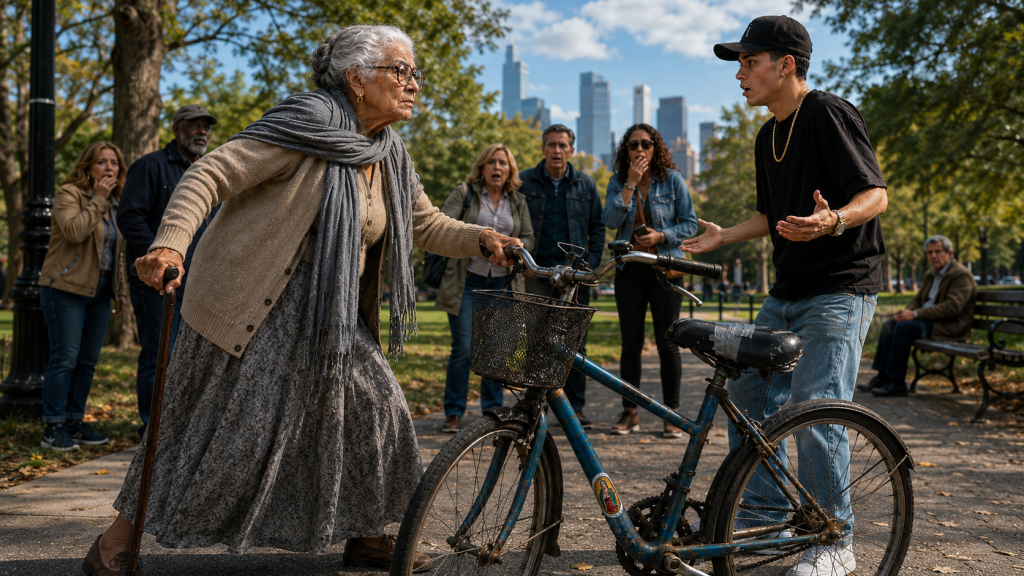
“Morning, granny. Are you the one who wants to take a look at it?”
I looked up at him slowly.
“Oh, yes,” I said in the softest old-lady voice I could manage. “My knees aren’t what they used to be, but I still like to ride.”
He laughed.
That laugh told me everything I needed to know.
“Yeah, it’s a good ride,” he said. “Just a few cosmetic details.”
Cosmetic details.
I stood up slowly, leaning on the cane.
He watched me like I was made of dust and paper.
“May I look at the handlebars?” I asked.
“Sure.”
I stepped closer.
My fingers touched the rubber grips.
The second I felt them, something broke inside me.
Not loudly.
Quietly.
Like a thread pulled too tight.
I flicked the bell.
It rang crooked and off-pitch.
Mine.
I swallowed the lump in my throat.
“And where did you get this bicycle?” I asked.
He shrugged. “Belonged to my uncle.”
“Your uncle?”
“Yeah. He doesn’t use it anymore.”
“How strange,” I said.
His eyes narrowed. “What’s strange?”
I pointed to the sticker.
“Because I put that on there myself.”
His smile disappeared.
“What?”
I lifted my head.
The old-lady voice was gone.
“I said, that bicycle is mine.”
He tightened his hand around the handlebar. “Lady, I don’t know what you’re talking about.”
“Yes, you do.”
“No, I don’t.”
“You stole it from outside the farmers market two days ago.”
His face hardened.
“Let go of the bike.”
“No.”
“I said let go.”
“And I said no.”
He pulled hard.
I kept one hand on the handlebar.
Just one.
The bicycle did not move.
His eyes flicked down to my arm. I saw the confusion there. He had expected weakness. He had expected trembling fingers and fear.
He had not expected resistance.
“Let go, old woman,” he snapped.
I looked him straight in the eyes.
“You were raised wrong, kid.”
People began to notice.
The man feeding pigeons turned around.
The woman with the stroller slowed.
Two teenagers near the basketball court lifted their phones.
The thief saw the attention and panicked.
That was when he made his mistake.
He shoved me.
Not hard enough to injure me, but hard enough to humiliate me.
Or so he thought.
My cane dropped from my hand and struck the ground with a dull thud.
His eyes followed it.
That was his second mistake.
I stepped in.
One step.
The same step I had practiced thousands of times.
My hip turned, my foot moved, and I swept his ankle with clean precision.
He landed on the grass with a shocked grunt before his mouth could form another insult.
The crowd gasped.
I still had the bicycle.
The thief stared up at me, blinking like a child who had just discovered gravity.
“You kicked me!” he shouted.
I leaned slightly over him.
“No, sweetheart,” I said. “I corrected your balance.”
The teenagers burst out laughing.
That made him angrier.
He scrambled up and rushed toward me again, reaching for the handlebars.
This time, I caught his wrist.
Not with cruelty.
With control.
I turned it just enough to stop him cold.
His knees bent.
His face twisted.
“Don’t,” I said.
The word was quiet.
But it carried forty years of command.
He froze.
“Listen carefully,” I continued. “That bicycle belonged to my husband. He is gone now. This is what I have left of him. You do not get to steal from old women and call it business.”
For the first time, he looked embarrassed.
Not sorry.
Not yet.
But embarrassed.
Then a police siren chirped behind us.
A patrol car rolled up along the curb.
Lily stepped from behind the tree, phone in hand, face pale but proud.
“I called them anyway, Grandma.”
I smiled at her.
“Good girl.”
The thief looked between me, Lily, the officers, and the gathered crowd.
His arrogance drained out of him like water from a cracked bucket.
One officer approached and asked, “Ma’am, are you all right?”
I straightened my shawl.
“Perfectly.”
The other officer looked at the young man holding his wrist.
“And you?”
The thief opened his mouth, then closed it.
The woman with the stroller spoke first.
“He tried to shove her. She defended herself.”
The man with the pigeons nodded. “I saw the whole thing.”
One of the teenagers waved his phone. “I recorded it.”
The officer sighed and looked at the thief.
“That makes my job easier.”
They asked me questions.
I answered every one.
Yes, the bicycle was mine.
Yes, I had proof.
Yes, my granddaughter had screenshots of the advertisement.
Yes, I wanted to press charges.
The thief looked stunned when I said that.
Maybe he thought I would forgive him because I was old.
People confuse age with softness.
I believe in mercy.
But mercy without accountability is just permission.
Before they put him in the patrol car, he looked back at me.
“I didn’t know it was special,” he muttered.
I held the handlebars of my bicycle.
“That is the problem with stealing,” I said. “You never know how much something is worth to the person you took it from.”
He lowered his head.
For one second, he looked very young.
I almost felt sorry for him.
Almost.
After the officers left, Lily ran to me and threw her arms around my shoulders.
“Grandma, you scared ten years off my life.”
I hugged her back.
“At my age, I can’t spare any, so I gave them to you.”
She laughed, but she was crying too.
I picked up my cane from the grass and handed it to her.
“Carry this for me, please. It is getting in my way.”
She looked at it, then at me.
“You are impossible.”
“I prefer experienced.”
We walked back through the park together, me pushing my bicycle slowly beside me.
The bell was crooked.
The basket needed tightening.
There was a new scratch on the frame.
But it was home.
That afternoon, Lily fixed the basket while I made tea. She said I should let her drive me places from now on.
I told her no.
She said I was stubborn.
I told her yes.
The next morning, I rode to the bakery.
Mrs. Henderson saw me and clapped her hands.
“Betty! You got it back!”
I rang the crooked little bell.
Everyone in line turned and smiled.
I bought one loaf of bread, one small coffee, and a bunch of tomatoes I did not need.
Then I rode past the farmers market, past the café, past the corner where Arthur used to wait for me when my knees first started aching.
For a moment, I imagined him walking beside me.
Laughing softly.
Shaking his head.
“You always did know how to make a point, Betty,” he would have said.
I smiled into the morning wind.
At 85, people think your story is almost over.
They speak louder around you.
They move you aside.
They call you sweet names and expect you to shrink into them.
Granny.
Dear.
Little old lady.
But I am still Betty.
I am still Arthur’s wife.
I am still a teacher.
And if someone tries to steal what is mine, they had better understand one thing.
I may ride slowly now.
But I still know how to stand my ground.
THE END! THANK YOU FOR READING!