

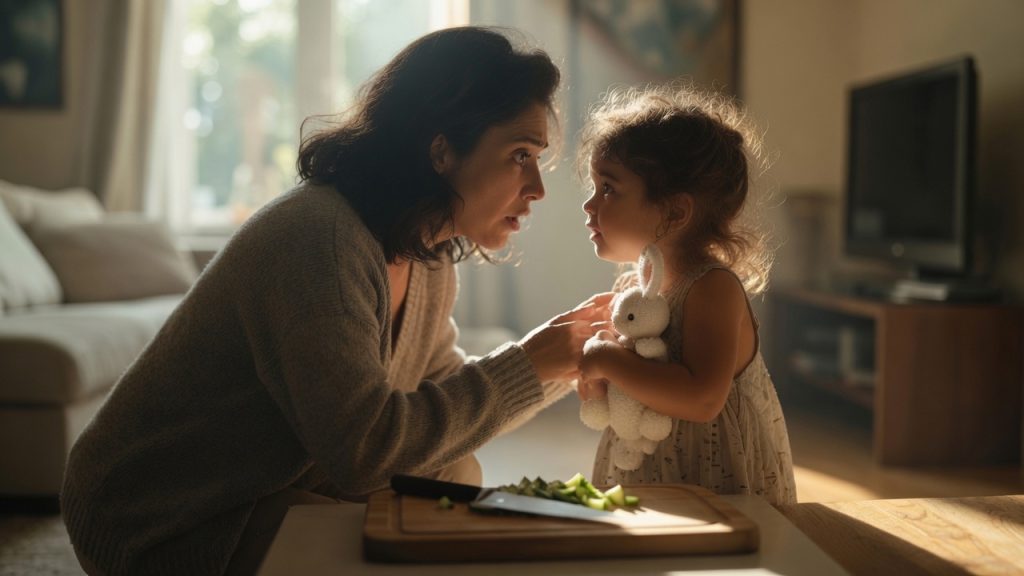
I was chopping vegetables when my four-year-old daughter pulled my arm and asked me softly: “Mommy… can I stop taking the pills Grandma gives me every day?” The knife fell from my hand. It struck the cutting board with a sharp sound that made both of us flinch. For one second, the whole kitchen seemed to stop breathing.
The pot on the stove kept bubbling. The afternoon light kept coming through the window. Cars kept passing outside our apartment building. But inside me, everything dropped. My blood. My breath. My heart. I turned slowly and looked at my daughter. Emma stood barefoot on the kitchen tiles, clutching her stuffed bunny against her chest. Her brown curls were messy from sleep, though it was barely four in the afternoon. Her eyes looked heavy and frightened, the way they had looked too many times lately.
“Mommy?” she whispered again.
From the living room, the television suddenly went silent.
My mother-in-law had turned it off.
My name is Mariela.
Until that afternoon, I thought my worst mistake had been letting Diane, my mother-in-law, move into our apartment “only while she recovered from her knee.”
Three weeks.
That was what she had promised.
Three weeks to rest, use her cane, drink tea, and watch soap operas while her son drove her to physical therapy.
At first, I tried to be kind.
Diane was Andrés’s mother. She was sixty-two, stubborn, proud, and recently widowed. She said her knee hurt too much to stay alone in her house. She said she did not want to burden us, but somehow she arrived with three suitcases, two boxes of medicine, and a mouth full of opinions.
I told myself patience was part of marriage.
I told myself family meant sacrifice.
I told myself it was temporary.
But Diane did not rest.
She watched.
She corrected.
She criticized everything.
“That girl needs routine.”
“Young mothers panic over everything.”
“Emma sleeps too late.”
“Emma eats too little.”
“Emma talks too much.”
“She should not still cry like that at four.”
“She needs discipline, mija.”
That word always came from her like a slap.
Discipline.
As if my daughter were not a child, but a problem to be solved.
I clenched my teeth and stayed quiet more times than I can count.
Every evening, when Andrés came home, I tried to explain that his mother was taking over the apartment, that she was undermining me in front of Emma, that something about her behavior made me uncomfortable.
And every evening, Andrés rubbed his face and said the same thing.
“Please, Mariela. Be patient with her. She’s my mother.”
So I was patient.
I allowed Diane to comb Emma’s hair.
I allowed Diane to read her stories.
I allowed Diane to prepare her snacks.
I allowed Diane to sit beside her during cartoons.
I allowed Diane to give her “vitamins” every morning, because I had seen a bottle of children’s gummies in the kitchen cabinet and I did not ask more questions.
That was my sin.
Trusting.
Emma was four years old.
Huge dark eyes.
Soft brown curls.
A laugh that used to run through the apartment like music.
She loved stickers, strawberry yogurt, dancing in socks, and making towers out of plastic cups. She used to wake me by climbing into bed and whispering, “Mommy, the sun is awake.”
But ever since Diane arrived, my little girl had changed.
She slept too much.
She stared at the wall.
She left food on her plate.
She tripped over her own feet.
She stopped asking for songs at bedtime.
Sometimes I would find her sitting in the hallway, holding her bunny, looking confused, like she had walked into the wrong home.
When I asked what was wrong, Diane always answered before Emma could.
“She’s growing.”
“She’s tired.”
“She’s finally calming down.”
That word scraped me inside.
Calming.
As if my daughter’s joy had been noise.
As if her little spirit had been something Diane needed to turn down.
That afternoon, I was making zucchini in the kitchen when Emma appeared behind me.
She did not come running like always.
She came slowly, barefoot, pale, and trembling.
She pulled on my sweater.
“Mommy…”
I crouched down.
“What happened, love?”
She looked toward the living room.
Then toward the hallway.
Then she brought her mouth close to my ear.
“I don’t want to take the pills Grandma gives me every day anymore… can I stop doing it?”
The world went silent.
Not the pot.
Not the street.
Not my own breathing.
Only that sentence.
Pills.
Every day.
I knelt in front of her and took her little hands.
“Emma, my love, what pills?”
Her eyes filled with tears.
“The ones she says are so I won’t be bad.”
I felt like vomiting.
I forced my voice to stay gentle.
“You are not bad. You are not in trouble. You did very well telling me.”
Emma’s lips trembled.
“Grandma said if I told you, you would get sick because of me.”
My whole body went cold.
I glanced toward the living room.
Diane was sitting there in silence now.
No television.
No coughing.
No cane tapping.
Just silence.
I lowered my voice.
“Emma, where are the pills?”
She shook her head.
“I’m scared.”
“I know, baby. But I am right here.”
“She hides them.”
“Where?”
Emma looked toward Diane’s bedroom.
“In the flower bag.”
Diane’s flower bag.
A large cloth purse with roses printed on it that she carried everywhere, even from the sofa to the bathroom.
My hands began to shake.
“Can you bring it to me?”
Emma shook her head harder.
“She’ll hear.”
From the living room, Diane called out calmly.
“Mariela? Everything all right in there?”
I looked at my daughter.
Her face collapsed in terror.
I stood slowly.
“Yes,” I called back. “Emma spilled some water.”
Diane did not answer.
I turned off the stove.
Then I took Emma’s hand and whispered, “Go to your room and put on your shoes. Quietly.”
She nodded.
I wiped my hands on a towel, picked up my phone, and walked toward the hallway as if nothing was wrong.
Diane sat on the sofa, wearing a blue cardigan and house slippers, her cane leaning against the coffee table. Her eyes followed me.
“What happened?” she asked.
“Nothing,” I said.
Her gaze moved to Emma, who had disappeared down the hallway.
“She looks upset.”
“She’s tired.”
Diane smiled faintly.
“That’s what I’ve been telling you.”
I smiled back.
I do not know how I managed it.
Then I walked past her and into the guest room.
Her room.
The air smelled like menthol cream and lavender powder.
Her suitcases sat open near the wall. Clothes were folded too neatly. Her prayer book was on the nightstand. Beside it sat a glass of water and a small plastic container with several loose tablets inside.
My stomach twisted.
I looked toward the door.
Diane called from the living room.
“Mariela?”
I opened the closet.
The flower bag was on the top shelf.
I pulled it down.
Inside were tissues, mints, receipts, a small wallet, and beneath all of it, an orange pharmacy bottle.
I took it out.
The label had been partially scratched, but enough remained.
Diane Patterson.
Adult medication.
A dosage written clearly under her name.
Not vitamins.
Not children’s gummies.
Not anything my four-year-old should have been taking.
My knees nearly gave out.
I heard Diane’s slippers in the hallway.
“What are you doing in my room?”
I turned.
She stood in the doorway.
Without her cane.
Without limping.
Her face had changed.
The sweet grandmother expression was gone. In its place was something hard, sharp, and furious.
“What is this?” I asked, holding up the bottle.
She looked at it, then at me.
Her voice was cold.
“You had no right to go through my things.”
“You gave this to Emma?”
“She needed help.”
I stared at her.
“She is four.”
“She was wild,” Diane snapped. “She cried over everything. She screamed. She ran. She exhausted everyone.”
“She is a child.”
“She is your child,” Diane said. “That is the problem.”
Something inside me cracked.
I stepped past her, bottle in my hand.
She grabbed my arm.
I pulled away so hard she stumbled.
“Do not touch me.”
Her eyes widened.
Then she shouted toward the hallway.
“Emma! Come here!”
My daughter appeared at her bedroom door, shoes half on, bunny in her arms.
“Come here now,” Diane ordered.
Emma froze.
I moved between them.
“Get your shoes on, baby.”
Diane laughed once.
“Where do you think you’re going?”
“To the doctor.”
“No.”
One word.
Flat.
Commanding.
As if she still believed she was in charge.
I grabbed my purse, put the bottle inside, picked Emma up, and walked to the back door of the apartment.
Diane followed us.
“Mariela, stop acting crazy.”
I did not answer.
She raised her voice.
“Andrés will hear about this.”
I opened the door.
“He will.”
“Do not take that child out of this house.”
I looked back at her.
“That child is my daughter.”
Then I left through the back stairwell as if I were taking out the trash.
Emma clung to me so tightly her fingers dug into my neck.
“Mommy,” she whispered, “is Grandma going to get angry?”
“It doesn’t matter.”
“She said Daddy believes her more.”
My eyes burned.
“It doesn’t matter.”
I buckled her into the car seat with shaking hands and drove straight to her pediatrician’s office.
During the drive, I kept looking at her in the mirror.
She sat small and quiet, hugging her bunny, blinking slowly.
Too slowly.
How had I missed it?
How had I let someone put something into my daughter’s body while I cooked, cleaned, worked, smiled, and told myself I was being a good wife?
My phone began to vibrate before I reached the clinic.
Andrés.
I did not answer.
It rang again.
Then came a message.
My mother says you took Emma out without telling anyone. Come back now.
I kept driving.
Another call.
Another message.
Mariela, answer me.
Then Diane.
I know where you are. Don’t let them draw her blood.
My hands tightened on the steering wheel.
The pediatrician received us as an emergency.
Dr. Salazar was a calm man with gray hair and kind eyes, the kind of doctor who crouched down when speaking to children and kept stickers in every drawer.
I handed him the bottle.
At first, he took it like someone expecting a misunderstanding.
Then he read the label.
His face changed.
He read it once.
Then again.
Then he looked at Emma.
“How many did she give her?”
“I don’t know,” I said. “Emma says every day.”
He placed the bottle on the counter as if it burned.
“Mariela, I need to examine her now. And I need you not to return to that house tonight.”
A chill ran down my back.
“What is it?”
He did not answer immediately.
He called a nurse.
He ordered tests.
He asked them to close the door.
Then he asked to speak with me away from Emma.
“She may be sedated,” he said quietly. “I cannot know the full effect without tests, but based on what you’ve told me, this is serious.”
I pressed my hand to my mouth.
“Could she be hurt?”
“We are going to take care of her. But I need to ask you something very important. Did you authorize this medication?”
“No.”
“Did her father?”
“I don’t know. I don’t think so.”
“Has your mother-in-law ever been allowed to give prescription medication to your child?”
“No. Never.”
He nodded, and his expression grew heavier.
“Then this is no longer a family disagreement. This is a child safety issue.”
My phone vibrated again.
This time, it was Diane.
I know where you are. Don’t let them draw her blood.
Dr. Salazar saw my face and gently took the phone.
He read the message.
His jaw tightened.
“Mariela,” he said, “listen to me carefully. Do not go outside. I’m asking the nurse to call security. I’m also calling child protective services and the police.”
Before I could answer, headlights flashed through the clinic window.
Andrés’s car had just parked outside.
Diane was in the passenger seat.
No cane.
No limp.
Smiling.
Emma saw them through the window and began to shake.
From the examination table, she whispered:
“She’s here.”
The nurse closed the blinds.
I went to Emma and wrapped my arms around her.
“You are safe with me.”
But my voice trembled.
The clinic door opened in the waiting area.
I heard Diane before I saw her.
“Where is my granddaughter?”
The receptionist tried to speak calmly.
“Ma’am, you need to wait—”
“No, I do not need to wait. My daughter-in-law is having some kind of breakdown.”
Andrés’s voice followed.
“Mom, lower your voice.”
Then Diane appeared at the hallway entrance.
She looked polished, controlled, almost elegant, with her flower bag over her arm.
Andrés came behind her, his face tense and confused.
His eyes landed on me.
“Mariela, what are you doing?”
I stood in front of Emma.
“What am I doing? Protecting our daughter.”
Diane gave a short laugh.
“From what? Vitamins?”
I reached into my bag, pulled out the orange bottle, and threw it against Andrés’s chest.
He caught it clumsily.
“Read the label.”
He looked down.
His face shifted from anger to confusion.
Then confusion to something pale and sick.
“Mom?”
Diane stepped forward.
“She misunderstood. She always exaggerates.”
Andrés looked at the bottle again.
“This has your name on it.”
“It was one time.”
Emma cried out from behind me.
“No! Every morning!”
The room froze.
Diane’s eyes snapped toward Emma.
My daughter hid her face against my back.
Dr. Salazar stepped between us.
“Mrs. Patterson, please step away from the child.”
Diane stared at him.
“I am her grandmother.”
“And I am her doctor.”
“She needed help calming down,” Diane said. “You people act like I poisoned her.”
“No one here gave you permission to medicate a four-year-old,” he answered.
Andrés looked at me.
“Mariela, how long?”
“Ask your mother.”
His eyes moved to Diane.
She straightened her shoulders.
“She was out of control.”
“She’s four,” Andrés said.
“She screamed. She cried. She embarrassed me in the grocery store. She refused naps. She would not listen.”
“She’s four,” he repeated, weaker this time.
Diane’s face hardened.
“And you two were too weak to fix it.”
The words hung in the room like smoke.
Something broke across Andrés’s face.
For the first time since I had known him, he looked at his mother not as a son trying to please her, but as a father seeing danger.
“Mom,” he whispered, “what did you do?”
Diane lifted her chin.
“I did what mothers do. I brought order.”
Then Emma lifted one trembling finger and pointed at Diane’s purse.
“She has more in there.”
Diane’s hand tightened around the strap.
Dr. Salazar turned to the nurse.
“Call security now.”
Diane stepped back.
“This is ridiculous.”
“Ma’am,” the doctor said, “please put the purse on the chair.”
“No.”
Andrés moved toward her.
“Mom. Put it down.”
She looked at him as if he had slapped her.
“You would take her side over mine?”
He swallowed.
“I’m taking my daughter’s side.”
Her face twisted.
Then she turned toward the exit.
Security arrived before she reached the door.
The flower bag was taken from her with her shouting that everyone would regret this, that I had always hated her, that I was poisoning her son against her.
When the nurse opened the bag, she found three bottles.
One was the orange bottle from the pharmacy.
Another had no label.
The third had a peeled label and tablets inside.
There was also a folded napkin with crushed pieces wrapped inside.
I felt the floor sway.
Andrés sat down hard in a chair.
He looked as if the bones had gone out of him.
“Mom,” he said, almost like a child. “Why?”
Diane stopped shouting.
For one strange second, she looked almost calm.
Then she said, “Because that girl was ruining your marriage.”
No one spoke.
Diane looked at me with hatred so old and deep it frightened me.
“You were tired. He was tired. You complained all the time. The child screamed. The house was chaos. I helped.”
“You drugged her,” I said.
“I helped.”
“You told her I would get sick if she told me.”
Diane’s eyes flicked away.
“You made her afraid of me.”
“She already clung to you too much.”
My hands curled into fists.
“She is my daughter.”
“She is my son’s daughter too,” Diane snapped. “And you never let him breathe.”
Andrés stood.
“Enough.”
Diane looked at him.
He was shaking.
“I said enough.”
Police arrived fifteen minutes later.
Child protective services arrived soon after.
I answered every question.
So did Dr. Salazar.
So did Emma, gently, with a child specialist sitting beside her and her bunny in her lap.
She told them Grandma gave her “tiny white pieces” in applesauce.
She told them Grandma said they were magic vitamins.
She told them Grandma said good girls took them.
She told them Grandma said Mommy would be sick if Emma told.
Every sentence tore another piece out of me.
Andrés stood outside the room with his hands over his mouth, crying silently.
I wanted to comfort him.
I also wanted to scream at him.
Because for three weeks, I had told him something was wrong.
For three weeks, he had chosen peace over truth.
His mother over me.
Convenience over our daughter’s discomfort.
When Emma was sent to the hospital for monitoring, I rode in the ambulance with her.
Andrés asked to come.
I said no.
His face crumpled.
“Mariela, please.”
I looked at him through the ambulance doors.
“You can meet us there. But not in here.”
He nodded.
He deserved worse.
But I did not have the strength to give it.
At the hospital, they ran more tests.
They checked Emma’s heart.
Her breathing.
Her blood pressure.
Her coordination.
They asked how much she had slept.
How much she had eaten.
Whether she had fallen.
Whether she had vomited.
Whether she had ever been hard to wake.
Every question felt like an accusation.
Because the answer was yes too many times.
Yes, she had slept too much.
Yes, she had been hard to wake.
Yes, she had stumbled.
Yes, she had stopped laughing.
And I had believed Diane.
I had believed “she’s tired.”
I had believed “she’s growing.”
I had believed “she’s finally behaving.”
That night, Emma slept in a hospital bed with wires taped to her tiny chest.
I sat beside her holding her hand.
Andrés sat across the room.
He had not spoken for over an hour.
Finally, he whispered, “I didn’t know.”
I did not look at him.
“You didn’t want to know.”
He flinched.
“I trusted her.”
“So did I.”
“But she’s my mother.”
I turned then.
“And Emma is your daughter.”
His eyes filled.
“I know.”
“Do you?”
He lowered his head.
“I should have listened.”
“Yes.”
“I should have believed you.”
“Yes.”
“I should have protected her.”
My voice broke.
“Yes.”
He cried then.
Not loudly.
Not dramatically.
Just quietly, into his hands, like a man watching the person he thought he was collapse.
I let him cry.
But I did not comfort him.
Because my daughter was lying in a hospital bed because everyone had been too afraid to challenge Diane.
Including me.
The next morning, a social worker came to speak with us.
Diane had been detained for questioning.
There would be an investigation.
There would be legal steps.
There would be restrictions.
There would be no contact.
Not with Emma.
Not with me.
Not with our home.
The social worker asked if I had somewhere safe to stay.
I said yes before Andrés could answer.
My sister, Lucia, lived forty minutes away.
She came to the hospital with a suitcase, a blanket, and a face full of murder.
When she saw Emma, she cried.
When she saw Andrés, she did not speak to him at all.
That told me everything.
After Emma was cleared to leave, I took her to Lucia’s house.
Andrés followed in his car.
When we arrived, he stood near the driveway looking lost.
“Can I come in?”
I looked at Emma.
She was asleep against my shoulder.
“I don’t know.”
His face tightened.
“Mariela, I’m her father.”
“And you will have to prove what that means now.”
He nodded slowly.
“What do you want me to do?”
That question should have made me angry.
It did.
But it also sounded honest.
So I gave him the first honest answer I had.
“I want you to stop being your mother’s son long enough to be Emma’s father.”
He closed his eyes.
Then he said, “I’ll do whatever it takes.”
“Start by changing the locks.”
He nodded.
“Then file for a protection order with me.”
Another nod.
“Then pack Diane’s things and put them somewhere else. I do not want one trace of her in our home.”
“I’ll do it.”
“Andrés.”
He looked at me.
“If you defend her once, excuse her once, minimize this once, I will leave with Emma and you will hear from my lawyer.”
His face went pale.
But he did not argue.
“Okay,” he whispered.
The days that followed were the hardest of my life.
Emma had nightmares.
She woke crying that Grandma was coming.
She refused applesauce.
She refused gummy vitamins.
She refused anything she did not see me open myself.
She followed me from room to room, even to the bathroom, terrified that if she let go of me someone would take her away.
I slept on a mattress beside her bed.
Every time she moved, I woke.
Every time she breathed too quietly, I touched her forehead.
Every time she said “Mommy,” I answered before she finished.
“I’m here.”
Andrés went to therapy.
At first, I thought it was only because I demanded it.
Then one evening, he came to Lucia’s house with red eyes and a folder in his hand.
“My therapist said something today,” he told me.
I crossed my arms.
“What?”
“She asked me when I learned that keeping my mother calm mattered more than telling the truth.”
I said nothing.
He looked down.
“And I knew the answer.”
His voice cracked.
“When I was six.”
For the first time, I saw him not as the man who failed me, but as the boy Diane had trained.
That did not erase what happened.
It did not excuse it.
But it explained the chains.
And explanations can be useful when you are deciding whether someone is willing to break them.
Two weeks later, we returned to our apartment together.
The locks were changed.
Diane’s things were gone.
The guest room was empty.
The flower bag was gone.
The kitchen cabinet had only food in it.
And on the fridge, where Diane had once taped a handwritten schedule for Emma without asking me, Andrés had taped a new note.
Emma is safe here.
Mommy and Daddy listen.
No secrets.
No medicine unless Mommy or Daddy says yes.
I stood in front of that note and cried harder than I expected.
Emma looked at it, then at me.
“Grandma can’t come?”
“No, baby.”
“Even if she says sorry?”
I knelt in front of her.
“Even then.”
She thought about it.
“Because sorry doesn’t make it safe?”
My throat closed.
“That’s right.”
She nodded slowly.
Then she walked into her room.
For the first time in weeks, she pulled out her plastic cups and began to build a tower.
Not a big one.
Not like before.
But a tower.
And when it fell, she laughed.
Just a little.
But it was real.
I sat on the floor and cried silently while she built it again.
The legal process was ugly.
Diane denied everything at first.
Then she admitted “helping.”
Then she claimed I was unstable.
Then she claimed Andrés had known.
He had not.
The investigation found messages she had sent to a friend, complaining that Emma was “too loud,” that I was “soft,” and that children today needed “stronger hands.”
They found search history.
They found notes.
They found proof that it had not been a mistake.
The worst part came when we learned Diane had been telling neighbors that Emma had “behavior problems” before she ever moved in with us.
She had been preparing a story.
A cover.
A reason.
She had not snapped one day.
She had planned.
When Andrés heard that, something in him went quiet forever.
He visited his mother only once after her arrest.
Not alone.
With an attorney present.
I did not go.
He told me about it later.
“She cried,” he said.
I stiffened.
“She said she did it because she loved me.”
I waited.
He looked at me.
“I told her love does not poison a child.”
I breathed out.
“And then?”
“I left.”
He did not visit again.
Months passed.
Emma healed slowly.
Not perfectly.
Healing is not a straight road, especially for children who do not yet have words for betrayal.
Some days she danced again.
Some days she hid when an older woman spoke too loudly in a store.
Some days she asked the same question ten times.
“Mommy, you believe me?”
Every time, I answered the same.
“Yes. Always.”
Andrés worked hard.
He did not ask for forgiveness like it was a gift he deserved.
He earned small pieces of trust by showing up.
He came to every appointment.
He learned how to ask Emma before hugging her.
He learned not to say, “Don’t be scared.”
He learned to say, “I can see you’re scared. I’m here.”
He learned that being a father was not providing rent, fixing shelves, or kissing her forehead at bedtime.
It was believing her when her voice shook.
It was choosing her safety even when the danger wore his mother’s face.
As for me, I changed too.
I stopped being polite when my instincts screamed.
I stopped swallowing discomfort to keep peace.
I stopped calling silence patience.
Because silence had almost cost me my daughter.
One afternoon, almost a year later, I was chopping vegetables again.
Zucchini.
The same as that day.
Emma sat at the kitchen table coloring a picture of a house with a bright yellow sun above it.
Andrés was washing dishes.
The apartment was quiet, but not the frightening kind.
The safe kind.
Emma looked up from her drawing.
“Mommy?”
I put down the knife immediately.
“Yes, love?”
She held up the picture.
It showed three people holding hands.
Me.
Her.
Andrés.
Behind us, there was a tall gray shape outside the house.
“What’s that?” I asked gently.
She looked at it for a moment.
“That’s the bad thing outside.”
I swallowed.
“And why is it outside?”
She smiled a little.
“Because the door is locked.”
Andrés turned away from the sink.
His shoulders shook.
I walked to Emma and kissed the top of her head.
“Yes,” I whispered. “The door is locked.”
That night, after Emma fell asleep, I stood in the hallway and watched her breathe.
Her bunny was tucked under one arm.
Her curls spread across the pillow.
Her mouth was slightly open.
Peaceful.
A year earlier, I had mistaken quiet for peace.
Now I knew better.
Peace was not a child made silent.
Peace was a child sleeping without fear.
And I promised myself I would never confuse the two again.
Diane eventually stood before a judge.
She wore a gray dress and no expression.
Her attorney spoke about age, grief, pain, loneliness, and misunderstanding.
But the prosecutor spoke about a four-year-old child.
About trust.
About fear.
About secret medication.
About a grandmother who used love as a disguise for control.
When I gave my statement, my hands shook, but my voice did not.
I looked at the judge, not Diane.
“My daughter asked me if she could stop taking pills so she wouldn’t be bad. She was four years old. No child should ever believe she has to be medicated into being loved.”
The courtroom was silent.
Diane did not look at me.
That was fine.
I was not speaking to her.
I was speaking for Emma.
In the end, the court gave Diane consequences.
Not as many as my anger wanted.
But enough to keep her away.
A permanent protective order followed.
Supervised restrictions.
No contact.
No calls.
No letters.
No birthday cards.
No gifts.
No messages through relatives.
Diane disappeared from our daily life, but the lesson she left behind remained carved into me.
Evil does not always arrive looking like a monster.
Sometimes it arrives with soup.
With folded laundry.
With advice.
With a cane it does not need.
With the words, “I know what I’m doing.”
And sometimes the smallest voice in the house is the one brave enough to tell the truth.
Emma is six now.
She runs again.
She laughs again.
She eats applesauce again, but only when she helps open it.
She still keeps her bunny on her bed, though she pretends she is too big to need him.
Sometimes she asks about Diane.
Not often.
When she does, I answer carefully.
“Grandma made dangerous choices.”
“Grandma is not allowed near us.”
“You did nothing wrong.”
“You were brave.”
One day, she asked, “Was I bad?”
I dropped to my knees so fast my knees hit the floor.
“No,” I said. “Never. You were never bad.”
She studied my face.
“Then why did she say that?”
Because some people need control more than they need love.
Because some adults call obedience goodness.
Because your grandmother confused silence with success.
Because your father was trained to excuse her.
Because I was trained to be polite.
But I did not say all that.
Not yet.
I held her hands and said, “Because she was wrong.”
Emma nodded.
Then she asked, “You believed me?”
My eyes filled.
“Yes.”
She smiled.
“That’s why I told you.”
Those six words broke me and healed me at the same time.
Because children notice who listens.
They notice who turns away.
They notice who makes excuses.
They notice who becomes safe.
I cannot undo the three weeks Diane lived in my house.
I cannot unmake the mornings when she stood in my kitchen and gave my child something dangerous while calling it care.
I cannot erase the fear from Emma’s body.
But I can do what I failed to do before.
I can listen faster.
I can act sooner.
I can protect louder.
And I can teach my daughter the truth Diane tried to steal from her.
That her energy is not bad.
Her feelings are not bad.
Her voice is not bad.
Her tears are not bad.
Her laughter is not bad.
She does not need to be smaller to be loved.
She does not need to be quiet to be safe.
She does not need to swallow anything someone gives her just because they are family.
Now, in our house, we have rules.
No secret medicine.
No secret threats.
No adult is allowed to tell a child to hide something from a parent.
No one gets respect simply because they are older.
Respect is proven by safety.
And love is proven by protection.
Sometimes people ask me how I knew something was wrong.
I tell them the truth.
I didn’t.
Not soon enough.
My daughter told me.
A four-year-old child with a stuffed bunny and trembling hands saved herself by whispering the truth in a kitchen.
And the only good thing I did was finally listen.
So every time I chop vegetables now, every time the knife touches the cutting board, I remember that sound.
The knife falling.
The television turning off.
Emma’s voice in my ear.
“Mommy… can I stop taking the pills Grandma gives me every day?”
That sentence became the line between the life I thought I had and the truth waiting underneath it.
Before it, I believed family deserved trust.
After it, I learned family must earn it.
Before it, I believed peace meant keeping everyone calm.
After it, I learned peace means keeping children safe.
And if I have to choose between being called dramatic and being my daughter’s shield, I will choose dramatic every single time.
Because my daughter is not bad.
She was never bad.
She was a little girl asking to be rescued.
And I thank God every day that I heard her before silence swallowed her whole.
THE END! THANK YOU FOR READING!