

My daughter married a Korean man when she was twenty-one. She hasn’t come home in twelve years. But every year, without fail, she sends me eighty thousand dollars. This Christmas, I chose to go to her without telling anyone. And when I opened the door to her house… I froze. I will never forget that morning when I held the plane ticket in my hands.
My heart was beating in a strange, racing rhythm, as if it already knew something my mind had not yet accepted. Twelve years. Exactly twelve years since Mary Lou married Kang Jun, a Korean man almost twenty years older than her. Twelve Christmases without her laughter in my kitchen. Twelve birthdays where I placed a candle on a cake she never came home to eat.
Twelve years of receiving money from my only child, but never feeling her arms around me again.
Every year, exactly eighty thousand dollars arrived in my account.
Not seventy-nine thousand.
Not eighty-one.
Exactly eighty thousand.
And every year, attached to the transfer, there was a short message.
“Mom, always take care of yourself. I’m doing well.”
That sentence should have comforted me.
Instead, it haunted me.
Because mothers know.
A mother can hear pain inside silence.
A mother can see sadness behind a smile.
And even from across an ocean, I knew my daughter was hiding something from me.
My name is Theresa Whitman.
I am sixty-three years old, and I was widowed young.
My husband died when Mary Lou was only six, leaving behind a small house, unpaid bills, and a little girl with dark curls who asked every night when Daddy was coming home.
I raised her alone.
I worked in a bakery before sunrise and cleaned offices after sunset.
Sometimes, I came home so tired that I fell asleep at the kitchen table, still wearing my coat.
But Mary Lou never complained.
She would quietly take off my shoes, cover me with a blanket, and leave a glass of water beside my hand.
She was that kind of child.
Gentle.
Smart.
Always thinking of others before herself.
Teachers loved her.
Neighbors adored her.
Everywhere she went, people said the same thing.
“Theresa, that girl is going to have a wonderful life.”
I believed them.
I prayed for that every night.
Then, when she was twenty-one, she came home and told me she had met someone.
His name was Kang Jun.
He was from South Korea.
He owned businesses, she said.
He was kind, serious, respectful.
And he wanted to marry her.
At first, I thought she was joking.
Then I saw her face.
She was not joking.
“Mary Lou,” I said carefully, “how old is this man?”
She looked down at her hands.
“Forty.”
My heart sank.
“Forty?”
“Mom, please don’t look at me like that.”
“He is almost twenty years older than you.”
“I know.”
“You are still so young.”
“I know what I’m doing.”
But I could see it in her eyes.
She had already decided.
I was not against him because he was Korean.
Never.
Love has no country when it is honest.
But age does matter when one person has lived twice as much life as the other.
Power matters.
Distance matters.
And something about Kang Jun frightened me.
He was polite when I met him.
Too polite.
He bowed slightly, brought expensive flowers, and spoke in a calm voice.
But his eyes never warmed.
He looked at my daughter the way a businessman looks at something valuable he has already purchased.
Still, Mary Lou defended him.
“He helped me when I was lost, Mom.”
“Lost how?”
She turned away.
“Just lost.”
I wanted to ask more, but I didn’t.
That was my first mistake.
The wedding was simple.
Too simple.
No big celebration.
No family from his side.
No church full of flowers.
Only a small ceremony, a few witnesses, and my daughter in a cream dress, smiling with tears in her eyes.
Less than a month later, she left for South Korea.
At the airport, she hugged me so tightly I could barely breathe.
“Mom,” she whispered, “whatever happens, remember that I love you.”
I laughed through my tears.
“What do you mean, whatever happens? You’re only moving, not disappearing.”
She did not laugh.
She only held me tighter.
When they called her flight, she stepped away from me.
Kang Jun placed his hand on her back.
Not gently.
Not roughly either.
But with ownership.
My daughter looked back once.
Then she disappeared through the gate.
I thought she would return after a year.
Then after two.
Then maybe after three.
By the fifth year, I stopped saying, “When are you coming home?”
Because every time I asked, her face changed.
She always had a reason.
Work.
Weather.
Documents.
Her husband’s health.
Business problems.
And then, suddenly, the video calls became shorter.
Sometimes she called from rooms I could not recognize.
Sometimes she seemed afraid to speak too loudly.
Once, I heard a door close behind her, and she flinched.
“Mary Lou,” I asked, “is everything all right?”
She smiled too quickly.
“Yes, Mom. Everything is fine.”
Fine.
That word became a knife.
The money started after her first year away.
Eighty thousand dollars.
I called her immediately.
“Mary Lou, what is this?”
“It’s for you, Mom.”
“No. This is too much.”
“You raised me alone. Let me take care of you now.”
“But where did this come from?”
“My husband’s business is doing well.”
Every year, the same amount came.
Neighbors praised her.
“How lucky you are, Theresa.”
“Your daughter married rich.”
“She never forgot you.”
“Eighty thousand a year? I wish my children loved me that much.”
I smiled when they said those things.
But at night, alone in my kitchen, I cried.
Because money cannot knock on your door.
Money cannot sit across from you at Christmas dinner.
Money cannot say, “Mom, I missed you.”
My house improved because of her.
The leaking roof was repaired.
The old car was replaced.
My medical bills were paid.
But every improvement felt like a bandage placed over a wound that never healed.
Each Christmas, I still cooked Mary Lou’s favorite beef stew.
I set a plate for her.
A fork.
A napkin.
A glass.
And every year, the chair stayed empty.
Then came the Christmas that changed everything.
I was wrapping small gifts for the neighbor’s grandchildren when my phone rang.
It was Mary Lou.
For the first time in months, she called on video.
Her face appeared on the screen, pale and thinner than before.
Behind her was a white wall.
No decorations.
No tree.
No sign that Christmas existed.
“Merry Christmas, Mom,” she said.
I stared at her.
There was a bruise near her wrist.
She tried to hide it by pulling her sleeve down, but I saw it.
“What happened to your arm?”
She froze.
“Nothing. I bumped into something.”
“Mary Lou.”
“Mom, please.”
One second.
That was all it took.
Her voice broke on that word.
Please.
Then she looked over her shoulder, as if someone might be listening.
“I have to go.”
“Wait. Are you coming home this year?”
She stared at me, and her eyes filled with tears.
“I wish I could.”
Then the call ended.
I sat there for a long time, holding the phone in my hand.
That night, I did not sleep.
By morning, I had made my decision.
I was going to Korea.
I did not tell Mary Lou.
I did not tell my neighbors.
I did not tell anyone except Mrs. Alvarez next door, because I needed help buying the ticket and preparing my documents.
She held my hand when I confessed the truth.
“I’m scared,” I told her.
She squeezed my fingers.
“Then go scared. But go.”
For a woman who had never left the country, the journey felt impossible.
At the airport, I almost turned back three times.
Everything was too bright, too loud, too fast.
People moved as if they knew exactly where they belonged.
I stood there with my small suitcase, my passport, and a printed address folded inside my coat pocket.
The flight felt endless.
I gripped the armrest during takeoff so tightly that my knuckles turned white.
A kind young woman beside me asked if I was all right.
“I’m going to see my daughter,” I told her.
She smiled.
“That’s beautiful.”
I nodded.
But inside, I whispered, I hope she is alive.
When I landed in Seoul, the cold hit me like a wall.
The airport was enormous.
Signs flashed in a language I could not read.
Voices surrounded me, unfamiliar and quick.
I felt old.
Small.
Lost.
But I had come too far to turn back.
I showed the taxi driver the address.
He nodded and took my suitcase.
For almost an hour, I watched the city pass by through the window.
Tall buildings.
Bright signs.
Busy streets.
Then slowly, the city changed.
The roads became quieter.
The houses larger.
Finally, the taxi stopped in front of a two-story home behind a black metal gate.
The garden was neat.
Too neat.
The bushes were trimmed perfectly.
The pathway was clean.
But there was no warmth.
No wreath on the door.
No lights.
No children’s toys.
No sound of a television or music.
I paid the driver with trembling hands.
When he drove away, silence swallowed me.
I rang the bell.
No answer.
I waited.
Rang again.
Still nothing.
The gate was not locked.
My heart began pounding.
I pushed it open and stepped inside.
“Mary Lou?” I called.
My voice disappeared into the cold air.
The front door was also unlocked.
That frightened me more than if it had been locked.
I placed my hand on the handle.
Took one breath.
Then pushed the door open.
And froze.
The living room was spacious, clean, and lifeless.
Everything looked expensive.
White sofa.
Glass table.
Smooth wooden floors.
Tall curtains.
But it did not feel like a home.
It felt like a showroom where no one was allowed to breathe.
There were no shoes by the door.
No coat on a chair.
No cup on a table.
No smell of food.
No family photographs.
No proof that my daughter had ever laughed inside those walls.
“Mary,” I whispered.
No one answered.
I stepped deeper inside.
The flowers on the table were plastic.
Cold to the touch.
The kitchen was spotless.
Too spotless.
The refrigerator contained only bottles of water, a few eggs, and withered fruit.
My daughter used to love cooking.
She used to leave flour on the counter, spoons in the sink, cinnamon on her fingers.
This kitchen had no soul.
I climbed the stairs slowly.
My knees ached, but fear pushed me upward.
There were three doors.
The first room was a bedroom.
The bed was perfectly made.
One pillow.
One folded blanket.
The closet was filled with women’s clothes.
No suits.
No men’s shirts.
No shoes belonging to Kang Jun.
My chest tightened.
The second room was an office.
A desk.
A computer.
Folders arranged neatly.
But there were no personal items.
No photographs.
No books marked with use.
No signs of Kang Jun.
It was as if he had never existed.
Then I opened the third door.
And my legs nearly gave out.
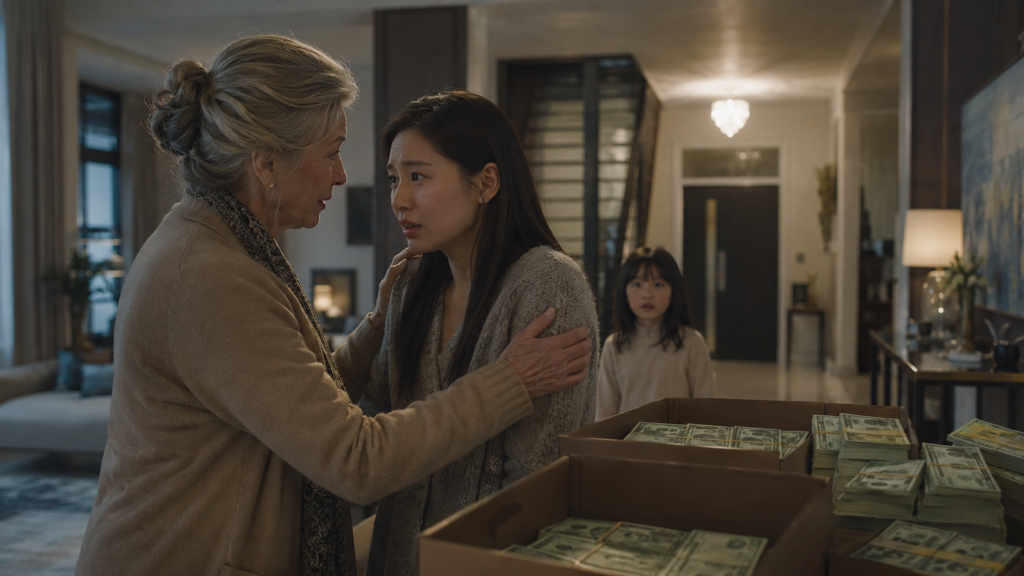
Boxes.
So many boxes.
Some were stacked against the wall.
Others were open.
Inside them were bundles of cash.
Dollars.
Thousands and thousands of dollars.
My hands began to shake.
I touched one bundle, as if it might vanish.
This was not normal.
This was not money kept for emergencies.
This was hidden money.
Secret money.
Dangerous money.
I backed away, my breath becoming shallow.
Then I heard a door open downstairs.
Footsteps.
Slow.
Careful.
Coming up the stairs.
I turned toward the hallway, gripping the edge of a box.
“Who’s there?” I whispered.
No answer.
The footsteps stopped outside the room.
Then Mary Lou appeared in the doorway.
For one second, neither of us moved.
My daughter.
My baby.
She stood before me, thinner than I remembered, with her hair tied back and her face pale from shock.
Her eyes widened.
“Mom?”
The word came out like a broken prayer.
I took one step toward her.
“Mary Lou.”
She covered her mouth.
“Why are you here?”
“Because twelve years of money cannot replace my daughter.”
Her face crumpled.
She rushed into my arms, and suddenly she was no longer a grown woman in a foreign country.
She was my little girl again, sobbing against my shoulder.
I held her tightly.
I wanted to ask everything at once.
Why didn’t you come home?
Where is your husband?
Why is there cash in this room?
Why do you look so afraid?
But before I could speak, a small face peeked from behind the doorway.
A little girl.
Maybe seven years old.
She had dark hair and large eyes.
Mary Lou’s eyes.
The child looked at me shyly.
“Grandma?” she asked in careful English.
My heart stopped.
I looked at Mary Lou.
“You have a child?”
Mary Lou closed her eyes as tears slipped down her cheeks.
“Yes.”
The little girl stepped closer.
“My name is Hana,” she said softly.
I knelt, though my knees hurt terribly.
“Hana,” I whispered. “You are beautiful.”
She smiled, but only a little.
A cautious smile.
A child’s smile learned in a house where noise was dangerous.
I looked back at my daughter.
“Where is Kang Jun?”
The moment I said his name, Mary Lou’s entire body changed.
Fear took over her face.
She grabbed my hand and pulled me fully into the room.
“Mom, listen carefully.”
“What is happening?”
“Kang Jun is not my husband anymore.”
“What?”
“He died nine years ago.”
The room spun.
I grabbed the wall.
“Died?”
She nodded.
“In a car accident. Three years after we married.”
I stared at the cash-filled boxes.
“Then where is this money coming from?”
Mary Lou wiped her face with trembling hands.
“It was never his money.”
I could not speak.
She looked toward the stairs, then closed the door quietly.
“Hana, go to your room.”
The child hesitated.
“It’s okay,” Mary Lou said gently. “Grandma is here.”
Only after Hana left did my daughter continue.
“Kang Jun was rich, yes, but not the way people thought. He worked with men who moved money through businesses. Dirty money. Illegal money. I didn’t know at first. I was young and stupid and lonely, and he made me believe he loved me.”
My heart twisted.
“He didn’t?”
“He owned me, Mom.”
Her words hit me harder than any scream.
She sat on the floor beside the boxes, as if her strength had finally left her.
“When we came here, he took my passport. He said it was for safety. Then he controlled my phone, my clothes, my schedule. He told me you would hate me if you knew how trapped I was. He told me I had chosen this life, so I had no right to cry.”
I covered my mouth.
“All those years…”
“I tried to leave in the first year. He found out. After that, he watched everything.”
“Why didn’t you tell me?”
“Because he threatened you.”
My blood turned cold.
“He knew where you lived. He had people in America. He said if I caused trouble, something would happen to you.”
I remembered every Christmas plate I had set for her.
Every unanswered question.
Every “I’m doing well.”
And suddenly, I understood.
She had not abandoned me.
She had been protecting me.
Mary Lou opened one of the boxes and pulled out a folder.
“When Kang Jun died, I thought I was free. But his partners came. They said he had hidden money, and they believed I knew where it was. I didn’t. Not then.”
“What did they do?”
“They kept watching me. Threatening me. They said I had to continue helping with the accounts because my name was on some company papers Kang Jun made me sign.”
She looked at the floor.
“I was pregnant with Hana.”
I reached for her hand.
“Oh, my baby.”
“I was alone, Mom. I didn’t know the laws. I didn’t know who to trust. Then one day, I found a storage key hidden in Kang Jun’s old coat. That led me to documents. Accounts. Cash. Proof of everything.”
She pointed at the boxes.
“This is only part of it.”
“Part of what?”
“Evidence.”
I stared at her.
“Evidence?”
“Yes. I have spent years gathering proof. Names, transfers, companies, bank routes. I didn’t send you money because I was living a rich life. I sent it because I was afraid the money would be taken or traced here. I sent it to you because you were the only person I trusted.”
The truth crushed me.
All that money sitting in my account.
All those years, I thought it was love wrapped in distance.
But it had been survival.
“You should have told me,” I whispered.
“I wanted to. Every day. But if they heard your name too much, they would look closer. So I kept the messages short.”
I thought of the bruise on her wrist.
“What happened to your arm?”
She pulled her sleeve down.
“One of them came last week. He said they know I’ve been collecting documents. He gave me until New Year’s to hand everything over.”
My stomach tightened.
“When is he coming back?”
Mary Lou did not answer.
That silence was enough.
Then, from downstairs, the front door opened.
Hana screamed.
Mary Lou jumped to her feet.
“Mom, hide.”
“No.”
“Mom, please.”
For twelve years, I had been afraid of the truth.
But not anymore.
I was sixty-three years old.
I had crossed an ocean for my child.
I was not going to hide while someone came into her home to hurt her.
Heavy footsteps moved below.
A man’s voice called out in Korean.
Mary Lou went pale.
“He’s early.”
She grabbed the folder and pushed it into my hands.
“If something happens, take this to the police.”
“I’m not leaving you.”
The footsteps climbed the stairs.
Mary Lou stood in front of me.
The door opened.
A man in a black coat stood there.
He was younger than Kang Jun would have been, perhaps in his forties, with sharp eyes and a cold smile.
He looked at Mary Lou.
Then at me.
His smile disappeared.
“Who is this?”
Mary Lou lifted her chin.
“My mother.”
The man stepped into the room.
“That was a mistake.”
I felt fear, yes.
But beneath it, something stronger rose in me.
A mother’s rage.
He looked at the boxes, then at the folder in my hand.
“Give that to me.”
“No,” I said.
His eyes flicked toward me, amused.
“You don’t understand what this is.”
“I understand enough.”
He reached for the folder.
And before he could touch it, Hana appeared behind him and shouted, “Police!”
The man turned.
Sirens wailed outside.
Mary Lou gasped.
I looked at my daughter.
She was crying.
But this time, she was smiling too.
“You called them?” I whispered.
She shook her head.
“Hana did.”
Later, I learned the truth.
Mary Lou had taught Hana for months what to do if the bad men came back.
There was an emergency phone hidden in her room.
One button.
One call.
The police arrived quickly, along with two officers who spoke English.
The man tried to leave, but they stopped him at the stairs.
He shouted.
Mary Lou shook.
I held her hand through all of it.
That afternoon became a storm of questions, documents, officers, translators, and phone calls.
The cash was photographed.
The folders were taken.
The computer from the office was sealed.
Mary Lou gave statements for hours.
I sat beside Hana in the kitchen, holding a cup of tea neither of us drank.
She looked at me and asked, “Are you taking Mommy away?”
I pulled her close.
“No, sweetheart. I came to bring Mommy home.”
For the first time, Hana hugged me.
That night, Mary Lou finally slept with her head in my lap, just as she had when she was a little girl.
I stroked her hair until my fingers ached.
I whispered apologies she was too exhausted to hear.
“I’m sorry I didn’t come sooner.”
“I’m sorry I believed the money meant you were safe.”
“I’m sorry, my baby.”
The investigation did not end in one day.
Things like that never do.
But something changed the moment I walked into that house.
My daughter was no longer alone.
Within weeks, the authorities placed Mary Lou and Hana under protection while the case grew larger than any of us had imagined.
Kang Jun’s old partners were arrested one by one.
Companies were frozen.
Accounts were traced.
And the money Mary Lou had sent me over the years became part of the evidence, not a crime, because she had kept every record and every message.
She had been smarter than all of them.
Stronger too.
But strength had cost her twelve years of her life.
When we finally flew home, Mary Lou held my hand during takeoff.
This time, I was not afraid of the plane.
I was afraid to let go of her.
At the airport back home, Mrs. Alvarez waited with flowers.
When Mary Lou saw her, she broke down.
Then my neighbors saw Hana.
The little girl hid behind my coat at first, but when Mrs. Alvarez offered her a candy cane, she smiled.
That Christmas, my house was full for the first time in twelve years.
Not full of expensive things.
Not full of money.
Full of shoes by the door.
Coats on chairs.
Steam from the kitchen.
A child’s laughter.
Mary Lou stood beside me while I stirred beef stew on the stove.
She took the spoon from my hand.
“Let me, Mom.”
I watched her carefully.
There were still shadows in her eyes.
Healing does not arrive all at once.
But she was home.
My daughter was home.
At dinner, I set three plates.
Mine.
Mary Lou’s.
Hana’s.
Then I looked at the empty fourth chair, the one I had set for twelve years.
Mary Lou noticed.
She touched my hand.
“Mom, you don’t have to set that place anymore.”
I smiled through my tears.
“Yes,” I said. “I do.”
She frowned gently.
“Why?”
I placed a napkin on the plate.
“Because that chair was never empty for nothing. It was waiting for the truth.”
Mary Lou cried then.
Not the frightened crying I had seen in Korea.
Not the silent crying of a trapped woman.
This was different.
This was the sound of a daughter finally allowing herself to be held.
Later that night, after Hana fell asleep on the sofa with a blanket wrapped around her, Mary Lou sat beside me near the Christmas tree.
“I thought you would hate me,” she whispered.
“For what?”
“For not coming back. For lying. For sending money instead of explaining.”
I turned to her.
“Mary Lou, I was hurt. I was confused. I was angry sometimes. But hate you? Never.”
She leaned against my shoulder.
“I missed you every day.”
“I know.”
“I wanted to come home.”
“I know.”
“I was so scared.”
I kissed her forehead.
“I know now.”
Outside, snow began to fall.
Inside, my daughter breathed slowly beside me, finally safe.
For years, people told me I was lucky because my daughter sent money.
But they were wrong.
Money is not luck.
Money is not love when it comes without a voice, without a visit, without peace.
That money was a trail.
A signal.
A silent cry from a daughter who could not say, “Help me.”
And I almost missed it.
Now, when people ask me about those eighty-thousand-dollar transfers, I don’t smile politely anymore.
I tell them the truth.
Sometimes, the child who seems far away is not forgetting you.
Sometimes, she is trapped.
Sometimes, she is protecting you the only way she knows how.
And sometimes, a mother must stop waiting by the phone and cross the world herself.
Because there are doors that will never open unless we are brave enough to push them.
That Christmas, I did not get expensive gifts.
I did not need them.
I got my daughter back.
I got a granddaughter I never knew existed.
And as we sat together under the soft glow of the Christmas lights, Hana climbed onto my lap and asked, “Grandma, will you cook this soup every Christmas?”
I looked at Mary Lou.
She was smiling through tears.
“Yes,” I told Hana.
“Every Christmas.”
Then Mary Lou reached across the table and held my hand.
For the first time in twelve years, the chair beside me was no longer empty.
And for the first time in twelve years, when my daughter said, “Mom, I’m doing well,” I believed her.
THE END! THANK YOU FOR READING!