

On my birthday, my father walked into my house carrying a white bakery box and a smile he had saved just for me. Inside that box was my favorite strawberry shortcake. Inside that smile was the kind of love I had spent two years pretending I no longer needed. “Happy birthday, sweetheart,” he began.
Then he saw my face. The smile disappeared so quickly it felt like the whole kitchen went dark. My father, Richard Bennett, stood in the doorway with his keys still in one hand and the cake balanced in the other. His eyes moved over me slowly, from the concealer I had packed under my cheekbone to the purple mark along my jaw, to the split near the corner of my lip that no amount of lipstick could hide.
For one second, nobody moved.
Not me.
Not my husband.
Not my mother-in-law.
The only sound was the quiet clink of Linda’s fork against her plate as she froze halfway through cutting the pie she had brought.
Derek, my husband, sat at the dining table with one ankle propped over his knee, sipping coffee like this was any normal Saturday morning.
Like it was not my thirty-second birthday.
Like he had not ruined it before the sun had even risen.
Like the bruises on my face were just part of the decorations.
Dad set the cake box down on the counter very carefully.
Too carefully.
That was the first sign.
My father was not a loud man. He had never been the kind to slam doors or curse in anger. He was the kind of man who got quiet when danger entered the room.
“Emily,” he said, his voice low. “Who did this to you?”
My hands were shaking so badly that the paper plates in my fingers bent in half.
I opened my mouth.
But Derek answered before I could.
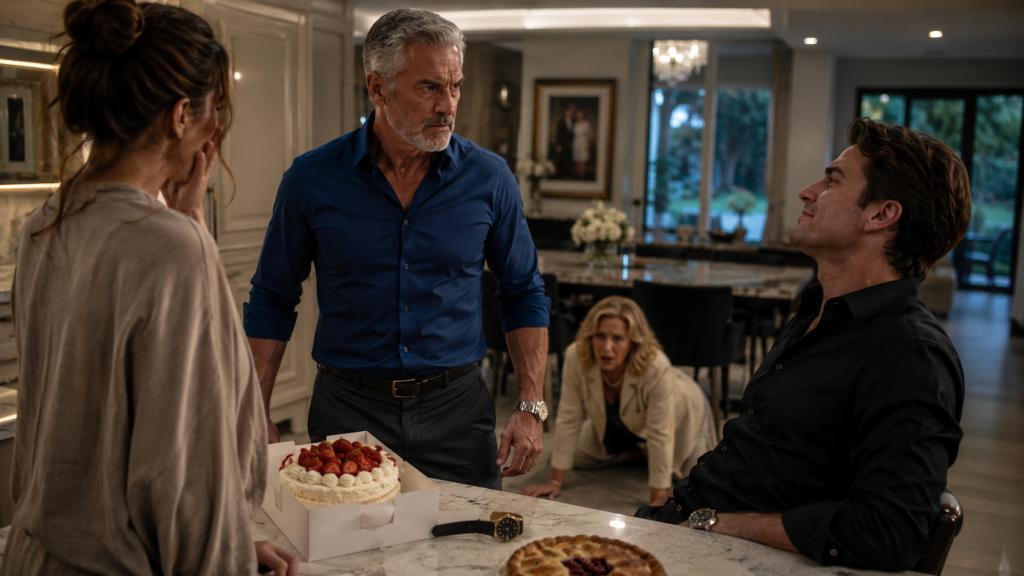
“Oh, that was me,” he said, and laughed.
Not a nervous laugh.
Not an embarrassed laugh.
A proud one.
He leaned back in his chair, lifting his mug toward my father like they were two men sharing a private joke.
“Instead of congratulations, I gave her a slap.”
For a moment, the whole room seemed to stop breathing.
Linda gave a short, awkward chuckle. It came out thin and ugly, the sound of a woman who knew something was wrong but had spent her whole life choosing comfort over courage.
“Derek,” she whispered, “don’t start.”
But Derek’s smile widened.
He thought he was untouchable.
He thought my father was just an old mechanic from a quiet street in Ohio. He thought the gentle man who used to fix neighbors’ lawn mowers for free and cry during old movies would lower his eyes, mumble something about family business, and let it go.
Derek had always mistaken kindness for weakness.
That was his first mistake.
Dad stared at him.
No anger showed on his face. No shouting. No trembling. Just a stillness so deep it made the air colder.
Then he slowly unbuckled his watch.
He laid it on the counter beside the cake.
The sound of the metal touching marble was small, but it landed in the room like thunder.
Derek’s smile flickered.
Dad rolled up the sleeves of his blue button-down shirt.
One fold.
Then another.
The same calm way he used to prepare before repairing an engine in our garage. Measured. Focused. Certain.
Then he turned to me without taking his eyes off Derek.
“Emily,” he said, “step outside.”
My breath caught.
“Dad—”
“Outside.”
It was not harsh.
It was protective.
And somehow that made my knees almost give out.
I backed toward the porch door, barely able to feel my feet. Through the window over the sink, I could still see the kitchen. Derek stood too quickly, his chair scraping against the tile.
“What the hell is this?” he snapped.
Linda shoved herself away from the table.
For the first time since I had married her son, I saw real fear in her face.
Not guilt.
Fear.
She looked from Derek to my father, then toward the hallway, as if calculating the fastest escape. Then, because the chair had trapped her legs and panic had stolen her dignity, she dropped down on all fours and scrambled away across the floor.
Her pearl necklace swung under her chin as she crawled past the barstool.
That was when I knew this day was about to end very differently.
Not because my father was about to hurt Derek.
But because everyone in that kitchen had finally understood something I should have understood years earlier.
A coward can rule a house only until someone unafraid walks through the door.
I stepped onto the back porch, clutching the railing as the cold air hit my face.
It was late November, and the wind smelled like wet leaves and rain. I stood there barefoot in my own backyard, wearing a soft beige sweater I had picked because it covered my arms, and I listened.
At first, there was silence.
Then Derek’s voice.
“Listen, old man, you don’t get to come into my house and act like—”
“My daughter’s house,” Dad said.
His voice was so calm I almost didn’t recognize it.
Derek laughed sharply.
“She’s my wife.”
“She is my daughter first.”
Something shifted inside me at those words.
For two years, Derek had worked very hard to make me forget that.
He had not started with slaps.
Men like Derek rarely do.
He started with comments.
Small ones.
“You’re too sensitive.”
“Your friends don’t really care about you.”
“Your father treats you like a child.”
“My mother understands marriage better than you do.”
Then he moved to rules.
No late calls with Dad because “married women don’t run to Daddy.”
No visits unless Derek approved because “your family doesn’t respect boundaries.”
No separate bank account because “that’s suspicious.”
No makeup unless he liked it.
No dresses that made men look.
No laughing too loudly in public.
No disagreeing in front of his mother.
Every rule arrived wrapped in the same sentence.
“I just love you too much to lose you.”
By the time love began to feel like a locked door, I had already stopped telling people where the key was.
The first time he grabbed my wrist, he cried afterward.
The first time he shoved me, he bought roses.
The first time he slapped me, he said I had made him feel small.
And somehow I apologized.
That is the part people who have never lived through it do not understand.
You do not wake up one morning trapped.
You are trained into it.
One excuse at a time.
One humiliation at a time.
One silence at a time.
That morning, on my birthday, I had woken before dawn and found Derek standing in the bedroom doorway with my phone in his hand.
“Your father texted,” he said.
My stomach tightened.
Dad had written, Happy birthday, sweetheart. I’ll bring cake around noon.
Derek held the phone up like evidence.
“You invited him?”
“No,” I said quickly. “He just said he was coming by.”
Derek’s eyes narrowed.
“We talked about this.”
“It’s my birthday.”
The words escaped before I could stop them.
That was all it took.
His hand came across my face so fast I didn’t even raise my arms.
The second one knocked me against the dresser.
The third was not a slap anymore.
It was punishment.
When it was over, he stood above me breathing hard, then fixed his hair in the mirror.
“Clean yourself up,” he said. “My mother is coming for lunch.”
Then he smiled.
“And don’t embarrass me.”
So I cleaned myself up.
I pressed ice wrapped in a dish towel to my cheek.
I covered what I could.
I set out plates.
I answered the door when Linda arrived with pie and looked straight at my swollen face.
She paused.
Then she walked past me and said, “Marriage is hard in the beginning.”
We had been married for three years.
I had never felt more alone than I did in that kitchen.
Until my father walked in.
On the porch, I heard Derek’s voice rising again.
“You think you can threaten me?”
“No,” Dad said. “I think you already threatened yourself.”
There was a pause.
Then Dad continued, “I heard every word.”
My fingers tightened around the railing.
Inside the kitchen, Derek went silent.
Dad must have lifted his phone, because I heard him say, “I started recording when I saw her face. You admitted what you did.”
Linda gasped from somewhere near the hallway.
“Richard,” she said, suddenly sweet, suddenly pleading, “please. Families handle these things privately.”
The back door opened.
I turned, expecting Derek.
But it was my father.
He stepped outside and looked at me, and all the strength in his face cracked for one second.
Just one.
Enough for me to see the pain underneath.
“Oh, my girl,” he whispered.
That broke me.
Not the slap.
Not the bruises.
Not Linda crawling away.
Those three words.
My girl.
I started crying so hard I couldn’t breathe.
Dad wrapped his arms around me, careful not to touch my face. He held me the way he had when I was seven and fell off my bike, the way he had when Mom died, the way he had when I called him from college after failing my first exam and swearing my life was over.
“You’re coming home with me tonight,” he said.
“I can’t,” I whispered.
“Yes, you can.”
“He’ll make it worse.”
Dad looked through the window at Derek.
“No,” he said. “He won’t.”
Then he dialed 911.
Derek came out of the kitchen like a storm.
“You called the police?” he shouted.
Dad stepped in front of me.
“Stay where you are.”
Derek pointed at me over my father’s shoulder.
“You see what she does? She plays victim. She provokes people, then cries to Daddy.”
My father did not move.
“She is not speaking to you.”
“This is my wife!”
“She is not your property.”
Derek’s face twisted.
For the first time, I saw how ugly he looked when he was not pretending to be charming.
The neighbors must have heard the shouting because curtains moved in the house next door. Across the street, Mrs. Alvarez stepped onto her porch with her phone in her hand.
Derek noticed.
His voice dropped.
“Emily,” he said, suddenly softer. “Come inside. We’ll talk.”
That voice used to fool me.
It was the voice he used after every outburst.
Gentle.
Wounded.
Almost loving.
The voice that said he never meant it, that I knew how his temper was, that marriage required forgiveness.
But this time, standing behind my father with cold air on my bruised face, I heard it for what it was.
A leash.
“No,” I said.
The word was small.
But it was mine.
Derek blinked.
“What?”
“I said no.”
His jaw clenched.
Dad did not smile, but I felt something in him relax.
Sirens sounded in the distance.
Derek looked toward the street, then back at me.
Linda appeared behind him, no longer crawling, but still bent and shaking. Her perfect hair was coming loose, and one of her earrings was missing.
“Derek,” she hissed, “stop talking.”
He turned on her.
“You shut up!”
She flinched.
And there it was.
The thing I had never seen clearly before.
Linda had not protected me because she had spent her life protecting herself from the same storm she helped create. She had raised Derek, excused Derek, defended Derek, and feared Derek.
But fear did not make her innocent.
It only made her useful to him.
Two police cars pulled up in front of the house.
Derek changed instantly.
His shoulders dropped.
His hands opened.
His face arranged itself into concern.
When the officers came through the gate, he stepped forward.
“Thank God you’re here,” he said. “My wife is having some kind of episode, and her father threatened me.”
I almost laughed.
Not because it was funny.
Because he was so predictable.
One officer looked at me.
Her expression changed immediately.
“Ma’am,” she said gently, “are you safe standing here?”
Before I could answer, Derek said, “She’s fine.”
The officer did not look at him.
“I asked her.”
My throat tightened.
Dad squeezed my shoulder once, then stepped aside.
I looked at the officer.
“No,” I said. “I’m not safe.”
Derek exhaled sharply.
“Unbelievable.”
The second officer turned to him.
“Sir, step back.”
Dad handed over his phone with the recording. Then he explained what he had heard, what Derek had admitted, and what he had seen when he entered.
Linda tried to interrupt.
“It was just family drama,” she said. “Young couples fight.”
The female officer turned toward her.
“Did you see him hit her?”
Linda’s mouth opened.
Derek stared at her.
For a long moment, Linda stood between truth and fear.
Then she looked at me.
Her face crumpled.
“Yes,” she whispered.
Derek exploded.
“You lying old—”
The officer moved fast.
“Sir, hands where I can see them.”
Derek shouted, cursed, blamed me, blamed my father, blamed stress, blamed marriage, blamed his mother for “making things sound worse.”
But the recording was there.
My face was there.
My statement was there.
And for once, his anger did not control the room.
They put him in handcuffs in the same kitchen where he had laughed about hitting me.
He looked at me as they led him out.
“You’ll regret this,” he said.
The officer stopped walking.
Dad stepped forward, but I raised my hand.
For years, I had swallowed my voice to survive him.
Not today.
“No,” I said, my voice shaking but clear. “I already regret staying this long.”
Derek’s face changed then.
Not with guilt.
With disbelief.
He had never imagined I would say that in front of witnesses.
They took him out the front door.
The neighbors watched from porches and windows. The birthday cake sat open on the counter. The pie Linda had brought was still on the table, one slice half-cut, the knife resting in the filling.
For a strange second, I thought about how much work I had done to make the house look perfect.
The polished floors.
The flowers.
The folded napkins.
The clean dishes.
A beautiful home can hide an ugly life.
But only for so long.
After the officers left, Linda sat at the dining table with her hands folded tightly in her lap. She looked smaller than I had ever seen her.
“Emily,” she said, “I didn’t know it was this bad.”
I stared at her.
The old me might have accepted that.
The old me might have comforted her.
But something had broken open inside me, and through that break came a truth I could no longer ignore.
“Yes, you did.”
She looked down.
“You saw my face when you came in,” I said. “You saw my arms last summer. You heard him call me names. You told me men get angry when women push them. You knew enough.”
Tears filled her eyes.
“I was afraid of him too.”
“I believe you,” I said. “But you still left me alone with him.”
She covered her mouth.
Dad stood beside me, silent.
Linda reached for her purse.
“I’ll go.”
I did not stop her.
At the door, she turned back.
“For what it’s worth,” she whispered, “I’m sorry.”
I looked at her for a long time.
“It’s worth less than what you think,” I said.
She left.
And then the house was quiet.
Too quiet.
The kind of quiet that comes after a storm tears off the roof and leaves you staring at open sky.
Dad walked to the counter, closed the cake box, then looked at me.
“Pack what matters.”
I nodded.
At first, I thought I would know exactly what to take.
But when I stepped into the bedroom, I froze.
My whole married life was in that room.
The framed wedding photo on the dresser.
The perfume he said was too strong.
The blue dress he liked because it made me look “respectable.”
The jewelry he bought after fights.
The bed where I had lain awake night after night, listening to him breathe, wondering which version of him would wake up beside me.
I opened a suitcase and packed slowly.
Documents first.
Passport.
Birth certificate.
Bank papers.
My mother’s necklace.
A photo of Dad and me at my high school graduation.
Then clothes.
Not the ones Derek liked.
The ones I had stopped wearing because they made me feel like myself.
A red sweater.
A pair of jeans.
Running shoes.
My old college hoodie.
When I opened the bathroom cabinet, I saw the concealer on the shelf and suddenly hated it.
Not because makeup was bad.
Because I had used it like a bandage over a wound that needed rescue.
I left it there.
Dad carried my suitcase to his truck.
Before I walked out, I turned back and looked at the kitchen one last time.
The cake was gone from the counter.
Dad had taken it with him.
I almost smiled.
Of course he had.
Richard Bennett did not waste cake, even during a family disaster.
The drive to his house took forty minutes.
I sat in the passenger seat wrapped in his coat, watching the town blur past the window. My phone kept buzzing in my lap.
Derek’s number.
Unknown numbers.
Linda.
Derek again.
Then messages.
You ruined my life.
You misunderstood.
Call me.
I love you.
You’re dead to me.
Please.
Please.
Please.
Each message sounded like a different mask falling from the same face.
Dad did not ask to see them.
He just said, “You don’t have to answer.”
So I didn’t.
When we reached his house, the porch light was already on.
He still lived in the small white home where I had grown up. The rose bushes my mother planted were bare for winter. The old wind chime still hung near the door. The welcome mat was faded, but familiar.
I stepped inside and smelled coffee, cedar, and home.
That was when I broke down again.
Not dramatically.
Not loudly.
I just folded at the kitchen table and cried into my hands.
Dad put a mug of tea in front of me and sat across from me.
For a while, he said nothing.
Then he reached into his shirt pocket and pulled out a small envelope.
“I was going to give you this after cake,” he said.
I wiped my eyes.
Inside was a birthday card.
On the front was a watercolor of a little girl holding balloons.
Inside, in Dad’s careful handwriting, were the words:
Emily,
You were the greatest gift your mother and I ever received. Nothing you do, nothing you suffer, and nothing anyone says can make you less precious to me.
Come home whenever you need.
No questions.
No shame.
Always.
Love, Dad.
I pressed the card to my chest and sobbed.
“I was embarrassed,” I whispered.
Dad’s eyes filled with tears.
“Sweetheart, the shame belongs to him.”
I shook my head.
“I thought you’d be disappointed.”
He looked almost angry then, but not at me.
“I am disappointed,” he said. “But not in you. I’m disappointed that someone convinced my daughter she had to bleed quietly to be loved.”
Those words stayed with me.
That night, I slept in my childhood bedroom under the quilt my mother had sewn when I was fifteen.
I did not sleep well.
Every sound woke me.
Every car outside made my heart race.
But Derek did not come.
The next morning, Dad drove me to the courthouse.
My hands shook as I filled out forms. The woman behind the glass looked at my face, softened her voice, and guided me through the process. By noon, there was a protective order filed.
By evening, my phone had seventy-six missed calls.
By the end of the week, Derek had violated the order twice through messages and one “accidental” drive past my father’s house.
By the end of the month, I had a lawyer.
And by spring, I had something I had not felt in years.
A morning where I woke up without fear.
It did not happen all at once.
Healing is not a door you walk through.
It is a thousand small steps away from the person who taught you to crawl.
I started therapy.
I changed my number.
I opened a bank account in my name only.
I cut my hair short because Derek had always said women with short hair looked “hard.”
I bought yellow curtains for my father’s guest room because I wanted sunlight everywhere.
Some days I felt brave.
Some days I felt stupid.
Some days I missed the good version of Derek so badly I hated myself.
Then my therapist said something that saved me.
“You don’t miss him. You miss the man he pretended to be when he wanted you to stay.”
After that, the grief made more sense.
Linda testified eventually.
Not because she suddenly became noble, but because Derek turned on her too. He blamed her for everything. He screamed at her in front of officers during a hearing. He called her weak.
And finally, after decades of raising a storm and calling it a son, Linda admitted under oath that she had seen him hurt me before.
Her apology came in a letter six months later.
I read it once.
Then I put it away.
Forgiveness, I learned, is not a performance you owe people who watched you suffer.
It is a private decision.
And sometimes the decision is simply this:
I will not carry your guilt for you.
My divorce was finalized ten months after my birthday.
On that day, Dad took me to a small diner off Route 16. We ordered pancakes for dinner because Mom used to say pancakes tasted better after sunset.
The waitress brought a slice of strawberry shortcake with one candle on top.
I laughed.
“Dad, it’s not my birthday.”
He lit the candle anyway.
“It is,” he said. “Your first one.”
I stared at the flame.
For years, I had thought birthdays were about age.
That night, I understood they could also be about return.
The return of your name.
Your voice.
Your body.
Your choices.
Your future.
I closed my eyes and made a wish.
Not for revenge.
Not for Derek to suffer.
Not even for Linda to understand.
I wished for a life where no one ever again had to ask permission to treat me gently.
Then I blew out the candle.
Dad clapped like I was five years old.
I rolled my eyes, but I was smiling.
A real smile.
The kind that reached the parts of my face that had once been bruised.
A year later, on my thirty-third birthday, I hosted dinner in my own apartment.
It was small.
One bedroom.
Second floor.
Too many plants.
Yellow curtains in the living room.
A strawberry shortcake on the table.
Dad arrived exactly at noon, carrying flowers this time instead of fear.
When I opened the door, he looked at my face.
Healthy.
Bare.
Unhidden.
His eyes filled with quiet relief.
“Happy birthday, sweetheart,” he said.
I stepped aside.
“Come in, Dad.”
He walked into my home.
My real home.
A place where no one raised a hand.
A place where laughter did not need permission.
A place where love sounded like safety.
After dinner, while we washed dishes side by side, Dad noticed his old watch on my counter.
The same one he had taken off that terrible day.
I had kept it.
Not because I wanted to remember the fear.
Because I wanted to remember the moment fear stopped being the strongest person in the room.
Dad picked it up and smiled sadly.
“You still have this?”
I nodded.
“That watch saved me.”
“No,” he said gently. “You saved you.”
I looked at him.
He placed the watch back on the counter.
“I just showed up.”
For a long time, I believed rescue had to be loud.
Sirens.
Courtrooms.
Handcuffs.
Men standing between you and danger.
But the truth is, rescue begins much earlier.
It begins with one person seeing what everyone else pretends not to see.
It begins with someone asking, “Who did this to you?” and actually wanting the answer.
It begins when you stop protecting the person who keeps hurting you.
And sometimes, it begins on your birthday, with strawberry shortcake on the counter, a watch laid carefully beside it, and your father’s voice telling you to step outside.
I used to think that was the day my life fell apart.
Now I know better.
That was the day my life finally came back to me.
THE END! THANK YOU FOR READING!