

Seven years ago, my husband left for a fishing trip with our twin boys — and none of them ever came home. Then last weekend, my daughter found an old phone hidden in her closet. Crying, she handed it to me and whispered: “Mom… Dad sent me a video the night before they disappeared. He told me not to show you.”
Seven years have passed since Ryan walked out our front door before sunrise with Jack and Caleb, promising they’d be back before dinner. And somehow, even now, a part of me still looks toward the door whenever it creaks open, expecting to hear their laughter again. But they never returned.
Now it’s just me and Lily.
She’s thirteen today — quiet, thoughtful, and far more mature than a child her age should be.
The kind of quiet that comes from growing up beside a mother who never truly stopped grieving.
Sometimes I still walk past the twins’ old bedroom and imagine them frozen in time at nine years old — arguing over fishing rods, wearing mismatched socks, laughing loud enough to shake the walls.
I came into their lives when they were toddlers, but I never loved them as anything less than my own sons.
That matters more than people think.
Because after a tragedy, people suddenly cling to words like “stepmother,” as if love becomes smaller when there’s no shared blood.
Every summer, Ryan took the boys fishing at Lake Monroe.
It was their tradition — father and sons leaving before dawn and coming home smelling like lake water and sunscreen.
Lily begged to go every single year.
And every single year, Ryan would kiss the top of her head and smile.
“Next year, Peanut.”
But next year never came.
The morning they disappeared felt completely ordinary.
Ryan stood in the kitchen making coffee before sunrise while Jack struggled with the buttons on his shirt.
Caleb bragged nonstop about catching the biggest fish on the lake.
Lily stood near the back door in her pajamas, making one last desperate plea.
“Daddy, please let me come.”
Ryan crouched beside her and smiled gently.
“You’re still too little for the boat, Peanut. Next year.”
Then he kissed her cheek, ruffled the twins’ hair, and looked over at me.
“We’ll be back before dinner. Although Jack’s probably just catching weeds again.”
Jack groaned.
Caleb laughed hysterically.
And I laughed too.
I didn’t know it would be the last normal moment of my life.
By afternoon, I kept checking the clock.
By evening, I had already called Ryan four times.
The first calls rang unanswered.
Then the phone went straight to voicemail.
As darkness settled and the driveway stayed empty, panic wrapped around my chest.
I left Lily with a neighbor and drove to the lake with several people from our street.
We found the boat first.
It floated silently near the north shore.
Empty.
No Ryan.
No boys.
No voices.
Their life jackets were still sitting untouched inside.
I screamed their names until my throat burned raw.
Nothing answered.
The search lasted for days.
Ryan’s best friend, Paul, helped organize volunteers and rescue crews.
Again and again, he repeated the same heartbreaking words:
“Anna… you need to accept it.”
Everyone eventually settled on the same explanation.
A strong current.
A tragic accident.
The lake swallowed them whole.
But no bodies were ever found.
For nearly a year afterward, I drove to the lake almost every day after dropping Lily at school.
I’d sit there staring at the water, somehow convinced that if I waited long enough, the lake would finally give me answers.
One afternoon, I got out of the car and screamed all three of their names into the wind until my voice disappeared.
Eventually, I stopped going.
Not because I healed.
But because the lake itself started to feel cruel.
I packed away every photo from those fishing trips because I couldn’t bear seeing smiling faces I never truly got to say goodbye to.
Still, life kept moving forward.
Lily grew older.
Bills still needed paying.
Homework still had to be checked.
Soccer uniforms still needed washing.
I learned how to survive beside the emptiness my family left behind.
I thought that would be the rest of my life.
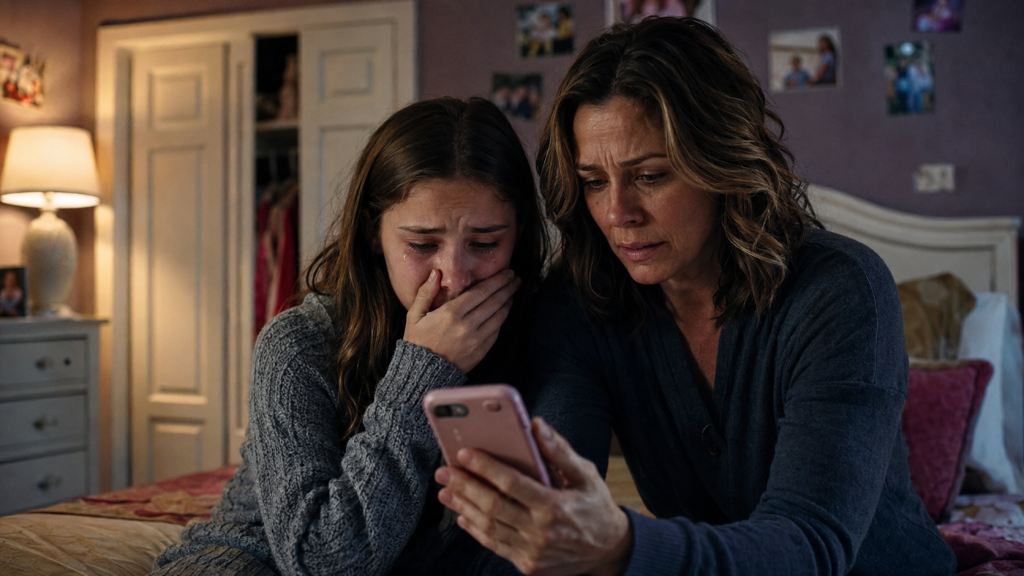
Then last weekend, Lily walked into my room holding an old pink phone.
And everything changed.
It happened after dinner.
I was folding laundry while half-watching television when she appeared quietly in the doorway.
“I found this in one of the closet boxes,” she said softly. “The charger was there too.”
She swallowed hard.
“I was looking through old games and pictures from when I was little… and then I found something else.”
Immediately, I knew something was wrong.
“What is it, sweetheart?”
Her eyes filled with tears.
“Mom… Dad sent me a video the night before they left.”
The laundry slipped from my hands.
“What?”
“He told me not to show you until ten years passed,” she whispered. “I was only six. After they disappeared… I forgot about it.”
Her voice broke completely.
“He said you might hate him after you watch it.”
For a moment, I could not move.
The room felt like it had tilted beneath my feet.
Lily held the phone out to me with both hands, as if it were something dangerous.
I took it.
The screen was cracked across one corner.
The little pink case was faded and sticky with age.
There were butterfly stickers on the back — stickers Ryan had helped Lily put on when she was six.
My thumb shook as I opened the message.
There it was.
A video.
Sent at 11:48 p.m.
The night before the fishing trip.
The title read:
For Lily Only.
I pressed play.
Ryan’s face appeared on the screen.
He was sitting in our garage.
The light above him flickered.
His hair was messy, his eyes red, and his voice was barely more than a whisper.
“Hey, Peanut.”
Lily let out a small sob beside me.
Ryan looked over his shoulder, then back at the camera.
“If you’re watching this years from now, then I need you to listen carefully. I love you more than anything in this world. I love your mother too. What I’m doing is going to hurt her, and I hate myself for that.”
My knees weakened.
I sat down on the edge of the bed.
Ryan took a trembling breath.
“Tomorrow morning, I’m taking Jack and Caleb away. Not fishing. Not really. I know everyone will think we went to the lake. That’s what they need to think.”
The room went silent except for Lily’s crying.
I stared at the screen, unable to breathe.
Ryan’s eyes filled with tears.
“Your mom doesn’t know the truth. I didn’t tell her because if she knew, she would try to stop me. And if she tried to stop me, Paul would know.”
My blood turned cold.
Paul.
Ryan’s best friend.
The man who stood beside me at the lake.
The man who held my shoulders while I screamed.
The man who organized searches and told me again and again to accept that my husband and sons were dead.
Ryan leaned closer to the camera.
“Paul found out something about the twins’ real mother. Something dangerous. She didn’t die the way people said she did, Anna doesn’t know that, and the boys are not safe here anymore.”
I covered my mouth.
The twins’ biological mother, Marissa, had died when they were two.
At least, that was what Ryan had always told me.
A car accident.
A rainy road.
No survivors.
It was one of the first painful things Ryan trusted me with when we started dating.
And now, after seven years of mourning, he was telling my six-year-old daughter that even that had been a lie.
Ryan’s voice cracked.
“Peanut, if Paul ever comes near you or your mom, run. Don’t trust him. Don’t let him inside the house. Don’t let him help. He is not who we thought he was.”
Then Ryan looked down, pressing his fingers to his eyes.
“I’m sorry, Anna,” he whispered, even though the message was meant for Lily. “God, I am so sorry.”
The video ended.
For several seconds, neither of us spoke.
Then the doorbell rang.
Lily screamed.
The sound tore through the house like a gunshot.
I grabbed the phone and stood.
The doorbell rang again.
Slow.
Patient.
Familiar.
I moved to the bedroom window and pulled the curtain aside.
Paul stood on our porch.
Seven years older than the last time I had seen him regularly, but still unmistakably Paul.
Tall.
Broad-shouldered.
Wearing a navy jacket and holding a small gift bag.
He looked up toward the second-floor window.
And smiled.
My hand tightened around the curtain.
“Mom,” Lily whispered. “Why is he here?”
I didn’t answer.
Because I didn’t know.
Paul had drifted out of our lives after the first year.
At first, he checked on us constantly.
Then less often.
Then birthday cards.
Then silence.
And now, on Lily’s thirteenth birthday, he was standing on my porch minutes after we watched a video warning us about him.
The doorbell rang a third time.
I turned to Lily.
“Go into your closet. Call 911. Tell them there is an unwanted man at our door and you are scared.”
Her eyes widened.
“What about you?”
“Do it now.”
She ran.
I walked downstairs slowly, every step feeling like it belonged to someone else.
At the door, I looked through the peephole.
Paul lifted the gift bag slightly.
“Anna?” he called gently. “It’s Paul. I know it’s late. I just wanted to drop something off for Lily.”
My mouth went dry.
I did not open the door.
“What do you want?”
There was a pause.
“I heard it was her birthday.”
My heartbeat pounded in my ears.
“How did you know that?”
He smiled again, but this time it didn’t reach his eyes.
“Come on, Anna. I was family once.”
No.
He was never family.
Ryan had said it clearly.
Don’t let him inside the house.
“What’s in the bag?”
“A little keepsake. Something of Ryan’s.”
My stomach tightened.
Something of Ryan’s.
After seven years?
After all this time?
“You can leave it on the porch.”
Paul’s face changed.
Only for a second.
The smile slipped.
Then it returned.
“I’d rather hand it to you.”
“I said leave it.”
Behind me, upstairs, I heard Lily’s closet door close.
Good girl.
Paul stepped closer to the door.
“Anna, open the door.”
His voice had changed.
No more warmth.
No more concern.
Just command.
I backed away.
“No.”
He looked directly into the peephole.
“You watched it, didn’t you?”
Every nerve in my body froze.
I stopped breathing.
Paul’s expression hardened.
“You really should have let the past stay buried.”
That was when I knew.
Ryan had not drowned.
Jack and Caleb had not drowned.
My family had disappeared because of whatever Paul had done.
And somehow, after seven years, he knew the video had been found.
A sharp bang hit the door.
I jumped backward.
Paul had slammed his fist against it.
“Open the door, Anna.”
I ran to the kitchen, grabbed the biggest knife from the block, and backed into the hallway.
The front door shook again.
Then again.
The lock held, but barely.
Upstairs, Lily screamed my name.
Sirens wailed faintly in the distance.
Paul heard them too.
Through the narrow window beside the door, I saw him step back.
For one terrifying second, I thought he would run.
Instead, he lowered the gift bag to the porch, looked straight at the house, and said:
“You have no idea what Ryan took from me.”
Then he walked away.
When the police arrived, I was still holding the knife.
Lily was shaking so hard she could barely speak.
The officers searched the yard, the street, and the nearby blocks, but Paul was gone.
One officer picked up the gift bag with gloved hands.
Inside was a small wooden tackle box.
Ryan’s tackle box.
The one I thought had disappeared with him.
I nearly collapsed when I saw it.
The officer opened it carefully.
Inside were old fishing lures, a folded photograph, and a small silver key taped under the lid.
The photograph showed Ryan with Jack and Caleb.
They were standing in front of a roadside motel sign.
Not at Lake Monroe.
Not on the day they supposedly drowned.
On the back of the photo, Ryan had written one sentence:
Anna, if this finds you, go to the storage unit under my mother’s maiden name.
I gave the police everything.
The phone.
The video.
The tackle box.
The key.
But I knew from the officers’ faces that this was bigger and stranger than anything they had expected from a routine trespassing call.
The next morning, Detective Morales arrived at our house.
She was in her late forties, sharp-eyed, calm, and serious.
She watched the video twice without interrupting.
Then she looked at me.
“Did your husband ever mention being involved in a custody dispute over the twins?”
“No,” I said. “Their mother died when they were toddlers.”
Detective Morales exchanged a glance with the officer beside her.
Then she opened a file.
“Anna, Marissa Cole did not die in a car accident.”
My hands went numb.
“What?”
“She disappeared. Her body was never found.”
I stared at her.
The room seemed to close in around me.
“But Ryan told me…”
“I know what he told you,” she said gently. “But according to these records, Marissa had filed multiple complaints against Paul Whitaker before she disappeared.”
Paul.
Again.
My throat tightened.
“What kind of complaints?”
“Harassment. Threats. Stalking. One report claimed Paul believed Jack and Caleb were his children.”
The words hit me so hard I almost couldn’t understand them.
“No. That’s impossible.”
Detective Morales nodded slowly.
“Maybe. Maybe not. But your husband clearly believed the boys were in danger.”
A terrible memory surfaced.
Paul standing over Caleb at a barbecue, staring at him for too long.
Paul once saying Jack had “his temper.”
Paul offering to babysit too often.
Paul arriving unexpectedly after Ryan changed the locks on the garage.
Things I had dismissed.
Things Ryan had brushed off.
Things that now felt like warning signs written in red.
We went to the storage facility that afternoon.
The unit was registered under Ryan’s mother’s maiden name, just as the photograph said.
The key fit.
When the metal door rolled up, the smell of dust and cardboard rushed out.
Inside were boxes.
Dozens of them.
Files.
Photographs.
A map.
Copies of police reports.
A second prepaid phone.
And letters.
Letters from Ryan to me.
My hands shook as I opened the first one.
Anna,
If you are reading this, then something went wrong. I wanted to tell you the truth every day. I wanted to ask you to come with us. But Paul was watching too closely, and I could not risk him following all four of us. I thought if I left you and Lily behind, he would believe the boys were dead. I thought he would stop looking.
The paper blurred as tears filled my eyes.
I read on.
Marissa was afraid of him. She told me Paul was obsessed with the boys. She said he believed they belonged to him, even though every test proved they were mine. When she disappeared, everyone treated her like an unstable woman who ran away. But I found her journal. She wrote that if anything happened to her, Paul had done it.
I pressed the letter to my chest.
Ryan had carried this alone.
All those years of smiling across dinner.
All those mornings kissing Lily goodbye.
All while planning an escape he believed would save our sons.
There were more letters.
Some written before the disappearance.
Some written after.
That was when I realized the impossible truth.
Ryan had lived.
At least for a while.
One letter was dated six months after the lake.
Another two years after.
Another four.
Each one shorter than the last.
He wrote about moving from state to state.
About new names.
About Jack missing Lily.
About Caleb asking if I hated them.
About watching me from a distance once, outside a grocery store, and nearly breaking his cover just to hear my voice.
I sobbed so hard Detective Morales had to help me sit down.
Then we found the last envelope.
It was dated three years earlier.
Anna,
I think Paul found us.
If he comes for me, I will do everything I can to get the boys away first. They are older now. Smart. Brave. They know who they are. They know about you. They know about Lily. They know I loved you enough to break your heart because it was the only way I knew to keep you breathing.
There was no goodbye at the end.
Only three words.
Find the lighthouse.
Taped inside the envelope was a postcard.
A white lighthouse on a rocky shore.
No address.
No state.
Just a name printed at the bottom.
Bell Harbor Light.
Detective Morales took one look at it and called someone.
Within hours, everything began moving fast.
Bell Harbor was a small coastal town three states away.
There had been an old missing persons report there from three years earlier.
A man using the name Adam Reed had vanished after a fire at a rented cottage.
Two teenage boys had also disappeared that same night.
No bodies were found.
My heart broke all over again.
Ryan had vanished twice.
But the boys?
The boys might still be alive.
For the first time in seven years, hope entered my body like pain.
Violent.
Sharp.
Almost unbearable.
The investigation reopened.
Paul’s house was searched.
At first, they found nothing.
Then officers discovered a locked room behind shelving in his basement.
Inside were photographs.
Not just of Ryan.
Of us.
Of me walking Lily to school.
Of Lily at soccer practice.
Of our house.
Photos taken over seven years.
Paul had never stopped watching.
Hidden among the photographs was a folder labeled “Bell Harbor.”
Inside were maps, motel receipts, and one grainy surveillance photo from a gas station.
Ryan stood near the pump.
Older.
Thinner.
Alive.
Beside him stood Jack and Caleb.
They were no longer nine.
They were sixteen.
Tall, serious-faced boys with Ryan’s eyes.
When Detective Morales showed me the photo, I pressed my hand to the screen and broke.
“My sons,” I whispered.
Lily leaned against me, crying.
“They’re alive?”
Detective Morales did not promise.
She was too careful for that.
But her eyes softened.
“We have reason to believe they survived the fire.”
Paul was arrested two days later trying to cross into Canada.
In his car, police found cash, fake IDs, and a printed article about Lily’s school award ceremony.
That detail made me sick.
He had been coming back for her.
Maybe because she found the phone.
Maybe because he wanted leverage.
Maybe because monsters do not stop being monsters simply because time passes.
For weeks, the investigation consumed our lives.
Detectives traced Ryan’s false identities.
Old motel cameras.
School records under changed names.
Clinic visits.
Cash purchases.
Every clue led somewhere, then nowhere.
Then one night, just after midnight, Detective Morales called.
“Anna,” she said, and her voice was different.
My whole body went still.
“We found someone.”
I gripped the phone.
“Who?”
“A young man in Oregon. He’s been living under the name Jacob Reed.”
Jack.
My Jack.
The room spun.
Lily sat up in bed, instantly awake.
“Mom?”
I couldn’t speak.
Detective Morales continued gently.
“He is alive. He is safe. And Anna… he has Caleb with him.”
I fell to my knees.
For seven years, grief had lived inside my chest like a locked room.
And in one sentence, the door burst open.
The reunion happened three days later in a small private room at the police station.
I thought I would run to them.
I thought I would throw my arms around them and never let go.
But when the door opened, I froze.
Two young men stood there.
Seventeen now.
Not little boys.
Not the children I had kept preserved in my memory.
Jack was taller than Ryan had been.
Caleb had a scar above his eyebrow.
Both of them looked at me with fear, hope, and seven years of stolen childhood between us.
Then Caleb whispered:
“Mom?”
That one word destroyed me.
I crossed the room and pulled them into my arms.
They were bigger than I remembered.
Stronger.
But when they started crying, they sounded like my boys again.
Lily ran in after me.
For one second, the twins stared at her.
The little sister they had lost was now almost their height.
Then Jack laughed through tears.
“Peanut?”
Lily sobbed and crashed into them.
We held each other until none of us could stand.
Later, they told us what happened.
Ryan had staged the boat accident to make Paul believe they were dead.
For four years, he kept them moving.
He homeschooled them.
Changed jobs.
Changed names.
Sent letters he never dared mail.
He planned to come back once Paul was exposed.
But Paul found them in Bell Harbor.
There was a confrontation.
A fire.
Ryan got the boys out through a back window and told them to run to the lighthouse, just like they had practiced.
He promised he would meet them there.
He never came.
The boys waited until morning.
Then fear took over.
They ran.
A woman named Nora found them days later sleeping behind her diner.
She did not ask too many questions.
She gave them food.
Then shelter.
Then, eventually, a home.
They had been too scared to contact anyone.
Ryan had drilled one rule into them:
If Paul finds us, everyone we love is in danger.
So they stayed hidden.
Surviving.
Waiting.
Growing up in the shadow of a man who had stolen everything from us.
“What happened to Dad?” Jack asked Detective Morales.
No one answered immediately.
Because we still did not know.
Two months later, they found Ryan.
Not alive.
The remains were discovered near the old Bell Harbor cottage, buried beyond the tree line where the fire had spread.
Paul eventually confessed to enough for the world to finally know the truth.
He had killed Marissa years earlier after she threatened to expose him.
He had stalked Ryan.
He had hunted my family.
And when Ryan tried to protect his sons, Paul made sure he never came home.
At the trial, Paul looked smaller than I remembered.
Not powerful.
Not charming.
Not the loyal friend who had once handed out search flyers with tears in his eyes.
Just a coward in a suit.
He turned once and looked at me.
I did not look away.
For seven years, I had believed the lake took my husband and sons.
But it had been a man.
A man we had invited into our home.
A man who stood beside me while I mourned the family he had helped tear apart.
When the judge sentenced him, I felt no joy.
Only exhaustion.
Justice does not give back lost years.
It does not return birthdays.
It does not erase nightmares.
But it does unlock the door.
And after seven years, we finally walked out.
Jack and Caleb came home with us.
Not easily.
Not perfectly.
You do not repair seven years of fear with one hug.
They had nightmares.
So did Lily.
So did I.
Sometimes Caleb slept on the floor beside Lily’s door because he was afraid someone would come for her.
Sometimes Jack sat in Ryan’s old chair in the garage and stared at nothing.
Sometimes I caught myself standing in the hallway, watching all three of them breathe, terrified that if I blinked, they would vanish again.
But slowly, life returned.
Not the old life.
A different one.
A wounded one.
A life with therapy appointments and quiet dinners.
A life where Lily taught her brothers how to use the streaming apps they had missed.
A life where Jack fixed the loose kitchen cabinet Ryan never got around to repairing.
A life where Caleb found the old fishing rods in the garage and cried for an hour before asking if we could keep them.
For a long time, I could not go back to Lake Monroe.
Then, on the anniversary of the disappearance, Jack asked if we could.
I almost said no.
But Caleb nodded.
Lily held my hand.
So we went.
The lake looked the same.
That was the cruelest part.
The water still glittered.
The trees still leaned over the shore.
Families still laughed near picnic tables, completely unaware that, to us, this place had once been the edge of the world.
We stood near the north shore where the empty boat had been found.
Jack held Ryan’s old tackle box.
Caleb held the photograph from Bell Harbor.
Lily held the pink phone.
I held nothing.
For years, I had carried enough ghosts.
Jack opened the tackle box and placed one of Ryan’s favorite lures into the water.
It bobbed once, then drifted away.
Caleb whispered:
“He saved us.”
I nodded, tears falling silently.
“Yes,” I said. “He did.”
Lily leaned against me.
“He saved us too, didn’t he?”
I looked at my daughter.
The little girl Ryan had left behind because he believed it was the only way to keep her alive.
The girl who had carried the truth in an old pink phone without knowing it.
The girl who found the key that brought her brothers home.
“Yes,” I whispered. “He saved us too.”
That evening, we went home together.
All four of us.
The house was loud again.
Not the same laughter.
Not the same voices.
But close enough to make my heart ache.
Jack and Caleb’s old bedroom had to be changed.
They were not nine anymore.
They were young men who had lived too much and lost too much.
Still, on the first night back, they both slept there.
Twin beds.
Mismatched blankets.
Just like before.
Before I went to bed, I passed their doorway and stopped.
Jack was asleep.
Caleb was half-awake, staring at the ceiling.
“You okay?” I whispered.
He turned his head toward me.
For a moment, I saw the little boy who used to ask me to check under his bed for monsters.
Then he said softly:
“I missed you, Mom.”
Seven years of pain rose in my throat.
I walked over, sat beside him, and brushed his hair back the way I used to.
“I missed you every second.”
He closed his eyes.
And for the first time in seven years, I did not listen to the silence of my house and feel abandoned by it.
I listened to breathing.
Three children breathing under my roof.
My children.
The next morning, I woke before sunrise.
Old habits.
Old grief.
But this time, I heard movement downstairs.
When I entered the kitchen, Jack was making coffee exactly the way Ryan used to.
Caleb was burning toast.
Lily was laughing at both of them.
Sunlight spilled across the floor.
For a second, my heart forgot how to hurt.
Then Jack turned and smiled.
“Morning, Mom.”
Not Anna.
Not stepmom.
Mom.
I stood there in the doorway, wearing the same robe I had worn through years of lonely mornings, and finally understood something.
Some losses change shape.
Some grief never fully leaves.
But sometimes, after the longest night of your life, the door opens.
And the voices you thought you’d never hear again come home.
Not the way you expected.
Not without scars.
But real.
Alive.
Home.
And this time, when the door creaked open, I did not imagine their laughter.
I heard it.
THE END! THANK YOU FOR READING!