

The Gunnery Sergeant stepped through the doorway as if the room belonged to him.
Conversation died instantly.
Even Vivian stopped smiling.
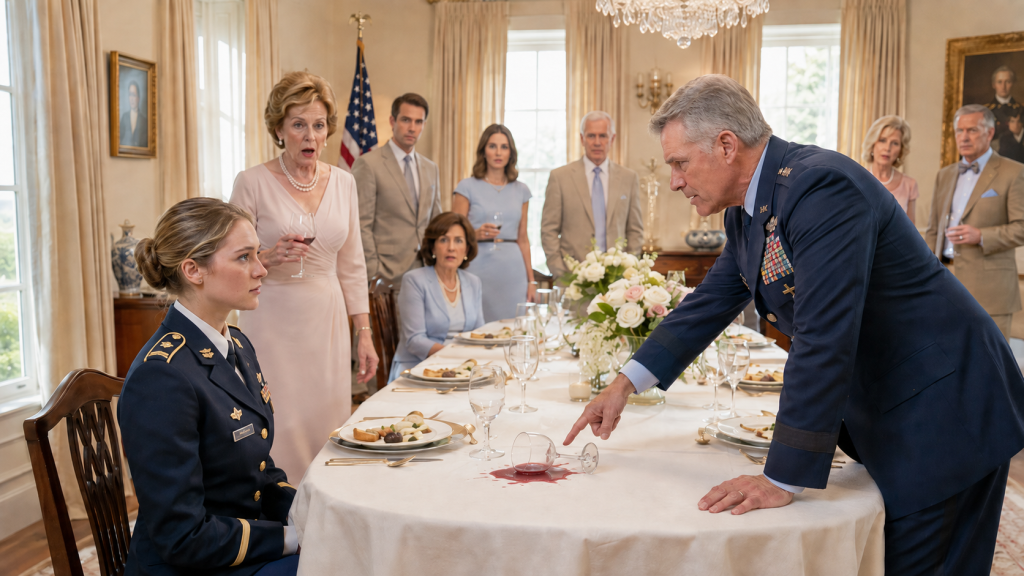
He was tall, broad-shouldered, and somewhere in his late forties. His dress blues were immaculate, his ribbons arranged precisely, his expression controlled in that unmistakable way Marines learned after years of standing in places where emotion could get people hurt.
In his right hand rested a small blackened coin.
The edges were warped.
One side had been scorched almost smooth.
But I recognized it.
My breath caught.
For the first time that night, my hands began to shake.
“Gunnery Sergeant Alvarez,” I whispered.
His eyes softened when he looked at me.
“Staff Sergeant Carter.”
Vivian turned sharply.
“Staff Sergeant?”
She looked at me as if she had never heard the title before.
Maybe she hadn’t.
To her, my military service had always been some embarrassing detour between the life she wanted me to have and the daughter she wished I had become.
Alvarez crossed the room.
Every person watched him.
Retired officers straightened instinctively.
Two former Marines near the fireplace exchanged glances.
He stopped beside my chair.
Then he looked at the ruined plate my mother had shoved away from me.
His jaw tightened.
“I apologize for arriving unannounced,” he said.
Vivian recovered quickly.
“Oh, no. Of course not. We’re always honored to have military guests.”
The hypocrisy was so smooth that I almost laughed.
Five minutes earlier, she had called me an ugly soldier.
Now she smiled like she hosted Marines every weekend.
Alvarez did not return the smile.
“I’m not here as a guest.”
Vivian’s expression changed.
He placed the burned coin on the table in front of me.
It made a tiny metallic sound against the wood.
That sound pulled me backward three years.
Heat.
Smoke.
Twisted steel.
Someone screaming my name.
My fingers closed around the edge of the chair.
Maya noticed.
She reached under the table and touched my hand.
I held on to her.
Alvarez looked around the room.
“I came because I heard Staff Sergeant Carter was back in town.”
Vivian laughed nervously.
“She’s been home for months.”
“Not like this.”
He looked at me.
“Not standing in uniform again.”
My mother’s eyes narrowed.
“What exactly is this about?”
Alvarez turned toward her.
“It’s about your daughter.”
Vivian sighed.
“Well, if she has done something embarrassing with the Marines, perhaps tonight isn’t—”
“Ma’am.”
One word.
He did not raise his voice.
He didn’t need to.
Vivian stopped talking.
Alvarez placed both hands behind his back.
“Your daughter saved seven Marines.”
No one moved.
I stared at the coin.
Vivian blinked.
“What?”
“She saved seven Marines,” he repeated.
A fork slipped from someone’s hand and struck a plate.
Maya’s fingers tightened around mine.
Vivian gave a short laugh.
Not because anything was funny.
Because disbelief was the only defense she had left.
“That’s absurd.”
Alvarez’s face hardened.
“No, ma’am.”
He looked at the scars along my neck.
“She almost died doing it.”
The room changed.
It was subtle.
But I felt it.
The way people looked at me changed.
Until that moment, my scars had been an uncomfortable detail.
Something guests politely ignored.
Something my mother treated like evidence of failure.
Now everyone stared for another reason.
Vivian looked from Alvarez to me.
“You told us there was an accident.”
“There was,” I said.
My voice sounded strange after so much silence.
“You said it was a vehicle incident.”
“It was.”
“You never said anything about saving anyone.”
I finally looked at her.
“You never asked.”
That landed harder than shouting would have.
Maya lowered her head.
Vivian’s face flushed.
“I asked plenty.”
“No.”
My voice remained calm.
“You asked when the scars would fade.”
Silence.
“You asked why I had gained weight during recovery.”
I swallowed.
“You asked whether I could wear a higher collar to your Christmas dinner.”
A few people looked away.
“You asked whether the surgery had affected my chances of getting married.”
My mother’s mouth tightened.
“But you never asked what happened.”
Vivian opened her lips.
Nothing came out.
Alvarez picked up the coin.
“This belonged to Sergeant Thomas Reed.”
My chest tightened.
I hadn’t heard that name spoken aloud in months.
Maybe longer.
“He carried it on every deployment,” Alvarez continued. “Called it his lucky coin.”
He held it up.
“It was recovered from the wreckage.”
My eyes burned.
Maya whispered, “Claire?”
I couldn’t answer her.
Alvarez continued.
“Our convoy was returning from a logistics transfer when the lead vehicle was hit.”
He paused.
Not dramatic.
Just careful.
There were things he would not describe in a dining room.
I was grateful for that.
“We lost communications for several minutes. Visibility was almost nothing. One vehicle caught fire, another was blocked, and several Marines were trapped.”
Someone near the window covered her mouth.
Alvarez looked at me.
“Staff Sergeant Carter was injured in the first impact.”
My mother stared at him.
“She should have evacuated.”
He shook his head.
“She refused.”
I closed my eyes.
I could see it again.
Sergeant Reed trapped behind a bent door.
Corporal Hayes trying to drag someone clear.
Private Moreno unable to stand.
Smoke rolling over us.
My left arm barely working.
My face burning.
My body screaming at me to stop.
But Marines were still inside.
So I went back.
Again.
And again.
And again.
Alvarez’s voice pulled me back.
“She made seven trips.”
Nobody breathed.
“Seven,” he repeated. “While injured.”
Vivian looked at me.
“You?”
I almost smiled.
Not because I was proud of shocking her.
Because somehow, after all those years, she still seemed surprised that I could be anything beyond the version of me she had created in her head.
Alvarez looked at the guests.
“On the last trip, the vehicle became fully involved.”
He paused.
“She got Sergeant Reed out.”
My fingers curled around the tablecloth.
“But he died later from his injuries.”
I had spent years blaming myself for that.
If I had moved faster.
If I had noticed him sooner.
If I had been stronger.
If.
If.
If.
Reed had been thirty-one.
Married.
Two daughters.
He used to keep drawings from them inside his helmet bag.
Purple horses.
Pink dinosaurs.
Crooked hearts saying DADDY.
I still remembered every one.
Alvarez placed the coin in front of me again.
“Before he died, Reed told me something.”
My throat closed.
I had never heard this.
Alvarez’s voice softened.
“He said, ‘Make sure Carter knows she got me home.’”
I looked up.
Everything blurred.
The room disappeared.
The guests disappeared.
My mother disappeared.
All I could see was Alvarez.
“What?”
“He knew.”
My lips trembled.
“He knew you got him out.”
I shook my head.
“I was too late.”
“No.”
His voice sharpened.
“You were not.”
My chest hurt.
“He died.”
“Yes.”
Alvarez stepped closer.
“But he died in a hospital with his wife holding his hand because you got him out of that vehicle.”
I covered my mouth.
A sound escaped me.
Small.
Broken.
For three years, I had believed Sergeant Reed died because I failed.
No therapist had convinced me otherwise.
No citation.
No report.
No medal.
Nothing.
But those words did.
He got home.
Because of me.
I bent forward.
Maya wrapped both arms around me.
I cried.
Not quietly.
Not gracefully.
I cried like someone who had been carrying a boulder for three years and had finally been told she could put it down.
Nobody in that dining room laughed.
Nobody looked disgusted.
Nobody looked away.
Maya whispered against my shoulder.
“You saved him.”
I nodded against her.
“I tried.”
“You did.”
Alvarez waited.
When I could finally breathe again, he pulled a handkerchief from his pocket and offered it to me.
I laughed through the tears.
“You always carried one of those?”
“My wife makes me.”
That broke the tension.
A few people smiled.
Even I did.
I wiped my face carefully.
Then Vivian spoke.
“Well.”
The entire room turned toward her.
I recognized that tone.
It was the tone she used whenever attention had drifted away from her and she needed to reclaim it.
“This is certainly very touching.”
Maya stiffened beside me.
I looked at my mother.
Vivian straightened her pearls.
“I wish Claire had told us.”
I stared at her.
There it was.
The shift.
In less than five minutes, she had transformed herself from the woman who humiliated me into the mother unfairly excluded from my heroism.
“I suppose,” she continued, “some people process trauma by shutting out their family.”
Alvarez looked stunned.
Maya whispered, “You have got to be kidding.”
Vivian ignored her.
She looked around the room.
“Of course we have always been proud of Claire’s service.”
I laughed.
This time I couldn’t stop myself.
Vivian’s eyes narrowed.
“What?”
“You called me a stain on the family ten minutes ago.”
Her face changed.
Several guests shifted.
Vivian looked around as if hoping everyone had forgotten.
No one had.
“That was a private family matter.”
“You said it in front of fifty people.”
“You were behaving badly.”
I looked at the plate she had shoved.
“I was eating chicken.”
A nervous laugh came from somewhere near the kitchen.
Vivian’s cheeks darkened.
“You know exactly what I mean.”
“No.”
I sat straighter.
“Actually, I don’t.”
The fear I had carried into the room was disappearing.
For years, my mother’s voice had lived inside my head.
Too big.
Too loud.
Too scarred.
Too masculine.
Too difficult.
Too angry.
Too damaged.
It had followed me through physical therapy.
Through surgeries.
Through nights when I couldn’t sleep.
Through mornings when I avoided mirrors.
Through every moment I tried to build a life after the Marines.
But suddenly, surrounded by people who had witnessed exactly who Vivian was, her voice sounded smaller.
Almost ridiculous.
I stood.
My legs trembled, but I stood anyway.
“You told me I was ugly because of my scars.”
Vivian rolled her eyes.
“Claire.”
“No.”
I looked around.
“For once, you’re going to let me finish.”
Her face hardened.
“You don’t speak to me that way in my house.”
I met her stare.
“That sentence used to terrify me.”
Something flickered in her eyes.
I continued.
“When I was twelve, you weighed me every Sunday morning.”
Maya stared at me.
Vivian went pale.
“At fourteen, you put a lock on the pantry because you thought I was getting heavy.”
Someone gasped quietly.
“At sixteen, you made me wear a sweater at the beach because you said my shoulders were too broad.”
“Claire, stop.”
“At eighteen, when I told you I was joining the Marines, you said I was choosing a life for women who weren’t pretty enough to marry rich men.”
Vivian looked toward the door.
Some guests were staring at her now with open disgust.
“You’re twisting things.”
“No.”
I shook my head.
“I spent my whole life twisting myself so your words wouldn’t sound as cruel as they were.”
Maya began crying.
I looked at her.
“And Maya got the other version.”
Vivian’s eyes flashed.
“Leave your sister out of this.”
“No.”
Maya froze.
I gestured toward her untouched plate.
“She has been staring at that bread basket all night.”
My mother’s face became rigid.
Maya whispered, “Claire.”
I looked at her gently.
“When did you last eat?”
She shook her head.
“Maya.”
“I had coffee.”
“When?”
“This morning.”
“What else?”
Her silence answered.
I looked at Vivian.
“What are you doing to her?”
“I’m not doing anything.”
“She’s twenty-three years old and afraid to eat bread in front of you.”
“Maya is disciplined.”
Maya suddenly stood.
Her chair scraped backward.
“No, I’m hungry.”
Vivian stared at her.
Maya’s whole body shook.
“I am hungry all the time.”
The room became completely still.
Maya looked toward the buffet.
Then back at our mother.
“I count almonds.”
My heart broke.
“I measure strawberries.”
Tears spilled down her cheeks.
“I lie to my friends about having eaten already because if I gain three pounds, I can hear your voice before I even get home.”
Vivian whispered, “Maya.”
“You made me afraid of food.”
“No.”
“Yes.”
Maya’s voice cracked.
“You made me afraid of becoming Claire.”
The words hit me.
She looked at me immediately.
“I’m sorry.”
I shook my head.
“It’s okay.”
“No, it’s not.”
She wiped her face.
“Mom spent years telling me you ruined yourself. She said you came back looking damaged. She told me if I wasn’t careful, I’d lose control like you did.”
Vivian snapped, “Enough.”
Maya flinched.
Alvarez took one step forward.
Not threatening.
Just present.
Maya noticed.
So did Vivian.
For once, my sister did not sit down.
“No,” Maya said.
Her voice grew stronger.
“I’m not finished.”
Vivian looked furious.
“You’re embarrassing yourself.”
“No.”
Maya laughed bitterly.
“You are.”
The room was so quiet I could hear the old clock in the hallway.
Tick.
Tick.
Tick.
Maya looked around at the guests.
“Our mother keeps a scale in the guest bathroom.”
Vivian’s face drained.
“She weighs me before family events.”
A woman from Vivian’s church whispered, “Oh my God.”
Maya continued.
“She has taken food off my plate since I was eleven.”
Vivian reached for her wine.
Her hand shook.
“She tells me which men will find me attractive based on what I weigh.”
“Maya, you are being hysterical.”
Maya stared at her.
Then she laughed.
Really laughed.
It was painful and furious and freeing all at once.
“Of course.”
She wiped her tears.
“That’s what you call women when you can’t control them.”
My mother looked at me.
“This is your fault.”
I almost expected the words.
“You come back here wearing that uniform, bringing strangers into my house, upsetting your sister—”
“I didn’t bring him.”
Alvarez raised one eyebrow.
“Ma’am, I can confirm that.”
A few guests nearly smiled.
Vivian ignored him.
“You’ve always enjoyed drama.”
I stared at her.
That old instinct returned.
Apologize.
Calm her down.
Make the evening easier.
Protect the family image.
I had done it my whole childhood.
I had done it at graduation.
At my enlistment ceremony.
At my first promotion.
Even after my injury.
Every time Vivian hurt me, I had tried to make her comfortable afterward.
Not tonight.
“Why did you invite me?”
The question stopped her.
“What?”
“Why did you ask me to come tonight?”
She blinked.
“Because you’re my daughter.”
“No.”
I shook my head.
“You’ve barely called me in six months.”
“That’s because you’re difficult.”
“You specifically asked me to wear my dress uniform.”
Her eyes shifted.
There.
I saw it.
Something else was happening.
I looked around the room.
Retired officers.
Business owners.
Charity-board members.
Donors.
Vivian’s annual veterans’ foundation dinner.
Of course.
I had been so anxious about coming home that I hadn’t connected it.
“You needed me for the photographs.”
Vivian said nothing.
Maya’s face changed.
“Mom?”
I looked toward the printed programs stacked on a side table.
The Carter Family Veterans Initiative.
My stomach dropped.
I picked one up.
On the front was a photograph of Vivian standing beside an American flag.
Underneath:
Supporting wounded veterans and their families with dignity.
I almost laughed.
Alvarez took the program.
His expression darkened.
I flipped through the pages.
Then I saw my name.
Staff Sergeant Claire Carter, USMC.
A paragraph described me as Vivian’s “beloved daughter whose courageous military journey inspired our family’s commitment to wounded service members.”
I looked at my mother.
“You used me.”
Vivian crossed her arms.
“Don’t be childish.”
“You used my service to raise money.”
“It’s a charity.”
“You called my scars ugly.”
“And that has nothing to do with the work I do.”
“It has everything to do with it.”
One retired officer stood.
He was Colonel James Whitaker, a friend of my late father.
He had known me since childhood.
“Vivian.”
She turned.
“What?”
“How much did this foundation raise last year?”
Her eyes narrowed.
“I don’t see how that’s relevant.”
“I do.”
Whitaker picked up another program.
“This says twelve hundred wounded veterans received assistance.”
Vivian’s lips tightened.
“They did.”
“What kind of assistance?”
“Our staff handles distribution.”
He looked at me.
I had never known about the foundation.
Not really.
I knew Vivian attended charity events.
I assumed it was mostly social.
Whitaker continued.
“My company donated seventy-five thousand dollars last year.”
Vivian smiled stiffly.
“And we were deeply grateful.”
“I’d like to know where it went.”
A ripple moved through the guests.
Vivian straightened.
“This is becoming ridiculous.”
One of the charity-board women stood.
“Actually, James has a point.”
Her name was Elaine Porter.
I remembered Vivian mentioning her constantly.
Elaine picked up her phone.
“We received a report showing more than four hundred thousand dollars in family assistance grants.”
Vivian nodded quickly.
“Exactly.”
Elaine looked at her screen.
“But the tax filing listed only one hundred and eighteen thousand in direct assistance.”
Vivian froze.
Nobody said anything.
Elaine looked puzzled.
“I asked Martin about it last month.”
My mother’s voice became cold.
“This is not the appropriate time.”
Alvarez looked at me.
I looked at Maya.
She looked terrified.
Not surprised.
Terrified.
That distinction mattered.
“Maya?”
She wouldn’t meet my eyes.
I walked toward her.
“What do you know?”
Vivian stepped between us.
“She knows nothing.”
Maya whispered, “Claire.”
“What?”
Her face crumpled.
“I found bank statements.”
Vivian spun around.
“Maya.”
My sister backed away.
“Two months ago.”
“Maya, stop talking.”
“Why?”
Vivian’s voice became low.
“Because you don’t understand what you saw.”
Maya looked at me.
“There are transfers.”
My stomach tightened.
“What transfers?”
“From the foundation.”
Vivian moved toward her.
I stepped between them.
My mother stopped.
Maya continued.
“Payments to Mom’s interior designer.”
Elaine slowly lowered her phone.
“Excuse me?”
“Private club fees.”
Vivian snapped, “Those were donor-development expenses.”
“Your vacation to Paris.”
“That was a conference.”
“You took no meetings.”
My mother went silent.
Maya wiped her face.
“I checked the dates.”
People began murmuring.
Vivian looked around.
“Everyone needs to calm down.”
Nobody listened.
A businessman near the fireplace was already scrolling through his phone.
Another guest stepped away to make a call.
The comfortable social dinner began turning into something Vivian could no longer control.
I looked at Maya.
“How much?”
“I don’t know.”
“How much did you see?”
“At least two hundred thousand.”
Vivian shouted her name.
“Maya!”
My sister jumped.
Then she squared her shoulders.
“No.”
Just one word.
But it was the strongest thing I had ever heard her say.
“No more.”
My mother stared at her.
Maya walked toward the buffet.
Every person watched.
She picked up a clean plate.
Then she took bread.
A dinner roll.
Something completely ordinary.
But her hands shook as if she were defusing a bomb.
She put butter beside it.
Then potatoes.
Then chicken.
Vivian looked horrified.
“Maya.”
My sister turned.
“I’m hungry.”
She sat beside me.
Then she took a bite of bread.
She cried while she chewed.
I put my hand on her back.
“Good.”
She laughed through tears.
“It tastes amazing.”
I smiled.
“It’s bread.”
“I know.”
Alvarez looked away for a second.
I think he was giving us privacy.
Elaine approached Vivian.
“I need access to the foundation accounts.”
Vivian scoffed.
“Tomorrow.”
“Tonight.”
“You have no authority to demand that.”
“I’m board treasurer.”
“And I am founder.”
Elaine’s expression hardened.
“Then you know exactly why I have that authority.”
Vivian looked toward the remaining board members.
Nobody defended her.
One by one, they began asking questions.
Who approved the reimbursements?
Who signed the vendor contracts?
Why had the independent audit been delayed?
Why were assistance numbers different from federal filings?
My mother’s charity-board dinner became an impromptu investigation at her own dining table.
And she blamed me for every second of it.
Her eyes burned into mine.
“You planned this.”
“No.”
“You invited that man here.”
“I didn’t.”
“You turned Maya against me.”
“No.”
“You poisoned everyone.”
I shook my head.
“You did this.”
Vivian laughed bitterly.
“You really believe you’re some hero now.”
I looked at the burned coin.
“No.”
That surprised her.
“I don’t feel like a hero.”
I picked it up.
“I feel like someone who survived something terrible.”
My thumb moved over the damaged metal.
“And spent three years trying to understand why surviving felt harder than dying.”
Alvarez lowered his head.
I continued.
“I wake up some mornings and my body hurts before I even open my eyes.”
Nobody moved.
“I hate fireworks.”
My voice trembled.
“I can’t sit with my back toward a crowded room.”
I looked at the doorway.
“I memorize exits without meaning to.”
My eyes filled.
“I still dream about Sergeant Reed.”
Alvarez’s face tightened.
“I still hear his voice sometimes.”
I swallowed hard.
“And sometimes I look at these scars and wish I could have my old face back.”
Vivian’s eyes flicked away.
“But then I remember Corporal Hayes calling me last Christmas.”
I smiled faintly.
“His son had just learned to walk.”
I looked around the room.
“I remember Moreno sending me a picture of her graduation.”
My voice strengthened.
“I remember Alvarez telling me tonight that Reed got to hold his wife’s hand because I got him out.”
I looked at my mother.
“So maybe my scars aren’t beautiful to you.”
I touched the raised skin near my collar.
“But they are not shameful.”
Vivian said nothing.
“They are not dirty.”
Nothing.
“They do not make me less of a woman.”
Her face tightened.
“And they do not belong to you.”
That was the truth I needed.
Not applause.
Not revenge.
Not even an apology.
My body belonged to me.
My story belonged to me.
My survival belonged to me.
For the first time, I believed it.
Alvarez reached into his jacket.
“I also came for another reason.”
He handed me an envelope.
I looked at him.
“What is this?”
“Reed’s wife asked me to give it to you if you ever came home.”
My chest tightened.
“I’ve been home.”
“You weren’t ready.”
I knew what he meant.
Not physically.
Something deeper.
My hands trembled as I opened it.
Inside was a photograph.
Sergeant Reed sitting on a hospital bed.
His wife beside him.
His face bruised.
His body wrapped in blankets.
But he was smiling.
On the back, handwriting.
I recognized his wife’s name.
Claire,
Thomas talked about you during his final hours.
He said you kept telling him not to quit.
He said you dragged him through fire while your own uniform was burning.
He asked me to tell you something if I ever got the chance:
He never blamed you.
He loved you like a sister.
Our daughters know your name.
They know you brought their father home.
Whatever you carry from that day, please do not carry guilt.
You gave us goodbye.
You gave him dignity.
You gave our family something no medal can measure.
With love,
Rebecca Reed.
I couldn’t finish reading aloud.
My knees gave slightly.
Alvarez caught my elbow.
Maya stood and hugged me.
This time when I cried, I did not try to hide.
I heard other people crying too.
Even Colonel Whitaker wiped his eyes.
Vivian stood alone at the head of the table.
For years, she had demanded perfection.
Perfect daughters.
Perfect dinners.
Perfect photographs.
Perfect bodies.
Perfect appearances.
Now her perfect room was full of people looking at the truth.
She had no idea how to survive it.
“I think everyone should leave.”
Her voice shook.
Nobody moved.
She raised it.
“I said this evening is over.”
Elaine picked up her purse.
“You’re right.”
Vivian relaxed slightly.
Then Elaine added, “The board will be meeting tomorrow morning without you.”
My mother stared.
“You cannot remove me from my own foundation.”
“We can suspend you pending an audit.”
“You wouldn’t dare.”
Elaine looked at me.
Then Maya.
Then the program praising Vivian’s supposed dedication to wounded veterans.
“Yes.”
She picked up the program.
“I would.”
One by one, guests began leaving.
Some stopped beside me.
A retired Navy captain shook my hand.
A woman from Vivian’s church hugged Maya.
A local business owner quietly told Elaine he would provide copies of every donation his company had made.
Nobody congratulated Vivian on dinner.
Nobody praised the centerpieces.
Nobody complimented the wine.
The things she cared about most had become invisible.
Within twenty minutes, fewer than ten people remained.
Alvarez stayed.
So did Whitaker.
Elaine stayed to collect foundation documents from the study.
Vivian stood in the hallway watching everything collapse.
I expected satisfaction.
I felt none.
Mostly, I felt tired.
Maya sat beside me eating potatoes.
I smiled.
“How are they?”
She thought dramatically.
“Terrifying.”
I laughed.
She laughed too.
Then she took another bite.
We sat like that for several minutes.
Two sisters doing something our mother had made complicated our entire lives.
Eating dinner.
Eventually Vivian approached.
Her makeup had started to run near one eye.
She looked older.
Not weak.
Just stripped of performance.
“Claire.”
I looked up.
She waited.
I didn’t rescue her from the silence.
Finally she said, “Can we speak privately?”
“No.”
Her face tightened.
“I am your mother.”
“And Maya is my sister.”
Maya looked nervous.
I reached for her hand.
“Anything you need to say can be said here.”
Vivian looked at Alvarez.
“And him?”
“He stays.”
Alvarez said nothing.
My mother hated that.
But she sat.
For several seconds, she stared at her hands.
Then she whispered, “You have no idea what my life was like.”
There it was.
Not an apology.
An explanation.
Maybe a defense.
I listened anyway.
“My mother was worse than me.”
Maya closed her eyes.
Vivian continued.
“She weighed me too.”
I felt something twist inside my chest.
“She used to pinch my stomach before school.”
Vivian laughed bitterly.
“She said nobody loves an ugly girl.”
The anger in my body changed.
Not disappeared.
Changed.
For the first time, I saw the chain.
My grandmother had hurt Vivian.
Vivian had hurt us.
And if Maya and I weren’t careful, we could carry it forward.
My mother looked at me.
“I thought I was helping you.”
I shook my head.
“No.”
Tears filled her eyes.
“I wanted you to be strong.”
“You taught me to hate myself.”
Vivian flinched.
“You taught Maya to starve herself.”
She looked at Maya.
My sister said nothing.
“I didn’t understand.”
“You didn’t want to.”
My mother wiped her cheek.
“I was afraid.”
“Of what?”
Her voice became tiny.
“That people would judge you.”
I almost laughed.
“So you judged us first?”
She looked down.
Yes.
That was exactly what she had done.
She wounded us before strangers could.
Controlled us before life could.
Criticized us before the world had the chance.
Maybe she believed cruelty could create armor.
Instead, it created wounds.
I looked at her.
“What about the foundation?”
Vivian became still.
There would be no easy explanation for that.
“Some expenses were misclassified.”
Alvarez’s eyebrows rose.
I almost smiled.
“Two hundred thousand dollars?”
“I will speak with an accountant.”
“Maya says you paid for Paris.”
“It was related to donor cultivation.”
“Did you meet donors?”
Silence.
“Maya?”
“No.”
Vivian snapped, “Stay out of this.”
Maya stared at her.
Then slowly smiled.
“You still think that works.”
Vivian blinked.
Maya took another bite of bread.
“It doesn’t.”
Something inside me nearly burst with pride.
My mother looked trapped.
“I made mistakes.”
Elaine walked back into the dining room carrying three binders.
“Those mistakes may be crimes.”
Vivian turned pale.
Elaine looked at us.
“I’m taking these for review.”
“You cannot remove foundation property.”
“I already called counsel.”
Vivian stood.
“This is my house.”
Elaine nodded.
“And tomorrow morning, a forensic accountant will receive copies of everything.”
She looked at Vivian.
“Do not destroy records.”
My mother stared at her.
For once, Vivian had no response.
Elaine left.
The house became quiet.
I checked the time.
Nearly eleven.
I looked at Maya.
“Come home with me.”
Vivian’s head snapped up.
“No.”
I ignored her.
Maya stared.
“My apartment is small.”
I smiled.
“But I have frozen pizza.”
She laughed.
Then cried.
Then laughed again.
“I don’t have clothes.”
“We’ll buy some tomorrow.”
Vivian stood.
“Maya, don’t be ridiculous.”
My sister looked at her.
“I’m leaving.”
“You live here.”
“Not anymore.”
“You cannot survive without me.”
Maya’s face changed.
That sentence had probably controlled her for years.
She stood slowly.
“Watch me.”
Vivian’s mouth opened.
Nothing came out.
Maya went upstairs.
I stayed downstairs.
Alvarez leaned against the wall near the doorway.
“You okay?”
“No.”
He nodded.
“Good answer.”
I smiled weakly.
“You?”
“Also no.”
We looked at each other.
There was comfort in honesty.
“Why did you really come tonight?”
He looked at the burned coin.
“Reed’s wife called me last week.”
“How did she know I was here?”
“Marines gossip.”
I laughed.
“Apparently.”
“She heard you were wearing dress blues tonight.”
He shrugged.
“She said it might be time.”
I looked at the coin.
“Why didn’t you tell me about his last words years ago?”
Alvarez’s expression changed.
“Because I was angry.”
I looked up.
“At me?”
“At myself.”
He sat across from me.
“I ordered that convoy.”
My heart sank.
“You followed procedure.”
“So did you.”
I understood.
He had carried his own version of the same guilt.
Alvarez sighed.
“For a long time, I couldn’t say Reed’s name without thinking about everything I should have done differently.”
He tapped the table.
“Then his wife told me I was being selfish.”
I smiled faintly.
“She sounds tough.”
“She is terrifying.”
That made me laugh.
Alvarez continued.
“She told me guilt is sometimes another way of making everything about ourselves.”
I frowned.
He smiled.
“I hated hearing it too.”
I looked at the photograph.
“She said Thomas made choices. You made choices. I made choices. The enemy made choices. Doctors made choices. Life happened.”
He leaned forward.
“You can learn from it without appointing yourself God over the outcome.”
I stared at him.
“That sounds like her.”
“It was.”
I looked at Reed’s photograph again.
For three years, I had treated his death like a debt I owed.
Maybe I could finally stop paying interest on grief.
Footsteps sounded on the staircase.
Maya appeared with two suitcases.
Vivian followed.
“This is insane.”
Maya kept walking.
“You’re upset.”
“Yes.”
“You’ll regret this.”
“Maybe.”
“You have no job.”
“I’ll get one.”
“You barely know how to pay bills.”
“I’ll learn.”
“You need me.”
Maya stopped near the front door.
She turned.
“I needed a mother.”
Vivian froze.
Maya’s voice trembled.
“I needed someone to tell me I was okay.”
My mother’s eyes filled.
“I needed someone to let me eat birthday cake without making me run five miles the next morning.”
She wiped her face.
“I needed someone to tell me that gaining weight didn’t mean losing love.”
Vivian whispered, “Maya.”
“I needed you.”
My sister looked at me.
“But I don’t need this.”
She picked up her suitcase.
“I’m leaving.”
Alvarez grabbed the second bag.
“Marine logistics.”
Maya laughed through tears.
“Thank you.”
We walked outside.
The night air was cold.
I inhaled slowly.
For the first time all evening, breathing felt easy.
Behind us, Vivian stood in the doorway.
Small beneath the massive chandelier.
She called my name.
I stopped.
Not because I was afraid.
Because I wanted to know whether she could finally say something real.
“Claire.”
I waited.
She looked at my uniform.
Then my scars.
Then the coin in my hand.
“I’m sorry.”
Two words.
I had imagined hearing them since childhood.
In my imagination, they fixed everything.
In reality, they didn’t.
But they mattered.
I nodded.
“Get help.”
She blinked.
“What?”
“If you mean it, get help.”
She started crying.
I continued.
“Not a charity gala. Not church friends. Not excuses.”
My voice remained gentle.
“Therapy.”
Vivian looked down.
“And cooperate with the audit.”
Her jaw tightened.
I almost smiled.
There she was.
“But especially the therapy.”
I turned.
Maya and I walked to my car.
Alvarez loaded her suitcases.
Before getting into his truck, he handed me the burned coin.
“Keep it.”
I stared.
“This belongs to Reed’s family.”
“Rebecca wants you to have it.”
My throat tightened.
“Why?”
Alvarez smiled.
“Because it stopped being a lucky coin the day you became his luck.”
I couldn’t speak.
He hugged me.
Hard.
The kind of hug Marines gave when too many years had passed between conversations.
Then he pulled back.
“You coming to the reunion next month?”
I hesitated.
Crowds still made me nervous.
Questions about the scars made me tired.
Seeing people from that deployment scared me.
Then I looked at Reed’s coin.
“Yes.”
Alvarez smiled.
“Good.”
Maya climbed into my passenger seat.
“Do Marines always talk like movie trailers?”
Alvarez pointed at her.
“I like her.”
I laughed.
“Good night, Gunny.”
“Good night, Staff Sergeant.”
I drove away from my mother’s house without looking back.
The first week Maya stayed with me, she slept fourteen hours a day.
She ate cautiously.
Toast without butter.
Soup.
Half a banana.
Every meal looked like a negotiation.
I didn’t push.
I simply ate beside her.
One morning, I made pancakes.
Maya stared at them.
“Those are huge.”
“They’re pancakes.”
“They have chocolate chips.”
“Yes.”
She looked nervous.
I poured coffee.
“You don’t have to eat them.”
She stared for another minute.
Then she took one.
Later, she took a second.
She cried afterward.
Not because she regretted it.
Because she didn’t.
That scared her.
Healing often looked strange like that.
A pancake could be a battle.
A grocery store could be terrifying.
A mirror could be dangerous.
But Maya fought.
She found a therapist specializing in eating disorders.
She joined a support group.
She stopped weighing herself.
Then, one morning, she threw away the bathroom scale.
We stood over the garbage can together.
“Should we ceremonially burn it?” she asked.
“Probably illegal.”
“Marines are boring.”
“We prefer disciplined arson.”
She laughed so hard she snorted.
I hadn’t heard her laugh like that since we were children.
I started therapy again too.
Not because Vivian told me to.
Not because the Marine Corps recommended it.
Because I wanted a life larger than survival.
I worked on Reed’s death.
My scars.
My anger.
My mother.
The guilt I felt for leaving Maya in that house while I enlisted.
My therapist stopped me.
“You were nineteen.”
“I should have known.”
“You were nineteen.”
“I saw what Mom did.”
“You were nineteen.”
“I could have—”
“You were nineteen.”
Eventually, I believed her.
Some burdens belonged to adults who failed us.
Not children who survived them.
The foundation investigation moved quickly.
Elaine called me six weeks later.
“We found more than misclassified expenses.”
“How much?”
“Nearly six hundred thousand over four years.”
I sat down.
“Jesus.”
“Personal travel. Renovations. Designer clothing described as donor entertainment. Club memberships. Household staff billed as administrative support.”
I closed my eyes.
“What happens now?”
“The board is cooperating with authorities.”
“Is she going to prison?”
Elaine paused.
“I don’t know.”
That answer relieved me.
Not because I wanted Vivian protected.
Because I no longer wanted to organize my life around what happened to her.
She would face consequences.
Those consequences belonged to her.
Two months later, Vivian was formally removed from the foundation.
The board renamed it.
They asked me to join.
I declined.
At first.
Then Elaine explained something.
“We don’t need your photograph.”
I smiled.
“We need someone who knows what wounded veterans actually need.”
That changed things.
I agreed to serve as an advisor.
My first demand was simple.
No fundraising gala would ever use a veteran’s story without permission.
My second was more important.
More money went directly to families.
Rent.
Transportation.
Childcare.
Therapy.
Home modifications.
The things people actually needed after the flags were folded and speeches ended.
Six months after the dinner, I attended the Marine reunion.
I almost didn’t go.
I sat in the parking lot for twenty minutes.
Hands sweating.
Heart racing.
Then Maya called.
“You inside?”
“No.”
“Why?”
“I’m reconsidering every decision I’ve ever made.”
“Good.”
“What?”
“That sounds normal.”
I laughed.
She continued.
“Now go inside.”
“What if everyone stares?”
“They will.”
“Helpful.”
“You’re gorgeous.”
“Maya.”
“What?”
I smiled.
“I’m scarred.”
“You’re scarred and gorgeous.”
My throat tightened.
She added, “Both can be true.”
I looked at myself in the rearview mirror.
For years, I had avoided studying the scars.
That night, I looked.
Really looked.
They ran from my neck toward my jaw.
Uneven.
Pale in some places.
Dark in others.
Visible above the collar.
Evidence.
Not ugliness.
Not beauty.
Evidence.
I had lived.
I got out of the car.
Alvarez met me at the entrance.
“You’re late.”
“I’m retired enough to ignore you.”
“You’re not retired.”
“Then emotionally retired.”
He laughed.
Inside were Marines I hadn’t seen since the hospital.
Hayes hugged me so hard my feet nearly left the ground.
Moreno cried.
I cried.
Everyone pretended not to.
At the far end of the room stood a woman with two girls.
My heart stopped.
Rebecca Reed.
She saw me.
For one second, neither of us moved.
Then she walked toward me.
Her daughters followed.
The older one looked about twelve.
The younger one ten.
Rebecca stopped inches away.
“Claire?”
I nodded.
She hugged me.
I broke.
Again.
But I no longer felt ashamed of breaking.
Her daughters hugged me too.
The younger one whispered, “You knew our dad?”
“Yes.”
“What was he like?”
I laughed through tears.
“Annoying.”
Rebecca burst out laughing.
“He cheated at cards.”
“He absolutely did.”
“He sang badly.”
“Very badly.”
The girls smiled.
For nearly an hour, I told them stories.
Not about the day he died.
About how he lived.
How he put hot sauce on everything.
How he carried their drawings.
How he bragged about them constantly.
How every Marine knew which daughter liked horses and which one wanted to become an astronaut.
The older girl wiped her eyes.
“He talked about us?”
“Constantly.”
She smiled.
That moment gave me something I hadn’t expected.
Reed was no longer only the man I failed to save forever.
He became my friend again.
That mattered.
A year passed.
Then another.
Maya moved into her own apartment.
She got a job at a nonprofit arts center.
She started painting again.
Her kitchen contained bread.
Real bread.
Bagels.
Peanut butter.
Cheese.
Cookies.
Food without moral judgment.
The first time I visited, she proudly opened the refrigerator.
“Look.”
I stared.
“What?”
“Whole milk.”
I laughed.
“You’re insane.”
“I know.”
She smiled.
“But free.”
Vivian’s legal case ended with restitution, probation, and community-service requirements after she pleaded guilty to financial misconduct involving charity funds.
She sold the house.
Most of the proceeds went toward restitution.
The pearls disappeared.
The charity-board dinners disappeared.
The social circle shrank.
For nearly eight months, neither Maya nor I saw her.
Then one afternoon, I received a letter.
Not an email.
Not a text.
A letter.
Claire,
I have rewritten this many times.
My therapist says apologies should not demand forgiveness.
So I am trying not to.
I was cruel to you.
I was cruel to Maya.
I called cruelty discipline because discipline sounded respectable.
I called control love because love sounded better.
I used your military service for status while privately shaming the injuries your service caused.
There is no justification for that.
When I told you that your scars were ugly, I was wrong.
But I understand now that simply calling them beautiful would also miss the point.
They are yours.
Your body is yours.
Your story is yours.
I had no right to define any of them.
I do not know whether you will ever want a relationship with me.
I hope someday you might.
But I understand if the answer is no.
I am sorry.
Mom.
I read it three times.
Then I called Maya.
“Did you get one?”
“Yes.”
“What do you think?”
She was quiet.
“I think I believe she means it.”
“Me too.”
“Does that mean we forgive her?”
I looked out the window.
“No.”
Maya exhaled.
“Good.”
I smiled.
“It means we decide slowly.”
And we did.
Healing did not turn Vivian into a different person overnight.
She still made mistakes.
The first time we met for coffee, she almost commented on Maya’s body.
I saw the words reach her mouth.
Then stop.
She closed her eyes.
“I was about to say something I shouldn’t.”
Maya nodded.
“Yes.”
“I’m sorry.”
“Thank you for stopping.”
Small moment.
Huge change.
Later, Vivian looked at my scars.
I braced myself.
She noticed.
Then she lowered her eyes.
“I’m sorry.”
Not for the scars.
For making me expect pain.
That distinction mattered.
We never became a perfect family.
I stopped believing perfect families existed.
But we became something more honest.
Vivian learned boundaries.
Maya learned hunger wasn’t failure.
I learned survival didn’t require silence.
Two years after that dinner, the veterans foundation opened a transitional housing center.
They asked me to speak.
I almost refused.
Then Elaine told me the building would include twelve apartments for wounded veterans and their families.
I agreed.
On opening day, I stood behind a podium wearing civilian clothes.
No uniform.
No medals.
My scars visible.
Maya sat in the front row.
Alvarez sat beside her.
Rebecca Reed came with her daughters.
And three rows back sat Vivian.
Quiet.
No pearls.
No committee title.
No special seat.
Just my mother.
I looked at the crowd.
“For a long time,” I began, “I thought courage meant being able to endure pain without anyone seeing it.”
I paused.
“I was wrong.”
The room went still.
“Sometimes courage is dragging someone out of danger.”
I looked at Alvarez.
“Sometimes it is surviving when you wish you hadn’t.”
I looked at Rebecca.
“Sometimes it is asking for help.”
I looked at Maya.
“Sometimes it is eating the bread.”
She laughed through tears.
“And sometimes courage is telling the truth in a room where silence has always been rewarded.”
Vivian lowered her head.
I touched the burned coin inside my pocket.
“I have scars.”
I smiled.
“Some are visible.”
A few people smiled.
“Some aren’t.”
I looked around.
“So does everyone here.”
I took a breath.
“We do not honor people by pretending their wounds don’t exist.”
My voice strengthened.
“We honor them by refusing to reduce them to those wounds.”
Applause began.
Quietly.
Then louder.
I finished the speech.
Afterward, Vivian approached.
She waited until everyone else had spoken to me.
She had learned that too.
Not to demand first place.
“You were wonderful.”
“Thank you.”
She hesitated.
Then looked at my neck.
I waited.
She smiled gently.
“Your father would have been proud.”
My throat tightened.
“I think so too.”
She nodded.
Then she hugged me.
Not long.
Not possessive.
Just a hug.
When she stepped away, Maya appeared holding three pieces of cake.
Vivian stared at hers.
Maya raised an eyebrow.
“Don’t you dare.”
My mother laughed.
Then she took the cake.
We sat together.
Three women.
Three histories.
Three plates.
Nobody measured anything.
Nobody criticized anyone.
Nobody performed.
Across the room, Alvarez caught my eye.
He tapped the pocket where he knew I kept the coin.
I smiled.
Years earlier, I thought the worst thing that happened to me was the fire.
I was wrong.
The fire burned my body.
But shame almost took my life afterward.
Shame made me hide.
Shame made Maya disappear inside herself.
Shame gave Vivian permission to call cruelty love.
Truth ended that.
Not instantly.
Not neatly.
But truth opened the door.
And once it opened, none of us could pretend we had not seen what was on the other side.
I still have bad nights.
I still wake from dreams sometimes.
I still touch the scar beneath my jaw when I’m nervous.
I still miss Sergeant Reed.
I probably always will.
But guilt no longer owns his memory.
When I think of him now, I remember his terrible singing.
I remember his daughters laughing.
I remember Rebecca telling me I gave them goodbye.
And I remember one burned coin sitting in my palm beneath the bright lights of my mother’s dining room.
The night Vivian tried to make my scars proof that I was ugly, that coin became proof of something else.
Not that I was fearless.
I wasn’t.
Not that I was invincible.
I wasn’t.
Not even that I was a hero.
That word still makes me uncomfortable.
The coin proved something simpler.
I had been there.
I had been hurt.
I had been afraid.
And I had gone back anyway.
Seven times.
Years later, I finally understood that I had done the same thing with my life.
I had gone back.
Back to therapy.
Back to family.
Back to the Marines who remembered me before the scars.
Back to the sister who needed me.
Back to myself.
The last time I saw Alvarez before he moved to Arizona, we sat outside a diner drinking terrible coffee.
He looked at the scar along my neck.
“You know something?”
“What?”
“Reed would be annoyed.”
“Why?”
“You spent years feeling guilty over him.”
I laughed.
“He would.”
“He’d probably tell you to get over yourself.”
“That sounds exactly like him.”
Alvarez smiled.
Then he became serious.
“You did good, Carter.”
I looked down at the coin in my hand.
“So did you.”
We sat quietly.
No uniforms.
No ceremony.
No speeches.
Just two people who had survived the same day differently.
Before leaving, Alvarez pointed at me.
“One rule.”
“What?”
“Don’t hide the scars.”
I smiled.
“I don’t anymore.”
And I meant it.
Because those scars were never the ugliest thing in my mother’s dining room that night.
Cruelty was.
Silence was.
Pretending was.
The scars were simply proof that a Marine had once walked into fire for people she loved.
And survived long enough to learn how to love herself too.
💬THE END! THANK YOU FOR READING!