

An entitled man took the accessible football seats I bought with my last savings for my son in a wheelchair—then a quiet elderly woman taught him a lesson.
My eleven-year-old son, Caleb, had spent four months counting down to that football game.
He had marked the date on the calendar in our kitchen with a thick blue marker.
Every morning before school, he rolled his wheelchair past it.
Every evening, he checked the number of days left.
“Forty-two days, Mom.”
“Thirty-one.”
“Seventeen.”
“Seven.”
By the final week, he barely talked about anything else.
Football had always been the thing Caleb loved most.
Before the accident, he had played in the neighborhood youth league.
He wasn’t the biggest kid.
He wasn’t the fastest.
But he understood the game in a way that surprised even his coaches.
He could watch a defense line up and tell you where the pressure was coming from.
He knew which receiver should adjust his route.
He loved drawing formations in school notebooks.
Sometimes I would find sheets of homework covered with tiny Xs and Os in the margins.
His dream changed every few months.
Quarterback.
Coach.
Sports broadcaster.
Then quarterback again.
I used to joke that he would need three careers.
Caleb would grin.
“I’ve got time.”
Six months before that game, everything changed.
He had been walking home from school on a Tuesday afternoon.
I remember the day because I had been stuck at work finishing inventory.
Normally I picked him up.
That afternoon Caleb called and said he wanted to walk home with two friends.
I almost said no.
Then I thought about how quickly he was growing up.
I told him to stay on the sidewalk and come straight home.
Twenty-three minutes later, my phone rang.
It was a police officer.
There are sentences a parent hears once and remembers forever.
“Ma’am, your son has been involved in an accident.”
Caleb had been crossing near Maple Avenue when a five-year-old boy named Owen chased a soccer ball into the street.
A pickup truck was coming around the corner.
Caleb saw it before anyone else.
He ran after Owen.
Witnesses said Caleb pushed the little boy backward hard enough to send him tumbling onto the curb.
The truck missed Owen.
It didn’t miss Caleb.
He was thrown nearly twenty feet.
By the time I arrived at the hospital, he was already in surgery.
His backpack was sitting on a chair outside the operating room.
There was still dirt on it.
One shoulder strap was torn.
I sat beside that backpack for six hours.
I remember staring at a little football keychain attached to the zipper.
I kept touching it because I needed something solid.
Something normal.
A surgeon finally came out shortly after midnight.
Caleb had survived.
His spine had been badly damaged.
The doctor spoke carefully.
There had been swelling.
Nerve damage.
Multiple fractures.
They had stabilized his spine, but they couldn’t tell us how much movement he would recover.
Maybe some.
Maybe none.
There were words like rehabilitation and long-term mobility and adaptation.
I barely heard them.
All I could think was that twelve hours earlier, my son had walked out the door wearing muddy sneakers.
Now doctors were explaining wheelchairs to me.
The first time Caleb asked what had happened to Owen, he was still groggy from medication.
“Is the little boy okay?”
I leaned over his hospital bed.
“Yes.”
He closed his eyes.
“Good.”
A few days later, when he understood what the doctors were saying about his legs, he cried for the first time.
Not loudly.
Caleb had never been a loud crier.
He stared at the blanket covering his feet and asked if he would ever play football again.
I couldn’t lie.
“I don’t know.”
He cried into my shoulder for nearly an hour.
Then, the next morning, Owen’s mother came to visit.
She brought Owen with her.
The little boy carried a handmade card.
On the front he had drawn Caleb wearing a cape.
He wrote, in crooked letters:
THANK YOU FOR SAVING ME.
Owen’s mother could barely speak.
She hugged me.
Then she hugged Caleb.
She kept saying, “You saved my baby.”
After they left, Caleb stared at the card for a long time.
Then he said something I will never forget.
“If I hadn’t pushed him, Mom, he’d be the one in this chair.”
I wanted to tell him it wasn’t fair.
I wanted to tell him children shouldn’t have to make choices like that.
Instead, I kissed his forehead.
“You did something incredibly brave.”
He shrugged.
“He’s five.”
That was Caleb.
He went through months of therapy.
He learned to transfer from his chair.
He learned how to navigate ramps.
He learned which grocery stores had doors that were actually accessible and which claimed they were.
He learned patience in a world that wasn’t always patient with him.
What hurt him most wasn’t the chair.
It was football.
His teammates visited.
His coach brought him a signed ball.
He attended a few practices.
But watching from the sideline was difficult.
He never complained.
That almost made it worse.
Every Sunday, we still watched professional games together.
Caleb would sit on the couch with a blanket over his legs and call out plays before they happened.
One afternoon, during a commercial, he asked quietly:
“When I’m strong enough, can we see them for real?”
I knew exactly what he meant.
His favorite team played less than two hours away.
Tickets were expensive.
Accessible seating was limited.
Money was already tight.
The medical bills had eaten through what little savings I had.
Therapy meant missed work.
Our apartment required several changes.
Insurance covered some things and argued about others.
Still, I smiled.
“Yes.”
He looked at me.
“You promise?”
“I promise.”
I started saving the next morning.
Five dollars here.
Ten there.
I stopped buying coffee on the way to work.
I packed peanut butter sandwiches instead of buying lunch.
I canceled the streaming service I barely used.
I sold an old bracelet my grandmother had given me.
That one hurt.
But I kept imagining Caleb seeing the field.
Eventually, I found two accessible seats near the end zone.
They cost more than I had hoped.
I stared at the purchase screen for almost ten minutes.
Then I bought them.
My checking account looked terrifying afterward.
I didn’t care.
When I printed the confirmation, I put it inside an envelope.
That evening, I handed the envelope to Caleb.
He opened it.
For several seconds, he didn’t understand.
Then he screamed.
Not cried.
Screamed.
“NO WAY!”
I laughed so hard I nearly cried.
He read the tickets three times.
Then he wheeled himself across the room and hugged me.
“This is the best thing ever.”
For four months, that game gave him something to anticipate.
Something that belonged to his life after the accident.
When game day finally arrived, Caleb woke up before my alarm.
He was already wearing his jersey when I walked into the kitchen.
“You slept in that, didn’t you?”
“No.”
“You absolutely slept in that.”
“Maybe.”
We left early.
Caleb talked nearly the entire drive.
Stats.
Players.
Possible matchups.
Weather.
He had researched everything.
When the stadium appeared beyond the freeway, he pressed both hands against the car window.
“Oh my gosh.”
I laughed.
“It’s just a stadium.”
He looked personally offended.
“Mom. No. It is not just a stadium.”
Parking took forever.
Getting through security took longer.
But Caleb didn’t care.
The second we entered the concourse, his whole face changed.
Thousands of fans moved around us.
Music blasted through speakers.
The smell of popcorn, grilled onions, pretzels, and grass floated together.
Caleb took a deep breath.
“Mom.”
“What?”
“I can smell the grass.”
I smiled.
That was when I knew every skipped lunch had been worth it.
We bought one souvenir cup to share.
Caleb refused a jersey because he knew they were expensive.
“I already have one.”
That was another thing about him.
He had learned too early how much things cost.
I hated that.
We followed the signs toward our section.
I checked the ticket twice.
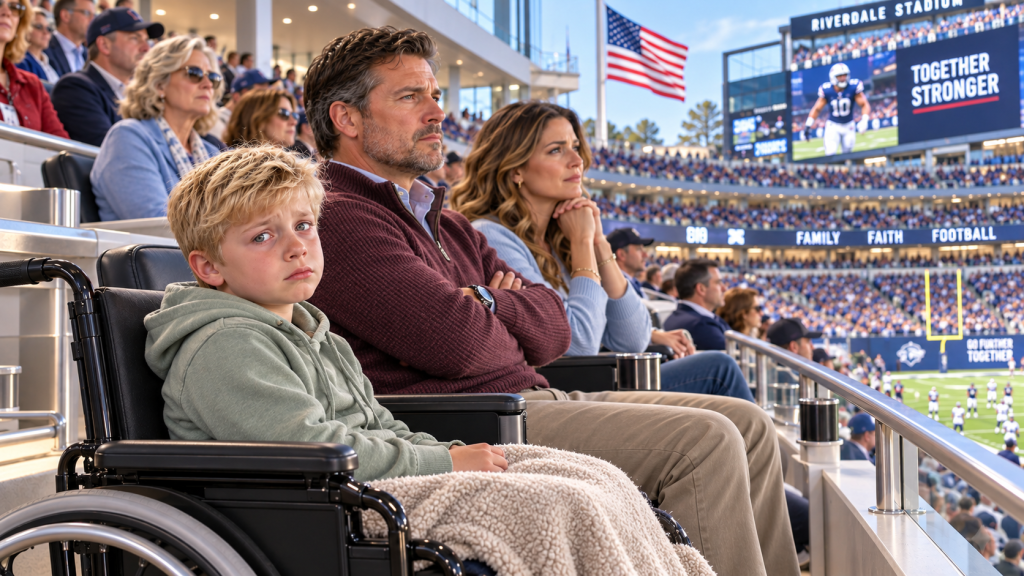
Row A.
Accessible platform.
Two spaces near the railing.
Perfect.
I could already see part of the field.
Caleb was bouncing slightly in his chair.
Then we reached our seats.
And someone was already there.
A man and a woman.
The man was probably in his late forties.
Expensive coat.
Gold watch.
Leather shoes.
The woman beside him wore designer sunglasses on top of her head and held a plastic cup of wine.
Her large handbag sat directly in the open wheelchair space.
At first, I assumed they were confused.
Stadium seating could be complicated.
I smiled politely.
“Excuse me.”
The man looked over.
“These are our seats.”
I held up the tickets.
He glanced at them.
Then he looked at Caleb.
Then back at the field.
“Sit somewhere else.”
I thought I had misheard him.
“I’m sorry?”
“You heard me.”
He pointed vaguely toward the concourse.
“There are televisions everywhere.”
I stared.
“My son uses a wheelchair. These are accessible seats. We purchased them.”
He sighed.
It was the kind of sigh people make when a cashier tells them their coupon expired.
“Lady, I just want to watch the game.”
“So does my son.”
The woman took a sip of wine.
The man didn’t move.
“Then stand behind us.”
I looked at Caleb.
Then at his wheelchair.
“He can’t stand.”
The man finally turned fully toward us.
His eyes dropped to the chair.
He shrugged.
“Not my problem.”
Something hot moved through my chest.
I held the tickets closer.
“Your purse is literally sitting in the designated wheelchair space.”
The woman looked at her bag.
She didn’t move it.
Instead she smiled.
“Maybe security can find you somewhere upstairs.”
I couldn’t believe this was happening.
I had imagined so many versions of that afternoon.
Caleb cheering.
Caleb seeing his favorite player.
Caleb maybe getting a picture.
Never this.
An usher noticed the disagreement and hurried over.
He was young.
Maybe twenty.
“Is there a problem?”
“Yes,” I said. “These people are in our seats.”
The usher checked our tickets.
Then his face became serious.
“Sir, these seats belong to them.”
The man leaned back.
“Do you know who I am?”
The usher paused.
“No, sir.”
The man smiled humorlessly.
“I spend enough money in this stadium every season to buy half the place.”
The usher looked uncomfortable.
“That doesn’t change the seat assignment.”
The man pointed at Caleb.
“Your kid can watch from the concourse. I bet he doesn’t even understand the rules.”
Caleb went still.
That was the moment I stopped being polite.
“You need to get out of his seat.”
The woman muttered, “Unbelievable.”
The man laughed.
“People like you always want special treatment.”
I almost screamed.
Special treatment.
My son had lost the ability to walk after saving a child.
He spent hours every week in therapy.
He navigated elevators, narrow sidewalks, broken ramps, inaccessible bathrooms, and strangers staring at him.
And this man thought sitting in the seat I paid for was special treatment.
Before I could speak, Caleb gently tugged my sleeve.
“It’s okay, Mom.”
I turned.
His excitement was gone.
He was looking down.
“We can watch from the hallway.”
Those words hurt more than anything the man had said.
After everything Caleb had survived, he was willing to disappear just to stop adults from arguing.
“No,” I whispered.
He forced a smile.
“Really. It’s okay.”
Then a calm voice came from the row behind us.
“You.”
Everyone turned.
An elderly woman sat three seats behind the accessible platform.
She was small.
White hair.
Plain gray cardigan.
No team merchandise except an old pin attached near her collar.
On her knees rested a dented metal lunchbox.
The kind workers used decades ago.
She pointed at the man.
“Stand up.”
He laughed.
“Oh, God.”
The woman didn’t blink.
“Stand up. Now.”
“Don’t stick your nose into other people’s business.”
She rose slowly.
The crowd around us had begun paying attention.
The elderly woman stepped down carefully.
She held the lunchbox in both hands.
“I’ve got something better for you than this view.”
The man smirked.
“What, your sandwich?”
“Open it.”
Something in her tone made the joke die.
She held the lunchbox out.
He hesitated.
Then, probably wanting to humiliate her, he took it.
“Fine.”
He flipped the latch.
The lid opened.
His expression changed instantly.
The laughter disappeared.
The color drained from his face.
For several seconds, he simply stared inside.
His wife leaned toward him.
“What is it?”
He didn’t answer.
I couldn’t see inside yet.
The man whispered:
“No.”
The elderly woman said nothing.
He reached into the box with trembling fingers.
He pulled out an old photograph.
Then a newspaper clipping.
Then a small brass stadium badge.
He stared at the photograph.
“Oh no.”
His wife’s confident expression disappeared.
“What?”
The man looked at the elderly woman.
“You’re Evelyn Bennett.”
“Yes.”
He dropped to his knees.
Right beside Caleb’s wheelchair.
The entire section fell silent.
“Please.”
His voice barely came out.
“Please don’t do this.”
Evelyn Bennett looked down at him.
“You did this yourself, Martin.”
He swallowed.
“Give me one more chance.”
Evelyn handed the newspaper clipping to me.
My hands shook slightly as I read the headline.
LOCAL TEEN SAVES BOY AFTER STADIUM COLLAPSE.
The article was thirty-one years old.
There was a grainy photograph beneath it.
A teenage boy standing beside a hospital bed.
The boy looked different.
Younger.
Thinner.
But the eyes were unmistakable.
Martin.
The arrogant man kneeling beside us.
I kept reading.
During a high school championship game, part of a temporary stadium platform had collapsed.
A twelve-year-old boy named Daniel Bennett had been trapped.
Seventeen-year-old Martin Hale had rushed into the damaged section before emergency crews arrived.
He helped lift a piece of metal off Daniel.
The boy survived.
But Martin suffered a serious leg injury.
The article said he spent almost a year using a wheelchair.
I looked at him.
Then at Evelyn.
“Daniel was my son,” she said.
Caleb looked up.
Martin lowered his head.
Evelyn continued.
“For almost a year after that accident, Martin couldn’t walk properly.”
Nobody spoke.
“He learned what inaccessible buildings felt like.”
Martin closed his eyes.
“He learned what it felt like when people parked in spaces he needed.”
Evelyn’s voice never rose.
“He learned what it felt like when adults complained because his wheelchair took up room.”
Martin whispered, “I remember.”
“Do you?”
Her voice sharpened.
“Because I’ve been listening to you for five minutes, and it doesn’t sound like you remember anything.”
His wife slowly moved her handbag from Caleb’s wheelchair space.
Too late.
Evelyn tapped the newspaper clipping.
“After Daniel recovered, you visited our home.”
Martin nodded.
“You told me you wanted to build a life where nobody could ever make you feel powerless again.”
The man’s jaw tightened.
“You said you were going to become successful.”
A bitter sadness appeared in Evelyn’s eyes.
“You did.”
She looked at his expensive watch.
“Apparently you forgot the rest.”
Just then a man in a stadium blazer hurried down the steps.
Two security staff followed him.
He took one look at the elderly woman.
“Mrs. Bennett?”
She smiled faintly.
“Hello, Thomas.”
“We’ve been looking everywhere for you.”
Martin looked confused.
The stadium manager turned toward him.
Then the recognition was immediate.
“Mr. Hale.”
Martin stood.
“Thomas, listen—”
The manager lifted one hand.
“No. I heard enough over the radio.”
His eyes moved to Caleb.
“Are these your seats?”
I handed him the tickets.
“Yes.”
He checked them.
Then he looked at Martin.
“You were asked by an usher to move.”
Martin straightened.
His old arrogance tried to return.
“I have a premium account here.”
“I’m aware.”
“I spend over sixty thousand dollars a season.”
The manager nodded.
“I’m aware of that too.”
Martin seemed relieved.
Then the manager said:
“And your account doesn’t entitle you to steal another guest’s accessible seating.”
Martin’s face hardened.
“I didn’t steal anything.”
“You refused to leave seats that weren’t assigned to you.”
“I was going to move.”
“No,” the young usher said quietly.
Everyone looked at him.
The usher’s face turned red.
But he continued.
“He said the boy should watch from the hallway.”
Martin glared.
The manager’s expression became cold.
“Did you?”
Silence.
Evelyn answered.
“He did.”
Martin rubbed his forehead.
“This is getting blown out of proportion.”
Caleb finally spoke.
“No, it isn’t.”
His voice was soft.
Everyone turned toward him.
Caleb looked at Martin.
“You said I probably didn’t understand football.”
Martin looked embarrassed.
Caleb continued.
“You said people like us want special treatment.”
Martin looked at the concrete floor.
Caleb’s voice shook.
“I didn’t ask for special treatment.”
He pointed toward the wheelchair symbol painted beside the seats.
“I asked for the place my mom paid for.”
The section stayed silent.
I put my hand on Caleb’s shoulder.
He kept looking at Martin.
“My mom sold her grandma’s bracelet for these tickets.”
That surprised me.
I hadn’t told him.
I looked at him.
“How did you know?”
“I heard you talking to Aunt Rachel.”
My throat tightened.
Caleb turned back to Martin.
“She skipped lunch for months.”
Martin’s wife looked at me.
There was no smirk now.
Only shame.
Caleb continued.
“I didn’t want her to fight with you because she already does everything for me.”
I had to look away for a moment.
Martin’s face changed.
Not dramatically.
But something broke.
Maybe because a child had just shown more dignity than he had.
Evelyn picked up the photograph.
She handed it to Martin.
“This was taken the day you visited Daniel.”
He stared at it.
I looked over his shoulder.
The picture showed teenage Martin sitting in a wheelchair beside Daniel Bennett.
Both boys were laughing.
Martin had written something across the bottom.
Evelyn read it aloud from memory.
“Never let anyone make you smaller because you need help.”
Martin shut his eyes.
The crowd around us was completely quiet.
Evelyn said:
“You wrote that.”
He whispered, “I know.”
“Do you?”
His eyes filled.
That seemed to surprise everyone, including Martin.
He looked at Caleb.
“I’m sorry.”
Caleb didn’t respond.
Martin crouched so they were closer to eye level.
“I mean it.”
His voice cracked.
“I’m sorry.”
Caleb studied him.
Martin swallowed.
“I used a wheelchair when I was seventeen.”
Caleb glanced at the clipping.
“I know.”
“I hated it.”
“I don’t hate mine.”
Martin paused.
Caleb shrugged.
“I hate what happened. But the chair helps me go places.”
That sentence seemed to hit Martin hard.
“I wish I had understood that then.”
Caleb said nothing.
Martin continued.
“When I finally walked again, I wanted to forget that year.”
Evelyn spoke from behind him.
“And eventually you forgot the people living it.”
Martin nodded slowly.
“Yes.”
The stadium manager stepped forward.
“Mr. Hale, security is going to escort you from this section.”
Martin looked up.
“I understand.”
“You and your guest will be relocated.”
Martin nodded.
Then the manager added:
“And your premium account will be reviewed.”
Martin’s wife gasped.
“Reviewed?”
The manager turned.
“Yes.”
“Over this?”
Evelyn looked at her.
“Over how you treated a disabled child.”
The woman opened her mouth.
Then closed it.
Martin stood.
He looked at Caleb’s seat.
Then at his own assigned ticket.
“Where were we supposed to be sitting?”
His wife reluctantly pulled out her phone.
The seats were eight rows higher.
Perfectly good seats.
Martin had simply decided he preferred Caleb’s view.
That somehow made everything worse.
Security waited.
But before Martin left, he turned to me.
“I don’t expect you to forgive me.”
I said nothing.
“You shouldn’t.”
He reached into his coat.
For one terrible second, I thought he was going to offer money.
If he had, I would have thrown it back at him.
Instead, he pulled out a business card.
He looked at it.
Then tore it in half.
“I was going to give you this and try to make myself feel better.”
Evelyn watched him.
Martin dropped the pieces into a trash bin.
“That would be insulting.”
For the first time, Evelyn nodded.
“Yes.”
Martin looked at Caleb.
“I hope your team wins.”
Caleb said:
“They’re going to lose by three.”
A few people laughed.
Even Martin smiled.
“You think?”
“Our offensive line can’t handle their pass rush.”
The young usher covered a grin.
Martin nodded.
“You definitely understand the game.”
Caleb raised one eyebrow.
“More than you.”
The entire section laughed.
Martin actually laughed too.
Then security led him and his wife away.
The tension broke.
I exhaled.
My legs felt weak.
The stadium manager helped make sure Caleb’s space was clear.
Then he turned to Evelyn.
“I still need to know why you weren’t in the suite.”
Evelyn rolled her eyes.
“Because suites are boring.”
The manager sighed.
“Mrs. Bennett.”
Caleb looked between them.
“Do you own the stadium?”
Evelyn laughed.
“Heavens, no.”
The manager smiled.
“Mrs. Bennett’s late husband was one of the architects who redesigned this stadium twenty years ago.”
I looked at her.
Evelyn waved dismissively.
“Robert designed parking structures.”
The manager shook his head.
“Robert Bennett led the accessibility redesign.”
Caleb’s eyes widened.
Evelyn looked embarrassed by the attention.
“My husband believed stadiums should be built for everyone.”
The manager pointed around us.
“These wheelchair platforms, widened ramps, companion seating, elevator access—his team pushed for all of it.”
Caleb looked at Evelyn as though she had become a celebrity.
“That’s awesome.”
Evelyn smiled.
“He would have liked you.”
The manager touched the old pin on her cardigan.
“And Mrs. Bennett attends one game every year on the anniversary of Mr. Bennett’s first stadium project.”
Evelyn looked toward the field.
“He loved football.”
Caleb grinned.
“So do I.”
“That much is obvious.”
The national anthem began soon afterward.
Everyone stood.
I stayed beside Caleb.
Normally moments like that reminded me of the accident.
People rising.
Caleb remaining seated.
But that afternoon, he didn’t look embarrassed.
He looked proud.
Evelyn stayed seated too.
Not because she had to.
Because she wanted Caleb to have company.
When the anthem ended, she moved into the empty companion seat beside us.
“I hope you don’t mind.”
Caleb shook his head.
“No.”
The game began.
And for three hours, the world became simple.
Football.
Noise.
Cheering.
Caleb screamed until his voice cracked.
He correctly predicted a blitz in the second quarter.
Evelyn bought him nachos.
I protested.
She ignored me.
“Grandmothers are legally permitted to spoil children.”
“You’re not his grandmother.”
“Technicality.”
Caleb laughed.
His team went into halftime down by ten.
Caleb looked delighted.
“I told you.”
I stared.
“Why are you happy?”
“Because now the comeback will be better.”
Evelyn laughed.
“You should coach.”
Caleb smiled.
“I might.”
There was a brief pause.
Before the accident, Caleb always said he would play.
After the accident, he avoided talking about his future in football.
That was the first time I heard him say coach.
Something loosened in my chest.
During halftime, the stadium manager returned.
He crouched beside Caleb.
“How would you feel about visiting the field after the game?”
Caleb stared at him.
“What?”
“Field access.”
Caleb looked at me.
Then at the manager.
Then at Evelyn.
He whispered:
“Seriously?”
“Seriously.”
Caleb almost launched himself out of his chair from excitement.
I laughed.
“Yes, seriously.”
The second half was wild.
Caleb’s team came back.
Late in the fourth quarter, they tied the score.
Then the opposing team kicked a field goal with twelve seconds left.
Caleb slumped.
“Told you.”
His prediction had been exactly right.
Loss by three.
Evelyn stared at him.
“You’re unsettling.”
Caleb grinned.
“I study.”
After the stadium began emptying, an employee escorted us toward a restricted elevator.
Caleb’s hands shook from excitement.
We passed through a tunnel.
The noise changed.
Then suddenly the field opened in front of us.
The grass looked brighter from ground level.
Caleb stopped rolling.
He just stared.
I stood behind him.
For once, I didn’t take a picture immediately.
I wanted to remember his face without a screen between us.
He whispered:
“Mom.”
“I know.”
“No, you don’t.”
His voice cracked.
“This is better than I imagined.”
I finally took a photograph.
Caleb near the sideline.
Empty stadium rising behind him.
Evelyn standing a few feet away.
Then a player walked out from the tunnel.
Caleb froze.
It was the team’s starting quarterback.
His favorite player.
The man approached us.
“Caleb?”
My son looked like his brain had stopped working.
“Yes?”
“I heard you called the final score before kickoff.”
Caleb nodded slowly.
The quarterback smiled.
“That’s annoying.”
Caleb laughed.
They talked football for nearly ten minutes.
Not pity.
Not inspiration.
Football.
Real football.
Coverages.
Protection.
Route concepts.
The quarterback eventually said:
“You ever think about coaching?”
Caleb’s face changed.
“Maybe.”
“You should.”
Then he signed Caleb’s jersey.
Not the front.
The shoulder.
“Because you’re wearing that again.”
Caleb nodded quickly.
The player took a photo with him.
Then he crouched beside the wheelchair.
“I also heard why you’re here.”
Caleb looked confused.
The quarterback glanced at me.
“About the accident.”
Caleb became quiet.
“I don’t really talk about it.”
“You don’t have to.”
The player nodded.
“I just wanted to say I’m glad you’re here.”
Then he left.
Caleb stared at the signature.
I wiped my eyes.
Evelyn pretended not to notice.
As we headed back toward the tunnel, we saw Martin.
He was standing with the stadium manager.
Alone.
His wife was gone.
Martin looked nervous when he saw us.
I immediately tensed.
The manager noticed.
“It’s all right.”
Martin raised both hands slightly.
“I asked for two minutes.”
I looked at Caleb.
He shrugged.
Martin approached.
He wasn’t wearing his expensive coat anymore.
He held the old photograph.
Evelyn’s photograph.
He gave it back to her.
“Thank you.”
Evelyn took it.
“For what?”
“For embarrassing me.”
Evelyn’s mouth twitched.
“I can do it again if necessary.”
Martin almost smiled.
Then he looked at Caleb.
“I called my mother.”
That surprised everyone.
Martin continued.
“I haven’t spoken to her in almost a year.”
Evelyn said nothing.
“I told her what happened.”
Caleb asked:
“What did she say?”
Martin looked embarrassed.
“She said she raised me better.”
Caleb laughed.
Martin nodded.
“She also reminded me that when I was in my wheelchair, she once spent forty minutes arguing with a movie theater because someone took the accessible space.”
Evelyn smiled faintly.
“Your mother was terrifying.”
Martin nodded.
“She still is.”
Then he became serious.
“I’ve spent a lot of years convincing myself money meant I could avoid inconvenience.”
His eyes moved toward Caleb’s chair.
“Somewhere along the way, I started treating other people as inconveniences.”
I didn’t say anything.
Martin looked at me.
“I’m sorry.”
This time, it sounded different.
Not because I suddenly liked him.
I didn’t.
But because he wasn’t trying to escape consequences.
He was naming what he had done.
Caleb asked:
“What happens to your season tickets?”
Martin looked toward the manager.
The manager said:
“We’ll decide that later.”
Martin nodded.
“I told them I won’t contest whatever decision they make.”
Evelyn raised an eyebrow.
“That’s progress.”
Martin smiled painfully.
“Small progress.”
Then he said something unexpected.
“I also called Daniel.”
Evelyn went still.
“My son?”
Martin nodded.
“First time in fourteen years.”
Evelyn’s eyes filled.
“What did he say?”
“He told me I was an idiot.”
She laughed through tears.
“That sounds like Daniel.”
“He also said he’d call me tomorrow.”
Evelyn looked down at the old lunchbox.
For the first time, I understood something.
She hadn’t carried that box to destroy Martin.
She carried it because part of her still remembered the seventeen-year-old boy who had once risked himself to save her son.
She wanted him to remember too.
Maybe that was the real lesson.
Not that people never change.
That they can change in both directions.
A brave teenager can become a selfish man.
And maybe, if confronted with the person he used to be, that selfish man can begin becoming someone else again.
Martin nodded toward Caleb.
“I won’t bother you anymore.”
Caleb stopped him.
“Wait.”
Martin turned.
Caleb hesitated.
Then said:
“You should come to one of my therapy sessions.”
I stared at him.
Martin looked equally surprised.
“What?”
“Not to watch me.”
Caleb frowned.
“That would be weird.”
Evelyn laughed.
Caleb continued:
“My rehab center has wheelchair basketball on Saturdays.”
Martin nodded slowly.
“I didn’t know that.”
“You should.”
“Why?”
Caleb shrugged.
“Because you forgot.”
Silence.
Martin looked at Evelyn.
Then back at Caleb.
“Okay.”
Caleb narrowed his eyes.
“You mean it?”
“Yes.”
“Next Saturday. Nine.”
Martin nodded.
“I’ll be there.”
I expected him not to show.
I was wrong.
The next Saturday at exactly 8:47 in the morning, Martin walked into Caleb’s rehabilitation center.
No suit.
No gold watch.
Jeans.
Sweatshirt.
He looked uncomfortable.
Caleb was already on the court.
Wheelchair basketball was loud, fast, physical, and nothing like Martin expected.
He stood against the wall watching.
After twenty minutes, one of the coaches rolled toward him.
“You want to try?”
Martin nearly laughed.
Then he saw Caleb watching.
“Sure.”
They put him in a sports wheelchair.
Within four minutes, Martin crashed into the padding.
Caleb shouted:
“Special treatment?”
The gym erupted in laughter.
Martin lay there for a second.
Then laughed harder than anyone.
He came back the next week.
And the week after that.
I remained cautious.
People sometimes perform remorse when others are watching.
But Martin kept coming even when Caleb missed a session.
He donated equipment anonymously.
I only learned because the rehabilitation center director accidentally thanked him in front of me.
He volunteered at an accessibility fundraiser.
He convinced his company to audit their offices for wheelchair access.
He started spending time with Daniel Bennett again.
Slowly.
Awkwardly.
Not every story needs a villain to remain a villain forever.
That doesn’t erase what happened.
I never forgot how Martin spoke to Caleb in that stadium.
Neither did Caleb.
Forgiveness, I learned, didn’t require pretending.
Three months after the game, I received an envelope in the mail.
Inside was no money.
No check.
Just a photocopy of the old newspaper clipping.
Martin had written underneath it:
I spent thirty-one years forgetting the best thing I ever did.
Your son reminded me.
Thank you.
There was also a note for Caleb.
Caleb read it privately.
Then folded it into his desk.
I never asked what it said.
Spring arrived.
Caleb’s doctors began noticing small changes.
Tiny ones.
Muscle response.
Sensation.
Movement in one foot.
Nobody promised anything.
We had learned not to build our happiness around promises.
Caleb kept going to therapy.
He kept watching football.
He kept studying plays.
Then his old youth football coach asked him to come help during practice.
Not as a mascot.
Not as inspiration.
As an assistant.
Caleb took it seriously.
Very seriously.
Within two weeks, he was correcting twelve-year-olds who were twice his size.
“Your feet are wrong!”
“Caleb,” I whispered from the sideline.
“What?”
“They’re kids.”
“So am I.”
Fair point.
One evening, after practice, his coach came over.
“He sees things quickly.”
I smiled.
“He always has.”
“I’m serious.”
The coach looked at Caleb.
“He could be good at this.”
My eyes burned.
“I know.”
A year after the stadium incident, we returned to another game.
This time, I didn’t have to sell anything.
The team’s community outreach department had invited Caleb and several children from the rehab center.
Accessible seating.
Field passes.
Everything arranged.
Caleb was taller.
More confident.
His wheelchair had stickers all over it.
He had also regained a small amount of movement in his left leg.
Not enough to walk independently.
Maybe someday.
Maybe not.
Caleb refused to let that question control his life.
When we reached the accessible seating platform, I saw someone standing nearby.
Martin.
He smiled.
Then immediately pointed to his assigned seat.
“Mine is over there.”
Caleb laughed.
“Good.”
Evelyn sat behind us again.
Still wearing the gray cardigan.
Still carrying the old lunchbox.
I pointed to it.
“You bring that everywhere?”
She smiled.
“Only when someone might need reminding.”
Martin groaned.
“Please retire the lunchbox.”
“Behave yourself.”
Caleb laughed.
Before kickoff, the stadium announcer asked everyone to turn toward the large screen.
A photo appeared.
Caleb pushing Owen out of the street.
Then another.
Caleb in his wheelchair.
Then another.
Caleb coaching at youth practice.
The announcer told the story briefly.
The crowd stood.
Tens of thousands of people applauded.
Caleb covered his face.
“Oh no.”
I laughed and cried at the same time.
Owen and his family appeared from the tunnel.
Owen ran toward Caleb.
He was six now.
He hugged him.
Caleb hugged him back.
Then Owen handed him a football.
On it he had written:
MY HERO.
Caleb shook his head.
“You don’t have to keep calling me that.”
Owen smiled.
“Yes I do.”
The crowd cheered louder.
Caleb looked at me.
He was embarrassed.
Happy.
Overwhelmed.
Alive.
So completely alive.
I thought about the night in the hospital when I believed football had been taken from him forever.
I had been wrong.
Football had changed.
His life had changed.
But changed didn’t mean ended.
Sometimes dreams survive by becoming different dreams.
Sometimes the child who wanted to run onto the field becomes the coach who teaches others where to run.
Sometimes a wheelchair isn’t the end of freedom.
It becomes the thing that carries someone toward a new version of it.
And sometimes an old lunchbox contains exactly what a person needs to remember who they used to be.
The game began.
Caleb watched closely.
Halfway through the second quarter, he leaned toward Martin.
“Safety blitz.”
Martin squinted.
“No chance.”
The quarterback took the snap.
Safety blitz.
Sack.
Caleb slowly turned toward him.
Martin sighed.
“I hate you.”
Caleb grinned.
“No, you don’t.”
Evelyn laughed.
I leaned back in my seat.
The crowd roared around us.
The grass smelled exactly the way Caleb remembered.
And for once, I wasn’t thinking about what had been lost.
I was thinking about everything still ahead.
Because dignity should never depend on whether someone can walk.
Kindness should never depend on whether someone is wealthy.
And the measure of a person isn’t how important they believe themselves to be.
It’s what they do when they encounter someone the world has already made things harder for.
Martin had forgotten that.
A small elderly woman with a dented metal lunchbox made him remember.
And my son?
My son never forgot.
He had learned at eleven what some adults spend entire lifetimes avoiding.
Strength isn’t always standing.
Sometimes strength is surviving.
Sometimes it is speaking up.
Sometimes it is making room.
And sometimes it is looking at the seat that belongs to someone else and simply having the decency to move.
💬THE END! THANK YOU FOR READING!