

My parents made me sleep in the garage for seven years so that my “gifted” brother could have both bedrooms to himself.
Twelve years later, their house was destroyed.
My mother called and asked, “Can we come live with you?”
I looked through my kitchen window at the detached garage behind my house.
Then I smiled.
“The garage is still empty.”
The silence on the other end of the phone lasted so long that I checked the screen to make sure the call hadn’t disconnected.
“Mia,” my mother finally said, “this really isn’t the time for jokes.”
“I’m not joking.”
Their house had been badly damaged in a windstorm.
Part of the roof had collapsed.
Water had gotten into the upstairs rooms.
Several windows were shattered, and according to my father, the electrical system had been damaged badly enough that the city wouldn’t allow them back inside until repairs were completed.
Their insurance company had placed them in a hotel temporarily.
But inspections were delayed.
Contractors were backed up.
The hotel coverage was nearly exhausted.
And suddenly the two people who had spent most of my childhood teaching me that comfort was something I should sacrifice for family needed somewhere comfortable to live.
My name is Mia Carter.
I’m twenty-nine years old.
And until that phone call, I hadn’t spent more than three consecutive hours with my parents in twelve years.
It wasn’t because we were completely estranged.
That would have been simpler.
We still exchanged birthday messages.
I attended Christmas every few years.
My father occasionally called to ask whether my car was running well.
My mother sent me articles about women’s health, home organization, and recipes I never asked for.
From the outside, we probably looked like a distant but functional family.
That was because my parents were very good at pretending nothing terrible had ever happened.
When I was ten, they decided my brother Aaron was gifted.
That word changed everything.
Aaron tested several grade levels above average in mathematics.
One of his teachers recommended enrichment classes.
Another told my parents he had “exceptional academic potential.”
Within months, our house had become a shrine to that potential.
Aaron needed quiet.
Aaron needed resources.
Aaron needed space.
Aaron needed specialized software.
Aaron needed shelves for science projects.
Aaron needed room for a telescope.
Aaron needed a separate desk.
Then apparently one desk wasn’t enough.
We lived in a three-bedroom house.
My parents had one bedroom.
Aaron and I each had one.
Until my mother decided Aaron’s bedroom was too cramped for someone with “that kind of mind.”
The solution was simple.
He would sleep in his original bedroom.
My bedroom would become his study.
And I would move into the garage.
Nobody asked me.
I came home from school one Friday and found half my belongings packed into plastic storage bins.
My posters had been taken down.
My bookshelf was empty.
My blankets were folded on top of a box.
“What’s happening?” I asked.
Mom didn’t even stop taping a box.
“We’re reorganizing.”
“Why?”
“Aaron needs a dedicated study area.”
I stared at her.
“So where am I going?”
She smiled in that overly patient way adults smile when they have already made a decision and don’t want to admit you have any right to object.
“We’ve made a nice little area for you in the garage.”
I thought she meant temporarily.
Maybe a week.
Maybe until they rearranged something.
I followed her outside.
There was a folding cot beside the water heater.
A small dresser had been pushed against the concrete wall.
A lamp sat on top of it.
One of my stuffed animals had been placed on the pillow.
My mother pointed toward it like she had just unveiled a hotel suite.
“See?”
I remember staring at that stuffed rabbit.
Not because I loved it particularly much.
But because placing it there told me she knew exactly what this was.
She knew a child was being moved out of her bedroom.
And she thought a toy on the pillow would make it feel acceptable.
“There’s no heat,” I said.
“The garage is attached to the house.”
“That doesn’t make it warm.”
“We’ll get you extra blankets.”
“What about summer?”
“We can get a fan.”
I looked at my father.
He was standing in the doorway.
“Dad?”
He avoided my eyes.
“Your brother really needs the room, Mia.”
That sentence became the soundtrack of my childhood.
Aaron needs the room.
Aaron needs quiet.
Aaron needs the computer.
Aaron needs the money.
Aaron needs us to miss your school play because his academic competition is the same night.
Aaron needs you not to have friends over because he’s studying.
Aaron needs the car.
Aaron needs tutoring.
Aaron needs everything.
And Mia?
Mia will manage.
I spent seven years sleeping beside paint cans, holiday decorations, tools, a lawn mower, and a water heater.
There was no proper insulation.
The concrete floor became painfully cold in winter.
Sometimes I could see my breath when I woke up.
My parents bought me an electric blanket eventually, but the garage outlets were old, and Dad warned me not to plug too many things in at once.
In summer, the heat became suffocating.
Mosquitoes found their way inside.
So did spiders.
Once, a mouse got into a cereal bar I had left near my bed.
I screamed.
My mother came out, saw the mess, and told me I shouldn’t leave food lying around.
There was one hanging utility bulb.
No closet.
No proper emergency exit besides the garage door and the interior door leading into the house.
At night, my parents locked the interior door.
They claimed it was because they were afraid a burglar could enter through the garage.
That meant if I needed the bathroom after everyone went to bed, I had to knock.
Sometimes nobody heard me.
I learned to stop drinking water after eight.
At twelve years old, I considered that normal.
That’s the frightening thing about children.
They can learn to consider almost anything normal if adults insist on it long enough.
I stopped complaining eventually.
Not because it stopped hurting.
Because complaining changed nothing.
At school, I never invited anyone over.
When friends asked why, I said my parents were strict.
When teachers asked about home, I said everything was fine.
I became very good at making myself small.
Aaron wasn’t cruel to me.
That almost made it worse.
He wasn’t some villain laughing while I froze.
He was a kid.
He accepted what our parents gave him because children usually accept the world adults build around them.
Sometimes he would come into the garage and sit on the edge of my cot.
Sometimes he’d say, “You can use my study room if I’m not using it.”
My study room.
That’s what he called my old bedroom.
I never corrected him.
Once, when I was fourteen, he found me doing homework on the garage floor because my folding table had broken.
He stood there for a few seconds and said, “Why don’t Mom and Dad buy you another desk?”
I remember laughing.
Not because it was funny.
Because I honestly didn’t know how to answer.
By seventeen, I had saved $1,840 from working evenings at a grocery store.
Two weeks after graduating high school, I packed everything I owned into a friend’s pickup truck.
My mother stood in the driveway while I carried out the last cardboard box.
“You’re really leaving?” she asked.
“Yes.”
“You could stay while you go to community college.”
I looked toward the garage.
“No.”
Her expression tightened.
“You always make things sound worse than they were.”
I didn’t answer.
Dad hugged me awkwardly.
Aaron carried two boxes to the truck.
I left.
For the first time in seven years, I slept in a room with a door that locked from the inside.
It was a tiny rented room in a house with three other college students.
The carpet smelled strange.
The radiator clanged all night.
The mattress sagged in the middle.
I cried myself to sleep because it felt luxurious.
That’s the part my parents never understood.
When you’ve spent years being told you require less, ordinary things feel extravagant.
A warm room.
Privacy.
A real window.
Being able to use the bathroom without asking permission.
I worked nights.
I went to community college slowly because I couldn’t afford full-time tuition.
I cleaned offices.
I stocked shelves.
I worked weekend reception at an assisted-living facility.
Eventually, I transferred into a state university program focused on construction management and building safety.
By twenty-five, I was working for the municipal building department.
It amused some people when they found out.
“Mia knows every code violation in the city,” one coworker joked.
They didn’t know why I cared.
I cared because buildings communicate.
A safe room says someone expected you to survive the night.
Proper wiring says someone thought your life mattered enough not to risk a fire.
Smoke alarms say someone planned for you to wake up.
Heat says you deserve warmth.
Windows say you deserve air.
Exits say you deserve a way out.
I inspect illegal bedrooms regularly.
Basements without egress windows.
Converted storage rooms.
Closets people try to rent as sleeping spaces.
Garages with extension cords running beneath rugs and portable heaters pressed against mattresses.
The first time I rejected a converted garage as an illegal bedroom, the property owner became furious.
“It’s perfectly fine,” he said.
I pointed to the violations.
“No emergency egress.”
“I’ve got a door.”
“Improper heating.”
“They have blankets.”
“No smoke detection.”
“They can buy one.”
I looked at him.
“No.”
Something in my voice made him stop arguing.
Afterward, I sat in my city truck for fifteen minutes.
I was twenty-three.
For the first time in my life, somebody had officially declared that what happened to me as a child would not have been considered acceptable housing for an adult tenant.
I laughed.
Then I cried.
At twenty-seven, I bought my own house.
It wasn’t large.
A two-bedroom bungalow with white siding, an old maple tree in front, and a detached garage behind it.
The garage had been partially converted by the previous owner.
I finished the work myself.
Insulation.
Drywall.
Proper electrical circuits.
A ductless heating and cooling unit.
Smoke and carbon monoxide detectors.
A bathroom.
A legal secondary exit.
A sleeper sofa.
Cabinets.
A little refrigerator.
I turned it into a guest space and workshop.
I rarely had guests.
But I liked knowing that if someone stayed there, they would be safe.
Which brought me back to my mother on the phone.
“You can stay thirty days,” I told her. “No rent.”
“Oh, thank God.”
“But there are rules.”
She sighed.
“Mia.”
“You’ll stay in the garage guest space.”
Silence.
“What?”
“The garage.”
“You have two bedrooms.”
“One is mine.”
“And the other?”
“My office.”
“You have an office at work.”
“And I have an office here.”
My father took the phone.
“We appreciate anything you can offer.”
“Thirty days,” I repeated. “Kitchen and laundry at agreed times. My bedroom and office are private. No extra guests without asking. Don’t redirect your mail here. Don’t make changes to the property.”
Dad said, “Understood.”
Mom’s voice came faintly from the background.
“We’re her parents.”
I heard Dad say, “Susan.”
Then Mom returned.
“I’m sure once we arrive, we can figure something more comfortable out.”
That told me everything.
They had heard the rules.
They just didn’t believe rules involving me were permanent.
Three days later, they arrived.
Mom stepped out of their rental car and stared at the house.
“You bought this?”
“I did.”
“You never sent pictures.”
“You never asked.”
Dad walked around the side of the bungalow.
When he saw the garage, he stopped.
Mom looked from him to me.
“You were serious.”
“I usually am.”
She lowered her voice.
“Mia, after everything we’ve been through this week, you’re really going to make us sleep out there?”
I unlocked the door.
“Take a look first.”
They entered.
Dad whistled softly.
“This is nicer than my first apartment.”
Mom said nothing.
She inspected the bathroom.
Opened cabinets.
Touched the thermostat.
Looked at the sofa.
“This has heat?”
“Yes.”
“Air conditioning?”
“Yes.”
“A shower?”
“Yes.”
Dad examined the smoke detector.
“You wired all of this?”
“Some. I hired an electrician for the panel work.”
Mom sat on the edge of the sofa.
“Thirty days is a long time to live out here.”
Seven years was longer.
I thought it.
I didn’t say it.
Not yet.
The first night, I made dinner.
Mom spent most of the meal commenting on my kitchen.
“You could fit a larger table over there.”
“You should replace these cabinet handles.”
“Have you thought about taking down that wall?”
“No.”
She seemed offended every time I answered without inviting discussion.
Then her phone rang.
Her entire voice changed.
“Aaron, sweetheart.”
I hadn’t heard that tone in years.
Soft.
Warm.
Concerned.
She told him about the storm.
She reassured him repeatedly.
“Don’t worry about us. Mia is helping.”
When she hung up, I asked, “Did you ask Aaron whether you could stay with him?”
Mom reached for her water.
“He’s extremely busy.”
“So am I.”
“It’s different.”
“How?”
“He doesn’t really have the room.”
Aaron lived alone in a three-bedroom townhouse.
I nodded slowly.
“So the person who needed two rooms still doesn’t have one to spare.”
“Mia,” Dad warned.
And there it was.
Less than twenty-four hours.
Protect Aaron from discomfort.
Expect Mia to absorb it.
Only this time, the table belonged to me.
“I’m asking a reasonable question.”
Mom pushed back her chair.
“This is exactly what I was afraid of.”
“What?”
“You’re using our hardship to punish us.”
I looked toward the window.
The garage light glowed outside.
“If I wanted to punish you, I could have said no.”
The next morning, I found Mom inside my office.
The door had been closed.
She was standing beside my desk, looking at a framed certificate.
“What are you doing?”
She turned.
“I was looking for the bathroom.”
“The bathroom is down the hall in the opposite direction.”
“I got confused.”
“You walked past it.”
Her expression hardened.
“You don’t need to talk to me like I’m a stranger.”
“Then don’t ignore my boundaries like a stranger who thinks they don’t apply.”
“Mia—”
“My office is private.”
She walked past me without answering.
That evening, I printed the house rules.
One page.
Simple.
Thirty-day limit.
No permanent residency.
Private areas.
No alterations.
No guests without permission.
Dad read it.
Signed.
Mom stared at the signature line.
“You cannot seriously expect your own mother to sign this.”
“Yes.”
“We raised you.”
“And this is my house.”
“You’re treating us like tenants.”
“No. Tenants have more rights than temporary guests.”
Dad rubbed his forehead.
“Susan, just sign it.”
Mom eventually did.
I watched the pen move across the paper.
For seven years, nobody had asked whether I consented to sleeping in a garage.
Now they needed my permission to stay in one.
It should have felt satisfying.
Mostly, it felt sad.
On day six, I returned from work and found half my kitchen reorganized.
Plates moved.
Pantry shelves rearranged.
Coffee maker relocated.
Cleaning supplies changed.
Mom was standing on a stool moving glasses.
“Put everything back.”
She looked down.
“Excuse me?”
“You heard me.”
“I was helping.”
“No. You were changing my house.”
“This layout makes more sense.”
“To you.”
Dad entered through the back door.
“What’s going on?”
“Your daughter is having a meltdown because I organized a cupboard.”
I stared at Mom.
“This isn’t about a cupboard.”
“Everything with you becomes symbolic.”
“Because you keep doing the same thing.”
“What same thing?”
“Deciding what I need without asking.”
Mom climbed down.
“We are your parents.”
“That doesn’t give you ownership.”
“You’re acting like we abused you.”
There it was.
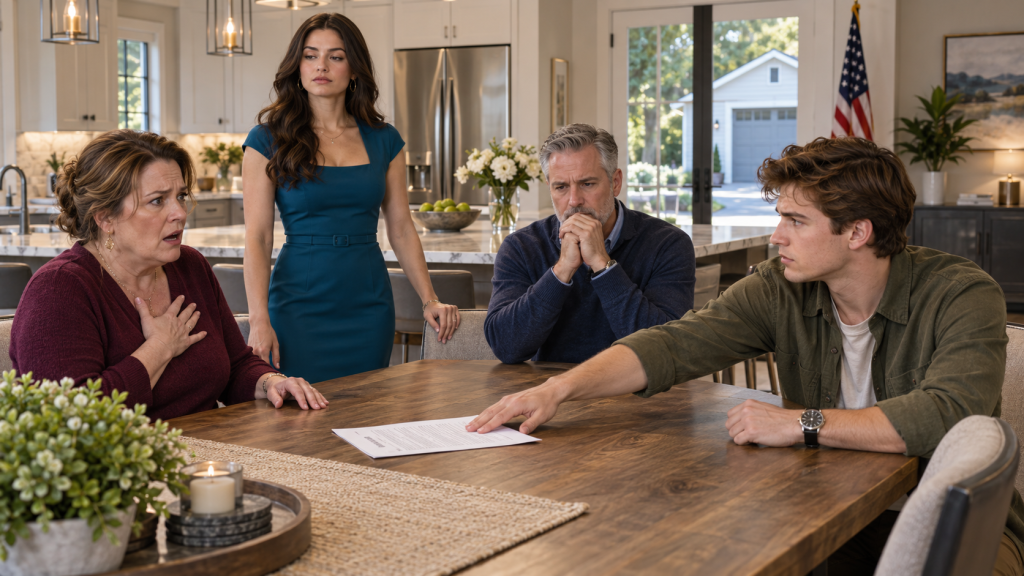
The sentence.
The one neither of us had ever said directly.
I leaned against the counter.
“You made a ten-year-old sleep in an unheated garage for seven years.”
Her face changed.
“Aaron needed quiet.”
“He had a bedroom.”
“He was advanced.”
“So I became storage.”
“That’s ridiculous.”
“Is it?”
“You had a bed.”
“A folding cot.”
“You had blankets.”
“Because the room wasn’t heated.”
“It was attached to the house.”
“The door was locked at night.”
“That was for security.”
“It prevented me from accessing the bathroom.”
Dad went pale.
Mom shook her head.
“You always exaggerate.”
I walked to my office.
When I returned, I was carrying a yellow folder.
I had kept it for years.
Not because I planned revenge.
Because when people deny your memories long enough, you start saving evidence.
I placed a paper on the counter.
“This is from eighth grade.”
Mom looked down.
It was a recommendation from my technical arts teacher.
A summer drafting program.
Tuition: eighty-five dollars.
My teacher had written that I showed exceptional spatial reasoning and should consider architecture or engineering.
At the bottom was a declined enrollment form.
Reason: financial hardship.
My mother’s signature.
Beside it, I placed an old receipt.
Eight hundred forty-seven dollars.
Desk.
Shelving.
Special lighting.
Equipment cabinet.
Purchased three weeks later.
For Aaron’s second room.
Dad stared at both papers.
“I didn’t know about the drafting program.”
“You signed the form too.”
He looked closer.
His signature was there.
His face collapsed.
“I don’t remember this.”
“I do.”
Mom crossed her arms.
“We couldn’t afford every opportunity.”
“No. Just his.”
“That isn’t fair.”
“Tell me what opportunity you paid for me to pursue.”
She opened her mouth.
Nothing came out.
Dad sat down.
“Your brother had possibilities we didn’t want him to lose.”
I looked directly at him.
“And what possibilities did you decide I could lose?”
Silence.
Then Mom began crying.
Not quietly.
She covered her face.
“I did everything I could for this family.”
I felt something inside me go still.
“You turned out fine,” she said through tears.
“No.”
She lowered her hands.
“What?”
“I turned out successful.”
I pointed toward the garage.
“Those are not the same thing.”
Nobody spoke.
“You don’t get to use the fact that I survived your choices as proof those choices were acceptable.”
Mom stared at me.
I continued.
“You have twenty-four days left.”
“You’re counting?”
“I counted seven years.”
That night, they ate in the garage.
A week later, Aaron called.
“You seriously put Mom and Dad in your garage?”
“Do you have a spare bedroom?”
Pause.
“I have work, Mia.”
“You have three bedrooms.”
“They’re used.”
“For what?”
“One is my office.”
“And the other?”
Silence.
“Music equipment.”
I nearly laughed.
“That sounds familiar.”
He knew exactly what I meant.
“I didn’t make you sleep out there.”
“No.”
That surprised him.
“You were a kid.”
Another silence.
“But you’re an adult now.”
“What’s that supposed to mean?”
“It means there’s still an unspoken family rule that your space is more valuable than mine.”
“That’s not fair.”
“Then invite them to your place.”
“I can send money for a hotel.”
“Exactly.”
He didn’t answer.
“I’m not asking you to apologize for being a child,” I said. “I’m asking you to notice the pattern now that you’re old enough to see it.”
He hung up quietly.
That evening, Dad came inside alone.
“Aaron called.”
“I know.”
“He offered to pay for our hotel.”
“Of course.”
Dad sat at the table.
“I told him no.”
I looked up.
“Why?”
He stared at his hands.
“Because you were right.”
I didn’t respond.
He swallowed.
“There’s something else.”
My stomach tightened.
“What?”
“Your grandparents set up education accounts.”
I frowned.
“I know.”
“No.”
His voice cracked.
“You don’t.”
My grandparents had created investment accounts when Aaron and I were young.
When I graduated, my parents told me mine contained barely enough to pay for one semester of books.
I had accepted it.
Markets fluctuated.
Fees existed.
Maybe my grandparents hadn’t contributed equally.
I never questioned it.
Dad looked sick.
“Yours had more.”
“How much?”
He told me.
I thought I had misheard.
“What?”
He repeated the amount.
It wasn’t a fortune.
But at eighteen, it would have changed my life.
I could have attended school full-time.
I might not have needed to work until two in the morning.
I might not have spent years choosing between tuition and groceries.
“What happened to it?”
Dad stared at the table.
“We used it.”
“For what?”
He didn’t answer quickly enough.
I already knew.
“Aaron?”
He nodded.
“Academic programs. Travel. Test preparation. Some tuition.”
The room became completely silent.
“Did Mom know?”
“Yes.”
“Did Aaron?”
“Not then.”
“Did Grandpa know?”
“No.”
I stood.
My chair scraped against the floor.
Dad flinched.
“You told me there was almost nothing.”
“I know.”
“You watched me work nights.”
“I know.”
“You watched me drop classes because I couldn’t pay.”
His eyes filled.
“I know.”
I walked to the sink.
My hands were shaking.
“You watched me take five years to finish a degree because you stole my education money and gave it to the child who already had everything.”
“Mia—”
“Don’t.”
He stopped.
I slept badly that night.
The next morning, before work, I placed another document on the kitchen table.
Three conditions.
Respect my house and boundaries.
Tell Aaron the full truth.
And when the insurance settlement arrived, repay the education money taken from me.
Mom read the final condition and exploded.
“You are unbelievable.”
Dad stayed quiet.
“You’re charging us for raising you?”
“No.”
I pointed at the page.
“I’m requiring you to repay money that legally and morally belonged to me.”
“We spent it on your brother’s future.”
I looked directly at her.
“That sentence is the entire problem.”
“He had opportunities—”
“So did I.”
“We were trying to help our son succeed.”
“You had two children.”
She slapped the agreement onto the table.
“You’re obsessed with money.”
“No.”
My voice remained calm.
“I’m obsessed with finally refusing to be the person whose resources get sacrificed whenever someone else wants something.”
“You’ve become cold.”
I almost smiled.
“I’m not cold, Mom.”
I folded my arms.
“I’ve just become expensive to exploit.”
She didn’t sign.
Not that day.
Not the next.
On the fourth evening, I came home and found Aaron sitting at my kitchen table.
Mom and Dad stood behind him.
For one second, I was ten again.
Three people waiting for Mia to adjust.
Then Aaron picked up the unsigned agreement.
He slid it toward Mom.
“Sign it.”
Mom stared at him.
“What?”
“Dad told me.”
Her face drained.
“Aaron—”
“He told me about the account.”
“We did what we had to do.”
“No.”
Aaron’s voice shook.
“You did what was easiest.”
Mom stepped toward him.
“You were brilliant. You had opportunities other children didn’t.”
Aaron laughed bitterly.
“And apparently Mia had money other children didn’t.”
“Aaron.”
“You gave me things that belonged to her.”
Nobody moved.
He turned to me.
“How much was there?”
Dad answered.
Aaron went pale.
“That much?”
Mom snapped, “Money isn’t everything.”
I laughed once.
“Funny. It mattered enough when you took mine.”
Aaron pulled out his phone.
“I can pay half.”
Mom spun toward him.
“No.”
He looked confused.
“I benefited from it.”
“You were a child.”
“So was she.”
Mom opened her mouth.
Aaron continued.
“I’m paying half back.”
“I don’t want your money,” I said.
He looked at me.
“It isn’t about whether you want it.”
“Yes, it is.”
“You lost years because of what I received.”
“Because of what they chose.”
I looked at him carefully.
“You didn’t steal from me.”
“I never questioned why everything was easier for me.”
“You were twelve.”
“I’m not twelve now.”
That stopped me.
Aaron looked toward the garage.
“I have three bedrooms.”
Mom frowned.
“What does that have to do with anything?”
“Everything.”
He rubbed his face.
“I called Mia angry because she made you stay in the garage.”
He looked at me.
“Then she asked why I hadn’t offered you a bedroom.”
Mom said quickly, “You’re busy.”
“No.”
Aaron’s voice hardened.
“I’m comfortable.”
She stared at him.
“I have an office I could move into my bedroom. I have music equipment that could go into storage.”
“Aaron, you don’t need—”
“That’s the point.”
He looked directly at her.
“I’ve never needed to make space for anyone because you taught me everyone else should make space for me.”
Dad closed his eyes.
Aaron turned back to me.
“I’m sorry.”
It was the first apology I had ever received from anyone in my family.
And strangely, it was from the person who owed me the least.
Mom sat down.
For several seconds, she said nothing.
Then she picked up the pen.
Before signing, she looked at me.
“If I do this, you owe me something too.”
Aaron frowned.
“Mom.”
I raised a hand.
“No. Let her finish.”
She swallowed.
“I want you to stop punishing us forever.”
I studied her.
“That’s not something you can put in an agreement.”
“You know what I mean.”
“I actually don’t.”
“You bring up the garage every time we disagree.”
“I’ve barely spoken to you for twelve years.”
“Exactly.”
Her eyes filled.
“You left.”
I stared at her.
“Yes.”
“You left and never came back.”
“You know why.”
“You could have forgiven us.”
That word.
Forgiven.
People often use it like a door they can demand someone else open.
“I might forgive you someday,” I said.
Hope flickered across her face.
“But forgiveness doesn’t mean pretending.”
Her expression fell.
“It doesn’t mean access.”
I continued.
“It doesn’t mean you get to make decisions for me again. It doesn’t mean there are no consequences.”
Mom stared at the agreement.
“What do you want from me?”
“For once?”
I sat across from her.
“The truth.”
“What truth?”
“Say it.”
Her brow furrowed.
“Say what happened.”
“We’ve discussed this.”
“No.”
“You’ve defended it.”
I leaned forward.
“Say what happened without explaining why.”
She looked at Dad.
He said nothing.
Aaron remained still.
Mom’s mouth tightened.
“We gave Aaron more resources.”
“Keep going.”
She hesitated.
“We moved you into the garage.”
“For seven years.”
“For seven years.”
“Was it appropriate?”
Silence.
“Mom.”
“No.”
The word barely came out.
I felt my throat tighten.
She stared at the paper.
“No,” she repeated. “It wasn’t appropriate.”
Dad covered his mouth.
Mom’s eyes filled.
“We told ourselves you were independent.”
I said nothing.
“You didn’t complain after a while.”
“Because it didn’t help.”
“I know.”
That was new.
“I know that now.”
She wiped her face.
“We thought because you were strong, you needed less.”
I swallowed.
“That’s what adults say when they want permission to neglect the child who causes fewer problems.”
Mom flinched.
“I know.”
Again.
Those two words hurt more than her excuses ever had.
Because excuses gave me something to fight.
Acknowledgment left only grief.
She continued.
“We were wrong.”
Aaron looked down.
Dad began crying silently.
Mom pushed the signed agreement toward me.
Then she said something I never expected.
“You didn’t deserve that.”
I stared at her.
For twenty years, some part of me had been waiting for those four words.
I wished they felt bigger.
Instead, they felt quiet.
Like a lock clicking open in a room I had forgotten was closed.
The next morning, Aaron rented a storage unit.
Two days later, he moved his music equipment out of his third bedroom.
He offered our parents the room.
Mom initially refused.
“I’m not being chased out of Mia’s house.”
I almost laughed.
Nobody was chasing her.
But Dad surprised both of us.
“We should go.”
Mom stared at him.
“We still have two weeks.”
“I know.”
“Then why?”
Dad looked toward me.
“Because maybe respecting her means leaving before she has to ask.”
Mom went silent.
That afternoon, they packed.
Before leaving, Dad stood inside the garage doorway.
He touched the wall.
“This is nicer than the room we gave you.”
“Yes.”
“I’m sorry.”
I nodded.
He looked disappointed.
Maybe he expected me to hug him.
I didn’t.
An apology is not a vending machine where you insert regret and receive absolution.
But I believed he meant it.
That mattered.
Mom approached last.
She held the yellow folder.
“You should keep these.”
“I planned to.”
She touched the drafting-course paper.
“You wanted to do this?”
“Yes.”
“I don’t remember.”
“I do.”
Her face twisted.
“I hate that sentence.”
“What sentence?”
“That you remember things I don’t.”
I thought about it.
“That’s common when one person experiences a decision and the other person experiences a wound.”
She nodded slowly.
Then she left.
My parents stayed with Aaron for almost three months.
Something changed during that time.
Not magically.
Not completely.
But enough.
Aaron began noticing things.
Mom asking him what he wanted for dinner before asking Dad.
Mom rearranging his kitchen.
Mom assuming he would change his work schedule for appointments.
At first he called me constantly.
“Was she always like this?”
“Yes.”
“Why didn’t I notice?”
“Because most of it benefited you.”
He became quiet.
One evening he admitted something.
“I think I liked not noticing.”
“Probably.”
“You could pretend to be nicer.”
“You called the wrong sister.”
He laughed.
It was one of the first genuinely easy conversations we had ever had.
Meanwhile, Dad began sending me payments.
Small ones.
I called him.
“What is this?”
“The account.”
“The settlement hasn’t arrived.”
“I know.”
“Where is this money coming from?”
“My savings.”
“Dad—”
“It should have been yours years ago.”
I almost sent it back.
Then I stopped.
Accepting repayment wasn’t greed.
It was accountability.
So I kept it.
Three months after the storm, the insurance settlement arrived.
Dad and Mom repaid the remaining amount.
With interest.
I hadn’t asked for interest.
Dad insisted.
“I calculated what the money would probably have earned.”
I stared at the transfer confirmation for a long time.
Then I used part of it to create a scholarship.
Eighty-five dollars had once stood between me and a drafting program.
So the scholarship was for students in technical education programs who needed help with fees, tools, or certification costs.
The first recipient was a sixteen-year-old girl named Kayla who wanted to take a summer architecture course.
The program fee was $120.
Her mother worked two jobs.
Kayla wrote in her application that she was willing to miss the program if the money was needed for household expenses.
I approved it immediately.
Then I paid for her drafting kit too.
I didn’t tell my parents.
That part belonged to me.
Their house was rebuilt five months later.
A week before they moved home, Mom asked whether I would come see it.
I almost said no.
Then I went.
The outside looked almost unchanged.
New roof.
Fresh siding.
Replacement windows.
Inside, contractors had repaired nearly everything.
Aaron’s old study room was still there.
Or what had been his study room.
I stood in the doorway.
For years, I had imagined that room as enormous.
It wasn’t.
Just an ordinary bedroom.
A window.
A closet.
Four walls.
That was all.
Seven years of my childhood had been rearranged around approximately 120 square feet.
Mom appeared behind me.
“We changed it.”
I looked around.
The shelves were gone.
The old desk was gone.
There was a bed.
A dresser.
A lamp.
“What is it now?”
“A guest bedroom.”
I raised an eyebrow.
Mom looked uncomfortable.
“We thought…”
She stopped.
“What?”
“We thought maybe someday you might stay.”
I looked at the bed.
“No.”
Her face fell.
“I don’t mean never visiting.”
I turned toward her.
“But I’ll never sleep in this room.”
She nodded.
“I understand.”
And I think she did.
Before I left, Dad walked me to my car.
“There’s something I’ve been meaning to ask.”
“What?”
“Do you think we can ever fix this?”
I looked toward the house.
“No.”
His shoulders fell.
Then I continued.
“But maybe we can build something different.”
He looked at me.
“The family we had can’t be repaired into one where none of this happened.”
I opened the car door.
“But we can decide what happens next.”
He nodded slowly.
“That sounds fair.”
“It is.”
Fair.
That word mattered to me more than forgiveness.
A year passed.
Then another.
Mom changed in small ways.
She began asking before giving advice.
Sometimes she even waited for the answer.
Dad became quieter.
More reflective.
He attended one of my municipal presentations about safe housing and emergency egress.
Afterward, he waited until everyone had left.
“I kept thinking about that garage.”
I looked at him.
“So did I.”
“I should have known.”
“Yes.”
He nodded.
No excuses.
Progress.
Aaron and I became closer too.
Not instantly.
There were years between us filled with assumptions and resentment.
But he did the work.
He stopped letting Mom treat him as the family exception.
At Christmas, when she served him first, he passed his plate to me.
Mom glared.
I burst out laughing.
“What?”
Aaron smiled.
“Nothing.”
Mom eventually laughed too.
Two years after the storm, Aaron called and asked if I wanted to see his townhouse.
“Why?”
“I renovated something.”
That sounded suspicious.
When I arrived, he led me upstairs.
His old music room had been converted into a guest bedroom.
Proper bed.
Desk.
Closet.
Smoke alarm.
Nothing special.
Just a room.
Above the desk was a framed photograph.
Two children.
Aaron and me.
I was about nine.
He was grinning.
I was holding a model bridge I had built for school.
“I found that in Mom’s storage,” he said.
I stared at it.
“I remember that bridge.”
“You won something, didn’t you?”
“Second place.”
“I don’t remember.”
I smiled sadly.
“Neither did they.”
He looked down.
“I’m trying to.”
That was enough.
Years later, the garage behind my bungalow still exists.
I never tore it down.
People sometimes find that strange.
Given my history, they assume I would hate garages.
I don’t.
A garage didn’t hurt me.
People did.
The structure was never the insult.
The message was.
You need less.
You matter less.
Someone else’s future is worth your discomfort.
Someone else’s dreams are worth your sacrifice.
Someone else deserves the room.
Today, my garage is warm.
Safe.
Bright.
Sometimes friends stay there.
Sometimes Aaron sleeps there when he visits.
The first time he did, he joked from the doorway.
“This feels dangerously symbolic.”
I handed him a blanket.
“You have a thermostat.”
“I know.”
“A bathroom.”
“I noticed.”
“Two exits.”
“You’ve mentioned that three times.”
“And a smoke detector.”
He laughed.
“You’re enjoying this.”
“A little.”
Mom has never slept there again.
Not because I forbade it.
Because she never asked.
One summer evening, she visited for dinner.
Afterward, we sat on the back steps.
The garage door was open.
Sunlight stretched across the floor.
Mom stared toward it.
“You know what I thought when you first told us we had to stay there?”
“What?”
“I thought you were cruel.”
I said nothing.
She looked at me.
“I thought you had waited all those years for the chance to humiliate us.”
“And now?”
She watched the light fading.
“Now I think you were giving us more than we gave you.”
I swallowed.
She continued.
“You gave us heat.”
A pause.
“Privacy.”
Another pause.
“A bathroom.”
I almost smiled.
“You gave us a deadline instead of seven years.”
That one hurt.
Mom wiped her eyes.
“I’m sorry, Mia.”
“I know.”
“I wish I could change it.”
“I know.”
She looked at me.
“Do you forgive me?”
Years earlier, I might have hated the question.
That evening, I understood she wasn’t demanding an answer.
She was asking.
So I gave her the truth.
“Mostly.”
She smiled through tears.
“Mostly?”
“Some things take longer.”
“That’s fair.”
There was that word again.
Fair.
I leaned back on my hands.
“You know what’s strange?”
“What?”
“I spent years thinking what I wanted was for you to understand exactly how it felt.”
Mom looked toward the garage.
“And do you?”
“No.”
She seemed surprised.
“I don’t want you to understand exactly how it felt.”
“Why?”
“Because to understand that, you’d have to be ten.”
I looked at her.
“And nobody should feel like that at ten.”
Mom cried then.
Quietly.
I put my arm around her.
Not because the past disappeared.
Not because everything had been repaired.
Because healing had finally stopped meaning pretending.
For most of my childhood, I believed strength meant enduring whatever people gave me.
Cold.
Disappointment.
Neglect.
Silence.
Being overlooked.
I thought being strong meant never needing help.
Never complaining.
Never asking for space.
I was wrong.
Strength is saying, “No, this belongs to me.”
Strength is locking the office door.
Strength is asking for repayment.
Strength is giving people consequences without becoming cruel.
Strength is understanding that compassion and boundaries can exist in the same house.
My parents needed somewhere to live.
I gave them somewhere safe.
I did not give them my bedroom.
I did not surrender my office.
I did not rearrange my life to protect them from the memory of what they had done.
And strangely, that boundary did more for our family than years of polite pretending ever had.
It forced us to say the words.
You favored him.
You neglected me.
You took what belonged to me.
You were wrong.
I survived.
That didn’t make it okay.
And then, slowly, we found new words.
I’m sorry.
I believe you.
I remember.
I understand.
I’ll repay it.
I’ll do better.
You matter too.
Those words came late.
But late doesn’t always mean worthless.
Last year, Kayla—the first student who received money from my scholarship—sent me a photograph.
She had been accepted into an architecture program.
In the photo, she was standing beside a model of an affordable housing complex she had designed.
Her message read:
“Thank you for helping me when I needed someone to believe my future mattered.”
I sat at my desk for a long time after reading that sentence.
Then I walked outside.
The evening was cold.
I crossed the yard and opened the garage door.
Warm air touched my face.
The lights came on automatically.
Smoke detector blinking.
Heater humming.
Everything safe.
Everything correct.
I sat on the sleeper sofa.
For a moment, I pictured the ten-year-old version of myself sitting beside me.
Thin blanket.
Cold hands.
Homework balanced on her knees.
Listening to laughter through the wall.
Wondering what she had done wrong.
I wished I could tell her.
Nothing.
You did nothing wrong.
You weren’t less talented.
Less valuable.
Less deserving.
You weren’t the extra child.
You weren’t storage.
You deserved a room.
You deserved warmth.
You deserved someone who looked at your future and protected it too.
But I can’t go backward.
Nobody can.
So instead, I built something forward.
A safe house.
A safe garage.
A career that protects people from spaces they shouldn’t be forced to live in.
A scholarship that opens doors someone once closed on me.
A relationship with my brother built on truth instead of favoritism.
And, somehow, a relationship with my parents that exists because I finally stopped pretending the old one was acceptable.
Sometimes people ask whether telling my parents the garage was available was revenge.
Maybe a tiny part of me enjoyed the irony.
I’m human.
But revenge would have been giving them what they gave me.
An unsafe room.
No heat.
No privacy.
No bathroom.
No choice.
I didn’t do that.
I gave them what I should have received.
Safety.
Dignity.
Boundaries.
And a clear way out.
That difference matters.
Because breaking a family pattern doesn’t mean reversing who gets hurt.
It means deciding the hurting stops with you.
My parents once taught me that love meant making yourself smaller so someone else could become bigger.
It took me twenty years to unlearn that.
Love without fairness becomes favoritism.
Sacrifice without consent becomes exploitation.
Forgiveness without accountability becomes permission.
And family without boundaries can become the place where people learn they are worth less.
I know better now.
So does Aaron.
And I think, finally, so do my parents.
The garage behind my house is still there.
Still insulated.
Still heated.
Still safe.
Still empty most nights.
But when I look at it now, I don’t see the place I was banished to.
I see proof.
Proof that the same kind of space can carry a completely different message.
My childhood garage said:
You don’t need much.
My garage says:
If you stay here, you will be safe.
My parents’ house once told me:
There isn’t enough room for you.
My house tells me:
You decide who gets space.
My mother once said:
Aaron needs the room.
Years later, when she needed mine, I finally understood something I wish I had known at ten years old.
Having compassion for someone does not require surrendering yourself.
You can open the door without handing over the house.
You can help without disappearing.
You can love people and still make them knock.
And sometimes the healthiest thing you can offer someone who spent years ignoring your boundaries is not revenge.
It is a boundary they cannot ignore.
That evening, I turned off the garage lights and walked back toward my house.
Through the kitchen window, I could see photographs on the refrigerator.
One of Aaron and me.
One of Dad at my building-safety presentation.
One of Mom holding the first scholarship certificate.
And one photograph of me standing in front of my bungalow the day I bought it.
I was twenty-seven.
Keys in one hand.
A ridiculous smile on my face.
Behind me were two bedrooms.
A kitchen.
An office.
And one detached garage.
All mine.
No one could send me out there.
No one could take my room.
No one could decide my future required less space than somebody else’s.
I unlocked my back door.
Stepped inside.
And closed it behind me.
Home.
Finally, completely, unquestionably home.
💬THE END! THANK YOU FOR READING!