

My daughter arrived that afternoon wearing a smile so practiced it looked painful. At first, nothing seemed unusual. She hugged me. Complimented the flowers on the porch. Laughed at her father’s jokes during dinner. But a mother notices things. The way she flinched when someone moved too quickly.The way she carefully adjusted her posture whenever she sat down.
The way her smile never quite reached her eyes.
Later that evening, I carried fresh towels upstairs and knocked lightly on her bedroom door.
When no one answered, I assumed she was in the bathroom.
I stepped inside.
And froze.
Chloe was changing clothes.
Across her back, beneath the warm bedroom light, dark bruises stretched from shoulder to shoulder.
Finger-shaped bruises.
Hand-shaped bruises.
Bruises no one could explain away.
For a moment, I forgot every word I had ever learned.
“Sweetheart,” I whispered. “What happened to you?”
She spun around instantly and clutched her blouse against her chest.
Not embarrassed.
Terrified.
“Please, Mom,” she begged. “Don’t.”
Those two words shattered me.
For twenty-eight years, I had presided over federal courtrooms.
I had listened to criminals lie under oath.
I had sentenced violent offenders.
I had watched powerful people weaponize fear against those they believed were weaker.
Yet nothing prepared me for seeing my own daughter afraid inside the house where she once felt safest.
I closed the door gently behind me.
“Who did this?”
Her eyes filled with tears.
She looked away.
Then finally whispered a single name.
“Marcus.”
My son-in-law.
The successful attorney everyone admired.
The man with the flawless suits, polished manners, and reputation for winning impossible cases.
The man I had trusted.
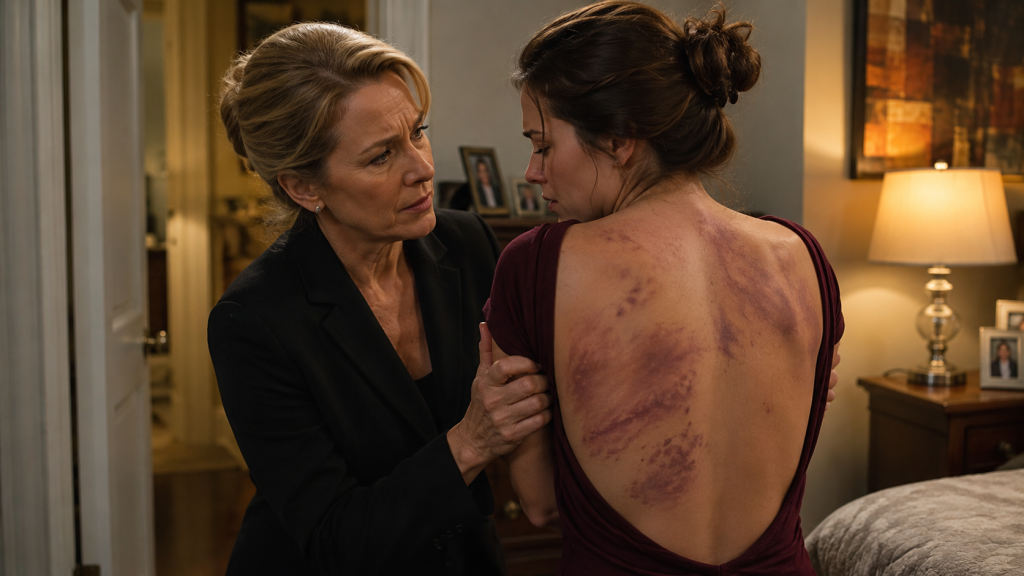
“He said it was my fault,” Chloe said softly. “He said I embarrassed him during a dinner with clients.”
My jaw tightened.
“He told me if I ever spoke about it, he’d ruin me.”
The room suddenly felt smaller.
“He said nobody would believe me,” she continued. “He said he knows judges. He knows prosecutors. He knows how to make people think I’m unstable.”
I listened carefully.
Every word.
Every excuse.
Every threat.
Then I asked the question that mattered most.
“Did he tell you that because he’s a lawyer, he’s untouchable?”
She nodded.
A strange calm settled over me.
Not anger.
Not panic.
Something colder.
I removed my reading glasses and placed them carefully on the dresser.
“Good,” I said.
Chloe blinked.
“Good?”
“Because men who think they’re untouchable make the biggest mistakes.”
She stared at me.
“Mom, please. You don’t understand. He has connections.”
I stepped closer and gently held her hands.
“No, sweetheart,” I said quietly. “He doesn’t understand.”
Her expression faltered.
“Understand what?”
I looked directly into her eyes.
“That the woman he threatened happens to be the daughter of someone who spent nearly three decades putting arrogant men exactly like him on the witness stand.”
For the first time all evening, I saw a flicker of hope cross her face.
Downstairs, Marcus sat comfortably in our kitchen, laughing with my husband over coffee and dessert.
The perfect husband.
The perfect professional.
The perfect lie.
When I entered the room, he immediately stood.
“Judge Vance,” he said with a charming smile. “Always a pleasure.”
I studied him for a moment.
His tailored suit.
His expensive watch.
His confident posture.
Then I smiled.
“The pleasure,” I replied calmly, “will be all mine.”
Marcus smiled back.
Completely unaware.
Because men like Marcus always believe they are the smartest person in the room.
They never realize the danger until the evidence starts speaking for itself.
That night, I did not accuse Marcus.
I did not raise my voice.
I did not give him the satisfaction of seeing my rage.
Instead, I sat across from him at the kitchen table and asked gentle questions, the kind that sounded harmless until a careless man answered too much.
“How has work been, Marcus?”
“Brutal,” he said, leaning back. “Clients are emotional. Judges are unpredictable. Everyone thinks their feelings matter.”
My husband glanced at me.
He knew that look on my face.
He knew I was no longer just a mother.
I was listening like a judge.
Marcus continued, enjoying his own voice.
“Marriage is stressful too,” he added. “Sometimes Chloe takes things personally. She’s sensitive.”
“Sensitive how?” I asked.
He smiled.
“You know how she is. She gets overwhelmed. Dramatic. I try to keep her grounded.”
Grounded.
The word landed in my chest like a stone.
Upstairs, my daughter was sitting on her childhood bed with evidence of his cruelty across her back.
And he was downstairs calling her dramatic.
I nodded slowly.
“Marriage can reveal a lot about character.”
Marcus lifted his coffee cup.
“Exactly.”
He thought I agreed with him.
That was his first mistake.
His second mistake came twenty minutes later.
His phone rang.
He looked at the screen and sighed.
“Client emergency. I should take this.”
He stepped into the hallway, but he did not go far enough.
His voice dropped, but not enough.
“Yes, I’m at her parents’ house.”
A pause.
“No, she won’t say anything.”
Another pause.
Then he laughed softly.
“Because she knows better.”
My husband’s face changed.
I placed my hand on his wrist beneath the table, silently telling him not to move.
Not yet.
Marcus returned with the same polished smile.
“Sorry about that.”
“No trouble,” I said.
But inside, the case had already begun.
After Marcus went to bed in the guest room, I found my husband in the den.
His hands were shaking.
“What happened to Chloe?”
I closed the door.
Then I told him.
For the first time in forty years of marriage, I watched my husband cry without making a sound.
He sat down slowly, pressed both hands over his face, and whispered, “I invited him into our home.”
“We both did,” I said.
“Where is she?”
“Upstairs.”
He stood immediately.
I stopped him.
“Careful. She needs safety before anger.”
He froze.
That was the hardest lesson for parents.
When someone hurts your child, every instinct screams to fight.
But sometimes the first act of love is not rage.
It is control.
By morning, Chloe had agreed to let a doctor document her injuries.
I called an old colleague who had left federal service years ago and now ran a private clinic specializing in trauma evaluations.
No police lights.
No public scene.
Just documentation.
Photographs.
Medical notes.
A timeline.
Chloe sat on the exam table, pale and silent, while the doctor spoke gently.
I stayed beside her the entire time.
When the doctor finished, she looked at Chloe and said, “I believe you.”
Three simple words.
Chloe broke.
She covered her face and sobbed like a little girl.
I held her while she cried.
Not because everything was fixed.
Because somebody had finally said the words Marcus told her she would never hear.
By noon, Sarah arrived.
Sarah had once been my sharpest clerk.
Now she was one of the strongest prosecutors in the state.
She walked into my living room with a leather bag, a calm face, and eyes that missed nothing.
“Chloe,” she said softly, “nothing happens today that you don’t understand. Nothing moves forward without you knowing what it means.”
Chloe nodded.
Then Sarah asked questions.
Dates.
Threats.
Witnesses.
Messages.
Financial control.
Isolation.
Medical history.
I watched my daughter answer in a voice that trembled but did not break.
Marcus had not started with bruises.
Men like him rarely do.
He started with jokes.
Then corrections.
Then control.
He criticized her clothes.
Her friends.
Her job.
Her memory.
Then came the apologies, flowers, and promises.
Then came the threats.
Then came the first time he grabbed her hard enough to leave marks and told her she had forced him to do it.
By the time Chloe finished, my husband had left the room twice because he could not bear to hear more.
But Chloe kept going.
And with every sentence, I saw her returning to herself.
Sarah placed a recorder on the coffee table.
“Do you have voicemails?”
Chloe nodded.
Her hands shook as she opened her phone.
The first message played.
Marcus’s voice filled the room.
Cold.
Controlled.
Familiar.
“If you embarrass me again, Chloe, I promise you will regret it.”
The second.
“You think anyone will believe you over me? I make witnesses look stupid for a living.”
The third.
“You leave me, and I’ll make sure everyone knows you’re unstable.”
My husband stood by the window, staring outside with his fists clenched.
Sarah looked at me.
I looked at Chloe.
“That is enough to begin,” Sarah said.
But Chloe was not finished.
“There’s more.”
She opened a hidden folder on her phone.
Photos.
Screenshots.
Emails.
A note she had written six months earlier titled: If something happens to me.
My heart nearly stopped.
“Why didn’t you tell me?” I whispered.
She looked at me with shame in her eyes.
“Because I thought you’d be disappointed in me.”
That hurt worse than anything.
I knelt in front of her.
“Chloe, listen to me. The shame belongs to the person who hurt you. Not to you. Never to you.”
She nodded, crying silently.
That evening, Marcus came downstairs in a crisp shirt, looking annoyed.
“I have a hearing Monday,” he said. “We should get back tonight.”
Chloe was sitting on the sofa between me and Sarah.
My husband stood behind us.
Marcus stopped when he saw the room.
His eyes moved from Sarah to the folder on the coffee table.
For one second, the mask slipped.
Then he smiled.
“Who’s our guest?”
Sarah stood.
“Sarah Whitman.”
Marcus’s smile tightened.
He recognized the name.
Most attorneys did.
“Prosecutor Whitman,” he said. “Interesting.”
“Very,” Sarah replied.
Marcus looked at Chloe.
“What is this?”
Chloe’s hand trembled.
I reached over, but she did not take it.
She stood on her own.
“This is me telling the truth.”
Marcus laughed softly.
Not because anything was funny.
Because he was trying to take control of the room.
“Chloe, you’re embarrassing yourself.”
My husband took one step forward.
I lifted one hand.
He stopped.
Marcus saw it and smirked.
“Judge Vance, surely you understand how emotional disputes can become.”
“I understand evidence,” I said.
His jaw tightened.
Sarah opened the folder.
“Medical report. Photographs. Voicemails. Written threats. Witness statement from the neighbor who heard shouting on April fourteenth. Screenshots of messages where you told Chloe to cover bruises before a firm dinner.”
Marcus’s face changed color.
Just slightly.
But enough.
“You have no right to collect private marital communications.”
Sarah smiled.
“Counselor, I suggest you choose your next words very carefully.”
There it was.
The first crack.
Marcus looked at Chloe.
“You did this?”
She flinched.
Then straightened.
“Yes.”
His voice dropped.
“You’ll regret this.”
Sarah clicked her pen.
“Thank you. That threat happened in front of four witnesses.”
Marcus realized too late what he had done.
My daughter looked at him, really looked at him, and I saw the fear begin to loosen its grip.
“You said nobody would believe me,” Chloe said.
Marcus did not answer.
“You were wrong.”
The silence was beautiful.
Two officers arrived thirty minutes later.
Quietly.
Professionally.
Marcus tried everything.
He demanded badge numbers.
He threatened careers.
He accused Chloe of being unstable.
He said I was abusing my position.
He said Sarah had a conflict.
He said he would sue everyone in the room.
But the louder he became, the smaller he looked.
When one officer asked if he had anything else to say, Marcus pointed at Chloe and said, “She ruins everything.”
My daughter looked away.
Not from fear.
From release.
Because finally, other people heard him.
Finally, the perfect man revealed himself.
After they took him outside, Chloe collapsed into my arms.
My husband held us both.
For a long time, none of us spoke.
There are moments when justice does not feel like victory.
It feels like surviving.
The next weeks were hard.
Harder than people imagine.
Freedom does not arrive like sunlight through a window.
Sometimes it arrives in court dates, protection orders, bank appointments, therapy sessions, and nights when the person who escaped still wakes up afraid.
Marcus’s firm suspended him after the charges became public.
Then came the disciplinary complaint.
Then came the clients who suddenly remembered moments when his temper had slipped.
Then came a former assistant who admitted he had threatened her career years earlier.
Men like Marcus build walls out of silence.
But once one brick falls, others often follow.
Chloe moved into our home temporarily.
At first, she apologized for everything.
For needing help.
For crying.
For sleeping late.
For being scared.
Every time, I told her the same thing.
“You are home. You do not have to earn safety here.”
Slowly, she began to believe it.
She started drinking coffee on the porch in the morning.
She started answering old friends’ messages.
She started wearing colors again.
One afternoon, I found her in the garden, laughing with her father because he had planted tomatoes upside down.
The sound made me turn away and cry quietly by the kitchen sink.
Not from sadness.
From gratitude.
The first hearing was held six weeks later.
I did not preside.
Of course I did not.
I sat in the gallery as a mother, not a judge.
Marcus entered wearing a suit and a face full of practiced innocence.
For years, I had watched men like him walk into courtrooms believing charm was a legal strategy.
But courtrooms are not dinner parties.
Eventually, facts take the floor.
Chloe testified.
Her voice shook at first.
Then steadied.
She described the threats.
The fear.
The way he used his profession like a weapon.
Marcus’s attorney tried to make her sound confused.
Chloe looked at him and said, “I was scared. I was not confused.”
I will remember that sentence for the rest of my life.
Across the aisle, Marcus looked down.
For once, he was not the one controlling the story.
After the hearing, Chloe stepped into the courthouse hallway and breathed like someone who had been underwater for years.
“You were right,” she said.
“About what?”
“He wasn’t untouchable.”
I took her hand.
“No one is.”
Months passed.
The criminal case continued.
The protective order remained.
The bar investigation widened.
Marcus’s reputation, the thing he had valued more than his wife’s humanity, began to collapse under the weight of his own behavior.
But the most important change happened quietly.
Inside Chloe.
She stopped whispering.
She stopped asking permission to exist.
She stopped calling herself foolish for loving someone who had hidden his cruelty behind charm.
Healing was not simple.
Some days, she still cried.
Some nights, fear still found her.
But she kept going.
One year after that weekend visit, Chloe moved into her own apartment.
Not far from us.
A small place with big windows, white curtains, and a little balcony full of plants.
On moving day, her father carried boxes while pretending not to cry.
I helped her arrange books on a shelf.
Then I noticed something on her kitchen counter.
A framed photograph.
It was Chloe at twelve years old, standing between me and her father outside the courthouse after I had been sworn in as a federal judge.
She was grinning proudly.
I picked it up.
“I remember this day.”
Chloe smiled.
“I do too.”
“You said you wanted to be brave like me.”
Her smile softened.
“I still do.”
I shook my head.
“No, sweetheart. You are braver.”
She looked away, blinking fast.
That evening, as I was leaving, Chloe walked me to the door.
“Mom?”
“Yes?”
“When you saw the bruises, I thought my life was over.”
I reached for her hand.
“It wasn’t over.”
She nodded.
“It was the first day I got it back.”
I hugged her carefully, the way I had learned to do while she was healing.
Then I stepped into the hallway.
Before I left, she called after me.
“Mom?”
I turned.
She stood in the doorway of her new home.
No practiced smile.
No fear in her eyes.
Just my daughter.
“I’m not scared of him anymore.”
I felt my throat tighten.
For twenty-eight years, I had believed justice lived in courtrooms.
In evidence.
In verdicts.
In sentences handed down from a bench.
But that day, standing outside my daughter’s apartment, I understood something deeper.
Sometimes justice is a woman locking her own door.
Sleeping safely in her own bed.
Laughing without checking the room first.
And finally believing that the life ahead of her belongs to her again.
THE END! THANKS FOR READING! 👇
WATCH TREADING STORY 👉 HERE.