

Hours before my 18th birthday, my family raised a toast to “my future” while my mother kept asking what time my trust fund would finally be accessible. I smiled, cut the cake, and said nothing. Because by then, I had already signed something she never saw coming.
My mother had a special voice for money. Soft enough to sound like concern. Sharp enough to make you feel she had already spent it. At midnight, she lifted her glass across the cake and smiled like a proud mother. My stepfather, Brent, stood beside her with one hand on the back of her chair and said I was finally old enough to make “mature decisions.”
Mature decisions.
That phrase stayed in the room longer than the candle smoke.
My name is Olivia Hart.
I turned eighteen that night, but the truth is, my birthday had not been about me for months.
It had been about the trust fund my grandmother left behind.
My grandmother called it protection.
My mother called it “accessible.”
That was her favorite word.
“When it becomes accessible, we can finally breathe.”
“When it becomes accessible, we can stabilize the house.”
“When it becomes accessible, you can start contributing like an adult.”
She never said college.
She never said safety.
She never said your future.
Just accessible.
By sixteen, I already understood how money worked in our house.
It moved toward Brent’s business problems.
Toward my stepbrother Tyler’s emergencies.
Toward overdue bills my mother called “temporary” right before they became my responsibility.
Money never moved toward me unless my grandmother sent it.
And even then, it had a strange way of disappearing into the household.
A check for school clothes became “just until payday.”
Birthday cash became “helping with groceries.”
A savings bond my grandmother gave me when I was twelve somehow became a down payment on Tyler’s used car.
My mother cried when I asked where it went.
Not because she felt guilty.
Because I had made her explain herself.
That was the first thing I learned about my mother.
She could turn any question into an accusation against you.
My grandmother saw it before anyone else did.
Her name was Eleanor Hart, but I called her Nana.
She was the kind of woman who kept peppermint candies in her purse, receipts in perfect envelopes, and secrets only when they protected someone.
When I was little, she would take me to the library on Saturdays and let me check out more books than I could carry.
Then we would sit in her car with hot chocolate and she would ask me what kind of life I wanted.
Not what job.
Not what husband.
Not what kind of house.
Life.
I never understood how important that question was until she was gone.
Nana died when I was fourteen.
Cancer took her quickly, but not quietly.
Even in the hospital bed, with her silver hair tied back and her hands thin as paper, she still looked at my mother like she could read every thought behind her eyes.
The day before she died, she held my hand and whispered, “This money is not love, Olivia. Don’t let anyone convince you it is.”
I cried so hard I couldn’t answer.
She squeezed my fingers.
“It is a door,” she said. “And only you should choose when to open it.”
After the funeral, my mother changed.
At first, she played the grieving daughter.
Black dresses.
Soft sobs.
Long Facebook posts about “my beautiful mother and her legacy.”
But when the attorney explained that Nana had placed most of her estate into a trust for me, one that I could not freely access until I turned eighteen, my mother’s grief became math.
How much?
When?
Who controls it?
Can a parent request an early distribution?
Could the trustee approve family expenses?
Mr. Keading, Nana’s attorney, answered every question politely.
No.
No.
No.
Not without Olivia’s direct benefit.
My mother smiled through all of it, but her eyes went cold.
After that, every year of my life felt like a countdown she had started in her head.
At fifteen, she told me I needed to stop being selfish about “family stability.”
At sixteen, she said Nana would have wanted me to help keep a roof over our heads.
At seventeen, she stopped pretending.
“You need to understand,” she told me one night, standing in the kitchen while Brent sat at the table pretending not to listen, “when that money becomes accessible, you will finally be able to contribute.”
I was doing homework at the counter.
I remember looking down at my notebook.
My pen had stopped moving.
“To what?” I asked.
She frowned.
“To the family.”
I looked around the kitchen.
At the cracked tile Brent had promised to fix.
At the stainless-steel fridge he insisted we needed after his business had its “temporary cash problem.”
At Tyler’s gaming laptop on the table, newer than anything I owned.
“What family?” I asked before I could stop myself.
The slap didn’t come.
My mother didn’t hit.
She punished with silence.
For three days, she barely spoke to me except to remind me that food, electricity, and shelter were not free.
Brent was worse.
He was not loud.
He was reasonable.
Men like Brent are dangerous because they do not need to shout.
They simply sit across from you with folded hands and make theft sound like responsibility.
“Olivia,” he said one evening, “your mother has carried you for eighteen years.”
I was seventeen.
“She gave up her youth for you,” he continued. “She built a life around you. Now you have a chance to ease that burden.”
I stared at him.
“My grandmother left that money for school.”
“She left it for your future,” Brent said. “And your future includes your family.”
That was how they spoke about it.
Not my money.
Not Nana’s gift.
A family resource.
A shared blessing.
A way forward.
But I had seen what “forward” meant in our house.
Forward meant Brent’s failed fitness equipment business getting another loan.
Forward meant Tyler needing tuition after losing his scholarship because he skipped classes.
Forward meant my mother remodeling the kitchen because “presentation matters.”
Forward meant me taking the bus to school with shoes I glued twice at the sole.
So during the week of my birthday, I stopped listening to what my mother said and started watching what she prepared.
She bought a leather folder.
She printed forms.
She asked twice whether I still had the trust officer’s card in my drawer.
Then she asked the exact time the account would “unlock,” like my birthday was not a birthday at all, but a vault door she had been standing beside for years.
That was when I made the call.
Three hours before midnight, while my family was setting out cake plates and champagne glasses, I sat across from Mr. Keading, the quiet attorney who had handled my grandmother’s trust from the beginning.
His office smelled like old paper, lemon polish, and rain.
A notary sat beside him.
A pen rested on the table between us.
I felt small in that chair.
Not young.
Small.
Like every adult in my life had been waiting for me to become legally useful.
Mr. Keading slid a folder toward me.
Not like my mother’s folder.
His was plain.
No tabs.
No emotional labels.
Just facts.
He explained that once I turned eighteen, I would gain certain rights over the trust.
Not full reckless access, because Nana had been careful.
But enough access for education, housing, health, and future planning.
Enough that my mother could pressure me.
Enough that I could make mistakes if I let guilt hold the pen.
I asked one question.
“What can I do before tomorrow?”
Mr. Keading looked at me for a long second.
Then he said, “You can decide whether access means spending power or protection.”
So I decided.
He showed me the amendment Nana had allowed for in the trust documents.
A protective election.
It would place additional restrictions on withdrawals for several years, requiring independent trustee approval for major distributions.
It would also prevent loans, transfers, or family obligation claims.
In plain language, it meant no one could corner me at a kitchen table and make me sign my future away.
Not even me under pressure.
Especially not me under pressure.
My hand shook when I signed.
Not because I was unsure.
Because I knew the moment my mother found out, the version of me she tolerated would disappear.
The useful daughter.
The quiet daughter.
The daughter who still hoped that if she obeyed enough, she might be loved without owing anything.
When the notary stamped the page, I felt something inside me break open.
Not fear.
Not joy.
Something sharper.
Freedom with a bruise around it.
Then I went home.
The house was glowing when I walked in.
White candles.
Gold paper plates.
A cake from the expensive bakery downtown.
The same bakery my mother said was “too much” when I asked for it at sixteen.
This year, suddenly, nothing was too much.
Tyler was in the living room with his girlfriend, bragging about a spring break trip he had not paid for yet.
Brent was pouring champagne into glasses, including one for me, though I did not drink.
My mother came toward me wearing the pearls Nana had left her.
I stared at them longer than I meant to.
They looked wrong on her.
“Where were you?” she asked.
“At the library,” I lied.
Her eyes flickered.
She knew I was lying.
I knew she knew.
But midnight was close, and greed makes some people patient.
So she smiled.
“My girl,” she said, touching my cheek. “Tomorrow begins everything.”
No, I thought.
Tonight ends it.
At midnight, they sang.
I blew out the candles.
Brent raised his glass and gave his little speech.
“To Olivia’s future,” he said.
Everyone lifted their glasses.
My mother watched me over the rim of hers.
“What time exactly tomorrow?” she asked softly.
There it was.
The real birthday wish.
I cut the cake.
I smiled.
And I said nothing.
That night, I slept better than I had in months.
Not because I thought the morning would be easy.
Because for once, the worst thing they could do was be angry.
They could not take the money.
They could not take the door Nana left me.
They could only stand outside it and knock.
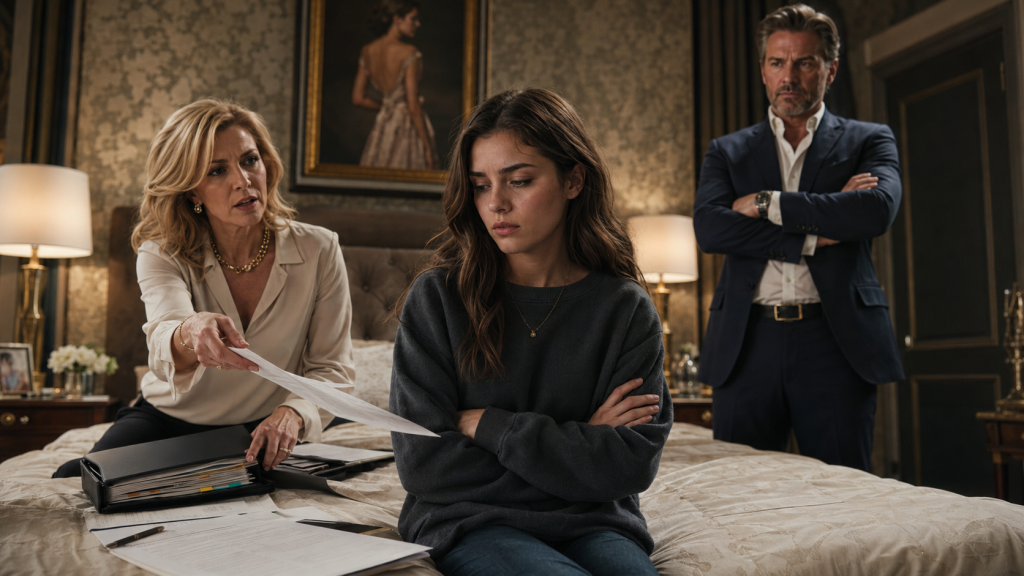
My mother walked into my room at 8:07 the next morning without knocking.
No happy birthday.
No hug.
No breakfast tray.
Just my mother in the doorway with that leather folder in one hand and a mug of coffee in the other.
She sat on the edge of my bed like the meeting had already been approved by everyone who mattered except me.
Then she opened the folder.
There were tabs.
Not notes.
Not questions.
Tabs.
Household.
Brent.
Tyler.
Stabilization.
Olivia Future.
That last one almost made me laugh, because my future was listed after everyone else’s problems.
My mother slid a typed page across my blanket.
“We’ve done the math,” she said.
Of course she had.
Some people only respect numbers when the total comes out in their favor.
I looked down at the page.
The polite language.
The signature line.
The phrase “shared family obligations” sitting there like a clean napkin over something rotten.
My grandmother would have called it fiction with formatting.
Brent appeared in the doorway wearing a button-down shirt, like this was a business meeting.
He used the calm, patient voice grown men use when they think a young woman is being emotional around money.
“We’re not taking anything from you,” he said. “We’re organizing it.”
I looked at him.
Then at my mother.
Then at the tabs spread across my bed like they had already divided my life into categories.
My mother tapped one blank line with her fingernail.
“This just keeps everything simple,” she said.
Simple.
For her.
For Brent.
For Tyler.
For everyone except the person whose name was on the trust.
Before I could answer, my phone buzzed.
Mr. Keading’s name lit up on the screen.
My mother saw it.
Her smile disappeared so fast it felt like someone had turned off a light.
I picked up the phone.
“Good morning, Mr. Keading.”
My mother’s eyes narrowed.
Brent straightened.
Mr. Keading’s voice was calm enough for everyone in the room to hear.
“Olivia, I’m calling to confirm that the protective amendment you signed last night has been filed and accepted.”
My mother blinked.
“What amendment?”
I kept my eyes on her as I answered.
“The one that keeps my trust from being withdrawn, transferred, borrowed against, or used for household obligations.”
Brent’s face changed first.
Not shock.
Anger.
Fast and ugly before he covered it.
“You had no right,” he said.
That made me smile.
“Actually, I’m the only one who did.”
My mother stood so quickly coffee spilled onto my blanket.
“Olivia, after everything I sacrificed—”
“Grandma sacrificed,” I said.
The words came out quiet.
But they landed hard.
My mother froze.
I had never spoken to her like that before.
Not because she had never deserved it.
Because I had always been afraid of what would happen afterward.
But adulthood did not arrive with fireworks or confidence.
Sometimes it arrived with coffee on your blanket and your mother’s hand hovering over papers she had no right to bring into your room.
“Grandma sacrificed,” I repeated. “You waited.”
The room went silent.
Mr. Keading continued over the phone.
“Any attempt to pressure Olivia regarding the trust should be directed to my office. I also need to remind everyone present that coercion involving trust assets may have legal consequences.”
Brent’s jaw tightened.
My mother stared at the phone like it had betrayed her.
Then Tyler shouted from downstairs.
“Did she sign it?”
My mother’s silence answered for me.
Tyler came up the stairs two at a time.
He stopped when he saw my face.
Then the papers.
Then the coffee soaking into my blanket.
“What did you do?” he asked.
I almost laughed.
Not because anything was funny.
Because all three of them had the same reaction.
Not what happened?
Not are you okay?
Not happy birthday.
What did you do?
“I protected what Nana left me,” I said.
Tyler scoffed.
“From us?”
“Yes.”
His mouth opened, then closed.
That single word had done what years of arguing could not.
It named the truth too plainly for them to decorate it.
My mother pressed a hand to her chest.
“I cannot believe you would treat your own family like criminals.”
I looked at the folder.
“At least criminals usually know they’re stealing.”
Brent stepped into the room.
“Careful,” he said.
Something in his tone made Mr. Keading speak again.
“Olivia, are you safe?”
My mother’s eyes widened.
The question humiliated her more than anything I had said.
“Yes,” I answered.
Then I looked at Brent.
“For now.”
Brent backed up half a step.
My mother’s face crumpled then.
Not with sadness.
With strategy.
Tears filled her eyes.
“You think money makes you grown?” she whispered. “You think your grandmother loved you more than I do because she wrote documents?”
“No,” I said. “I think Nana loved me enough to make documents because she knew you would confuse love with access.”
She slapped me then.
It happened so fast even Brent looked startled.
The sound cracked through the room.
For one second, nobody moved.
My cheek burned.
My phone was still in my hand.
Mr. Keading heard everything.
“Olivia,” he said sharply, “leave the room. Now.”
My mother’s hand flew to her mouth.
Not because she regretted it.
Because there had been a witness.
I got out of bed slowly.
I picked up my backpack from beside my desk.
It was already packed.
That was the other thing I had done the night before.
Two pairs of jeans.
Three shirts.
My laptop.
Nana’s old watch.
My documents.
The small framed photo of her holding me at age six, both of us laughing in the library parking lot.
My mother saw the bag.
Her expression shifted from anger to fear.
Real fear this time.
“You’re leaving?”
“I’m going to stay with Aunt Claire for a while.”
Aunt Claire was Nana’s younger sister.
My mother hated her because Claire saw too much and apologized too little.
“You planned this?” my mother whispered.
“No,” I said. “You did. I just finally paid attention.”
I walked past Brent.
He did not move.
Downstairs, the house still smelled like birthday cake.
The gold plates were stacked by the sink.
The champagne glasses from the night before sat cloudy on the counter.
Evidence of a celebration that had never really been for me.
Tyler followed me down.
“So that’s it?” he snapped. “You get rich and dump us?”
I stopped at the front door.
“I’m not rich,” I said. “I’m protected.”
He rolled his eyes.
“Same thing.”
“No,” I said. “That’s why you don’t understand it.”
Outside, Aunt Claire’s old blue sedan was already waiting at the curb.
When I opened the door, she got out.
She was seventy-two, thin as a reed, with white hair pinned at the back of her head and eyes exactly like Nana’s.
My mother appeared behind me.
The slap mark must have still been red on my face because Aunt Claire’s expression changed.
Only slightly.
But enough.
“Get in the car, Olivia,” she said.
My mother turned on her.
“You have no right to interfere.”
Claire looked past her, into the house, at the leather folder still clutched in her hand.
“Eleanor was right about you,” she said.
My mother flinched like she had been slapped too.
For the first time all morning, she had no answer.
I got into the car.
As we drove away, I looked back once.
My mother stood on the porch in her robe, holding that folder against her chest like a child.
For a second, I almost felt sorry for her.
Almost.
Then Aunt Claire reached over and placed a wrapped muffin in my lap.
“Blueberry,” she said. “Your grandmother’s recipe.”
I stared at it.
And suddenly, after holding myself together all morning, I cried.
Not graceful tears.
Not movie tears.
The kind that make your throat hurt.
Aunt Claire did not tell me to stop.
She just drove.
Her house was small, quiet, and full of plants.
There was a guest room at the back with yellow curtains and a quilt Nana had made before I was born.
On the desk, Aunt Claire had placed a vase of daisies and a card.
Happy Birthday, Olivia.
Not congratulations.
Not finally.
Not now you can help.
Just happy birthday.
I sat on the bed and read it three times.
That afternoon, Mr. Keading called again.
He confirmed that the amendment was secure.
He also told me Nana had left another letter.
One I could only receive after I turned eighteen and made an independent decision about the trust.
“I think she hoped you would choose protection,” he said.
The next morning, Aunt Claire drove me to his office.
My cheek had faded from red to pale purple.
Mr. Keading noticed but did not comment.
He simply handed me an envelope with my name written in Nana’s beautiful slanted handwriting.
My hands trembled as I opened it.
My dearest Olivia,
If you are reading this, then you have reached the age when people may start calling you grown while still trying to make your choices for you.
Be careful of those people.
Especially if they use the word family when they mean debt.
I laughed through tears at that line.
Nana always knew.
The letter continued.
I did not leave this trust because I believed money could save you.
Money cannot raise you, comfort you, or love you.
But it can give you time.
Time to study.
Time to leave.
Time to say no without becoming homeless.
Time to become the woman you are, not the woman someone finds useful.
Your mother is my daughter, and I loved her.
But love does not require blindness.
She has always been hungry for security, and hunger can make people justify terrible things.
Do not hate her if you can help it.
But do not hand her the keys to your life just because she cries at the door.
You are not responsible for healing what other people broke before you were born.
Live, Olivia.
Choose your life.
And when someone raises a glass to your future, make sure it is truly yours.
All my love,
Nana.
By the time I finished reading, the page was spotted with tears.
Mr. Keading handed me a tissue.
Aunt Claire squeezed my shoulder.
For the first time since Nana died, I felt her with me.
Not as grief.
As guidance.
In the weeks that followed, my mother called thirty-seven times.
The first messages were angry.
Then tearful.
Then practical.
Then angry again.
She said I had humiliated her.
She said Brent might leave.
She said Tyler’s tuition was in danger.
She said I was selfish, manipulated, cold, ungrateful.
Then one night, she left a message that was almost quiet.
“I don’t know how to talk to you if money isn’t part of it.”
I listened to that one twice.
Then I deleted it.
Not because it didn’t hurt.
Because it did.
But pain is not always a sign that you made the wrong choice.
Sometimes it is just the sound of an old chain pulling loose.
I stayed with Aunt Claire through the summer.
I applied to college using the education distributions Nana had protected.
I opened my own bank account.
I learned how to cook three meals that were not cereal, toast, or microwave noodles.
I bought shoes without asking permission.
Small things.
Ordinary things.
Things that felt enormous to someone who had spent her life being treated like an investment waiting to mature.
The week before I moved into my dorm, my mother asked to meet me at a café.
Aunt Claire offered to come, but I said no.
Not because I trusted my mother.
Because I trusted myself.
She was already there when I arrived.
She looked smaller than I remembered.
No pearls.
No leather folder.
Just a woman with tired eyes and hands wrapped around a cup of tea.
For a few minutes, neither of us spoke.
Then she looked at me and said, “I shouldn’t have slapped you.”
It was not the apology I deserved.
But it was the first honest sentence she had given me in years.
“No,” I said. “You shouldn’t have.”
She swallowed.
“I was scared.”
“I know.”
Her eyes filled.
“I thought if we had that money, everything would finally be okay.”
I looked at her carefully.
“That’s the difference between us,” I said. “You saw Nana’s gift as a rescue. I saw it as a chance to not need rescuing.”
She cried then.
Quietly.
I did not comfort her.
That may sound cruel.
But I had spent my whole childhood managing her feelings.
That day, I let them belong to her.
Before I left, she reached across the table.
I did not take her hand.
Not yet.
Maybe someday.
Maybe never.
Healing is not a door other people get to unlock because they are suddenly sorry.
Outside, the sun was bright.
I walked back to Aunt Claire’s car with my head high and my heart aching.
Both things were true.
A month later, I moved into my dorm.
My room was tiny.
The mattress was stiff.
The desk wobbled.
The hallway smelled like laundry detergent and burnt popcorn.
It was the most beautiful place I had ever lived.
On the first night, I placed Nana’s photo beside my bed.
Then I taped her letter inside my closet door where only I could see it.
My phone buzzed.
A text from my mother.
Good luck tomorrow.
No mention of money.
No guilt.
No request.
Just four words.
I stared at them for a long time.
Then I typed back.
Thank you.
It was not forgiveness.
Not yet.
But it was a beginning small enough not to scare me.
That night, I climbed into bed and listened to the sounds of other students laughing in the hall.
For the first time in my life, nobody knew where I was because they needed something from me.
Nobody was waiting outside my door with forms.
Nobody was asking when I would become useful.
I thought about my birthday cake.
The toast.
Brent’s speech.
My mother’s favorite word.
Accessible.
And I finally understood something Nana had tried to teach me.
Some doors should open.
Some should stay locked.
And sometimes the bravest thing a girl can do on the first morning of adulthood is refuse to hand over the key.
My name is Olivia Hart.
I turned eighteen the night my family toasted my future.
But I truly became free the next morning, when I chose to keep that future for myself.
THE END! THANK YOU FOR READING!