

“Perfect for what?” I asked, although the look on Preston’s face had already given me the answer.
He turned toward Kendra, and they exchanged a quick, confident glance. It was the kind of glance married couples shared when they had discussed something privately and assumed everyone else would eventually agree.
“For us,” Preston said.
I stared at him.
Kendra adjusted Lila against her shoulder and smiled as though Preston had just announced something generous.
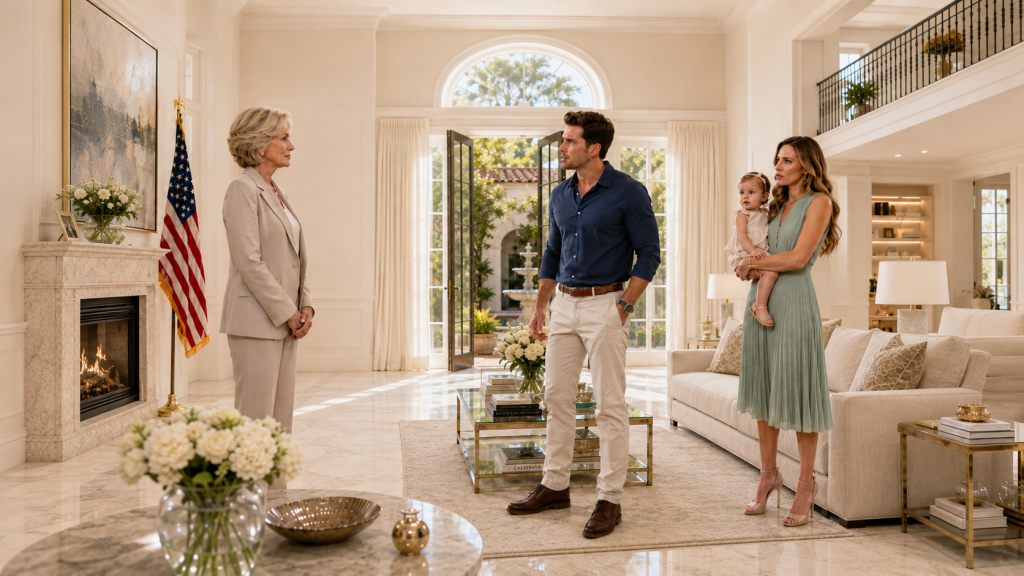
“Our apartment is getting too small,” she explained. “Lila needs her own room, and Preston needs a proper office. This place has more space than you could ever use.”
Preston walked toward the French doors and looked out at the garden.
“You can stay in the guesthouse,” he said. “It’s practically a small home by itself. You’d still have privacy, and we’d be right here if you needed anything.”
If I needed anything.
Three weeks earlier, he had looked at my apartment behind the laundromat and told me to be realistic. Now he was standing inside my home, assigning me a smaller building in my own garden.
Kendra crossed the living room and opened the glass cabinet containing my grandmother’s china.
“These dishes are pretty,” she said, lifting one of the cups. “A little old fashioned, though. We could box them up and put them in storage.”
I walked over and gently removed the cup from her hand.
“They belonged to my grandmother.”
“I know,” Kendra replied. “That’s why I said we should keep them.”
She said it slowly, as if explaining something to a confused child.
Preston barely listened. He was already pointing toward the blue wall.
“That color would have to go,” he said. “Something neutral would make the room look more expensive.”
The silence inside me became calm and complete.
For most of my life, silence had been something I used to protect other people. I stayed quiet when my husband criticized the meals I prepared. I stayed quiet when Preston forgot my birthday but expected me to plan an elaborate dinner for his. I stayed quiet when Kendra spoke to me as though kindness were something she performed for an audience.
But this silence was different.
This silence belonged to me.
“You’re right about one thing,” I said.
Preston turned.
“Someone here needs to start being realistic.”
His smile faded.
I walked to the front door and opened it.
“You need to leave.”
Kendra laughed softly.
“Marianne, don’t be dramatic.”
“I’m not being dramatic. I’m asking you to leave my house.”
Preston stared at me as though I had spoken in a language he didn’t understand.
“Your house?”
“Yes.”
“Mom, we’re family.”
“That doesn’t make this your house.”
He stepped closer, lowering his voice.
“You’re sixty-one years old. You’re living alone in a place with five bedrooms.”
“Four bedrooms.”
“That’s not the point.”
“It seems to be your entire point.”
His jaw tightened.
“We’re trying to make a practical arrangement.”
“No. You walked into my home without knocking, decided where I should live, criticized my furniture, and began planning renovations. That isn’t an arrangement. That is entitlement.”
Kendra shifted Lila onto her other hip.
“Preston only wants what’s best for everyone.”
“What’s best for everyone,” I repeated, “or what’s best for you?”
Preston’s face reddened.
“You wouldn’t even have this place if Dad hadn’t supported you for thirty-four years.”
The words struck exactly where he intended them to.
For a moment, I saw him as a little boy again, standing in our old kitchen with scraped knees while I washed blood from his skin. I remembered sewing costumes at midnight, driving him to practices, sitting beside him through fevers, and working quietly from home so he never had to come back to an empty house.
Then I looked at the man in front of me.
“Your father did not buy this villa.”
“Then how did you?”
“That is none of your business.”
“I’m your son.”
“That still doesn’t make my finances your property.”
Kendra touched his arm.
“Let’s go,” she said. “She’s obviously overwhelmed.”
I looked directly at her.
“I’m not overwhelmed.”
She gave me a thin smile.
“Of course not.”
Preston walked toward the door, but he stopped beside me.
“This isn’t finished.”
“It is for today.”
“You’re going to regret treating us this way.”
“No,” I said. “I regret allowing you to believe you could treat me this way.”
He stepped outside. Kendra followed, holding Lila against her chest.
Before leaving, she looked back at the vaulted ceiling.
“You’re going to feel very lonely in this enormous house.”
Then she closed the door behind her.
I stood in the foyer until their SUV disappeared through the gate.
Only then did my knees begin to shake.
I sat on the bottom step of the staircase and pressed both hands against my face.
I had imagined many reactions when Preston learned about the villa. Surprise. Confusion. Perhaps even resentment. But some foolish part of me had also imagined pride.
I had imagined him walking through the courtyard and saying, “Mom, you did this?”
I had imagined showing him the guesthouse and telling him that he and Kendra could stay there during holidays.
I had imagined Lila learning to walk beneath the jasmine vines.
Instead, my son had entered my home and erased me from it within ten minutes.
My phone began vibrating before his SUV reached the end of the street.
The first message came from Preston.
You embarrassed me in front of my wife.
The second arrived moments later.
We were trying to help you.
Then another.
You’re acting irrationally.
I read the messages twice.
I did not answer.
That evening, I locked the gate and checked every door. I carried my dinner outside and sat beneath the bougainvillea, but the courtyard no longer felt peaceful.
Every sound made me look toward the driveway.
At nine thirty, an email arrived from Preston.
The subject line read: FAMILY HOUSING PROPOSAL.
Attached was a document containing twelve pages.
He had created it before visiting me.
The document described him and Kendra as “primary occupants” of the villa. It designated the guesthouse as my “private residential unit.” It stated that Preston would assume responsibility for maintenance, landscaping, insurance decisions, and future renovations.
There was even a section giving him authority to approve visitors.
At the bottom was a place for my signature.
I read the document slowly, feeling my disbelief harden into something colder.
This had not been a spontaneous suggestion.
They had planned it.
They had seen photographs of my house, researched the property, and written an agreement before arriving at my door.
At ten fifteen, Preston called.
I let it ring.
He called again.
Then Kendra called.
I turned off the phone and went to bed, but sleep never came.
The dryers behind my old apartment had once kept me awake with their endless rumbling. That night, the villa was completely silent, yet my mind was louder than any machine.
At seven the next morning, I called my attorney.
Her name was Helen Mercer. She had represented me during the divorce and had always spoken to me directly, never through my husband, never as though I were incapable of understanding legal language.
When I explained what had happened, she became quiet.
“Forward me the document,” she said.
I sent it while we were still speaking.
She read the first few pages.
“Do not sign anything,” she said.
“I wasn’t going to.”
“Has Preston ever had power of attorney?”
“No.”
“Does he have access to your bank accounts?”
“No.”
“Does he have keys to the villa?”
“I don’t think so.”
“That isn’t the same as no.”
The words made my stomach tighten.
During my first week in the villa, Preston had still possessed a key to my old apartment. Years earlier, he had also kept a spare key to our family home.
I had never asked whether he had copied either one.
Helen told me to change the gate code, replace the exterior locks, and install cameras.
“You’re making it sound as though he’s dangerous,” I said.
“I’m making it sound as though he feels entitled. Entitled people often convince themselves that taking something is the same as receiving what they deserve.”
By noon, a locksmith had replaced every exterior lock. The security company installed cameras near the gate, courtyard, side entrance, and guesthouse.
I changed the gate code, which had been Preston’s birthday.
That small detail hurt more than I expected.
For years, every password I created had contained something connected to him. His birthday. His initials. The name of his childhood dog.
My life had been organized around my son for so long that separating myself from him felt like dismantling part of my identity.
At three that afternoon, my ex-husband called.
Richard and I had spoken only when necessary since the divorce. Our conversations usually involved paperwork or family events.
This time, he skipped the greeting.
“What did you do to Preston?”
I looked out at the courtyard.
“What did he tell you?”
“He said you humiliated him and Kendra.”
“I asked them to leave after they announced they were moving into my house.”
Richard sighed.
“You know how Preston is. He gets excited.”
“He prepared a twelve-page occupancy agreement.”
Silence.
Then Richard said, “He probably thought he was helping.”
“Did you know about it?”
“No.”
I waited.
Richard had never been good at lying to me. After thirty-four years, I knew every version of his silence.
“You knew he wanted the villa,” I said.
“He mentioned that the house seemed large for one person.”
“And what did you say?”
“I said it might make sense for family to live together.”
I closed my eyes.
“You encouraged him.”
“I did not encourage him to throw you out.”
“He wasn’t throwing me out. He was generously allowing me to live in the guesthouse.”
Richard exhaled heavily.
“Marianne, can we please avoid turning this into another war?”
“There is no war. There is my house and a son who thinks it belongs to him.”
“How did you afford it?”
There it was.
The question Preston had not asked because he had been too busy claiming the villa.
“My grandmother left me two rental properties.”
“I know about those old houses.”
“I sold them.”
Richard’s voice changed.
“You sold both?”
“Yes.”
“When?”
“During the divorce.”
“You never told me.”
“They were inherited property. They were mine.”
“I understand that legally.”
“But not personally?”
He didn’t answer.
I remembered the day my grandmother gave me the deeds. Richard had laughed and called the houses “two aging headaches.” He told me to sell them before they became worthless.
Instead, I hired a property manager, saved the rental income, paid for repairs, and kept careful records for nineteen years.
Richard had forgotten the properties existed.
I had not.
“You always acted like you didn’t understand money,” he said.
“No, Richard. You always acted like I didn’t understand money.”
He went silent.
For decades, he had handled our investments while I handled everything else. When I asked questions, he told me not to worry. When I suggested changes, he called them emotional decisions.
Eventually, I stopped speaking.
The fact that I had quietly managed my grandmother’s properties was not deception. It was survival.
“Preston is under pressure,” Richard finally said.
“What kind of pressure?”
“You should ask him.”
“I did. He talked about paint colors.”
“He and Kendra have expenses.”
“So does everyone.”
“He may need help.”
I almost laughed.
During the previous five years, I had given Preston and Kendra nearly seventy thousand dollars.
I paid part of their wedding expenses after they exceeded their budget. I covered six months of their mortgage when Preston changed jobs. I paid a hospital bill after Lila’s birth, even though they had insurance. I wrote checks without asking for receipts because Preston always said he would repay me when things improved.
Things never improved enough for repayment.
Yet somehow, there was always money for expensive watches, restaurant dinners, resort photographs, and a new SUV.
“What kind of help?” I asked.
Richard hesitated.
“That is for Preston to explain.”
“Then he can explain it without demanding my home.”
I ended the call.
For the next two days, Preston sent no messages.
Instead, other people began calling.
My sister, Denise, told me a five-bedroom villa was too large for a single woman.
My cousin Laura reminded me that young families struggled to find good housing.
Richard’s sister said Preston was devastated.
Each conversation followed the same pattern. They began by saying they did not want to interfere, then repeated Preston’s version of the story as though it were fact.
According to him, he had offered to move in because he was worried about me living alone. I had screamed at Kendra, frightened Lila, and thrown them into the street.
By the fourth call, I stopped defending myself.
“I appreciate your concern,” I told each person. “The matter is private.”
On Wednesday morning, my neighbor Celia knocked on the door.
She was the woman who had posted the housewarming photographs. Her face looked apologetic.
“I think this is my fault,” she said.
“You didn’t do anything wrong.”
“If I hadn’t posted those pictures—”
“He would have learned eventually.”
Celia handed me a small container of lemon cake.
Then she looked toward the gate.
“A woman came by yesterday afternoon.”
“What woman?”
“Your daughter-in-law.”
My chest tightened.
“Kendra was here?”
“She parked outside and walked along the wall. I saw her taking pictures near the guesthouse.”
“Did she come inside?”
“I don’t think so. The gate was closed.”
I checked the security recordings.
At two seventeen the previous afternoon, Kendra’s car stopped across the street. She walked beside the outer wall, held her phone above the gate, and photographed the courtyard.
Then she tried the keypad.
She entered Preston’s birthday.
When the gate did not open, she tried again.
After the third failed attempt, she returned to her car.
I saved the recording and sent it to Helen.
Her reply arrived minutes later.
Document everything.
That evening, Preston finally called again.
This time, I answered.
“Why was Kendra outside my house yesterday?”
He paused.
“She wanted to see the guesthouse.”
“She already saw it through the windows.”
“You changed the gate code.”
“Yes.”
“That was unnecessary.”
“She tried to enter without permission.”
“She’s family.”
“Family still knocks.”
He sighed as though I were exhausting him.
“Mom, we need to talk in person.”
“About what?”
“Our financial situation.”
At last, the truth was approaching.
We agreed to meet the next afternoon at a café near the bay.
Preston arrived twenty minutes late. He was not wearing his expensive watch.
He sat across from me and ordered coffee without looking at the menu.
For a while, neither of us spoke.
Then he placed both hands on the table.
“We’re behind on the mortgage.”
“How far behind?”
“Four months.”
I felt a flicker of alarm, but I kept my voice steady.
“Why?”
“Kendra stopped working after Lila was born.”
“You said that was temporary.”
“It was supposed to be.”
“And your salary?”
“My company reduced commissions.”
“How much do you owe?”
He looked toward the window.
“On the mortgage?”
“On everything.”
His jaw moved.
“I don’t know exactly.”
“You prepared a twelve-page agreement for my villa, but you don’t know how much debt you have?”
“Kendra handles some of the cards.”
“How many cards?”
“I said I don’t know.”
I waited.
Finally, he admitted they owed nearly one hundred and eighty thousand dollars beyond the mortgage.
The number was so large that I thought I had misunderstood.
“How?”
He rubbed his forehead.
“Credit cards. A business loan. Taxes.”
“What business?”
“Kendra started an online home décor company.”
I remembered her social media posts showing designer candles, imported rugs, and custom furniture.
I had assumed the company was profitable.
It wasn’t.
They had borrowed heavily to create the appearance of success, expecting investors who never came. When the business failed, they used credit cards to cover household expenses.
Then they borrowed against their apartment.
Then they stopped making payments.
“Why didn’t you tell me?”
“I’m telling you now.”
“No. You came to my house and tried to move me into the guesthouse.”
“We thought we could rent our apartment and use the income to pay the debt.”
“While living in my villa for free.”
“We would maintain the property.”
“You wanted control of the property.”
“We wanted stability for our daughter.”
The mention of Lila was deliberate.
For years, Preston had known exactly which part of my heart to touch when he wanted something.
I took a breath.
“I will pay for a financial counselor,” I said. “Someone who can review your debts and help you create a plan.”
His expression hardened.
“A counselor can’t fix this.”
“You may need to sell the SUV.”
“We owe more than it’s worth.”
“You may need to sell other things.”
“That still won’t be enough.”
“You may need to declare bankruptcy.”
Kendra had apparently forbidden that option because it would damage their image and affect future business opportunities.
“So what do you expect from me?” I asked.
Preston leaned forward.
“You own the villa without a mortgage.”
“Yes.”
“You could take out a loan against it.”
“No.”
“You didn’t even think about it.”
“I have thought about spending the rest of my life rescuing you. I have been thinking about it for years.”
His face changed.
“You make it sound like I’m some kind of parasite.”
“I think you’re in serious trouble. I also think you believed my home should solve that trouble without requiring you to change.”
“I’m your only child.”
“And I am your mother, not your emergency bank.”
He pushed back his chair.
“Dad was right.”
“About what?”
“You’ve changed.”
The words were meant as an accusation.
Instead, I nodded.
“Yes.”
He stared at me.
“Yes, I have changed,” I continued. “I had to.”
“You’re choosing a house over your family.”
“No. I’m choosing not to lose my house because my family refuses to face reality.”
He stood.
“Don’t expect to see Lila.”
The threat landed harder than anything else he had said.
He knew it.
For one terrible second, I almost called him back. I almost promised money. I almost offered the guesthouse.
Then I remembered Kendra lifting my grandmother’s cup and deciding it belonged in storage.
I remembered Preston discussing the removal of my fountain.
I remained seated.
“That would be your decision,” I said quietly. “And one day, you would have to explain it to her.”
He walked out without finishing his coffee.
For ten days, I heard nothing.
I spent those days meeting with Helen, reviewing my estate plan, and organizing every financial document connected to the villa.
Helen suggested placing the property into a revocable trust. I would remain in complete control during my lifetime, but clear instructions would determine what happened after my death.
“Do you want Preston to inherit the villa?” she asked.
The question hurt.
Before his visit, I had assumed he would.
Now I pictured him entering before my belongings had been removed, repainting the blue wall, boxing up the china, and telling people the house had always been meant for him.
“I don’t know,” I admitted.
“You don’t have to decide today.”
“I want Lila protected.”
“Then we can establish a separate trust for her education. Preston and Kendra would not control the principal.”
I looked at Helen.
“Would that seem cruel?”
“Protecting a child from her parents’ creditors is not cruel.”
We created the trust.
I also prepared medical directives naming my sister Denise as a backup decision-maker, but only after I explained the entire situation to her. Denise apologized for repeating Preston’s version of events.
“I thought he was just worried about you,” she said.
“He was worried about losing access to something he wanted.”
That Friday, I drove to a garden center with Celia. I purchased two jasmine plants and a small lemon tree for the courtyard.
We had lunch near the water.
For several hours, I did not think about Preston.
At two forty-three, my phone displayed an alert from the front gate camera.
A moving truck had arrived.
At first, I assumed it belonged to a neighbor.
Then the truck stopped directly outside my gate.
Preston stepped out of the passenger side.
Kendra’s car pulled up behind him.
I watched through the security application as Preston entered a code into the keypad. The gate remained closed.
He tried again.
Then Kendra walked toward the side wall and pointed to something beyond the camera’s view.
A minute later, one of the movers climbed over the low section of the wall and opened the pedestrian gate from inside.
My hands went numb.
“What’s wrong?” Celia asked.
“They’re at my house.”
I called the police while Celia drove.
By the time we reached the villa, the moving truck was inside the courtyard.
Two men were carrying a sofa through my front door.
Kendra stood in the foyer directing them.
“Put that in the blue room,” she said.
Preston turned when he saw me.
His expression was annoyed rather than ashamed.
“Mom, calm down.”
“Get them out.”
“We don’t have time for another argument.”
I looked at the mover holding one end of the sofa.
“You do not have permission to bring anything into this house.”
The mover immediately lowered his end.
Preston stepped between us.
“She’s my mother. We’re moving in to take care of her.”
“That is not true.”
Kendra walked forward.
“Our apartment is being sold.”
“Then find another apartment.”
“With what money?” Preston snapped.
“Not my villa.”
A police car entered through the open gate.
Two officers approached.
Preston began speaking before they reached us.
“This is a family misunderstanding.”
One officer looked at me.
“Are you the property owner?”
“Yes.”
I showed him my identification and the digital copy of the deed stored on my phone.
“Do these people live here?” he asked.
“No.”
“Did you give them permission to move belongings inside?”
“No.”
Preston shook his head.
“She told us we could stay.”
“When?”
“Last month.”
“That is false,” I said.
The officer asked whether I wanted them removed from the property.
I looked at my son.
His face held no apology. Only anger that I had interrupted his plan.
“Yes.”
Kendra gasped.
“You’re throwing your granddaughter onto the street?”
“You arrived with a moving truck after breaking through my gate.”
“We had nowhere else to go!”
“You had ten days to tell me that.”
Preston stepped closer.
“You called the police on your own son.”
“No. I called the police on people entering my home without permission.”
The officer moved between us.
“Sir, step back.”
For the first time, Preston seemed to understand that the situation was no longer under his control.
The movers carried the sofa back outside. Boxes were removed from the foyer. A portable crib, several suitcases, a television, and two dining chairs were loaded onto the truck.
Kendra stood beside her car, crying loudly while holding Lila.
The sight of my granddaughter nearly broke me.
Lila reached one small hand toward me.
I took a step forward.
Kendra turned away.
That was when I understood the true shape of the weapon they were using.
They believed my love for Lila would make me surrender.
Perhaps the old version of me would have.
But surrender would not save them. It would only teach them that every boundary could be destroyed if they applied enough pressure.
The police issued Preston and Kendra a formal trespass warning.
They were not arrested, but Preston told everyone that they had been.
By the following morning, relatives were calling again.
This time, I sent a single message to the family group.
Preston and Kendra entered my locked property without permission by having a mover climb over the wall. They attempted to move into my home after I had explicitly refused. The police removed them and issued a trespass warning. They were not arrested. I will not discuss this further.
I attached a still image from the security recording.
The calls stopped.
Two days later, an envelope arrived by certified mail.
Inside was a petition requesting emergency guardianship over me.
I read the first page three times.
Preston claimed I was showing signs of cognitive decline. According to the petition, I had made a “sudden and irrational real estate purchase,” isolated myself from family, displayed hostility toward loved ones, and become vulnerable to manipulation by new acquaintances.
He requested temporary control over my finances and property until a full evaluation could be completed.
Attached were photographs of my old apartment, the villa, and the police car in my courtyard.
There was also an affidavit signed by Richard.
My ex-husband stated that during our marriage, I had rarely managed major financial decisions and had recently behaved “in a manner inconsistent with my prior personality.”
I sat at the kitchen table with the papers spread in front of me.
For thirty-four years, Richard had treated my patience as weakness.
Now my son was trying to turn that same patience into proof that I was incompetent.
Helen arrived within an hour.
She read the petition without speaking.
“Can he do this?” I asked.
“Anyone can file a petition. That doesn’t mean he will win.”
“He wants control of everything.”
“Yes.”
My voice cracked.
“He would rather declare me incapable than admit I told him no.”
Helen reached across the table.
“We are going to answer this with facts.”
The next two weeks were filled with appointments.
A neurologist evaluated my memory, reasoning, language, attention, and judgment. I completed financial exercises, recalled lists of words, interpreted hypothetical situations, and explained every stage of the villa purchase.
A psychiatrist interviewed me for nearly two hours.
My accountant prepared nineteen years of records from the rental properties.
The property manager provided maintenance invoices, lease agreements, tax statements, and correspondence showing that I had made every major decision.
The bank documented that the villa had been purchased with proceeds from the inherited properties and savings held in my name.
Helen obtained the email containing Preston’s housing proposal.
She also preserved the messages in which he demanded that I borrow against the villa.
Then she requested the full security recording from the day of the moving truck.
Richard called me the night before the hearing.
“I didn’t know Preston was going to file for guardianship,” he said.
“But you signed an affidavit.”
“He said the lawyer needed background information.”
“Did you read it?”
A long silence followed.
“Not carefully.”
“After thirty-four years, you signed a statement questioning my mental capacity without reading it carefully.”
“I thought he was trying to protect you.”
“From what?”
“He said your neighbors were influencing you.”
“My neighbors brought lemon cake. Preston brought a moving truck.”
Richard sighed.
“I made a mistake.”
“No. You made a choice. Mistakes happen accidentally.”
“I can withdraw the affidavit.”
“Helen will contact your attorney.”
“Marianne—”
I ended the call.
The hearing took place on a humid Tuesday morning.
Preston sat across the courtroom beside his lawyer. Kendra was behind him, wearing a pale dress and holding a tissue.
She looked like a worried daughter-in-law.
I wondered how many hours she had spent choosing that dress.
The judge reviewed the medical reports first.
Both doctors found me fully capable of managing my personal and financial affairs.
Preston’s lawyer argued that intelligence did not eliminate vulnerability. He described the villa as an impulsive purchase and suggested that my new friendships had encouraged me to reject my family.
Helen stood.
“My client planned this purchase for years. She owned and managed rental properties inherited from her grandmother. She sold those properties through licensed professionals, paid all applicable taxes, obtained an independent inspection, and purchased her current home without debt.”
She handed the judge a binder.
“This is not evidence of impulsivity. It is evidence of competence.”
Preston’s lawyer called Richard.
He admitted he had not read the affidavit carefully. He also admitted that he had rarely allowed me to participate in financial decisions during our marriage.
“Was that because she was incapable?” Helen asked.
Richard looked at me.
“No.”
“Why, then?”
He swallowed.
“Because I preferred to handle them.”
“Did Mrs. Cole ever fail to manage the household budget?”
“No.”
“Did she ever miss payments?”
“No.”
“Did she create the financial instability currently facing your son?”
“No.”
Helen then submitted Preston’s occupancy proposal.
The judge read several pages.
“Mr. Cole,” she said, looking at Preston, “you prepared this document before visiting your mother?”
“Yes.”
“You designated yourself as the primary occupant of her home.”
“I intended to help manage the property.”
“You also gave yourself authority over visitors and renovations.”
“She lives alone.”
The judge looked over her glasses.
“That was not my question.”
Preston shifted in his seat.
“Yes.”
Helen played the security footage.
The courtroom watched as the mover climbed over my wall.
Then the audio from the foyer played.
Kendra’s voice could be heard directing furniture toward the blue room.
Preston’s lawyer objected, but the judge allowed the recording.
When it ended, Helen faced my son.
“Your petition says your mother became hostile without reason. Did she tell you not to move into her home?”
“She was emotional.”
“Did she say no?”
“She didn’t understand our situation.”
“Did she say no?”
Preston looked toward me.
“Yes.”
“Did you enter anyway?”
“We had nowhere to go.”
“Did you ask for temporary shelter?”
He hesitated.
“No.”
“Did you ask to rent the guesthouse?”
“No.”
“Did you ask permission to bring a moving truck?”
“No.”
Helen returned to her table.
The judge denied the petition.
She stated that there was no evidence of incapacity and substantial evidence that the filing had been motivated by a property dispute.
Then she ordered Preston to pay a portion of my legal fees.
The decision should have felt like victory.
Instead, I felt exhausted.
Outside the courthouse, Preston approached me.
“You destroyed me in there.”
I looked at him.
“You filed a petition to take control of my life.”
“I was desperate.”
“You were willing to have me declared incompetent.”
“I needed somewhere for my family to live.”
“You could have asked me for temporary help.”
“You would have said no.”
“You never gave me the chance.”
His eyes filled with anger.
“You enjoyed humiliating me.”
“No, Preston. There is nothing enjoyable about discovering that your son sees you as an obstacle.”
Kendra walked toward us.
“Come on,” she said to him. “There’s nothing left to say.”
She looked at me with open hatred.
“You’ll die alone in that house.”
I did not answer.
They walked away.
Three months passed.
Preston and Kendra moved into a rental owned by Kendra’s parents. They sold the SUV and closed the failed business. Kendra returned to work.
Richard paid the legal fees Preston could not cover, but he also refused to give them more money until they met with a financial counselor.
For the first time, the people who had always rescued Preston began saying no.
I did not see Lila.
I mailed birthday gifts, but they were returned.
Some mornings, I stood inside the guesthouse and imagined a crib beside the window.
The loss was real.
Boundaries did not make me feel powerful every day. Sometimes they simply made me lonely.
But loneliness was not proof that I had chosen wrongly.
I joined a local gardening club. Celia and I hosted dinners in the courtyard. I learned to make lemon preserves from the fruit growing outside my kitchen.
I also began volunteering at a community center that helped women rebuild their lives after divorce.
Many of them arrived frightened by bank statements, property documents, and legal forms their husbands had always controlled.
I recognized the expression on their faces.
It was the same expression I had worn for years.
I helped them create budgets, organize records, and prepare questions for attorneys.
Every time a woman said, “I’m not good with money,” I asked, “Who told you that?”
The answer was almost never herself.
Six months after the court hearing, the gate camera alerted me just after sunset.
Preston stood outside alone.
He wore jeans and a plain shirt. The expensive watch was gone.
He did not enter a code.
He pressed the call button.
I watched him on the screen for nearly a minute.
Then I opened the gate.
He walked to the front door and knocked.
That mattered.
I invited him into the courtyard but not the house.
We sat across from each other beneath the bougainvillea.
For a while, he stared at the fountain he had once planned to remove.
“Kendra left,” he said.
I felt no satisfaction.
“When?”
“Three weeks ago. She took Lila to her parents.”
“I’m sorry.”
“She said I ruined everything.”
“Did you?”
He looked at me.
“I don’t know.”
“Then you haven’t learned enough yet.”
His eyes lowered.
“I blamed her at first. I told myself the business was her idea, the spending was her fault, and moving here was what she wanted.”
“But?”
“But I signed every loan. I bought the SUV. I wrote that agreement.”
I waited.
He rubbed his hands together.
“I thought the villa should be mine.”
“I know.”
“I thought because you were my mother, everything you had was eventually mine anyway.”
“That is not how love works.”
“I know that now.”
“Do you?”
He nodded slowly.
“I kept thinking about the apartment behind the laundromat. I was ashamed of you.”
The admission hurt, even though I already knew it.
“Why?”
“Because Dad always talked about success like it was something people could see. The right house, the right car, the right clothes. When I saw you in that apartment, I thought you had failed.”
“And when you saw the villa?”
“I thought you had something that could save me.”
“You still didn’t see me.”
His eyes filled with tears.
“No.”
The word was barely audible.
For most of his childhood, I had rushed to comfort him whenever he cried.
That evening, I remained seated.
“I am sorry,” he said. “Not just for the moving truck. Not just for court. I’m sorry I treated your life like it belonged to me.”
I looked toward the garden.
“An apology is a beginning, Preston. It is not a repair.”
“What do I do?”
“You stop asking me to tell you how to become a decent man.”
He flinched.
Then he nodded.
“I’ve started therapy.”
“That’s good.”
“I’m working with the financial counselor.”
“That’s also good.”
“I sold the watch.”
“I noticed.”
A faint smile touched his face, but it disappeared quickly.
“I want you to see Lila.”
My heart tightened.
“Is that what Kendra wants?”
“She said she’d consider it if you agreed not to discuss what happened.”
“I would never involve Lila in adult conflicts.”
“I told her that.”
He looked toward the French doors.
“I don’t expect to come inside.”
“Not tonight.”
He accepted the answer.
Before leaving, he placed a small envelope on the table.
Inside was a check for two hundred dollars.
“It’s the first payment toward what I owe you,” he said.
“You owe much more than money.”
“I know.”
He returned the next month with another check.
Then another.
The amounts were small, but each one arrived on time.
He continued therapy. He moved into a modest studio apartment and began working weekends in addition to his regular job.
When Kendra allowed me to see Lila, our first meeting took place at a public park.
Kendra remained guarded.
She did not apologize.
I did not demand one.
I sat on a bench while Lila placed fallen leaves in my lap. She had grown enough to walk unsteadily across the grass.
When she called me “Nana,” I turned my face away so she would not see me cry.
Rebuilding my relationship with Preston happened slowly.
There were no dramatic promises.
We met for coffee once a month. Sometimes the conversations were awkward. Sometimes he became defensive, and I ended the meeting early.
But he stopped punishing me for having boundaries.
A year after the court hearing, Preston called and asked whether he could visit the villa.
“Why?” I asked.
“To see you.”
“Anyone else?”
“Just me.”
He arrived at four in the afternoon.
He knocked.
When I opened the door, he waited until I invited him inside.
His gaze moved across the vaulted ceiling, the staircase, and the French doors.
This time, he did not comment on the size of the house.
He walked into the living room and stopped in front of the blue wall.
“I like the color,” he said.
I almost smiled.
“You hated it.”
“I didn’t know what I liked. I only knew what I thought looked expensive.”
He handed me a small gift bag.
Inside was a restored photograph of my grandmother standing in front of one of the rental houses she had left me. I had never seen the picture before.
“Dad found it in an old box,” Preston said. “I had it framed.”
My grandmother stood proudly beside the porch, wearing a flowered dress and holding a ring of keys.
On the back, she had written one sentence.
A woman should always have something that is hers.
I pressed my fingers against the glass.
“She would have loved this villa,” Preston said.
“Yes,” I whispered. “She would have.”
We carried coffee into the courtyard.
Preston told me he and Kendra were attending counseling. They had not decided whether to remain married, but they had agreed to stop using Lila as leverage against each other.
He had paid down several credit cards and negotiated a settlement on the business loan.
“I’m not asking for praise,” he said.
“Good.”
He laughed softly.
It was the first genuine laugh we had shared in more than a year.
Before he left, he stood near the fountain.
“I never congratulated you.”
“For what?”
“For this.”
He looked toward the white walls glowing beneath the evening sun.
“For building a life after everything fell apart.”
I studied his face, searching for entitlement or hidden expectation.
There was none.
“I’m proud of you, Mom,” he said.
The words came late.
But they came.
“Thank you,” I replied.
I did not promise him the villa.
I did not give him a key.
Forgiveness did not require me to forget what had happened or return to the woman I had once been.
My estate plan remained unchanged.
A protected trust would provide for Lila’s education. Preston would receive personal items, family photographs, and my grandmother’s china if he treated it with the respect it deserved.
The villa would eventually be sold, and part of the proceeds would support the community program for women rebuilding after divorce.
The guesthouse would remain available during my lifetime for friends, visitors, and anyone I personally invited.
No one would ever again decide who belonged in my home except me.
Two years after Preston first walked through my door and claimed the villa, we celebrated Lila’s third birthday in the courtyard.
Kendra came too.
She stood near the jasmine vines for several minutes before approaching me.
“I owe you an apology,” she said.
I looked at her.
“Yes, you do.”
Her eyes filled with embarrassment.
“I thought having money meant being safe. When I saw this place, I convinced myself we needed it more than you did.”
“You did not know what I needed.”
“No.”
She glanced toward Lila, who was chasing bubbles near the fountain.
“I was cruel to you.”
“Yes.”
“I’m sorry.”
I accepted the apology without pretending it erased the past.
That afternoon, Preston carried folding chairs from the guesthouse, but he asked before entering. Kendra helped wash dishes without rearranging my cabinets.
When Lila smeared frosting across the pale stone floor, everyone froze.
Then I laughed.
It was my floor.
My choice.
My mess to welcome.
As the sun lowered behind the palms, Preston raised his glass.
“To Mom,” he said. “And to her home.”
Not our home.
Not the family villa.
Her home.
I looked around the courtyard at the people gathered beneath the lights.
The house was still spacious.
Some evenings, it was still quiet.
But Kendra had been wrong.
I was never lonely because the villa was too large.
I had been lonely when the people closest to me refused to see me.
Now, for the first time, my son was learning.
And for the first time in my life, I understood that love did not require surrender.
The villa had given me more than arched windows, stone floors, or a garden filled with jasmine.
It had given me a door I was allowed to close.
A gate I controlled.
A blue wall no one could repaint without my permission.
Most importantly, it had given me proof that starting over was not something shameful.
At sixty-one, I had not reached the end of my life.
I had finally stepped into it.
That night, after everyone left, I carried the last coffee cup into the courtyard.
The lights glowed against the bougainvillea. The fountain moved softly beneath the stars. Through the open French doors, I could see my grandmother’s photograph resting beside the cabinet of china.
I thought about the woman I had been in the apartment behind the laundromat.
She had sat beneath fluorescent lights while her son judged her chipped cabinets and curling floors.
She had smiled because she was still afraid that defending herself would cost her his love.
I wished I could return to that kitchen and sit beside her.
I would tell her that silence was not the same as peace.
I would tell her that being needed was not the same as being valued.
I would tell her that a mother could love her child without handing him every key she possessed.
Then I would tell her to wait.
Because one day, she would wake beneath a vaulted ceiling, walk past a wall painted exactly the color she wanted, and open the doors to a garden that belonged entirely to her.
One day, her son would finally knock.
And she would be the one who decided whether to let him in.
THE END! THANK YOU FOR READING!