

MY SISTER BROKE MY VIOLIN RIGHT BEFORE THE MOST IMPORTANT PERFORMANCE OF MY LIFE—BECAUSE I WOULDN’T GIVE HER MY DRESS.
She thought she had ruined everything.
Twenty minutes later, she was the one panicking.
It happened in the dressing room less than half an hour before I was supposed to walk onto the biggest stage of my life.
I was standing in front of the mirror, trying to steady my breathing, when my sister Vanessa came in without knocking.
She was already irritated.
I could tell by the way she dropped her handbag onto the chair.
“You’re seriously wearing that?”
I glanced at her through the mirror.
“Yes.”
The emerald dress hung beside me.
It had been delivered that afternoon in a garment bag with the designer’s name embossed discreetly near the zipper.
The fabric shimmered when it caught the light, not flashy or glittery, but deep and elegant.
Vanessa stared at it.
“I want to borrow it.”
I thought she was joking.
“For what?”
“For tonight.”
I turned around.
“I’m wearing it tonight.”
“You can wear something else.”
“No.”
Her expression hardened immediately.
Vanessa had never handled rejection well.
Even when we were children, a simple no could turn into a storm.
If she wanted one of my toys, Mom told me to share.
If she wanted to sit in the front seat, Dad told me not to make a scene.
If she borrowed my sweaters without asking, I was told sisters shared clothes.
If she took money from my drawer and forgot to return it, Mom would say, “You know Vanessa. She doesn’t think about these things.”
That sentence had excused almost everything she did.
You know Vanessa.
She doesn’t think.
You know Vanessa.
She gets emotional.
You know Vanessa.
Just let it go.
By the time we were teenagers, Vanessa had learned that consequences were things that happened to other people.
She wasn’t cruel all the time.
That almost made it worse.
There were days when she could be funny, charming, affectionate, even protective.
But the moment she wanted something badly enough, everyone else became an obstacle.
And that night, she wanted my dress.
She walked toward it and ran her fingers over the fabric.
“I’m going to the donor reception after your performance.”
“So am I.”
“You don’t need this dress to play violin.”
“I bought it for tonight.”
She laughed.
“You didn’t buy this.”
I froze.
“What?”
She examined the label.
“This looks custom.”
“It is.”
“So you definitely didn’t buy it.”
I turned away.
“That doesn’t mean you can wear it.”
“Why are you always so weird about everything?”
“I’m not being weird.”
“You have clothes in your closet worth thousands.”
“That has nothing to do with this.”
She lifted the hanger.
I took it from her.
“No.”
She stared at me.
“You always say no when it matters.”
“And you always decide something matters only after someone else has it.”
Her mouth tightened.
I knew I shouldn’t have said it.
But it was true.
She crossed her arms.
“So that’s what you think of me?”
“I think you should wear the dress you brought.”
“I hate the dress I brought.”
“That isn’t my problem.”
She looked at me for several seconds.
Then something changed in her face.
It was subtle.
But I knew that look.
Vanessa had worn it when we were twelve and I refused to let her take my birthday necklace.
She had worn it at sixteen when Dad wouldn’t give her the car.
She had worn it at twenty-two when our grandmother refused to change her will.
It was the look she got when she believed someone needed to be taught a lesson.
“Fine,” she said quietly.
I turned back toward the mirror.
That was my mistake.
I heard the click of my violin case opening behind me.
At first, my brain didn’t process the sound.
Then I turned.
Vanessa was standing over the open case.
Her hand was wrapped around the neck of my violin.
“Put it down.”
She lifted it.
“Vanessa.”
She looked at the instrument, then at me.
“What?”
“Put it back.”
“You care more about this thing than you do about your own sister.”
My throat tightened.
“That violin belonged to Grandpa.”
“So?”
“So put it down.”
She raised one eyebrow.
“Give me the dress.”
“No.”
For one second, neither of us moved.
Then Vanessa smiled.
It wasn’t a nice smile.
“Maybe now you’ll learn not to be so selfish.”
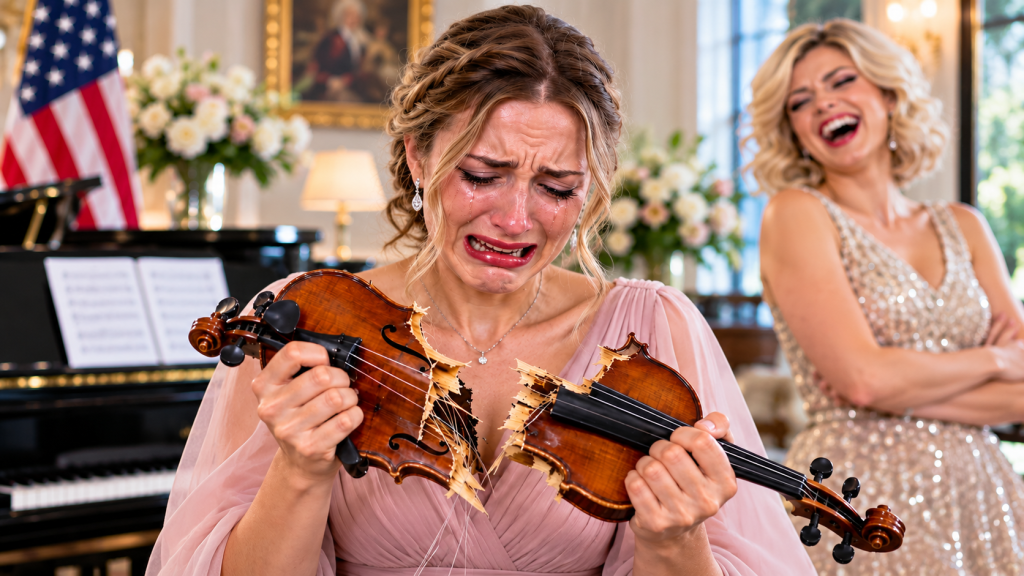
She slammed the violin against the edge of the dressing table.
The sound was small.
Much smaller than something that devastating should have sounded.
A sharp wooden crack.
Then silence.
The violin slipped from her hand and hit the floor.
The neck had fractured.
Part of the upper bout was split.
The bridge had collapsed.
One string had snapped and curled across the wood.
For several seconds, I couldn’t breathe.
Vanessa stared down.
I stared down.
The room seemed to tilt.
That violin had belonged to my grandfather.
He had started teaching me when I was four years old.
My earliest memory of music wasn’t a concert hall.
It was sitting on his knee in his tiny study while he tapped rhythms against my wrist.
He used to tell me that the violin punished force and rewarded patience.
“Never try to conquer the instrument,” he would say.
“You listen to it first.”
He taught me scales before I understood why scales mattered.
He sat beside me through squeaks, tears, blisters, competitions, failures, auditions, and endless rehearsals.
When I was thirteen and wanted to quit, he drove me two hours to hear a great violinist perform Sibelius.
I cried through the final movement.
Grandpa had smiled beside me.
“One day,” he whispered, “you’ll understand why that piece found you.”
He died six years later.
Cancer.
He left me the violin in his will.
The instrument had been made in the nineteenth century by a respected Italian maker.
Its monetary value was close to eighty thousand dollars.
But I would have rejected ten times that amount before giving it away.
It was the last physical thing I had that still felt like him.
And now it lay broken on the floor.
Vanessa looked at me.
For a moment, I thought she might apologize.
Instead, she shrugged.
“Maybe now you’ll stop acting like everything you own is sacred.”
My eyes filled.
But I refused to cry in front of her.
“Get out.”
She picked up the emerald dress.
“You’re not going to need this now.”
I looked at her.
She draped it over her arm.
“The performance is obviously canceled.”
“You think so?”
She laughed.
“With what violin are you planning to play?”
The door opened.
Mom stood there.
Her expression changed when she saw the damaged instrument.
“Oh my God.”
I looked at her.
For one tiny second, I hoped this would finally be the moment.
The moment when she would look at Vanessa and say enough.
The moment when she would recognize that her younger daughter had crossed a line no apology could erase.
Mom stepped inside.
“Vanessa, what happened?”
Vanessa sighed.
“Claire was being impossible.”
I almost laughed.
Mom looked at me.
“Claire?”
“She broke Grandpa’s violin.”
“I know what I’m looking at.”
“It’s worth nearly eighty thousand dollars.”
Vanessa scoffed.
“That old thing?”
Mom rubbed her forehead.
“Please. Both of you. Not tonight.”
I stared at her.
“Not tonight?”
“This is an important evening.”
“Yes, Mom. I’m aware.”
“I don’t want this turning into a family disaster.”
I looked at the broken violin.
Then at Vanessa.
Then at the dress in her hands.
“She deliberately destroyed something Grandpa left me.”
Vanessa rolled her eyes.
“I damaged it.”
“You broke it.”
“Whatever.”
Mom exhaled.
“Claire, we can deal with the violin tomorrow.”
I nearly smiled.
There it was.
Tomorrow.
The magical place where every consequence for Vanessa went to die.
Tomorrow we’ll talk.
Tomorrow she’ll apologize.
Tomorrow we’ll work something out.
Tomorrow never came.
My phone buzzed.
I looked down.
Maestro Adrian Cole.
Five minutes. Ready?
Vanessa noticed.
“You should probably tell him what happened.”
I didn’t answer.
Instead, I knelt beside the violin.
Carefully, I lifted every visible damaged piece.
My hands shook.
I wrapped the instrument in the soft cloth from the case and placed it inside.
The sight of it hurt.
I closed the lid.
Then I stood.
Mom frowned.
“Where are you going?”
“To the stage.”
Vanessa laughed.
“With what violin?”
I looked at her.
And for the first time since she walked into the room, I smiled.
“With one you’ve never seen.”
Her expression changed.
Only slightly.
But I saw it.
Confusion.
Two years earlier, I had traveled to Vienna for an international chamber competition.
I hadn’t expected to win.
I nearly didn’t enter.
My grandfather’s death had shaken my confidence badly, and for a while, playing had felt like reopening a wound every day.
But Maestro Cole convinced me.
I played Bartók in the semifinal.
Brahms in the final.
When they announced my name as the winner, I stood there under the lights completely numb.
That night changed my life.
One of the judges introduced me to Eleanor Hayes.
Eleanor was a major patron of classical music, chairwoman of several arts foundations, and one of those people who seemed able to walk into any room and immediately know who was pretending.
She didn’t flatter me.
She asked questions.
Why did I play?
What did I want to do with music?
What frightened me?
What did I think young musicians needed most?
Three months later, she offered to sponsor part of my training.
The sponsorship eventually expanded.
Coaching.
Travel.
Competition fees.
Recording opportunities.
And, on major occasions, access to historical instruments held by the Hayes Foundation.
That evening, the foundation had arranged for me to perform on a 1718 Stradivarius.
Estimated value:
Just under nine million dollars.
It was already inside the building.
Locked in a climate-controlled security room.
Waiting.
I had planned to play the first half of the evening on my grandfather’s violin and use the Stradivarius for the featured concerto.
I had wanted Grandpa’s instrument with me before stepping into the most important performance of my career.
Vanessa had destroyed that possibility.
But she hadn’t destroyed the performance.
She stared at me.
“You have another violin?”
“Yes.”
“What kind?”
“That doesn’t matter.”
She looked uncertain.
Mom looked relieved.
“Oh, thank goodness.”
I picked up the broken violin case.
Then I looked at the dress.
“Keep it.”
Vanessa’s confidence returned instantly.
“Seriously?”
“Yes.”
She smiled.
“I knew you’d stop being dramatic.”
I said nothing.
That was the other thing Vanessa never understood.
Silence didn’t mean surrender.
Sometimes silence meant someone had finally decided not to protect you from yourself.
I walked out.
Ten minutes later, I was standing in the secure backstage room while Eleanor watched a technician inspect the Stradivarius.
She was sixty-eight, silver-haired, elegant, and terrifying when disappointed.
Her eyes moved to the case I was carrying.
“What happened?”
“An accident.”
She looked directly at me.
I had never been good at lying to Eleanor.
She held out her hand.
“May I?”
I placed the case on the table.
She opened it.
The room went quiet.
The technician inhaled sharply.
Eleanor stared.
“Was that your grandfather’s?”
“Yes.”
She knew what the instrument meant to me.
Her expression hardened.
“Who did this?”
I looked away.
“It doesn’t matter right now.”
“It matters.”
“I have to perform.”
She studied me.
Then she closed the case.
“Fine.”
Her voice became softer.
“After.”
The Stradivarius was placed in my hands.
Every time I held it, I felt slightly terrified.
Three centuries of history seemed to live inside the wood.
I drew the bow across the open A string.
The sound filled the room effortlessly.
Warm.
Focused.
Alive.
For a few moments, nothing else existed.
Not Vanessa.
Not the dress.
Not the broken violin.
Only sound.
Then footsteps thundered down the hallway.
The door opened.
Vanessa rushed in.
She was wearing the emerald gown.
Her face was pale.
Really pale.
Not irritated.
Not offended.
Terrified.
“Claire.”
I lowered the bow.
She hurried forward.
“Please.”
Eleanor’s eyes narrowed.
She recognized the dress immediately.
I said nothing.
Vanessa looked between us.
“You have to help me.”
“What happened?”
“You know what happened.”
“No. I don’t.”
She lowered her voice.
“Security thinks I stole the dress.”
Eleanor folded her arms.
Interesting.
Vanessa finally seemed to notice who she was standing beside.
Her expression became even worse.
Ten minutes earlier, Eleanor had walked into the donor reception and seen Vanessa wearing the emerald gown.
The dress had not actually been mine.
Not completely.
It had been commissioned by designer Luca Moretti for the Hayes Foundation.
The piece was part of a philanthropic collaboration between the designer and the foundation.
It was insured for close to sixty thousand dollars.
After my performance, Eleanor was supposed to announce that I had been chosen as the foundation’s newest international youth arts ambassador.
I would wear the gown during the announcement and photography session.
The dress would then be auctioned several months later to raise money for music education programs.
Only three people knew about the arrangement.
Me.
Eleanor.
And Luca.
Vanessa knew none of this.
She had simply seen a beautiful gown in my dressing room and decided she deserved it more.
Worse, when she entered the reception, several donors complimented her.
Vanessa, being Vanessa, had apparently claimed the gown was hers.
One donor recognized Luca’s signature work.
Then Luca himself walked into the room.
He had immediately asked where she got it.
Vanessa told him she bought it privately.
That had created a problem.
A very large problem.
Luca knew exactly where the gown belonged.
Security was contacted.
Then someone noticed that the garment tag had been removed.
Vanessa had cut it off.
She had also apparently spilled champagne near the lower hem.
Not much.
But enough.
She stepped closer to me.
“Tell them you gave it to me.”
I stared at her.
“You took it.”
“You said keep it.”
“After you were already holding it.”
“That still counts.”
Eleanor’s voice cut through the room.
“No, it doesn’t.”
Vanessa looked at her.
“You don’t understand.”
“Oh, I understand perfectly.”
“Who are you?”
I almost closed my eyes.
Vanessa genuinely had no idea.
Eleanor extended one hand.
“Eleanor Hayes.”
Vanessa froze.
She knew the name.
Everyone in the donor reception knew the name.
Her eyes widened.
Eleanor continued.
“That dress was commissioned on behalf of my foundation.”
Vanessa looked at me.
“You never told me.”
“I told you not to take it.”
“But you said it was yours.”
“No. You assumed.”
Her breathing became shallow.
“Security wants to call the police.”
I remained calm.
“Then explain what happened.”
“I can’t.”
“Why?”
“You know why.”
“No. Say it.”
Her jaw tightened.
“Claire.”
“Say it.”
She looked toward Eleanor.
“I was upset.”
“About?”
“The dress.”
“And?”
Silence.
I waited.
Finally, she whispered, “I broke her violin.”
Eleanor’s face became unreadable.
Vanessa continued quickly.
“It was an accident.”
“No, it wasn’t,” I said.
She glared at me.
“You made me angry.”
“There it is.”
“What?”
“You still think I made you do it.”
“Because you always push people!”
I laughed softly.
“You asked for my dress. I said no. You broke my violin.”
“Because you were being selfish.”
Eleanor looked at her.
“Do you know which violin you broke?”
Vanessa crossed her arms.
“An old family instrument.”
I stared at her.
She didn’t even know.
She had never asked.
“It belonged to Grandpa.”
“I know that.”
“He learned on it.”
She stopped.
“He what?”
“Our great-grandfather bought it before Grandpa was born. Grandpa learned on it. He taught Dad a little on it. He taught me on it. It has been in the family for three generations.”
Vanessa’s expression changed.
Only slightly.
“You never told me that.”
“I did.”
“When?”
“More than once.”
She looked away.
The truth was obvious.
She hadn’t remembered because it had never mattered to her.
A stage manager appeared at the door.
“Claire, places.”
My stomach tightened.
This was it.
Eleanor touched my shoulder.
“Go.”
Vanessa stepped in front of me.
“Wait.”
I looked at her.
“Tell security it’s fine.”
“I have to perform.”
“Claire.”
“Move.”
Her eyes filled with panic.
“Please.”
That word sounded strange coming from Vanessa.
She almost never said please.
“After my performance.”
“What if they call the police before then?”
I looked at her.
“Then maybe for once you’ll have to handle what happens after you do something.”
Her face crumpled.
I walked past her.
The stage lights were brighter than I remembered.
As I stepped onto the platform, applause rose from the hall.
Hundreds of faces disappeared beyond the glare.
Maestro Cole stood at the podium.
He looked at the Stradivarius.
Then at me.
His expression softened.
He knew something had happened.
He didn’t ask.
Musicians rarely need words in moments like that.
I sat for the first section, then stood when it was time for the concerto.
Sibelius.
The piece Grandpa had taken me to hear when I was thirteen.
The piece he said would find me someday.
My bow touched the strings.
The orchestra began.
The first notes felt fragile.
Then the music took over.
Everything I had been holding inside me went into the violin.
Every ignored apology.
Every time Mom told me to keep the peace.
Every birthday Vanessa hijacked.
Every possession I was forced to share.
Every boundary that had been treated like an insult.
Every hour Grandpa sat beside me.
Every correction.
Every laugh.
Every cup of tea cooling beside his chair while I practiced.
Every moment I wished he were still alive.
The Stradivarius responded to all of it.
The third movement arrived like fire.
I stopped thinking.
Stopped worrying.
Stopped being afraid.
There was only the bow.
The orchestra.
The pulse.
The terrifying, beautiful rush of sound.
And when the final note ended, the hall became silent.
One second.
Two.
Then the audience stood.
The applause hit me like a wave.
I looked toward the wings.
Eleanor was standing there.
So was Mom.
And behind them, Vanessa.
Still wearing the emerald dress.
Two security officers stood beside her.
She wasn’t smiling anymore.
I bowed.
For the first time all night, I cried.
Not because Vanessa had hurt me.
Because she hadn’t stopped me.
Nothing she did had stopped me.
After the performance, the orchestra cleared the stage for the foundation presentation.
I went backstage.
Mom rushed toward me.
“Oh, Claire.”
She hugged me tightly.
“You were incredible.”
“Thank you.”
She pulled away.
Then her expression changed.
“We need to talk about Vanessa.”
Of course.
Not about the performance.
Not about Grandpa.
Not about the broken violin.
Vanessa.
I looked past her.
My sister stood twenty feet away.
Eleanor was speaking to security.
Luca Moretti stood beside them.
He looked furious.
Mom lowered her voice.
“Can you please tell them she didn’t steal the dress?”
“She took it without permission.”
“She thought it belonged to you.”
“That wouldn’t make it okay.”
“I know, but she’s your sister.”
There it was again.
The phrase that had protected Vanessa her entire life.
She’s your sister.
As if biology were a debt I could never finish paying.
I looked at Mom.
“She broke Grandpa’s violin.”
“We will deal with that.”
“When?”
“Tomorrow.”
I laughed.
Mom frowned.
“What?”
“You’ve been saying tomorrow for twenty years.”
“That isn’t fair.”
“It’s exactly fair.”
She looked wounded.
I continued.
“When she ruined my tenth birthday cake because I got more presents, tomorrow. When she stole money from my college savings jar, tomorrow. When she crashed my car after taking it without asking, tomorrow. When she told everyone at Grandma’s funeral that I was only crying for attention, tomorrow.”
Mom looked away.
“She was young.”
“She’s thirty.”
“I know.”
“She broke an eighty-thousand-dollar family instrument because I wouldn’t give her a dress.”
Mom’s eyes filled.
“I don’t want her arrested.”
“Neither do I.”
She looked relieved.
“But I’m not lying for her.”
The relief disappeared.
Eleanor approached.
“Claire.”
“Yes?”
“We need to begin the announcement soon.”
I nodded.
Then Luca stepped forward.
He examined the dress.
There was a small champagne stain near the hem.
He closed his eyes.
Vanessa whispered, “I’m sorry.”
Luca stared at her.
“You cut the identification tag.”
“It was scratching me.”
He looked stunned.
“You cut the authentication tag from a couture garment?”
“I didn’t know.”
“That appears to be a recurring theme.”
Vanessa’s face reddened.
Eleanor almost smiled.
I did not.
A security officer turned to Eleanor.
“Would you like us to contact law enforcement?”
Vanessa looked at me.
Mom looked at me.
Everyone looked at me.
But it wasn’t entirely my decision.
The dress belonged to the foundation.
Eleanor folded her hands.
“Claire?”
I understood what she was asking.
Not whether Vanessa deserved consequences.
Whether I wanted this moment to become something else.
I looked at my sister.
For the first time, she seemed small.
Not innocent.
Not helpless.
Just frightened.
I thought about Grandpa.
He believed in consequences.
But he didn’t believe in humiliation.
He once told me that revenge was usually an attempt to make someone feel as small as they had made you feel.
“That doesn’t heal anything,” he had said.
So I looked at Eleanor.
“No police.”
Vanessa exhaled.
Mom nearly collapsed with relief.
I held up one hand.
“But I’m not covering the damage.”
Vanessa stared at me.
“What?”
“The dress needs professional restoration.”
Luca nodded.
“And the violin needs evaluation.”
Her face changed again.
“You want me to pay?”
“Yes.”
“I don’t have eighty thousand dollars.”
“You shouldn’t have broken something worth eighty thousand dollars.”
Mom stepped forward.
“Claire.”
“No.”
My voice was quiet.
But something in it stopped her.
“I am finished paying for Vanessa’s choices.”
No one spoke.
I looked at my sister.
“You will pay for whatever restoration is possible. You will also pay for the dress damage. If you can’t pay at once, you’ll make payments.”
“That could take years.”
“Yes.”
“That’s insane.”
“So was breaking the violin.”
She looked at Mom.
“Say something.”
Mom opened her mouth.
Then closed it.
For once, she didn’t rescue her.
Vanessa stared at her.
“Mom?”
Mom looked exhausted.
“Claire is right.”
I almost didn’t believe what I heard.
Vanessa laughed bitterly.
“Of course. Suddenly everyone’s against me.”
“No,” Mom said quietly. “I think maybe I’ve been too afraid of you being upset.”
Vanessa went still.
Mom continued.
“Every time you did something wrong, I tried to smooth it over. I thought I was keeping the family together.”
“You’re choosing her.”
“No.”
Mom’s voice broke.
“I’m finally refusing to choose between you by pretending one of you never gets hurt.”
Vanessa’s eyes filled.
“This is unbelievable.”
She turned toward the door.
Eleanor stopped her.
“The gown.”
Vanessa froze.
She looked down.
“Oh.”
Luca gestured toward the dressing area.
“You’ll change before leaving.”
Vanessa disappeared into the room.
Ten minutes later, she came out wearing the dress she had originally brought.
The emerald gown was placed carefully inside a protective garment bag.
She wouldn’t look at me.
Eleanor leaned close.
“Are you ready?”
“For what?”
She smiled.
“The second reason you’re here.”
I had almost forgotten.
The stage manager called my name.
I walked back under the lights.
Eleanor joined me.
The applause rose again.
She took the microphone.
“Tonight, we heard an extraordinary young musician.”
My heart pounded.
She spoke about music education.
About the importance of giving talented students access to instruments, teachers, and opportunities.
Then she announced the new Hayes Foundation International Arts Ambassador program.
My name appeared on the screen behind us.
The applause grew louder.
I looked into the audience.
Several conservatory representatives were standing.
So were donors.
Photographers gathered near the stage.
Eleanor continued.
“As our inaugural ambassador, Claire Morgan will spend the next two years performing internationally while helping establish a scholarship fund for young musicians who cannot afford advanced training.”
I swallowed.
That part still felt unreal.
Then Eleanor said something that had not been in the rehearsal.
“And tonight, Claire has reminded us that great musicians are not defined by the instrument in their hands, but by what they carry within them.”
I looked at her.
She knew.
She had changed the speech.
Applause filled the room again.
I thought of Grandpa.
And this time, when the tears came, I let them.
After the ceremony, I spent nearly an hour speaking with donors and musicians.
Luca arranged to take the emerald gown back to his studio.
He told me the champagne stain would likely come out.
The removed tag could be replaced.
“No permanent disaster,” he said.
I smiled.
“I’m glad.”
Then his expression softened.
“I’m sorry about your violin.”
“Thank you.”
Eleanor had already contacted one of the best restoration specialists in the country.
He agreed to inspect it the next morning.
I knew restoration might be possible.
But I also knew it would never be exactly as it had been.
Some damage becomes part of an object forever.
Maybe people were like that too.
At nearly midnight, I returned to my dressing room.
Mom was waiting.
Vanessa wasn’t.
“She left.”
“I figured.”
Mom sat down.
For once, she looked older than I remembered.
“I owe you an apology.”
I didn’t answer.
She stared at her hands.
“I thought keeping peace meant stopping arguments.”
“It usually meant stopping me from reacting.”
“I know.”
Her voice was barely above a whisper.
“When you were children, Vanessa was so difficult when she didn’t get what she wanted. You were easier.”
I laughed sadly.
“So I got punished for being easier.”
Mom closed her eyes.
“Yes.”
The word surprised me.
No excuse.
No explanation.
Just yes.
She looked at me.
“I taught her that your boundaries didn’t matter because I kept asking you to move them.”
I swallowed.
“That’s exactly what happened.”
“I’m sorry.”
I wanted the apology to fix something.
It didn’t.
But it mattered.
Sometimes healing doesn’t begin with forgiveness.
Sometimes it begins when someone finally names the injury correctly.
Mom asked quietly, “Can I see the violin?”
I opened the case.
She covered her mouth.
Tears filled her eyes.
“Your grandfather would be furious.”
I smiled faintly.
“At Vanessa?”
“At all of us.”
That made me laugh.
Grandpa hated family drama.
But he hated dishonesty more.
Mom touched the edge of the case.
“I’m going to help with the restoration.”
“No.”
“Claire—”
“Vanessa needs to pay.”
“She may not be able to.”
“Then she’ll figure it out.”
Mom nodded slowly.
“You’re right.”
Two words I had waited years to hear.
The next morning, the violin was delivered to a master restorer.
He examined it for almost an hour.
I sat across from him, terrified to ask.
Finally, he looked up.
“It can be repaired.”
I nearly cried.
“It won’t be invisible,” he said.
“I don’t care.”
“The fracture will always be part of the instrument.”
“That’s okay.”
He smiled.
“Good answer.”
The restoration would cost a little over twelve thousand dollars.
Far less than replacing the instrument.
Far more than Vanessa had in savings.
When Mom told her the amount, Vanessa called me immediately.
“You expect me to pay twelve thousand dollars?”
“Yes.”
“That’s almost half my savings.”
“You broke it.”
“I said I was sorry.”
“No. You said you were sorry after security became involved.”
Silence.
Then she said, “You really hate me.”
“I don’t hate you.”
“Then why are you doing this?”
“Because you broke something and you’re responsible for repairing it.”
“That’s not how family works.”
I closed my eyes.
“That is exactly how family should work.”
She hung up.
For three weeks, we didn’t speak.
Then a payment arrived.
Two thousand dollars.
No message.
A month later, another payment arrived.
Then another.
Mom told me Vanessa had canceled a vacation.
She sold two designer handbags.
She picked up extra freelance work.
For the first time in her life, no one stepped in to erase the cost of what she had done.
I expected to feel satisfied.
Instead, I mostly felt sad.
Six months later, my grandfather’s violin came home.
The repair line was visible if you knew where to look.
The wood had been stabilized.
The neck restored.
The sound had changed slightly.
Not worse.
Just different.
The first time I played it again, I cried.
I played the piece Grandpa taught me when I was seven.
A simple Bach minuet.
Halfway through, someone knocked on my apartment door.
Vanessa.
I almost didn’t open it.
But I did.
She stood there holding a small envelope.
“What are you doing here?”
She looked nervous.
“I have the rest.”
She handed me the envelope.
Inside was a cashier’s check.
The final balance.
I stared at it.
“You didn’t have to bring this personally.”
“I know.”
She looked past me.
“Is that the violin?”
“Yes.”
“Can I see it?”
I hesitated.
Then I opened the door wider.
She stepped inside.
The instrument rested on the table.
For a long time, Vanessa simply looked at it.
Then she whispered, “I really did that.”
“Yes.”
Her eyes filled.
“I don’t know what was wrong with me.”
I leaned against the chair.
“You were angry because someone told you no.”
She nodded.
“I keep thinking about that night.”
“So do I.”
“I thought you were trying to embarrass me.”
“I wasn’t.”
“I know.”
She wiped her cheek.
“I think I always believed everyone else was doing something to me when they didn’t give me what I wanted.”
I didn’t answer.
She continued.
“Mom told me she apologized to you.”
“She did.”
“She apologized to me too.”
“For what?”
“For never making me deal with anything.”
That surprised me.
Vanessa laughed bitterly.
“I was furious at first.”
“I’m sure.”
“She told me she thought protecting me was love.”
I looked at her.
“And what do you think?”
She stared at the violin.
“I think she protected me so much I became someone who thought consequences were cruelty.”
That was the first truly self-aware thing I had heard Vanessa say in years.
Maybe ever.
She reached toward the violin.
Then stopped.
“Can I?”
I nodded.
She touched the repaired section gently.
“I’m sorry.”
This time, the apology sounded different.
No panic.
No audience.
No security.
No Mom standing nearby.
Just us.
“I know I can’t undo it.”
“No.”
“I know paying for it doesn’t fix everything.”
“No.”
She looked at me.
“I’m still sorry.”
I believed her.
That didn’t mean everything became normal.
I didn’t suddenly trust her.
We didn’t hug and erase years of resentment.
Real life rarely works that way.
But something changed.
Boundaries became real.
Mom stopped calling me whenever Vanessa was upset.
Vanessa stopped assuming my possessions were hers.
When she asked to borrow something and I said no, she accepted it.
Sometimes awkwardly.
Sometimes with visible effort.
But she accepted it.
A year later, I performed Sibelius again.
This time, it was in Vienna.
The same city where my career had changed.
The Hayes Foundation had expanded the scholarship program to twelve students.
Two of them traveled with us.
One was a seventeen-year-old violinist from a family who could never have afforded advanced training.
Before the performance, she asked why I kept two violin cases backstage.
I smiled.
“One is very valuable.”
She pointed toward the Stradivarius case.
“That one?”
“Yes.”
Then she pointed toward Grandpa’s repaired violin.
“And that one?”
I looked at it.
“That one is priceless.”
After the concert, I walked into the reception wearing another Luca Moretti gown.
This one was deep blue.
As I entered, I saw Mom near the entrance.
And beside her stood Vanessa.
She had asked permission before coming.
That still amused me.
When she saw me, she smiled.
“You were amazing.”
“Thank you.”
Then she looked at the dress.
“Beautiful.”
I raised one eyebrow.
“Don’t even think about it.”
She laughed.
“I brought my own.”
That small joke carried years inside it.
Later that evening, Vanessa and I stood on a balcony overlooking Vienna.
She held a glass of sparkling water.
I leaned against the railing.
“Do you remember when Grandpa brought us here?”
I looked at her.
“What?”
She smiled.
“We were kids. He took us to that tiny music shop near the cathedral.”
I had forgotten.
Vanessa continued.
“You spent two hours staring at violins. I kept complaining because I wanted ice cream.”
“That sounds accurate.”
She laughed.
Then her expression softened.
“I wish I’d understood him better.”
“You were young.”
“So were you.”
“Yes.”
She looked at me.
“But you listened.”
I smiled.
“He was hard to ignore.”
We stood quietly.
Then Vanessa said, “Do you think he’d forgive me?”
I thought about it.
Grandpa wasn’t sentimental about forgiveness.
He believed forgiveness without change was just permission.
But he also believed people shouldn’t be trapped forever inside their worst moment.
“Yes,” I said.
“If you really learned from it.”
She nodded.
“I’m trying.”
“I know.”
That was as much forgiveness as I could give then.
And it was enough.
Years later, people still asked about the famous performance where I played the 1718 Stradivarius.
Critics wrote about the final movement.
Conservatories mentioned it when inviting me to masterclasses.
Recordings circulated online.
People talked about the instrument.
The dress.
The foundation announcement.
But that wasn’t what I remembered most.
I remembered the sound of my grandfather’s violin breaking.
For years, I thought that sound represented loss.
Eventually, I understood something else.
That night broke more than an instrument.
It broke a family pattern.
It broke the rule that Vanessa could hurt people and someone else would clean up the consequences.
It broke Mom’s belief that keeping peace meant silencing the person who had been wronged.
And it broke my habit of surrendering boundaries simply because enforcing them made someone else uncomfortable.
The violin was repaired.
So was the dress.
Our family took longer.
Maybe families always do.
Some things could never return to exactly what they had been.
There were scars.
Visible ones.
But scars weren’t always evidence of failure.
Sometimes they were proof that something survived.
Years after Grandpa’s violin was restored, I performed a small private recital for the scholarship students.
No famous critics.
No cameras.
No couture dress.
No nine-million-dollar violin.
Just a room full of young musicians.
I played Grandpa’s violin.
Afterward, one of the students approached me.
She pointed to the faint repair line.
“What happened there?”
I smiled.
“It was broken once.”
Her eyes widened.
“Completely?”
“Pretty badly.”
“And they fixed it?”
“Yes.”
She looked fascinated.
“Does it sound the same?”
I thought about the question.
Then I lifted the violin.
“No.”
She looked disappointed.
I smiled.
“It sounds like something that survived.”
She smiled back.
That night, after everyone left, I stayed alone in the recital room.
I placed the violin beneath my chin.
Then I played the opening phrase Grandpa had taught me decades earlier.
The wood vibrated beneath my fingers.
Different.
Familiar.
Alive.
And for a moment, I could almost hear his voice.
Listen first.
Don’t force it.
Let the instrument tell you what it needs.
I closed my eyes.
Maybe Grandpa hadn’t only been talking about music.
Maybe he had been teaching me something I would need long after he was gone.
You cannot force people to respect you.
You cannot force family members to change.
You cannot force an apology to be sincere.
But you can decide what you will accept.
You can decide what you will protect.
And sometimes, the moment someone tries hardest to break you becomes the moment you finally understand that they never had that power in the first place.
Vanessa thought breaking my violin would end the most important performance of my life.
Instead, I walked onto that stage anyway.
I played.
I succeeded.
And for the first time in our lives, she was the one who had to face what happened afterward.
The emerald dress was never the real issue.
Neither was the Stradivarius.
Neither was the money.
The real issue was one word.
No.
A word Vanessa had never learned to hear.
And a word I had finally learned I didn’t need to apologize for saying.
That single boundary changed everything.
Years later, when Vanessa asks before borrowing something, I sometimes smile.
She knows why.
Sometimes she smiles too.
We never became the kind of sisters who talked every day.
We became something more honest.
Two adults who understood that love without boundaries becomes resentment.
And boundaries without consequences become suggestions.
Mom changed too.
She stopped treating conflict like catastrophe.
She stopped asking me to sacrifice peace so everyone else could feel comfortable.
And whenever our family disagreed, she no longer said the sentence I had hated since childhood.
“Claire, just let it go.”
Instead, she learned to ask something different.
“What actually happened?”
It was a small change.
But small changes can rewrite entire families.
As for Grandpa’s violin, I still have it.
I still perform with it.
Not always.
But often enough.
The repair line remains visible.
I could have asked the restorer to disguise it further.
I chose not to.
I like seeing it.
It reminds me of the night everything cracked.
And everything finally began to heal.
💬THE END! THANK YOU FOR READING!