

The day before my wedding, I visited my future mother-in-law for what was supposed to be a quick stop.
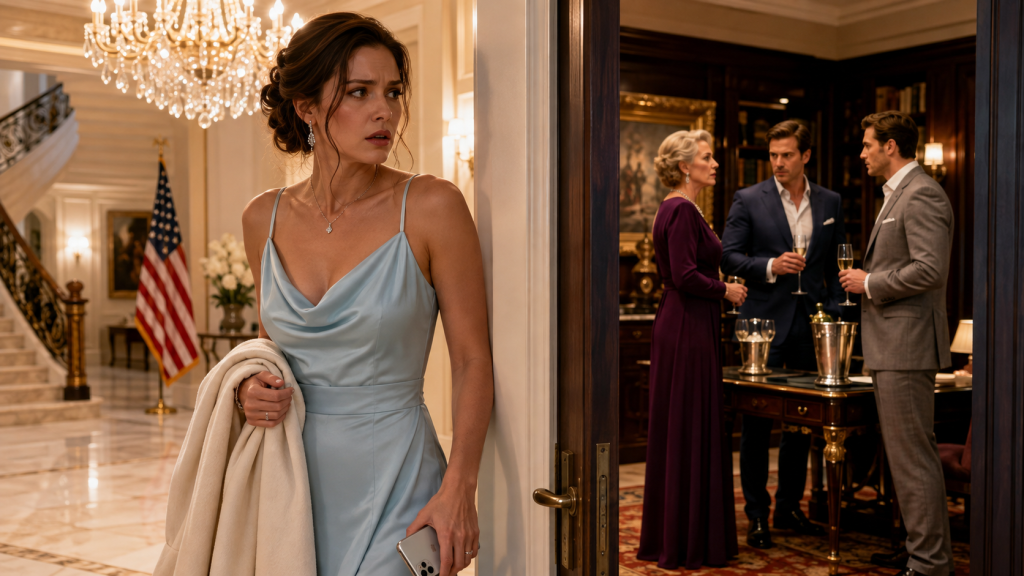
I had already reached the front door when I realized I had forgotten my coat. But when I walked back inside and discovered what was really happening, everything changed.
In that moment, I made one decision without hesitation.
The wedding was over.
The night before the ceremony, I had stopped by Vivian Blackwell’s estate for a small family celebration. She welcomed me with champagne beneath crystal chandeliers she proudly claimed had been imported from Venice.
Everything looked polished and perfect until she casually asked whether I had signed the revised prenuptial agreement.
“I’ll review it tonight,” I said.
Her smile faded slightly.
“Adrian said you had already agreed.”
“I agreed to consider it.”
Vivian held my gaze over the rim of her champagne glass.
“Marriage requires trust.”
“So does paperwork.”
The conversation ended, but something about her reaction stayed with me as I walked toward my car. Halfway down the long driveway, a cold gust reminded me that I had left my coat inside.
I turned back, expecting to grab it and leave.
Instead, that forgotten coat became the reason I was still alive.
The front door had not fully latched, so I stepped inside quietly. As I approached the hallway beside the library, I heard voices coming from Vivian’s study.
The door was slightly open.
Then I heard her speak in a tone I had never heard before.
“She’s suspicious.”
A familiar laugh answered.
Adrian.
“Emily thinks being a corporate attorney makes her brilliant,” he said. “Once we’re married, she’ll relax.”
Vivian sounded uneasy.
“And if she refuses to transfer the company shares?”
“She won’t. I’ll keep playing the devoted husband until she signs. After that, the lake house accident solves everything.”
For one second, I thought I had misunderstood.
Then another voice joined the conversation.
Lucas Grant.
Our wedding planner.
Adrian’s closest friend.
“The boat has already been serviced,” Lucas said. “The fuel line will fail far enough from shore. Everyone knows Emily can’t swim.”
Vivian laughed softly.
“Tragic widowhood will suit my son.”
Every word felt unreal, yet every sentence fit together perfectly.
They were not joking.
They were planning my death as calmly as if they were finalizing the wedding seating chart.
I slipped my phone from my purse and activated the voice recorder. My hand trembled once and then went steady.
Fear disappeared.
Focus took its place.
Then Adrian said the sentence that killed the last piece of love I still had for him.
“Her father built that medical software empire, but Emily controls it now. Tomorrow I marry two hundred million dollars. By autumn, I bury her.”
The man I had loved for three years was not marrying me for love.
He wanted my company, my inheritance, and everything my father had built.
My death was not merely a possibility in their plan.
It was the final step.
I took my coat from the hallway without making a sound. When I reached my car, I locked the doors and sat with both hands gripping the steering wheel until my breathing slowed.
Every instinct told me to call the police and run.
Instead, I began thinking like the prosecutor I had once been.
Recordings alone rarely destroy conspiracies. Strong cases require layers: evidence, witnesses, timing, and suspects arrogant enough to keep talking.
They thought I was simply a wealthy bride who practiced corporate law.
They had no idea I had quietly purchased the security company that maintained Vivian’s estate three months earlier after noticing irregularities in its surveillance contract.
They had never read the updated monitoring agreements they signed during the system upgrade.
Every word spoken in that study had already been recorded by the estate’s own security network.
My phone recording was only the backup.
My father had taught me that powerful people rarely destroy themselves with one mistake.
They destroy themselves by believing no one is watching.
I picked up my phone and made the first call.
“Daniel,” I said quietly.
My head of corporate security answered immediately.
“Everything all right?”
“No.”
He heard my voice and stopped asking unnecessary questions.
“What happened?”
“There won’t be a wedding tomorrow.”
A brief silence followed.
Then he asked, “Do you want me to activate the contingency plan?”
“Yes.”
“What level?”
“The highest one.”
“I’ll have the team moving within ten minutes.”
When the call ended, I looked back at the glowing estate.
Inside, they were probably raising another glass, convinced I was going home to prepare for the ceremony.
They did not know the wedding was already over.
They simply had not been told yet.
By midnight, Daniel had secured copies of the estate recordings, the revised prenuptial agreement, and every access log connected to Vivian’s security system. I drove to an unmarked office downtown, where two detectives and a federal financial crimes investigator were waiting.
Detective Claire Harris sat across from me while the recording played.
Nobody interrupted.
Adrian’s voice filled the room, cold and detached, describing my death as though it were a routine business transaction.
When the recording ended, Harris leaned forward.
“We need them to believe tomorrow is proceeding exactly as planned.”
I understood immediately.
Canceling the ceremony would make them run. Allowing them to arrive would bring every conspirator into one controlled location.
The federal investigator, Naomi Chen, opened the revised prenuptial agreement on her laptop.
“This isn’t a normal prenup,” she said. “Buried inside the attached financial disclosures is a conditional voting proxy. Once you marry Adrian, he receives authority to vote your company shares if you are declared medically incapacitated.”
“Declared by whom?”
Chen turned the screen toward me.
“A physician selected by your spouse.”
My stomach tightened.
“And if I die?”
“Your shares move into a marital trust. Adrian becomes the sole trustee.”
Daniel placed a second document beside the laptop.
“They prepared the trust already. The signature page has your name on it.”
I looked down.
The signature resembled mine, but the final curve was wrong. My father had taught me to sign important documents with a tiny break between the first and last name. It was almost invisible unless someone knew to look for it.
The forged signature had no break.
“They weren’t waiting for me to sign,” I said.
“No,” Chen replied. “The wedding was enough. They planned to substitute the forged documents afterward.”
Detective Harris folded her arms.
“We can arrest them now on conspiracy charges, but the defense will claim it was a tasteless hypothetical conversation. If they take additional steps tomorrow, particularly regarding the forged transfer documents, the case becomes much stronger.”
“You want the wedding to continue.”
“We want the operation to continue,” she corrected. “You can stop at any point.”
I thought of Adrian standing at the lake house, waiting for a boat to drift far enough from shore.
I thought of Vivian selecting flowers for my funeral.
Then I thought of my father.
He had spent thirty-four years building Meditron Systems from a rented office above a pharmacy. His software helped hospitals detect medication errors before they reached patients. When he died, he left me controlling ownership because he trusted me to protect the company from people who valued profit more than human lives.
Adrian had mistaken that responsibility for weakness.
“I’ll walk down the aisle,” I said.
At eight the next morning, I put on my wedding dress.
My makeup artist noticed how still I was.
“Are you nervous?” she asked.
“Not anymore.”
She smiled, misunderstanding me.
Outside the bridal suite, officers disguised as catering staff moved through the hotel chapel. Daniel’s security team monitored every entrance. Detective Harris wore a floral dress and sat among the guests. Naomi Chen waited in a surveillance van beneath the parking garage.
Nobody knew whether Adrian had additional accomplices.
That uncertainty frightened me more than the ceremony itself.
At ten thirty, Daniel entered the suite carrying a small velvet case.
“Your microphone,” he said.
Inside was a pearl brooch that matched the earrings my father had given me on my thirtieth birthday.
Daniel fastened it to my dress.
“The transmitter is active. Harris will hear everything.”
“What did you find about the company insider?”
His expression darkened.
“We traced Lucas’s calls. He has spoken eighteen times this month with someone using an encrypted number registered through a shell company.”
“Do you know who?”
“Not yet. But the number connected to Meditron’s private network twice yesterday.”
Someone inside my own company had been feeding them information.
Before I could ask another question, my maid of honor, Sarah, knocked on the door.
“It’s time.”
Sarah had been my closest friend since law school. She knew nothing about the operation. The police had insisted that we keep the circle small, both for security and to preserve natural reactions.
When she saw me, tears filled her eyes.
“Your father would be so proud.”
The words almost broke me.
I took her hand.
“Whatever happens in there, stay close to the exit.”
Her smile vanished.
“What does that mean?”
“Please trust me.”
Before she could respond, the chapel doors opened.
Music rose from the string quartet.
Two hundred guests turned toward me.
At the altar, Adrian smiled with practiced tenderness. He looked exactly like the man I had once believed him to be: elegant, confident, and completely devoted.
Vivian sat in the front row wearing silver silk. She lifted a handkerchief to her eyes, performing grief for a future she believed she controlled.
Lucas stood near the side aisle, pretending to check the flower arrangements while glancing repeatedly at his phone.
I walked toward them slowly.
Each step carried me farther from the woman I had been the previous evening.
Adrian reached for my hand when I arrived.
“You look incredible,” he whispered.
His fingers were warm.
His eyes were calm.
Nothing in his face suggested that he had spent the previous night discussing my murder.
The officiant welcomed everyone and began speaking about love, loyalty, and the sacred promise of marriage.
Then Daniel sent a message to the emergency phone hidden inside my bouquet.
WE FOUND ANOTHER NAME.
A second message appeared.
JONATHAN PIERCE.
My stomach tightened.
Jonathan was Meditron’s chief financial officer.
He had been my father’s closest business partner for almost twenty years.
After my father died, Jonathan became my adviser, mentor, and protector. He attended every major board meeting. He knew the structure of my trusts, the value of my shares, and the details of my fear of deep water.
He had introduced me to Adrian at a charity auction three years earlier.
Before I could process the betrayal, every light in the chapel went dark.
Someone screamed.
The string quartet stopped abruptly.
Adrian’s hand clamped around my wrist.
“Stay with me,” he said.
His grip was far too tight.
Emergency lights should have activated immediately, but the chapel remained completely black.
This was not part of the police plan.
Through the microphone, I heard Detective Harris’s voice in my earpiece.
“Emily, move toward the east exit.”
Adrian pulled me in the opposite direction.
“Where are we going?” I asked.
“There’s a private hallway behind the altar.”
“How do you know?”
He did not answer.
A body brushed past me. Then I heard Lucas whisper, “Now.”
Adrian dragged me behind a curtain.
I resisted, planting my heels against the floor.
“What are you doing?”
“Getting you somewhere safe.”
“You’re hurting me.”
His grip loosened for half a second.
I tore my hand away.
A flashlight beam swept across the curtain, and Adrian’s expression changed.
The tenderness vanished.
For the first time, I saw the real man beneath the performance.
He reached for me again.
Before he could touch me, Daniel emerged from the darkness and drove his shoulder into Adrian’s chest.
They crashed against a row of chairs.
I ran toward the aisle as emergency lights finally flickered on.
Guests were crying and shouting. Officers disguised as servers moved through the room, ordering everyone to remain seated.
Lucas was gone.
So was Vivian.
Detective Harris reached me near the front row.
“Are you injured?”
“No.”
“Daniel?”
“He’s with Adrian.”
Two officers dragged Adrian from behind the curtain. His lip was bleeding, and one sleeve of his tuxedo had torn at the shoulder.
“What is this?” he shouted. “Emily, tell them to let me go!”
I stared at him.
He looked offended rather than frightened, as though his greatest concern was the public humiliation.
Harris placed him in handcuffs.
“You are under arrest for conspiracy to commit murder, attempted kidnapping, fraud, and additional charges pending investigation.”
The chapel fell silent.
Adrian’s face emptied of color.
Then he looked at me.
“What did you do?”
The question almost made me laugh.
Not “What are they talking about?”
Not “Are you safe?”
“What did you do?”
I stepped closer.
“I went back for my coat.”
Understanding flashed across his face.
Vivian was found in the hotel kitchen wearing a catering jacket over her silver dress. She had attempted to leave through a loading entrance but was stopped by two uniformed officers.
Lucas escaped during the blackout.
Security footage showed him entering a maintenance corridor carrying a black leather case.
Jonathan Pierce never arrived at the wedding.
By noon, federal agents were searching his home and office.
At one thirty, Meditron’s board received an emergency email, apparently sent from my account. It announced that I had suffered an emotional breakdown at the altar and was temporarily transferring executive authority to Jonathan.
The attached board resolution carried my forged signature.
Jonathan had planned everything.
The wedding, the blackout, and possibly Adrian himself.
At police headquarters, Adrian demanded a lawyer and refused to speak.
Vivian lasted forty-three minutes.
When Detective Harris showed her the security recording from the study, she began blaming everyone except herself.
“It was Adrian’s idea,” she insisted. “He was desperate.”
“For what?” Harris asked.
“Money. The Blackwell estate is nearly bankrupt. His father left debts no one knew about. Jonathan promised to solve everything.”
“In exchange for Emily’s company?”
Vivian looked down at her hands.
“He said no one would actually be hurt.”
The recording had captured her laughing about my death, but she continued pretending to be an innocent mother manipulated by stronger men.
Harris placed a photograph of the altered boat engine in front of her.
“Someone deliberately weakened the fuel line and disabled the emergency radio.”
Vivian’s lips trembled.
“I never touched the boat.”
“But you knew about it.”
“I thought they were trying to frighten her into signing.”
“Your exact words were, ‘Tragic widowhood will suit my son.’”
Vivian stopped talking.
Lucas was captured that evening at a private airfield forty miles outside the city. He had purchased a ticket to Belize using cash and a false passport.
The black leather case contained copies of my trust documents, photographs of the lake house, two unregistered phones, and a small bottle of prescription sedatives.
After his arrest, Lucas asked for a deal.
He claimed Jonathan had recruited Adrian eighteen months earlier.
Jonathan knew the Blackwells were drowning in debt. He offered to erase their obligations and restore the family fortune if Adrian married me and gained access to Meditron.
At first, according to Lucas, the plan involved only financial manipulation.
Adrian would persuade me to place shares in a marital trust. Jonathan would then use those shares to force a sale of Meditron to a pharmaceutical conglomerate.
The deal would earn Jonathan almost eighty million dollars in hidden commissions.
But I repeatedly refused to combine my personal assets with Adrian’s finances.
That was when the plan changed.
Jonathan suggested incapacity.
Adrian began encouraging me to see a physician he knew, claiming my long working hours were causing anxiety. The doctor was supposed to diagnose me with a severe mental health condition after the wedding, allowing Adrian to activate the voting proxy.
I had refused that appointment too.
Then Jonathan suggested the lake.
Lucas told investigators that Adrian had hesitated when murder was first discussed.
For several seconds, hearing that gave me a strange and painful hope.
Then Lucas explained what had changed Adrian’s mind.
Jonathan showed him the amount he would inherit.
Adrian agreed the same night.
Three days after the failed wedding, I returned to Meditron headquarters under federal protection.
Employees filled the lobby. Some applauded when I entered. Others stood in stunned silence, having believed the false announcement about my breakdown.
Jonathan’s office had been emptied.
His computers were gone. The drawers had been wiped clean, and the framed photograph of him standing beside my father had disappeared from the wall.
Daniel placed a folder on the desk.
“Federal agents found a hidden account connected to Jonathan,” he said. “Payments went to Adrian, Lucas, the boat mechanic, and a physician named Dr. Bell.”
“Anything else?”
“One payment was made six years ago.”
I looked up.
My father had died six years earlier.
“To whom?”
“A mechanic who worked on your father’s car two days before the crash.”
The room seemed to tilt.
My father’s death had always been ruled an accident. His car had left a mountain road during heavy rain. Investigators concluded that he had been driving too quickly and lost control.
But my father never drove quickly in bad weather.
I had told the police that at the time.
No one listened.
“Where is the mechanic?” I asked.
“Daniel Ruiz. He disappeared four years ago. Federal agents are trying to locate him.”
I walked to the window.
Far below, traffic moved through the city as though nothing had changed.
All those years, Jonathan had sat beside me at memorial dinners. He had comforted me at my father’s funeral. He had helped me sort through the estate and encouraged me to take control of the company.
He had called me the daughter he never had.
“What did my father know?” I whispered.
Daniel opened another folder.
“Six weeks before the crash, your father hired an outside accounting firm to investigate missing funds. The investigation was canceled after his death.”
“By Jonathan.”
“Yes.”
“How much was missing?”
“At least thirty-one million dollars.”
My father had discovered Jonathan’s theft.
Jonathan had arranged the crash, survived the investigation, and then stayed close to me so he could eventually take the entire company.
Adrian had not entered my life by chance.
Our first meeting had been staged.
Our relationship had been an assignment.
Every vacation, every anniversary, every whispered promise had been part of a long financial operation.
That realization hurt more than the murder plot.
A person could understand being hated.
Being carefully studied, imitated, and deceived for years was something else entirely.
That evening, I returned to the apartment I had owned before my engagement. Daniel insisted on checking every room before allowing me inside.
My wedding dress was still hanging in a garment bag at the hotel. The flowers had been removed. The gifts remained unopened.
On the kitchen counter sat a framed photograph of Adrian and me at the lake house.
I picked it up.
We were standing on the dock at sunset. Adrian had one arm around my waist. I remembered how safe I had felt.
Behind us, partly visible near the boathouse, stood Jonathan.
I turned the frame facedown.
My phone rang.
The number was blocked.
Daniel motioned for me not to answer, but Detective Harris had already arranged monitoring on my devices.
I accepted the call and activated the speaker.
For several seconds, there was only breathing.
Then Jonathan spoke.
“I’m sorry the wedding became unpleasant.”
His voice was calm.
Almost amused.
“Where are you?”
“You know I won’t answer that.”
“The police are looking for you.”
“The police have always looked in the wrong places.”
I gripped the edge of the counter.
“Did you kill my father?”
Silence.
Then he sighed.
“Your father was a brilliant programmer, Emily. But he became sentimental. He believed companies should serve people rather than investors. Men like that build empires and then prevent them from reaching their true value.”
“That isn’t an answer.”
“It is the only answer you need.”
“You arranged the crash.”
“I corrected a problem.”
Daniel’s eyes met mine.
The call was being traced, but Jonathan knew enough about security to keep it brief.
“You stood beside me at his funeral,” I said.
“I stood beside you because you were the future of the company.”
“And Adrian?”
“A useful man with expensive weaknesses.”
“You chose him.”
“I introduced you. You chose him.”
The cruelty of that statement struck exactly where he intended.
Then his voice softened.
“You can still save Meditron.”
“From you?”
“From collapse. Your father’s idealism created a company that cannot survive the next decade. Approve the sale, resign as chief executive, and I’ll disappear. Refuse, and information will be released that destroys the company’s reputation.”
“What information?”
“You’ll discover that tomorrow morning.”
The call ended.
Investigators traced it to a disposable phone near a train station. By the time officers arrived, the phone was lying beneath a bench.
At seven the next morning, files began appearing online.
They seemed to show that Meditron had concealed software errors linked to patient deaths in twelve hospitals.
News networks repeated the allegations within minutes. The company’s stock price collapsed. Hospital clients demanded explanations. Board members called an emergency meeting.
The documents looked authentic.
Some contained my father’s signature.
But I noticed something Jonathan had missed.
The software version mentioned in the reports had not existed on the dates listed.
My father had designed Meditron’s original coding structure. After his death, I had overseen a complete rebuilding of the system. Jonathan understood finance but knew almost nothing about engineering.
The forged reports used current terminology for an older product.
I called our chief technology officer.
“Rina, isolate every document and compare the metadata with our archived development records.”
“I already started.”
“How long?”
“Give me one hour.”
At the emergency board meeting, Jonathan appeared through a video call.
His location was hidden behind a blank gray wall.
Several board members demanded that I resign until the allegations could be investigated.
Jonathan spoke in the patient tone he had used for years whenever he wanted to appear reasonable.
“Emily has suffered an unimaginable personal trauma,” he said. “No one should expect her to manage a crisis of this magnitude.”
I stared at his image on the screen.
He was trying to remove me without using the forged resolution.
Board member Charles Whitmore cleared his throat.
“For the stability of the company, perhaps a temporary leave would be appropriate.”
“And who would take control?” I asked.
Jonathan lowered his eyes modestly.
“I would accept that responsibility only if the board believed it necessary.”
My phone vibrated.
Rina had sent her analysis.
The documents were fraudulent.
More importantly, their metadata contained a location tag from one of Meditron’s decommissioned data centers outside the city.
A building Jonathan believed had been disconnected from our network.
Daniel leaned close and whispered, “Federal agents are moving.”
I looked at the screen.
“Jonathan, before the board votes, I have one question.”
“Of course.”
“Why did you fabricate reports using terminology created two years after the alleged incidents?”
His expression did not change, but his eyes shifted.
“I have no idea what you mean.”
“Our engineers completed the analysis. The documents are fake.”
Board members began murmuring.
I continued.
“The metadata also identifies the computer used to create them.”
Jonathan reached toward his camera.
“Emily, you should be careful about making reckless accusations.”
“The computer is inside our old Franklin County data center.”
His video disappeared.
Federal agents reached the facility eleven minutes later.
Jonathan was gone.
But he had left in a hurry.
Inside, investigators found servers containing years of stolen company records, forged documents, illegal payments, and surveillance files on my personal life.
There were photographs of me leaving restaurants, entering courtrooms, visiting doctors, and attending my father’s grave.
Jonathan had monitored me for years.
One folder was labeled WATER.
Inside were reports about my childhood swimming accident, interviews with former teachers, and photographs of the lake house.
Another folder was labeled ADRIAN.
It contained instructions.
Adrian had been told what flowers to send me, which restaurants I preferred, what books to mention, and even how long to wait before proposing.
Our romance had been written like a script.
At the bottom of the folder was a handwritten note from Jonathan.
Target responds strongly to perceived emotional safety. Avoid overt pressure during first eighteen months.
I read the sentence twice.
Then I closed the file.
Detective Harris watched me carefully.
“You don’t have to continue looking.”
“Yes, I do.”
The final folder was labeled BLACKWELL EXIT.
It contained plans to eliminate Adrian and Vivian after my death.
Jonathan had never intended to share the money.
Once Adrian inherited my shares, he would supposedly die from an accidental overdose. Vivian’s estate would then burn in an electrical fire, destroying financial records tying her to the conspiracy.
Lucas was scheduled to disappear during a sailing trip.
They had all believed they were Jonathan’s partners.
In reality, they were temporary tools.
When Harris showed Adrian the files, he finally agreed to speak.
I watched the interview through a one-way window.
He looked smaller without the tuxedo, the tailored suits, and the effortless confidence. His hair was uncombed, and dark circles framed his eyes.
“My mother didn’t know everything,” he said.
“She knew enough,” Harris replied.
“Jonathan controlled the money. He threatened us.”
“You discussed murdering your fiancée.”
Adrian looked toward the mirror, perhaps sensing I was behind it.
“I loved Emily.”
Harris did not react.
“You planned to kill her.”
“It wasn’t supposed to happen the way Lucas described.”
“The fuel line was damaged.”
“I thought she would be rescued.”
“By whom?”
Adrian had no answer.
Harris placed the BLACKWELL EXIT file on the table.
“Jonathan planned to kill you too.”
Adrian stared at the pages.
As he read, his face changed from disbelief to terror.
“He said we were partners.”
“You were evidence.”
For the first time, Adrian seemed to understand the world he had entered.
He gave investigators every account number, meeting location, and password he remembered. Most were useless. Jonathan had changed them already.
But Adrian revealed one detail that mattered.
Jonathan kept an encrypted drive inside the old boathouse at my lake property.
He had placed it there months earlier because he believed no one would search a location connected to the future crime until after my death.
Federal agents prepared to raid the property.
Then the lake house security system sent an alert.
Someone had entered through the boathouse.
Jonathan was there.
The authorities ordered me to remain in the city, but the encrypted drive was protected by biometric security.
My fingerprint was required to open it.
Jonathan had designed the lock using a print taken from a champagne glass during my engagement party.
He had thought of everything except the possibility that I would arrive alive and surrounded by federal agents.
We drove to the lake after sunset.
The road wound through dense forest before opening toward the water. Rain struck the windshield, reminding me of the night my father died.
The lake house stood dark except for one light near the boathouse.
Agents positioned themselves among the trees.
Detective Harris fitted me with a protective vest beneath my coat.
“You stay beside me,” she said. “You do not approach him alone.”
Daniel checked the transmitter at my collar.
“If anything feels wrong, we leave.”
I nodded.
But the moment we stepped onto the dock, the boathouse light went out.
A boat engine started.
Jonathan was trying to escape.
Agents shouted for him to stop.
The boat accelerated away from the dock, cutting across the black water.
Then it slowed.
A spotlight came on, illuminating Jonathan at the wheel.
He was holding a gun.
Beside him sat a metal case.
“Emily!” he called.
His voice carried across the water.
“Come to the end of the dock.”
Harris pulled me behind a wooden support.
“Do not move.”
Jonathan lifted the metal case.
“This contains proof about your father. His final recordings. His investigation. Everything he wanted you to know.”
I stepped out before Harris could stop me.
“You can leave the case and surrender.”
Jonathan laughed.
“You still believe the law protects people.”
“It protected me from Adrian.”
“No. Your suspicion protected you. The law arrived afterward.”
“You made one mistake.”
“Only one?”
“You taught Adrian to pretend he loved me, but you never understood why I loved him.”
Jonathan’s expression tightened.
“You studied my habits, my finances, and my fears. You thought emotional safety was something you could manufacture from a list. That is why you failed.”
“I failed because you forgot a coat.”
“No. You failed because all of you became comfortable enough to speak openly.”
Rain ran down my face.
Behind Jonathan, the boat drifted farther into the lake.
He raised the gun.
Harris shouted, “Drop the weapon!”
Instead, Jonathan fired toward the dock.
Wood splintered beside me.
Agents returned fire.
Jonathan ducked and pushed the throttle forward.
The boat surged away.
Then the engine coughed.
Once.
Twice.
And stopped.
For one strange second, nobody moved.
The irony was almost impossible to believe.
The boat Jonathan had selected for my murder had suffered the very failure his conspirators had engineered.
Fuel spread across the water behind it.
Jonathan tried restarting the engine, but smoke rose from the compartment.
Flames appeared near the stern.
He grabbed the metal case and moved toward the edge.
“Throw down the gun!” Harris ordered.
Jonathan looked at the burning engine, the dark water, and the officers approaching in a patrol boat.
Then he looked at me.
“You cannot protect the company forever!” he shouted.
“No,” I called back. “But I can protect it from you.”
He jumped.
The metal case dragged him downward.
For several seconds, he vanished beneath the surface.
Agents reached him before he drowned.
They pulled him onto the patrol boat, coughing and bleeding from a wound in his shoulder.
The metal case sank into the lake.
Divers recovered it the next morning.
Inside was the encrypted drive.
My fingerprint opened it.
The files proved that Jonathan had embezzled money for more than a decade. They also contained recordings my father had secretly made during his investigation.
In the final recording, my father confronted Jonathan.
“You’ve stolen from the company,” my father said.
“I increased its value.”
“You endangered it.”
“You built something extraordinary and then trapped it inside your morality.”
“If you resign and repay the money, I won’t involve the police.”
Jonathan laughed.
“You always mistake mercy for strength.”
My father’s voice became quiet.
“And you mistake patience for blindness.”
The recording ended there.
Three days later, my father’s car went over the mountain road.
Investigators eventually found the mechanic Jonathan had paid. He had been living under another name in Argentina. Faced with extradition and financial records linking him to the payment, he confessed that he had damaged the steering system.
Jonathan was charged with my father’s murder, conspiracy to murder me, attempted murder, fraud, embezzlement, forgery, and dozens of additional crimes.
Adrian pleaded guilty and testified against him.
Vivian pleaded guilty after prosecutors presented evidence that she had helped forge the trust documents.
Lucas received a reduced sentence for cooperating, though the judge reminded him that cooperation did not erase the fact that he had helped prepare my death.
Dr. Bell lost his medical license and was convicted of participating in the incapacity scheme.
The boat mechanic who sabotaged the fuel line also confessed.
Jonathan refused every plea offer.
At trial, he represented himself for the first three days, convinced he could outthink the prosecutors. By the fourth day, after the jury heard my father’s recording and saw the surveillance video from Vivian’s study, he requested an attorney.
It was too late.
The jury found him guilty on every major charge.
Before sentencing, Jonathan asked to address the court.
He stood in a dark suit, his injured shoulder slightly lower than the other.
“Everything I did increased the value of Meditron,” he said. “Without me, that company would have remained a regional software supplier. I created the fortune they accuse me of trying to steal.”
The judge looked at him for a long moment.
“You confuse proximity to success with ownership of it.”
Jonathan’s expression hardened.
The judge sentenced him to life in prison.
Adrian received twenty-eight years.
Before he was transferred, he asked to see me.
I almost refused.
Then I decided I wanted the last memory between us to belong to me rather than to him.
We met in a small room divided by thick glass.
Adrian picked up the phone.
For several seconds, neither of us spoke.
“You look well,” he finally said.
“I am.”
“I know you don’t believe me, but some of it was real.”
“What part?”
“The way I felt about you.”
“You received instructions about my favorite flowers.”
“At the beginning, yes.”
“You studied reports about my childhood.”
“I stopped following Jonathan’s instructions after the first year.”
“But you continued taking his money.”
Adrian looked down.
“I was trapped.”
“You were offered a choice every day for three years.”
He pressed his palm against the glass.
“I never wanted you to die.”
“You agreed to the boat.”
“I thought I could stop it before it happened.”
“You had eighteen months to stop it.”
His eyes filled with tears.
“I was afraid.”
“So was I.”
The difference was that fear had made me act.
It had made Adrian obey.
“I loved the person I thought you were,” I said. “But that person never existed.”
“Emily—”
I put down the phone.
He struck the glass with his palm as I walked away, but I did not turn around.
Vivian’s estate was sold to pay restitution and legal debts. The chandeliers she claimed came from Venice were revealed to be reproductions purchased from a discount supplier.
That detail made Sarah laugh harder than anything else.
“You nearly married into a family that lied about light fixtures,” she said.
“It should have been my first warning.”
Meditron survived the scandal.
Rina’s technical analysis disproved Jonathan’s fabricated patient reports, and an independent investigation confirmed that our software had not caused the deaths he alleged.
I created a permanent ethics office reporting directly to the board. Every executive account was audited. No officer, including me, could control company security or financial records without independent oversight.
I also established a foundation in my father’s name to help hospitals in underserved communities obtain safety software at reduced cost.
Jonathan had insisted my father’s morality prevented Meditron from reaching its true value.
He was wrong.
Trust became our greatest strength.
A year after the wedding that never happened, I returned to the lake house.
For months, I had considered selling it. Every room held memories connected to Adrian, and every view of the water reminded me of the plan to kill me.
But surrendering the house felt too much like giving them ownership of my fear.
So I stayed.
I hired an instructor named Maya and learned to swim.
At first, I could barely place my face in the water without panicking. Maya never rushed me. She taught me to breathe, float, and trust my own body.
By the end of summer, I could cross the protected cove without assistance.
One evening, I swam to the end of the dock and rested my arms on the warm wood.
Daniel stood nearby holding a towel.
“You know,” he said, “most chief security officers don’t include swimming supervision in their contracts.”
“You’re welcome to renegotiate.”
“I’ll ask for another week of vacation.”
“Denied.”
He smiled.
Daniel had become more than an employee during the investigation. He was my closest adviser and one of the few people who never treated me as fragile.
He had not tried to turn my survival into a romance, and I was grateful for that.
Healing did not require replacing one man with another.
It required learning that my life was complete without needing anyone to validate it.
I climbed onto the dock and wrapped myself in the towel.
The sunset spread across the water in shades of gold and violet.
For years, I had believed the most important day of my life would be my wedding.
I was wrong.
The most important day was the one before it.
It was the day I listened instead of dismissing my unease.
The day I returned for something ordinary and discovered something monstrous.
The day I stopped confusing charm with character.
People later called the coat lucky.
They said it had saved my life.
But the coat was only the reason I went back.
What saved me was paying attention.
What saved me was refusing to sign documents simply because people I loved pressured me.
What saved me was building systems that did not depend on blind trust.
What saved me was understanding that fear could be information rather than weakness.
I kept the coat.
It still hung near the front door of the lake house.
The fabric carried a small tear from the night Daniel pulled me away from Adrian in the darkened chapel. I could have repaired it, but I chose not to.
The tear reminded me that survival was not always graceful.
Sometimes it looked like running.
Sometimes it looked like gathering evidence while your hands shook.
Sometimes it meant smiling as you walked toward a man you knew wanted you dead because the truth required one final performance.
And sometimes it meant leaving the phone on the other side of prison glass and refusing to carry someone else’s regret.
On the first anniversary of my father’s foundation, we held a dinner at Meditron headquarters.
Doctors, engineers, hospital administrators, and families attended. A pediatric nurse told me that our donated software had identified a dangerous dosage error before medication reached a six-year-old patient.
My father’s work had saved another life.
During my speech, I looked toward his photograph near the stage.
“For a long time,” I told the audience, “I thought protecting a legacy meant keeping everything exactly as it had been left to me. I understand now that a legacy survives only when we are willing to defend its purpose, question the people surrounding it, and change the systems that allowed betrayal to grow.”
After the applause, I stepped away from the podium.
Sarah approached carrying two glasses of champagne.
“I checked them personally,” she said. “No Blackwells nearby.”
I laughed and accepted one.
Through the windows, the city lights stretched toward the horizon.
My life had not unfolded the way I once imagined.
There had been no wedding vows, no romantic photographs, and no honeymoon.
Instead, there had been arrests, courtrooms, headlines, and months of learning how thoroughly I had been deceived.
But there had also been truth.
There had been justice.
There had been a company saved, a father vindicated, and a woman who finally understood that walking away from a false future was not failure.
It was freedom.
The day before my wedding, I returned for a forgotten coat.
I left without a fiancé, without the family I thought I was joining, and without the life I had planned.
But I left alive.
In the end, that was not the only thing I saved.
I saved my father’s company.
I saved his name.
Most importantly, I saved the part of myself that had whispered something was wrong long before I possessed the evidence to prove it.
I would never ignore that voice again.
THE END! THANK YOU FOR READING!