

My 9-year-old daughter called from home and whispered, “Dad, I can’t hold the baby anymore.”
I was standing beside a fenced dog-training field outside Edmond, Oklahoma, when my phone rang.
A young German Shepherd was clearing a ramp across the field, dirt kicking from its paws under the late-afternoon sun.
After nearly fifteen years training dogs, I was used to noise, pressure, and making fast decisions.
Then I heard Tessa’s voice.
“Dad?”
I turned away from the field immediately.
Something about that one word was wrong.
“Tessa? What’s going on?”
For a few seconds, all I heard was her uneven breathing.
Then a weak baby cry came through behind her.
Miles.
My eight-month-old son.
“Tessa, talk to me. Where are you?”
“Kitchen.”
Her voice cracked.
“I can’t hold him anymore.”
“You’re doing okay. Sit on the floor if you’re not already there. Don’t try to carry him anywhere. I’m coming home.”
She went quiet again.
Then she whispered, “She told me she’d only be gone for seventeen minutes.”
I stopped walking.
Their mother was supposed to be home with them.
“When did she leave?”
Tessa hesitated long enough for my stomach to tighten.
“Before lunch.”
I don’t remember much about the drive back except gripping the wheel and keeping Tessa on speaker whenever the signal held.
I told her to stay seated, keep Miles supported, and tell me if either of them felt worse.
When I reached the house, I pushed through the door calling their names.
Tessa was exactly where she’d said she was.
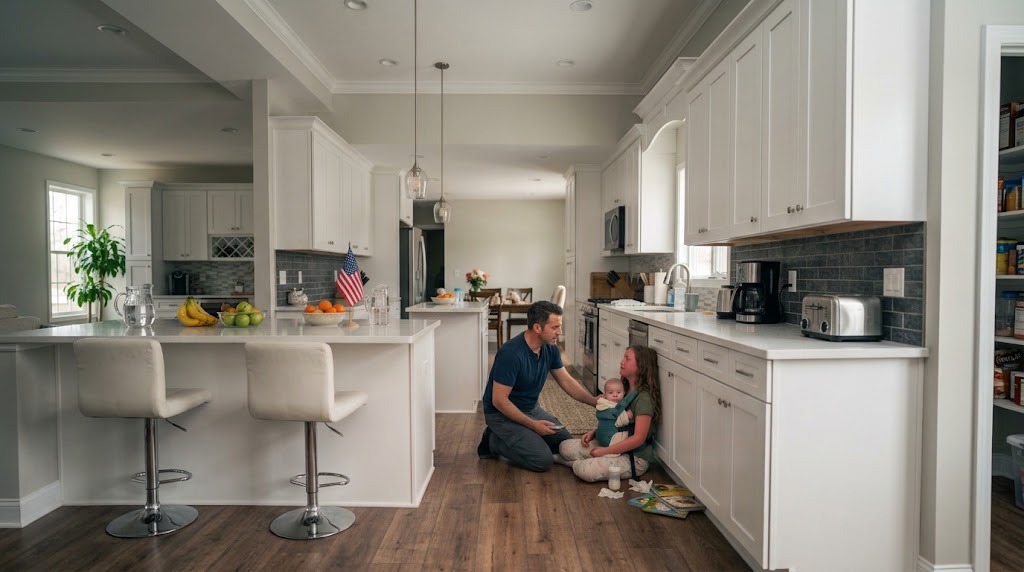
She sat against the kitchen cabinets with her legs stretched awkwardly in front of her.
Miles was secured to her chest in the baby carrier, squirming and crying, while Tessa’s hands trembled from exhaustion.
She looked up at me and tried to apologize.
“I’m sorry, Dad.”
Those were the first words out of her mouth.
Not “Where were you?”
Not “I’m scared.”
Not “Miles won’t stop crying.”
“I’m sorry.”
My chest tightened.
I dropped to my knees beside her.
“You have nothing to apologize for.”
“I tried to keep him happy.”
“I know.”
“He wouldn’t sleep unless I walked.”
“I know, sweetheart.”
“I changed him twice.”
“You did more than you ever should have had to do.”
Her lower lip trembled.
“I spilled the formula.”
“That’s okay.”
“I cleaned it up.”
“Tessa.”
She finally looked directly at me.
“You are nine years old.”
Her eyes filled.
“You were supposed to be playing, reading, watching television, annoying your brother for fun when I got home. You were never supposed to spend an entire day taking care of a baby by yourself.”
That did it.
She started crying.
Not loudly.
That would have been easier.
She just folded forward against me with eight hours of fear finally coming loose.
I held her with one arm while I unfastened Miles from the carrier with the other.
His diaper was heavy.
His face was red from crying.
He felt warm but not dangerously hot.
His hands grabbed at my shirt the second I lifted him.
I checked his breathing.
I checked his skin.
I looked for anything obviously wrong.
Then I held him against my shoulder while Tessa cried into my side.
On the counter was half a peanut-butter sandwich.
Beside it sat a plastic cup of water.
Neither had been touched.
“You didn’t eat?”
“I tried.”
She wiped her nose with her sleeve.
“He cried whenever I put him down.”
I closed my eyes for one second.
Just one.
Because if I let myself think too far ahead, I knew anger would take over.
And right then my children needed a father, not a man looking for someone to blame.
“Where’s Mom?”
Tessa looked toward the hallway.
“I don’t know.”
“What did she tell you?”
“She said she had to run out.”
“How long?”
“She said seventeen minutes.”
“Exactly seventeen?”
Tessa nodded.
“She was laughing when she said it.”
That detail stuck with me.
“Why seventeen?”
“I don’t know.”
“Did she say where she was going?”
“No.”
“Did you see what she was wearing?”
Tessa thought.
“The black dress.”
Not errands.
Rachel didn’t wear a black dress to pick up groceries.
“What else?”
“Her nice shoes.”
My stomach dropped another inch.
“Did she take her purse?”
“Yes.”
“Did she take her phone?”
“Yes.”
“Did she tell you what to do if Miles needed something?”
“She said his bottles were in the fridge.”
“And if there was an emergency?”
Tessa’s eyes shifted downward.
“What?”
“She said not to call you.”
I went still.
“Why?”
“She said you’d get mad.”
That sentence changed the shape of the room.
I stood slowly, Miles resting against my chest.
“Okay.”
Tessa watched my face.
“Are you mad?”
“Not at you.”
“At Mom?”
I didn’t answer immediately.
Children notice pauses.
I knew that.
So I chose my words carefully.
“I’m worried about the decision she made.”
Tessa nodded as if that distinction mattered to her.
It mattered to me too.
I called Rachel.
Straight to voicemail.
I called again.
Same thing.
Then I sent a message.
Where are you? Call me immediately. The kids were alone.
No answer.
I checked the garage.
Her SUV was gone.
Her everyday purse was gone too.
I carried Miles into the living room, laid him on the floor, changed him, and prepared a bottle.
Tessa sat beside me.
She watched everything I did.
Not like a child watching her father.
Like someone waiting to find out whether she had completed a job correctly.
That hurt more than I expected.
“You did this too?” I asked, holding up the clean diaper.
She nodded.
“Twice.”
“You remembered the cream?”
“Mom said he gets a rash.”
I looked away.
It is a strange thing to feel proud of your child for something that should never have been asked of them.
She had been responsible.
Brave.
Careful.
And none of that made what happened acceptable.
After Miles finished half the bottle, his crying eased.
I called our pediatrician’s after-hours number and explained what had happened.
They asked several questions.
Was he conscious?
Yes.
Any vomiting?
No.
Any fall?
Not that Tessa knew of.
Had he been fed?
Yes, though less consistently than usual.
Any fever?
Slightly warm, but nothing significant when I checked with the thermometer.
The nurse told me what to monitor and advised me to bring him in if anything changed.
Then I made Tessa eat.
She got through half the sandwich and some apple slices.
Only then did she mention the other phone.
“Dad?”
“Yeah?”
“I think Mom forgot something.”
“What?”
“There was a phone ringing upstairs.”
I looked at her.
“Her phone?”
“No.”
“How do you know?”
“She took her phone.”
“When did you hear the other one?”
“After she left.”
“Where?”
“Your bedroom.”
I should have stopped there.
Maybe I should have waited for Rachel to come home.
Maybe I should have given her an opportunity to explain.
But after finding my daughter on the kitchen floor with my infant son strapped to her chest, I no longer felt obligated to preserve the privacy of whatever had required leaving them alone.
I carried Miles upstairs.
Tessa followed until I told her to stay in the hallway.
I checked the nightstands first.
Nothing.
Then the dresser.
Socks.
T-shirts.
Receipts.
The vibration came again.
A faint buzzing beneath folded sweaters in the bottom drawer.
I pulled them aside.
There it was.
A second phone.
Cheap case.
No wallpaper.
No family photo.
No passcode required.
I stared at it for a long moment.
Then the screen lit.
Twelve unread messages.
All from a contact saved as one letter.
J.
The newest message read:
Did he suspect anything? I booked the room again.
The one beneath it:
You should’ve stayed. Stop letting the kids ruin every plan.
Then:
Seventeen minutes, remember? That’s what you told her. 😂
I felt the blood drain from my face.
He knew.
Whoever J was, he knew Tessa was being left with Miles.
And he thought it was funny.
I opened the thread.
I didn’t need to scroll far.
Rachel had been messaging him since early morning.
7:08 a.m.
Rachel: He leaves around 10.
J: Both kids?
Rachel: He thinks I’m home.
J: What about the baby?
Rachel: Tessa can handle him for a little while.
J: She’s nine.
Rachel: She acts forty.
Then a laughing emoji.
I sat on the edge of the bed.
Miles made a soft sound against my shoulder.
There are moments when your life doesn’t break loudly.
No explosion.
No shouting.
Nothing dramatic enough for the movies.
It simply divides.
Before.
After.
Before that phone, I believed my marriage had problems.
After that phone, I realized I had no idea who I was married to.
I kept reading.
The messages went back months.
Hotel reservations.
Restaurant photos.
Arguments about when they could meet.
Complaints about me.
Mockery.
Promises.
Rachel telling him I was “married to those stupid dogs.”
Jared complaining she was “always stuck with the kids.”
That was the name I eventually found.
Jared Mills.
A man from the fitness center Rachel had joined after Miles was born.
There were pictures.
Not explicit ones.
I was almost grateful for that.
But intimate enough.
His arm around her waist.
Her head on his shoulder.
The two of them in a hotel mirror.
A picture of breakfast beside a rumpled white bedspread.
Dates when she had told me she was visiting her sister.
Dates when she had claimed she was shopping with friends.
One date when I had stayed up until two in the morning with a teething baby while she told me a coworker was having a crisis.
But the affair wasn’t the worst part.
Not even close.
I found a second conversation.
This one between Rachel and someone saved as Kara.
Rachel had written:
I’m so tired of pretending I want this whole mom thing.
Kara: Then why did you have another baby?
Rachel: Because Ryan wanted another kid and I thought maybe it would fix everything.
My name looked strange on the screen.
Like it belonged to some other man.
Kara: And?
Rachel: It made it worse.
Kara: You need to be honest with him.
Rachel: No, I need enough money to leave.
I scrolled faster.
Rachel had been moving money.
Not huge amounts at first.
Two hundred dollars.
Three hundred.
Then fifteen hundred.
Then more.
Transfers from our joint savings account into an account I didn’t recognize.
I opened the banking app on my own phone.
Our emergency fund was lower than it should have been.
By almost twelve thousand dollars.
I had noticed it dropping.
Rachel always had an explanation.
Car repairs.
Medical bills.
Something for the house.
Birthday gifts.
She had been preparing to leave.
And apparently she didn’t care what happened to the kids while she arranged it.
Then I saw a message from two weeks earlier.
Jared: What are you going to do about custody?
Rachel: He can have most of it.
Jared: Good.
Rachel: But I’ll ask for half first. Better leverage.
My hands started shaking.
Jared: You think he’ll fight?
Rachel: Ryan lives for those kids. Of course he’ll fight.
Jared: Then say he’s unstable.
Rachel: He works with protection dogs. That won’t be hard.
I stared at that sentence until the screen blurred.
Unstable.
Protection dogs.
She intended to turn my career into evidence that I was dangerous.
Another message followed.
Rachel: If I tell people he has aggression issues, they’ll believe me.
Jared: Does he?
Rachel: No lol.
That was when I stopped reading.
Not because there wasn’t more.
Because I suddenly understood I needed to preserve everything.
I plugged the phone into the charger.
I photographed the messages with my phone.
Dates.
Times.
Names.
Transfers.
Anything related to the kids.
Anything related to money.
Anything related to false accusations she appeared to be planning.
Then I placed the second phone in a kitchen drawer and shut it.
I didn’t destroy it.
I didn’t throw it against a wall.
I didn’t call Jared.
I didn’t send Rachel a screenshot with a threat.
I had spent too many years working with high-drive animals to misunderstand what panic does.
You don’t charge blindly into a dangerous situation.
You control the environment.
You protect what matters.
Then you make decisions.
At 6:42 p.m., Rachel finally called.
I put her on speaker but walked into the garage so Tessa wouldn’t hear.
“Hey,” she said.
Not frantic.
Not apologetic.
Casual.
“Where are you?”
“Out.”
“I know that.”
A pause.
“Why are you being weird?”
“How long have the kids been alone?”
Silence.
Then she exhaled.
“Oh, come on.”
I gripped the workbench.
“Answer me.”
“I was only supposed to be gone a little while.”
“You left before lunch.”
“Tessa exaggerated.”
“Tessa called me at almost five because she physically couldn’t hold Miles anymore.”
“She’s dramatic.”
I closed my eyes.
“Rachel.”
“What?”
“She is nine.”
“I know how old our daughter is.”
“Do you?”
That was the first time my voice sharpened.
“Because I came home and found her on the floor shaking from exhaustion with our eight-month-old strapped to her chest.”
“I told her to use the carrier.”
“You told a nine-year-old to spend the day caring for an infant?”
“I didn’t plan to be gone all day.”
“Where are you?”
“That doesn’t matter.”
“It does to me.”
“I’m an adult, Ryan.”
“And they are children.”
“I’m coming home.”
“No.”
Another pause.
“What do you mean, no?”
“I mean I need you to tell me where you are and whether you’re coming back alone.”
Her breathing changed.
“What are you accusing me of?”
“I didn’t accuse you of anything.”
“You’re acting insane.”
There it was.
So fast.
The word she had already discussed using against me.
Insane.
I felt something inside me go cold.
“Come home alone,” I said.
Then I ended the call.
She arrived thirty-four minutes later.
I know because I watched the clock.
During those thirty-four minutes, I called my older brother, Nate, who lived fifteen minutes away.
I told him only that there had been a serious family problem and asked him to come over.
Nate knew me well enough not to demand details over the phone.
He arrived before Rachel.
Tessa was upstairs showering.
Miles had finally fallen asleep in his crib.
I showed Nate the second phone.
His jaw tightened.
“You need a lawyer.”
“I know.”
“Tonight.”
“I know.”
“And maybe the police.”
“I know.”
“You want me here when she comes in?”
“Yes.”
So he stayed.
Rachel’s SUV pulled into the driveway.
She came through the front door wearing the black dress Tessa had described.
Her hair was styled.
Her makeup was fresh.
She smelled like perfume.
She stopped when she saw Nate sitting at the kitchen table.
“What’s he doing here?”
Nate didn’t answer.
I stood by the counter.
“Where were you?”
Rachel dropped her keys into her purse.
“I told you, I was out.”
“With Jared?”
Her entire face changed.
Not dramatically.
Just a fraction.
But I saw it.
Her eyes moved toward the hallway.
Then toward the stairs.
Then back to me.
“Who?”
I opened the drawer.
Placed the second phone on the counter.
Rachel went pale.
Nate muttered something under his breath.
For almost ten seconds, none of us spoke.
Then Rachel moved toward the phone.
I put my hand over it.
“No.”
“That’s mine.”
“Yes.”
“You went through my property?”
“You left our children alone for hours.”
“That doesn’t give you the right—”
“Stop.”
She stared at me.
“You do not get to turn this conversation into my violation of your privacy.”
Her face hardened.
“So you read everything?”
“Enough.”
“You had no right.”
“Tessa had no right to be a nine-year-old today either, apparently.”
Her eyes narrowed.
“It wasn’t supposed to happen like that.”
“How was it supposed to happen?”
“I was coming back.”
“When?”
“I lost track of time.”
“At a hotel?”
Her mouth opened.
Closed.
Nate stood.
“I’m going outside.”
“No,” I said.
I needed a witness.
“Stay.”
Rachel crossed her arms.
“You’re enjoying this.”
That stunned me.
“Enjoying what?”
“Acting righteous.”
I stared at her.
“Our daughter called me because she was physically collapsing while holding our baby, and you think I’m enjoying being right?”
“I said I made a mistake.”
“No, you haven’t.”
She blinked.
“What?”
“You haven’t said that once.”
“Well, fine. I made a mistake.”
“Why didn’t you answer your phone?”
“It was on silent.”
“Why didn’t you check on the kids?”
“I thought they were fine.”
“For seven hours?”
“It wasn’t seven.”
“It was more.”
“I don’t know.”
“That’s the point.”
Her composure cracked.
“What do you want from me, Ryan?”
The question was so selfishly framed that I almost laughed.
Not “Are the kids okay?”
Not “What can I do?”
What do you want from me?
“I want you to pack a bag.”
She stared.
“This is my house too.”
“I know.”
“So you can’t throw me out.”
“I’m not physically removing you. I’m telling you that I will not spend tonight arguing while our children are upstairs.”
“Where am I supposed to go?”
I looked at the phone.
“Ask Jared.”
Her face twisted.
“You’re a bastard.”
Nate stood again.
I held up one hand.
“Do not do this in front of the kids.”
“I didn’t do anything in front of the kids.”
“You left them alone.”
She stepped toward me.
“I needed one day.”
“You didn’t ask for one day.”
“You’re never here.”
“I work.”
“And I’m stuck here with a baby all the time.”
I stared at her.
“You told me you wanted another child.”
“I thought I did.”
That was the first honest thing she had said.
The room went quiet.
I lowered my voice.
“Do you regret Miles?”
Her face changed.
For one second I saw guilt.
Then irritation replaced it.
“That’s not what I said.”
“Do you regret him?”
“I regret what my life became.”
I heard a floorboard upstairs.
All three of us froze.
Tessa was standing near the bottom of the staircase.
Wet hair.
Pajamas.
Bare feet.
She had heard enough.
Rachel looked at her.
“Tessa, honey—”
Tessa backed up one step.
I walked toward her.
“Go upstairs, sweetheart.”
She looked at Rachel instead.
“Are you mad because I called Dad?”
Rachel’s expression collapsed.
“No.”
“You told me not to.”
“I know.”
“I tried to do it right.”
I will remember that sentence for the rest of my life.
I tried to do it right.
Rachel started crying.
For the first time that evening, real tears.
“Tessa, I’m sorry.”
My daughter nodded.
But she did not move toward her mother.
She moved toward me.
I put my arm around her shoulders and took her upstairs.
That night, Rachel left.
Not because I forced her.
Because when she finally realized neither Tessa nor I was going to reassure her that everything was fine, she packed a suitcase and went to her sister’s.
At least that was what she told me.
The next morning, I learned she had gone to Jared’s apartment instead.
By nine, I had called an attorney.
By ten, Miles had been examined by his pediatrician.
He was dehydrated enough that the doctor was concerned, though fortunately not dangerously so.
He was otherwise okay.
Tessa was physically fine.
Emotionally was another matter.
She followed me from room to room for days.
If I walked to the mailbox, she asked where I was going.
If I went outside to bring in the trash bins, she stood at the window.
If I said I had work, she asked who would stay with Miles.
The first time I told her my mother was coming over, she asked, “But what if Grandma leaves too?”
That was when I realized what Rachel had taken from her.
Not just one afternoon.
Trust.
A child’s assumption that when an adult says, “I’ll be back,” they come back.
My mother arrived that afternoon with groceries and fury she worked hard to hide.
She hugged Tessa.
Then Miles.
Then she walked into the pantry, shut the door, and cried where she thought no one could hear.
I gave my employer the basic truth.
Family emergency.
I needed time away.
The owner of the training facility, Marcus, had known me for thirteen years.
He didn’t ask questions.
“Take the week,” he said.
“I may need longer.”
“Then take longer.”
“I can’t just disappear.”
“Ryan, dogs will still need training next month. Your kids need you now.”
I will always be grateful for that.
Rachel began texting constantly.
At first apologetic.
Then defensive.
Then angry.
Then apologetic again.
I’m sorry.
You’re making this bigger than it was.
I know I messed up.
You invaded my privacy.
Can I see the kids?
You’re turning Tessa against me.
I need my second phone back.
We need to talk about the money.
Jared means nothing.
Then, two hours later:
I love him.
Then:
I don’t know what I want.
I answered only messages about the children.
Everything else went through my attorney once we filed.
That infuriated her.
She called me cold.
Controlling.
Vindictive.
Exactly the words she had planned to use in the hidden messages.
The difference was that now I had those messages.
I also had the pediatric records.
Tessa’s phone log.
My location records showing I had been at work.
The security camera across our driveway showing Rachel leaving the house at 10:38 that morning and not returning before I did.
Most importantly, I had no interest in revenge.
My attorney told me that mattered.
“Do not make this about the affair,” she said.
Her name was Linda Chavez, and she had the kind of calm voice that made you pay attention.
“The affair may explain behavior, but the children are the issue.”
“I agree.”
“Do not threaten her.”
“I won’t.”
“Do not insult her.”
“I won’t.”
“Do not post anything online.”
“I don’t use social media much.”
“Good. Keep it that way.”
“Do I have to let her take them?”
Linda looked at me.
“Right now, we ask the court for temporary orders.”
The process was painful.
Slow.
Humiliating.
Private failures had to become documented facts.
Rachel’s attorney argued that the abandonment had been a one-time lapse in judgment.
Linda pointed out the messages showing Rachel had deliberately planned to leave Tessa responsible for Miles.
Rachel claimed she had intended to be gone less than an hour.
The messages showed she knew the hotel was forty minutes away without traffic.
Rachel claimed she returned as soon as she realized how much time had passed.
Her hotel receipt showed she had ordered room service at 3:27 p.m.
Rachel claimed she had repeatedly tried to call Tessa.
There were no calls.
She claimed she believed a neighbor was available.
No neighbor had been asked.
Then the second phone became important.
Not because of the affair.
Because of the messages.
The ones where Jared said, “She’s nine,” and Rachel responded, “She acts forty.”
The ones where she joked about using my work against me in a future custody battle.
The ones where she admitted I had no aggression problem.
The ones where she discussed asking for half custody as “leverage.”
I watched Rachel read those messages on paper in a courtroom.
For the first time, she looked ashamed.
Not angry.
Not trapped.
Ashamed.
The temporary order gave me primary physical custody.
Rachel received supervised parenting time at first.
I expected to feel victorious.
I didn’t.
There is nothing victorious about watching the mother of your children walk out of a courtroom while your attorney quietly tells you that you got what you asked for.
I wanted my kids safe.
I got that.
But the price was the destruction of the family I thought we had.
Tessa began counseling.
Her therapist, Dr. Harper, told me something that stayed with me.
“She may act older for a while.”
“She already does.”
“That can happen when children are given adult responsibilities too soon.”
“What do I do?”
“Let her be nine.”
It sounded simple.
It wasn’t.
The first time I asked Tessa what she wanted for dinner, she said, “Whatever is easiest.”
I said, “That wasn’t the question.”
She looked confused.
“What do you want?”
“Pizza?”
“Great.”
“Is that okay?”
“Yes.”
“With mushrooms?”
“Yes.”
“And those little bread things?”
“Breadsticks?”
She smiled.
“Yeah.”
“Done.”
It became almost a project.
Not making her responsible.
If Miles cried, I didn’t say, “Can you get his pacifier?”
I got it.
If I needed to shower, I waited until another adult was home or Miles was safely asleep.
If Tessa offered to help, I thanked her, but I never treated her as backup childcare.
One Saturday, I caught her standing beside his crib while he napped.
“You okay?”
She nodded.
“What are you doing?”
“Making sure he’s breathing.”
My throat tightened.
“Come here.”
She did.
I crouched until we were eye level.
“You don’t have to guard him.”
“I know.”
“Do you?”
She stared at the carpet.
“What if something happens?”
“Then I handle it.”
“What if you’re not here?”
“There will always be a responsible adult here with you.”
“Always?”
“As long as I can control it, yes.”
She thought about that.
Then she whispered, “Mom said that too.”
I couldn’t lie to her.
So I said, “Then I’ll have to prove it.”
That seemed to satisfy her more than another promise.
Over the next several months, Rachel’s life changed quickly.
Jared was less interested in her once the secrecy ended.
I learned that from Rachel’s sister, not because I asked.
Apparently he had enjoyed hotel rooms and stolen afternoons.
He had not been interested in court dates, supervised visits, or helping someone rebuild a life.
Three months after Rachel left, he ended things.
She called me that night.
I almost didn’t answer.
Then I did.
Her voice was quiet.
“He left.”
I said nothing.
“I know you don’t care.”
“That’s not what this is about.”
“I ruined everything.”
I looked through the doorway.
Tessa was asleep on the couch under a blanket.
Miles was in his playpen, chewing on a soft block.
“Yes,” I said.
Rachel started crying.
Not because I was cruel.
Because she expected me to tell her she hadn’t.
“I thought you’d say something else.”
“I’m not going to lie to make this easier.”
“I hate myself.”
“That doesn’t help the kids.”
“What am I supposed to do?”
“Get help.”
“I am.”
“Then keep doing it.”
There was a long silence.
“Do you hate me?”
I thought about it.
“No.”
She breathed out.
“I wish you did.”
“Why?”
“Because then I could tell myself you’re punishing me.”
I understood what she meant.
If I hated her, she could make the story about revenge.
But I wasn’t fighting for punishment.
I was fighting for stability.
“I don’t want to punish you.”
“I know.”
“I want Tessa to stop being afraid every time I leave the room.”
Rachel sobbed once.
“And I want Miles to grow up never knowing that he spent a day being carried around by a child who thought she couldn’t put him down.”
“I know.”
“And I want you to become someone they can trust again.”
That was the first phone call we had after the separation that felt honest.
Rachel entered therapy.
Real therapy.
Not the two appointments she had previously attended to satisfy her attorney.
She joined a parenting program.
She got a job.
She moved into a small apartment.
She stopped asking for unsupervised visits before anyone thought she was ready.
Something in her changed when she stopped trying to win.
Six months after the day Tessa called me, Rachel asked if we could meet with the counselor.
Not alone.
With Dr. Harper.
I agreed.
Rachel sat across from Tessa in the counselor’s office.
Miles was with my mother.
For a while, nobody spoke.
Then Rachel said, “I want to tell you something, and I’m not going to ask you to make me feel better.”
Tessa watched her carefully.
Rachel’s hands shook.
“That day, I told you I’d be gone seventeen minutes.”
Tessa nodded.
“I knew it would be longer.”
Tessa’s eyes filled.
“I knew I shouldn’t leave you with Miles.”
Another nod.
“I did it because I wanted something, and I decided what I wanted was more important than what you needed.”
Tessa looked at Dr. Harper.
Then back at Rachel.
Rachel continued.
“That was wrong.”
Her voice cracked.
“You didn’t fail me that day.”
Tessa’s face crumpled.
“I spilled his formula.”
Rachel covered her mouth.
“I know.”
“And he cried.”
“I know.”
“I didn’t know what to do.”
“You weren’t supposed to know what to do.”
Tessa started crying.
Rachel didn’t move toward her.
I noticed that.
Months earlier, she would have.
She would have tried to hug Tessa to soothe her own guilt.
This time she waited.
Tessa eventually asked, “Why did you tell me not to call Dad?”
Rachel closed her eyes.
“Because I knew he would stop me.”
“From seeing Jared?”
Rachel looked at her.
“Yes.”
It was the first time she had admitted the affair directly to our daughter.
Tessa was quiet.
“Did you like him more than us?”
“No.”
“Then why did you leave us?”
Rachel cried.
“Because sometimes adults can love people and still make selfish choices that hurt them.”
Tessa didn’t forgive her that day.
I didn’t expect her to.
But something shifted.
Truth does not repair everything.
Sometimes it simply gives healing a place to begin.
Over the next year, supervised visits became unsupervised daytime visits.
Then longer visits.
Rachel never regained the custody arrangement we once would have had.
The final order gave me primary custody.
She had regular parenting time, structured carefully around the children.
Neither of us got everything we wanted.
That was probably appropriate.
The financial mess was easier to resolve.
The twelve thousand dollars Rachel had moved became part of the divorce settlement.
There was no dramatic hidden fortune.
No secret mansion.
Just savings spent on hotels, meals, gifts, and an apartment deposit for a life that never happened.
The second phone remained in my attorney’s evidence file until the case concluded.
Then one day, months after everything was final, Linda handed it back to me in a small plastic bag.
“You can destroy it now if you want.”
I stared at it.
That little black rectangle had contained the collapse of my marriage.
For a while I had thought of it as the thing that ruined my life.
Eventually I understood it differently.
The phone had not ruined anything.
It had revealed what was already happening.
I took it home.
Tessa was at school.
Miles, now almost two, was napping.
I sat at the kitchen table.
The same kitchen where I had found my daughter on the floor.
For the first time in over a year, I turned the phone on.
Most of the old messages had already been preserved elsewhere.
I didn’t read them.
I opened the photos.
There were pictures of Rachel and Jared.
Pictures of restaurants.
Hotel balconies.
Wine glasses.
Then I found something unexpected.
Pictures of the kids.
Miles sleeping.
Tessa doing homework.
One picture of me in the backyard holding Miles while Tessa sprayed me with a garden hose.
Rachel had taken it from the kitchen window.
I stared at that picture for a long time.
There had been a family there.
Imperfect.
Strained.
But real.
And Rachel had been both things at once.
A mother who had loved her children.
And a woman who had betrayed them terribly.
People like simple stories.
Good person.
Bad person.
Victim.
Villain.
Life rarely cooperates.
Rachel did something I may never fully understand.
She endangered our children through selfishness.
She lied.
She cheated.
She tried to prepare false claims against me.
Those facts never changed.
But she also eventually stopped lying.
She accepted consequences.
She worked to rebuild trust without demanding forgiveness on her schedule.
That mattered too.
I powered off the phone.
Then I drove to an electronics recycling center and dropped it into the secure collection bin.
No smashing.
No dramatic fire.
No symbolic speech.
Just letting it go.
Two years after the phone call, I was back at the dog-training field outside Edmond.
Tessa was eleven.
Miles was almost three.
They sat behind the fence watching me work with a Belgian Malinois named Echo.
Tessa loved coming with me now.
Not because she had to help.
Because she wanted to.
She had discovered photography and liked taking pictures of the dogs.
Miles liked yelling “DOGGY!” every thirty seconds.
Rachel was supposed to pick them up that evening for dinner.
Not overnight.
Not yet.
But dinner.
At five on the dot, her car pulled into the lot.
Tessa saw it first.
“Mom’s here.”
I watched her face.
No panic.
No tight shoulders.
Just recognition.
Rachel walked over.
She looked different from the woman in the black dress.
Less polished.
More grounded.
She wore jeans, sneakers, and a blue sweater.
Miles ran toward her.
“Mommy!”
She knelt.
He crashed into her arms.
Tessa approached more slowly.
Rachel smiled.
“Hey, Tess.”
“Hi.”
“You ready?”
Tessa looked at me.
“Dad?”
“Yeah?”
“We’re getting tacos.”
“That sounds good.”
“You want us to bring you one back?”
I smiled.
“No. You guys go have dinner.”
She nodded.
Then she hesitated.
For a fraction of a second, the nine-year-old on the kitchen floor appeared in her eyes.
“When will you be here?”
“I’ll be at the field until seven.”
“And then?”
“Home.”
She nodded.
“Okay.”
Rachel watched the exchange quietly.
Then she said, “I’ll have them back at eight.”
I looked at her.
“Okay.”
And this time, I believed she would.
They walked toward the car.
Miles holding one of Rachel’s hands.
Tessa walking beside them with her camera bag over her shoulder.
Halfway there, Rachel stopped.
She turned around.
“Ryan?”
“Yeah?”
“Thank you.”
I knew what she meant.
Not for forgiving her.
I hadn’t, completely.
Maybe I never would.
Not for taking her back.
That was never going to happen.
She was thanking me for allowing space for her to become a mother again.
I nodded once.
“Eight.”
She smiled faintly.
“Eight.”
At 7:59 that evening, headlights swept across my living room window.
I looked at the clock without meaning to.
The front door opened.
Tessa came inside talking about salsa.
Miles was asleep on Rachel’s shoulder.
She carried him to the couch and handed him carefully to me.
“He ate too many chips.”
“Of course he did.”
“He also tried to drink the salsa.”
“That sounds like him.”
Tessa laughed.
Then she ran upstairs to put away her camera.
Rachel stood near the doorway.
“I’ll see them Wednesday?”
“Wednesday.”
She turned to leave.
Then Tessa called from upstairs.
“Mom?”
Rachel froze.
“Yeah?”
“Thanks for dinner.”
Rachel’s eyes closed for a second.
“You’re welcome, sweetheart.”
The door shut behind her.
I looked down at Miles sleeping against my chest.
Two years earlier, Tessa had been the one holding him there, exhausted and terrified.
Now she came back down the stairs wearing fuzzy socks and carrying a blanket.
She flopped onto the couch.
“Can we watch something?”
“Homework?”
“Done.”
“Room?”
“Mostly clean.”
“Define mostly.”
She grinned.
“Not dangerous.”
I laughed.
“Fine.”
She chose a ridiculous animal documentary.
Halfway through, Miles woke up and climbed across both of us.
Tessa started to catch him automatically.
Then stopped.
She looked at me.
That tiny pause told me more than any therapist could have.
She no longer assumed responsibility was hers.
I reached for Miles.
“I’ve got him.”
Tessa leaned back against the couch.
“I know.”
Three words.
That was all.
But those three words were the ending I had been waiting for.
Not a courtroom victory.
Not Rachel’s affair ending.
Not money returned.
Not an apology.
I’ve got him.
I know.
That was trust restored.
Not all at once.
Not perfectly.
But enough.
Later that night, after both children were asleep, I stood alone in the kitchen.
The house was quiet.
The tile near the cabinets had been replaced after a pipe leak months earlier.
You couldn’t even tell where Tessa had sat that day.
But I could.
I remembered everything.
The trembling hands.
The baby strapped to her chest.
The untouched sandwich.
Her apology.
I remembered the hidden phone.
The messages.
The black dress.
The courtroom.
The counseling office.
All of it had started with one phone call from a frightened nine-year-old.
For a long time, I had wished she had never needed to make that call.
Eventually I became grateful that she did.
Because she trusted me enough to break a rule an adult had given her.
She had been told not to call Dad.
She called anyway.
And that decision protected her brother.
It protected her.
In a strange way, it even forced Rachel to face the person she had become.
The next morning, I drove Tessa to school.
At a red light she looked over at me.
“Dad?”
“Yeah?”
“Do you remember when I called you?”
Every muscle in my body tightened.
“Yes.”
“I thought you were going to be mad.”
“At you?”
She nodded.
“Why?”
“Mom said you would.”
I kept my eyes on the road.
“I’m sorry you believed that.”
“I don’t anymore.”
I glanced at her.
She was looking out the window.
Not sad.
Just thoughtful.
Then she said, “Dr. Harper says sometimes kids think things are their fault because it makes scary things feel controllable.”
I smiled slightly.
“That sounds like Dr. Harper.”
Tessa shrugged.
“She talks a lot.”
“That also sounds like Dr. Harper.”
She smiled.
Then she became serious again.
“I used to think if I had been better with Miles, Mom would have come home sooner.”
My heart cracked.
“Tessa.”
“I know it’s not true now.”
I reached across the console and squeezed her hand.
“No. It isn’t.”
“I know.”
The light changed.
We drove on.
At school, she grabbed her backpack.
Before getting out, she looked at me.
“Dad?”
“Yeah?”
“If Miles ever calls me when he’s nine and says he needs help, I’m going to go get him.”
I laughed softly.
“I hope he has fewer emergencies.”
“Me too.”
She opened the door.
Then she leaned back inside.
“But I’d still go.”
“I know you would.”
She ran toward the entrance.
I watched until she disappeared inside.
Then I sat in the parking lot for another minute.
Parents like to believe we are the ones teaching our children courage.
Sometimes it’s the other way around.
That afternoon, when I picked her up, she was already talking before the door closed.
Apparently there was a photography contest.
She wanted to enter a picture she had taken at the dog-training field.
A photo of Echo clearing the ramp.
Dust frozen in the sunlight.
Ears forward.
Eyes focused.
The image was beautiful.
“When did you take this?”
“Saturday.”
“It’s good.”
“I know.”
I laughed.
“Confidence. I like it.”
She zoomed in on the picture.
“Look at his eyes.”
I did.
“What about them?”
“He knows where he’s going.”
I looked at my daughter.
For a second, I couldn’t speak.
Then I nodded.
“Yeah.”
“He does.”
So did she.
So did I.
Maybe Rachel did too.
Our family never returned to what it had been.
That version was gone.
But what replaced it was honest.
Two homes.
One set of parents learning how to communicate without pretending they were still married.
A daughter allowed to be a child again.
A little boy growing up surrounded by adults who understood that his care belonged to them.
And a father who learned that protecting a family does not always mean keeping it together.
Sometimes protecting it means accepting that the old shape of it is unsafe.
Sometimes it means walking into a lawyer’s office.
Sometimes it means sitting through counseling sessions where everyone says things you wish you could unhear.
Sometimes it means telling the truth without turning it into a weapon.
And sometimes it starts because a nine-year-old girl, exhausted on a kitchen floor, decides to ignore an adult’s order and call her dad.
I still keep that first voicemail.
Tessa doesn’t know.
It lasted only eleven seconds because the call dropped once before we reconnected.
Her voice is tiny.
“Dad, please call me. Miles is crying and I’m really tired.”
I don’t listen to it often.
I don’t need to.
But I have never deleted it.
Not because I want to remember her fear.
Because I want to remember what happened after she asked for help.
I came.
And every day since then, in all the ways that matter, I have tried to keep coming.
That is the promise I make now.
Not that nothing bad will ever happen.
I can’t promise that.
Not that adults will never disappoint her.
They will.
Not that families stay the same forever.
They don’t.
My promise is simpler.
If you call, I will answer.
If you are scared, tell me.
If someone says you’re not allowed to ask for help, ask anyway.
And if the weight you are carrying becomes too heavy, put it down.
You were never meant to carry everything alone.
Neither was I.
None of us were.
That is what the second phone finally taught me.
The secret inside it mattered.
The affair mattered.
The lies mattered.
The money mattered.
But the most important truth was never hidden in that drawer.
It was sitting on my kitchen floor when I came home.
A tired little girl holding her baby brother because she believed it was her job to keep everything from falling apart.
It wasn’t.
It never was.
And from that day forward, I made sure she knew it.
💬THE END! THANK YOU FOR READING!