

“What do you mean, another fit?” I asked.
Daniel glanced at our mother before answering.
It was only a second.
A tiny hesitation.
But I knew my brother well enough to recognize fear when I saw it.
“Clara’s been acting unstable,” he said. “Mom said she refused to eat, locked herself in rooms, scared Lily a couple of times.”
I stared at him.
Clara had never done anything like that.
Not once in eleven years of marriage.
She was the person who labeled leftovers so nothing spoiled, packed Lily’s lunches in little color-coded containers, and left granola bars in the glove compartment because she was convinced no child should ever have to say they were hungry twice.
And Daniel expected me to believe she had simply stopped eating while our daughter wasted away beside her.
The sirens outside grew louder.
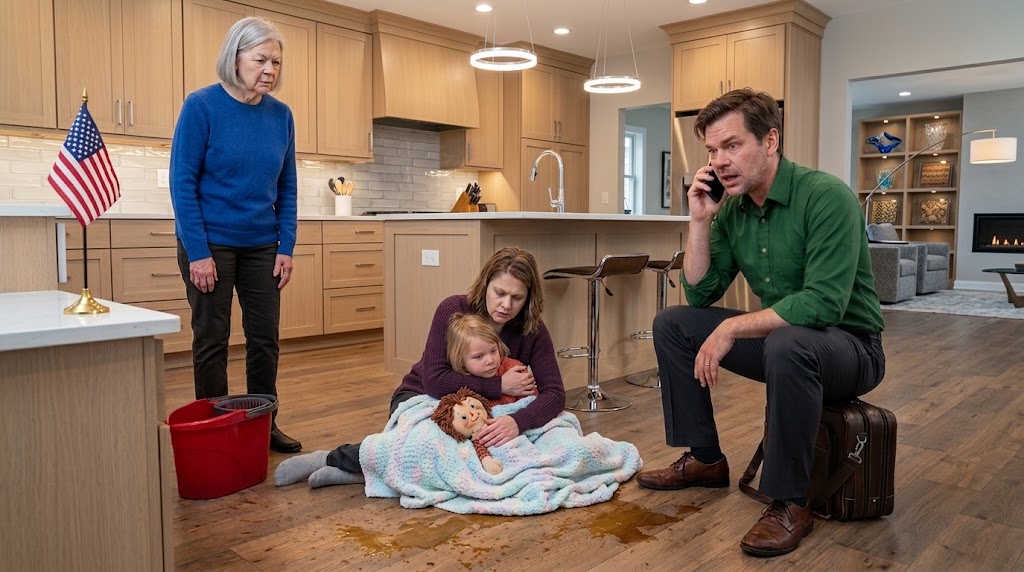
Evelyn tightened both hands around the mop handle.
“Michael, you’ve been gone three days,” she said. “You don’t know what it’s been like here.”
I looked at Lily.
Her small body lay curled against Clara’s.
Her bare feet were filthy.
One of her socks was missing.
There was a bruise near her knee and something dried at the corner of her mouth.
“You’re right,” I said quietly. “I don’t.”
Mother relaxed slightly.
Then I looked at her.
“So nobody leaves until I do.”
Her face changed.
“What?”
The front door burst open.
Two paramedics entered first, followed by another emergency responder carrying equipment.
I moved out of their way and pointed toward Clara and Lily.
“My wife lost consciousness. My daughter’s barely responsive. I found them like this less than five minutes ago.”
Everything after that became movement.
Questions.
Gloves.
Oxygen.
Monitors.
Someone called out Clara’s blood pressure.
Someone else said Lily’s blood glucose was dangerously low.
A paramedic cut open the side of Lily’s pajama sleeve to place a line.
My mother immediately began talking over everyone.
“She hasn’t been eating properly. I told her mother—”
“Ma’am, step back.”
“But I’m explaining—”
“Step back.”
For once, Evelyn obeyed.
Daniel stood near the hallway.
He wasn’t watching Lily.
He was watching the floor.
More specifically, he was watching Miss Button.
Lily’s doll.
The doll had belonged to her since she was three.
Clara had found it at a small craft market during a summer trip to Maine. It was handmade, with button eyes, yarn hair, a blue ribbon, and a tiny white dress Lily insisted on washing herself whenever it got dirty.
Now the dress was stained with something dark.
One of the paramedics moved it while checking beneath Clara’s arm.
Something clicked inside the doll.
Not a toy sound.
Metal.
Evelyn lunged forward.
“That filthy thing needs to be thrown away.”
I caught her wrist.
Hard enough to stop her.
Not hard enough to hurt her.
“Don’t touch it.”
Her eyes snapped to mine.
For one instant, I saw something I had never expected to see on my mother’s face.
Panic.
Daniel took a step backward.
The paramedic looked from the doll to Evelyn.
“What’s inside it?”
“I don’t know,” I said.
I remembered Clara’s last words.
The doll.
Then I remembered Lily whispering only moments earlier.
Grandma doesn’t know I recorded her.
My pulse hammered.
“Please don’t throw that away,” I said. “There may be something important inside.”
The paramedic nodded.
One of the responders brought over a clean evidence bag.
Evelyn laughed sharply.
“Evidence? Oh, please. This is ridiculous.”
Nobody answered her.
They sealed Miss Button inside the bag.
When they lifted Lily onto the stretcher, her eyelids fluttered.
I stayed beside her.
“Daddy?”
“I’m here, sweetheart.”
Her voice was so soft I had to lean close.
“Don’t let Grandma take Miss Button.”
“I won’t.”
“Mommy said hide it.”
“What did Mommy tell you to hide?”
But Lily’s eyes rolled shut.
The paramedic looked at me.
“We need to move.”
I followed them toward the door.
Mother grabbed my sleeve.
“Michael, you can’t possibly be going with them without hearing what happened.”
I looked down at her hand until she released me.
“My wife and child are barely breathing.”
“You’re acting like I did something.”
“I haven’t said what I think yet.”
That frightened her more than an accusation would have.
Daniel suddenly stepped forward.
“I’ll come to the hospital.”
“No.”
His mouth opened.
“No?” he repeated.
“Stay here.”
“Why?”
“Because the police are coming.”
Evelyn’s face drained of color.
“The police?”
“I asked the dispatcher to send them.”
“Michael, this is a family matter.”
My daughter was six years old and so hungry her ribs showed through her pajamas.
I looked at my mother.
“No,” I said. “It stopped being a family matter when I found a padlock on my pantry.”
I rode in the ambulance with Lily.
Clara was transported separately because both of them needed immediate treatment.
The ride lasted eleven minutes.
It felt like eleven years.
Lily drifted in and out while the paramedic spoke to her gently.
She asked Lily her name.
Her favorite color.
Her teacher’s name.
Whether she knew what day it was.
Most of the time, Lily answered with one or two words.
When the paramedic asked when she had last eaten, Lily whispered, “Yesterday.”
“What did you eat yesterday?”
“Crackers.”
“How many?”
Lily lifted two fingers.
My stomach twisted.
“What about before that?”
She closed her eyes.
“I don’t know.”
The paramedic looked at me.
I had no answer.
I had called home every night during my trip.
Mother had answered twice.
The first night she said Clara was giving Lily a bath.
The second night she said Clara had gone to bed with a headache.
The third night, nobody answered.
I sent Clara three messages.
She replied to only one.
Everything okay. Exhausted. Love you.
I had read it between meetings and believed it.
Now I wondered whether she had even written it.
At the hospital, they took Lily through one set of doors and Clara through another.
A nurse stopped me in the corridor.
“Mr. Bennett, we need information.”
I answered questions automatically.
Allergies.
Medications.
Medical history.
Emergency contacts.
I gave them everything I knew.
Then she asked, “Has your daughter recently had limited access to food?”
My throat tightened.
“Not with my permission.”
The nurse held my eyes for a second.
That answer told her enough.
A hospital social worker arrived twenty minutes later.
Then a police officer.
Then another.
By then, Clara was awake.
Barely.
They allowed me into her room for two minutes before the doctors continued testing.
She looked impossibly small beneath the hospital blankets.
An IV ran into her arm.
There was a purple mark near her wrist.
Her lips were cracked.
I sat beside her.
“Clara.”
Her eyes opened.
She started crying before she even spoke.
Not loudly.
That somehow made it worse.
“I tried,” she whispered.
I took her hand.
“You don’t have to explain anything right now.”
“I tried to keep Lily fed.”
“I know.”
“No. You don’t.”
Her fingers tightened weakly around mine.
“Your mother took my phone.”
I froze.
“What?”
“The first night.”
Clara swallowed.
“She said you’d called her and told her to take over because you were worried I was overwhelmed.”
“I never said that.”
“I know that now.”
“What happened?”
She looked toward the door.
“Where’s Lily?”
“She’s being treated. She spoke to me in the ambulance.”
Clara’s eyes filled again.
“Is she okay?”
“They’re taking care of her.”
It was not the certainty I wanted to give.
But it was the truth.
Clara closed her eyes.
“Miss Button.”
“I have it.”
“No. You don’t understand.”
“I think Lily recorded something.”
Clara stared at me.
“She told you?”
“She said you told her to hide it.”
Clara’s expression shifted.
Relief.
Fear.
Then exhaustion.
“Good girl,” she whispered.
A doctor returned, and I had to step away.
Before I left, Clara caught my sleeve.
“Michael.”
I turned.
“Don’t believe Daniel.”
I felt something cold spread through my chest.
“What did he do?”
But the doctor interrupted.
“We need to continue.”
I stepped out.
The police officers were waiting.
The older one introduced herself as Detective Mara Chen.
She had the calm expression of someone who had spent years listening to terrible things without allowing shock to show on her face.
“Mr. Bennett, I understand you found both victims?”
Victims.
The word hit me.
“Yes.”
“And your mother and brother were present?”
“Yes.”
“Can we speak somewhere private?”
We went into a consultation room.
I told her everything.
The locked pantry.
Clara’s condition.
Lily’s condition.
The messages.
The doll.
Daniel’s statement about Clara having “another fit.”
Detective Chen took notes.
“Did your wife have any history of psychiatric episodes?”
“No.”
“Substance abuse?”
“No.”
“Eating disorder?”
“No.”
“Any reason she would intentionally deprive your daughter of food?”
“Absolutely not.”
“Any financial conflict between your wife and your mother?”
That question caught me.
“Not that I knew of.”
“What about your brother?”
I thought about Daniel’s watch.
The expensive one.
Daniel had spent most of his adult life moving from job to job, always one emergency away from asking me for money.
Three months earlier, he had asked for fifteen thousand dollars to “invest in a logistics opportunity.”
I refused.
He stopped speaking to me for two weeks.
Then suddenly everything was normal again.
“I’ve helped him financially before,” I said.
“How much?”
“Over the years? Maybe forty thousand.”
Detective Chen’s pen stopped.
“Did your wife know?”
“Yes.”
“Did she approve?”
“At first. Not toward the end.”
“Why?”
“Because Daniel never repaid anything.”
The detective nodded.
“Has your mother ever asked you for money?”
“All the time.”
“How much recently?”
“She asked me to cover renovations to her apartment. I said no because I already pay part of her rent.”
“How much are the renovations?”
“She claimed twenty thousand.”
“And the pipes?”
I stared at her.
“What about them?”
“You said she was staying with you because her apartment had plumbing repairs.”
“Yes.”
Detective Chen looked at her notes.
“Was that independently verified?”
I realized I had never called the building manager.
Mother had told me.
I believed her.
“No.”
The detective closed her notebook.
“We’re going to look into that.”
Another hour passed.
Then the doctor finally came to speak to me about Lily.
She was severely dehydrated and hypoglycemic.
There were signs she had received inadequate nutrition over multiple days.
But she had responded to treatment.
Her oxygen levels were improving.
She was awake.
She was asking for me.
My knees almost gave out.
“And Clara?”
“She’s also dehydrated, but there’s something else we’re investigating.”
“What?”
The doctor hesitated.
“Preliminary tests indicate possible sedative exposure.”
My mind went blank.
“What kind?”
“We need confirmatory testing before I give you specifics.”
“She doesn’t take sedatives.”
“That’s important.”
“Could it have made her unconscious?”
“Yes.”
“Could it explain why she couldn’t stop someone from locking food away from Lily?”
The doctor’s expression tightened.
“Yes.”
I had to grip the back of a chair.
Somebody had not simply starved them.
Somebody had drugged my wife.
I thought of the soup across the kitchen floor.
The oily stain on Miss Button.
The drinking glass.
The bruises around Clara’s fingers.
I closed my eyes.
My mother had been standing over them with a mop.
Cleaning.
Not helping.
Cleaning.
Detective Chen returned around nine that night.
She wasn’t alone.
A forensic technician carried Miss Button in the same clear bag.
“We received permission from your wife to examine the doll,” Chen said.
I nodded.
“What did you find?”
“Your daughter hid a small digital audio recorder inside it.”
I stared at her.
“A recorder?”
“Apparently one your wife purchased several months ago.”
“Why?”
“We’ll let her explain when she’s stronger.”
The detective placed a tablet on the table.
“There are eleven audio files.”
My mouth went dry.
“Have you listened to them?”
“Enough to know we’re dealing with more than neglect.”
She didn’t play the recordings immediately.
She asked whether I wanted someone with me.
I said no.
Then she pressed the screen.
At first, there was only static.
Then Lily’s voice.
Very close to the microphone.
“Miss Button, this is a secret.”
I closed my eyes.
The recording continued.
Footsteps.
A door.
Then Evelyn.
“You will eat when I decide you’ve earned it.”
Clara’s voice followed.
“Evelyn, she is six.”
“And you are disrespectful.”
“Open the pantry.”
“You think because Michael married you, you get to run everything?”
“This is our house.”
There was a slap.
Not loud.
But unmistakable.
Then Lily screamed.
“Don’t hit Mommy!”
I stood so fast the chair scraped backward.
Detective Chen paused the recording.
I stared at the wall.
My breathing came too quickly.
“You don’t have to continue right now,” she said.
“Yes, I do.”
She watched me.
“I need to know.”
She pressed play.
My mother’s voice returned.
“You’ve poisoned him against his family for years.”
Clara answered.
“I stopped him from giving Daniel more money. That’s what this is about.”
Daniel’s voice came from somewhere farther away.
“You didn’t stop anything.”
I felt ice move through my veins.
He had been there.
The recording continued.
Clara said, “Michael will find out.”
Daniel laughed.
“Michael believes what he wants to believe.”
My mother replied, “By the time he gets home, he’ll believe you had some kind of breakdown.”
A cabinet opened.
Glass clinked.
Clara spoke again.
“What are you putting in that?”
“Something to help you sleep.”
“You’re insane.”
Then movement.
A struggle.
Lily crying.
Daniel swearing.
The file ended.
There were ten more.
In one, Mother rehearsed what she intended to tell me.
Clara is overwhelmed.
Clara won’t eat.
Clara is imagining things.
Clara has been frightening Lily.
In another recording, Daniel discussed transferring money.
Not from my account.
From Clara’s.
My wife had inherited approximately two hundred and eighty thousand dollars when her father died.
She kept most of it in an investment account intended for Lily’s future.
Daniel knew about it because I had once mentioned the account during an argument over why I wouldn’t keep financing him.
I had told him Clara wanted financial boundaries.
I had given him information he later used against her.
The realization made me sick.
In one recording, Daniel said, “We only need her passcode.”
Mother answered, “Then get it before Michael comes back.”
Clara shouted that they would go to prison.
Daniel told her nobody would believe her after three days without food and enough medication to make her confused.
That was when I stopped the recording.
I couldn’t hear any more.
Detective Chen waited.
“Where are they?” I asked.
“Your mother and brother?”
“Yes.”
“They’re being interviewed.”
“Are they under arrest?”
“I can’t discuss every detail of the investigation yet.”
I looked at her.
“But?”
“But neither of them is going home tonight.”
For the first time since entering the house, I could breathe.
Not easily.
But enough.
The next morning, Lily was sitting up.
A nurse had braided her hair.
She was eating half a banana in tiny bites.
I sat beside her bed.
She looked at me for a long time.
Then she asked, “Are you mad?”
The question broke something inside me.
“At you?”
She nodded.
“Never.”
“Grandma said you would be.”
“Grandma lied.”
“She said Mommy was taking your money.”
I swallowed.
“She lied about that too.”
“Uncle Daniel said Mommy was bad.”
“He lied.”
Lily stared at the banana.
“Why?”
Because greed could make adults cruel.
Because resentment left alone for years could rot into something monstrous.
Because my mother believed family loyalty meant obedience to her.
Because my brother had convinced himself that anything I had was partly his.
Because I had spent years avoiding uncomfortable confrontations, giving small amounts of money, forgiving manipulation, smoothing things over, telling Clara, “That’s just how they are.”
There was no way to explain all that to a six-year-old.
So I gave her the only answer she needed.
“Because sometimes grown-ups choose to do wrong things. But you didn’t cause any of it.”
She nodded slowly.
Then she leaned toward me.
“Mommy told me to put the recorder in Miss Button.”
“When?”
“The first night.”
“Why did she have a recorder?”
Lily shrugged.
“She said Grandma says different things when you’re not home.”
That answer stayed with me.
Later that morning, Clara explained.
For six months, Mother had been dropping by whenever I was at work.
Not every week.
Just often enough.
She criticized Clara.
Called her controlling.
Accused her of isolating me.
Insisted Daniel deserved financial help because “brothers take care of brothers.”
Whenever Clara told me, I confronted Mother.
Mother denied everything.
Then she cried.
Then she said Clara misunderstood.
Then I told Clara I believed her but asked her to ignore it for the sake of peace.
For the sake of peace.
Those words haunted me.
Clara had eventually bought a small recorder after one argument escalated into Mother threatening to “make sure Michael sees what kind of woman you really are.”
She never used it.
Not until my business trip.
The night I left, Evelyn took Clara’s phone and claimed I had instructed her to “rest.”
Clara demanded it back.
Daniel arrived.
They changed the Wi-Fi password.
Then Mother locked the pantry.
Clara tried to leave with Lily.
Daniel took her car keys.
She threatened to call the police from the neighbor’s house.
That was when Mother slipped medication into her tea.
Clara realized what was happening after the first dose made her dizzy.
She stopped drinking anything Evelyn gave her.
So Evelyn began mixing it into soup.
Clara tried to survive on tap water.
She fed Lily whatever she could find.
Two crackers.
A packet of raisins from Lily’s backpack.
Sugar from a baking container left outside the pantry.
On the second night, Clara remembered the recorder.
She told Lily to hide it inside the doll.
They recorded everything they could.
Clara’s final attempt to get help happened less than an hour before I came home.
She found a can of soup Daniel had forgotten in the garage refrigerator.
She heated it.
Mother caught her.
There was an argument.
Daniel had already left, believing Clara was too weak to resist.
Mother knocked the bowl from Clara’s hands.
Lily tried to pick up the food from the floor.
Evelyn shoved the mop between them and said nobody was eating food off “her clean floor.”
Clara collapsed.
Lily collapsed beside her.
Mother apparently decided to clean everything before calling me and inventing another explanation.
She didn’t expect me home early.
My flight had landed almost three hours ahead of my original schedule because I changed flights after my final meeting was canceled.
That change probably saved them.
The police found more.
Much more.
The plumbing emergency at Evelyn’s apartment did not exist.
The building manager confirmed there had been no major repairs.
Mother had deliberately moved into our house because she knew I would be traveling.
Daniel had been planning it with her for weeks.
They believed Clara had convinced me to cut Daniel out of my will.
They were wrong.
I didn’t even have a formal will at the time.
But paranoia didn’t need truth.
It needed fuel.
Investigators found screenshots on Daniel’s phone showing Clara’s investment balance.
He had photographed a statement months earlier while visiting our home.
They found searches about sedatives.
They found messages between him and Evelyn.
Some were so casual that they were more disturbing than threats.
Make sure she seems unstable.
Don’t overdo it.
Michael gets back Thursday evening.
We only need the code.
Mother replied with a thumbs-up emoji.
Daniel wrote that once Clara’s investment account was drained, they could make it appear she had transferred the money herself during a “breakdown.”
Then they planned to convince me she needed psychiatric treatment.
Their scheme had started as fraud.
It became imprisonment.
Then poisoning.
Then something dangerously close to murder.
Daniel hired an attorney immediately.
Mother did too.
Within forty-eight hours, their stories changed.
First Clara had starved herself.
Then she had attacked Evelyn.
Then Daniel claimed he had only come over once.
Then the recordings surfaced.
Then his attorney stopped letting him talk.
Mother tried something different.
She called me from county detention.
I almost didn’t accept.
Clara told me I should.
Not because she wanted reconciliation.
Because she wanted me to hear Mother when lying no longer worked.
I accepted the call.
“Michael.”
Mother sounded small.
For most of my life, that voice would have triggered something automatic in me.
Concern.
Guilt.
The need to fix whatever problem she had created.
Not anymore.
“What do you want?”
She started crying.
“I made mistakes.”
I said nothing.
“I was under enormous pressure.”
Still nothing.
“Daniel pushed everything too far.”
There it was.
Not remorse.
Blame.
“You put drugs in my wife’s food.”
“It wasn’t like that.”
“You locked food away from my daughter.”
“I was trying to teach Clara responsibility.”
“Lily is six.”
“I never wanted Lily hurt.”
“She could have died.”
“But she didn’t.”
The sentence landed harder than an apology ever could.
But she didn’t.
As if survival erased intention.
As if almost burying my child was a technicality.
I closed my eyes.
“Do you remember when Dad died?” I asked.
The crying stopped.
“What does that have to do with anything?”
“I was seventeen. Daniel was twelve. You told me I had to become the man of the family.”
“You did.”
“I got a job after school.”
“We needed help.”
“I gave you every paycheck.”
“That’s what families do.”
“I paid your electricity. I bought Daniel school clothes. I canceled college visits because you said you couldn’t manage without me.”
“You went to college eventually.”
“Three years later.”
She sighed.
“Michael, are we seriously discussing ancient history while your mother is sitting in jail?”
“No. I’m finally understanding it.”
“Understanding what?”
“That you trained me to believe love meant paying for everything and never saying no.”
“That is not fair.”
“And when Clara helped me understand boundaries, you decided she was the enemy.”
“She changed you.”
“Yes.”
My voice remained calm.
“She taught me that being a good son doesn’t require being a bad husband.”
Silence.
Then Mother said the cruelest thing she could think of.
“Your father would be ashamed of you.”
For years, that sentence would have destroyed me.
Instead, I thought about Clara on the kitchen floor.
I thought about Lily hiding a recorder inside a rag doll.
I thought about my mother holding a mop while my family suffocated beside her.
“No,” I said.
“My father would be ashamed that I let this go on as long as I did.”
Then I ended the call.
Clara came home six days later.
Lily came home one day before her.
I had the locks changed.
Security cameras installed.
The pantry padlock disappeared into a police evidence bag.
I replaced the kitchen floor where the soup stain had seeped between two cracked tiles.
For a while, Clara could not enter that room without freezing.
So we stopped using it.
I moved the microwave and a small refrigerator into the den.
We ate there.
Sandwiches.
Takeout.
Cereal.
Anything that didn’t require Clara to stand beside the stove.
At first, Lily refused to eat unless food was placed in front of both Clara and me too.
She would stare at our plates before taking a bite.
Her therapist told us not to force reassurance.
Just show consistency.
So every morning, I opened the pantry and left the door open.
Every afternoon, Lily chose her own snack.
Every evening, Clara decided what she wanted for dinner.
Nobody asked permission to eat.
Nobody counted crackers.
Nobody locked anything.
Miss Button came back from evidence processing three months later.
The police no longer needed the original device because the recordings had been copied and authenticated.
The doll had been opened carefully along the back seam.
A forensic technician had placed the recorder in a labeled bag.
When I showed Lily Miss Button, she hugged the doll so tightly I thought the buttons might pop off.
“She saved Mommy,” Lily whispered.
“You saved Mommy.”
Lily shook her head.
“Miss Button helped.”
I smiled.
“Then you were a good team.”
Clara watched us from the doorway.
Her eyes filled.
That night, after Lily went to sleep, she sat beside me on the porch.
Autumn had arrived.
Leaves moved across the driveway.
For several minutes, neither of us spoke.
Then Clara said, “I almost left you last year.”
I turned toward her.
She looked straight ahead.
“Because of your mother and Daniel.”
My chest tightened.
“I didn’t know.”
“I know.”
“Why didn’t you tell me?”
“I did.”
That hurt because it was true.
She had told me.
Maybe not with the words I am going to leave you.
But she had told me she couldn’t keep living with Mother criticizing her.
She had told me Daniel’s demands were hurting our marriage.
She had told me every time I gave them money after promising not to, it made her feel second place.
I had listened.
Then explained.
Defended.
Compromised.
Delayed.
“I thought I was keeping everyone together,” I said.
Clara nodded.
“I know.”
“I was actually teaching them there were no consequences.”
“Yes.”
There was no anger in her voice.
That made it worse.
“I’m sorry.”
She looked at me then.
“I don’t need you to spend the rest of your life apologizing.”
“What do you need?”
“A husband who believes what happens inside his own house.”
“You have one.”
“I hope so.”
That was not forgiveness.
Not yet.
And I learned something important in the months that followed.
Surviving something together does not automatically make a marriage stronger.
Sometimes trauma reveals cracks that existed long before the disaster.
Clara and I went to counseling.
Individually first.
Together later.
I learned how often I had mistaken avoidance for kindness.
How often I had told Clara she was right but refused to act like she was right.
How often I had prioritized Mother’s temporary comfort over my wife’s long-term safety.
Clara learned how to tell me what she needed without believing she had to collect evidence first.
Neither process was easy.
Both were necessary.
Daniel pleaded guilty the following spring.
The evidence against him was overwhelming.
The recordings.
Messages.
Financial searches.
Witness statements.
Medication purchased using cash from a pharmacy across town.
He admitted participating in unlawful confinement and attempting to access Clara’s financial accounts.
The more serious charges connected to the drugging remained part of the case, and his plea carried a substantial prison sentence.
He sent me a letter before sentencing.
Twelve handwritten pages.
Most of it blamed Mother.
She had manipulated him.
She had filled his head with resentment.
She had convinced him Clara was stealing me from the family.
He wrote that he never intended Lily to be hurt.
He wrote that he was desperate.
He wrote that he had always lived in my shadow.
At the end, he asked me to tell the judge he was a good person who had made bad choices.
I did not answer.
At sentencing, the judge asked whether I wanted to give a victim impact statement.
I stood.
Daniel looked at me.
For once, he wasn’t wearing an expensive watch.
He wasn’t smiling.
He looked like my little brother again.
The kid I used to walk to school.
The boy who slept in my room for a month after Dad died because he was afraid Mother would disappear too.
Part of me grieved for him.
But grief did not erase accountability.
“I spent most of my life protecting my brother from consequences,” I told the court. “I paid debts. Covered mistakes. Made excuses. I believed helping him meant rescuing him every time he fell.”
Daniel stared at the table.
“I understand now that sometimes rescuing someone repeatedly does not save them. Sometimes it teaches them that they can keep hurting people because somebody else will absorb the cost.”
I looked at him.
“My wife and daughter almost paid that cost with their lives.”
Daniel started crying.
“I love my brother. But loving him does not require lying about what he did.”
When I sat down, Clara squeezed my hand.
Mother went to trial.
She rejected every plea offer.
She believed the jury would understand.
She believed that if she testified, people would see her as a stressed grandmother trying to control an unstable daughter-in-law.
Her attorney strongly advised her not to take the stand.
Mother insisted.
For three hours, she explained.
She said Clara was disrespectful.
She said I had become distant.
She said Daniel was struggling.
She said families were supposed to share resources.
She said Clara had poisoned me against my own blood.
Then the prosecutor asked one question.
“If Mrs. Bennett was so unstable that you feared for your granddaughter, why did you lock the pantry instead of calling a doctor?”
Mother stared at her.
The courtroom went silent.
“I was trying to establish discipline.”
“For a six-year-old child?”
“For the household.”
The prosecutor played Lily’s recording.
You will eat when I decide you’ve earned it.
Mother closed her eyes.
The jury heard everything.
They heard Clara begging.
Lily crying.
Daniel planning.
Mother rehearsing lies.
They heard the sound of the bowl shattering.
They heard Lily ask if she could please have the soup from the floor.
Then they heard my mother say no.
The jury deliberated less than four hours.
She was convicted.
I did not feel victorious.
There are moments people imagine will bring satisfaction.
Watching someone who hurt your family finally face consequences should have been one of them.
Instead, I felt tired.
Clara felt the same.
Justice did not undo the kitchen floor.
It did not erase Lily’s nightmares.
It did not restore three lost days.
It only closed one door.
Healing required us to walk through another.
We sold the house the following summer.
People asked why.
The answer was simple.
Too many rooms had memories we did not want to keep.
We moved thirty miles away to a smaller place with huge windows, pale walls, and a kitchen that opened into the living room.
Lily chose the house because the pantry had no door.
The realtor laughed when she said that.
Clara and I didn’t.
We bought it.
On our first evening there, we had no furniture except three folding chairs and a mattress on the floor.
We ordered pizza.
Lily sat cross-legged between us.
Miss Button sat beside her.
“Can I have another slice?” she asked.
Clara smiled.
“You don’t have to ask permission to be hungry.”
Lily thought about that.
Then she stood, opened the pizza box, and took one.
Such a small thing.
But Clara reached for my hand.
I understood.
Months later, I received notice that Mother wanted to add me to her approved visitor list.
I declined.
She sent letters through her attorney.
I returned them unopened.
One arrived addressed to Lily.
I gave it to Clara.
We discussed it with Lily’s therapist.
We decided not to give it to her.
A child who had survived an adult’s cruelty did not owe that adult access simply because they shared DNA.
For the first time in my life, I stopped confusing boundaries with punishment.
They were protection.
There was another discovery I didn’t expect.
While reviewing Mother’s financial records, investigators found that she had been taking money from me for years under false pretenses.
Not enormous amounts at once.
Five hundred dollars for a medical bill that insurance had already paid.
Twelve hundred for an apartment repair that never happened.
Three thousand for Daniel’s certification program that he never attended.
Four hundred for an emergency dental appointment.
Eight hundred for car repairs.
Small enough that I never questioned them.
Over thirteen years, it added up to more than sixty thousand dollars.
When I told Clara, she didn’t say I told you so.
She just sat beside me.
“I feel stupid,” I admitted.
“You trusted your mother.”
“I ignored warnings.”
“Yes.”
“I kept thinking if I gave enough, she’d finally feel secure.”
Clara looked at me.
“People who use money to control relationships never feel secure. They just become afraid of losing control.”
I thought about that for a long time.
Eventually, I stopped searching for the exact moment Mother became capable of what she did.
Maybe there wasn’t one.
Maybe cruelty rarely begins as cruelty.
Maybe it starts with entitlement.
Then resentment.
Then rationalization.
Then one crossed boundary makes the next easier.
Evelyn had spent years believing my success belonged partly to her because she had raised me.
Daniel believed the same.
Clara became dangerous to them because she taught me the word no.
So they decided removing her influence would restore the old arrangement.
They underestimated her.
And they underestimated Lily.
Especially Lily.
A year after the incident, Lily’s elementary school held a family arts night.
Children displayed paintings, clay figures, poems, and small projects in the gymnasium.
Lily created a fabric doll.
It had red yarn hair.
Three buttons.
A blue dress.
Inside the chest, she stitched a tiny felt heart.
Her teacher asked her to write one sentence describing the project.
Lily wrote:
BRAVE DOESN’T ALWAYS LOOK LOUD.
I had to turn away when I read it.
Clara squeezed my shoulder.
“You okay?”
“No.”
She smiled gently.
“Me neither.”
We stood there crying quietly beside a six-year-old’s craft table while Lily ran around the gym with her friends.
She looked normal.
Happy.
Loud.
Alive.
That was enough.
Afterward, we stopped for ice cream.
Lily chose chocolate with rainbow sprinkles.
Clara got strawberry.
I ordered coffee.
We sat outside beneath string lights while cars passed on the road.
Lily asked about Grandma sometimes.
Less often as time passed.
We answered truthfully without giving details she wasn’t old enough to carry.
“Grandma made dangerous choices.”
“Grandma hurt people.”
“Grandma is somewhere she cannot hurt us now.”
Once, Lily asked, “Does Grandma still love me?”
Clara and I looked at each other.
I didn’t want to lie.
I also didn’t want to tell a child that love meant nothing.
So I said, “Maybe Grandma believes she loves you. But love has to be safe.”
Lily licked melted ice cream from her spoon.
Then she nodded.
“That makes sense.”
I wished I had understood it at six.
Or seventeen.
Or thirty.
But I understood it now.
Two years later, Clara opened a small financial education nonprofit with part of the inheritance Daniel had tried to steal.
She designed it for women rebuilding their lives after coercive relationships.
Not only physical abuse.
Financial control.
Isolation.
Manipulation.
The quiet forms of power that often arrive disguised as help.
She called the program Open Door.
I asked why.
She looked toward our kitchen.
Our doorless pantry was visible from where we stood.
“Because nobody should have to ask permission for basic things.”
The program grew.
Local shelters referred clients.
Banks donated.
Attorneys volunteered.
Clara became stronger.
Not the same.
Stronger was not the same as unchanged.
She still hated the smell of certain soups.
She still checked locks twice before bed.
Sometimes when I traveled for work, she became quiet the night before.
So I reduced travel.
Not because she asked.
Because I wanted to.
When travel was unavoidable, we planned together.
No surprise houseguests.
No family member with a key.
No assumptions.
The first time I left for three days again, I almost canceled.
Clara noticed.
“You have to go.”
“I can stay.”
“Michael.”
I looked at her.
She smiled.
“We are not building our life around fear.”
So I went.
I called once each evening.
Not ten times.
Once.
When I came home, Lily launched herself into my arms at the front door.
Clara stood behind her laughing.
The kitchen smelled like garlic bread.
The pantry stood open.
Miss Button sat on a stool.
I felt something inside me unclench.
That night, after Lily went to bed, Clara and I sat outside.
“Do you remember the first thing you said when you woke up in the hospital?” I asked.
She frowned.
“No.”
“You asked where Lily was.”
“That sounds like me.”
“The second thing you asked was about the doll.”
She laughed softly.
“That definitely sounds like me.”
“I keep wondering what would have happened if Lily hadn’t recorded them.”
Clara grew quiet.
“So do I.”
“Would anyone have believed us?”
“I think eventually.”
“Eventually might have been too late.”
She looked at me.
“But it wasn’t.”
No.
It wasn’t.
That was the truth I learned to live with.
There were a thousand ways the story could have ended differently.
If my meeting had not been canceled.
If I had stayed for the original flight.
If Clara had not bought the recorder.
If Lily had hidden it somewhere Mother found.
If the soup had contained more medication.
If my daughter had stopped breathing ten minutes earlier.
I could spend the rest of my life walking through those possibilities.
Or I could look at what was real.
My wife was beside me.
My daughter was asleep upstairs.
The house was quiet.
Food filled the kitchen.
No doors were locked.
No one controlled who could eat.
No one controlled who could speak.
No one called cruelty discipline.
We were safe.
A few months after that, I received one final letter from Mother.
Prison correspondence normally went straight back unopened.
This one was different.
On the front she had written only:
I am not asking you to forgive me.
I almost threw it away.
Instead, I gave it to Clara.
She handed it back.
“Your decision.”
So I opened it.
The letter was three pages.
For the first time, Mother did not blame Daniel.
She did not blame Clara.
She did not blame grief, money, stress, or disrespect.
She wrote about Dad dying.
About being frightened.
About realizing that she had turned me into a substitute husband at seventeen.
About how easy it became to ask.
Then expect.
Then demand.
She admitted resenting Clara because Clara saw the pattern.
She admitted fearing that if I became independent emotionally, I would leave her.
So she tried to make Clara look dangerous.
Then tried to make her helpless.
Then nearly killed her.
At the end, Mother wrote:
I kept telling myself I was trying to keep my family. I understand now that I destroyed it instead.
I read the letter twice.
Then I folded it.
Clara watched me from across the table.
“What are you going to do?”
“Nothing.”
“You believe her?”
“I believe she understands more than she did.”
“That isn’t what I asked.”
I looked at the letter.
“No. I don’t trust her.”
Clara nodded.
I put it away.
Forgiveness, I learned, was not the same as access.
Understanding was not reconciliation.
Remorse did not require me to return my daughter to someone who had endangered her.
Maybe one day I would forgive my mother completely.
Maybe not.
Either way, she would never again have power over our home.
Five years after the night I found Clara and Lily on the kitchen floor, we celebrated Lily’s eleventh birthday.
She wanted tacos, chocolate cake, karaoke, and exactly seven friends sleeping over.
Our house was chaos.
Shoes everywhere.
Music too loud.
Girls laughing until midnight.
Clara stood beside the kitchen island icing cupcakes while I cut strawberries.
Lily rushed through the room carrying Miss Button.
The doll had been repaired so many times that almost none of its original stitching remained.
“You still carry that thing?” I teased.
Lily hugged it dramatically.
“She’s a historical artifact.”
Clara laughed.
“She’s older than some of your friendships.”
“That’s rude, Mom.”
Lily ran back toward the living room.
I watched her go.
Tall now.
Healthy.
Fearless enough to argue about bedtime.
Clara nudged me.
“You’re doing the thing.”
“What thing?”
“The staring.”
“I’m allowed.”
“You look like you’re going to cry.”
“I might.”
She leaned against me.
Around us, the kitchen was full.
Fruit on the counter.
Cupcakes cooling.
Tortillas warming.
An open pantry overflowing with snacks because eleven-year-olds apparently consumed groceries like locusts.
I looked at Clara.
Then at the mop leaning innocently in the utility closet.
For years, that object had bothered me.
Eventually it became exactly what it was supposed to be.
A mop.
Nothing more.
That might have been the clearest sign that we had healed.
Not forgotten.
Not erased.
Healed.
The horrible things became memories instead of warnings.
The house became a home instead of a fortress.
Miss Button became a toy again instead of evidence.
And I became someone different from the man who had walked through the door after that three-day trip.
That man believed keeping the peace was his highest responsibility.
He was wrong.
My responsibility was protecting the people who trusted me enough to call my house home.
Sometimes protection looked dramatic.
Calling emergency services.
Handing evidence to police.
Standing in court.
Closing a jailhouse door on someone you once loved.
But most of the time, protection was quieter.
Listening the first time.
Believing your spouse.
Respecting boundaries.
Teaching your child that hunger was never something she had to earn permission to satisfy.
Saying no without apologizing.
And understanding that anyone who demanded unlimited access to your life as proof of love was asking for something love never required.
That night, after the birthday guests finally fell asleep across our living-room floor, I found Lily alone in the kitchen getting a glass of water.
Miss Button sat on the counter.
“You have fun?” I asked.
“The best.”
“Good.”
She opened the pantry.
Then stopped.
“Dad?”
“Yeah?”
“Do you remember when Grandma locked this?”
My chest tightened.
She rarely mentioned it anymore.
“Yes.”
“I remember some of it.”
I waited.
“She kept saying it was because we were bad.”
I crouched beside her.
“You weren’t bad.”
“I know.”
She said it immediately.
No hesitation.
No doubt.
I smiled.
“That’s good.”
Lily looked toward Miss Button.
“I used to think the recorder saved us.”
“It helped.”
“But Mom told me something.”
“What?”
“She said you coming home saved us too.”
I swallowed.
“I should have protected you before I left.”
“You didn’t know.”
“I should have listened better before that.”
She shrugged in the simple way children sometimes release the guilt adults cling to for years.
“You listen now.”
Three words.
That was all.
You listen now.
I hugged her.
She complained that I was squeezing too hard.
Then stole two cookies from the pantry and ran upstairs.
I didn’t stop her.
The next morning, Clara found the empty cookie wrapper beside Lily’s bed.
She held it up.
“Someone raided the pantry.”
Lily grinned.
“Wasn’t me.”
Miss Button was sitting beside her pillow.
Clara pointed at the doll.
“Miss Button?”
Lily gasped.
“Mom! Don’t accuse her without evidence.”
I laughed so hard I nearly dropped my coffee.
Clara laughed too.
Soon Lily joined us.
The three of us stood there laughing over two missing cookies and a battered rag doll that once carried the truth when nobody else could.
I looked at my family.
Not the family I had been born into.
The family I had finally learned to protect.
And for the first time, I understood that blood can connect people, history can bind them, and memories can make walking away feel impossible.
But love is not proven by what you tolerate.
It is proven by what you refuse to let destroy the people who depend on you.
The pantry remained open.
The kitchen remained full.
Miss Button remained on Lily’s bed.
And nobody in my house ever had to earn the right to feel safe again.
💬THE END! THANK YOU FOR READING!