

The dispatcher answered on the second ring.
“911. What is your emergency?”
I gripped the receiver so tightly that the plastic creaked in my hand.
“My husband put something in our food,” I whispered. “My son and I collapsed. He thinks we’re unconscious.”
There was a pause, but only for half a second.
Then the woman’s voice became calm and precise.
“Ma’am, I need your address.”
I gave it to her.
“My name is Claire Bennett. My son is Noah. He’s fourteen.”
“Are you both conscious now?”
“Yes.”
“Do you know what you ingested?”
“No.”
“Do not eat or drink anything else. Do not make yourself vomit. Is your husband still inside the residence?”
I looked toward the garage door.
Before I could answer, Noah grabbed my wrist.
His face had gone pale.
He pointed toward the kitchen window.
Daniel stood outside beside his car.
But he wasn’t alone.
A black SUV had pulled into the driveway.
A man stepped out.
Even from behind the curtain, I recognized him instantly.
Dr. Marcus Hale.
Our family physician.
Daniel’s best friend since college.
The same man who had treated Noah for pneumonia two winters earlier.
The same man who had sat at our Thanksgiving table.
The same man who had hugged me at my father’s funeral.
“He’s coming back,” I whispered into the phone.
“Who?”
“My husband. And there’s another man with him.”
“Can you get somewhere safe?”
I glanced around the kitchen.
There was nowhere.
The back door was twenty feet away.
The stairs were farther.
The garage door had already started rising.
“No.”
“Officers and paramedics are on the way. Stay on the line if you can.”
Noah understood without me saying anything.
He lowered himself back beside the chair.
I carefully placed the receiver on the floor behind the cabinet, leaving the line open.
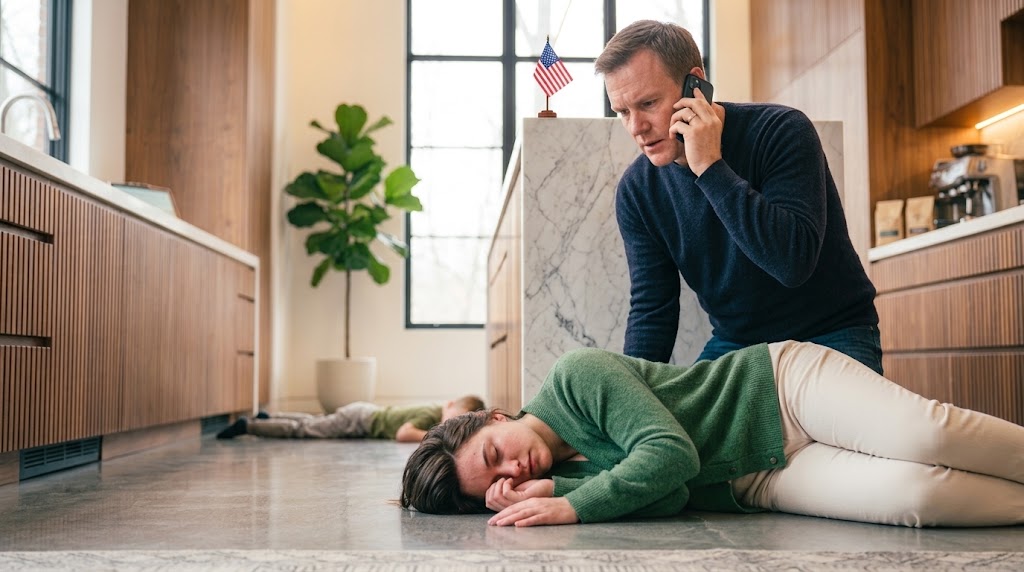
Then I returned to the exact position where Daniel had left me.
My cheek touched the cold tile.
I closed my eyes.
Noah did the same.
The door from the garage opened.
Footsteps entered the kitchen.
Two sets.
Daniel’s were familiar.
Marcus dragged his right foot slightly because of an old skiing injury.
For years, I had teased him about that limp.
Now the sound of it made my skin crawl.
“Are you sure the dose was enough?” Marcus asked.
His voice was barely above a whisper.
Daniel exhaled.
“They both dropped within ten minutes.”
“That wasn’t my question.”
“It was enough.”
Marcus moved closer.
I could smell his cologne.
He crouched beside me.
For one terrible moment, I thought he might check my pulse.
Instead, he lifted my eyelid.
Every instinct screamed at me to flinch.
I didn’t.
“Pupils are sluggish,” he murmured.
Daniel said, “Good.”
“No. Not good. It means they absorbed it, but I told you not to improvise.”
“I didn’t improvise.”
“You gave them dinner too early.”
“It doesn’t matter.”
“It absolutely matters.”
Daniel’s voice hardened.
“They’re unconscious, Marcus.”
“For now.”
I heard fabric move as Marcus stood.
Then his next words turned my blood cold.
“If she wakes before respiratory depression starts, she can call for help.”
Daniel gave a short laugh.
“With what phone?”
My stomach tightened.
Marcus walked toward Noah.
I heard him kneel.
Noah’s breathing stayed slow.
Perfectly slow.
Marcus touched his neck.
I counted silently.
One.
Two.
Three.
Then Marcus stood again.
“The kid’s pulse is stronger.”
“He’s younger.”
“That’s not how this works.”
A cabinet opened.
Glass clinked.
Daniel said, “Then give him more.”
For one second, there was silence.
Marcus replied, “I’m not injecting a fourteen-year-old.”
“You already gave me the medication.”
“That was for Claire.”
My heart seemed to stop.
Daniel stepped closer to him.
“You knew Noah would be here.”
“You said you’d send him to your sister’s.”
“He changed plans.”
“Then you should have changed plans.”
Daniel’s voice dropped dangerously.
“We are too far into this to suddenly develop morals.”
Marcus didn’t answer.
Neither man knew that every word was flowing through the open telephone line to a 911 dispatcher.
I prayed she could hear them.
I prayed the police were close.
Daniel walked toward the refrigerator.
The door opened.
Then closed.
“Where’s the vial?” he asked.
Marcus sounded irritated.
“I gave it to you.”
“I used what you gave me.”
“All of it?”
“You said twelve milliliters.”
“I said six.”
Silence.
A different kind of silence.
Marcus swore under his breath.
“You gave her twelve?”
“I split it between the plates.”
“You idiot.”
A chair scraped.
Daniel said, “What?”
“Depending on how much each of them ate, you could have killed them already.”
“That was the point.”
“No. The point was for this to look like an accident.”
I heard Marcus begin pacing.
“Too much and toxicology will flag it immediately.”
Daniel’s reply came quickly.
“You said it wouldn’t show.”
“I said a therapeutic level might not raise questions in someone with a prescription history.”
“I don’t have a prescription history.”
“She does.”
My thoughts raced.
A prescription history?
Then I remembered.
Six months earlier, after my mother died, Marcus had prescribed me a mild sleep aid.
I had taken exactly three tablets.
The bottle was still in my bathroom cabinet.
Or at least I thought it was.
Marcus continued.
“You were supposed to grind one tablet into her wine, wait until she became drowsy, then stage the rest. I never told you to dump half a bottle of veterinary sedative into dinner.”
Veterinary sedative.
My heart pounded so hard I worried they could hear it.
Daniel hissed, “Keep your voice down.”
“They’re unconscious.”
“Exactly.”
Marcus sighed.
“Where are their phones?”
“In my jacket.”
“And the food?”
Daniel stopped moving.
“What about it?”
“You need to get rid of it.”
My stomach dropped.
The plate.
The untouched food.
If he cleared the table, he might open the freezer later.
He might find the bag.
Daniel walked toward us.
I heard dishes being stacked.
The blue plate lifted from the table.
Then Noah made the smallest sound.
Not a word.
Not even a breath.
A swallow.
But Marcus heard it.
“Wait.”
Everything stopped.
“What?” Daniel asked.
Marcus didn’t answer.
I sensed him moving closer.
Then Noah suddenly convulsed.
His sneaker struck the chair leg.
The chair clattered across the tile.
My eyes snapped open.
“Noah!”
His body jerked once, then curled inward.
The pretending was over.
Daniel froze.
Marcus rushed forward.
I pushed myself up.
Daniel stared at me as if he had seen a corpse sit up.
“What the hell?”
I grabbed Noah.
His eyes were open, but unfocused.
“Mom?”
“I’m here.”
Marcus crouched beside him.
“Move.”
“Don’t touch him!”
“Claire, he needs medical attention.”
“You poisoned him!”
Marcus’s expression changed.
For the first time, fear broke through his controlled face.
“Listen to me.”
“No!”
Daniel backed toward the counter.
His gaze moved from me to the hallway.
To the front door.
To the phone cord stretching from behind the cabinet.
His face drained of color.
“You called someone.”
He lunged toward the phone.
I grabbed the nearest thing I could reach.
A heavy ceramic serving bowl.
I swung it into his forearm.
He shouted and stumbled backward.
The phone receiver flew across the floor.
The dispatcher’s voice crackled through it.
“Claire? Claire, officers are arriving. Stay away from the suspects if possible.”
Daniel heard her.
So did Marcus.
Daniel’s face transformed.
Not panic.
Rage.
“You stupid—”
He stepped toward me.
Marcus grabbed his arm.
“Stop.”
Daniel shoved him.
“Get off me!”
“Police are coming!”
“Then fix it!”
“There is nothing to fix!”
Outside, tires screeched.
Then came the sound I had been praying for.
Sirens.
Close.
Very close.
Daniel ran toward the garage.
Marcus stood frozen.
I pulled Noah against me.
His body had stopped shaking, but he looked exhausted.
“Mom, I feel weird.”
“Stay with me.”
Daniel reached the garage door just as the front of the house exploded with noise.
“Police! Police! Come out with your hands visible!”
Daniel stopped.
He turned toward Marcus.
And I saw something pass between them.
A decision.
Marcus shook his head.
“Don’t.”
Daniel reached inside his jacket.
Marcus shouted, “Daniel!”
Three officers entered from the hallway.
“Hands!”
Daniel froze.
“Hands where we can see them!”
His right hand emerged slowly.
Empty.
One officer forced him to his knees.
Another moved toward Marcus.
Marcus immediately lifted both hands.
“I’m a physician. The boy may have ingested a sedative.”
The officer snapped, “Keep your hands visible.”
Paramedics rushed in behind them.
I moved aside only when they reached Noah.
A woman in navy uniform checked his pupils.
“What did he eat?”
“Dinner. Chicken, rice, sauce. I don’t know what was in it.”
“What symptoms?”
“Dizziness, weakness. We both collapsed. He just had some kind of seizure.”
Another paramedic placed an oxygen mask over Noah’s face.
I grabbed his hand.
“I’m not leaving him.”
“You can come.”
Daniel was on the floor near the pantry with his hands cuffed behind his back.
He looked at me.
Not apologetically.
Not even fearfully.
He looked offended.
As though I had violated some private agreement by surviving.
“Claire,” he said.
I turned away.
“Claire, listen to me.”
An officer stepped between us.
“Don’t speak to her.”
Daniel ignored him.
“It wasn’t what you think.”
I laughed.
It came out broken.
“What exactly do you think I think?”
Marcus stared at the floor.
Daniel’s mouth tightened.
Then I remembered the freezer.
“The food.”
The paramedic looked at me.
“What?”
“I saved some.”
Daniel’s head snapped up.
I pointed toward the freezer drawer.
“In a bag behind the peas.”
One officer retrieved it.
Daniel swore.
That was the moment I knew I had done the right thing.
We were taken to the hospital under police escort.
The ride felt endless.
Noah drifted in and out of consciousness while the paramedic monitored his heart.
I answered questions.
Weight.
Medications.
Allergies.
Time of ingestion.
Amount eaten.
I could barely remember how many bites I had taken.
Maybe seven.
Maybe ten.
Noah had eaten less because he didn’t like the sauce.
That might have saved him.
Or saved us both.
At the hospital, they separated us immediately.
Blood samples.
Cardiac monitoring.
IV fluids.
Toxicology screening.
A nurse took my clothes and sealed them in evidence bags because some of the sauce had spilled onto my sleeve when I fell.
Hours passed under fluorescent lights.
A detective arrived shortly after midnight.
Her name was Elena Ramirez.
She was in her forties, with dark hair pulled into a low bun and the calm expression of someone who had learned not to waste words.
She waited until the doctor said I was stable enough to talk.
Then she pulled a chair beside my bed.
“Mrs. Bennett, I need to ask you some difficult questions.”
“I know.”
“Do you feel safe answering them?”
“Yes.”
“Has your husband ever tried to harm you before?”
I opened my mouth.
Then stopped.
I wanted to say no.
That was the automatic answer.
Daniel had never punched me.
Never shoved me down stairs.
Never threatened me with a weapon.
But as I sat there, I started remembering things differently.
The time he replaced my blood-pressure medication because he said the pharmacy had filled it wrong.
The time I became violently ill during a weekend trip he had insisted we take.
The time my car brakes felt soft and Daniel claimed I was imagining it.
The life insurance salesman who had visited our house two months earlier.
The argument about updating our wills.
The passwords Daniel suddenly wanted access to.
Detective Ramirez watched my face.
“What are you remembering?”
“I don’t know.”
“Take your time.”
I stared at my IV tubing.
“Three months ago, Daniel convinced me to increase my life insurance.”
“How much?”
“Two million dollars.”
She didn’t react.
“Who is the beneficiary?”
“Daniel.”
“And your son?”
“He has a separate policy through a college savings plan.”
“How much?”
I swallowed.
“Five hundred thousand.”
“Beneficiary?”
“Daniel.”
She wrote something down.
“Any major financial problems?”
“Not that I know of.”
“Business problems?”
Daniel owned a commercial real estate consulting firm.
He had always told me it was thriving.
New clients.
New developments.
Bigger contracts.
But suddenly I remembered small things.
He had started checking the mail himself.
He got angry when I asked about taxes.
He had sold his vintage motorcycle even though he loved it.
Last month, I found a bank notice in the recycling bin.
He said it was nothing.
“I need access to our finances,” I said.
Ramirez nodded.
“We’re already pursuing warrants.”
“What about Marcus?”
Her expression shifted.
“Dr. Hale is in custody.”
“Did he admit anything?”
“I can’t discuss his statement yet.”
“Is Noah okay?”
“He’s awake.”
Everything inside me loosened.
“Can I see him?”
“As soon as the physician clears it.”
I closed my eyes.
Tears slipped into my hair.
For the first time since the kitchen floor, I allowed myself to cry.
Noah survived because he had eaten less than half his dinner.
The toxicology report came back the next morning.
Both of us had high levels of medetomidine in our systems.
The emergency physician explained that it was a powerful sedative commonly used in veterinary medicine.
It could cause profound drowsiness, slowed heart rate, low blood pressure, respiratory complications, and loss of consciousness.
Marcus had access to it because he volunteered twice a month at an animal rescue clinic run by his sister.
The bag of food from the freezer tested positive.
So did residue found in a small glass vial recovered from Daniel’s jacket.
That alone would have been enough to turn my world upside down.
But it was only the beginning.
By noon, detectives had searched our house.
They found my old prescription sleep medication in Daniel’s desk.
The label had been altered.
They found copies of my medical records printed from Marcus’s office.
They found a typed document titled “Timeline.”
Detective Ramirez brought me a photograph of it.
8:10 dinner.
8:20 symptoms.
8:30 unconscious.
9:00 transfer.
10:15 call.
11:00 cleanup.
12:30 discovery.
My hands began trembling.
“What does ‘transfer’ mean?”
“We’re investigating that.”
“What does ‘discovery’ mean?”
She hesitated.
“We believe your husband planned to leave the residence and return later.”
“Return to find us dead?”
“That appears to have been the intended narrative.”
My stomach turned.
“What was the call?”
She looked at me.
“We don’t know yet.”
But she did know something.
I could see it.
“What aren’t you telling me?”
Ramirez closed the file.
“Claire, do you know someone named Rebecca Sloan?”
The name meant nothing at first.
Then something clicked.
Sloan.
Sloan Development Group.
One of Daniel’s largest clients.
“I know the company.”
“Rebecca Sloan is their chief financial officer.”
“Okay.”
“Your husband has exchanged more than nine hundred messages with her during the last six months.”
The room seemed to tilt.
“What kind of messages?”
“Personal.”
I looked away.
Of all the things I had learned in twenty-four hours, infidelity should have been the least shocking.
But betrayal has strange layers.
Even when someone has tried to kill you, discovering they kissed someone else still hurts in its own separate place.
“How long?”
“We’re not sure.”
I wiped my face.
“Was she involved?”
“We’re trying to determine that.”
My phone was returned to me that afternoon.
It contained thirty-seven missed calls.
Friends.
Family.
Neighbors.
But one voicemail stood out.
It was from my younger sister, Megan.
“Claire, call me as soon as you get this. Police came by Mom’s old house asking about Daniel. I don’t know what’s happening, but I found something in the storage boxes you gave me. You need to see it.”
Mom’s old house.
Storage boxes.
I called her immediately.
She answered crying.
“What happened?”
“I’ll explain later. What did you find?”
“A letter.”
“From who?”
“Mom.”
My chest tightened.
Our mother had died eight months earlier after a sudden fall down her basement stairs.
Daniel had been the one who found her.
I stopped breathing.
“What does it say?”
Megan was quiet.
Then she whispered, “It’s about Daniel.”
Detective Ramirez was still in the hall.
I waved frantically.
She came in while Megan read the letter over speakerphone.
“Claire, I’m writing this because I don’t know how to bring it up without causing trouble in your marriage. Daniel came to me last week asking about the family trust. He wanted to know whether the house and investment accounts would pass directly to you if something happened to me. I told him that was none of his concern. He became angry. I may be overreacting, but something about the conversation frightened me. Please be careful.”
The letter was dated nine days before Mom died.
I stared at Ramirez.
She stared back.
Something enormous had just opened between us.
“Where was the letter?” she asked.
Megan replied, “Inside Mom’s old recipe binder.”
Ramirez stood.
“Do not touch it again. Put it somewhere safe. An officer will come collect it.”
After the call ended, I whispered, “You think Daniel killed my mother.”
“I think we have to investigate.”
“He found her.”
“Yes.”
“He was alone with her that afternoon.”
“Yes.”
“He told me she must have slipped.”
Ramirez’s voice softened.
“Claire, I need you not to jump ahead of the evidence.”
But my mind was already ahead.
Far ahead.
My mother had never liked Daniel.
She tolerated him because I loved him.
She once told me he smiled with his mouth but not his eyes.
I had laughed.
I had defended him.
Mom had left me nearly one million dollars after her death.
Daniel had encouraged me to move most of it into our joint investment account.
I had refused.
For the first time, I understood how angry that refusal had made him.
Three days later, investigators reopened my mother’s death.
The original ruling had been accidental.
There had been bruising consistent with a fall.
No evidence of forced entry.
No obvious motive.
Now there was a motive.
And there was something else.
A neighbor’s security camera had captured Daniel’s car arriving at my mother’s house forty-seven minutes earlier than he originally told police.
He claimed he arrived around 5:30.
The camera showed him turning into her driveway at 4:43.
Her smartwatch recorded a sudden fall at 5:06.
Daniel called 911 at 5:41.
Thirty-five minutes later.
Thirty-five minutes.
I had spent eight months believing Daniel had discovered my mother’s body and been too traumatized to save her.
Now I wondered whether he had stood beside her and waited.
Marcus changed his story on the fourth day.
His attorney negotiated.
The details came to me gradually because prosecutors didn’t want to overwhelm Noah or me.
Marcus admitted that Daniel had approached him months earlier.
At first, Daniel claimed I was abusing prescription medication.
He said he needed something that would “knock me out” so he could search my phone for proof of an affair.
Marcus knew the request was unethical.
He provided medication anyway.
Then Daniel asked questions about toxicology.
What drugs were hard to detect?
What could resemble accidental overdose?
What slowed breathing?
What happened when sedatives were mixed with alcohol?
Marcus claimed he didn’t realize Daniel intended murder until two weeks before the dinner.
The prosecutors didn’t entirely believe him.
Neither did I.
He had provided access to medication.
He had printed my medical records.
He had helped Daniel plan how my prescription history could be used to confuse investigators.
And on the night we collapsed, he came to our house instead of calling an ambulance.
Whatever doubts he later developed did not erase that.
But his cooperation revealed the larger scheme.
Daniel was broke.
Not struggling.
Not temporarily overextended.
Broke.
His company had lost nearly four million dollars after two commercial projects failed.
He had borrowed against our house without telling me.
He had forged my signature on loan documents.
He owed private lenders hundreds of thousands more.
Worst of all, investigators discovered he had moved nearly six hundred thousand dollars from client escrow accounts to cover his debts.
Sloan Development Group had started an internal audit.
Rebecca Sloan had discovered the missing funds.
That explained the messages.
But not in the way I first assumed.
Rebecca wasn’t Daniel’s mistress.
She was blackmailing him.
Her messages made that clear.
Pay back the money.
Resign quietly.
Give up your equity.
Or she would report him.
Daniel couldn’t repay anything.
But if Noah and I died, he would receive the insurance money, gain access to my inheritance, and sell our house before his fraudulent loans were discovered.
Two and a half million dollars in life insurance.
Nearly one million from my mother’s estate.
My retirement savings.
Our home.
Noah’s college fund.
It would have bought Daniel time.
Maybe even freedom.
Except there was one problem he hadn’t anticipated.
My mother’s trust.
Daniel believed her money had passed directly to me.
It hadn’t.
Mom had quietly placed most of her estate into a trust for Noah.
I was trustee.
Daniel could not access the principal unless both Noah and I were gone.
The first time Detective Ramirez explained that to me, I felt physically ill.
“So Noah wasn’t collateral.”
“No.”
“He was necessary.”
Ramirez didn’t answer.
She didn’t need to.
That truth broke something inside me that betrayal alone could not.
Daniel had raised Noah since he was two.
He coached his soccer team.
Taught him to ride a bike.
Stayed up all night helping him build a science fair volcano that barely worked.
He called him buddy.
He had once driven three hours back from a business trip because Noah was scared before surgery.
None of those memories made sense anymore.
I began questioning everything.
Was any of it real?
Did monsters love people before deciding money mattered more?
Did Daniel change?
Or had I simply never seen him clearly?
Noah asked the same question.
“Did Dad ever love us?”
We were sitting together in my hospital room.
He had been discharged but refused to leave until I was released too.
Daniel was his stepfather legally, but Noah had called him Dad for most of his life.
I didn’t know what answer would hurt less.
“I think people can love someone and still become dangerous.”
“That doesn’t make sense.”
“No.”
He stared at his hands.
“Was he really going to kill me?”
I wanted to lie.
Every mothering instinct told me to protect him.
But he had already heard Daniel say they wouldn’t be a problem after tonight.
He had already felt poison in his own body.
“Yes.”
Noah nodded once.
Then he cried without making a sound.
I held him.
We stayed like that for a long time.
The case against Daniel grew stronger every day.
Then came the most disturbing discovery of all.
Police found a hidden folder on his laptop.
Inside were photographs.
My mother’s basement stairs.
The kitchen floor where Noah and I collapsed.
The electrical panel.
The gas furnace.
Our cars.
The upstairs bathtub.
There were notes under several images.
Fall.
Carbon monoxide.
Brake failure.
Drowning.
Investigators believed Daniel had considered multiple methods before choosing poisoning.
One file had been created eleven months earlier.
Three months before my mother died.
When police searched Daniel’s office storage unit, they found the same type of nonslip shoe covers sometimes used by contractors.
One pair contained microscopic traces of dust matching the limestone from my mother’s basement.
Then the medical examiner reviewed Mom’s original autopsy.
A bruise behind her shoulder didn’t fit the fall as neatly as once believed.
Neither did the position of her body.
The case was officially reclassified as a homicide investigation.
Daniel was charged with my mother’s murder six weeks later.
I learned about it from Detective Ramirez.
She came to my temporary apartment because Noah and I could no longer bear to live in our house.
She sat across from me at the dining table.
“We believe your mother confronted him.”
“About what?”
“The trust.”
My hands went cold.
“He knew?”
“Not everything. But she told him he would never control her money.”
According to prosecutors, Daniel went to Mom’s house that afternoon demanding she change the trust.
She refused.
They argued in the basement.
He pushed her.
Not a shove intended merely to frighten.
A hard push.
She fell backward down the stairs.
But the fall did not kill her instantly.
Her smartwatch showed movement for twenty-three minutes afterward.
Daniel called no one.
He waited.
At some point, he searched her desk.
He was likely looking for trust documents.
Then he called 911 and pretended he had just arrived.
I asked Ramirez the question that had haunted me.
“Did she suffer?”
Ramirez looked down.
“I’m sorry.”
That was answer enough.
I went to the bathroom and vomited.
For weeks after that, I barely slept.
Every sound startled me.
A car door.
A knock.
The refrigerator motor clicking on.
I checked Noah’s breathing three times a night.
I locked doors, then checked them again.
I installed cameras.
I moved twice before I stopped feeling like Daniel somehow knew where we were.
Therapy helped.
So did Noah’s.
We went separately at first.
Then together.
Some days he was angry.
Some days I was.
Some days neither of us said much at all.
One afternoon, three months after the poisoning, Noah brought home a cardboard box from school.
Inside were old photographs.
Daniel at his soccer games.
Daniel holding a birthday cake.
Daniel asleep on the couch while eight-year-old Noah had drawn a mustache on him with washable marker.
“What do I do with these?” Noah asked.
“You don’t have to decide now.”
“I hate looking at him.”
“Then we can put them away.”
“But I don’t want to pretend my whole childhood didn’t happen.”
That sentence stayed with me.
We kept the box.
Not displayed.
Not destroyed.
Just stored.
Because healing, I learned, did not require rewriting every good memory into something ugly.
It required accepting that good memories and terrible truths could exist in the same life.
Daniel’s trial began thirteen months after that night in the kitchen.
He pleaded not guilty.
He wore a navy suit.
His hair had more gray.
He looked thinner.
When I entered the courtroom, his eyes found mine immediately.
For a fraction of a second, I saw the man I had married.
Then I remembered my son lying on the kitchen floor.
I looked away.
The prosecution opened with the 911 recording.
The courtroom listened to my whisper.
“My husband put something in our food.”
Then came Daniel’s voice.
“They won’t be a problem after tonight.”
Marcus’s voice followed.
“Are you sure the dose was enough?”
Daniel stared straight ahead.
The jury listened to everything.
The staged timeline.
The insurance policies.
The forged loan documents.
The toxicology results.
The veterinary medication.
The food sample I had hidden in the freezer.
That freezer bag became one of the most important pieces of evidence.
The prosecutor held it up in a sealed evidence container.
“This exists,” she told the jury, “because Claire Bennett, while impaired by a powerful sedative and terrified for her child, had the presence of mind to preserve what the defendant intended to destroy.”
Daniel’s defense argued that Marcus had acted alone.
They claimed Marcus was obsessed with me.
They claimed he manipulated Daniel.
They suggested I had misunderstood Daniel’s words.
They implied that perhaps I had taken medication voluntarily.
The evidence destroyed each argument.
Daniel’s fingerprints were on the vial.
His search history contained phrases such as sedative overdose symptoms, toxicology detection windows, life insurance accidental death investigation, and how long after death are beneficiaries paid.
Then Rebecca Sloan testified.
She described the missing escrow funds.
The threats.
Daniel’s desperation.
She handed over a recording from a meeting they had held eight days before the poisoning.
Daniel’s voice played through courtroom speakers.
“I’ll have money soon.”
Rebecca answered, “From where?”
“You don’t need to know.”
“I need six hundred thousand dollars.”
“You’ll have it.”
“When?”
“By the end of the month.”
“How?”
Daniel paused.
Then said, “My situation is changing.”
The prosecutor stopped the recording there.
The jury understood.
Marcus testified on the ninth day.
He looked older too.
He admitted supplying the medication.
He admitted falsifying parts of my medical history.
He admitted helping Daniel think through how an overdose might be misinterpreted.
Then the prosecutor asked him the question everyone had been waiting for.
“What did Mr. Bennett tell you would happen to his wife and stepson?”
Marcus swallowed.
“He said they would go to sleep.”
“And then?”
“He said they wouldn’t wake up.”
A murmur moved through the gallery.
Daniel looked at Marcus with pure hatred.
Marcus continued.
“He said after they died, he would call me later and report that he had returned home and found them.”
“Why you?”
“Because I was their physician.”
“And what were you expected to say?”
Marcus closed his eyes.
“That Claire had been struggling with insomnia. That she may have taken medication accidentally.”
“And Noah?”
“He said Noah must have eaten something intended for Claire.”
The prosecutor stepped closer.
“Was Noah’s death accidental?”
Marcus hesitated.
“No.”
“Please clarify.”
“He told me the boy had to die too.”
I stopped breathing.
Beside me, Megan grabbed my hand.
The prosecutor asked, “Why?”
Marcus looked toward me.
Then at the jury.
“Because of the trust.”
Daniel was convicted on every major count.
Attempted murder.
Conspiracy.
Fraud.
Forgery.
Theft.
And, in a separate proceeding six months later, the murder of my mother.
At sentencing, I was allowed to speak.
I stood fifteen feet away from the man with whom I had shared sixteen years.
I had rehearsed a dozen versions of my statement.
Angry versions.
Cruel versions.
Versions where I described every nightmare he gave us.
But when I finally stood at the microphone, I said something simpler.
“You tried to decide the value of our lives.”
Daniel looked at me.
“You calculated what I was worth dead. You calculated what Noah was worth dead. You calculated what my mother’s life was worth when she stood between you and money.”
My hands trembled, but my voice didn’t.
“You were wrong.”
His expression tightened.
“Noah’s life is not an insurance policy. My mother was not an obstacle. And I was never property you could erase when I became inconvenient.”
The courtroom was silent.
“You did take things from us. You took safety. You took trust. You took part of Noah’s childhood. You took my mother.”
I paused.
“But you did not take our future.”
Daniel looked down.
For the first time since the kitchen floor, he seemed small.
Not powerful.
Not brilliant.
Not frightening.
Small.
The judge sentenced him to life without the possibility of parole for my mother’s murder, plus consecutive sentences connected to the attempt on Noah and me.
Marcus received a lengthy prison sentence under his cooperation agreement and permanently lost his medical license.
There were no winners.
People sometimes told me afterward that justice must have felt satisfying.
It didn’t.
Justice was necessary.
But satisfaction is the wrong word.
Nothing about hearing that my husband would die in prison brought my mother back.
Nothing restored Noah’s ability to call someone Dad without feeling sick.
Nothing erased the memory of cold kitchen tile beneath my cheek.
Justice closed a door.
Healing happened somewhere else.
It happened slowly.
In ordinary places.
The first time Noah ate dinner at a friend’s house without texting me to ask whether the food was safe.
The first night I slept six hours without waking up to check the locks.
The first time I cooked chicken with the same sauce Daniel had used that night.
I almost threw it away.
Instead, Noah came into the kitchen, looked at the pan, and said, “Smells good.”
I stared at him.
“You sure?”
He understood.
He always did.
“Yeah.”
We ate it together.
Nothing happened.
And somehow, that tiny dinner felt like winning something back.
Two years after the trial, we returned to my mother’s house.
Megan had kept it while the case moved through court.
We finally decided to sell it.
Before the realtor arrived, Noah and I walked through the rooms one last time.
The basement door was open.
I stopped in front of it.
For a long time, I couldn’t move.
Noah stood beside me.
“You don’t have to go down.”
“I know.”
I went anyway.
The stairs had been replaced during the investigation.
Fresh wood.
New railing.
At the bottom, Mom’s old shelves were still there.
Canning jars.
Christmas decorations.
A box labeled CLAIRE SCHOOL.
I laughed through tears when I opened it.
Inside were certificates, bad drawings, spelling tests, a clay handprint from kindergarten.
Mom had saved everything.
At the bottom was a photograph of her holding newborn Noah.
On the back, she had written:
For my Claire—when life frightens you, remember that courage rarely feels brave while it is happening.
I sat on the basement floor and cried.
Noah sat beside me.
“That sounds like Grandma.”
“Yeah.”
“You were brave that night.”
I shook my head.
“I was terrified.”
He picked up the photograph.
“Maybe that was her point.”
I looked at him.
Fourteen had become sixteen.
His face was changing.
Older.
Stronger.
For a moment, I saw the little boy who used to climb into my bed during thunderstorms.
Then I saw the young man he was becoming.
“You were brave too,” I said.
“I just copied you.”
“No.”
He looked down.
“I knew something was wrong before I fell.”
“What?”
He rubbed the edge of the photograph.
“The food tasted bitter.”
My chest tightened.
“You never told me.”
“I thought Dad had burned the sauce.”
He gave a sad smile.
“Then I saw you fall.”
I remembered.
My fork sliding from my fingers.
The room tilting.
Noah staring at me.
“What did you do?”
“I stopped chewing.”
He hesitated.
“I spit some into my napkin.”
That was why his dose had been smaller.
That tiny instinct had probably saved him.
Maybe saved both of us.
If Noah had fully lost consciousness, I might have believed he was dying and panicked before Daniel left.
If I had moved too soon, Daniel might have acted differently.
Our survival had depended on a hundred small things.
Bitter sauce.
A hidden landline.
A freezer bag.
A dispatcher who listened.
A child who trusted his mother when she whispered, “Don’t move yet.”
We sold Mom’s house that spring.
I used a portion of what she left us to create a scholarship in her name for women returning to school later in life.
She had earned her college degree at fifty-two.
Daniel used to mock that.
He called it sentimental.
I called it perfect.
Noah eventually changed his last name.
He chose mine.
Not because I asked.
One day, he came home with paperwork and set it on the kitchen table.
“Bennett reminds me of him,” he said. “I want Grandma’s name.”
My maiden name was Whitaker.
So at seventeen, Noah became Noah Whitaker.
I became Claire Whitaker again shortly after.
We didn’t celebrate with anything dramatic.
Just pizza.
A cheap cake.
And two candles shaped like a W.
Three years after the poisoning, Detective Ramirez called me.
I still had her number saved.
My stomach tightened when I saw it.
“Everything okay?”
“Everything’s fine.”
She sounded almost amused.
“I’m retiring.”
I smiled.
“You earned it.”
“I wanted you to know something before I left.”
“What?”
“You remember the dispatcher from your 911 call?”
“Of course.”
“Her name is Denise Carter.”
I waited.
“She asked about you more than once.”
My throat tightened.
“Really?”
“She said she never forgot the call.”
“Neither did I.”
Ramirez gave me Denise’s contact information after confirming she was comfortable with it.
Two weeks later, Noah and I met her at a coffee shop.
She was younger than I imagined.
Mid-thirties.
Curly hair.
Bright red glasses.
When she saw us, she stood so quickly she nearly knocked over her chair.
She hugged me.
Then Noah.
“I heard everything,” she said.
I sat down.
“Everything?”
“Enough.”
Her eyes filled.
“When your husband said they wouldn’t be a problem after tonight, I upgraded the call immediately. I told responding officers there was an active poisoning and possible homicide in progress.”
“That’s why they came so fast.”
She nodded.
“When the second man mentioned giving your son more, I thought…”
She stopped.
Noah leaned forward.
“You thought we were dead?”
“I thought I was listening to two people about to die.”
He looked at me.
Then back at her.
“But we didn’t.”
Denise smiled through tears.
“No.”
I reached across the table and held her hand.
“You helped make sure we didn’t.”
For years afterward, people asked why I pretended to be unconscious instead of confronting Daniel immediately.
The answer is simple.
Fear made me observant.
If I had stood up the moment I heard his phone call, I might not be alive.
If Noah had shouted, Daniel might have stopped us from reaching the phone.
If I had run for the front door, we might have collapsed before getting outside.
There was no brilliant strategy.
No superhuman courage.
I was a frightened mother lying on a kitchen floor trying to keep my child alive.
So I listened.
I waited.
I saved the food.
I found the phone.
I called for help.
And sometimes survival is nothing more glamorous than that.
One decision.
Then another.
Then another.
Years later, I bought a smaller house.
Different neighborhood.
Different kitchen.
Bright windows.
No garage entrance near the stove.
I chose it because the first time Noah walked inside, he opened the back door and said, “This place has good exits.”
We both laughed.
Dark humor becomes a strange kind of medicine after trauma.
On the day he left for college, I stood in that kitchen watching him stuff too many snacks into his backpack.
“You have a meal plan,” I said.
“I know.”
“You don’t need twelve granola bars.”
“I might.”
“You won’t.”
He zipped the bag.
Then he stopped.
For half a second, I knew exactly what he was remembering.
Food.
Trust.
Control.
He looked at me.
“Mom?”
“Yeah?”
“I’m okay.”
I smiled.
“I know.”
“And you’re okay?”
I thought about the question.
Once, I would have lied.
Now I understood that okay did not mean untouched.
It meant living.
It meant remembering without being controlled by the memory.
It meant walking into kitchens.
Eating dinner.
Sleeping with the lights off.
Trusting carefully.
Loving again, eventually.
Not Daniel.
That chapter was closed.
But friends.
Family.
Myself.
“Yes,” I said.
“I’m okay.”
Noah hugged me.
Then he whispered the same words I had whispered to him years earlier on the kitchen floor.
“Don’t move yet.”
I pulled back.
“What?”
He grinned.
Then reached behind me and grabbed the car keys I had forgotten on the counter.
“You’ll need these if you’re driving me.”
I laughed so hard I cried.
Real laughter.
The kind that hurt your ribs.
And for one beautiful second, that sentence belonged to us again.
Not to fear.
Not to Daniel.
To us.
As we drove away, I looked back at the house.
Sunlight filled the kitchen windows.
There was no blue plate.
No hidden vial.
No man whispering into a phone about how soon we would be gone.
There was only an empty breakfast cup beside the sink, two slices of toast on a plate, and a freezer filled with ordinary food.
Once, ordinary had seemed boring.
Now I knew better.
Ordinary was precious.
Ordinary was waking up.
Ordinary was your child complaining about homework.
Ordinary was forgetting the car keys.
Ordinary was dinner that was only dinner.
Daniel had believed that by taking our lives, he could solve his problems.
Instead, he destroyed his own.
He believed money would erase evidence.
He believed friendship would buy silence.
He believed a doctor could disguise murder as tragedy.
Most of all, he believed unconscious people could not hear him.
He was wrong about that too.
I heard every word.
So did Noah.
So did the dispatcher.
And in the end, the sentence Daniel whispered because he thought I was helpless became one of the sentences that buried him.
“It’s done.”
No.
It wasn’t.
Not even close.
Because that night was not the end of my life.
It was the end of his control over it.
And the moment I opened my eyes on that cold kitchen floor and whispered to my son, “Don’t move yet,” I wasn’t surrendering.
I was surviving.
One breath at a time.
💬THE END! THANK YOU FOR READING!