

Vanessa’s designer handbag slipped from her fingers, slamming onto the polished marble floor.
The sound echoed through the cathedral.
Nobody moved.
Nobody spoke.
Even Julian seemed to forget how to breathe.
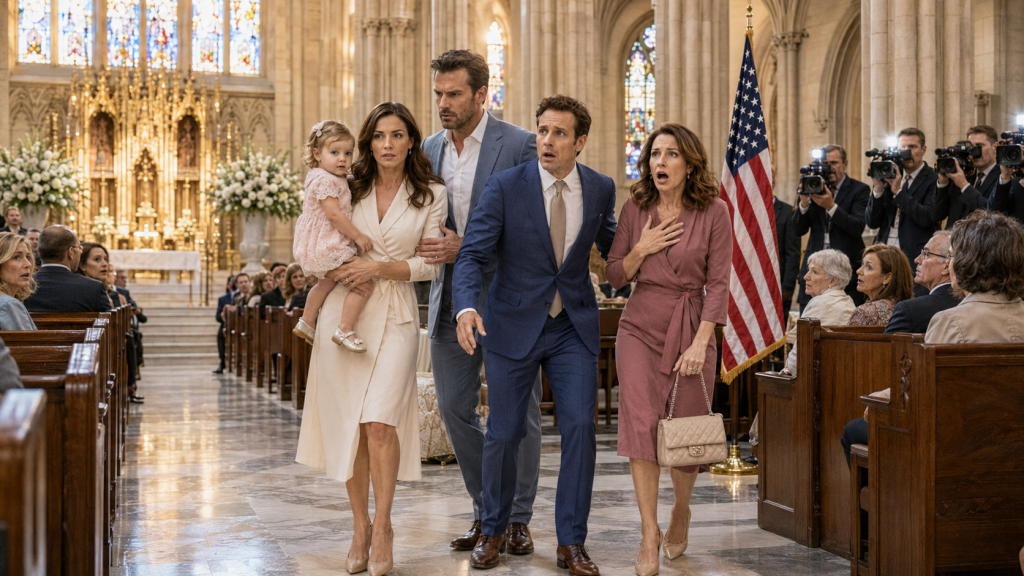
Harrison Sterling continued walking toward me as if the hundreds of people staring at him did not exist. Beside him, the little girl in the black velvet coat looked around the cathedral with enormous hazel eyes.
Then she saw me.
Her entire face lit up.
“Mommy!”
She pulled her hand free from Harrison’s and ran.
The silence shattered beneath the quick tapping of her tiny shoes.
I dropped to my knees just as she reached me.
“Grace.”
She threw her arms around my neck.
“I missed you.”
“I missed you too, sweetheart.”
I kissed her forehead and held her against me.
When I looked up, Julian’s expression had transformed from arrogance to complete disbelief.
His eyes moved from me to Grace.
Then from Grace to Harrison.
Then back to me.
Vanessa looked worse.
Her face had gone pale beneath layers of expensive makeup.
Harrison reached us and rested one hand gently against my shoulder.
“Sorry we’re late,” he said quietly. “The board meeting went longer than expected.”
He leaned down and kissed my cheek.
Somewhere behind us, someone gasped.
The photographers at the rear of the cathedral began taking pictures so quickly that the flashes looked like lightning.
Julian finally found his voice.
“What is this?”
Harrison turned.
For the first time, he acknowledged him.
“Julian Vance.”
Julian swallowed.
Everyone in the business community knew Harrison Sterling.
Sterling Global controlled infrastructure, shipping technology, renewable energy, venture capital, and industrial logistics operations across four continents.
Three months earlier, Sterling Global had acquired Crown Meridian Shipping.
Crown Meridian was Julian’s largest corporate client.
Without them, Vance Logistics would lose nearly forty percent of its annual revenue.
Julian forced a nervous laugh.
“Mr. Sterling.”
“Harrison is fine.”
Julian glanced at me.
“You know Evelyn?”
Harrison looked at him almost curiously.
“Yes.”
Vanessa’s fingers tightened around Julian’s arm.
“How?”
Harrison smiled.
“She’s my wife.”
The cathedral erupted in whispers.
Julian actually took a step backward.
Vanessa stared at my left hand.
I had deliberately worn black gloves during the memorial reception.
Slowly, I removed the glove from my left hand.
A platinum wedding band rested beneath a simple emerald-cut diamond.
Vanessa’s mouth fell open.
Julian looked as though someone had struck him.
“You’re married?”
“For nearly four years.”
“And you never told anyone?”
I stood.
“I told the people who mattered.”
His face tightened.
The insult landed exactly where I intended.
Seven years earlier, Julian had believed abandoning me the night before our wedding would destroy me.
For a while, it almost had.
Not because I missed him.
Because humiliation has a strange way of becoming grief.
I had spent four years loving someone who had treated my loyalty like a resource he could exploit.
I had funded his company when banks refused him financing.
I had introduced him to my father’s industrial contacts.
I had rewritten investor presentations at midnight.
I had negotiated warehouse agreements while Julian played golf with men he wanted to impress.
I thought we were building a life.
Julian thought I was building his escape route.
When he walked into my bridal suite with Vanessa, I finally understood the difference.
My stepsister had always wanted whatever belonged to me.
When we were teenagers, she borrowed my clothes without asking.
At university, she dated a boy immediately after he broke up with me.
When my father promoted me inside Whitmore Industrial, Vanessa accused him of favoritism even though she had refused every entry-level position he offered her.
Julian was simply the biggest thing she had ever stolen.
The strange thing was that once the wedding was canceled, I discovered how little of my future had actually depended on him.
I withdrew the personal guarantees I had made for his company.
I resigned from the advisory role I had held unofficially.
I stopped introducing him to suppliers.
Within six months, Julian learned something important.
My money had not merely helped his company.
My reputation had kept it alive.
But my father, Robert Whitmore, asked me not to destroy him.
“Walk away,” he said.
So I did.
I moved to London for two years to oversee Whitmore Industrial’s European expansion.
That was where I met Harrison.
Not at a gala.
Not at a billionaire’s private island.
Not through some arranged business introduction.
I met him in an airport lounge after he accidentally spilled coffee across a stack of contracts I had spent six hours annotating.
He apologized.
I told him his apology was useless unless he could reproduce forty-seven pages of handwritten notes.
He laughed.
I didn’t.
Twenty minutes later, Harrison Sterling was sitting beside me with a laptop, helping reconstruct every annotation from memory.
At the time, I knew his surname.
I did not know exactly who he was.
He introduced himself simply as Harrison.
For three months, we kept running into each other.
London.
Zurich.
Singapore.
Chicago.
Eventually I realized those encounters were not coincidences.
“You’re stalking my conference schedule,” I accused him over dinner in Paris.
“I prefer strategic persistence.”
“You are insufferable.”
“You keep having dinner with me.”
“That’s because the restaurants are excellent.”
He smiled.
“I’ll take what I can get.”
Harrison never asked me to shrink.
That was the first thing I noticed.
If I worked late, he brought dinner.
If I disagreed with him, he listened.
If I challenged his assumptions in meetings, he challenged mine.
He never called ambition masculine.
He never treated intelligence like an inconvenience.
And when I told him about Julian, Harrison did not say I should forgive.
He did not say I should get revenge.
He simply said, “Anyone stupid enough to lose you has already punished himself.”
Two years later, we married quietly at my father’s estate in Connecticut.
Only fourteen people attended.
Dad walked me down the garden path.
Harrison cried.
I did too.
Grace was born the following year.
My father adored her.
He kept a framed photograph of her beside his desk until the day he died.
Julian knew none of this.
Neither did Vanessa.
Because after what happened seven years earlier, I stopped allowing them access to my life.
They mistook silence for emptiness.
That was their first mistake.
Their second was believing my father’s funeral was an opportunity.
A man in a dark suit approached.
Arthur Bell.
My father’s attorney for thirty-eight years.
He carried a black leather portfolio.
“Evelyn.”
I nodded.
Arthur looked toward Julian and Vanessa.
“There are matters concerning Robert’s estate that must be addressed after the service.”
Vanessa recovered enough to straighten her shoulders.
“Yes,” she said quickly. “Obviously. We’re family.”
Arthur looked at her.
“No, Mrs. Vance. I was speaking to Evelyn.”
Her expression hardened.
“My mother was married to Robert for twenty-three years.”
“That is correct.”
“And Robert treated me like a daughter.”
Arthur remained expressionless.
“That statement may be debated elsewhere.”
Several people nearby turned away to hide smiles.
Vanessa flushed.
Julian stepped forward.
“This isn’t appropriate.”
Harrison looked at him.
“No. Interrupting a memorial service to mock the deceased man’s daughter probably wasn’t appropriate.”
Julian’s jaw tightened.
“You don’t know the history.”
“I know more than you think.”
Before Julian could answer, the cathedral organ began.
I took Grace’s hand.
“This is my father’s funeral,” I said. “Whatever arguments you came here to start can wait.”
Then I walked toward the front pew.
Harrison sat beside me.
Grace climbed between us.
For the next seventy minutes, I tried to forget Julian and Vanessa existed.
The priest spoke about my father’s generosity.
His stubbornness.
His love of engineering.
His habit of carrying a pocket notebook everywhere.
Three longtime employees told stories.
One described how Dad paid the college tuition of a machinist’s daughter after the machinist died unexpectedly.
Another remembered him spending Christmas morning repairing a broken factory heating system alongside maintenance crews.
I cried quietly when the choir sang his favorite hymn.
Grace reached up and wiped my cheek.
“Grandpa is with the stars now?”
“That’s what he told you, remember?”
She nodded.
“He said I should look up.”
Harrison squeezed my hand.
After the final prayer, mourners began moving toward the adjoining reception hall.
Arthur asked immediate family to remain.
Vanessa sat in the second row.
Julian beside her.
My stepmother, Diane, remained near the aisle.
Diane had married my father when I was fourteen.
For years our relationship had been complicated but civil.
After Vanessa’s betrayal, something changed.
Diane had known about the affair.
That was the truth that damaged our relationship permanently.
She admitted it six months after the canceled wedding.
She had discovered Julian and Vanessa together almost five months before my wedding.
Instead of telling me, she convinced herself the affair would end.
She did not want Vanessa publicly disgraced.
She did not want the family scandal.
So she stayed silent.
My father never fully forgave her.
Neither did I.
Still, Dad remained married to her until his death.
Illness has a way of rearranging priorities.
Diane cared for him faithfully during his final eighteen months.
I respected her for that.
But respect did not erase history.
Arthur stood near the altar.
“This is not the formal estate reading,” he explained. “That will take place tomorrow. However, Robert left specific instructions that several items be disclosed immediately following his funeral.”
Julian crossed his arms.
Vanessa looked annoyed.
Arthur opened the portfolio.
“First, Robert Whitmore’s controlling interest in Whitmore Industrial was transferred into the Evelyn Whitmore Sterling Family Trust eighteen months ago.”
Vanessa blinked.
“What?”
Arthur continued.
“Mrs. Evelyn Sterling currently controls fifty-eight percent of voting shares.”
Julian turned toward me.
“That’s impossible.”
Harrison almost smiled.
Arthur ignored him.
“Second, the Manhattan residence, the Connecticut estate, and Robert’s investment holdings were transferred into separate trusts. Beneficiaries are specified privately.”
Vanessa stood.
“My mother is his wife.”
Arthur nodded.
“Mrs. Diane Whitmore has been very generously provided for.”
“Then what do I get?”
The question hung in the cathedral.
Even Diane looked embarrassed.
“Vanessa,” she whispered.
“What? We’re all thinking it.”
“No,” Diane said. “We aren’t.”
Arthur removed an envelope.
“Robert left you this.”
Vanessa grabbed it.
She tore it open.
Inside was a single sheet of paper.
Her expression changed as she read.
“What does it say?” Julian asked.
Vanessa stared at the page.
Arthur answered.
“It says, ‘Vanessa, I gave you opportunities. Evelyn gave you loyalty. You mistook both for weakness. I hope someday you understand the difference.’”
Julian scoffed.
“That’s it?”
Arthur nodded.
“That is the entirety of Mr. Whitmore’s direct bequest to Mrs. Vance.”
Vanessa looked toward her mother.
“You let him do this?”
Diane’s face crumpled.
“I didn’t control Robert.”
“You were his wife.”
“I was also the woman who spent twenty-three years watching you demand things you never earned.”
Vanessa went still.
I had never heard Diane speak to her that way.
Neither had anyone else.
“You’re choosing her now?”
Diane looked exhausted.
“This isn’t about choosing Evelyn. This is about the fact that your stepfather is dead and you are standing inside his funeral asking what you inherited before his flowers have even been removed.”
Vanessa’s eyes filled with fury.
“You promised me.”
“I promised you I would love you. I never promised you Robert’s company.”
Julian stood.
“This is absurd. Vanessa was practically his daughter.”
My father’s former COO, Martin Reeves, who had remained near the back, finally spoke.
“Then perhaps she should have visited him while he was dying.”
Julian turned sharply.
Martin continued.
“Evelyn was here every week. Vanessa came twice in eighteen months.”
Vanessa’s face turned red.
“I had children.”
“You had nannies.”
“That is none of your business.”
“You made it everyone’s business when you came here expecting ownership.”
Julian’s expression became increasingly tense.
This was not how he had expected the afternoon to go.
He looked toward Harrison.
“Mr. Sterling, perhaps we should discuss Crown Meridian privately.”
Harrison checked his watch.
“No.”
Julian stared.
“No?”
“This is my wife’s father’s funeral.”
“I understand, but given your company’s acquisition—”
“You’ll hear from our executives.”
Julian lowered his voice.
“I think you should understand that Vance Logistics manages a significant percentage of Meridian’s East Coast operations.”
“I understand perfectly.”
Julian’s shoulders loosened slightly.
Then Harrison continued.
“That’s why we terminated the contract this morning.”
Silence.
Julian stared at him.
“You what?”
“The termination notice was delivered to your office at nine fourteen.”
“You can’t terminate us.”
“We can.”
“Our agreement has another thirty-one months.”
Harrison nodded.
“It also contains a material nondisclosure clause.”
Julian’s confidence vanished.
Vanessa looked between them.
“What are you talking about?”
Harrison said nothing.
Arthur closed his folder.
I understood immediately.
Three weeks before my father died, Sterling Global’s compliance department discovered irregularities involving Vance Logistics.
Julian had been selling confidential Crown Meridian shipping forecasts to a competing freight brokerage.
He used insider routing data to underbid Meridian subsidiaries through shell companies.
The investigation was ongoing.
Until that moment, Julian did not know we knew.
“Harrison,” I said softly.
He looked at me.
“Not here.”
He nodded.
I was not protecting Julian.
I was protecting my father’s funeral from becoming a corporate crime scene.
Harrison turned toward him.
“You’re right. Another day.”
Julian’s face remained gray.
The reception passed under a cloud of whispers.
News had already spread.
By the time we left the cathedral, photographs of Harrison kissing my cheek were appearing on business websites.
Headlines called me his “secret wife,” which amused him.
“You’re apparently mysterious now,” he said while we sat in the back of our car.
“I always wanted to be mysterious.”
“You alphabetize the refrigerator.”
“That is organization.”
“That is terrifying.”
Grace giggled between us.
I leaned my head against Harrison’s shoulder.
For the first time all day, I laughed.
Then my phone vibrated.
Julian.
I declined the call.
It rang again.
Declined.
Again.
Harrison raised an eyebrow.
“Persistent.”
“He learned from the best.”
The phone stopped.
Then came a message.
We need to talk. You owe me an explanation.
I stared at the screen.
Seven years earlier, he had canceled our wedding with less emotion than someone canceling a restaurant reservation.
Now he believed I owed him something.
I blocked his number.
The formal will reading took place the next morning at Arthur’s office.
Diane attended.
Vanessa arrived with Julian.
I came alone.
Harrison offered to join me, but I wanted to handle my father’s estate as Robert Whitmore’s daughter, not Harrison Sterling’s wife.
Arthur began.
Diane received the Manhattan apartment she and my father had shared, a twenty-million-dollar trust, lifetime medical care, and several personal properties.
She cried.
“My God.”
Arthur looked at her kindly.
“Robert wanted you comfortable.”
She covered her mouth.
“He was angry with me.”
“He was also married to you for twenty-three years.”
Diane looked toward me.
“I didn’t deserve his kindness.”
“That wasn’t your decision to make,” I said.
She nodded through tears.
Vanessa sat rigidly.
Arthur continued.
Several charitable foundations received substantial bequests.
Longtime employees received bonuses.
My father’s art collection went partly to museums and partly to me.
Then Arthur reached the final document.
“Robert’s remaining personal estate passes to Evelyn.”
Vanessa laughed bitterly.
“Of course.”
Arthur looked up.
“There is one additional matter.”
Julian shifted.
My father had left a recorded message.
Arthur pressed a button.
Dad’s face appeared on a large screen.
He looked thin.
Ill.
But his eyes were sharp.
“Evelyn,” he began, “if you’re watching this, then Arthur ignored my instructions to make me look twenty years younger.”
I laughed despite myself.
Arthur smiled.
Dad continued.
“I made mistakes with this family. The greatest was believing silence could preserve peace.”
My chest tightened.
“I watched people hurt you because I thought protecting everyone would eventually bring us back together. It didn’t. Sometimes peace without accountability is only permission.”
Vanessa looked away.
Dad looked directly into the camera.
“Vanessa, I loved you. You may not believe that. But I did. I paid for your education. I offered you work. I gave you chances to become part of what we were building. You wanted the result without the responsibility.”
Vanessa’s eyes filled.
“And Julian. If you’re sitting beside her, then I assume you still believe what you took from Evelyn was the best thing you ever gained.”
Julian stiffened.
Dad smiled faintly.
“You never understood my daughter.”
I looked down.
“She was never valuable because she would inherit my company. The company became valuable because people like Evelyn were willing to build it.”
Julian’s jaw clenched.
Dad paused.
“Evelyn, I’m sorry I didn’t tell you sooner that I knew how much of Julian’s original business survived because of you. I kept records. Arthur has them.”
My head snapped toward Arthur.
He nodded.
Dad continued.
“Every loan. Every introduction. Every personal guarantee.”
Julian slowly turned toward me.
“I instructed Arthur to preserve those records because men like Julian often rewrite history.”
The recording ended several minutes later.
No one spoke.
Then Arthur slid a folder toward me.
Inside were financial documents I had not seen in years.
Checks.
Wire transfers.
Loan guarantees.
Emails.
Introductions.
Everything.
Julian looked uneasy.
“What exactly is that?”
“My father’s records.”
“For what purpose?”
Arthur answered.
“Historical clarity.”
Julian stood.
“This is ridiculous.”
“Sit down,” Vanessa whispered.
He ignored her.
“Your family has been obsessed with blaming me for everything for seven years.”
I looked at him.
“No one is blaming you for everything.”
“You married the richest man in the city and now suddenly my company loses its biggest contract the morning of Robert’s funeral?”
“That investigation began before my father died.”
Julian stared.
“What investigation?”
I said nothing.
His eyes narrowed.
“You did this.”
“No.”
“You’ve been waiting seven years to punish me.”
“Julian.”
He leaned forward.
“You expect me to believe Harrison Sterling randomly fell in love with you?”
The room became very quiet.
Vanessa closed her eyes.
Even she knew he had gone too far.
I stood.
“You still think this is about you.”
He laughed.
“Isn’t it?”
“No.”
I picked up my handbag.
“That may be the saddest thing about your life.”
I left.
Three days later, the first subpoena arrived at Vance Logistics.
The Securities and Exchange Commission was not involved.
Not yet.
The investigation began as a civil audit by Sterling Global.
But it uncovered more.
Julian had created three shell transportation companies.
He secretly awarded subcontracting work to those companies, then billed clients inflated rates.
Vanessa owned forty percent of one shell corporation.
Her signature appeared on documents.
She claimed she knew nothing.
Julian claimed she handled the accounts.
Their marriage began collapsing almost immediately.
I heard about it through Diane.
I never asked.
She simply called one evening.
“Vanessa says Julian is blaming her.”
“She’ll survive.”
“Evelyn.”
“Yes?”
“I owe you an apology.”
I remained silent.
“I should have told you about the affair.”
“Yes.”
“I thought I was protecting my daughter.”
“You were.”
“I hurt you to do it.”
“Yes.”
Her voice shook.
“I have regretted it every day.”
I sat beside the window overlooking Central Park.
Grace was asleep.
Harrison was still working.
“I don’t hate you, Diane.”
She cried quietly.
“That somehow makes it worse.”
“I spent years being angry. Then I realized anger was keeping me connected to a day I wanted to forget.”
“I don’t expect forgiveness.”
“I’m not sure forgiveness is a single decision.”
“No.”
“But Dad loved you.”
She sobbed.
“He did.”
“And you took care of him.”
“I tried.”
“That matters to me.”
We did not repair twenty-five years in one conversation.
But we began.
A month after the funeral, Vance Logistics lost two additional clients.
Then a bank froze one of its credit facilities.
Julian went on business television and blamed “aggressive consolidation by multinational conglomerates.”
He did not mention the audit.
Then a journalist discovered that Evelyn Whitmore Sterling, daughter of Robert Whitmore, was married to Harrison Sterling.
Suddenly the story became irresistible.
The woman abandoned before her wedding had secretly married one of the most powerful businessmen in America.
I hated the headlines.
Harrison loved teasing me about them.
“My mysterious billionaire husband,” I read aloud one morning.
He poured coffee.
“I like mysterious.”
“This one says I orchestrated your acquisition of Crown Meridian to destroy Julian.”
“Impressive.”
“I was apparently planning revenge while giving birth to Grace.”
“Efficient.”
I threw a napkin at him.
Grace laughed from her high chair.
For all the noise outside, our home remained ordinary.
Breakfast.
Bath time.
Business calls.
Half-finished puzzles.
Harrison reading bedtime stories with terrible character voices.
That normality was everything Julian had once convinced me I was incapable of having.
I had believed him.
For longer than I wanted to admit.
At thirty-two, hearing the man you planned to marry tell you that you were too cold, too ambitious, too old to become the kind of woman he wanted leaves scars.
Even when you know he is cruel.
Even when you know he is wrong.
Part of you remembers.
When I met Harrison, I kept waiting for him to notice whatever defect Julian had supposedly discovered.
One night during our first year together, I finally told him.
“What happens when you decide I work too much?”
He looked confused.
“Then I tell you.”
“What happens when you want someone softer?”
“I buy a pillow.”
I stared at him.
He smiled.
Then his expression became serious.
“Evelyn, love is not hiring someone for a position.”
That sentence changed something inside me.
Julian had loved what I could provide.
Harrison loved who arrived after all the providing stopped.
Six weeks after Dad’s funeral, Julian came to my office.
He bypassed reception by following an employee through the security gate.
By the time my assistant alerted me, he was already outside my door.
“Evelyn.”
Security stood behind him.
“It’s fine,” I said.
They remained nearby.
Julian entered.
He looked different.
His tailored suit was wrinkled.
His face was thinner.
“We need to talk.”
“You keep saying that.”
“You won’t answer.”
“That should tell you something.”
He closed the door.
“Sterling is destroying me.”
“Harrison doesn’t manage the compliance investigation.”
“Don’t insult me.”
“I’m telling you the truth.”
Julian paced.
“They’re accusing me of fraud.”
“Did you commit fraud?”
He stopped.
“You think you’re better than me.”
“No.”
“You always did.”
“No, Julian. I thought we were equals.”
“That was the problem.”
I stared at him.
There it was.
Seven years later.
Finally.
“The problem?”
He laughed bitterly.
“You never needed me.”
I leaned back.
“You resented me because I was capable?”
“You don’t understand.”
“Explain.”
“Every room we walked into, people knew your father. They knew you. They asked your opinion before mine.”
“So?”
“I was supposed to be your husband.”
“And?”
“And I was tired of being Evelyn Whitmore’s boyfriend.”
My voice softened.
“So you chose Vanessa.”
“She made me feel important.”
I nodded.
He seemed surprised.
“You understand?”
“Yes.”
Relief flickered across his face.
Then I continued.
“You wanted admiration more than partnership.”
His expression hardened again.
“You weren’t easy to love.”
“Maybe.”
I stood.
“But you didn’t have to betray me.”
He looked away.
I walked around the desk.
“You could have ended our engagement.”
“I know.”
“You could have told me months before the wedding.”
“I know.”
“You could have returned the money I invested.”
Silence.
“You could have refused to humiliate me.”
“I know.”
I looked at him carefully.
“So whatever happened afterward was built from choices you made.”
He swallowed.
“I need help.”
There it was.
The real reason.
“With what?”
“The investigation.”
“I can’t interfere.”
“You can talk to Harrison.”
“No.”
“Evelyn.”
“No.”
His voice rose.
“I could lose everything.”
I looked at him.
“I lost everything too.”
He blinked.
“Seven years ago.”
“That’s different.”
“Why?”
“You rebuilt.”
“So can you.”
He stared at me.
For the first time, I saw fear rather than arrogance.
“What about my children?”
I paused.
Julian and Vanessa had two sons.
Five and six.
None of this was their fault.
“They will not starve.”
“What does that mean?”
“If your financial situation becomes catastrophic, I will make sure your children have access to schooling and healthcare through a trust.”
His eyes widened.
“You’d do that?”
“For them.”
Not for him.
He understood.
“What about Vanessa?”
“She is their mother.”
“You hate her.”
“No.”
He frowned.
“You don’t?”
“I stopped caring enough.”
That hurt him more than anger would have.
Security escorted him out.
Two days later, Vanessa came to my home.
Harrison was away in Boston.
Grace was upstairs with her nanny.
I almost refused to see her.
Then I remembered my father’s words.
Peace without accountability is permission.
So I let her in.
Vanessa looked exhausted.
No makeup.
No jewelry except her wedding band.
For several seconds, we simply stared at each other.
She spoke first.
“Julian came here?”
“To my office.”
“He told me.”
I waited.
“He wants me to take responsibility for the shell companies.”
“Did you know about them?”
“One.”
“Which one?”
“Vantage Freight.”
I knew it.
“You signed incorporation documents.”
“Yes.”
“Why?”
“He told me it was for tax planning.”
“Did you believe him?”
She hesitated.
“No.”
At least that was honest.
“He said everybody does things like this.”
“Everybody doesn’t.”
“I know.”
She sat.
“I could be charged.”
“Possibly.”
“My boys could lose both parents.”
“That depends on what you did.”
She looked at me with sudden anger.
“Don’t pretend you care.”
“I care about your children.”
“You think you’ve won.”
I almost laughed.
“Vanessa.”
“You have the company. Harrison. Your daughter. Dad left you everything.”
“Dad wasn’t your father.”
“He raised me.”
“He tried to.”
Her eyes flashed.
“You always looked down on me.”
“No. I spent years trying to include you.”
“You had everything.”
“No.”
“Yes! You were smarter. Dad respected you. Teachers liked you. Men listened to you. Everything you touched worked.”
“That is not how my life felt.”
“You were the golden daughter.”
“You slept with my fiancé.”
She looked down.
The anger left my voice.
“You had twelve weeks of pregnancy to tell me before my wedding.”
Tears appeared in her eyes.
“I wasn’t pregnant.”
I froze.
“What?”
Vanessa stared at the floor.
“I wasn’t pregnant.”
For several seconds, I could not understand the words.
Then I did.
“The baby?”
“There was no baby.”
My stomach turned.
“You lied.”
“Yes.”
“Why?”
“Because Julian kept saying he would leave you, but he never did.”
I sat slowly.
Vanessa continued crying.
“The wedding was getting closer. He panicked. I panicked. I told him I was pregnant.”
“And he believed you?”
“I showed him a test.”
“How?”
“My friend was pregnant.”
I felt physically sick.
“So the entire thing…”
“He found out three months after the wedding.”
“The wedding?”
My eyes narrowed.
“You married him anyway.”
She nodded.
Of course.
They had proceeded with the ceremony I planned.
Same ballroom.
Same flowers.
Same menu.
Only the bride changed.
“What happened when he learned?”
“He was furious.”
“But stayed.”
“I became pregnant with Noah two months later.”
I stood and walked toward the window.
Seven years.
For seven years, I had believed Vanessa was carrying Julian’s child when he abandoned me.
It had never been true.
Behind me she whispered, “I’m sorry.”
I turned.
“Why tell me now?”
“Because everything is falling apart.”
There it was.
Not conscience.
Consequences.
“You want something.”
She started crying harder.
“I need help.”
“With the investigation.”
“Yes.”
“No.”
“Evelyn.”
“No.”
“I’m your sister.”
“You remembered that very late.”
“We grew up together.”
“Yes.”
“You can’t let me go to prison.”
“I’m not sending you anywhere.”
“You know what I mean.”
“I can’t erase evidence.”
“Harrison can.”
I stood so quickly she flinched.
“Never ask me that again.”
“I’m desperate.”
“Then tell the truth.”
She stared at me.
“All of it.”
“Julian will destroy me.”
“Maybe.”
“He’ll take the boys.”
“Then get a lawyer.”
“He controls the money.”
“Diane has money.”
Vanessa blinked.
I continued.
“Your mother has more than enough resources to help you retain independent counsel.”
“She won’t speak to me.”
“She will if the children need her.”
Vanessa wiped her face.
“You really won’t help me?”
“I just did.”
She looked confused.
“Tell the truth. Get your own lawyer. Stop protecting Julian.”
Her face twisted.
“You still hate me.”
“No.”
I opened the door.
“I just finally learned not to rescue people from choices they keep making.”
She left.
That evening, I told Harrison everything.
Including the fake pregnancy.
He stared at me.
“She lied?”
“Yes.”
“About carrying his child?”
“Yes.”
He shook his head.
“That is…”
“Psychotic?”
“I was going to say desperate.”
“Very diplomatic.”
He pulled me toward him.
“How do you feel?”
“I don’t know.”
That was true.
Angry.
Vindicated.
Sad.
Mostly tired.
For years, I had replayed that bridal-suite moment and wondered how long Julian had known Vanessa was pregnant.
Now I knew.
He had been manipulated.
But that did not make him innocent.
He still took my ring and placed it on her finger.
He still humiliated me.
He still married her.
He still chose cruelty.
The lie explained his decision.
It did not excuse his behavior.
Three months later, Vanessa accepted a cooperation agreement.
She handed investigators emails, bank statements, and records from Vantage Freight.
Julian was indicted on multiple counts of wire fraud, commercial bribery, and conspiracy.
The story dominated financial news for weeks.
Vance Logistics filed for bankruptcy.
Its legitimate assets were sold.
Several hundred employees feared losing their jobs.
That bothered me.
They had not committed Julian’s crimes.
So Whitmore Industrial and Sterling Global jointly acquired two operating divisions from bankruptcy court.
We kept most of the employees.
Julian later claimed I had engineered his downfall to steal his company.
I never responded publicly.
People believe whatever makes their lives easier.
The documents told the truth.
Vanessa avoided criminal charges related to the most serious offenses because of her cooperation, though she pleaded guilty to one lesser financial offense and received probation.
She divorced Julian before his trial.
Diane moved closer to her grandchildren.
Slowly, carefully, she and I developed something resembling friendship.
Not mother and daughter.
Maybe someday.
But real.
Julian’s trial began fourteen months after my father’s funeral.
I attended only one day.
The prosecution called me as a witness regarding the early financing of Vance Logistics.
Julian sat at the defense table.
For the first time since I had known him, he looked small.
His attorney asked whether I resented him.
“I did once.”
“Once?”
“Yes.”
“And now?”
“No.”
“Why not?”
“Because resentment requires energy.”
A few jurors smiled.
The attorney continued.
“Isn’t it true that your husband’s conglomerate terminated Vance Logistics?”
“Yes.”
“And isn’t it true that Sterling Global later purchased assets from the bankrupt company?”
“Yes.”
“So your family profited from Mr. Vance’s collapse.”
“No.”
The lawyer raised an eyebrow.
“No?”
“We purchased assets in a court-supervised bankruptcy process to preserve contracts and jobs. The transaction records are public.”
He changed direction.
When I stepped down, Julian watched me.
For one second, I remembered him at twenty-nine.
Ambitious.
Charming.
Full of plans.
The man I once thought I would grow old beside.
Then I realized I felt nothing.
That freedom surprised me.
Julian was convicted on several counts.
He was sentenced to prison.
I did not celebrate.
Neither did Harrison.
We took Grace to Central Park that afternoon.
She fed ducks.
Harrison bought her an ice cream cone that melted down the front of her coat.
I complained.
He laughed.
Life continued.
Three years passed.
Whitmore Industrial expanded.
I became executive chairwoman after Martin retired.
Harrison continued running Sterling Global.
Grace started kindergarten.
Vanessa found work with a nonprofit that assisted women rebuilding financial independence after divorce.
When Diane told me, I thought it was ironic.
Then I realized irony did not mean insincerity.
Vanessa had changed.
At least somewhat.
One December afternoon, she asked to meet.
We sat in a quiet café.
She looked different.
Simpler clothes.
Smaller jewelry.
More tired eyes.
“I wanted to tell you something.”
I waited.
“I used to think having what you had would make me feel like you.”
“What do you mean?”
“Your career. Dad’s approval. Julian.”
She looked down at her coffee.
“I thought if I took the things people admired about you, eventually they would admire me.”
I said nothing.
“It never worked.”
“No.”
“I know.”
She looked at me.
“I am sorry.”
This time, there was no request attached.
No lawyer.
No investigation.
No inheritance.
Just words.
“I know sorry doesn’t fix anything.”
“It doesn’t.”
She nodded.
“But it matters that you said it.”
Tears filled her eyes.
“Do you think you’ll ever forgive me?”
I considered the question.
“I think I already did.”
Her head lifted.
“That doesn’t mean I trust you.”
“I understand.”
“And it doesn’t mean we become sisters the way we were.”
“I understand.”
“But I don’t want to carry hatred.”
She started crying.
Neither did I.
Years later, Julian was released.
By then Grace was nine.
He contacted me once.
Through a letter.
He wrote that prison had given him time to understand how much of his life had been driven by insecurity.
He apologized.
He said he had spent years blaming Vanessa.
Then Harrison.
Then me.
Eventually he realized the common denominator was himself.
I read the letter once.
Then put it in a drawer.
I never answered.
Some endings do not require reconciliation.
Sometimes closure is simply refusing to reopen the door.
On the tenth anniversary of my father’s death, our family gathered at the Connecticut estate.
Diane was there.
Vanessa brought her sons.
Grace chased them across the lawn.
Harrison stood beside me holding two glasses of lemonade.
“You’re staring,” he said.
“I’m thinking.”
“Dangerous.”
I nudged him.
Across the garden stood the old oak tree where we were married.
Dad had decorated it with lights himself.
He insisted the grounds crew was doing it incorrectly.
He nearly fell from the ladder.
I could hear his voice in my memory.
People spend too much time worrying about what they lose, Evelyn. Build something worth keeping.
At thirty-two, I thought losing Julian meant losing my future.
At thirty-nine, he looked at me in my father’s cathedral and assumed I had spent seven years waiting for the life he refused to give me.
He could not imagine that somewhere beyond his sight, I had built something larger.
Not because Harrison was a billionaire.
Not because I inherited a company.
Not because I had a daughter.
Those things were blessings.
But they were not the victory.
The victory was understanding that no person gets to decide your worth by refusing to recognize it.
Julian once told me I was too ambitious to be a proper wife.
Harrison built conference calls around school pickup.
Vanessa told me I was incapable of giving someone a legacy.
Grace called me Mommy while running down a cathedral aisle.
Julian believed abandoning me would make me smaller.
Instead, it removed the person who kept asking me to shrink.
Harrison handed me the lemonade.
“You disappeared into your head again.”
“Sorry.”
“Good thoughts?”
I watched Grace laughing beneath the oak tree.
“Yes.”
He kissed my temple.
“What are you thinking about?”
I smiled.
“The St. Regis.”
Harrison groaned.
“Your almost-wedding?”
“My canceled wedding.”
“Should I be worried?”
“No.”
“Good.”
I leaned against him.
“I was thinking that Julian accidentally gave me the best wedding gift anyone ever could.”
Harrison raised an eyebrow.
“What was that?”
“Freedom.”
He smiled.
“That was unusually generous of him.”
I laughed.
The sun was setting behind the trees.
Grace ran toward us.
“Mom!”
“Yes?”
“Grandma Diane says dinner!”
“We’re coming.”
She grabbed Harrison’s hand.
“Daddy, race me!”
“That seems unfair.”
“You’re slow.”
“I am deeply offended.”
She took off running.
Harrison chased her.
I followed more slowly.
Halfway toward the house, I stopped.
For just a moment.
Behind me stood the tree where I married the man who loved me.
Ahead of me was the house my father built.
Inside were people who had hurt one another, forgiven some things, accepted others, and learned that family was not automatically made holy by blood.
It became meaningful through honesty.
Boundaries.
Choices.
Grace turned around.
“Mommy!”
I smiled.
“Coming.”
Then I walked toward them.
Not toward the life I had once planned.
Toward the life I had chosen.
And for the first time in a very long while, there was nothing behind me I wanted back.
💬THE END! THANK YOU FOR READING!