

Dad placed the sealed folder on the table beside my hospital bed.
For several seconds, I simply stared at it.
Leo slept in the bassinet next to me, wrapped in a pale blue blanket. The private recovery suite was quiet except for the soft hum of the air conditioner and the faint sounds of traffic far below.
My incision still burned every time I moved.
But suddenly, I barely noticed the pain.
“What is it?” I asked.
Dad pulled a chair closer.
“You asked me for help,” he said. “I made several calls.”
That was my father.
General Charles Brooks never raised his voice when he was angry.
He became quieter.
More precise.
More frightening.
I had seen that expression only a handful of times growing up.
Usually when something serious had happened.
He nodded toward the folder.
“Your attorney found information you need to understand before Dominic realizes how much trouble he’s in.”
My stomach tightened.
I reached for it.
Dad stopped me gently.
“Audrey.”
I looked up.
“Whatever is inside that folder does not change what he did to you today.”
I swallowed.
“I know.”
“Do you?”
His eyes were steady.
“Because I know you. You will read this and immediately begin asking yourself what you missed. What you should have noticed. Whether you somehow allowed this to happen.”
He leaned forward.
“You didn’t.”
I looked toward Leo.
For months, I had defended Dominic.
When he stopped coming to prenatal appointments, I told myself he was busy.
When he complained that pregnancy had made me emotional, I wondered whether he was right.
When he began letting his mother make decisions about our nursery, our apartment, even the guest list for Leo’s christening, I told myself he was simply trying to keep the peace.
When he started using my SUV every day, I told myself marriage meant sharing.
When he began controlling how much I spent, despite the fact that much of our lifestyle was financed through assets I had brought into the marriage, I told myself he was trying to be responsible.
And five days after major abdominal surgery, when he left me outside a hospital with twelve dollars and a newborn baby, I finally ran out of excuses.
I opened the folder.
The first page contained financial records.
The second contained corporate filings.
Then property searches.
Then screenshots.
Then photographs.
My hands began to shake.
“Dominic has another apartment?”
“Not exactly,” Dad said.
The apartment was a luxury rental in Tribeca leased through a consulting company connected to Dominic’s business partner.
There were photographs of Dominic entering the building.
Many times.
Sometimes alone.
Sometimes with a blonde woman I recognized immediately.
I stared at her.
“No.”
Dad said nothing.
Her name was Cassandra Vale.
Thirty-one.
Marketing consultant.
Dominic had introduced her to me twice at business dinners.
He called her brilliant.
I had once complimented her earrings.
I felt physically sick.
“How long?”
“At least eight months based on what the investigators have confirmed.”
Eight months.
I had been seven months pregnant the first time I met Cassandra.
I remembered standing beside Dominic at a charity event in a maternity gown, swollen ankles hidden beneath the hem, while Cassandra hugged me and said I was glowing.
I pressed my palm against my forehead.
“God.”
“There’s more,” Dad said.
Of course there was.
Dominic had been moving money.
Not huge transfers that would immediately attract attention.
Smaller ones.
Consulting fees.
Business expenses.
Reimbursements.
Payments to shell entities.
Money from accounts that had been funded partly by my inheritance.
Money he had repeatedly assured me was invested conservatively.
I flipped through the pages faster.
Twenty-eight thousand dollars.
Fourteen thousand.
Nine thousand.
Thirty-six thousand.
Another nineteen.
“Dad.”
“I know.”
“How much?”
“Your lawyer is still calculating.”
“How much have they found?”
His jaw tightened.
“Just over four hundred thousand dollars.”
I stared at him.
My chest went cold.
“That’s impossible.”
“It isn’t.”
“He couldn’t access that much.”
“He shouldn’t have been able to.”
I turned another page.
A copy of my signature appeared on several authorization forms.
Except I had never signed them.
The resemblance was good.
Very good.
But I knew my own handwriting.
“That isn’t mine.”
“No.”
“He forged my signature?”
“It appears so.”
I felt something inside me snap into place.
Not heartbreak.
Not anymore.
Clarity.
Dominic hadn’t simply become careless.
He hadn’t simply become selfish after we married.
He had been using me.
Maybe not from the beginning.
Maybe yes.
I didn’t know yet.
But suddenly Dad’s warning from years earlier returned so clearly I could hear his voice.
Make sure you learn who he is before you tell him who you are.
I had thought I had learned.
I had been wrong.
“What happens now?”
Dad’s expression softened.
“That depends on what you want.”
“I want my son safe.”
“He will be.”
“I want Dominic nowhere near my accounts.”
“Already happening.”
“My property?”
“Protected.”
“My documents?”
“Being secured.”
“The apartment?”
Dad almost smiled.
“That part may interest you.”
Before our wedding, Dad had insisted on what he called boring paperwork.
I had rolled my eyes at him.
Dominic had rolled his eyes even harder.
The Manhattan apartment had originally belonged to a family investment trust.
After my marriage, I had been granted full beneficial use of it.
Dominic had never owned a percentage.
Not one tile.
Not one doorknob.
Not one square foot.
I had forgotten because I never cared.
It was our home.
At least, that was how I had seen it.
Dominic apparently saw it differently.
“He really thought it belonged to us,” I whispered.
Dad shook his head.
“He thought it belonged to him.”
My phone buzzed on the table.
Dominic.
I ignored it.
It buzzed again.
Then again.
Finally a text appeared.
AUDREY WHAT DID YOU DO?
Another.
CALL ME NOW.
Then:
YOU CANNOT TAKE MY CAR.
I actually laughed.
Dad raised an eyebrow.
“What?”
I showed him.
For the first time that afternoon, my father smiled.
Not kindly.
“He called it his car?”
“Apparently.”
My phone rang.
Victoria.
I declined it.
Then Dominic again.
Declined.
Then his sister.
Declined.
Then his father.
Declined.
The messages multiplied.
YOU’RE EMBARRASSING ME.
MY INVESTORS SAW EVERYTHING.
THEY MADE ME HAND OVER THE KEYS IN THE PARKING LOT.
MY MOTHER HAD TO TAKE A TAXI.
CALL ME.
AUDREY THIS HAS GONE TOO FAR.
I stared at that message.
Gone too far.
I pictured myself standing outside St. Vincent’s.
Five days postpartum.
Hospital bracelet still around my wrist.
Leo against my chest.
A diaper bag at my feet.
Twelve dollars in my hand.
I typed one response.
You told me not to make things difficult.
Then I turned off my phone.
Dad let out a quiet breath that was suspiciously close to a laugh.
“I raised you well.”
“You raised me to be polite.”
“I also raised you to know when politeness has expired.”
That evening, a nurse helped me shower.
Someone brought warm soup.
Leo fed peacefully.
For the first time since giving birth, I slept for almost three uninterrupted hours.
When I woke, it was dark outside.
Dad was gone, but my mother sat near the window holding Leo.
Mom had spent most of my childhood being the gentler force beside Dad’s discipline.
Where Dad was strategic, Mom was emotional.
Where Dad thought in plans, Mom thought in people.
When she saw I was awake, tears immediately filled her eyes.
“Oh, sweetheart.”
“Mom, don’t.”
That made her cry harder.
She carefully placed Leo into the bassinet and came to me.
“I should have known.”
“There was nothing to know.”
“I knew you weren’t happy.”
I looked away.
“I wasn’t ready to admit it.”
She sat beside me.
“Did he ever hit you?”
“No.”
“Threaten you?”
“No.”
“Scare you?”
I thought about the question.
“Not physically.”
Mom understood.
Dominic didn’t need to strike me.
He made me question myself.
He corrected my memories.
He called me dramatic when I disagreed.
He controlled plans until I stopped making them.
He mocked the friends he didn’t like until I saw them less.
He treated my money as shared and his money as private.
Then he convinced me that questioning any of it made me selfish.
“He made me smaller,” I whispered.
Mom squeezed my hand.
“That counts.”
The next morning, my attorney arrived at nine.
Her name was Evelyn Hart.
She was sixty-two, silver-haired, immaculate, and carried herself with the calm confidence of someone who had dismantled arrogant men before breakfast.
She opened her briefcase.
“Your husband has retained counsel.”
“That was fast.”
“He called six firms last night.”
“Six?”
“Four declined after conflict checks.”
She smiled faintly.
“One apparently declined after learning who your father is.”
Dad, standing near the window, looked irritated.
“I did not ask anyone to decline representation.”
“I know, General.”
“Then why did they?”
Evelyn adjusted her glasses.
“Self-preservation.”
I almost smiled.
Then she turned serious.
“Dominic is demanding access to the apartment.”
“No.”
“Good.”
“He abandoned me outside a hospital.”
“I am aware.”
“He can stay wherever Cassandra lives.”
Evelyn paused.
“You know about Cassandra.”
“I saw the file.”
“Then we can proceed efficiently.”
She explained everything.
The SUV would be returned to secure storage until I decided what to do with it.
Dominic’s access to several shared financial accounts had been frozen pending review because of suspected unauthorized transfers.
My personal accounts were untouched.
The apartment remained under the trust structure established years before the marriage.
Dominic’s name had never been added.
His belongings would be inventoried and made available to him through counsel.
Then Evelyn folded her hands.
“Custody will be his primary leverage.”
My body stiffened.
“He’s not taking Leo.”
“He cannot simply take him.”
“He’ll try.”
“Yes.”
I hated how calmly she said it.
“Dominic already told his attorney that you are unstable.”
I stared at her.
“Unstable?”
“He says you suffered severe postpartum emotional distress, abruptly disappeared with the baby, removed him from his residence, seized the family vehicle, and had him locked out without warning.”
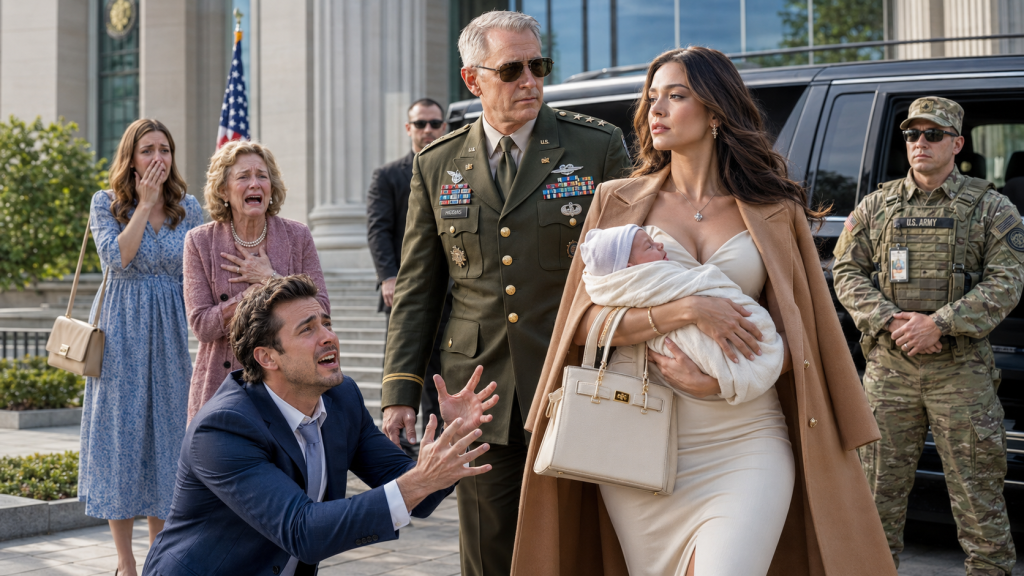
Dad’s face changed.
Evelyn raised one hand.
“We expected this.”
I felt rage move through me like heat.
“He left me at a bus stop.”
“Hospital entrance,” Dad corrected coldly.
“He gave me twelve dollars.”
“We have surveillance footage,” Evelyn said.
I froze.
“What?”
“St. Vincent’s exterior security cameras captured the discharge area.”
She opened her tablet.
“We also have the nurse’s statement.”
The same nurse who had warned Dominic not to make me bend down had documented the interaction.
The hospital discharge record stated I was not recommended to use public transportation alone with a newborn immediately following C-section recovery.
The bus system had camera footage too.
My MetroCard transaction placed me exactly where I said I had been.
Evelyn looked almost bored.
“His version is not strong.”
I leaned back against the pillows.
“What does he want?”
“According to his attorney? Reconciliation.”
I laughed.
Evelyn did not.
“According to his actions? Financial access.”
That stopped me.
“He wants the accounts unfrozen.”
“Yes.”
“Of course.”
“He also wants the apartment.”
“He can want it.”
“And access to the SUV.”
I looked at Dad.
Dad looked at Evelyn.
Evelyn sighed.
“I assume that means no.”
“No,” Dad and I said together.
Dominic filed an emergency custody petition two days later.
That was when any tiny remaining piece of me that still hoped he might feel ashamed disappeared.
His filing described me as emotionally unstable.
Manipulated by an overbearing father.
Financially vindictive.
Possibly suffering from postpartum psychosis.
He claimed I had endangered Leo by taking him onto public transportation.
That was the sentence that almost broke me.
He had forced us onto that bus.
Now he was using it against me.
Evelyn read the filing without expression.
Then she said, “Good.”
I stared at her.
“Good?”
“He has committed his lies to paper.”
Three days later, we entered family court.
I wore a simple navy dress that did not press against my incision.
Dad offered to attend.
I asked him not to.
Not because I was ashamed.
Because this was my fight.
For once, I didn’t want Dominic looking across the room and seeing General Charles Brooks.
I wanted him to see me.
Dominic sat beside his attorney wearing one of the suits I had bought him for our anniversary.
When I entered, his entire face changed.
He looked exhausted.
For half a second, I almost felt sorry for him.
Then Victoria leaned forward from the row behind him and whispered something.
Dominic straightened.
The hearing began.
His attorney argued first.
He described a marriage shattered by postpartum instability.
He said I had become paranoid.
Secretive.
Erratic.
He suggested my powerful family had overreacted to a routine marital disagreement.
Routine.
I looked at Evelyn.
She wrote one word on her legal pad.
Wait.
Then Dominic testified.
He said he had never abandoned me.
He claimed I had insisted I could get home myself.
He said he gave me cash for convenience.
He said the bus had been my choice.
He said he had offered to return after lunch.
Evelyn stood.
“Mr. Romano, did you drive Mrs. Romano’s SUV away from St. Vincent’s Hospital on May eighteenth?”
“Yes.”
“With your mother?”
“Yes.”
“And other family members?”
“Yes.”
“Your wife was five days post-Cesarean section?”
“She had been discharged.”
“That wasn’t my question.”
“Yes.”
“She was holding your five-day-old son?”
“Yes.”
“Did you leave her your vehicle?”
“She had transportation.”
“What transportation?”
“She could take a taxi.”
“With twelve dollars?”
Dominic hesitated.
“I didn’t know how much cash I handed her.”
Evelyn nodded.
Then the video played.
No sound was necessary.
The judge watched Dominic hand me the bills.
Watched him remove the diaper bag.
Watched him drop it near my feet.
Watched me try to bend.
Watched the nurse intervene.
Watched Dominic leave.
Then Evelyn presented the nurse’s signed statement.
Then my discharge instructions.
Then transit footage.
Then Dominic’s text messages.
MOM WANTS THE SUV TOMORROW TOO, SO DON’T MAKE PLANS.
AND CLEAN UP BEFORE WE GET HOME.
The judge slowly removed his glasses.
Dominic stared at the table.
His attorney stopped taking notes.
Victoria looked furious.
Not embarrassed.
Furious.
The emergency petition failed.
I received temporary primary physical custody.
Dominic was granted supervised visitation until further review.
Outside the courtroom, he caught up with me.
“Audrey.”
I kept walking.
“Audrey, please.”
Evelyn stopped.
“Do not approach my client.”
Dominic ignored her.
“This is insane.”
I turned around.
“No.”
My voice surprised even me.
“This is the first sane thing I’ve done in a long time.”
His face twisted.
“You’re destroying our family.”
“You left your family outside a hospital because your mother wanted lunch.”
Victoria stepped toward me.
“That is enough.”
I looked at her.
She had spent four years treating me like an inconvenient employee.
Criticizing my cooking.
My clothes.
My pregnancy weight.
My career.
My friendships.
My family.
Even the way I planned my own baby shower.
For years, I had stayed polite because Dominic said confronting her would create drama.
Now I understood that silence had created something worse.
I looked directly at her.
“You’re right.”
She blinked.
“It is enough.”
Then I walked away.
The financial investigation deepened.
Every week brought another discovery.
Dominic had used money from accounts connected to me to cover business losses.
Then he used more money to hide the first losses.
Then more to maintain appearances.
Trips.
Watches.
Restaurant memberships.
Private car services.
Hotel suites.
Cassandra.
His entire image of success had been partially funded by assets he mocked me for having.
And the irony was almost unbearable.
Dominic had repeatedly joked that my father probably survived on a modest government pension.
He once told Victoria, within my hearing, that my family had “respectable jobs but no real money.”
I had never corrected him.
Dad believed discussing wealth was vulgar.
Mom agreed.
Our family had investments built over generations.
Dad’s Army career was a separate thing entirely.
But Dominic had apparently decided that because I didn’t advertise money, I must not understand it.
The apartment became his greatest shock.
His attorney demanded marital equity.
Evelyn produced the trust documents.
Dominic demanded reimbursement for renovations.
Records showed I had paid for them.
He claimed furniture.
Receipts showed most of it was purchased through my accounts.
He claimed the artwork.
Several pieces had belonged to my grandmother.
He claimed the home office equipment.
That, I gave him.
I also gave him three watches.
His golf clubs.
His clothes.
His wine collection.
And the espresso machine he once claimed he could not live without.
“I’m feeling generous,” I told Evelyn.
She smiled.
The SUV caused another argument.
Dominic insisted he had made payments.
There were no payments.
Dad had purchased it outright as a wedding gift to me before the marriage.
Title in my name.
Insurance in my name.
Registration in my name.
Dominic had simply driven it so often he began believing possession meant ownership.
I sold it.
Not because I needed the money.
Because I never wanted to sit inside it again.
The proceeds went into an education fund for Leo.
When Dominic learned that, he sent me seventeen messages.
I read none.
The affair became impossible for him to deny.
Cassandra eventually contacted Evelyn herself.
She had apparently believed Dominic was separated.
He had told her our marriage existed only on paper.
He told her I was difficult.
Cold.
Controlling.
He told her I refused intimacy.
That I used pregnancy to manipulate him.
That he planned to leave me after Leo’s birth.
When Cassandra realized he had lied, she ended the relationship.
Then she provided records.
Messages.
Photos.
Receipts.
One message made me stare at the screen for a long time.
Dominic had written:
Once Audrey has the baby, she’ll be too dependent to do anything.
Too dependent.
That sentence hurt more than the affair.
Because suddenly everything around Leo’s birth made sense.
Why Dominic pressured me to stop working earlier than planned.
Why he encouraged me to transfer more household management to him.
Why he wanted access to accounts.
Why he kept saying motherhood should become my “real priority.”
He wasn’t preparing to support me.
He was preparing to control me.
I printed that message.
Then I placed it inside my own folder.
Not Dad’s.
Mine.
By the time Leo was six weeks old, I had recovered enough to return to the apartment.
The first night back was strange.
Dominic’s clothes were gone.
His shoes were gone.
His cologne no longer sat beside my perfume.
The silence felt enormous.
I walked through every room holding Leo.
The living room where Dominic had proposed we buy a larger television instead of building a reading corner.
The kitchen where he criticized me for ordering takeout during my third trimester.
The nursery where Victoria had replaced the curtains I chose because she said mine looked cheap.
I stood there staring at those curtains.
Then I took them down.
At eleven that night, Mom helped me hang the ones I originally loved.
Soft white linen.
Tiny embroidered stars.
It was a small thing.
But when we finished, I cried.
Mom didn’t ask why.
She understood.
Freedom sometimes looks ridiculous from the outside.
A curtain.
A changed lock.
Ordering dinner without explaining the price.
Turning off your phone.
Sleeping diagonally across a bed.
Buying flowers no one else likes.
For me, recovery happened in those details.
Dominic’s supervised visits began the following month.
I never interfered.
Whatever he had done to me, Leo deserved the opportunity to know his father if it could happen safely.
But Dominic struggled with the reality of parenting without an audience.
During visits, he complained that Leo cried too much.
That diaper changes took too long.
That feeding schedules were inconvenient.
The supervisor documented everything.
Dominic frequently arrived late.
Twice he canceled.
Once because of a business meeting.
Once because Victoria had theater tickets.
Then, three months after our separation, he requested expanded custody.
His argument was simple.
He said supervised visits made it difficult to bond.
Evelyn agreed to review progress.
The supervisor’s reports did not help him.
Neither did his financial records.
Neither did the affair.
Neither did the forged signatures.
Then something happened none of us expected.
Federal investigators contacted Dominic.
Not because Dad ordered anything.
Despite what Dominic later told people, my father never used military authority against him.
He didn’t need to.
Dominic’s own financial decisions attracted attention once the disputed transfers were examined.
Several payments involving his company appeared connected to false invoices and tax irregularities.
The divorce investigation had uncovered enough inconsistencies that accountants were legally required to report certain findings.
Dominic blamed me.
Then Dad.
Then Evelyn.
Then Cassandra.
Then his business partner.
He blamed everyone except Dominic Romano.
His company began collapsing.
Investors withdrew.
One partner resigned.
Another sued.
A major client terminated its contract.
Dominic’s carefully manufactured image cracked almost overnight.
The expensive lunches stopped.
The private club membership disappeared.
The Tribeca apartment was surrendered.
The tailored suits remained.
There was nowhere impressive to wear them.
Victoria called me one evening.
I almost didn’t answer.
Something made me do it.
“Audrey.”
Her tone was different.
Smaller.
“Yes?”
“We need to discuss Dominic.”
“No, we don’t.”
“He’s under tremendous pressure.”
“That sounds like something he should discuss with his attorney.”
“You are the mother of his child.”
“I’m aware.”
“He is Leo’s father.”
“I’m also aware.”
She hesitated.
Then came the real reason.
“He needs access to some money.”
I closed my eyes.
Of course.
“What money?”
“His accounts are frozen or restricted. I don’t understand all the technical details.”
“You don’t need to.”
“He cannot even pay his legal expenses properly.”
“That sounds difficult.”
“Audrey.”
There it was.
The old tone.
The one that expected obedience.
“I know you’re angry, but you have resources.”
I almost admired the audacity.
“Victoria, five days after I gave birth, your son left me outside a hospital.”
She exhaled sharply.
“You keep repeating that.”
“Yes.”
“As if one bad afternoon defines an entire marriage.”
“No.”
I looked at Leo sleeping in his crib.
“It revealed one.”
She went silent.
I continued.
“And you were there.”
“That was Dominic’s decision.”
“You climbed into my SUV.”
“I didn’t realize you had no ride.”
“You watched me standing there with a hospital bracelet.”
“That does not mean—”
“You watched the nurse help me.”
Silence.
“You watched him drop my baby’s diaper bag on the ground.”
Silence again.
“And then you went to lunch.”
When Victoria finally spoke, her voice was low.
“What do you want me to say?”
For once, I answered truthfully.
“Nothing.”
I hung up.
The divorce took eleven months.
Eleven months of depositions.
Financial disclosures.
Mediation.
Custody reviews.
Expert evaluations.
Messages from relatives who believed forgiveness was easier than consequences.
I learned quickly that people often tell women to forgive when what they actually mean is please restore the old arrangement because your boundaries are inconveniencing us.
Dominic apologized many times.
But his apologies always included explanations.
Stress.
Business pressure.
His mother.
My pregnancy.
My father.
Money.
Miscommunication.
The word “but” followed every expression of regret.
I’m sorry, but you shut me out.
I’m sorry, but you knew I was under pressure.
I’m sorry, but your father intimidated me.
I’m sorry, but you never told me who he really was.
That last one became his favorite.
During mediation, Dominic finally exploded.
“You lied to me about your father!”
I stared at him across the conference table.
“I never lied.”
“You told me he worked for the government.”
“He did.”
“You said he was retired.”
“He is.”
“You never said he was a four-star general.”
“You never asked.”
“That is not normal information to hide from your husband.”
I thought about that.
Maybe he was right.
Maybe in a healthy marriage, I should have told him earlier.
But the fact remained that his cruelty had nothing to do with my father’s rank.
“You believed my father was ordinary,” I said.
Dominic laughed bitterly.
“That’s not what I said.”
“You believed he had no power.”
His attorney shifted uncomfortably.
“You thought there would be no consequences for humiliating me because you believed nobody important would care.”
“That’s ridiculous.”
“Is it?”
His jaw tightened.
“You treated me the way you thought you could get away with treating me.”
He looked away.
That was the first time Dominic had no answer.
The final custody arrangement granted me primary physical custody.
Dominic received scheduled parenting time, gradually increasing if he remained consistent.
I never celebrated that outcome.
Custody is not a trophy.
Leo was not something to win.
I wanted his father to become better.
Not for me.
For him.
The financial settlement was far less dramatic than Dominic expected.
Because most major assets I brought into the marriage were properly protected, there was little for him to claim.
His own business interests had declined enormously in value.
He was responsible for substantial legal and financial liabilities tied to his conduct.
The forged documents remained part of separate proceedings.
In the end, Dominic left the marriage with his personal belongings, limited remaining business assets, and a reality he had spent years avoiding.
Appearances are not wealth.
Possession is not ownership.
Control is not love.
And silence is not weakness.
The divorce became final on a rainy Thursday morning.
I expected to feel triumphant.
Instead, I felt tired.
When the judge signed the final order, I looked down at my hands.
No ring.
No trembling.
Just stillness.
Outside the courthouse, Dominic stood beneath the awning.
For the first time since I had known him, he looked ordinary.
No expensive car waiting.
No assistant.
No crowd.
No Victoria.
Just a man holding an umbrella.
“Audrey.”
I stopped.
Evelyn stood several feet away.
Close enough to intervene.
Far enough to give me the choice.
Dominic looked at me.
“I never thought it would end like this.”
“Neither did I.”
“I did love you.”
Maybe he expected me to argue.
I didn’t.
“I think you loved what I did for your life.”
His eyes dropped.
“That’s not fair.”
“Maybe.”
Rain splashed against the sidewalk.
He rubbed one hand over his face.
“Do you hate me?”
I thought about it.
“No.”
He looked surprised.
“Hating you would require too much attention.”
That hurt him.
I could see it.
But it was true.
“I hope you become the kind of father Leo deserves.”
“I will.”
“For his sake, I hope so.”
He swallowed.
“And us?”
“There is no us.”
“I mean eventually.”
“No.”
The certainty came easily now.
He nodded.
Then he asked the question I knew had been eating at him for almost a year.
“If you had told me who your father was, do you think any of this would have happened?”
I looked directly at him.
“Yes.”
His face changed.
“You think I still would have left you there?”
“No.”
That was the difference.
“You probably wouldn’t have left me there if you knew.”
He frowned.
“Then how can you say—”
“Because that means you were capable of treating me well only when you believed there might be consequences.”
He went silent.
“I needed a husband who treated me with dignity because I was his wife. Not because my father had stars on his uniform.”
Dominic looked down.
For once, he understood.
At least I think he did.
I walked away.
A year later, Leo took his first steps across my living room.
Dad was sitting on the floor pretending not to cry.
Mom was openly crying enough for both of them.
Leo stumbled toward Dad, grabbed one of his fingers, and shouted something that sounded vaguely like “Go!”
Dad immediately declared it his first word.
“It was not,” Mom said.
“It clearly was.”
“He said mama last week.”
“That was babbling.”
“Charles.”
“I’m trained in communication analysis.”
“You commanded soldiers, not babies.”
Dad looked at Leo solemnly.
“Your grandmother is undermining the chain of command.”
I laughed so hard my stomach hurt.
A good hurt this time.
Later that evening, after everyone left, I stood by the nursery window holding Leo.
Manhattan glowed beneath us.
Cars moved like ribbons of light.
Somewhere out there, buses rolled along the same streets I had traveled that afternoon after leaving the hospital.
For a long time, I hated remembering that ride.
Then eventually, I stopped.
Because that bus had carried me away from something.
Not toward humiliation.
Toward clarity.
The elderly woman who surrendered her seat had probably forgotten me within days.
The driver who lowered the steps probably never knew what happened afterward.
The nurse who defended me returned to her shift.
None of them knew how important their small kindness had been.
Strangers had treated me with more care in twenty minutes than my husband had shown me during one of the most vulnerable moments of my life.
That mattered.
It taught me something.
Cruelty is not normal merely because you have grown accustomed to it.
Kindness should not feel shocking inside a marriage.
Respect should not depend on status.
And love that requires you to become smaller is not love worth protecting.
Dad visited the following Sunday.
He brought Leo a toy Army helicopter despite my repeated instructions not to turn my apartment into a miniature military installation.
“Dad.”
“It’s educational.”
“He’s fourteen months old.”
“Excellent age for aviation exposure.”
Mom walked in behind him carrying groceries.
“Do not encourage him.”
Dad handed the helicopter to Leo.
Leo immediately threw it.
Dad looked offended.
“Needs discipline.”
“He needs a nap.”
We laughed.
Then Dad followed me into the kitchen.
For a moment, he became serious.
“You’re happy.”
It wasn’t a question.
I considered it anyway.
“Yes.”
Not because everything was perfect.
Dominic remained part of my life through Leo.
Some visits went well.
Others did not.
He eventually found stable work with a smaller firm.
He moved into a modest apartment in Brooklyn.
For the first time in his adult life, he lived within his actual means.
Strangely, it seemed good for him.
Without constant investors to impress, restaurants to dominate, cars to borrow, and people to impress, he became quieter.
More attentive with Leo.
Not overnight.
Not magically.
But gradually.
Our relationship never repaired.
It transformed into something distant and functional.
We exchanged schedules.
Medical information.
School updates.
Photos from important events.
Nothing more.
Victoria struggled longer.
She hated boundaries.
Especially mine.
But after several canceled visits caused by her interfering with Dominic’s parenting time, he finally told her something I never expected.
“Mom, Audrey isn’t the problem.”
He told me that months later while picking Leo up.
I nearly dropped the diaper bag.
“You said that?”
Dominic looked embarrassed.
“Don’t make it dramatic.”
I laughed.
“There he is.”
He almost smiled.
Then his expression changed.
“I was awful to you.”
It was the first apology without a but.
I studied him.
“Yes.”
“I know.”
I nodded.
“I appreciate you saying it.”
He looked toward Leo.
“I kept thinking being successful meant making people believe I was important.”
I said nothing.
“And then I lost everything I thought made me important.”
“You didn’t lose everything.”
He looked at me.
“You still have a son.”
His eyes softened.
“Yeah.”
That was enough.
Forgiveness did not mean reconciliation.
It did not mean forgetting.
It did not mean giving Dominic access to the life I had rebuilt.
It simply meant I eventually stopped carrying the anger everywhere I went.
I no longer needed him to suffer.
I needed him to grow.
Whether he did or not belonged to him.
My life belonged to me.
Two years after the hospital incident, I returned to St. Vincent’s.
Not as a patient.
The hospital was holding a fundraiser for a maternal recovery initiative providing transportation assistance to postpartum mothers.
After what happened to me, I had quietly donated enough to help launch the program.
No woman recovering from childbirth should ever stand outside a hospital wondering how she will get herself and her newborn home safely.
Dad insisted on attending.
This time, everyone knew exactly who he was.
He wore civilian clothes.
No uniform.
No stars.
No entourage.
Just my father.
Before the event began, I saw a nurse near the reception desk.
I recognized her instantly.
She had shorter hair now.
But it was her.
The nurse who stepped forward when I tried to bend down.
I walked toward her.
“Excuse me.”
She turned.
“Yes?”
“I don’t know if you remember me.”
She studied my face.
Then her eyes widened.
“The bus.”
I laughed.
“Yes.”
“Oh my goodness.”
She hugged me.
“How are you?”
“Good.”
“Your baby?”
I pointed.
Dad stood across the room holding Leo, who was attempting to steal his grandfather’s glasses.
“He’s perfect.”
The nurse smiled.
“I wondered about you.”
“You helped me.”
“I barely did anything.”
“No.”
I shook my head.
“You did exactly what I needed.”
Her eyes filled slightly.
“I’m glad.”
I handed her a card.
Inside was a note thanking her.
Not for rescuing me.
I rescued myself.
But for reminding me that care was supposed to look like care.
That night, I spoke briefly at the fundraiser.
I did not mention Dominic by name.
I did not mention Dad’s rank.
I did not tell the dramatic version reporters might have preferred.
I simply talked about dignity.
“Sometimes the hardest moment in someone’s life looks ordinary from the outside,” I said.
“A woman holding a baby.”
“A person waiting for transportation.”
“A patient standing quietly on a sidewalk.”
“You may never know what someone is carrying emotionally, financially, or physically.”
“So when you have the opportunity to make someone’s burden lighter, even briefly, do it.”
Dad watched from the front row.
His eyes were suspiciously bright.
Afterward, he hugged me.
“Good speech.”
“Thank you.”
“You should have mentioned transportation readiness procedures.”
“No.”
“Could have improved operational clarity.”
“Dad.”
He smiled.
“I’m proud of you.”
That meant more to me than any standing ovation.
Months later, on Leo’s third birthday, he climbed onto my lap and asked why Grandpa had so many pictures wearing “the green clothes.”
Dad had given me permission to tell Leo simple things about his career.
“Grandpa was a soldier.”
Leo’s eyes widened.
“Like superhero?”
“Not exactly.”
Dad, standing nearby, cleared his throat.
I ignored him.
“He worked with lots of people to keep other people safe.”
Leo considered that.
“Did Grandpa save you?”
The room became quiet.
Dad looked at me.
Mom looked at me.
Even Dominic, who had come for the birthday party and was standing near the cake, turned.
I looked at my son.
Children ask questions adults spend years complicating.
Did Grandpa save you?
I smiled.
“No.”
Dad’s expression softened.
“Grandpa helped me when I asked.”
Leo waited.
“But Mommy saved Mommy.”
Dad nodded once.
Dominic looked down.
And that was the truth I wanted my son to grow up understanding.
Powerful people can help you.
Family can support you.
Lawyers can protect you.
Friends can stand beside you.
Strangers can offer kindness.
But there comes a moment when you must believe your own life deserves defending.
I had spent too long waiting for Dominic to become the man I imagined.
Too long waiting for Victoria to approve of me.
Too long explaining away behavior that was slowly teaching me not to trust myself.
That day outside the hospital, I did not feel brave.
I felt exhausted.
Humiliated.
Sore.
Afraid.
I had twelve dollars in my hand and stitches across my abdomen.
Bravery did not feel like power.
It felt like whispering three words into a phone.
Dad, I need help.
Then saying four more.
I want to leave.
Everything changed after that.
Not because my father was a general.
Not because attorneys appeared.
Not because Dominic lost the SUV.
Those things made the story dramatic.
But they were not what saved me.
What saved me was finally understanding that I did not need permission to stop accepting cruelty.
Years later, I still kept those twelve dollars.
Not the exact bills.
Those disappeared somewhere along the way.
But after the divorce was finalized, I placed twelve dollars inside a small frame.
It sits inside my home office.
People sometimes ask why.
I usually smile.
“It reminds me of the most expensive bus ride I ever took.”
They laugh.
I let them.
Only a few people know what it really means.
It reminds me of the day my marriage became clear.
The day a stranger gave me her seat.
The day my father answered on the first ring.
The day I stopped worrying whether leaving would make me look like I had failed.
The day I finally understood that staying somewhere you are continually diminished is not loyalty.
It is surrender.
And leaving was not the end of my family.
It was the beginning of a healthier one.
Leo is older now.
Curious.
Loud.
Fearless.
He loves helicopters because Dad eventually succeeded in that particular campaign.
He loves dinosaurs because I succeeded in mine.
He spends weekends with Dominic when scheduled.
Sometimes he comes home talking excitedly about pancakes they made together.
Sometimes about a park.
Sometimes about Grandpa.
Sometimes about nothing at all.
That is how I want it.
I do not want my son carrying the weight of our marriage.
That belongs to the adults.
One afternoon, Dominic returned Leo after a weekend visit.
Before leaving, he paused by my door.
“I saw the transportation program’s new report.”
I was surprised.
“You read it?”
“Yeah.”
The initiative had expanded.
Three hospitals now participated.
Then six.
Then eleven.
Hundreds of women had received safe transportation home after difficult deliveries, medical complications, or emergency births.
Dominic looked embarrassed.
“I know why you started it.”
I waited.
“I’m sorry that I’m the reason you needed to.”
That sentence stayed with me.
Not because it changed anything between us.
Because it showed me he finally understood something he once refused to see.
I nodded.
“Thank you.”
He looked toward the elevator.
“Audrey?”
“Yes?”
“I’m glad you called your father.”
For one second, neither of us spoke.
Then I smiled slightly.
“So am I.”
The elevator doors opened.
Dominic stepped inside.
No anger.
No accusations.
No unfinished arguments.
Just the closing of a door that should have closed years earlier.
I walked back inside.
Leo was building a tower in the living room.
Dad was on video call complaining that Leo’s construction lacked structural integrity.
Mom was shouting from somewhere behind him that a three-year-old did not require engineering criticism.
Leo knocked the tower over deliberately.
Dad looked horrified.
I laughed.
Then Leo ran into my arms.
And as I lifted him, I thought about that woman I had been outside St. Vincent’s.
I wished I could go back and stand beside her.
I would not tell her everything would be easy.
It wasn’t.
I would not tell her she would never cry over Dominic again.
She did.
I would not tell her court would be painless.
It wasn’t.
I would not tell her betrayal stops hurting the moment you walk away.
It doesn’t.
I would simply tell her this:
Get on the bus.
Hold your baby.
Make the call.
And do not confuse the end of one life with the end of your future.
Because sometimes the moment that feels most humiliating becomes the moment you finally see everything clearly.
Dominic thought twelve dollars was enough to send me quietly home.
He was wrong.
Those twelve dollars took me somewhere neither of us expected.
They carried me out of a marriage built on control.
They carried me toward people who loved me without conditions.
They carried me toward the mother I wanted to become.
And most importantly, they carried me back to myself.
💬THE END! THANK YOU FOR READING!