

My son charged me $950 every month to sleep in the smallest bedroom in his house while his mother-in-law lived downstairs for free in a private suite nearly twice the size of mine.
For months, I said nothing.
I bought groceries.
I cooked dinner.
I walked their dog.
I stayed home for contractors.
I folded laundry when the baskets overflowed.
I smiled when my daughter-in-law’s mother complained that the pool was too cold, her mattress was too firm, or the brand of sparkling water I bought wasn’t the one she preferred.
I kept telling myself that family required patience.
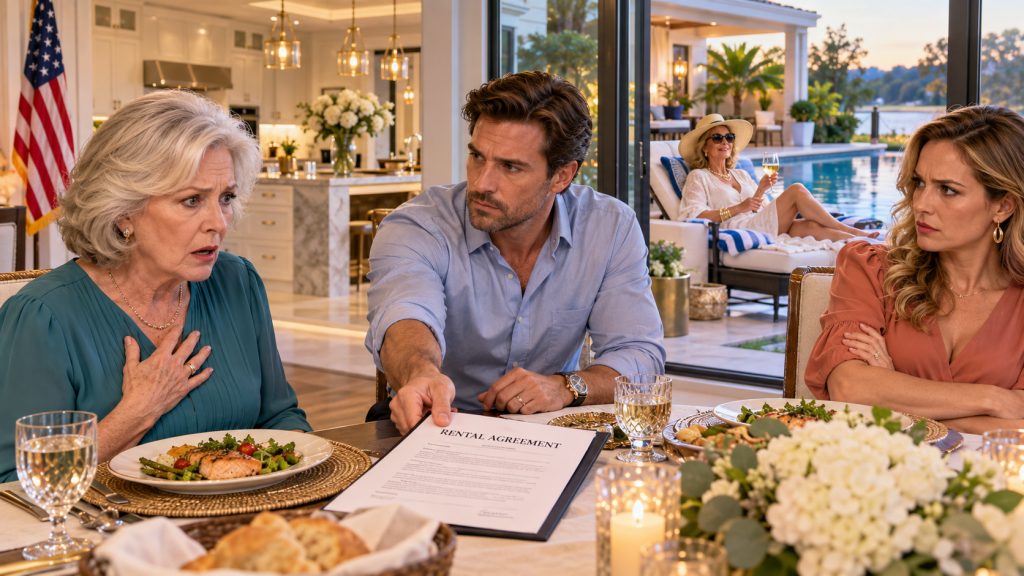
Then one Sunday evening, my son placed a new rental agreement beside my dinner plate.
“Starting next month, we need $1,300.”
I thought I had misheard him.
I stared at the figure.
Then I looked through the French doors toward the backyard, where my daughter-in-law’s mother was reclining beside the heated pool with a glass of wine.
“How much does Linda pay?” I asked.
My daughter-in-law, Claire, immediately stiffened.
“My mother doesn’t pay rent.”
“Why not?”
Claire set down her fork.
“Because my mother is family.”
For a moment, nobody spoke.
I slowly turned toward my son.
“And what exactly am I?”
Daniel barely looked at me.
He gave a tired sigh, as if I were the one making dinner uncomfortable.
“Mom, if you don’t like the way we run our house, nobody is forcing you to stay.”
I stared at him.
“Are you telling me to leave?”
“I’m telling you that if you don’t like my rules, find somewhere else to live.”
I nodded once.
“All right.”
Claire rolled her eyes.
“Margaret, don’t make this dramatic.”
I folded the rental agreement in half and stood.
“I’m not.”
Daniel thought I would go upstairs, sulk for a few days, then quietly hand him another check.
He thought I had nowhere else to go.
He had no idea how seriously I was about to take him.
My name is Margaret Ellis.
I was sixty-eight years old when my husband, Robert, died.
Until that year, I had never spent more than a few weeks living alone.
Robert and I had been married for forty-one years.
We met when I was twenty-three and he was twenty-five.
He was an electrician’s apprentice with a crooked smile and a habit of carrying peppermint candies in his shirt pocket.
I worked in payroll for a medical clinic.
Our first apartment had brown carpet, yellow kitchen cabinets, and a heater that made a banging noise every night around two in the morning.
We loved it anyway.
Over the years, we raised one son, Daniel.
We bought a house.
Then another.
We survived layoffs, illnesses, tuition bills, leaking roofs, broken cars, and one particularly terrible vacation during which Robert accidentally locked our keys inside the rental car in the middle of a thunderstorm.
We weren’t wealthy.
At least, we never thought of ourselves that way.
We were careful.
Robert believed in saving money before spending it.
He believed in paying off credit cards every month.
He believed that if you could afford something, you should still wait three days before buying it just to make sure you truly wanted it.
That rule drove Daniel crazy as a teenager.
“Dad, normal people just buy things,” he once complained after Robert made him wait before purchasing a new gaming console.
Robert laughed.
“Normal people also complain about being broke.”
That was Robert.
Practical.
Steady.
Never flashy.
By the time we reached retirement age, decades of careful saving had quietly added up.
We owned our townhouse outright.
We had retirement accounts.
Robert had a life insurance policy.
We held a conservative investment portfolio.
Years earlier, we had sold a small rental property we purchased when Daniel was in elementary school.
We never discussed exact numbers with friends.
We barely discussed them with Daniel.
Our money was simply the foundation beneath our life.
Then Robert died on a Tuesday morning.
The night before, he said he had indigestion.
I told him it was probably the chili.
At six the next morning, I woke and found him sitting on the edge of the bed.
His skin looked gray.
He was sweating.
“Robert?”
He pressed a hand against his chest.
“I think you should call someone.”
I called an ambulance.
I remember the paramedics.
I remember standing in the hospital hallway.
I remember a nurse asking whether I wanted water.
I remember staring at the clock above the emergency room doors.
Then a cardiologist came toward me.
There are sentences you hear with your ears.
And there are sentences you feel enter your body like cold water.
“We did everything we could.”
That was the sentence that divided my life.
Before it, I was Robert’s wife.
After it, I was a widow.
People surrounded me for the first few weeks.
Neighbors brought food.
Friends called constantly.
Daniel and Claire came almost every evening.
Linda came several times too.
Linda was Claire’s mother.
She had always been dramatic, outspoken, and very particular about everything.
At Robert’s funeral, she cried so loudly that Ruth, my oldest friend, whispered, “Did she secretly marry him too?”
I nearly laughed.
Then immediately felt guilty for wanting to.
After the funeral, life slowly returned to normal for everyone except me.
That is one of the strangest things about grief.
The world keeps moving even when yours has stopped.
People went back to work.
Neighbors stopped bringing casseroles.
The condolence cards stopped arriving.
The flowers wilted.
And every evening I sat alone in the townhouse Robert and I had shared for eighteen years.
His reading glasses were still beside his chair.
His gardening shoes were in the garage.
His coffee mug remained in the dishwasher because I couldn’t bring myself to put it away.
At night, the silence felt enormous.
Sometimes I turned on the television simply so another human voice would exist in the room.
Once, while grocery shopping, I reached for Robert’s favorite cereal.
I placed it in the cart automatically.
Halfway down the aisle, I realized he would never eat it.
I stood there holding the box and began crying.
A woman I had never met put her hand on my arm.
That became my life.
Every ordinary thing contained a trapdoor.
Daniel worried about me.
At least, I believed he did.
“You shouldn’t be alone,” he said one evening.
“I’m not helpless.”
“I know.”
“I can still drive.”
“I know.”
“I pay my own bills.”
“Mom.”
He sat beside me.
“I’m not saying you can’t take care of yourself. I’m saying you shouldn’t have to sit here alone while you’re grieving.”
Claire agreed.
“You can stay with us,” she said. “We have all that room.”
I hesitated.
I loved my home.
But every corner reminded me of Robert.
“Just temporarily,” Daniel said.
“Until you decide what you want.”
That sounded reasonable.
Around that same time, Daniel’s construction business was struggling.
Two clients canceled large contracts.
A commercial project was delayed.
Claire had also renovated their kitchen, and the cost had apparently gone far beyond the original budget.
Daniel never directly asked me for money.
He didn’t need to.
I heard the stress in his voice.
One night he called and apologized for being distracted.
“Payroll is due Friday,” he said. “I’m moving money around.”
A week later, after I sold the townhouse, I transferred $25,000 to him.
When I told him, he stared at me.
“No.”
“Yes.”
“Mom, I can’t take this.”
“You can.”
“You just sold your house.”
“I have enough.”
“I’ll repay you.”
“You don’t need to.”
His eyes filled with tears.
He hugged me.
“I swear I’ll never forget this.”
I believed him.
Six weeks later, I moved into Daniel and Claire’s house.
They lived in a large suburban home with four bedrooms upstairs and a downstairs mother-in-law suite.
I assumed I would stay in one of the larger bedrooms.
Claire explained otherwise.
“One room is Daniel’s office.”
That made sense.
“The second is my craft room.”
I paused.
“And the third?”
“We keep that one for guests.”
I looked at her.
“Aren’t I a guest?”
She laughed.
“You’re family.”
At the time, I smiled.
I took the smallest room.
It had one window, a narrow closet, and barely enough space for a full-size bed and dresser.
I placed a photograph of Robert on the nightstand.
I told myself I didn’t need much.
I wasn’t there for luxury.
I was there because I thought being around family would help me heal.
At first, it did.
Daniel checked on me every morning.
Claire invited me to watch television with them.
I cooked dinner several nights a week because cooking gave me something useful to do.
I started grocery shopping too.
Daniel and Claire were always busy.
I didn’t mind.
Then I began walking Winston, their elderly golden retriever.
Winston and I quickly became inseparable.
Every afternoon at four, he appeared outside my door carrying his leash.
“You’re the only one he listens to,” Daniel joked.
I stayed home when contractors came.
I signed for deliveries.
I watered the plants.
I did laundry when I noticed the baskets overflowing.
I picked up prescriptions.
I brought packages inside.
When Claire forgot ingredients for dinner, I drove to the store.
I thought I was contributing.
Daniel often said so.
“Honestly, Mom, you’re saving us.”
Those words made me feel needed.
And when you are grieving, being needed can feel dangerously similar to being loved.
Three months later, Linda sold her house in Florida.
She announced that she wanted to move closer to Claire.
One Saturday morning, two vehicles packed with luggage pulled into the driveway.
A moving company arrived behind them.
Linda stepped out wearing oversized sunglasses and carrying a little white dog named Princess, who immediately barked at Winston.
Claire ran outside.
“Mom!”
They hugged.
I stood on the porch smiling.
I assumed Linda would use the larger upstairs guest room.
Instead, Claire turned to Daniel.
“Did you get Mom’s suite ready?”
Suite.
That was when I learned Linda would be living downstairs.
The mother-in-law suite had a large bedroom.
A private sitting area.
A bathroom with double sinks.
A walk-in closet.
French doors opened directly onto the pool deck.
The entire space was nearly twice the size of my room.
I didn’t say anything.
Maybe Linda had trouble climbing stairs.
That would have been reasonable.
Except within days, I watched her climb the stairs repeatedly without difficulty.
She came upstairs whenever she wanted coffee.
She came upstairs to complain about Princess barking.
She came upstairs to ask what I was cooking.
Stairs were clearly not the problem.
Then Linda complained about the mattress.
“This thing is like sleeping on concrete.”
Daniel bought a new one.
She complained the room was too dark.
Claire ordered lamps.
The pool was too cold.
Daniel increased the temperature.
The bathroom towels were too rough.
New towels appeared.
Linda said parking outside made her car too hot.
Daniel gave her his garage space.
Then Daniel began using Claire’s spot.
And somehow, I ended up parking on the street.
I asked about it once.
Claire looked surprised.
“Mom’s knees bother her.”
I looked toward Linda, who had spent the previous afternoon walking through a shopping mall for nearly four hours.
I said nothing.
I was still determined not to become the difficult mother-in-law.
Then Linda’s preferences started appearing on my grocery list.
Wild-caught salmon.
Imported mineral water.
Organic strawberries.
Free-range eggs.
A certain brand of coffee.
A particular yogurt.
One afternoon, I brought home the wrong yogurt.
Linda held it up.
“Oh, Margaret. I can’t eat this.”
I waited for her to say thank you for shopping.
She didn’t.
“What happens if you eat it?” I asked.
She blinked.
“What?”
“You said you can’t eat it. Are you allergic?”
“No. I just don’t like this brand.”
I stared at her.
She stared back.
Then she handed it to me.
“Would you mind exchanging it?”
I should have said yes, I minded.
Instead, I drove back to the store.
That was the pattern.
Small surrender after small surrender.
Not one thing seemed important enough to fight about.
Together, they slowly changed the shape of my life.
Then, about a month after Linda moved in, Daniel asked me to sit down with him and Claire.
He placed a sheet of paper on the kitchen island.
HOUSEHOLD CONTRIBUTION AGREEMENT.
Below that was a figure.
$950 per month.
I read it twice.
“What is this?”
Daniel looked uncomfortable.
“Household expenses have increased.”
“I buy groceries.”
“We appreciate that.”
“I cook.”
Claire crossed her arms.
“You eat too.”
I looked at her.
“I walk Winston.”
“You like walking.”
“I stay home for contractors.”
Daniel sighed.
“Mom, nobody is saying you don’t contribute.”
“Then why am I paying nearly a thousand dollars for one room?”
“It isn’t just the room,” Claire said. “There’s electricity, water, internet.”
I looked toward the pool.
Linda was floating on an inflatable lounger.
“How much is Linda paying?”
Claire immediately stiffened.
“Her situation is different.”
“How?”
“Her money is tied up.”
“She just sold a house.”
“It’s invested.”
“So?”
Claire’s voice cooled.
“Margaret, we’re discussing your arrangement.”
That should have been the moment I stood up.
Instead, I signed.
I told myself $950 wasn’t much compared with an apartment.
I told myself Daniel’s business was struggling.
I told myself families helped one another.
Mostly, I told myself I didn’t want another conflict after losing Robert.
The first rent payment felt strange.
The second felt humiliating.
By the fourth, it had somehow become normal.
But paying rent did not make me more welcome.
It made me less welcome.
Claire started referring to the family room as “our private sanctuary.”
One evening, I sat there reading.
At eight-thirty, she appeared in the doorway.
“Margaret?”
“Yes?”
“Daniel and I were hoping to watch a movie.”
“Go ahead.”
She waited.
I looked up.
“Oh. You want me to leave.”
“We just need couple time.”
I closed my book.
Another afternoon, my friend Ruth came over for coffee.
We sat in the kitchen for an hour.
After she left, Claire approached me.
“Could you give us more notice next time?”
“For what?”
“Guests.”
“Ruth?”
“Yes.”
“She was here for coffee.”
“It’s still our home.”
I stared at her.
“I pay rent.”
“For your bedroom.”
I almost laughed.
“So I’m a tenant when you want money, but a guest when you want rules?”
Claire frowned.
“You’re making this adversarial.”
I walked away.
The worst moment came about two weeks later.
I returned upstairs and found six plastic storage boxes stacked beside my dresser.
They blocked half the light from my only window.
I opened the door wider and called Claire.
She came upstairs.
“What are these?”
“Mom’s winter things.”
“In my room?”
“She needed storage.”
“She has a walk-in closet.”
“It’s full.”
“So?”
Claire looked irritated.
“So we needed another place.”
“And you chose the bedroom I pay $950 to use?”
“It’s temporary.”
“How temporary?”
She shrugged.
“Margaret, it’s our house.”
There it was again.
Our house.
I started hearing those words everywhere.
When I asked about the thermostat.
Our house.
When Linda’s visitors used the driveway while my car sat on the street.
Our house.
When I wanted to move an extra chair into my room.
Our house.
Yet on the first of every month, my check was welcome.
The breaking point arrived on a Sunday night.
I had spent most of the afternoon cooking pot roast.
Linda ate two servings.
Then she carried her wine outside and left her plate on the table.
Claire brought out a folder.
Daniel slid a paper toward me.
“Starting next month, we need to adjust the rent.”
I looked down.
$1,300.
I laughed.
Not because it was funny.
Because sometimes disbelief sounds like laughter.
“You’re serious?”
“Costs have increased.”
“I already buy groceries.”
“Everything is expensive now.”
“I cook.”
Daniel rubbed his forehead.
“Mom, we’ve discussed this.”
“No. You announce things. We don’t discuss them.”
Claire’s expression hardened.
“We’re not going to argue over every household expense.”
That was when I looked outside.
Linda was sitting beside the pool.
The heater was running because she disliked cool water.
Her car was inside the garage.
Her imported sparkling water was chilling in the refrigerator.
Her boxes were blocking my bedroom window.
“How much does Linda pay?”
Claire stopped moving.
“What?”
“How much does your mother contribute every month?”
“My mother doesn’t pay rent.”
“Why?”
Claire put down her glass.
“Because my mother is family.”
Those four words entered the room like a slap.
I looked at Daniel.
I waited.
Surely he would say something.
Surely my son would tell his wife that I was family too.
He didn’t.
“And what exactly am I?”
Daniel sighed.
He didn’t even look ashamed.
“Mom, if you’re unhappy, you’re free to find somewhere else.”
I felt something inside me go still.
“You’re telling me to move?”
“I’m saying if you don’t like my rules, find somewhere else to live.”
Claire leaned back in her chair.
I nodded.
“All right.”
Daniel looked surprised.
“All right?”
“You’re right.”
Claire rolled her eyes.
“Please don’t start acting dramatic.”
“I’m not.”
I folded the rental agreement.
Then I went upstairs.
I closed my bedroom door.
For a long time, I simply sat on the bed.
Linda’s storage bins cast shadows across the carpet.
Robert’s photograph sat on the dresser.
I picked it up.
“What happened to me?” I whispered.
The woman in that room was not the woman Robert had married.
Robert’s Margaret had opinions.
She spoke up when something was unfair.
She once argued with an insurance company for six weeks over a billing mistake of eighty-three dollars because she refused to let them win.
Yet here I was paying my own son nearly a thousand dollars a month while being told I was less family than his wife’s mother.
Why?
Because I was afraid.
Not of money.
Not of housing.
Of losing Daniel.
After losing Robert, I had become willing to tolerate almost anything if it meant keeping my son nearby.
And Daniel had mistaken my fear for dependence.
I opened the locked case inside my suitcase.
There were financial statements.
Insurance documents.
Investment records.
Daniel knew I had sold my townhouse.
He knew Robert had left life insurance.
He did not know exact amounts.
After Robert died, Daniel began asking questions that made me uncomfortable.
“How much is in Dad’s retirement?”
“Are you keeping the investments?”
“What happens to everything eventually?”
“Do you really need all those accounts?”
Eventually.
That word stayed with me.
I stopped discussing money.
Daniel apparently interpreted silence as scarcity.
I called my financial adviser the next morning.
Susan answered on the second ring.
“Margaret?”
“Susan, remember when you told me not to make any big decisions during the first year after Robert died?”
“Yes.”
“I think I’m ready now.”
“For what?”
“To buy a home.”
There was a pause.
Then she said, “I’m glad.”
Not are you sure.
Not slow down.
Just I’m glad.
Susan connected me with a realtor named Alice.
Three days later, Alice drove me to a gated community fifteen minutes away.
The first house was too large.
The second smelled like cigarettes.
The third was a two-bedroom cottage with pale siding and a little brick walkway.
The moment I entered, I felt something I had not felt in months.
Peace.
Sunlight filled the living room.
There was a small office.
A bright kitchen.
A sunroom overlooking a garden.
The second bedroom had a window seat.
I stood in the doorway imagining Ruth drinking coffee there.
The primary bedroom had two windows.
Two.
I almost laughed thinking about Linda’s boxes blocking the only window in my rented room.
“There’s another interested buyer,” Alice said.
“What are they asking?”
She told me.
I called Susan.
“Can I buy it outright without creating problems?”
“You can.”
“Then make a cash offer.”
Alice stared.
“Cash?”
“Yes.”
My offer was accepted before dinner.
I told nobody.
For the next two weeks, I behaved exactly the same.
I cooked.
I shopped.
I walked Winston.
I smiled at Linda.
Claire assumed I had accepted the $1,300 increase.
Daniel never asked whether I had found another place.
He never imagined I could.
Then Susan called.
“I found something while reviewing your old records.”
I went to her office.
She placed a folder in front of me.
The moment I saw Daniel’s address, I remembered.
Years earlier, when Daniel and Claire purchased their house, they were short on the down payment.
Robert and I helped.
Part of the money was a gift.
But another portion had been structured as a private loan.
Robert insisted on paperwork.
Daniel signed a promissory note.
He made payments for several years.
Then payments became irregular.
Then they stopped.
Robert never pushed him.
“He’ll catch up,” Robert always said.
After Robert died, I completely forgot about it.
“How much is still owed?” I asked.
Susan turned the page.
More than forty-eight thousand dollars remained after the original terms and recorded payments were considered.
I stared at the number.
“There’s more,” Susan said.
Robert had secured the private loan through a recorded lien connected to the property.
I remembered teasing him years earlier.
“Do we really need all this paperwork? He’s our son.”
Robert had replied, “That’s exactly why we need it. Money and family should never depend on memory.”
I almost cried.
Even after death, Robert was protecting me.
“What does this mean?” I asked Susan.
“It means the obligation still exists. Your attorney should review everything, but this was not simply an undocumented gift.”
I sat silently.
Daniel had charged me rent while owing me money.
He had increased that rent while owing me money.
He had told me to leave a house that my own money had helped him purchase.
“What do you want to do?” Susan asked.
“I don’t know.”
“Then don’t decide emotionally.”
That sounded exactly like Robert.
I hired an attorney named James.
He reviewed the papers.
“The agreement appears enforceable,” he said. “But you have options. You don’t have to demand immediate payment.”
“I don’t want to destroy my son.”
“Then don’t.”
“I do want him to understand that I’m not a helpless old woman he can bill whenever his expenses increase.”
James smiled.
“That seems achievable.”
I closed on my cottage the following Thursday.
The moving truck came the next Monday at nine in the morning.
Daniel and Claire were working.
Linda had a spa appointment.
Ruth arrived carrying coffee.
“I brought reinforcements.”
“You’re one person.”
“I have strong opinions. That counts as several.”
The movers emptied my room quickly.
My clothes.
Books.
Photographs.
Robert’s old desk.
The armchair he bought me for our thirtieth anniversary.
When everything was gone, I moved Linda’s boxes into the hallway.
I vacuumed.
Then I placed my key on the kitchen island.
Beside it, I left an envelope.
Inside was a copy of the promissory note and a letter.
Daniel,
You told me that if I did not like your rules, I should find somewhere else to live.
I did.
I have purchased a home.
My attorney will also be contacting you regarding the unpaid balance on the loan your father and I made toward this house.
Future financial questions should go through him.
I love you.
Mom.
I considered removing the last sentence.
I didn’t.
Love was not the problem.
Loving Daniel did not mean I had to tolerate disrespect.
At twelve-thirty, I left.
My new house smelled like fresh paint and wood.
The movers arranged the furniture.
Ruth ordered pizza.
At sunset, we sat in the sunroom surrounded by boxes.
My phone began ringing.
Daniel.
Then Claire.
Then Daniel again.
Messages followed.
MOM CALL ME.
WHERE ARE YOU?
WHAT IS THIS LOAN PAPER?
YOU BOUGHT A HOUSE?
Then another message:
Dad never expected us to repay that.
I stared at it.
That was not true.
Robert expected repayment.
He simply had trusted his son enough not to chase him.
I placed my phone facedown.
Ruth raised an eyebrow.
“You’re not answering?”
“Not tonight.”
“Good.”
We ate pizza from paper plates.
The next morning, Daniel found me.
He pounded on the door.
When I opened it, he looked furious.
“So this is where you are.”
“Good morning.”
“You bought a house?”
“Yes.”
“With cash?”
“That’s not your concern.”
His eyes moved past me.
“You could afford this?”
There it was.
Not surprise that I had moved.
Surprise that I had money.
“How much money do you have?”
I stared at him.
“Enough.”
“Mom, you gave me twenty-five thousand dollars!”
“Yes.”
“And you had enough to buy this too?”
“Yes.”
“Why didn’t you tell me?”
“Why should I?”
“Because I’m your son!”
The irony almost made me smile.
“Interesting.”
“What?”
“Nothing.”
He held up the copy of the loan paperwork.
“What is this?”
“You know what it is.”
“Dad said not to worry about that.”
“Your father said he trusted you to repay it when your finances improved.”
“My business has struggled.”
“And yet you renovated your kitchen.”
“That was Claire’s project.”
“You heated the pool.”
“Mom.”
“You purchased new furniture for Linda.”
“That’s different.”
“You charged me rent.”
He stared at me.
“That was household expenses.”
“And this is a debt.”
He ran his hands through his hair.
“You’re doing this because Claire upset you.”
“No.”
“Yes, you are.”
“I’m doing this because you reminded me I had choices.”
“What does that mean?”
“It means I forgot I was allowed to leave.”
Daniel looked stunned.
“I never said you weren’t allowed.”
“You didn’t need to. You simply treated me as though I couldn’t.”
“That’s not fair.”
“You told me to find somewhere else because you thought I wouldn’t.”
He looked away.
Then he said quietly, “I didn’t think you actually would.”
There it was.
The truth.
I nodded.
“I know.”
His face changed.
“Mom…”
“You thought I needed you more than you needed me.”
“I didn’t mean it like that.”
“You don’t need to explain.”
“What happens now?”
“I live here.”
“I mean with us.”
“I don’t know.”
“And the money?”
“Talk to James.”
“Your lawyer?”
“Yes.”
“You hired a lawyer against your own son?”
“I hired a lawyer to manage an agreement between adults.”
He looked wounded.
I almost softened.
Then I remembered my room.
The boxes.
The rent.
Claire saying her mother was family.
I held the door.
“I have an appointment.”
Daniel stared at me for several seconds.
Then he left.
Claire arrived that evening.
She was calmer.
Too calm.
“Can I come in?”
I let her.
She looked around.
“This is beautiful.”
“Thank you.”
“How much was it?”
I ignored the question.
Claire sat.
“Margaret, things got out of hand.”
“Yes.”
“I shouldn’t have said what I said.”
“No.”
“I was defensive.”
“Yes.”
She frowned.
“You’re not making this easy.”
“I didn’t realize I was supposed to.”
She exhaled.
“If Daniel has to repay almost fifty thousand dollars, that’s going to hurt us.”
“I imagine so.”
“We have expenses.”
“So do I.”
“You clearly have money.”
I almost laughed.
“So because I saved carefully, I should finance your household indefinitely?”
“That’s not what I’m saying.”
“It sounds remarkably similar.”
Claire leaned forward.
“Do you really need the money?”
That question settled everything.
“Do you?”
She blinked.
“What?”
“You charged me $950. Then $1,300. Did you need it?”
“Our costs increased.”
“And apparently my costs don’t matter because you’ve decided I have enough.”
Claire went quiet.
I continued.
“Your mother lived in a private suite for free.”
“Her situation is different.”
“You keep saying that without explaining how.”
“She’s my mother.”
“And Daniel is my son.”
Claire looked away.
Then she said, “This feels like revenge.”
“No.”
“It does.”
“Revenge would be demanding every dollar tomorrow.”
Her face changed.
“Can you?”
“My attorney says I have several options.”
Claire swallowed.
“I’m not choosing the harshest one. Daniel can arrange payments.”
She stared at me.
“Why are you doing this?”
“Because agreements matter.”
“That’s not the real reason.”
“No. The real reason is that I spent months paying for the privilege of being treated as less important than someone who contributed nothing. And the only reason I tolerated it was because I was grieving.”
Claire’s face softened slightly.
“I didn’t know you felt that way.”
“I told you.”
“No, you complained about little things.”
“The little things were the message.”
“What message?”
“That there was always room for your mother and always a price for me.”
Claire said nothing.
I stood.
“I think we’re finished.”
She reached the door.
Then turned.
“Are you really never coming back?”
“Yes.”
“What about Winston?”
That caught me.
I had missed Winston terribly.
“He’s your dog.”
“He keeps waiting outside your old room.”
My throat tightened.
Claire saw it.
For the first time that evening, her face lost its defensiveness.
“He misses you.”
“I miss him too.”
She nodded.
Then she left.
Over the following weeks, James negotiated with Daniel’s attorney.
They proposed a seven-year repayment plan.
I agreed with conditions.
Payments had to be automatic.
Everything had to be documented.
If payments stopped without communication, enforcement options remained.
No vague promises.
No “family understanding.”
Robert would have approved.
For three months, Daniel and I barely spoke.
He sent flowers on my birthday.
I texted thank you.
Claire occasionally sent photographs of Winston.
Linda never contacted me.
I learned later that she complained bitterly after I left because nobody was buying her groceries.
Apparently, wild-caught salmon tasted less delicious when she had to pay for it herself.
Without me in the house, responsibilities shifted quickly.
Daniel and Claire had to walk Winston.
They had to stay home for contractors.
They had to shop.
They had to cook.
They had to clean.
And Linda apparently contributed none of those things.
One afternoon, Daniel called.
“Can I come over?”
“Why?”
“I want to talk.”
I considered saying no.
Then I agreed.
He arrived alone.
He looked tired.
We sat at the kitchen table.
I made coffee.
For several minutes, neither of us spoke.
Then Daniel placed a check in front of me.
The amount was much larger than his scheduled monthly payment.
“What’s this?”
“I sold the boat.”
I stared at him.
Daniel loved that fishing boat.
Robert had helped him choose it.
“You didn’t have to do that.”
“I know.”
“Then why?”
“Because I couldn’t justify making minimum payments to you while keeping something I don’t need.”
I looked at him.
That sounded like Robert.
Daniel stared into his coffee.
“I’ve been thinking a lot.”
“About?”
“You.”
I waited.
“And Dad.”
I said nothing.
“I think he’d be ashamed of me.”
“Don’t speak for him.”
Daniel looked up.
“What?”
“You don’t know what your father would say.”
He nodded slowly.
“You’re right.”
Then he swallowed.
“I’m ashamed of myself.”
That was different.
I sat back.
He continued.
“I kept telling myself everything was reasonable. You could afford rent. You were staying in our house. You bought groceries because you liked helping.”
“I did like helping.”
“I know.”
“That wasn’t the problem.”
“I know that now.”
He rubbed both hands over his face.
“After you moved out, everything became obvious.”
“What did?”
“How much you were doing.”
I almost smiled.
“Claire and I started arguing over who would walk Winston. We forgot a contractor appointment. We ordered takeout six nights in two weeks.”
“That sounds expensive.”
“It was.”
He smiled weakly.
“Linda complained there wasn’t fresh salmon.”
I raised an eyebrow.
“What did you tell her?”
“To buy some.”
That made me laugh.
Daniel laughed too.
It was the first time we had laughed together since Robert died.
Then his expression became serious.
“When Claire said her mother was family, I knew it was wrong.”
“Yet you said nothing.”
“I didn’t want to fight with her.”
“So you let me absorb it.”
“Yes.”
I appreciated that he didn’t make excuses.
“I’m sorry.”
I looked at him.
He continued.
“I’m sorry for charging you differently than Linda. I’m sorry for raising your rent. I’m sorry I acted as though the money you gave me didn’t matter. And I’m sorry I told you to leave.”
I felt tears gathering.
But I didn’t rush to comfort him.
He needed to finish.
“I thought you needed us.”
“I did.”
“I know.”
“I needed family. That didn’t mean I needed your house.”
He nodded.
“I understand that now.”
Then he said something unexpected.
“Linda is moving.”
I blinked.
“What?”
“She’s getting an apartment.”
“Why?”
“Because I asked her to start contributing.”
I stared.
“And what did she say?”
Daniel looked almost embarrassed.
“She said she shouldn’t have to pay rent to family.”
I covered my mouth.
Then I started laughing.
I tried to stop.
I couldn’t.
Daniel laughed too.
Soon both of us were laughing until our eyes watered.
When we finally stopped, I said, “Life has a sense of humor.”
“No kidding.”
“What changed?”
Daniel shrugged.
“I started hearing everything differently after you left.”
He looked toward the window.
“Linda told me last week that family shouldn’t keep track of who contributes what.”
I raised an eyebrow.
“And?”
“I asked why that rule didn’t apply to you.”
I felt something shift.
Not forgiveness exactly.
But movement.
“I love you, Mom.”
“I love you too.”
“Can you forgive me?”
“Eventually.”
He nodded.
“I deserve that.”
“I’m not trying to punish you.”
“I know.”
“Forgiveness isn’t pretending nothing happened.”
“I know.”
That visit became the beginning of something new.
Daniel continued making payments.
Sometimes he sent extra.
He stopped asking about my finances.
He called to talk instead of requesting something.
One Saturday, he invited me to lunch.
I accepted.
We talked about Robert.
We talked about his business.
We talked about ordinary things.
For the first time in years, money never entered the conversation.
Claire took longer.
Our relationship remained polite but distant.
Then one spring afternoon, the doorbell rang.
When I opened it, Winston nearly knocked me over.
Claire stood behind him holding the leash.
I dropped to my knees.
“Oh, my boy.”
Winston covered my face with kisses.
His whole body wagged.
Claire smiled.
“He knew where we were the moment we entered the neighborhood.”
I hugged him.
“I missed him.”
“He missed you.”
She held out the leash.
“Would you like him for the weekend?”
I looked up.
“Really?”
“Yes.”
I took the leash.
“Thank you.”
Claire hesitated.
Then she said, “Margaret?”
“Yes?”
“I owe you an apology.”
I stood.
She looked nervous.
“What I said that night was awful.”
“Yes.”
“I was defensive about my mother.”
“I know.”
“But that doesn’t excuse it.”
“No.”
She looked down.
“I had started thinking of everything you did as normal.”
“It had become normal.”
“I didn’t notice how much you were contributing because you always did it.”
“That’s often what happens.”
“After you left, I noticed.”
I almost smiled.
“So did Daniel.”
Claire nodded.
“I’m sorry for making you feel like you didn’t belong.”
“You didn’t make me feel that way.”
She looked surprised.
“You treated me that way.”
Her eyes filled.
“That’s worse.”
“Yes.”
“I’m sorry.”
For a moment, I saw the younger Claire I had once liked.
Before money.
Before resentment.
Before competition between mothers.
“Thank you,” I said.
She nodded.
Then she turned toward her car.
“Claire?”
She looked back.
“How is Linda?”
Claire groaned.
“Living in a three-bedroom apartment.”
“For one person?”
“She needed storage.”
I laughed.
Claire laughed too.
It was a small thing.
But it mattered.
My life slowly expanded.
For months after Robert died, I had believed my future had ended with his.
Now I began discovering things I still wanted.
I joined a gardening club.
Ruth convinced me to take a pottery class.
My first bowl looked like it had been stepped on by an elephant.
I displayed it proudly anyway.
I traveled to Charleston.
Then Savannah.
Eventually, I joined a group trip to Italy.
Robert and I had always said we would go someday.
Someday never arrived for him.
So I went for both of us.
In Florence, I sat at a café watching people cross a sunlit square.
For the first time since his death, I thought about Robert without feeling only sadness.
I could almost hear him.
See? You finally went.
When I returned home, I realized something else.
I liked living alone.
Not being lonely.
Living alone.
There was a difference.
I could drink coffee in silence because I wanted silence.
I could leave a book on the sofa.
I could invite Ruth over without requesting permission three days in advance.
I could set the thermostat exactly where I wanted.
I parked inside my own garage.
It felt ridiculously luxurious.
About eighteen months after I moved out, Daniel’s company began recovering.
He won a city contract.
Then another.
His payments increased.
One Sunday afternoon, he came over carrying a folder.
The sight of it made me nervous.
“What now?”
He smiled.
“Nothing bad.”
He handed me a cashier’s check.
I looked at the amount.
The remaining balance.
“All of it?”
“Yes.”
“How?”
“We refinanced some equipment. Claire went back to work full-time.”
“You didn’t need to pay it this fast.”
“I know.”
“Then why?”
“Because I want it finished.”
He sat.
“And because I finally understood something Dad tried to teach me.”
“What?”
“That owing somebody money changes a relationship, even if nobody talks about it.”
I smiled.
“That sounds like him.”
Daniel nodded.
“I spent years pretending the loan didn’t matter because Dad stopped mentioning it. Then after he died, I convinced myself it had somehow disappeared.”
“It didn’t.”
“I know.”
He looked ashamed.
“I also think I resented you after you gave me the twenty-five thousand.”
That surprised me.
“Why?”
“Because I needed it.”
I waited.
“I hated needing my mother to rescue my business.”
“So you charged me rent?”
“I think part of me wanted to feel like I was helping you instead.”
That was the first explanation that truly made sense.
Not an excuse.
An explanation.
“People do strange things when pride is involved,” I said.
“I did.”
I picked up the check.
“You’re sure?”
“Yes.”
“Then thank you.”
After the funds cleared, James completed the paperwork releasing the lien.
I held the document in my hands and thought of Robert.
His careful records.
His insistence on putting things in writing.
He had never imagined those papers would one day protect me from Daniel.
Or maybe he had understood people better than I did.
A week later, I invited Daniel and Claire to dinner.
Winston came too.
Linda did not.
I didn’t hate Linda.
But I had learned that forgiveness did not require endless access.
Some relationships thrive with distance.
That was ours.
After dinner, Daniel wandered into the sunroom.
He stopped in front of a photograph of Robert and me from our fortieth anniversary.
“I miss him.”
“So do I.”
“I wish I could tell him I finished paying the loan.”
“I think he’d be glad.”
Daniel turned.
“Do you think he’d forgive me?”
I looked at him.
“Your father never stopped loving you.”
“That’s not what I asked.”
“No.”
He waited.
“I think he would expect you to learn from what happened.”
Daniel nodded.
“I’m trying.”
“I know.”
He hugged me.
It felt different from the hug he gave me after receiving the $25,000.
That hug had contained gratitude, relief, and need.
This one contained no transaction.
It was simply my son holding me.
Over the next year, our relationship improved.
Not because we forgot what happened.
Because we stopped pretending it hadn’t.
Daniel stopped assuming I would solve his problems.
I stopped offering before he asked.
That was harder than I expected.
Helping people had always made me feel useful.
Susan once told me, “Generosity only remains generosity when you can safely say no.”
I wrote those words on an index card.
I kept it near my desk.
One afternoon, Daniel called.
“Mom, my truck needs a new transmission.”
Years earlier, I would have immediately offered money.
Instead, I said, “That’s unfortunate.”
He laughed.
“I’m not asking you to pay for it.”
“I know.”
“Actually, I called because Dad used to know a mechanic in Chesterfield.”
I gave him the number.
After we hung up, I stared at the phone and smiled.
That was progress.
Another year passed.
I replaced the old armchair Robert had bought me.
I had kept it because it reminded me of him.
But the cushions sagged.
One spring afternoon, I realized keeping everything Robert touched was not the same as keeping Robert.
So I donated the chair.
Then I bought a bright blue one.
Ruth hated it.
“It looks like a peacock exploded.”
“I love it.”
“That’s because grief damaged your taste.”
I laughed.
Daniel said it was too loud.
Claire loved it.
I didn’t care.
The chair was mine.
My house was mine.
My time was mine.
My money was mine.
My decisions were mine.
Those things had always been true.
I had simply forgotten.
The following summer, I hosted dinner on the patio.
Daniel grilled chicken.
Claire brought salad.
Ruth brought pie.
Winston slept beneath my chair.
The garden was blooming.
After dinner, Daniel leaned back.
“This is a great house.”
“It is.”
He looked toward the windows.
“Do you ever wish you stayed with us?”
Everyone went quiet.
Daniel immediately raised his hands.
“That came out wrong.”
“No,” I said. “It’s a fair question.”
I thought about it.
“I wish I had left sooner.”
Daniel nodded.
“That makes sense.”
“I don’t say that to hurt you.”
“I know.”
“I stayed because I thought being near you was the same as belonging.”
He looked down.
“It wasn’t.”
“No.”
Claire remained silent.
“I was useful in your house,” I continued. “I cooked. Shopped. Walked Winston. Stayed home for contractors. Paid rent. I had confused being useful with being valued.”
Ruth watched me carefully.
“When I stopped being useful, I was terrified I’d have nothing.”
Daniel looked at me.
“But you did.”
“Yes.”
“What?”
I smiled.
“Me.”
Nobody spoke.
Then Ruth raised her glass.
“That deserves wine.”
We laughed.
Later that night, after everyone left, I stood alone on the patio.
For years after Robert died, I believed being alone was the same thing as loneliness.
It wasn’t.
Loneliness was sitting in my son’s house surrounded by people who made me feel unwelcome.
Peace was standing alone in my own garden and knowing nobody could make me justify my presence.
The next Mother’s Day, Daniel and Claire arrived with brunch.
Winston carried one of my gardening gloves in his mouth.
Daniel gave me flowers.
Then he handed me an envelope.
I gave him a suspicious look.
“What is this?”
“Nothing involving money.”
“Good.”
Inside was a photograph.
It had been taken at the previous summer’s dinner.
I was laughing.
Daniel stood beside me.
Claire was holding Winston.
Ruth was in the background waving dramatically.
On the back, Daniel had written:
Mom,
Thank you for teaching me something I should have learned years ago.
Family is not the person who gets the free room.
Family is the person you continue to respect when they stop giving you what you want.
I’m sorry it took losing your trust to understand that.
I love you.
Daniel.
I read it twice.
Then I looked up.
His eyes were wet.
“So?” he asked.
“So what?”
“Did I finally learn something?”
I smiled.
“Eventually.”
He laughed.
Then I hugged him.
That photograph now sits beside Robert’s.
I don’t display it because I believe we became a perfect family.
We didn’t.
Perfect families exist mostly in holiday cards.
What we became was more honest.
Daniel learned that love did not entitle him to my money.
Claire learned that protecting her mother did not require diminishing someone else’s.
And I learned that keeping peace at any price eventually becomes another kind of war.
One afternoon, almost three years after I moved out, Claire called.
“Would you mind if Mom comes with us for dinner Sunday?”
I hesitated.
“How long has it been?”
“Since you moved.”
Linda and I had not spoken directly once.
“What does she want?”
“To apologize.”
I nearly laughed.
“Linda?”
“Yes.”
“Are you sure?”
Claire sighed.
“She’s been talking about it for months.”
I agreed.
On Sunday, Linda arrived holding flowers.
She looked almost nervous.
That alone was remarkable.
She walked into my living room.
“Oh, Margaret. This is lovely.”
“Thank you.”
Her eyes traveled toward the hallway.
She could see the guest bedroom.
“Is that the guest room?”
“Yes.”
“It’s beautiful.”
I knew immediately where her mind had gone.
Before she could say anything else, Daniel coughed loudly.
Claire shot him a warning look.
Dinner remained surprisingly pleasant.
After dessert, Linda asked if we could talk privately.
We went into the sunroom.
She sat.
“I owe you an apology.”
I waited.
“I knew Claire and Daniel were charging you rent.”
“I assumed so.”
“I should have said something.”
“Yes.”
“I didn’t because it benefited me.”
That level of honesty surprised me.
“I liked having the downstairs suite. I liked not paying. I told myself your finances were better than mine.”
“You didn’t know my finances.”
“No.”
“And even if you did, it wouldn’t have made the arrangement fair.”
“I know that now.”
She looked embarrassed.
“When Daniel asked me to contribute after you left, I became furious.”
“I heard.”
“I told him family shouldn’t charge family.”
I smiled.
“So I heard.”
Her cheeks turned pink.
“It took me longer than I’d like to admit to hear the hypocrisy.”
“At least you heard it.”
She nodded.
“I’m sorry.”
I studied her.
For years, I had imagined what I might say if Linda ever apologized.
Most versions involved a very satisfying speech.
Standing there, I found I didn’t need one.
“Thank you.”
“That’s all?”
“What else were you expecting?”
She smiled awkwardly.
“I don’t know.”
“I don’t need you to suffer, Linda.”
She looked relieved.
“I just needed you to understand.”
“I do.”
When we returned to the living room, Linda paused near the guest bedroom again.
“You know,” she said lightly, “this really would be a lovely place to stay if I ever needed somewhere temporarily.”
Claire closed her eyes.
Daniel nearly choked on his coffee.
I looked at Linda.
The old Margaret would have said, Of course.
The grieving Margaret would have worried about seeming rude.
The new Margaret smiled.
“There’s a very comfortable hotel ten minutes away.”
Silence.
Then Daniel burst out laughing.
Claire covered her face.
For one second, Linda looked offended.
Then even she laughed.
“All right,” she said. “I deserved that.”
“Yes,” I replied. “You did.”
That night, after everyone left, I made tea.
I sat in my bright blue chair.
Robert’s photograph was across from me.
I looked at his smile.
“You were right,” I said softly.
He had always said money wasn’t meant to make us impressive.
It was meant to make us free.
But I had eventually learned that freedom was not simply having enough savings to buy a cottage.
Real freedom was understanding that money could not purchase belonging.
No amount of rent could make people respect me.
No amount of grocery shopping could earn love.
No amount of sacrifice could guarantee gratitude.
Family was not determined by who had the bigger room.
Or who paid.
Or who stayed for free.
Family revealed itself through behavior.
Through respect.
Through whether people still valued you after you stopped being useful to them.
My son once believed I would accept anything because I was grieving.
He believed I was too old to start over.
He believed I needed his house.
And, for a while, I allowed him to believe it.
The day Daniel told me, “If you don’t like my rules, find somewhere else to live,” he intended those words as a warning.
Instead, they became permission.
I found somewhere else.
Then I found something far more important.
I found the woman I had been before grief convinced me that losing one person meant I had to cling desperately to everyone else.
I found my voice.
I found my independence.
I found boundaries.
I learned how to say no without explaining.
I learned how to help without rescuing.
I learned how to forgive without pretending.
And I learned that loving someone does not mean allowing them to make you small.
A few weeks after Linda’s apology, Daniel called and asked whether he could stop by.
He arrived carrying a small wooden box.
“What’s this?”
“I found it in the garage.”
Inside were some of Robert’s tools.
A tape measure.
A worn screwdriver.
A small level.
And a peppermint candy.
I laughed through tears.
“He always had those.”
“I know.”
Daniel sat beside me.
“I almost threw the box away after Dad died.”
“I’m glad you didn’t.”
“So am I.”
We sorted through everything.
At the bottom was a folded piece of paper in Robert’s handwriting.
It wasn’t a letter.
Just a list.
Fix porch light.
Call insurance agent.
Buy Margaret anniversary card.
Remind Daniel about loan.
I stared at the last line.
Daniel saw it too.
Neither of us spoke for a moment.
Then Daniel laughed softly.
“Well.”
I touched Robert’s handwriting.
“He remembered.”
“Apparently.”
Daniel looked at me.
“I’m sorry he had to remind me from beyond the grave.”
“He would appreciate the efficiency.”
Daniel laughed.
Then he became serious.
“Mom?”
“Yes?”
“Thank you for not giving up on me.”
I looked at him.
“I came close.”
“I know.”
“I didn’t forgive you because you’re my son.”
He waited.
“I forgave you because you changed.”
Daniel nodded.
“I understand.”
That mattered.
Because apologies are words.
Change is evidence.
And over those years, my son had given me evidence.
When Daniel left, I carried Robert’s little wooden box into my office.
I placed the peppermint beside his photograph.
Then I looked around the home I had bought on the day I finally decided I deserved better.
Sunlight fell through the windows.
No boxes blocked it.
No one controlled the thermostat.
No one counted how many hours I used the family room.
No one asked me to justify my place.
I was home.
Not because I owned the walls.
Because I had finally stopped giving other people permission to decide what I was worth.
Sometimes the worst thing someone says to you becomes the sentence that changes your life.
“If you don’t like my rules, find somewhere else to live.”
So I did.
And I have never been more grateful that I took my son seriously.
💬THE END! THANK YOU FOR READING!