

A silver-haired man in a charcoal suit stepped out of Grandpa’s study, followed by a woman holding a leather folder against her chest.
Mom’s face went completely white.
“Mr. Lawson?” she whispered.
I recognized him immediately.
Daniel Lawson had been Grandpa’s attorney for as long as I could remember. When I was little, I used to think he was some kind of banker because he always wore dark suits and carried the same polished leather briefcase.
The woman beside him was Nora Ellis, a notary who had visited Grandpa twice during the last month of his life.
Dad stopped the movers with one sharp gesture.
Brianna came halfway down the stairs.
For the first time since arriving, she looked uncertain.
Mr. Lawson’s eyes moved slowly across the foyer.
The open front door.
The movers carrying boxes.
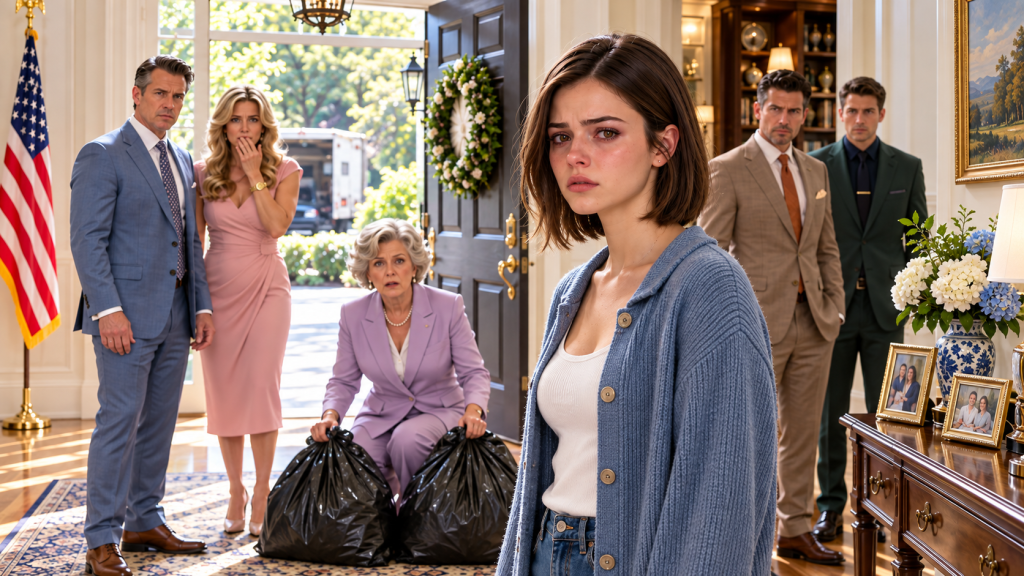
The garbage bags Mom had dropped.
Then me.
“I see you arrived exactly as Harold expected,” he said.
Mom recovered quickly.
She straightened her coat and lifted her chin.
“Good. Then you can explain to Emily that this property belongs to his children.”
Mr. Lawson’s expression didn’t change.
“Actually, Margaret, that is precisely why I’m here.”
He opened the folder.
Dad stepped forward.
“We should discuss the will privately.”
“No,” Mr. Lawson said.
Dad blinked.
“No?”
“Harold left specific instructions that this conversation happen in front of Emily and anyone attempting to take possession of the house.”
My heart started pounding.
Grandpa had never told me what was inside that folder.
He had only told me to let them in.
Let them talk.
Then open the study.
Mr. Lawson removed a sealed envelope.
My parents’ names were written across the front in Grandpa’s handwriting.
Before handing it over, he looked directly at Mom.
“Before we discuss ownership, Harold wanted you to answer one question about what happened seventeen years ago.”
Mom folded her arms.
“I don’t know what you’re talking about.”
“I believe you do.”
Dad stepped between them.
“This is ridiculous. Our father is dead. We don’t need an interrogation.”
Mr. Lawson remained perfectly calm.
“Your father anticipated that response too.”
He reached into the folder and removed another document.
“This is a copy of a letter Harold sent you both sixteen years ago.”
Dad’s face changed.
Only slightly.
But I saw it.
Mr. Lawson continued.
“He asked whether you intended to resume responsibility for Emily.”
Silence.
I looked at my parents.
Mom stared at the paper.
Dad stared at the floor.
I felt something cold move through me.
“What letter?” I asked.
Nobody answered.
Mr. Lawson looked at me.
“Your grandfather contacted your parents repeatedly after they left you here.”
My throat tightened.
I had spent seventeen years believing Grandpa simply accepted that my parents had disappeared.
Apparently, he hadn’t.
“How many times?” I asked.
Mr. Lawson hesitated.
“More than twenty.”
I stared at him.
Twenty.
Mom finally spoke.
“That doesn’t prove anything.”
Mr. Lawson nodded.
“You’re correct.”
Then he pulled out another stack.
“So Harold kept the responses.”
My mother’s face drained again.
Dad said, “Margaret.”
But she ignored him.
Mr. Lawson placed several photocopies on the hallway table.
I didn’t want to look.
Then I did.
The first letter was dated four months after they left me.
Mom’s handwriting.
I recognized it from an old birthday card Grandpa had once shown me.
Harold,
We are not in a position to take Emily back right now. She is settled with you and disrupting her routine would be unfair.
We will contact you when circumstances change.
Margaret.
My chest tightened.
The second letter came almost a year later.
Harold,
Please stop calling.
We have started over.
Emily is better off where she is.
Then another.
And another.
Each one shorter.
Colder.
By the time I was eight, they weren’t even pretending anymore.
One letter said:
We have Brianna now. Our home is not suitable for another child.
I looked toward the staircase.
Brianna’s face changed.
“What?”
She walked down slowly.
“What does that mean?”
Mom shook her head.
“Nothing. You were a baby.”
“But Emily was your baby too.”
Mom snapped, “This is complicated.”
“No,” I said quietly.
Everyone turned toward me.
For seventeen years, I had imagined dozens of explanations.
Maybe they were poor.
Maybe they were sick.
Maybe they had gotten into trouble.
Maybe they believed Grandpa could give me a better life.
Maybe they had tried to come back but Grandpa had refused them.
Children can invent almost anything to avoid accepting that their parents simply didn’t choose them.
Now I was standing in front of the truth.
“You had another child,” I said. “And you decided one daughter was enough.”
Mom’s mouth tightened.
“That’s not what happened.”
“What happened?”
She looked irritated rather than ashamed.
That hurt more than the letters.
“We were young,” she said. “Your father’s business failed. We had debts. Your grandfather had this enormous house and plenty of money. You were safe.”
Dad finally spoke.
“We did what we thought was best.”
Mr. Lawson looked at him.
“Then perhaps you’d like to explain the Vegas photographs.”
Dad froze.
Brianna actually laughed once.
Not because anything was funny.
Because sometimes shock comes out sounding wrong.
“What Vegas photographs?”
Mr. Lawson opened another envelope.
Mom rushed forward.
“Enough.”
He stepped back.
“These documents belong to Emily.”
“Those are private.”
“They were mailed to Harold with a Christmas card three months after you wrote that you were struggling financially.”
He handed the photographs to me.
I looked down.
My parents.
Younger.
Tan.
Smiling beside a hotel pool.
Mom wore a diamond necklace.
Dad held a champagne bottle.
On the back, someone had written:
Best decision we ever made. Finally living our lives.
The date was December 14.
Three days before Grandpa took me to the church Christmas party because I had cried when my preschool teacher asked why my parents weren’t coming to the holiday program.
I put the pictures down.
I didn’t cry.
That surprised me.
Maybe I had already cried all those tears as a child.
Mom pointed toward Mr. Lawson.
“This has nothing to do with the house.”
“No,” he said. “But Harold wanted Emily to know the truth before we discussed the house.”
Dad rubbed both hands over his face.
“Can we please get to the will?”
Mr. Lawson closed the first folder.
“Certainly.”
Brianna descended the final step.
Mom turned toward her.
“Go upstairs.”
“No.”
“Brianna.”
“I said no.”
Her voice had changed.
The spoiled confidence was gone.
She looked at me.
“How old were you when they left you?”
“Five.”
She swallowed.
“I was born the next year.”
“Yes.”
She turned slowly toward Mom.
“You told me Emily wanted to live with Grandpa.”
Mom looked furious.
“That was easier to explain to a child.”
“You told me she hated us.”
Dad said, “Brianna, enough.”
“No. You told me she refused to visit.”
Every word seemed to hit me separately.
I looked at my sister.
“You knew about me?”
“Of course I knew about you.”
Her eyes filled with confusion.
“They said Grandpa turned you against us.”
I almost laughed.
“They never called.”
Brianna looked at Dad.
“She’s lying.”
But Dad didn’t answer.
And that was enough.
Brianna took off her sunglasses.
Her eyes were wet.
“Oh my God.”
Mom exhaled loudly.
“Can everyone stop being dramatic? We made mistakes. Fine. People make mistakes. Your grandfather made plenty too.”
Mr. Lawson placed a document on the desk beside him.
“Harold agreed.”
She narrowed her eyes.
“What?”
“He knew he had made one significant mistake.”
Dad crossed his arms.
“And what was that?”
“Believing you would eventually return.”
The room went silent.
Mr. Lawson lifted the document.
“When Emily was ten, Harold changed his will.”
Dad stared.
“When she turned eighteen, he changed it again.”
Mom took one step backward.
“And six months ago, after his diagnosis, he completed the final version.”
She whispered, “What does it say?”
Mr. Lawson looked at me.
“Emily is Harold’s sole beneficiary.”
Nobody moved.
The movers standing near the doorway exchanged glances.
I couldn’t speak.
Mom did.
Immediately.
“That’s impossible.”
Mr. Lawson didn’t respond.
Dad stepped forward.
“I’m his son.”
“Yes.”
“This house has been in our family for three generations.”
“Yes.”
“He would never leave everything to a granddaughter.”
“He did.”
Mom shook her head.
“No. Emily manipulated him.”
Something inside me finally cracked.
“Manipulated him?”
She pointed at me.
“You lived here. You had access to him every day. He was elderly and sick.”
“He raised me.”
“You poisoned him against us.”
Mr. Lawson interrupted.
“Margaret.”
She ignored him.
“You wanted this.”
I stared at her.
“I wanted parents.”
That silenced her.
Not for long.
But long enough.
I continued.
“I wanted you to remember my birthday. I wanted Dad to teach me how to drive. I wanted you to show up when I graduated. Grandpa sat in the front row by himself.”
Mom looked away.
“You think I spent seventeen years planning to steal a house?”
She didn’t answer.
My voice shook.
“Until ten minutes ago, I didn’t even know he had contacted you.”
Dad looked toward the movers.
“Take a break outside.”
They didn’t need to be told twice.
The last man stepped onto the porch.
Dad closed the door.
Then he faced Mr. Lawson.
“What exactly did my father leave her?”
“Everything.”
Dad’s jaw tightened.
“Define everything.”
“The house.”
Mom sat down.
“The adjoining twelve acres.”
Dad’s head snapped up.
“The acreage too?”
“Yes.”
“His investment portfolio.”
Dad went pale.
“His retirement accounts.”
Brianna stared at me.
“And the contents of this residence, except for several personal gifts listed separately.”
Mom whispered, “How much?”
Mr. Lawson didn’t answer.
Dad did.
He looked like he already knew.
“At least three million.”
Mr. Lawson glanced at him.
“More.”
Nobody spoke.
Mom slowly stood.
“You’re saying he left her millions?”
“He left his estate to the person he considered his daughter.”
That sentence almost broke me.
I turned away.
The funeral flowers blurred.
I had been holding myself together since Grandpa died.
Through the hospital.
Through signing forms.
Through choosing his suit for the funeral.
Through standing beside the grave while the pastor talked about a good man going home.
I hadn’t cried much.
Grandpa hated seeing me cry.
Even at the hospital, when his breathing had become shallow, he told me:
“No tears wasted on me, kiddo. I got ninety years. That’s greedy.”
I had laughed.
Now my chest hurt so badly I could barely breathe.
Mom’s voice pulled me back.
“We’ll contest it.”
Mr. Lawson nodded.
“Harold expected that.”
Dad stared at him.
“Of course he did.”
“He requested two independent medical evaluations confirming his mental capacity when he signed the final will.”
Mr. Lawson held up another document.
“The signing was also recorded.”
Mom blinked.
“Recorded?”
“Yes.”
Her face changed.
Mr. Lawson opened Grandpa’s laptop.
I hadn’t noticed it sitting on the study desk behind him.
He turned the screen toward us.
Grandpa appeared.
Alive.
Sitting in his favorite chair.
The video had been recorded only five weeks before his death.
He looked thinner than I remembered.
But his eyes were sharp.
Very sharp.
Mr. Lawson pressed play.
Grandpa cleared his throat.
“If you’re watching this, I’m dead.”
Despite everything, a tiny laugh escaped me.
That was Grandpa.
Straight to the point.
On the screen, he continued.
“And if Margaret and Stephen are standing in my hallway pretending they’ve suddenly remembered where I live, then apparently I knew my children better than I wished I did.”
Mom turned away.
Grandpa looked directly into the camera.
“I want there to be no confusion about my wishes.”
He paused.
“Emily gets the house.”
Dad’s face hardened.
“Emily gets the land, investments, vehicles, accounts, furniture, and whatever else the law says is mine to give.”
He leaned forward.
“She gets these things because she stayed.”
My throat tightened.
Grandpa continued.
“She stayed when I was healthy.”
“When my knees went bad.”
“When I started forgetting where I put my glasses even though they were usually on my head.”
“When the cancer came.”
“When I needed someone to drive me to appointments.”
“When I couldn’t climb the ladder to clean the gutters.”
He smiled slightly.
“And because she is my granddaughter.”
His face became more serious.
“But there’s another reason.”
Mom looked at the screen.
“For seventeen years, I watched that girl wonder what she did wrong.”
My hands started shaking.
“You did nothing wrong, Emily.”
I covered my mouth.
“You were five.”
The room disappeared.
There was only Grandpa.
His voice.
His face.
“You were a child. Adults failed you. You didn’t fail them.”
I finally cried.
Quietly.
Brianna stared at me.
Grandpa continued.
“Margaret. Stephen.”
His expression hardened.
“If you are hearing this, you probably want to say I turned Emily against you.”
“No.”
“I spent years doing the opposite.”
I looked up.
“When she asked why you didn’t call, I told her you were busy.”
“When she asked whether you loved her, I said yes.”
“When she wondered if she had been bad, I told her children don’t get abandoned because they forgot to clean their room.”
My knees felt weak.
“I protected your names long after you stopped deserving it.”
Mom covered her face.
Dad didn’t move.
Grandpa continued.
“I’m not leaving Emily this estate to punish you.”
He paused.
“I’m leaving it to protect her from you.”
Dad whispered something under his breath.
Grandpa leaned back.
“I suspect you came for the house.”
Mom suddenly spoke to the screen.
“This is insane.”
Grandpa couldn’t hear her, of course.
But somehow the timing of his next words felt intentional.
“You can call me cruel if it helps.”
Brianna almost smiled.
“I’m dead. My feelings won’t be hurt.”
Then Grandpa became serious again.
“Emily owes you nothing.”
“She does not owe you money.”
“She does not owe you a room.”
“She does not owe you forgiveness.”
“She does not owe you family simply because you share blood.”
My tears kept falling.
“If she chooses to forgive you, that is hers to give.”
“If she chooses never to see you again, that is hers too.”
He looked directly into the camera one final time.
“And Emily?”
I leaned toward the laptop without meaning to.
“The house was never what made this your home.”
“You did.”
The screen went black.
Nobody spoke for a long time.
The old clock in the hallway ticked.
Once.
Twice.
Three times.
Then Mom said, “He hated us.”
Mr. Lawson closed the laptop.
“No.”
She looked at him.
“He did.”
“No. Harold spent years hoping you would become better people.”
Dad picked up one of the letters.
“He had no right to keep these.”
“He kept them because Emily deserved the truth someday.”
Mom turned toward me.
“This doesn’t change the fact that we’re your parents.”
I wiped my face.
“No.”
Something inside me had shifted.
“It changes the fact that I thought you wanted to be.”
She flinched.
Brianna sat on the stairs.
Dad paced across the foyer.
Then he stopped.
“Emily.”
I looked at him.
“We did make mistakes.”
I almost laughed.
Mistakes.
Forgetting a birthday is a mistake.
Showing up late is a mistake.
Leaving your five-year-old child for seventeen years requires thousands of decisions.
Every morning they didn’t call.
Every Christmas they didn’t visit.
Every time they passed a mailbox.
Every time they held Brianna.
Every time they looked at each other and decided they could wait another day.
Dad continued.
“But you have to understand our situation.”
“No.”
He frowned.
“No?”
“I’ve spent my whole life trying to understand your situation.”
That surprised him.
“I don’t want to anymore.”
Mom crossed her arms.
“So what happens now?”
Mr. Lawson answered.
“Now you leave.”
Her mouth fell open.
“This is my father’s house.”
“It is Emily’s house.”
“I grew up here.”
“So did she.”
Mom looked at me.
“You’re throwing your own mother out the morning after her father’s funeral?”
I stared at her.
“You arrived with a moving truck.”
She opened her mouth.
Then closed it.
Dad rubbed his jaw.
“We drove nine hours.”
“That sounds like poor planning.”
Brianna looked at me.
For one second, I expected her to defend them.
Instead, she stood.
“I’m leaving.”
Mom turned.
“What?”
“I’m going to a hotel.”
“Brianna.”
“I’m not staying here.”
She glanced upstairs.
“I’ll get my suitcase.”
“It’s still in the car.”
“Good.”
Mom grabbed her arm.
“We are a family. We stay together.”
Brianna pulled away.
“That’s interesting.”
“What’s that supposed to mean?”
“It means apparently you only believe that when there’s a house involved.”
Mom stared at her.
Brianna walked outside.
Dad followed.
For several minutes, Mom didn’t move.
Then she looked at me.
There was anger in her face.
But beneath it, something else.
Fear.
“I’m your mother.”
I nodded.
“I know.”
“You can’t erase that.”
“I’m not trying to.”
She waited.
I continued.
“But biology is the easiest part of being a parent.”
That was something Grandpa had said once.
Not about them.
About a television show.
At the time, I hadn’t realized he meant it.
Mom looked toward the study.
“He really left nothing to us?”
Mr. Lawson answered.
“There are two items.”
Her expression changed immediately.
“What?”
Mr. Lawson opened a small drawer.
He took out two envelopes.
One for Mom.
One for Dad.
Mom tore hers open.
Inside was a single photograph.
I recognized it.
Me at five years old.
Standing on Grandpa’s porch the day my parents left.
I was holding my stuffed rabbit.
On the back, Grandpa had written one sentence.
This was what you left behind.
Mom stared at it.
Then her knees seemed to soften.
She sat down.
For the first time that morning, she cried.
Not loudly.
Not dramatically.
She simply stared at the photograph.
Dad came back inside alone.
“Brianna called a taxi.”
Mr. Lawson handed him his envelope.
Dad opened it.
Same photograph.
Different message.
A father doesn’t abandon his child and return for the furniture.
Dad closed his eyes.
I didn’t feel victorious.
That surprised me too.
For years, I had imagined confronting them.
In some versions, I screamed.
In others, they begged me to forgive them.
Sometimes I imagined they had suffered.
That life had punished them.
But standing there, watching my father stare at Grandpa’s message, I felt mostly tired.
Mr. Lawson spoke softly to me.
“Emily, there are still several documents we need to review.”
I nodded.
Mom wiped her face.
“Can we at least stay until tomorrow?”
I looked at her.
“No.”
She looked wounded.
Maybe she expected me to soften.
I didn’t.
Not because I wanted revenge.
Because Grandpa had taught me the difference between kindness and surrender.
Kindness is giving someone food when they’re hungry.
Surrender is letting someone take your home because saying no feels uncomfortable.
I had confused those things my whole life.
Not anymore.
Mom stood.
“What about family photographs?”
“Mr. Lawson can help identify anything Grandpa specifically left to you.”
“And furniture?”
“No.”
“China?”
“No.”
“Your grandmother’s jewelry?”
I looked at Mr. Lawson.
He nodded toward me.
“Emily’s.”
Mom laughed bitterly.
“Of course.”
She walked toward the door.
Before leaving, she stopped.
“You know, your grandfather wasn’t perfect.”
“I know.”
That surprised her.
“He had a temper. He could be stubborn. He burned pancakes. He snored loud enough to wake the neighbors.”
For the first time all day, I smiled.
“He was terrible at apologizing.”
Mom watched me.
“But he stayed.”
Her face tightened.
I continued.
“That was enough.”
She left.
Dad remained.
He stood near the door with his hands in his coat pockets.
“You look like him.”
I didn’t answer.
“When you’re angry.”
Still nothing.
Dad looked toward the porch.
“I thought about you.”
That hurt.
More than I expected.
“Then why didn’t you call?”
He looked down.
“At first, I was ashamed.”
“And later?”
“Later, too much time had passed.”
“That’s not an answer.”
“It’s the only one I have.”
He walked out.
I closed the door.
For the first time since the moving truck arrived, the house became quiet.
Completely quiet.
Mr. Lawson waited.
“Do you want to continue today?”
I looked toward Grandpa’s chair.
“Yes.”
We spent the next two hours going through documents.
Grandpa had planned everything.
Property taxes were prepaid.
The house had no mortgage.
He had created an account specifically for maintenance.
He had even written instructions for the old tractor.
The battery dies if you leave the ignition halfway turned.
Ask Emily how I know.
I laughed through tears.
Mr. Lawson smiled.
“There’s something else.”
He handed me a key.
Small.
Brass.
“What’s this?”
“Desk drawer.”
Grandpa’s desk had dozens of drawers.
I knew all of them.
Or thought I did.
Mr. Lawson showed me a tiny lock underneath the center panel.
The key turned.
A hidden drawer slid forward.
Inside was a wooden box.
My name was carved into the lid.
I opened it.
Letters.
Dozens.
Each envelope had a date.
Birthday letters.
Christmas letters.
Graduation letters.
Some were marked:
Open when you buy your first house.
I laughed.
“Little late.”
Mr. Lawson smiled.
“Apparently not.”
Another said:
Open when you get married.
Another:
Open when you think you’ve ruined everything.
Another:
Open when you miss me.
That one destroyed me.
I pressed it to my chest.
Mr. Lawson quietly left the room.
I waited until I heard the front door close.
Then I opened it.
Kiddo,
If you’re reading this, I assume I’ve finally managed to do something without you hovering around asking whether I took my pills.
I laughed and cried at the same time.
Grandpa’s handwriting shook slightly.
Don’t turn this house into a museum.
Paint the walls.
Move the furniture.
Sell my ugly recliner.
I know you hate it.
I glanced at the recliner.
“I do.”
His letter continued.
Invite people over.
Make noise.
Burn dinner.
Fall in love if you feel like it.
Stay single if you don’t.
Plant tomatoes.
Or don’t.
You never liked them anyway.
I smiled.
The last paragraph was shorter.
You gave an old man a good life, Emily.
Don’t spend yours mourning mine.
And remember what I told you:
The people who leave don’t get to decide whether you were worth staying for.
You were.
Always.
Love,
Grandpa.
I sat there until evening.
Eventually, headlights appeared outside.
For one terrifying second, I thought my parents had returned.
Then Brianna got out of a taxi.
I almost didn’t open the door.
But Grandpa had told me to make my own choices.
So I did.
“What do you want?”
She held up her hands.
“I’m not moving in.”
I almost smiled.
“Good start.”
She looked embarrassed.
“I wanted to talk.”
I stepped aside.
She entered carefully this time.
No sunglasses.
No complaints about the smell.
No comments about bedrooms.
She looked around the foyer like she was seeing it for the first time.
“I’m sorry.”
I leaned against the wall.
“For which part?”
“Today.”
“That’s a big category.”
“I know.”
She swallowed.
“I’m sorry I walked into your house acting like it belonged to me.”
I said nothing.
“And I’m sorry about what Mom said.”
“You didn’t say it.”
“No. But I laughed.”
I remembered.
When Mom had called me Grandpa’s burden, Brianna had been upstairs shouting about paint.
“I didn’t know.”
“That doesn’t make it okay.”
“I know.”
She looked at me.
“I grew up thinking you hated us.”
I nodded slowly.
“I grew up thinking you forgot I existed.”
She winced.
We stood there in silence.
Then she said, “Can I ask you something?”
“What?”
“Did Grandpa ever talk about me?”
“Yes.”
Her eyes widened.
“What did he say?”
I walked toward the kitchen.
She followed.
I opened a cabinet.
Grandpa had kept photographs in an old cookie tin.
I pulled it down.
Inside were pictures printed from social media.
Brianna at graduation.
Brianna in a prom dress.
Brianna with a birthday cake.
Brianna standing beside my parents at some beach.
She covered her mouth.
“He had these?”
“He checked your public page.”
Her eyes filled with tears.
“He knew my name?”
“Of course he knew your name.”
“He never contacted me.”
“He didn’t want to put you in the middle.”
She touched one picture.
“He watched from far away.”
“Yes.”
Brianna sat at the table.
For several minutes, neither of us spoke.
Finally she said, “I think Mom and Dad are going to sue you.”
I wasn’t surprised.
“I figured.”
“They’re already talking about it.”
“Thanks for telling me.”
“They think you manipulated him.”
“I didn’t.”
“I know.”
That mattered more than I expected.
I looked at her.
“Why do you believe me?”
She gave a sad laugh.
“Because I watched Mom lie for twenty minutes today.”
Fair enough.
Before she left, Brianna stood at the front door.
“I don’t expect us to suddenly become sisters.”
“Good.”
She almost smiled.
“But maybe someday?”
I thought about it.
Grandpa had said forgiveness was mine to give.
He hadn’t said I needed to decide immediately.
“Maybe.”
Brianna nodded.
“That’s more than I deserve.”
“No.”
She looked at me.
“You didn’t abandon me.”
That surprised both of us.
She left.
The lawsuit arrived three weeks later.
Mom and Dad claimed Grandpa lacked mental capacity.
Their attorney argued undue influence.
They accused me of isolating him.
They claimed I had prevented contact.
Fortunately, Grandpa had expected all of it.
His doctors testified.
Neighbors testified.
His oncologist testified that Grandpa was “annoyingly lucid” until the final days.
Even his barber submitted a statement.
Harold complained about politics, baseball, and the price of coffee with complete mental clarity every third Thursday at 9:30 a.m.
The judge laughed when that was read.
My parents didn’t.
Then Mr. Lawson produced phone records.
Grandpa had called them dozens of times over the years.
Most calls lasted less than one minute.
Some went unanswered.
Then came emails.
Letters.
Certified mail receipts.
Proof.
Not revenge.
Not emotion.
Evidence.
The case lasted four months.
During those months, Brianna called me occasionally.
Sometimes she asked about the lawsuit.
Sometimes she asked about Grandpa.
Once she asked what his favorite food had been.
“Peach pie.”
“Did he make it?”
“He attempted to.”
“Was it good?”
“Absolutely not.”
She laughed.
That was the first normal conversation we ever had.
Mom called too.
I didn’t answer.
Dad sent emails.
I read one.
He apologized.
Sort of.
He said:
We should have handled things differently.
I deleted it.
Eventually the judge ruled.
The will stood.
Completely.
My parents received nothing beyond the items Grandpa explicitly named.
Two photographs.
Several childhood keepsakes.
And my grandmother’s old dining room clock, which Mom had once asked for.
When the decision came, Mr. Lawson called me.
“Congratulations.”
I looked around Grandpa’s kitchen.
“I don’t feel like celebrating.”
“You don’t have to.”
That night, I sat on the porch.
Autumn had become winter.
The garden was brown.
Grandpa’s empty chair sat beside mine.
I finally understood something.
Winning didn’t erase what happened.
It didn’t repair seventeen years.
It didn’t bring Grandpa back.
Justice sometimes looks less like celebration and more like quiet.
Like knowing nobody can take your home.
Like locking your own front door.
Like choosing who gets a key.
Six months after Grandpa died, Brianna visited again.
This time she called first.
She brought peach pie.
Store-bought.
“Didn’t want to repeat Grandpa’s mistakes.”
I laughed.
We ate it on the porch.
She told me she had moved out of our parents’ house.
Not because of me, she said.
Because after seeing what happened, she began noticing things she had ignored.
How Mom used money to control her.
How Dad avoided every difficult conversation.
How love in their house was often conditional.
“I think I was easier for them,” she said.
“Because you stayed?”
“Because I believed them.”
I didn’t know what to say.
So I said the truth.
“You were a kid too.”
She looked at me.
“That sounds like something Grandpa would say.”
“It is.”
Over the next year, we slowly became sisters.
Not movie sisters.
Not matching bracelets and daily phone calls.
Real sisters.
Awkward.
Careful.
Sometimes distant.
Sometimes close.
We learned each other.
She hated coffee.
I hated tea.
She talked during movies.
I threatened to ban her from the house.
She helped me repaint the upstairs hallway.
Not the master bedroom.
Grandpa’s room stayed almost exactly the same for a while.
Eventually, I changed that too.
I turned it into a guest room.
The first person who slept there was Brianna.
When she saw it, she smiled.
“So technically I did get the master bedroom.”
I threw a pillow at her.
Grandpa would have loved that.
Mom tried contacting me several times.
Her messages changed over time.
First angry.
Then defensive.
Then apologetic.
Finally, almost a year after Grandpa died, she sent one sentence.
I know sorry isn’t enough, but I am sorry.
I stared at that message for a long time.
Then I responded.
Thank you for saying it.
That was all.
I wasn’t ready for more.
Maybe someday.
Maybe never.
Grandpa had taught me that boundaries weren’t punishment.
They were doors.
You decide when to open them.
Dad eventually wrote a better letter.
Not perfect.
But better.
He didn’t explain.
He didn’t blame money.
Or youth.
Or fear.
He wrote:
I abandoned you because facing responsibility felt harder than walking away. Every year afterward, coming back required admitting what I had done, so I chose cowardice again.
I read that twice.
Then put it in Grandpa’s wooden box.
Some truths arrive too late to fix things.
But they can still be true.
Two years after Grandpa’s funeral, I stood in the garden planting tomatoes.
Yes.
Tomatoes.
I still didn’t like them.
But Grandpa had grown them every year.
Brianna sat nearby drinking lemonade.
“You’re planting vegetables you hate.”
“I’m honoring tradition.”
“You complained about tradition when Grandpa made you weed.”
“That was different.”
She laughed.
The house behind us looked different now.
I had painted the kitchen.
Replaced the roof.
Turned Grandpa’s study into my office but kept his desk.
The ugly recliner was gone.
Mostly.
I moved it to the basement.
I couldn’t bring myself to throw it away.
Some compromises are acceptable.
On the anniversary of Grandpa’s death, I opened another letter.
The envelope said:
Open when you finally believe you’ll be okay.
I had avoided it for months.
That afternoon, I decided I was ready.
Inside was a single page.
Emily,
If you opened this too early, put it back.
I smiled.
Still bossy.
If you opened it at the right time, then I was right.
You made it.
Not because of the house.
Not because of the money.
Not because I fixed anything.
You made it because somewhere along the way, you stopped waiting for people who left to tell you your value.
That was always the lesson.
Family can be blood.
Family can also be the people who show up.
Sometimes you get lucky and they’re both.
Sometimes you don’t.
Either way, build yourself a table where nobody has to earn the right to sit down.
Love you, kiddo.
Grandpa.
I read it twice.
Then I walked into the dining room.
Brianna was setting plates on the table.
Mr. Lawson and his wife were coming for dinner.
Our neighbors, the Parkers, were bringing dessert.
My friend Jenna had already arrived with her two children.
The house was loud.
Exactly like Grandpa wanted.
Someone burned garlic bread.
Probably me.
The dog was barking.
Yes, I eventually got a dog.
Grandpa always said the house needed one.
I stood in the doorway and looked around.
For years, I thought being abandoned had defined me.
Then I thought inheriting Grandpa’s house might define me.
Neither was true.
What defined me were the choices afterward.
The people I allowed in.
The boundaries I kept.
The love I accepted.
The love I gave.
The doorbell rang.
Brianna looked toward me.
“Expecting someone?”
“No.”
I walked into the foyer.
For one strange second, I remembered that morning two years earlier.
The moving truck.
The garbage bags.
Mom’s voice.
You were Grandpa’s burden.
I opened the door.
Mom stood there.
Alone.
No suitcases.
No moving truck.
No entitlement.
Just a small bouquet of daisies in her hands.
Grandpa’s favorite.
She looked older.
Nervous.
“I know I should have called.”
I didn’t answer.
She swallowed.
“I was nearby.”
Still nothing.
Then she looked past me toward the sound of people laughing inside.
“I won’t stay.”
I waited.
She held out the flowers.
“I just wanted to bring these.”
I took them.
“Thank you.”
She nodded.
Her eyes filled with tears.
“I miss him.”
“I do too.”
She looked down.
“I think I spent most of my life believing there would always be more time.”
Her voice broke.
“With Dad.”
“With you.”
“With everyone.”
I said nothing.
“I was wrong.”
We stood there.
Two people connected by blood and separated by nearly everything else.
Finally, she stepped backward.
“I should go.”
I looked at the flowers.
Then at her.
Grandpa had told me that forgiveness was mine.
Not an obligation.
Not a debt.
Mine.
“Mom.”
She stopped.
I almost couldn’t believe the word had come out.
She turned.
I opened the door a little wider.
“You can stay for dinner.”
She stared at me.
“But there are rules.”
She nodded immediately.
“Anything.”
“No talking about the lawsuit.”
“Yes.”
“No pretending the past didn’t happen.”
“Yes.”
“No blaming Grandpa.”
She lowered her eyes.
“Okay.”
“And this doesn’t mean everything is fixed.”
“I know.”
I studied her.
“Do you?”
She met my eyes.
“I’m starting to.”
I stepped aside.
She entered slowly.
The first time she had come back to that house after seventeen years, she walked in like she owned it.
This time, she waited for permission.
Maybe that was a beginning.
Maybe it wasn’t.
I didn’t need to know yet.
Brianna came around the corner carrying plates.
She froze.
“Mom?”
Mom looked terrified.
“Hi.”
Brianna glanced at me.
I shrugged.
“She brought daisies.”
Brianna smiled slightly.
“Grandpa’s favorite.”
“I remember,” Mom whispered.
That surprised me.
Mom looked toward the dining room.
“Should I help?”
Brianna handed her plates.
“You can start with these.”
I almost laughed.
Grandpa would definitely have approved.
Later that evening, everyone crowded around the dining table.
Mom sat near the end.
Quiet.
Uncomfortable.
Trying.
I noticed she kept looking at Grandpa’s empty chair.
I had never moved it.
Not because I was preserving a shrine.
I just liked it there.
After dinner, Mom touched the back of it.
“He used to sit here when I was little.”
“I know.”
“He always read the newspaper after dinner.”
“And complained about the editorials.”
She smiled.
“Yes.”
For the first time, we shared a memory that didn’t hurt.
Not exactly.
Some wounds don’t disappear.
They change.
They become scars.
Proof that something happened.
Proof that you survived it.
When everyone left, I stood on the porch alone.
The night was cold.
The house behind me was warm.
Lights glowed through the windows.
I could almost hear Grandpa beside me.
“You did good, kiddo.”
I looked toward the garden.
“I hope so.”
The wind moved through the trees.
Of course, no one answered.
But I didn’t need an answer.
Seventeen years earlier, my parents left me on that porch.
For most of my life, I thought that was the moment my family ended.
I was wrong.
That was the moment a different family began.
An old man opened the door.
He gave me a bedroom.
He packed my lunches.
He learned to braid hair badly.
He attended parent-teacher meetings.
He stayed awake when I had the flu.
He taught me to drive.
He threatened every boy who came to pick me up, then secretly slipped them gas money.
He clapped too loudly at graduation.
He taught me how to change a tire.
How to balance a checkbook.
How to tell when tomatoes were ripe.
How to leave people who treated me badly outside the door.
And eventually, even after he was gone, he taught me how to open that door again without giving away the key.
The house never belonged to my parents.
Not really.
Not because of paperwork.
Because a home isn’t inherited through blood alone.
It is built through presence.
Through ordinary mornings.
Through burned pancakes.
Through hospital visits.
Through arguments.
Through forgiveness.
Through people who stay.
That was Grandpa’s real inheritance.
The money helped.
The house mattered.
But the lesson mattered more.
Months later, I found one final note tucked behind a photograph in his desk.
It wasn’t sealed.
It wasn’t dated.
Just three lines written in his shaky handwriting.
Emily,
If they ever come back, remember:
You can forgive someone without giving them your house.
I laughed so loudly the dog started barking.
Then I framed it.
It hangs beside the front door now.
Visitors always ask what it means.
I usually smile and say,
“Long story.”
And it is.
A very long story.
But whenever I look at that note, I remember the morning after Grandpa’s funeral.
The moving truck.
The garbage bags.
My mother telling me I didn’t belong.
The study door opening.
And Grandpa, even after death, making sure I knew exactly where I belonged.
Right there.
In the home he built.
In the life he helped me create.
And finally, inside myself.
💬THE END! THANK YOU FOR READING!