

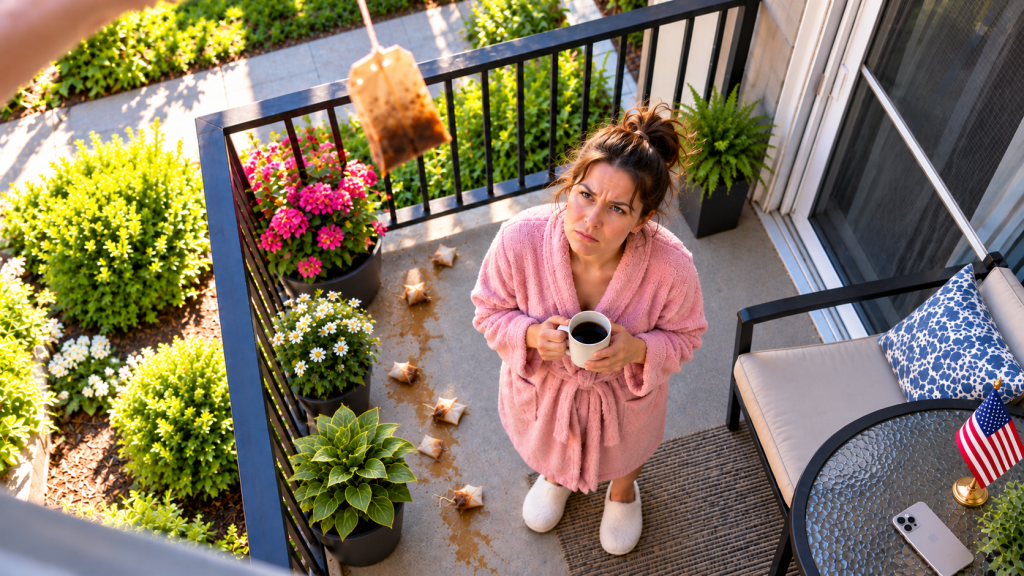
I asked my upstairs neighbor three separate times to stop throwing used tea bags onto my balcony.
The first time, he apologized.
The second time, he brushed it off.
By the third time, he actually laughed.
So I stopped asking.
Every day, another tea bag came over the railing.
Usually one around seven in the morning.
Another often appeared sometime around nine at night.
His routine became so predictable that I barely needed to look at the clock.
At first, I honestly thought it was an accident.
The very first tea bag landed beside one of my flowerpots.
I picked it up.
Dropped it in the trash.
Forgot about it.
Then, a week or two later, I walked outside and found another one sitting directly on a clean white towel I had draped over a chair to dry.
A dark brown stain had already soaked through the fabric.
That was when I decided to talk to him.
I went upstairs and knocked on apartment 4B.
When he opened the door, I held up the tea bag.
“Is this yours?”
His face immediately changed.
“Oh, wow. Did that fall from my balcony?”
“It’s not the first one.”
He rubbed his forehead.
“I’m sorry. I’m barely awake in the mornings. Sometimes I finish my tea outside and toss the bag without thinking.”
He looked genuinely embarrassed.
“It won’t happen again.”
I thanked him and went back downstairs.
For a moment, I even wondered whether I had made too much of something small.
The next morning answered that question.
Another wet tea bag was sitting on my balcony.
Still, I let it go.
For nearly three weeks, I said nothing.
I had lived in that building for eleven years and always tried to be an easygoing neighbor.
I didn’t want a petty argument over something that should have been simple to fix.
Then one evening, while I was sitting inside, I heard a soft sound outside.
Plop.
I already knew what it was.
Another tea bag.
This time, it had landed directly on the cushion of my favorite balcony chair.
By the time I picked it up, the fabric was stained.
That was enough.
I went upstairs again.
He opened the door.
“You’re still throwing tea bags onto my balcony.”
He shrugged.
“It’s just tea.”
“It ruined one of my towels. Now it stained my chair cushion.”
Instead of apologizing, he leaned casually against the doorframe.
“Well, you live below me. Things fall. That’s apartment living.”
“They aren’t falling. You’re throwing them.”
He smiled.
“You should probably be grateful it’s only tea.”
I stared at him.
“What exactly does that mean?”
He gave a small laugh.
“Could be worse.”
Then he shut the door.
I stood in the hallway for several seconds.
That conversation bothered me more than the tea bags ever had.
For eleven years, I had tried to be the kind of neighbor people could rely on.
I watered plants when people traveled.
Accepted deliveries.
Watched pets.
Signed for packages.
I had even collected his parcels several times the previous winter when he wasn’t home.
And somehow, using his own trash can was too much to ask.
Standing outside his apartment, I realized something else.
Getting angry wasn’t going to help.
If I shouted or made a scene, he could easily tell everyone that the woman downstairs had completely lost it over a few harmless tea bags.
I wasn’t going to give him that story.
Instead, I decided to give him one final chance.
If nothing landed on my balcony the next morning, I would let the whole thing go.
At exactly 7:04 a.m., I heard the familiar sound.
Plop.
I stepped outside.
There it was.
A freshly used tea bag sitting beside my flowerpots.
I stared at it for a few seconds.
Then, strangely, I smiled.
I went back inside.
Made coffee.
Sat at my kitchen table.
And started thinking.
By the time I finished my cup, I knew exactly what I was going to do.
Nothing destructive.
Nothing illegal.
No screaming match in the hallway.
I simply needed a way to make him understand that what felt insignificant from his balcony became someone else’s mess below.
It took most of the afternoon to prepare.
The following morning, I woke up early.
By 6:55, I was already sitting outside.
Coffee in one hand.
My phone within reach.
And absolutely no intention of knocking on apartment 4B for a fourth time.
At 7:03, I heard movement above me.
Then his balcony door slid open.
I waited.
A moment later, his hand appeared over the railing.
Something small dangled between his fingers.
The tea bag dropped.
This time, instead of sighing and throwing it away like I had done so many times before, I was ready.
It fell directly into a shallow plastic tray I had positioned beneath the railing.
The wet bag landed among dozens of others I had saved.
I had stopped throwing them away two weeks earlier.
Every tea bag had gone into a separate small plastic pouch after drying.
Each pouch had a date written on it.
Some had times.
A few had notes.
“Landed on towel.”
“Stained chair cushion.”
“Dropped while I was watering plants.”
“Second bag today.”
I used kitchen tongs to pick up the newest one.
Then I looked toward the balcony above me.
“Morning,” I called pleasantly.
Silence.
His door slid shut.
I went inside.
On my kitchen table was a folder I had spent the previous afternoon assembling.
There were photographs of the stains.
Photographs of the tea bags.
Screenshots showing the dates the pictures had been taken.
A receipt for the replacement towel.
An estimate from an upholstery cleaner for the chair cushion.
And a handwritten timeline beginning with the first time I spoke to him.
I also had a video.
Nothing dramatic.
Just thirty-four seconds of footage showing his hand extending over the upstairs railing and deliberately releasing the tea bag.
That detail mattered.
He could no longer claim it had accidentally fallen from a plate.
At nine o’clock, I walked downstairs to the building office.
Our property manager, Elena Alvarez, had worked there for almost five years.
She knew me well enough to understand that I wasn’t someone who filed complaints over every small inconvenience.
When I stepped into her office carrying a folder and a clear container, she glanced at both.
“What happened?”
I placed the folder on her desk.
“I have a strange problem.”
She listened while I explained everything.
At first, her expression was mostly confused.
Then I showed her the photographs.
After that, I showed her the video.
“You spoke to him already?”
“Three times.”
“Three?”
“Yes.”
“And he admitted doing it?”
“The first time he apologized. The second time he said things fall because I live below him. The third time he laughed.”
Elena watched the video again.
Then she looked at the plastic container.
“Are those all from him?”
“As far as I know.”
She leaned back in her chair.
“You’ve been collecting them?”
“Only because I figured eventually someone would ask me to prove it.”
For the first time, she smiled.
“I’m glad you did.”
She pulled our building handbook from a drawer.
I had never read the whole thing.
Apparently, buried somewhere between the rules about hallway storage and balcony grills was a section stating that residents could not discard objects, liquids, food waste, cigarette remnants, or household debris from balconies or windows.
It wasn’t really about tea.
It was about sanitation, property damage, and the possibility of hitting someone below.
Elena tapped the page.
“This is a lease violation.”
“I’m not trying to get him evicted.”
“I know.”
“I just want him to stop.”
She nodded.
“That is exactly what the first notice will say.”
The word first caught my attention.
“First?”
“Our policy is warning, formal violation, then additional action if the behavior continues.”
She printed something.
“Leave the copies of the photos with me. Keep your originals.”
“What about the tea bags?”
Elena stared at the container.
“Please take those with you.”
I laughed for the first time since the whole ridiculous situation began.
By noon, a notice had been placed on his door.
I didn’t go upstairs to read it.
I didn’t need to.
That afternoon, I saw him in the parking garage.
His name, I had learned when he moved in, was Trevor.
He was standing beside his car with the notice folded in his hand.
When he spotted me, his jaw tightened.
“You reported me?”
I stopped several feet away.
“Yes.”
“Seriously?”
“Yes.”
“Over tea bags?”
I looked at the paper in his hand.
“Apparently management thinks they’re worth writing about too.”
He gave a short laugh.
“I can’t believe you went running to the office.”
“I asked you three times.”
“You could have spoken to me again.”
“I did.”
“No, I mean before making it official.”
“That would have been the fourth time.”
He stared at me.
For once, Trevor didn’t seem to have a clever response.
Finally, he shook his head.
“You really have nothing better to do.”
I smiled.
“Have a good afternoon.”
Then I walked away.
Nothing landed on my balcony that evening.
Nothing came down the next morning.
By the second tea-free day, I began to think the notice had worked.
By the third, I relaxed enough to put my newly cleaned chair cushion outside again.
That night, I sat on the balcony for almost an hour reading.
It was the first time in weeks I had enjoyed the space without occasionally glancing upward.
I remember thinking how ridiculous it was that such a small thing had turned my own balcony into somewhere I didn’t want to sit.
The next morning, I stepped outside at 7:10.
No tea bag.
I watered my flowers.
Went to work.
Came home.
Still nothing.
I thought it was over.
Then came Saturday.
At 7:02 a.m., I heard Trevor’s balcony door slide open.
A few seconds later, something struck the concrete beside my chair.
Not a tea bag.
A small paper tag.
I bent down and picked it up.
Someone had written two words on the back in black marker.
“FILE THIS.”
For several seconds, I just stared.
Then I looked up.
His balcony was empty.
I took a picture.
Placed the tag inside one of my little plastic pouches.
Wrote the date.
And went back inside.
I didn’t knock upstairs.
I didn’t send him a note.
I didn’t confront him in the hallway.
That afternoon, Elena received another email from me.
I attached the photograph.
Her response arrived less than ten minutes later.
“Documented. Thank you.”
Monday morning, Trevor received his second notice.
That was when things became interesting.
For the next several days, nothing fell directly onto my balcony.
Instead, I began finding crumbs near the railing.
Once, there were sunflower seed shells.
Another morning, a small amount of potting soil appeared beside my flowers.
None of it was enough to damage anything.
Each individual incident looked harmless.
But together, the pattern was obvious.
Trevor had decided that if tea bags could get him in trouble, he would find other ways to remind me that he was still above me.
So I documented those too.
No drama.
No retaliation.
Photograph.
Date.
Time.
Email.
Photograph.
Date.
Time.
Email.
After about a week, Elena called me.
“Can you come by the office?”
When I arrived, she closed the door.
“I need to ask you something.”
“Okay.”
“Has Trevor had problems with anyone else?”
“Not that I know of.”
She turned her computer monitor slightly.
“I’ve received two other complaints since yours.”
That surprised me.
“About the balcony?”
“Not exactly.”
Apparently, after receiving the notice, Trevor had complained loudly in the lobby about a “crazy woman downstairs” trying to get him evicted.
He had said it in front of several residents.
One of them was a woman named Margaret who lived across the hall from him.
When she heard my name, she came to the office.
Margaret reported that Trevor regularly left garbage bags in the hallway overnight because he didn’t feel like walking them to the trash room.
Another neighbor mentioned that he often shook his entry mat over the balcony railing.
That explained some of the dirt.
Then Elena received a complaint from a couple living beside Trevor.
They said he had been playing music loudly after midnight for months but they had never formally reported him because they wanted to avoid conflict.
I frowned.
“I don’t want everyone piling on him because of me.”
“They aren’t.”
Elena folded her hands.
“This is actually why documentation matters. One resident complaining about another can look like a personality conflict. Four separate households reporting different violations looks like a pattern.”
“What happens now?”
“For you? Keep doing exactly what you’re doing.”
“For him?”
“That depends on him.”
I went upstairs feeling uneasy.
I had wanted the tea bags to stop.
That was all.
I didn’t enjoy the idea of Trevor getting into serious trouble.
But there was also a part of me that was starting to understand something.
People like Trevor often depended on everyone around them deciding that speaking up wasn’t worth the trouble.
One person ignored the garbage bags.
Another ignored the late-night music.
I had ignored the tea bags.
Eventually, everyone adjusted their life around the person causing the problem.
And the person causing it started believing there were no consequences.
That evening, I saw Margaret near the mailboxes.
She was in her seventies, tiny, always neatly dressed, and usually carried peppermint candies in her purse.
She touched my arm.
“Can I ask you something?”
“Of course.”
“Are you the one under 4B?”
I hesitated.
“Yes.”
Her eyes widened.
“So it’s true.”
“What?”
“The tea bags.”
I almost laughed.
“Apparently my balcony has become famous.”
Margaret lowered her voice.
“He told everyone you’re trying to have him thrown out.”
“I’m not.”
“I didn’t think so.”
She opened her mailbox.
“You’ve lived here longer than almost anyone. I’ve never even heard you raise your voice.”
“I asked him to stop throwing things over his balcony.”
“That seems reasonable.”
“He disagrees.”
Margaret pulled out two envelopes.
Then she looked at me.
“He leaves trash outside his door.”
“Elena mentioned that.”
“I asked him once to move it because the hallway smelled.”
“What did he say?”
Margaret sighed.
“He told me I should be grateful it wasn’t worse.”
I stared at her.
The exact same phrase.
Apparently Trevor had a favorite response whenever someone asked him to show basic consideration.
Margaret gave me a knowing look.
“So when Elena told me what you reported, I decided maybe I should stop being quiet too.”
That conversation changed how I felt.
I stopped worrying that I was somehow responsible for consequences Trevor had created for himself.
For the next week, things were peaceful.
No tea.
No dirt.
No notes.
I began using my balcony normally again.
Then one Friday night, I returned home from dinner with a friend and found Trevor waiting near the elevator.
He wasn’t blocking me.
He wasn’t yelling.
He was simply standing there with his arms crossed.
“I want to talk to you.”
I pressed the elevator button.
“You can talk.”
“Management says the next violation could affect my lease.”
“I didn’t write your lease.”
“You started this.”
“No. You started throwing garbage onto my balcony.”
“It was tea.”
“You keep saying that like the object is the problem.”
He stepped closer, though still several feet away.
“What is that supposed to mean?”
“It means I asked you politely to stop doing something that affected my home. You decided you didn’t have to because it seemed small to you.”
He scoffed.
“So you’re teaching me a lesson now?”
“No.”
The elevator doors opened.
“I’m documenting your choices.”
I stepped inside.
Before the doors closed, Trevor said, “You know, normal people talk things out.”
I held his gaze.
“Three times.”
Then the doors shut.
For several days after that, nothing happened.
Then, on Tuesday morning, I received a call from Elena before I left for work.
“Did anything land on your balcony last night?”
I looked outside.
“No.”
“Anything unusual?”
“No. Why?”
There was a pause.
“Someone threw a tea bag into the courtyard.”
I almost laughed.
“You’re kidding.”
“I wish I were.”
Our building had an interior courtyard with benches and a small landscaped garden.
Apparently, a resident walking her dog around nine thirty had felt something wet strike her shoulder.
A used tea bag had landed on her jacket.
She looked up in time to see someone step back from a fourth-floor balcony.
“Which apartment?”
Elena didn’t answer immediately.
She didn’t have to.
“Trevor?”
“We’re reviewing camera footage from the courtyard entrance and speaking to the resident.”
For the first time, I realized how much worse the situation could have become.
A wet tea bag was annoying on concrete.
On a person, it was different.
It could have landed in someone’s drink.
On a child.
On someone carrying a baby.
On a resident looking upward.
Maybe Trevor still thought tea was harmless.
But the problem had never really been the tea.
The problem was his belief that once something left his hand, what happened below was no longer his responsibility.
That afternoon, Elena slipped a notice under every apartment door reminding residents that throwing any object from balconies was prohibited.
Trevor received something different.
I didn’t know exactly what was in his letter.
But I knew he received one because I heard his voice in the office the next morning.
I was checking my mail when the office door opened.
“You can’t threaten my housing because someone says they saw something!”
Elena’s voice remained calm.
“No one is threatening you. I am explaining the consequences described in your lease.”
“This building is becoming ridiculous.”
“We have documented complaints.”
“From her?”
“From several residents.”
There was a long silence.
Then Trevor stepped out.
He saw me near the mailboxes.
For one uncomfortable second, neither of us moved.
Then he pointed at me.
“This is what you wanted.”
I shook my head.
“No.”
“Yes, it is.”
“I wanted you to use a trash can.”
A man standing near the lobby entrance snorted before quickly pretending to cough.
Trevor’s face reddened.
“This whole building is full of miserable people.”
He walked toward the elevator.
Margaret happened to be coming out.
She stepped aside.
Then, in the sweetest voice imaginable, she said, “Good morning, Trevor.”
He didn’t answer.
I had to bite the inside of my cheek to keep from smiling.
The next two weeks were quiet.
Completely quiet.
No tea bags.
No crumbs.
No soil.
No notes.
No confrontations.
I started believing Trevor had finally understood.
Then something unexpected happened.
A package arrived for apartment 4B while Trevor was away.
I happened to be near the lobby when the delivery driver appeared.
For months before the tea bag problem, I would have automatically offered to accept it.
That was what I had always done.
The driver looked at the directory.
“Do you know the resident in 4B?”
“Yes.”
“Could you take this for him?”
I almost said yes out of habit.
Then I stopped.
“No, sorry.”
There was nothing malicious about it.
I simply wasn’t willing to take responsibility for Trevor’s belongings anymore.
The driver nodded and left a delivery notice.
The following evening, Trevor knocked on my door.
It was the first time he had ever come to my apartment.
I didn’t open it immediately.
“Who is it?”
“Trevor.”
I opened the door but left the security chain attached.
He held a delivery notice.
“You were downstairs yesterday?”
“Yes.”
“The driver said you wouldn’t accept my package.”
“That’s right.”
“You always accepted them before.”
“That’s also right.”
He seemed genuinely confused.
“So why wouldn’t you take this one?”
I looked at him.
“Because I don’t want responsibility for your property.”
“It was just a package.”
“And it’s just tea.”
The words came out before I planned them.
For a second, we simply stared at each other.
Trevor’s expression changed.
Not anger.
Recognition.
I could almost see the sentence connecting in his mind.
I continued.
“You expected me to care about your things when you couldn’t be bothered to care about mine.”
“That’s different.”
“How?”
He opened his mouth.
Closed it again.
I wasn’t rude.
I didn’t smile.
I simply waited.
Finally, Trevor looked at the notice in his hand.
“I had medication in that package.”
That made me pause.
“If I had known it was medication, I would have helped.”
“You could have asked.”
“The delivery driver didn’t tell me.”
He nodded slowly.
For once, there was no sarcasm.
No laugh.
No smug comment.
He looked tired.
“I had to drive forty minutes to the distribution center.”
“I’m sorry you had to do that.”
He glanced past me toward my living room.
Then toward the balcony door.
“Did the chair cushion clean up?”
The question caught me completely off guard.
“Mostly.”
“How much did it cost?”
“Thirty-eight dollars.”
He nodded again.
“I’ll pay for it.”
I studied his face.
“Why?”
“Because I stained it.”
It was the first time I had heard him acknowledge that without minimizing it.
“You don’t have to pay me.”
“I know.”
That answer mattered.
The next morning, an envelope appeared under my door.
Inside were forty dollars and a small note.
“For the cushion. Sorry.”
No long explanation.
No demand that I withdraw complaints.
Just four words.
I placed the money on my counter and stared at it.
I wanted to believe the situation was finally changing.
For ten days, it seemed like it had.
Then the building held its quarterly resident meeting.
Normally, perhaps twelve people attended.
That evening, more than thirty showed up.
Apparently, rumors had spread about balcony violations, noise complaints, trash in the hallway, and possible changes to building enforcement.
Trevor sat near the back.
I sat near the front beside Margaret.
Elena reviewed ordinary things first.
Parking permits.
Maintenance scheduling.
Fire alarm inspections.
Then she addressed resident conduct.
She never named Trevor.
She didn’t name me either.
“We’ve had repeated complaints regarding items being discarded from balconies,” she said. “I want to be very clear. Nothing should ever be thrown from an upper floor. That includes food, liquids, cigarettes, plant material, or household waste.”
A man across the room raised his hand.
“What if someone keeps doing it after warnings?”
“Then we follow the enforcement process in the lease.”
Someone else asked whether residents should photograph violations.
Elena explained that documentation was helpful but residents should never put themselves at risk trying to gather evidence.
Everything remained calm.
Until Trevor spoke.
“So anyone can take a picture of something on their balcony and accuse the person above them?”
The room became quiet.
Elena looked toward him.
“We evaluate complaints based on available information.”
“What does that mean?”
“It means photographs, video, witness statements, repeated patterns, admissions, and other evidence.”
Trevor leaned back.
“So basically residents should spy on each other.”
“No,” Elena replied. “Residents should dispose of their waste properly.”
A few people laughed.
Trevor’s expression hardened.
Then something surprising happened.
A woman I barely knew raised her hand.
Her name was Priya.
She lived on the second floor with her husband and their six-year-old daughter.
“I don’t think this is about spying,” she said. “My daughter plays in the courtyard. I shouldn’t have to worry about someone dropping hot drinks or garbage from above.”
Trevor looked toward her.
“Nobody is throwing hot drinks.”
Priya’s eyebrows lifted.
“I didn’t say anyone was.”
That shut him up.
Another resident spoke.
Then another.
The discussion moved away from Trevor and became something bigger.
People talked about common spaces.
Noise.
Trash.
Respect.
One man admitted that he sometimes left recycling bags beside the trash room because he assumed maintenance would move them.
He promised to stop.
Another resident apologized for letting her dog wander off-leash in the courtyard.
The whole meeting became less about punishment and more about the simple idea that everyone’s convenience affected someone else.
I glanced back at Trevor once.
He wasn’t arguing anymore.
He was listening.
After the meeting, Margaret and I walked toward the elevator.
Trevor approached us.
For one second, I braced myself.
Instead, he looked at Margaret.
“I’m sorry about the garbage bags.”
Margaret blinked.
“What?”
“The bags outside my door.”
“Oh.”
“I shouldn’t have left them there.”
Margaret gave him a small smile.
“Thank you.”
Then Trevor looked at me.
He seemed about to say something.
But instead, he nodded and walked away.
The next morning, no tea bag came over the railing.
Nor the morning after that.
A week passed.
Then two.
The strange thing was that I had become so conditioned to expect that tiny wet plop that I still noticed 7:04 every morning.
I would be making coffee and think, This is when it usually happened.
Gradually, even that disappeared.
Life returned to normal.
Then, about a month later, I was watering my flowers when I heard Trevor above me.
“Hey.”
I looked up.
He leaned slightly over the railing.
Not enough to drop anything.
“Yeah?”
“I bought something.”
I waited.
A moment later, he held up a small silver container.
It was a countertop compost bin.
“For tea bags,” he said.
I laughed despite myself.
“That’s revolutionary.”
“I know.”
He smiled.
A real smile this time.
Then he disappeared inside.
I thought that would be the end of the story.
It wasn’t.
Because six weeks later, I came home to find a moving truck outside our building.
For one horrible moment, I wondered whether Trevor had finally been evicted.
Despite everything, that thought made me feel guilty.
Then I saw the boxes coming from apartment 2A.
An older resident named Harold was moving closer to his daughter.
While I helped hold the lobby door open, Trevor came downstairs carrying one of Harold’s boxes.
Then another.
Then another.
He spent almost two hours helping load the truck.
Nobody asked him.
He just did it.
At one point, Harold tried to hand him twenty dollars.
Trevor refused.
Watching him, I realized people weren’t always permanently fixed into the worst version of themselves.
Sometimes consequences didn’t destroy someone.
Sometimes they interrupted them.
Sometimes being forced to see the effect of your behavior was exactly what you needed.
I didn’t become friends with Trevor.
We weren’t suddenly having coffee together.
But we became neighbors.
Actual neighbors.
He held the elevator if he saw me coming.
I signed for one of his packages again several months later.
He watered my balcony plants when I spent a week visiting my sister.
When I came home, every plant was alive.
There was also a new box of tea sitting outside my door.
A sticky note was attached.
“Don’t worry. Bags stay upstairs.”
I laughed so loudly that Margaret opened her door to see what was happening.
I showed her the note.
She laughed too.
Things remained peaceful for nearly a year.
Then our building was sold.
A new management company announced renovations, rent adjustments, updated leases, and a long list of changes nobody particularly wanted.
Residents became nervous.
Some had been there longer than I had.
Margaret worried her rent would rise beyond what she could afford.
Priya and her husband worried about losing access to the courtyard during construction.
Trevor worried about parking.
For the first time since I had known him, he became one of the people trying to help everyone understand what was happening.
He printed copies of notices for Margaret because she didn’t use email.
He helped Priya carry groceries when the front entrance was blocked by construction.
He even organized a shared document where residents could report maintenance problems.
One evening, Elena called me into the office.
She was leaving.
The new owners had decided to bring in their own management staff.
“I’m going to miss this building,” she said.
“We’ll miss you.”
She smiled.
Then she opened a drawer and pulled out a thin folder.
“Remember these?”
Inside were copies of my original tea bag photographs.
I groaned.
“You still have those?”
“Record retention.”
She laughed.
Then she grew serious.
“You handled that situation better than most people would have.”
“I almost lost my mind several times.”
“But you didn’t.”
“I considered returning every tea bag to him.”
“I’m glad you didn’t.”
“So am I.”
Elena closed the folder.
“The reason I’m mentioning it is because people underestimate what calm documentation can do.”
I nodded.
“If you had dumped the bags outside his door, you both would have been filing complaints against each other.”
“That crossed my mind.”
“I know.”
She smiled again.
“But instead, only one person’s behavior needed defending.”
That sentence stayed with me.
Only one person’s behavior needed defending.
It wasn’t about being passive.
It wasn’t about letting people treat you badly.
It was about refusing to become the story they wanted to tell about you.
Trevor had expected me to yell.
He expected retaliation.
He expected some dramatic confrontation that would allow him to say, “See? She’s crazy.”
Instead, I gave him dates.
Photographs.
Receipts.
Video.
Three polite requests.
And room to make his own choices.
He did the rest.
A few months after Elena left, the new management company announced that they wanted resident volunteers for a building advisory committee.
Margaret nominated me.
I immediately refused.
“I already have a job.”
She ignored me.
Priya seconded the nomination.
Then, to my absolute disbelief, Trevor raised his hand.
“I vote for her.”
I turned around.
“You’re joking.”
“No.”
“You know I’m going to complain if you start throwing tea again.”
“That’s why you’re qualified.”
Everyone laughed.
I ended up agreeing to serve for six months.
Trevor joined too.
Our first committee meeting lasted two hours.
Most of it involved discussing package storage and renovation schedules.
At the end, someone brought up balcony rules.
Trevor raised his hand.
“I think the rule should be extremely simple.”
Everyone looked at him.
He pointed toward the ceiling.
“If it starts in your apartment, it stays your responsibility until it reaches a trash can.”
I stared at him.
Margaret burst out laughing.
Priya covered her mouth.
Even Trevor started laughing.
“What?” he said. “I learned.”
And he had.
The following spring, I replaced my old balcony chair entirely.
Not because of the stain.
It was simply time.
The chair had been outside for almost nine years.
Trevor saw the delivery men carrying the new one through the lobby.
“What are you doing with the old chair?”
“Probably donating it if someone wants it.”
He looked at me.
“I’ll take it.”
I blinked.
“The stained one?”
“It’s barely stained.”
“You’re serious?”
“My balcony needs a chair.”
I laughed.
“You understand the symbolism here, right?”
“That’s exactly why I want it.”
So Trevor took the chair.
He carried it upstairs himself.
A week later, I saw him sitting in it with a mug of tea.
I called up from below.
“Careful.”
He held up the mug.
“Trash can is three feet away.”
“Good.”
He lifted the cup in a toast.
That should have been enough irony for one story.
But life apparently had one final joke.
Several months later, Trevor knocked on my door holding a small package.
“This came for you.”
“Thanks.”
“I signed for it.”
“Appreciate it.”
He didn’t leave.
Instead, he stood awkwardly in the hallway.
“There’s something else.”
“What?”
“I’m moving.”
The words surprised me more than I expected.
“When?”
“End of the month.”
“Why?”
“My company offered me a position in Seattle.”
“That’s great.”
“Yeah.”
He looked toward the elevator.
“I almost turned it down.”
“Why?”
“Moving is annoying.”
“That is an excellent reason to limit your career.”
He laughed.
Then he became serious.
“I wanted to say something before I go.”
I waited.
“I was a jerk when I moved in.”
“That’s one description.”
“I mean it.”
He rubbed the back of his neck.
“I was going through some stuff. My engagement had ended. I hated my job. I had moved into a building where I didn’t know anyone. I think I decided everyone else was annoying before giving anyone a chance.”
I listened.
“I’m not telling you that as an excuse.”
“Good.”
He smiled.
“I knew you’d say that.”
“Then why tell me?”
“Because you were the first person who didn’t let me get away with it.”
I wasn’t sure how to respond.
Trevor continued.
“I kept throwing those stupid tea bags because after you asked me the second time, stopping would have meant admitting you were right.”
“That is incredibly stupid.”
“I know.”
“So instead you nearly risked your lease?”
“When you say it like that, it sounds worse.”
“It was worse.”
He nodded.
“I know that now.”
There was a brief silence.
Then he pulled something from his jacket pocket.
A tea bag.
Still wrapped.
I stared at it.
“You cannot be serious.”
He handed it to me.
On the paper wrapper, he had written:
“Last one. Dispose responsibly.”
I started laughing.
He did too.
I kept that tea bag.
Not because I was sentimental about garbage.
Because it reminded me of something I had learned during those months.
People often imagine boundaries as dramatic things.
A slammed door.
A shouted warning.
A final confrontation.
Sometimes they are.
But sometimes a boundary is quieter.
Sometimes it looks like refusing to knock for a fourth time.
Sometimes it looks like saving receipts.
Sometimes it looks like writing down dates while someone assumes you’ll eventually get tired and give up.
Sometimes the strongest response is simply refusing to participate in somebody else’s version of chaos.
Trevor moved out on the twenty-eighth.
That morning, I heard noise above me around seven.
For old time’s sake, I stepped onto my balcony.
Boxes moved across the floor upstairs.
Footsteps.
Tape tearing.
Cabinet doors closing.
Then Trevor leaned over the railing.
“Hey.”
“Hey.”
“I made tea.”
I narrowed my eyes.
“Don’t do it.”
He held up both hands.
The tea bag wasn’t there.
“Already in the trash.”
“Look at you.”
“Personal growth.”
A few hours later, the moving truck pulled away.
Apartment 4B sat empty for almost three weeks.
The first few mornings felt strangely quiet.
Then a young couple moved in.
Their names were Daniel and Sophie.
On their second day, Sophie knocked on my door.
“I think a sock fell onto your balcony.”
She looked embarrassed.
“I’m so sorry.”
I followed her outside.
A single gray sock lay near my plants.
I picked it up.
For one second, the entire history of apartment 4B flashed through my mind.
Then I started laughing.
Sophie looked confused.
“Is something wrong?”
“No.”
I handed her the sock.
“Long story.”
“I promise we’re not going to throw laundry down there.”
“I believe you.”
She still looked worried.
“Should I bring you something? It didn’t damage anything, did it?”
“No.”
I smiled.
“It’s just a sock.”
That sentence felt different now.
Because an accident is an accident.
Respect isn’t about never making a mistake.
It’s about what you do after someone tells you that your mistake is affecting them.
Sophie apologized once.
The sock never happened again.
That was all it ever should have taken.
A few weeks later, I received a postcard.
No return address was necessary.
The photograph showed the Seattle skyline.
On the back, Trevor had written:
“New apartment. Ground floor. Karma has a sense of humor.”
Underneath that, he added:
“Guy above me drops cigarette butts onto my patio. Already asked him once. I’m trying very hard not to become you.”
I laughed so hard I had to sit down.
Then I turned the postcard over and noticed another sentence squeezed along the bottom.
“Actually, I hope I do.”
I put the postcard on my refrigerator.
For the next year, it stayed there.
Every time someone visited and asked why I had a postcard from Seattle with a drawing of a tea bag in the corner, I gave them the short version.
I told them about the neighbor who threw tea bags.
The three polite requests.
The stained chair.
The folder.
The photographs.
The warning notices.
The courtyard.
The strange little war that never became a war because I refused to fight it that way.
Most people laughed.
A few said I had more patience than they would have.
One friend said she would have collected every tea bag and dumped them outside his door.
Maybe she would have.
There were days when I wanted to.
But looking back, I’m glad I didn’t.
Because revenge would have given me one satisfying afternoon.
Documentation gave me my balcony back.
And eventually, strangely enough, it gave me a decent neighbor too.
Two years after Trevor moved, I visited Seattle for a conference.
I debated whether to contact him.
Eventually, curiosity won.
I sent a message.
“In town. Still drinking tea?”
His response came almost immediately.
“Only indoors.”
We met at a café near my hotel.
He looked mostly the same.
Maybe happier.
Definitely less defensive.
At one point, I asked about the cigarette-butt neighbor.
Trevor groaned.
“You remember that postcard?”
“Of course.”
“Well, I asked him twice.”
“And?”
“He ignored me.”
I raised an eyebrow.
“What did you do?”
Trevor smiled.
“I started documenting.”
I burst out laughing.
“You’re kidding.”
“Nope. Photos. Dates. Emails.”
“I created a monster.”
“You created a functional tenant.”
“What happened?”
“Management warned him. He stopped.”
“That simple?”
“Pretty much.”
Trevor took a drink.
Then he looked at me.
“You know what the worst part was?”
“What?”
“The first time I found a cigarette butt on my patio, I immediately understood why you were so angry about the tea.”
I smiled.
“You had to move across the country for that?”
“Apparently.”
He shook his head.
“I picked it up and thought, Who does this?”
I stared at him.
He stared back.
Then we both laughed until the people at the next table looked over.
When I returned home after the conference, I stepped onto my balcony.
It had changed over the years.
New chair.
New flowers.
A little outdoor rug.
String lights along the wall.
The space felt peaceful again.
I sat down with a cup of coffee.
Above me, Sophie and Daniel were talking quietly.
Somewhere farther up, someone was watering plants.
A breeze moved through the courtyard.
Nothing fell.
And sitting there, I realized the whole experience had changed the way I thought about conflict.
I used to believe being a good neighbor meant being endlessly accommodating.
Being patient.
Letting small things go.
Avoiding awkward conversations.
Most of the time, those instincts served me well.
But kindness without boundaries can slowly turn into permission.
The first tea bag had been nothing.
The second was still small.
Even the stained towel could have been forgiven.
What mattered was what happened after I asked.
A reasonable person hears, “This is causing a problem,” and tries to stop.
An unreasonable person hears the same thing and begins calculating how much they can get away with.
That is when kindness has to change shape.
It doesn’t have to become cruelty.
It doesn’t have to become revenge.
It simply has to become firm.
A year after my Seattle trip, our resident committee approved renovations to the courtyard.
We added better lighting, new benches, and covered recycling containers.
During the meeting, Priya suggested putting small signs near the balcony doors reminding residents not to throw objects.
Margaret looked at me.
I looked at Margaret.
Both of us started laughing.
Nobody else understood at first.
Then Priya did.
“Oh,” she said.
“The tea bags.”
Eventually, the sign was installed.
It was simple.
“Nothing over the railing. Keep our neighbors safe and our shared spaces clean.”
No threats.
No complicated language.
Just a reminder that there was always someone below.
The day the sign went up, I took a picture and sent it to Trevor.
His reply came seconds later.
“I expect royalties.”
I wrote back:
“You owe me forty dollars for emotional damages.”
He answered:
“I already paid for the cushion.”
That was the last time we talked about the original incident for a long while.
Years passed.
Margaret eventually moved to live with her son.
Priya’s daughter grew tall enough that I barely recognized her.
Sophie and Daniel had a baby.
I became the person who occasionally accepted their diaper deliveries when they weren’t home.
Apartment life continued the way it always does.
People moved in.
People moved out.
Someone’s music was occasionally too loud.
Someone forgot laundry in the dryer.
Someone took the wrong parking space.
People apologized.
People adjusted.
Life went on.
And whenever a new resident complained at a committee meeting about something that seemed small, I tried not to dismiss it.
Because “small” depends heavily on which side of the railing you happen to be standing on.
One rainy afternoon, nearly five years after Trevor moved away, I found an unexpected envelope in my mailbox.
Inside was a wedding invitation.
Trevor was getting married.
At the bottom of the invitation, beneath the formal details, he had added a handwritten note.
“Before you ask, yes, there will be tea.”
I laughed.
I attended.
The wedding was small and warm.
When Trevor introduced me to his wife, Maya, he said, “This is the neighbor I told you about.”
Maya’s eyes widened.
“The tea bag neighbor?”
I pointed at Trevor.
“He’s the tea bag neighbor.”
She laughed.
“I’ve heard this story at least twenty times.”
Trevor looked offended.
“I don’t tell it that often.”
“You told my parents.”
“It was relevant.”
“How?”
“They asked how you became less stubborn.”
I nearly choked on my drink.
Later that evening, during the reception, Trevor stopped beside my table.
“You know something weird?”
“What?”
“If you hadn’t reported me, I probably would have kept acting like that.”
“Throwing tea bags?”
“Not just that.”
He glanced toward Maya.
“I think I was becoming someone who believed every inconvenience I caused was everyone else’s problem.”
“That sounds exhausting.”
“It was.”
He smiled.
“You never tried to embarrass me.”
“I considered it.”
“I’m sure.”
“You did a good job embarrassing yourself.”
“That too.”
We stood quietly for a moment.
Then Trevor lifted his glass.
“To reasonable neighbors.”
I lifted mine.
“To trash cans.”
He laughed.
“To trash cans.”
When I got home from the wedding, it was nearly midnight.
I stepped onto my balcony before going to bed.
The building was quiet.
For some reason, I thought about that first morning years earlier.
The tiny wet tea bag beside my flowerpot.
How easy it had been to throw away.
How small it seemed.
How impossible it would have been to guess where that ridiculous little problem would lead.
A stained towel.
A ruined cushion.
Three conversations.
A folder.
A warning.
An angry neighbor.
An apology.
A compost bin.
A move across the country.
A wedding invitation.
Life is strange that way.
Sometimes the smallest conflicts reveal the biggest habits.
And sometimes the best revenge is no revenge at all.
It is simply refusing to clean up someone else’s mess forever.
I still have the final wrapped tea bag Trevor gave me before he moved.
It sits in the back of a kitchen drawer.
Every now and then, when I’m looking for batteries or tape, I see it.
“Last one. Dispose responsibly.”
I never did dispose of it.
Maybe that makes me a hypocrite.
Or maybe some trash becomes a souvenir once it teaches you something valuable.
Either way, I know one thing for certain.
If another wet tea bag ever comes sailing over my balcony railing, I won’t spend weeks wondering whether I’m being unreasonable.
I’ll ask once politely.
I’ll ask twice if I’m feeling generous.
After that?
I know where the property manager’s office is.
And I still own a very good folder.
💬THE END! THANK YOU FOR READING!