

A Rich Guest Framed Me for Stealing Her Diamond Ring—Then Security Found What She Hid Behind the Hotel Dresser…
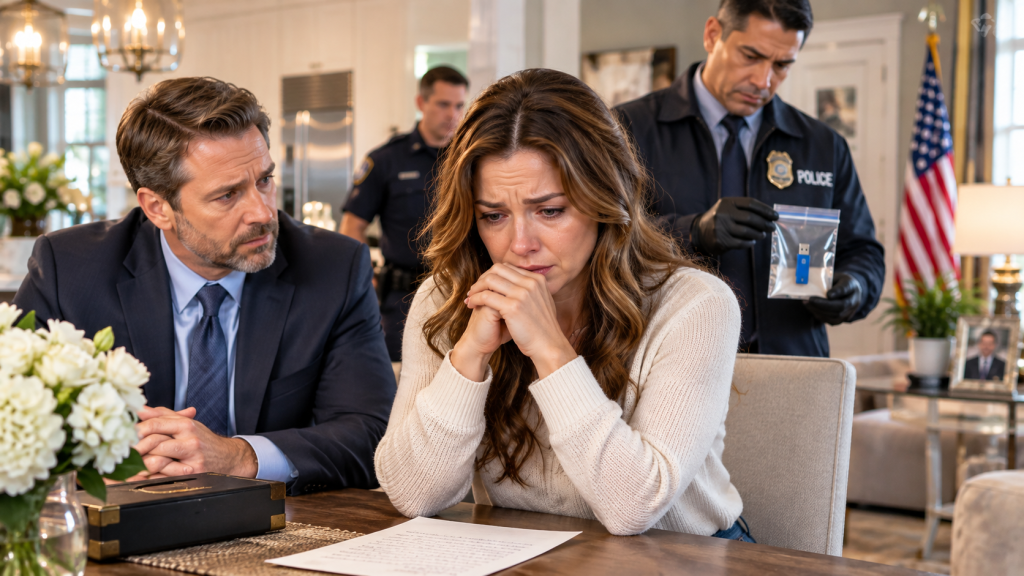
The blue flash drive left my apartment inside an evidence bag.
I stood at the window and watched Detective Alvarez carry it toward his car.
Such a tiny thing.
Blue plastic.
A metal connector.
A few scratches along one side.
It looked like something you could buy at a drugstore for fifteen dollars and forget in the bottom of a desk drawer.
But Daniel had carried it for years.
Lydia Carter had tried to destroy my livelihood because of it.
And now two detectives were treating it like it might contain enough evidence to bring down people who had spent years believing they were untouchable.
I wrapped my arms around myself.
Marcus stood a few feet behind me.
Martin Ellis was still sitting at my kitchen table.
Nobody spoke.
For eighteen months after Daniel died, I had thought I understood what grief was.
I thought grief was waking up and reaching across the mattress before remembering nobody was there.
I thought grief was deleting a dead man’s number from a daycare emergency-contact form.
I thought grief was standing in the grocery store and seeing his favorite cereal and suddenly having to walk away because your throat had closed.
I thought grief was watching Sophie draw four people when there were only three of us left.
I thought grief was Emma asking whether Daddy needed a coat in heaven.
But that morning, I discovered another kind.
The grief of realizing the person you loved had carried a secret because he was trying to protect you.
And the terrible question that came with it.
Had he protected me?
Or had he simply left me unprepared?
I turned from the window.
Martin looked at me.
“Rachel—”
“Don’t.”
He stopped.
I walked toward the kitchen table.
Daniel’s letter was still there.
One page.
A few sentences.
His handwriting.
That was what hurt the most.
I could recognize Daniel’s handwriting from across a room.
The slightly crooked D.
The way his R leaned too far forward.
The tiny hook at the end of his lowercase y.
Eighteen months without him, and my brain still knew every movement of his hand.
I touched the edge of the paper.
“Did he know they might come after me?”
Martin swallowed.
“I don’t know.”
“That isn’t an answer.”
“I genuinely don’t know.”
I looked at him.
“You worked with him.”
“Yes.”
“You knew about the Carter Foundation.”
“Yes.”
“You knew he kept evidence.”
“Yes.”
“You knew they were threatening him.”
Martin’s eyes lowered.
“Yes.”
“And after he died?”
He didn’t answer immediately.
That silence told me more than words could have.
“After he died,” I repeated, “did you ever wonder whether they might come looking for whatever he had?”
Martin finally lifted his eyes.
“Yes.”
My stomach tightened.
“How often?”
“Every day.”
I stared at him.
“Then why didn’t you warn me?”
“Because Daniel made me promise I wouldn’t involve you unless someone came looking for the drive.”
I laughed once, harsh and humorless.
“Someone did come looking for it, Martin. She just didn’t knock on the door and ask politely.”
“I know.”
“No, I don’t think you do.”
I pointed toward the apartment door.
“Forty-eight hours ago I was marched through the Grand Marlowe in front of half my coworkers because Lydia Carter said I stole her diamond ring. Security emptied my locker. Management suspended me. Police searched my purse.”
Martin looked down.
“I know.”
“I had to sit in an office while a woman wearing earrings worth more than my yearly income explained that people ‘in my situation’ sometimes become desperate.”
Marcus’s jaw tightened.
I continued.
“She knew my husband was dead. She knew I had children. She knew exactly what losing that job could do to us.”
Martin whispered, “I’m sorry.”
“Sorry doesn’t explain why you let me walk around for eighteen months without knowing Daniel had made enemies powerful enough to frighten him.”
“He thought ignorance would protect you.”
“Did it protect him?”
Martin flinched.
The moment the words left my mouth, I wished I could pull them back.
But they were true.
Daniel had died on a wet highway outside Hartford eighteen months earlier.
One-car accident.
Rain.
Bad visibility.
Guardrail.
The report used ordinary words for the worst day of my life.
For months I had forced myself to accept that ordinary explanation because the alternative was unbearable.
Now even that fragile certainty was cracking.
Martin leaned forward.
“I’ve wondered the same thing.”
My heart stumbled.
“What does that mean?”
Before he answered, my phone rang.
All three of us froze.
Detective Alvarez.
I answered.
“Hello?”
“Rachel?”
“Yes.”
“We opened the drive.”
Something in his tone made me sit down.
Not alarm exactly.
Something heavier.
The voice of a man who had expected one problem and discovered ten more.
“What did you find?”
“Your husband wasn’t investigating ordinary accounting irregularities.”
I looked at Martin.
He was staring at the phone.
Alvarez continued.
“There are spreadsheets, internal ledgers, copies of wire transfers, audio files, photographs, emails, scanned contracts, and notes connecting the Carter Foundation to several companies controlled by Lydia Carter’s family.”
“How much money are we talking about?”
“We’re still calculating.”
“Thousands?”
“No.”
“Hundreds of thousands?”
A pause.
“Millions.”
I stopped breathing for a second.
Marcus lowered himself into the chair beside me.
Alvarez continued.
“Some of the money appears to have originated as charitable donations intended for low-income housing projects, medical grants, and disaster relief.”
“And then?”
“It was moved through consulting firms and shell companies.”
“Owned by the Carters?”
“Some directly. Others through intermediaries.”
Martin closed his eyes.
He seemed to know what was coming.
I asked, “Did Daniel know all this?”
“He knew enough to be worried.”
My throat tightened.
“What else?”
“There are personal notes.”
“What kind?”
“Dates. Meetings. Names. Descriptions of conversations. Copies of threats.”
I looked at Daniel’s letter.
“Threats?”
“Yes.”
My fingers went cold.
“Against Daniel?”
“At least two appear to be.”
I could hear papers moving on Alvarez’s end.
Then he said, “Rachel, I need to ask something carefully.”
My whole body tensed.
“What?”
“Did Daniel ever tell you anyone was following him?”
“No.”
“Did he ever mention seeing the same vehicle near your home or workplace?”
“No.”
“Did he ever change routines unexpectedly?”
I thought.
Daniel suddenly refusing to take the girls to school some mornings.
Daniel replacing the locks after claiming one had become stiff.
Daniel telling me not to post our vacation location online.
Things I had dismissed.
Normal things.
Maybe not normal at all.
“He changed our locks about two months before he died.”
“Why?”
“He said the front lock was sticking.”
“Was it?”
“I don’t know.”
“Anything else?”
I swallowed.
“He started parking in different places when we went out.”
Martin looked up sharply.
“And he stopped letting the girls play near the front of the building alone.”
Alvarez went quiet.
I pressed the phone closer.
“What aren’t you telling me?”
“There’s footage from the Grand Marlowe.”
“What footage?”
“The night Lydia Carter accused you of stealing her ring.”
My back stiffened.
“The hotel said the main hallway camera near her suite wasn’t recording.”
“The main system wasn’t.”
I waited.
“There was a secondary security camera near the service elevator. It was running independently.”
Marcus stood.
“I knew it.”
I looked at him.
“What?”
“When the system went down, engineering put two portable units near the service corridor because of the gala.”
Alvarez heard him.
“That matches what security told us.”
My heartbeat quickened.
“What does it show?”
“Lydia left her suite approximately twenty minutes before she reported the ring missing.”
I remembered her accusation perfectly.
The way she stood in the hallway in a white evening dress.
The way she touched her empty ring finger.
The trembling performance in her voice.
“I had it right there,” she had said.
“Your housekeeper was the only person in my room.”
I gripped the edge of the table.
“What was Lydia doing?”
“She was carrying a small black pouch.”
I knew that pouch.
She had told security it contained cosmetics.
“Then?”
“She used the service elevator.”
“To where?”
“The employee level.”
My locker was on the employee level.
A cold wave moved through me.
“She went near my locker?”
“The camera doesn’t cover the full corridor.”
“But she went there.”
“Yes.”
“Before claiming I stole from her.”
“Yes.”
Marcus swore under his breath.
I pressed a hand against my forehead.
Alvarez continued.
“There’s more.”
Of course there was.
“What?”
“Hotel security performed another search of Lydia’s suite this morning.”
“Why?”
“One of the housemen remembered seeing the dresser pulled several inches away from the wall shortly before the theft was reported.”
Marcus frowned.
“That dresser shouldn’t move easily. It’s attached to an anti-tip bracket.”
“Exactly,” Alvarez said. “Security checked behind it.”
I stopped breathing.
“What did they find?”
“An envelope.”
“The ring?”
“No.”
“What?”
“A sealed envelope with Daniel Bennett’s name written across the front.”
For several seconds, nobody in my kitchen moved.
I heard a car outside.
A faucet dripping.
Emma’s clock ticking in the hallway.
Everything ordinary.
Everything impossible.
“That can’t be right.”
“It is.”
“My husband died eighteen months ago.”
“I know.”
“Why would Lydia Carter have an envelope with his name?”
“That’s what we want to determine.”
My voice dropped.
“What was inside?”
“A photograph.”
“Of Daniel?”
“Yes.”
My legs weakened.
I sat down.
“When was it taken?”
“We’re estimating approximately three weeks before his death based on the clothing and metadata recovered from another copy on the drive.”
Martin stood suddenly.
“There was another copy?”
“Yes.”
“What does the picture show?” I asked.
“Daniel outside a coffee shop.”
“Which coffee shop?”
“We’re checking.”
“Was he looking at the camera?”
“No.”
That answer chilled me more than anything.
Someone had photographed my husband without his knowledge.
“What else was in the envelope?”
Alvarez hesitated.
“A note.”
“What did it say?”
“Rachel—”
“Tell me.”
His voice softened.
“It said, ‘You were warned once. There will not be another warning.’”
I covered my mouth.
Martin turned away.
Marcus whispered my name.
Daniel had died twenty-two days after that photograph was taken.
For eighteen months, I had believed rain killed him.
Suddenly rain seemed like a convenient accomplice.
I forced out the question.
“Do you think Lydia killed my husband?”
“I’m not saying that.”
“Do you think his death was an accident?”
“We are requesting the original case files and arranging for a new forensic review.”
“That isn’t an answer.”
“It’s the only responsible answer I can give right now.”
I shut my eyes.
Alvarez added, “I want you to pick up your daughters.”
My eyes opened.
“Why?”
“Precaution.”
“Am I in danger?”
“We have no specific threat against you at this moment.”
“At this moment?”
“Rachel, get your daughters. Stay together. Officers will check the building periodically.”
The room seemed to shrink.
I looked toward the refrigerator.
Sophie’s spelling test was held there by a magnet.
Emma’s drawing of our family hung beside it.
Four stick figures.
She still drew Daniel.
“Okay.”
“And Rachel?”
“Yes?”
“Don’t speak to Lydia Carter. Don’t respond to reporters. If anyone contacts you claiming to know Daniel, call me first.”
The call ended.
Marcus grabbed his keys.
“I’m driving.”
“I can drive.”
“You’re shaking.”
I looked at my hands.
He was right.
Martin stepped toward me.
“I’ll come.”
“No.”
“Rachel—”
“You’re going to the police station.”
He looked stunned.
“You wanted to know how you can help me?”
He nodded.
“Tell them everything.”
His expression changed.
A mix of guilt and fear.
“Even if it makes me look terrible?”
“Especially then.”
He nodded slowly.
For once, he didn’t argue.
Twenty-five minutes later, Marcus and I pulled into the elementary school parking lot.
Children were outside for recess.
A teacher blew a whistle.
Two boys chased a soccer ball.
A girl sat on a bench tying her shoe.
The ordinary scene made my chest hurt.
I wanted my daughters to stay inside that ordinary world forever.
No corruption.
No threats.
No photographs taken from parked cars.
No wealthy strangers using them as leverage.
The school secretary looked surprised when I asked to sign both girls out.
“Everything okay?”
“Family situation.”
She studied my face but didn’t push.
Sophie came first.
Ten years old and already carrying Daniel’s ability to know when someone was lying.
She looked at me once.
“What happened?”
“Nothing you need to worry about.”
“That means something happened.”
I almost smiled.
Emma appeared behind her with a glittery folder.
“Are we going for ice cream?”
“No.”
“Dentist?”
“No.”
She considered the possibilities.
“Did Grandma fall again?”
“No.”
“Then why are we leaving?”
“Because I wanted you home.”
Emma smiled.
“Cool.”
Sophie didn’t.
On the drive back, she watched me from the rearview mirror.
Marcus kept his eyes on the road.
Emma talked about a classmate who had glued his pencil to his desk.
For five minutes, her little voice filled the car with something normal.
Then Sophie said quietly, “Is this about that lady from the hotel?”
I looked back.
“How do you know about her?”
“Kids at school were talking.”
My stomach dropped.
“Talking about what?”
“You.”
I turned fully in my seat.
“What about me?”
“Someone’s mom saw your picture online.”
Marcus’s hands tightened around the steering wheel.
Sophie continued.
“They said you stole something.”
Emma went silent.
I felt something inside me crack.
“No.”
My voice came out too sharp.
I softened it.
“No, sweetheart. I didn’t steal anything.”
Sophie nodded immediately.
“I know.”
“How?”
“Because you yelled at me for keeping two dollars I found under a vending machine.”
Despite everything, I laughed.
Marcus did too.
Emma leaned forward.
“I remember that.”
“It belonged to somebody.”
“Nobody claimed it.”
“That doesn’t make it yours.”
Sophie raised one eyebrow.
“Exactly.”
Then her expression became serious again.
“Are you going to jail?”
“No.”
“Promise?”
“Yes.”
This promise I could make.
Because for the first time since Lydia accused me, I knew the ring had never been in my possession.
Whatever game she had been playing, it was starting to fall apart.
When we reached my apartment, Detective Alvarez was waiting downstairs with another officer.
My heart jumped.
He came toward us immediately.
“Everything’s okay.”
I nearly laughed at the phrase.
He glanced at the girls.
“Could we talk privately?”
Marcus took Sophie and Emma upstairs.
I stayed in the lobby.
“What happened?”
“We found the ring.”
Every muscle in my body locked.
“Where?”
“Inside Lydia Carter’s luggage.”
I stared at him.
“What?”
“It was in a shoe bag inside a secondary suitcase.”
“No.”
“Yes.”
“She had it?”
“Yes.”
“All this time?”
“As far as we can determine.”
My anger arrived before relief.
Hot.
Sharp.
Almost dizzying.
“She framed me.”
Alvarez chose his words carefully.
“The evidence strongly indicates the theft report was fabricated.”
“She pointed at me in front of everyone.”
“I know.”
“She told police I was desperate because I’m a widow.”
“I know.”
“She made security search my locker.”
“Yes.”
“She wanted them to find something.”
Alvarez watched me.
“The flash drive.”
“Yes.”
I looked toward the elevator.
“She knew Daniel had it.”
“That appears likely.”
“And she thought he gave it to me.”
“Yes.”
The entire humiliating night rearranged itself in my mind.
Lydia’s accusations.
Her insistence my locker be searched immediately.
Her demand that police inspect my belongings.
The way she kept asking whether security had checked everything.
She had never cared about the diamond ring.
The ring was bait.
I was the trap.
“You should arrest her.”
“She’s being questioned.”
“Questioned?”
“We need to build the case properly.”
“If I had hidden a diamond ring and falsely accused somebody, would I be sitting in a luxury hotel with my lawyer?”
Alvarez didn’t answer.
That was answer enough.
Money did not erase consequences.
But it certainly bought comfortable waiting rooms before they arrived.
“What about Daniel?”
Alvarez’s expression changed.
“We obtained his accident file.”
I felt the air leave my lungs.
“And?”
“There were photographs of his car after the crash.”
“What did you see?”
“We’re sending them to specialists.”
“Detective.”
He hesitated.
“There may have been damage to a brake component before impact.”
I stared at him.
“May have?”
“We need a forensic mechanic to confirm.”
“You think somebody tampered with his brakes.”
“We’re investigating that possibility.”
My hand found the wall behind me.
“I buried him because of rain.”
Alvarez looked genuinely sorry.
“I know.”
“No, you don’t.”
My voice cracked.
“I told Sophie her father died because sometimes terrible accidents happen and nobody is responsible. I told Emma Daddy’s car slipped because the road was wet.”
I pressed both palms over my face.
“What am I supposed to tell them now?”
“You don’t have to tell them anything until we know more.”
But I already knew enough.
My husband had been afraid.
Someone photographed him.
Someone threatened him.
Then his brakes may have been damaged.
And the woman connected to everything had just tried to frame me.
That night I waited until Sophie and Emma fell asleep.
Then I sat alone in the kitchen.
Marcus had offered to stay.
I told him to go home.
I needed silence.
Daniel’s letter lay in front of me.
I read it again.
Rachel,
If you are reading this, something I hoped would never happen has happened.
There are people connected to my work who have done things they will do almost anything to hide.
I kept copies because I stopped trusting the people around me.
If anyone comes looking for a blue drive, do not give it to them.
Take it to the police.
Tell Martin you found it.
And please understand this:
Everything I did was for you and the girls.
I am sorry I could not explain.
Daniel.
I stared at the last line.
Everything I did was for you and the girls.
“You idiot.”
My voice sounded tiny in the kitchen.
“You absolute idiot.”
Tears blurred the page.
“You thought this was protecting us?”
I pressed my fist against my mouth.
“You should have told me.”
The apartment stayed quiet.
“You should have let me be scared with you.”
My chest tightened.
“You weren’t supposed to carry everything alone.”
For eighteen months, I had only missed him.
That night I was angry with him.
Angry that he had decided what I could handle.
Angry that he had kissed me goodnight while carrying secrets.
Angry that he had looked at our daughters and somehow convinced himself silence was safer than preparation.
Love could make people brave.
It could also make them foolish.
Daniel had been both.
At 1:12 in the morning, my phone rang.
Martin.
I answered immediately.
“Where are you?”
“Still at the station.”
“What happened?”
“They found something.”
My stomach tightened.
“What?”
“A payment.”
“To who?”
“A mechanic named Owen Price.”
The name meant nothing.
“Who is he?”
“He worked at the repair shop where Daniel took his car five days before he died.”
I went completely still.
“How much?”
“Thirty thousand dollars.”
“For fixing a car?”
“No.”
I shut my eyes.
“Who paid him?”
“A consulting company.”
“Owned by the Carters?”
“Connected to Lydia’s brother Nathan.”
My fingers tightened around the phone.
“What did the mechanic do?”
“We don’t know yet. Police are looking for him.”
My voice dropped.
“Martin, what did Daniel uncover?”
There was a long silence.
Then he finally told me.
The Carter Foundation had received millions in donations for housing projects, health clinics, scholarship programs, and disaster relief.
Daniel had been brought in as an outside financial auditor after a donor questioned why construction on several promised developments never began.
At first, the numbers looked messy.
Then they looked deliberate.
Invoices from companies that barely existed.
Consulting fees paid to businesses sharing mailing addresses.
Payments approved for projects that had never broken ground.
Money moving from charitable accounts into investment companies.
Daniel followed the transfers.
Several eventually reached companies controlled by Nathan Carter.
Others linked back to Lydia.
“How much?” I asked.
“Daniel estimated fourteen million.”
My mouth went dry.
“Fourteen million dollars?”
“That was when he stopped counting.”
I sank into the chair.
“What did he do?”
“He confronted the foundation’s chief financial officer.”
“Why would he do that before going to police?”
“He thought the CFO might cooperate.”
“Did he?”
“No.”
“What happened?”
“The Carters found out.”
I knew the next question before I asked.
“They offered Daniel money, didn’t they?”
Martin exhaled.
“Five hundred thousand dollars.”
Despite everything, I almost laughed.
Daniel once drove across town because a restaurant accidentally refunded him twice.
“He said no.”
“Of course.”
“They told him he was making a mistake.”
“And then?”
“They threatened his career.”
“And then?”
“They threatened you.”
The kitchen became very quiet.
“How?”
Martin’s voice shook.
“One recorded conversation mentioned the hotel.”
I stopped breathing.
“What did they say?”
“Lydia said they knew where you worked.”
My eyes closed.
“She knew who I was before she accused me.”
“Yes.”
She had looked straight into my face that night.
Not as a stranger.
Not as a wealthy guest furious over a missing ring.
She had known my name.
She had known my husband.
She had known my daughters existed.
The realization made my skin crawl.
Martin continued.
“Daniel wanted to go to federal authorities.”
“Why didn’t he?”
“He was gathering enough evidence that the case couldn’t be buried.”
“And then he died.”
“Yes.”
The next morning, Detective Alvarez called before breakfast.
They had found Owen Price.
He was arrested at his brother’s apartment two counties away.
By that afternoon, he had a lawyer.
By evening, he was talking.
I learned the details two days later.
Price claimed Nathan Carter paid him to damage Daniel’s brake line.
Not enough to cause immediate failure.
Just enough that pressure would gradually drop.
Price said Nathan told him the goal was to frighten Daniel.
Make him have a close call.
Make him understand how vulnerable he was.
The sentence made me sick.
Because men like Nathan always had another word for violence when they wanted to feel innocent.
Frighten.
Warn.
Pressure.
Teach a lesson.
Daniel’s car lost braking power on a wet curve traveling fifty-eight miles per hour.
He struck a guardrail and went down an embankment.
He died before paramedics arrived.
Nathan called it a warning.
My daughters called him Daddy.
Three days later, Lydia Carter was arrested.
So was Nathan.
The news vans returned to the Grand Marlowe.
Except this time they weren’t filming me.
They filmed Lydia leaving through a side entrance between two officers.
She wore sunglasses despite the cloudy sky.
Her lawyer walked beside her.
Reporters shouted questions.
“Did you frame hotel employee Rachel Bennett?”
“Did you know Daniel Bennett?”
“Were you involved in his death?”
Lydia said nothing.
For the first time, silence belonged to her.
The Grand Marlowe called me that afternoon.
The general manager asked me to come in.
I almost refused.
Then I decided I wanted to walk through those doors once more without lowering my head.
The lobby was exactly as I remembered.
Marble floors.
Huge floral arrangement.
Gold luggage carts.
Soft piano music.
Two days earlier, I had walked through that same space believing everyone thought I was a thief.
Now employees watched me differently.
Some looked embarrassed.
Some sympathetic.
A few looked away.
Marcus met me near the elevators.
“You okay?”
“No.”
“Good answer.”
I smiled slightly.
He walked beside me to the manager’s office.
Mr. Caldwell stood when I entered.
“Rachel.”
I didn’t shake his hand.
He slowly lowered it.
“Please sit.”
“I’d rather stand.”
He cleared his throat.
“First, I want to apologize.”
I waited.
“What happened to you should never have occurred.”
“No.”
“We relied too heavily on the guest’s accusation.”
“You believed her because she was Lydia Carter.”
His expression tightened.
“We believed the circumstances warranted investigation.”
“You suspended me before police found anything.”
“We were protecting the hotel.”
There it was.
Not me.
The hotel.
“I worked here eleven years.”
“We know.”
“You had eleven years to know what kind of employee I was.”
“I understand.”
“No. I don’t think you do.”
I looked around his expensive office.
“I cleaned rooms while I was pregnant. I came in during snowstorms. I worked Christmas because another supervisor had little children. After Daniel died, I came back before I was ready because my daughters needed health insurance.”
His eyes dropped.
“One rich guest pointed at me, and suddenly eleven years meant less than one accusation.”
“We should have handled it differently.”
“Yes.”
“We’re prepared to reinstate you immediately, with back pay.”
I studied him.
He expected relief.
Maybe gratitude.
Instead I removed my hotel identification badge from my purse.
Security had returned it that morning.
I placed it on his desk.
“No.”
He blinked.
“Rachel.”
“I’ll take the back pay you owe me.”
“Of course.”
“But I’m not coming back.”
“Think about this carefully.”
“I have.”
“You have seniority. Benefits. A supervisory position.”
“I also have a memory.”
He had no answer.
I turned toward the door.
Then stopped.
“One more thing.”
“Yes?”
“When an employee is accused by a guest in the future, don’t ask who has more money.”
His face reddened.
“Ask what the evidence says.”
Then I walked out.
Marcus followed me into the hallway.
“Did you just quit?”
“Yes.”
“You have another job?”
“No.”
“A plan?”
“No.”
He smiled.
“Good.”
I looked at him.
“How is that good?”
“Because I quit this morning.”
I stared.
“What?”
“I’ve been thinking about starting my own cleaning service for years.”
“Marcus.”
“I’m serious.”
“This is not the moment to recruit me.”
“It is exactly the moment.”
Despite everything, I laughed.
For the first time in days, the sound felt like mine.
The investigation lasted months.
Daniel’s blue drive became the center of everything.
Federal agents joined the case.
So did financial crime investigators.
The Carter Foundation’s accounts were frozen.
Several executives resigned.
One board member began cooperating.
Then another.
People who had once defended Lydia started remembering details.
People who had once called Daniel paranoid started calling him courageous.
That made me angry too.
It is easy to call a dead man courageous after the danger has passed.
I wanted to ask where all that courage had been while he was alive.
The trial began almost a year after Lydia first accused me.
By then my life looked completely different.
Marcus and I had opened a small cleaning company.
Bluebird Home Services.
Sophie picked the name because Daniel used to call her “little bluebird” when she sang around the apartment.
Emma designed our first logo.
The bird had enormous eyelashes.
I tried to remove them.
She cried.
The eyelashes stayed.
We began with three clients.
Then seven.
Then twenty.
Marcus handled scheduling and commercial contracts.
I supervised crews and training.
We hired workers who had been overlooked elsewhere.
Single mothers.
Older people returning to work.
Immigrants learning English.
People who had experience but not impressive résumés.
On every employee’s first day, I told them the same thing.
“If a client accuses you of stealing, we investigate fairly. We do not assume the person with the bigger house is telling the truth.”
Some laughed.
They thought I was joking.
I never was.
By the time the Carter trial started, Bluebird employed twelve people.
I attended court whenever the girls’ schedules allowed.
The first time I saw Lydia in the courtroom, she looked different.
Not broken.
People expected villains to look broken once they lost power.
She didn’t.
She looked polished.
Controlled.
Her hair perfect.
Her suit perfectly tailored.
But one thing had changed.
Nobody stood when she entered.
Nobody rushed to take her coat.
Nobody whispered her name with awe.
She was simply a defendant.
The prosecutor began with money.
Fourteen million dollars diverted through false invoices and shell companies.
Then came the threats.
Audio from Daniel’s drive filled the courtroom.
Nathan’s voice.
“If Bennett wants to play detective, teach him what happens when curiosity becomes expensive.”
Then Lydia.
Calm.
Almost bored.
“His wife works at the Marlowe. He should think carefully about whether he wants this reaching home.”
My stomach turned.
Sophie was not in court.
Thank God.
I gripped the wooden bench.
Martin sat beside me.
He whispered, “I’m sorry.”
I didn’t look at him.
“Stop apologizing.”
“I should have—”
“Martin.”
He stopped.
The prosecutor played another recording.
Daniel’s voice.
My Daniel.
For the first time in over two years, I heard him speaking words I had never heard before.
“You can threaten my job. You can sue me. You can bury me in paperwork. But if you threaten my wife again, I go straight to law enforcement.”
My throat closed.
I had forgotten how his voice sounded when he was angry.
Low.
Steady.
Never loud.
I covered my mouth.
Martin squeezed my shoulder.
On the recording, Lydia laughed.
“You’re not understanding your position.”
Daniel replied, “I understand it perfectly.”
The courtroom disappeared.
For a moment, I was back in our kitchen.
Daniel making coffee.
Daniel complaining the toaster burned one side of every slice.
Daniel calling from the grocery store because he forgot which peanut butter Emma liked.
That ordinary man had sat in a room with Lydia Carter and refused half a million dollars.
He had been scared.
I knew that now.
Bravery did not mean he wasn’t afraid.
It meant he had been afraid and stayed anyway.
The prosecution then showed the photograph found behind Lydia’s hotel dresser.
Daniel outside a coffee shop.
One hand in his pocket.
Paper cup in the other.
Unaware someone was watching.
The envelope appeared on the courtroom screen.
DANIEL BENNETT.
Then the note.
YOU WERE WARNED ONCE.
THERE WILL NOT BE ANOTHER WARNING.
For the first time, Lydia looked toward me.
Our eyes met.
I had imagined that moment many times.
I thought I would hate her.
I thought I would feel satisfaction.
Instead I felt something almost like distance.
She looked smaller than the woman who had stood in the hotel hallway and destroyed my reputation with one pointed finger.
Back then, I had thought her power came from money.
Now I understood.
Her power came from everyone agreeing to treat money like proof of importance.
The moment enough people stopped agreeing, she was just a woman in a courtroom answering for what she had done.
Owen Price testified for the prosecution.
He admitted damaging Daniel’s brakes.
His hands shook during testimony.
He said Nathan paid him thirty thousand dollars.
He claimed he believed the brakes would fail gradually.
He claimed he expected Daniel to notice.
He claimed nobody told him Daniel might die.
The prosecutor asked, “What did you think would happen when you deliberately damaged the brakes of a vehicle?”
Price stared down.
“I didn’t think.”
That sentence stayed with me.
I didn’t think.
How many graves had been filled because someone didn’t think?
Nathan’s lawyer attacked Price’s credibility.
Lydia’s lawyer claimed she knew nothing about the sabotage.
They argued her comments about me were intimidation, not evidence of murder.
They claimed the staged ring theft was separate.
A desperate attempt to recover confidential business records Daniel had stolen.
Hearing Daniel described as a thief almost made me stand up.
Martin caught my arm.
“Don’t.”
I stayed seated.
The defense attorney continued.
They claimed Daniel had unlawfully copied foundation documents.
They claimed he misunderstood complex transactions.
They claimed the photograph was meant to scare him, not harm him.
As if terror were somehow innocent when murder had not yet happened.
Then Detective Alvarez testified.
He explained the ring.
The hotel footage.
Lydia carrying the black pouch to the employee floor.
The false report.
The ring later found in her own suitcase.
The envelope hidden behind the dresser.
The prosecutor asked the question everyone had been waiting for.
“Why did Lydia Carter stage the theft?”
Alvarez answered carefully.
“Based on the evidence, investigators concluded she intended to create legal justification for a search of Rachel Bennett’s workplace belongings in hopes of locating the flash drive.”
The courtroom went quiet.
The prosecutor asked, “Why not simply ask Mrs. Bennett for it?”
“Because she did not know whether Mrs. Bennett was aware the drive existed.”
My eyes filled.
That was the cruelest part.
I hadn’t known.
Lydia had nearly destroyed my life over something I did not even know was hidden in my home.
The drive had been inside an old toolbox Daniel kept on the top shelf of our hall closet.
I had moved that toolbox twice after his death.
Once when the ceiling leaked.
Once when we reorganized for winter.
I had held the box containing the evidence that could explain my husband’s death and never known.
The trial lasted seven weeks.
Nathan Carter was convicted of conspiracy, fraud, witness intimidation, money laundering, and second-degree murder.
Owen Price received a reduced sentence for cooperating.
Lydia was convicted of fraud, obstruction, conspiracy, evidence tampering, false reporting, and participating in the intimidation scheme.
The jury did not find enough evidence to convict her of direct involvement in Daniel’s murder.
At first, that hurt.
I wanted every piece of his death laid at her feet.
Then Alvarez said something after court.
“Justice isn’t pretending we can prove what we can’t.”
I knew he was right.
Nathan had ordered the sabotage.
Price had done it.
Lydia had threatened Daniel, concealed evidence, and targeted me.
Those were the facts.
I did not need to turn uncertainty into certainty just because certainty felt more satisfying.
The sentencing hearing came several months later.
I was permitted to speak.
For days, I wrote and rewrote my statement.
I tried angry.
I tried eloquent.
I tried devastating.
Every version sounded like someone else.
Finally, the night before sentencing, I threw them all away.
When my name was called, I walked to the front.
My hands were shaking.
Lydia sat at one table.
Nathan at another.
I looked at the judge.
Then at them.
“My husband’s name was Daniel Bennett.”
My voice cracked.
I paused.
“He was not a whistleblower first.”
I looked at Lydia.
“He was a father.”
Nathan stared straight ahead.
“He packed school lunches badly. He put too much mustard on sandwiches. He sang every song off-key. He forgot birthdays unless they were written on the calendar in red.”
A few people smiled sadly.
“He loved old detective movies. He hated mushrooms. He could never fold fitted sheets.”
My eyes filled.
“And he believed that if something was wrong, knowing about it created a responsibility to do something.”
I took a breath.
“You treated that belief like a weakness.”
Lydia’s face remained still.
“You thought money made your lives more important than the lives of people you stole from.”
I thought of families waiting for housing that was never built.
Clinics that never opened.
Scholarships never awarded.
“You stole from people who may never know your names.”
I looked at Nathan.
“And when Daniel found out, you decided his life was a problem that could be managed.”
My voice shook.
“You managed him into a grave.”
The courtroom was silent.
I turned toward Lydia.
“And when you thought he had left evidence behind, you came after me.”
For the first time, she looked directly at me.
“You picked me because you thought I was easy.”
My hands stopped shaking.
“A hotel employee.”
“A widow.”
“A mother worried about rent.”
“Someone people would believe could be tempted by a diamond ring.”
I shook my head.
“You were wrong.”
I looked back at the judge.
“I am not asking for revenge.”
I swallowed.
“I am asking the court to remember that people with money can still ruin lives in very ordinary ways.”
A false accusation.
A threat.
A payment.
A damaged brake line.
“One small decision at a time.”
I stepped away.
Outside the courthouse, reporters shouted questions.
I didn’t answer.
Sophie and Emma were waiting at home with my mother.
That mattered more.
When I arrived, Emma ran into my arms.
“Did you win?”
I laughed through tears.
“It wasn’t a game.”
“Did the bad people lose?”
Sophie groaned.
“Emma.”
“What?”
I knelt.
“They were held responsible.”
Emma frowned.
“That means yes.”
Sophie looked at me.
“Are you okay?”
I thought about lying.
Then I said, “I think I’m getting there.”
That autumn, we visited Daniel’s grave.
The maple tree above him had turned red.
Sophie carried his old baseball cap.
Emma brought a drawing.
I carried nothing.
For once, I didn’t feel like I needed evidence that I remembered him.
Emma placed the picture against the headstone.
Four people.
Me.
Sophie.
Emma.
Daniel.
She had given Daniel enormous white wings.
Sophie examined it.
“Dad didn’t have wings.”
Emma rolled her eyes.
“He does now.”
“You don’t know that.”
“Yes, I do.”
“How?”
“Because otherwise how would he get around?”
I laughed.
Sophie tried not to.
Then she laughed too.
The girls wandered toward the path to collect bright leaves.
I remained beside Daniel.
His name was carved into the stone.
DANIEL BENNETT.
BELOVED HUSBAND AND FATHER.
I touched the letters.
“I’m still mad at you.”
The wind moved through the branches.
“You should have told me.”
A red leaf fell near my shoe.
“You should have trusted me enough to let me know what was happening.”
I swallowed.
“But I understand why you thought you were protecting us.”
I looked toward Sophie and Emma.
“That doesn’t mean you were right.”
The cemetery stayed quiet.
“They’re okay.”
My throat tightened.
“They miss you.”
I smiled.
“Emma thinks you have wings.”
The wind lifted another leaf.
“Sophie thinks that’s scientifically questionable.”
I laughed softly.
“You’d enjoy that argument.”
For a moment, I could almost hear him.
Rachel, don’t encourage them.
Memory could be cruel.
But sometimes it could also be kind.
I placed my palm against the stone.
“You did something brave.”
My eyes burned.
“And something incredibly stupid.”
I wiped my face.
“But they know who you were.”
I glanced at our daughters.
“And I’m going to make sure they know you weren’t fearless.”
I smiled.
“You were just scared of the right things.”
Before leaving, Emma came running back.
She touched the stone.
“Bye, Daddy.”
Sophie stood beside her.
She didn’t say anything.
She simply placed the baseball cap on top of the headstone for a moment.
Then she picked it up again.
“That was his favorite,” she explained.
“I’m not leaving it in the rain.”
Daniel would have approved.
Bluebird Home Services grew faster than Marcus or I expected.
By the second year, we had twenty-three employees.
Then thirty-one.
We moved out of Marcus’s spare room and into a small office above a bakery.
Every morning the entire hallway smelled like cinnamon.
Emma considered this the greatest business decision we ever made.
Sophie began helping after school.
Mostly filing.
Sometimes answering phones.
She was fourteen when she caught a client falsely accusing one of our employees of taking a bracelet.
The client insisted our cleaner, Rosa, was the only person who had entered the bedroom.
Rosa cried in my office.
The accusation brought me back to the Grand Marlowe so quickly I could almost smell the hotel carpet.
I asked the client one question.
“Did you check your own belongings thoroughly?”
“She stole it.”
“That wasn’t my question.”
The woman became offended.
I didn’t care.
Twenty minutes later, she called back.
Her daughter had borrowed the bracelet.
No apology to Rosa.
Just a quiet admission.
I ended the contract.
Marcus looked at me afterward.
“That was a big account.”
“I know.”
“Worth almost eighteen thousand a year.”
“I know.”
He smiled.
“Good.”
I laughed.
“Why do you always say good when something costs us money?”
“Because I like knowing what we refuse to sell.”
That sentence became something of a company motto.
Years passed.
Not quickly.
Grief does not disappear because court cases end.
There were birthdays when Daniel’s absence felt fresh.
Graduations.
Father-daughter events.
The first time Sophie drove a car, I cried so hard she thought I was terrified of her driving.
I was.
But that wasn’t why.
Daniel should have been in the passenger seat telling her to stop riding the brake.
Emma eventually stopped drawing him with wings.
Then, when she turned sixteen, she drew him again.
This time there were no wings.
Just Daniel sitting at our old kitchen table drinking coffee.
“Why this picture?” I asked.
She shrugged.
“That’s how I remember him.”
Ordinary.
That word used to feel insulting.
Now I understood it was precious.
Lydia appealed her conviction twice.
Both appeals failed.
Nathan’s sentence remained in place.
The Carter Foundation was dissolved.
Recovered assets were distributed through court-supervised programs.
Some of the stolen money finally reached housing organizations and medical charities.
Daniel’s name appeared in articles about the case.
Accountant Exposes Massive Charity Fraud.
Whistleblower’s Evidence Leads to Convictions.
Sometimes reporters called him heroic.
Sophie hated that.
One evening she was reading an article for a school assignment.
“They keep calling him ‘the whistleblower.’”
“That’s what he became known as.”
“But that wasn’t his name.”
“No.”
She frowned.
“Why don’t they say he was funny?”
“Because financial newspapers rarely review people’s jokes.”
“He wasn’t even that funny.”
I gasped.
“Your father would be devastated.”
“He told the same jokes every Christmas.”
“That was tradition.”
“That was suffering.”
Emma shouted from the other room, “The reindeer joke was funny!”
Sophie shouted back, “You were six!”
I sat there listening to them argue.
And suddenly I realized something.
For years, I had worried Daniel would become a tragedy in our family.
The dead father.
The murdered husband.
The man whose investigation changed everything.
But to Sophie and Emma, he remained something else.
Dad.
The man with terrible jokes.
The man who put too much syrup on pancakes.
The man who once wore mismatched shoes to a school event and didn’t notice until bedtime.
The Carters had taken his future.
They did not get his past too.
One spring afternoon, almost seven years after Lydia framed me, Detective Alvarez visited Bluebird.
He had more gray hair.
I teased him about it.
“You caused half of it,” he said.
“I was the victim.”
“You were also the person who called me twelve times in one day during the trial.”
“Eleven.”
“Twelve.”
“Prove it.”
He laughed.
Then he handed me a small evidence-release envelope.
“What is this?”
“Something the department no longer needs.”
Inside was the photograph.
Daniel outside the coffee shop.
The photograph that had been hidden behind the hotel dresser.
For years, I had only seen copies.
I held the original carefully.
The image used to terrify me.
Someone had watched him.
Followed him.
Photographed him.
Threatened him.
But now something unexpected happened.
I stopped seeing the person behind the camera.
I saw Daniel.
His coat slightly crooked.
Coffee cup in one hand.
Hair needing a trim.
One shoelace loose.
Alive.
That was all.
Alive.
Alvarez watched me.
“You okay?”
“Yes.”
I meant it.
That evening, I placed the photograph in the wooden box where I kept Daniel’s wedding ring, his watch, two movie tickets from our first date, and the letter he had left with the blue drive.
Then I closed the lid.
Not because I wanted to forget.
Because I didn’t need to keep everything open anymore.
A few months later, I saw Lydia for the last time.
Not in person.
On television.
A news program was covering the denial of another legal motion.
She appeared in old courtroom footage.
Perfect hair.
Controlled expression.
The same woman who had once stood in a hotel suite and pointed at me.
The reporter mentioned my name.
I reached for the remote.
Emma, now eighteen, looked up from the couch.
“You’re turning it off?”
“Yes.”
“Don’t you want to hear what happens?”
“I already know what happened.”
She waited.
I turned off the television.
The room became quiet.
“What happened?” she asked.
I smiled.
“She thought she could decide who I was.”
Emma looked toward the dark screen.
“And?”
“She couldn’t.”
That was the ending I had spent years trying to understand.
Not the convictions.
Not the prison sentences.
Not the recovered money.
Not even the truth about Daniel’s death.
The ending was that Lydia failed.
She failed to make me a thief.
She failed to make Daniel a coward.
She failed to make my daughters grow up believing power always wins.
She failed to erase the people whose money had been stolen.
And most of all, she failed to understand one very simple thing.
People like her believed reputation came from wealth.
From hotel suites.
From expensive jewelry.
From knowing managers by name.
From having lawyers answer before police finished asking.
But reputation is fragile when it is built only on other people’s fear.
Mine had been built differently.
Eleven years of work.
A marriage.
Two daughters.
Friends who stood beside me.
Employees who trusted me.
A husband who had loved me enough to try protecting me, even if he had done it badly.
The diamond ring Lydia used to frame me had cost more than anything I owned.
For two days, I thought that ring could destroy my life.
Instead, it destroyed her lie.
Because the moment police found it inside her own luggage, they looked again.
They looked at the service elevator footage.
They looked behind the dresser.
They found the envelope.
They found Daniel’s photograph.
They found the threat.
They opened the blue drive.
They followed the money.
They reopened the crash.
They found Owen Price.
They found Nathan’s payment.
One lie pulled a thread.
And once that thread started coming loose, everything Lydia Carter had spent years hiding began to unravel.
Sometimes I wondered what would have happened if she had simply left me alone.
Maybe the drive would still be sitting in Daniel’s toolbox.
Maybe I would have gone my whole life believing rain killed him.
Maybe the Carter Foundation would have continued stealing.
Maybe Nathan would have remained respected.
Maybe Lydia would still walk through hotel lobbies expecting everyone to move aside.
She had come after me because she thought I was the weakest person connected to Daniel.
She made the same mistake powerful people make again and again.
She confused quiet with weak.
She confused poor with powerless.
She confused grief with surrender.
And she confused my lack of knowledge with a lack of courage.
I had been terrified.
I had cried.
I had lost my job.
I had doubted myself.
I had spent nights staring at Daniel’s empty side of the bed wishing none of it had happened.
Courage was never about feeling strong.
Sometimes courage was showing up while your knees shook.
Sometimes it was answering one more detective’s question.
Sometimes it was walking back into the hotel where everyone had watched you be humiliated.
Sometimes it was quitting a job you needed because dignity mattered too.
Sometimes it was standing in court and saying your husband’s name.
Sometimes it was building something new after someone tried to take everything familiar away.
And sometimes courage was simply raising two girls who had already learned far too young that adults could be cruel, and teaching them cruelty was never the same thing as strength.
Years later, when Bluebird opened its third office, we hung a small framed photograph in the reception area.
Not the surveillance photograph.
A family picture.
Daniel standing behind me.
Sophie on his shoulders.
Emma in my arms.
All four of us laughing.
Below it was a tiny brass plaque.
DANIEL BENNETT.
TELL THE TRUTH, EVEN WHEN IT COSTS SOMETHING.
Marcus thought it might be too serious for a cleaning company.
Emma disagreed.
“People should know why this place exists.”
She was right.
Bluebird existed because one hotel failed me.
Because one friend believed me.
Because one husband left behind evidence.
Because one rich woman believed nobody would question her.
Because one detective did.
Because one houseman remembered a dresser had been moved.
Lives turn on strange details.
A ring.
A photograph.
A dresser.
A flash drive.
A mechanic’s payment.
A sentence recorded in a meeting room.
A widow saying, “No, I did not steal it.”
Sometimes the truth survives because one person preserves it.
Sometimes because another person notices something small.
And sometimes because the person everyone expected to disappear decides not to.
On the tenth anniversary of Daniel’s death, Sophie and Emma came with me to the cemetery.
Sophie was twenty.
Emma was eighteen.
Neither needed me to hold their hands anymore.
That hurt in a good way.
We stood beneath the maple tree.
Sophie had brought coffee.
Daniel’s favorite.
Emma brought flowers.
I brought the bluebird ornament that had hung in our first office.
We placed it beside the headstone.
Sophie smiled.
“Dad would think this is corny.”
“He absolutely would.”
Emma shook her head.
“He’d secretly love it.”
“That too.”
We stood there a little longer.
Then Sophie asked, “Mom?”
“Yeah?”
“Do you ever wish he hadn’t found the fraud?”
The question surprised me.
I looked at Daniel’s name.
A decade earlier, I would have answered immediately.
Yes.
Of course.
I would have traded every conviction, every recovered dollar, every newspaper article for one more morning with him.
Part of me still would.
But life did not offer trades like that.
“I wish he hadn’t died because of it,” I said.
“That’s different.”
Sophie nodded.
“I think he’d do it again.”
“So do I.”
Emma slipped her arm through mine.
“Would you tell him not to?”
I laughed.
“Yes.”
“Would he listen?”
“No.”
All three of us laughed.
And somehow that felt like the right way to remember him.
Not with anger.
Not even with sadness.
With the truth.
Daniel Bennett had been brave.
Daniel Bennett had been stubborn.
Daniel Bennett had made mistakes.
Daniel Bennett had loved us.
And the people who killed him had failed to erase what he left behind.
Before we walked away, I touched the top of the headstone.
“Your girls are okay,” I whispered.
Then I corrected myself.
“Our girls are more than okay.”
I looked at Sophie and Emma walking ahead.
“They’re incredible.”
The wind moved through the maple leaves.
For years, I had waited for grief to end.
It never did.
It changed.
At first it was a storm.
Then an ache.
Then a scar.
Then something softer.
A reminder that love had occupied a place so fully that absence could still be felt.
I no longer hated that feeling.
It meant Daniel had been here.
He mattered.
He still mattered.
As we reached the car, Emma called back toward the grave.
“Bye, Dad!”
Sophie smiled.
I looked once more over my shoulder.
Then I followed my daughters.
Home.
Back to our noisy lives.
Back to work.
Back to everything that had survived.
The woman who accused me of stealing her diamond ring thought that accusation would bury me.
Instead, security moved one dresser.
Police opened one envelope.
Detectives examined one blue flash drive.
And the truth Daniel died trying to protect finally came into the light.
Lydia Carter had believed money could decide what people saw.
She was wrong.
Because sooner or later, someone looks behind the dresser.
And sometimes that is all it takes.
💬THE END! THANK YOU FOR READING!